
Chapter 9 Interior Point Methods q Three major




- Slides: 22
Chapter 9. Interior Point Methods q. Three major variants Ø Affine scaling algorithm - easy concept, good performance Ø Potential reduction algorithm - poly time Ø Path following algorithm - poly time, good performance, theoretically elegant Linear Programming 2012 1
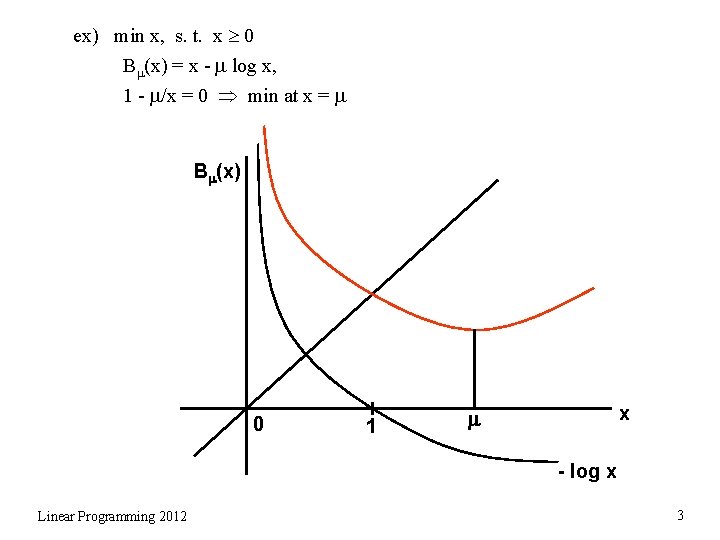
9. 4 The primal path following algorithm q min c’x Ax = b x 0 max p’b p’A + s’ = c’ s 0 Nonnegativity makes the problem difficult, hence use barrier function in the objective and consider unconstrained problem ( in the affine space Ax = b, p’A + s’ = c’ ) q Barrier function: B (x) = c’x - j=1 n log xj, > 0 B (x) + if xj 0 for some j Solve min B (x), Ax = b (9. 15) B (x) is strictly convex, hence has unique min point if min exists. Linear Programming 2012 2
ex) min x, s. t. x 0 B (x) = x - log x, 1 - /x = 0 min at x = B (x) 0 1 x - log x Linear Programming 2012 3
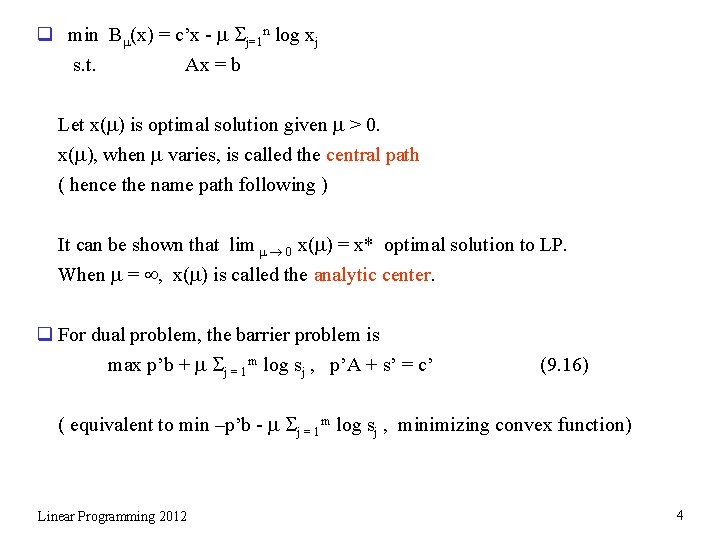
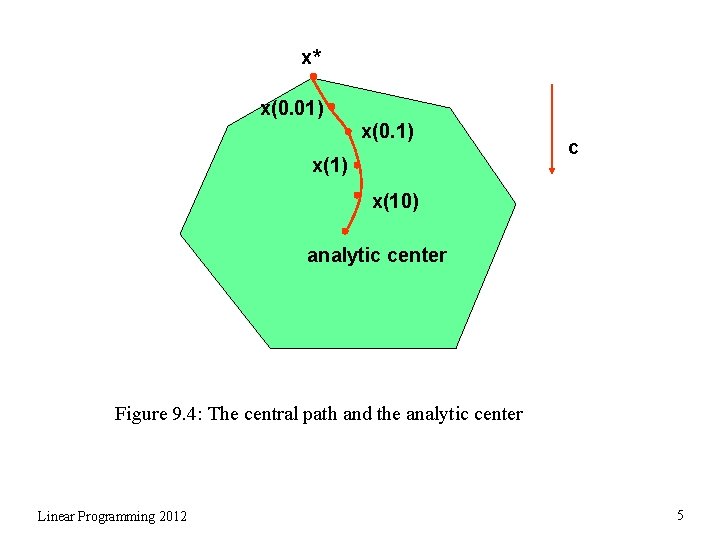
q min B (x) = c’x - j=1 n log xj s. t. Ax = b Let x( ) is optimal solution given > 0. x( ), when varies, is called the central path ( hence the name path following ) It can be shown that lim 0 x( ) = x* optimal solution to LP. When = , x( ) is called the analytic center. q For dual problem, the barrier problem is max p’b + j = 1 m log sj , p’A + s’ = c’ (9. 16) ( equivalent to min –p’b - j = 1 m log sj , minimizing convex function) Linear Programming 2012 4
x* x(0. 01) x(0. 1) x(1) c x(10) analytic center Figure 9. 4: The central path and the analytic center Linear Programming 2012 5
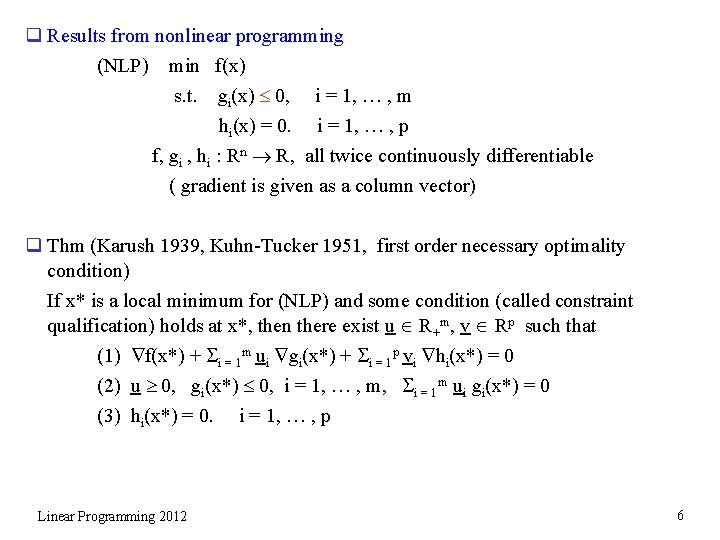
q Results from nonlinear programming (NLP) min f(x) s. t. gi(x) 0, i = 1, … , m hi(x) = 0. i = 1, … , p f, gi , hi : Rn R, all twice continuously differentiable ( gradient is given as a column vector) q Thm (Karush 1939, Kuhn-Tucker 1951, first order necessary optimality condition) If x* is a local minimum for (NLP) and some condition (called constraint qualification) holds at x*, then there exist u R+m, v Rp such that (1) f(x*) + i = 1 m ui gi(x*) + i = 1 p vi hi(x*) = 0 (2) u 0, gi(x*) 0, i = 1, … , m, i = 1 m ui gi(x*) = 0 (3) hi(x*) = 0. i = 1, … , p Linear Programming 2012 6
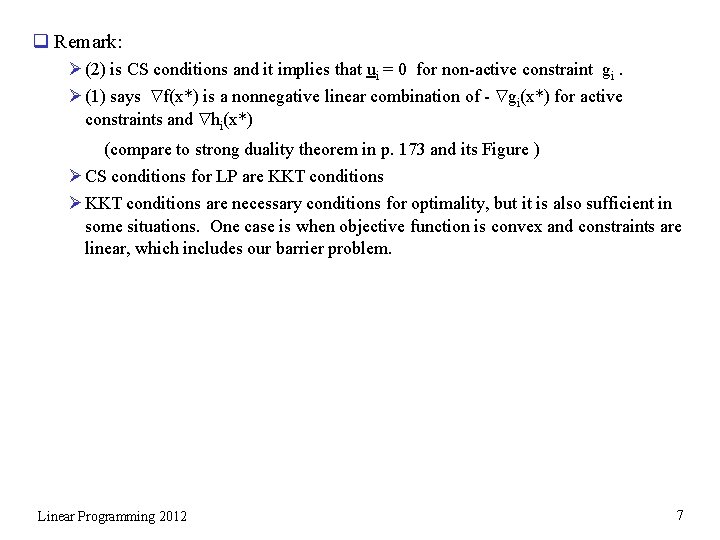
q Remark: Ø (2) is CS conditions and it implies that ui = 0 for non-active constraint gi. Ø (1) says f(x*) is a nonnegative linear combination of - gi(x*) for active constraints and hi(x*) (compare to strong duality theorem in p. 173 and its Figure ) Ø CS conditions for LP are KKT conditions Ø KKT conditions are necessary conditions for optimality, but it is also sufficient in some situations. One case is when objective function is convex and constraints are linear, which includes our barrier problem. Linear Programming 2012 7
q Deriving KKT for barrier problem: min B (x) = c’x - j=1 n log xj, s. t. Ax = b ( x > 0 ) f(x) = c - X-1 e, hi(x) = ai ( ai is i-th row vector of A, expressed as a column vector and X-1 = diag( 1/x 1, … , 1/xn ), e is the vector having 1 in all components. ) Using (Lagrangian) multiplier pi for hi(x), we get c - X-1 e = A’p (ignoring the sign of p) Note that hi(x) = ai’x – bi and hi(x) = ai. ( h(x) = Ax – b : Rn Rm) If we define s = X-1 e , KKT becomes A’p + s = c, Ax = b, XSe = e, ( x > 0, s > 0), where S = diag ( s 1, … , sn ). Linear Programming 2012 8
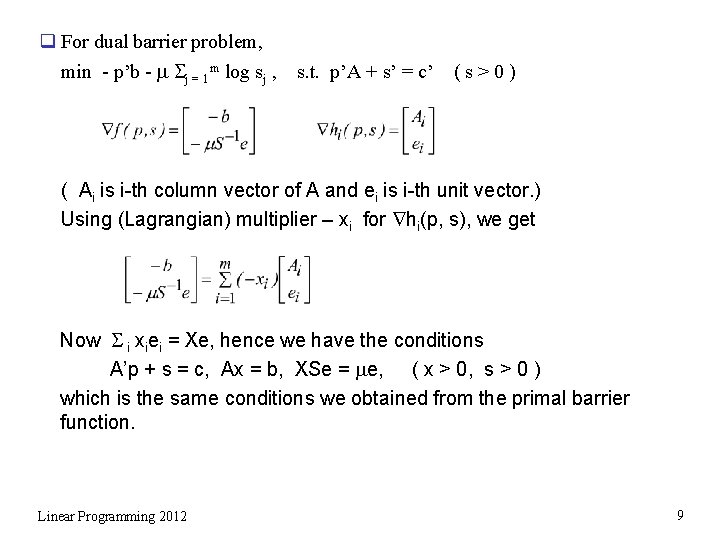
q For dual barrier problem, min - p’b - j = 1 m log sj , s. t. p’A + s’ = c’ ( s > 0 ) ( Ai is i-th column vector of A and ei is i-th unit vector. ) Using (Lagrangian) multiplier – xi for hi(p, s), we get Now i xiei = Xe, hence we have the conditions A’p + s = c, Ax = b, XSe = e, ( x > 0, s > 0 ) which is the same conditions we obtained from the primal barrier function. Linear Programming 2012 9
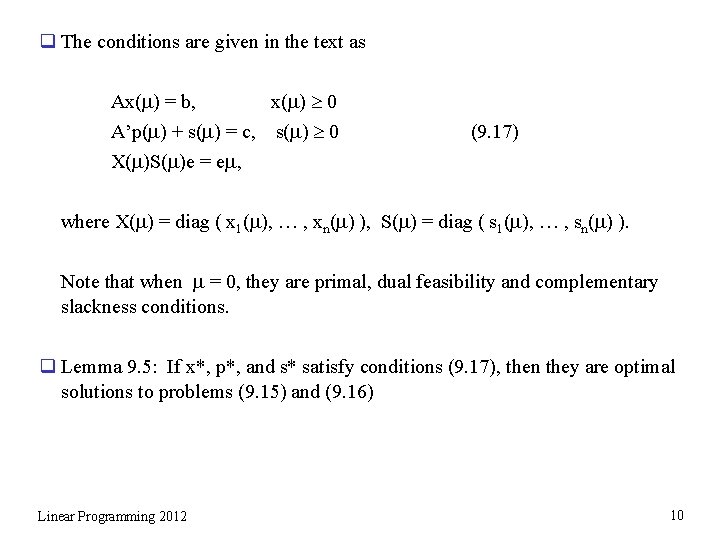
q The conditions are given in the text as Ax( ) = b, x( ) 0 A’p( ) + s( ) = c, s( ) 0 X( )S( )e = e , (9. 17) where X( ) = diag ( x 1( ), … , xn( ) ), S( ) = diag ( s 1( ), … , sn( ) ). Note that when = 0, they are primal, dual feasibility and complementary slackness conditions. q Lemma 9. 5: If x*, p*, and s* satisfy conditions (9. 17), then they are optimal solutions to problems (9. 15) and (9. 16) Linear Programming 2012 10
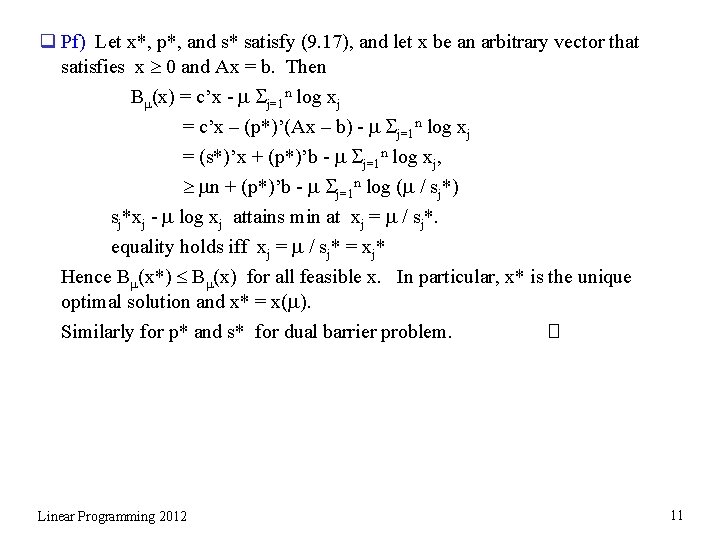
q Pf) Let x*, p*, and s* satisfy (9. 17), and let x be an arbitrary vector that satisfies x 0 and Ax = b. Then B (x) = c’x - j=1 n log xj = c’x – (p*)’(Ax – b) - j=1 n log xj = (s*)’x + (p*)’b - j=1 n log xj, n + (p*)’b - j=1 n log ( / sj*) sj*xj - log xj attains min at xj = / sj*. equality holds iff xj = / sj* = xj* Hence B (x*) B (x) for all feasible x. In particular, x* is the unique optimal solution and x* = x( ). Similarly for p* and s* for dual barrier problem. � Linear Programming 2012 11
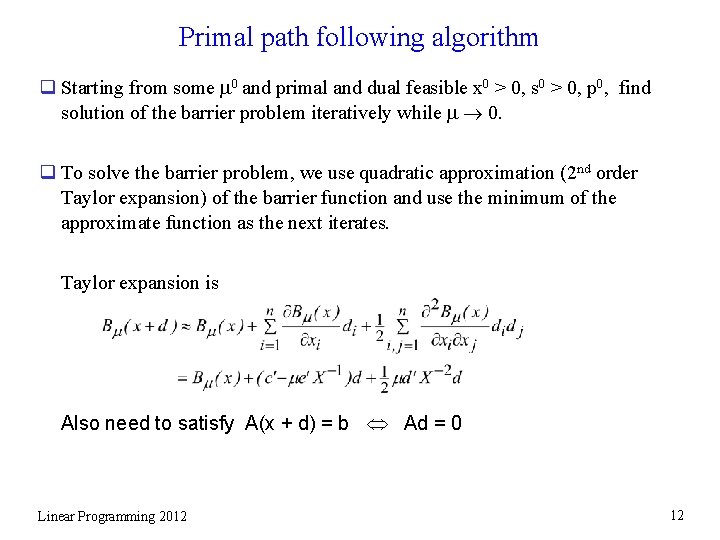
Primal path following algorithm q Starting from some 0 and primal and dual feasible x 0 > 0, s 0 > 0, p 0, find solution of the barrier problem iteratively while 0. q To solve the barrier problem, we use quadratic approximation (2 nd order Taylor expansion) of the barrier function and use the minimum of the approximate function as the next iterates. Taylor expansion is Also need to satisfy A(x + d) = b Ad = 0 Linear Programming 2012 12
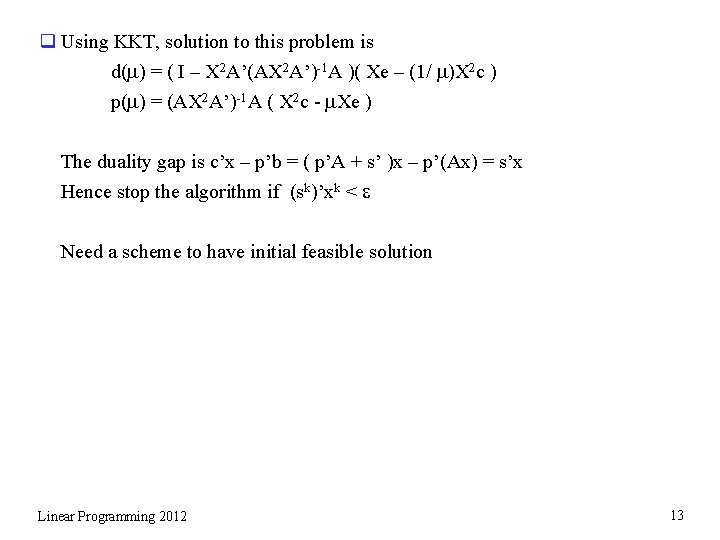
q Using KKT, solution to this problem is d( ) = ( I – X 2 A’(AX 2 A’)-1 A )( Xe – (1/ )X 2 c ) p( ) = (AX 2 A’)-1 A ( X 2 c - Xe ) The duality gap is c’x – p’b = ( p’A + s’ )x – p’(Ax) = s’x Hence stop the algorithm if (sk)’xk < Need a scheme to have initial feasible solution Linear Programming 2012 13
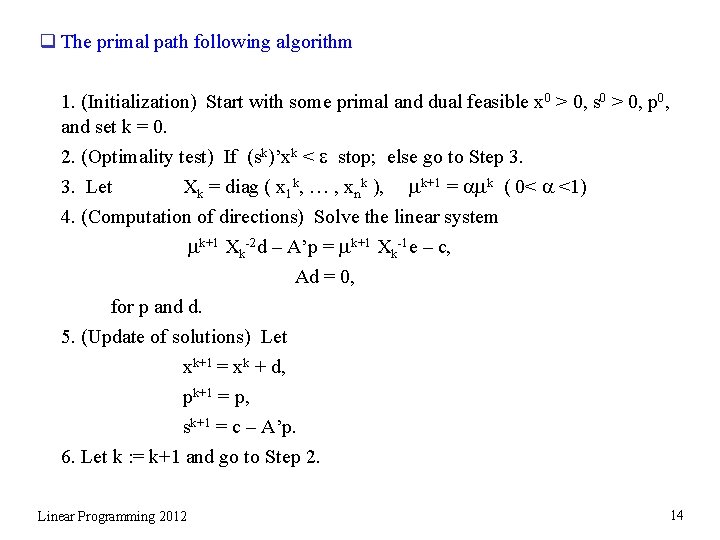
q The primal path following algorithm 1. (Initialization) Start with some primal and dual feasible x 0 > 0, s 0 > 0, p 0, and set k = 0. 2. (Optimality test) If (sk)’xk < stop; else go to Step 3. 3. Let Xk = diag ( x 1 k, … , xnk ), k+1 = k ( 0< <1) 4. (Computation of directions) Solve the linear system k+1 Xk-2 d – A’p = k+1 Xk-1 e – c, Ad = 0, for p and d. 5. (Update of solutions) Let xk+1 = xk + d, pk+1 = p, sk+1 = c – A’p. 6. Let k : = k+1 and go to Step 2. Linear Programming 2012 14
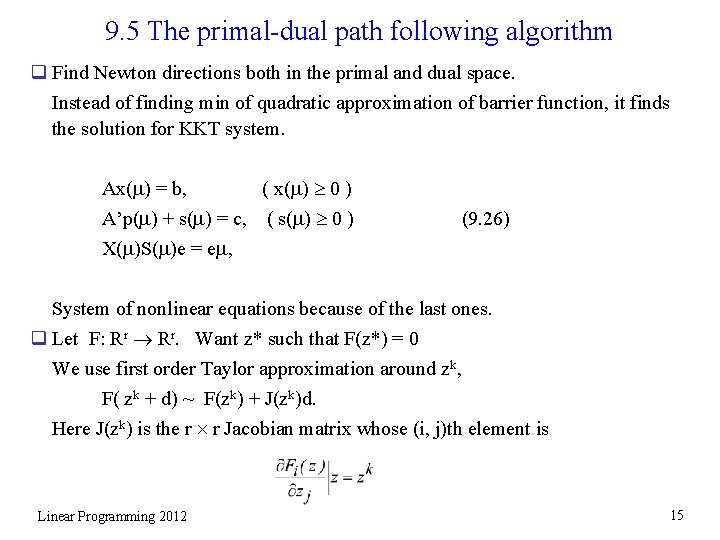
9. 5 The primal-dual path following algorithm q Find Newton directions both in the primal and dual space. Instead of finding min of quadratic approximation of barrier function, it finds the solution for KKT system. Ax( ) = b, ( x( ) 0 ) A’p( ) + s( ) = c, ( s( ) 0 ) X( )S( )e = e , (9. 26) System of nonlinear equations because of the last ones. q Let F: Rr Rr. Want z* such that F(z*) = 0 We use first order Taylor approximation around zk, F( zk + d) ~ F(zk) + J(zk)d. Here J(zk) is the r r Jacobian matrix whose (i, j)th element is Linear Programming 2012 15
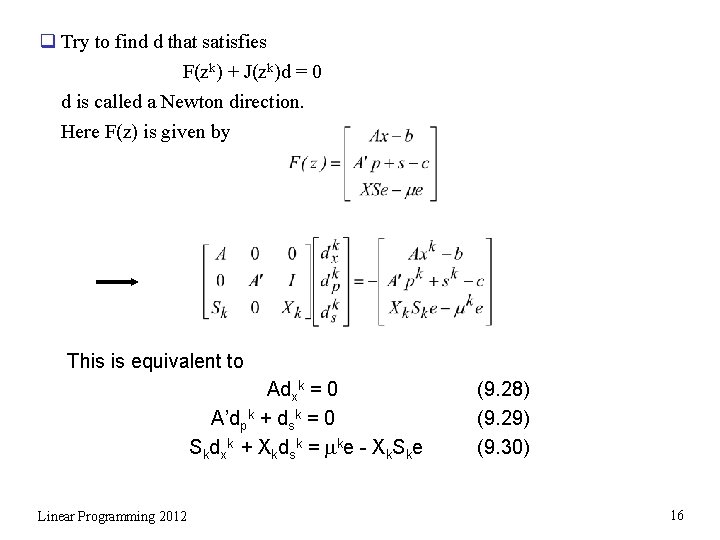
q Try to find d that satisfies F(zk) + J(zk)d = 0 d is called a Newton direction. Here F(z) is given by This is equivalent to Adxk = 0 A’dpk + dsk = 0 S k dx k + X k ds k = k e - X k S k e Linear Programming 2012 (9. 28) (9. 29) (9. 30) 16
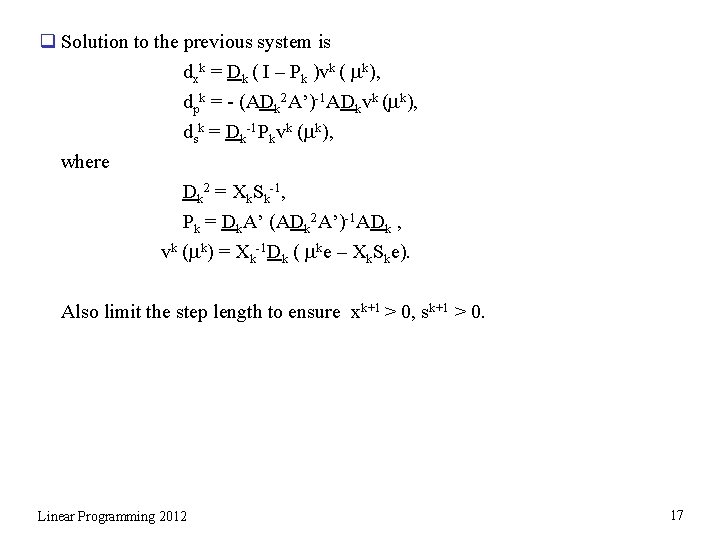
q Solution to the previous system is dxk = Dk ( I – Pk )vk ( k), dpk = - (ADk 2 A’)-1 ADkvk ( k), dsk = Dk-1 Pkvk ( k), where Dk 2 = Xk. Sk-1, Pk = Dk. A’ (ADk 2 A’)-1 ADk , vk ( k) = Xk-1 Dk ( ke – Xk. Ske). Also limit the step length to ensure xk+1 > 0, sk+1 > 0. Linear Programming 2012 17
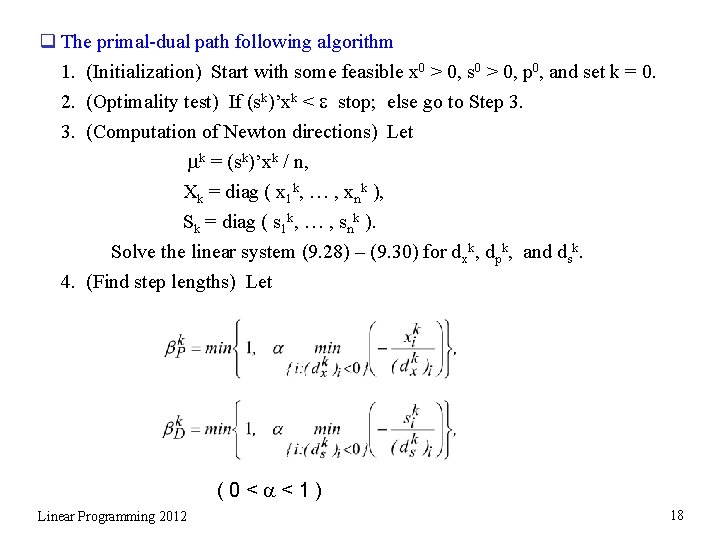
q The primal-dual path following algorithm 1. (Initialization) Start with some feasible x 0 > 0, s 0 > 0, p 0, and set k = 0. 2. (Optimality test) If (sk)’xk < stop; else go to Step 3. 3. (Computation of Newton directions) Let k = (sk)’xk / n, Xk = diag ( x 1 k, … , xnk ), Sk = diag ( s 1 k, … , snk ). Solve the linear system (9. 28) – (9. 30) for dxk, dpk, and dsk. 4. (Find step lengths) Let (0< <1) Linear Programming 2012 18
(continued) 5. (Solution update) Update the solution vectors according to xk+1 = xk + Pk dxk, pk+1 = pk + Dk dpk, sk+1 = sk + Dk dsk. 6. Let k : = k+1 and go to Step 2. Linear Programming 2012 19
Infeasible primal-dual path following methods q A variation of primal-dual path following. Starts from x 0 > 0, s 0 > 0, p 0, which is not necessarily feasible for either the primal or the dual, i. e. Ax 0 b and/or A’p 0 + s 0 c. Iteration same as the primal-dual path following except feasibility not maintained in each iteration. Excellent performance. Linear Programming 2012 20
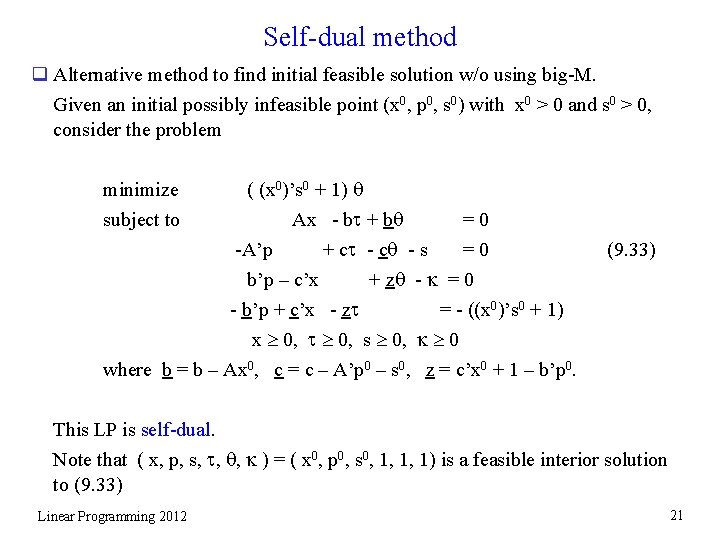
Self-dual method q Alternative method to find initial feasible solution w/o using big-M. Given an initial possibly infeasible point (x 0, p 0, s 0) with x 0 > 0 and s 0 > 0, consider the problem ( (x 0)’s 0 + 1) Ax - b + b =0 -A’p + c - s =0 b’p – c’x + z - = 0 - b’p + c’x - z = - ((x 0)’s 0 + 1) x 0, 0, s 0, 0 where b = b – Ax 0, c = c – A’p 0 – s 0, z = c’x 0 + 1 – b’p 0. minimize subject to (9. 33) This LP is self-dual. Note that ( x, p, s, , , ) = ( x 0, p 0, s 0, 1, 1, 1) is a feasible interior solution to (9. 33) Linear Programming 2012 21
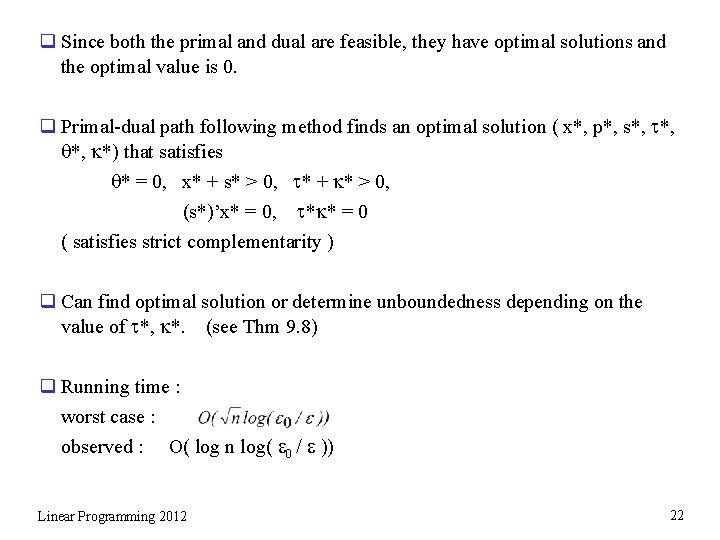
q Since both the primal and dual are feasible, they have optimal solutions and the optimal value is 0. q Primal-dual path following method finds an optimal solution ( x*, p*, s*, *, *) that satisfies * = 0, x* + s* > 0, * + * > 0, (s*)’x* = 0, * * = 0 ( satisfies strict complementarity ) q Can find optimal solution or determine unboundedness depending on the value of *, *. (see Thm 9. 8) q Running time : worst case : observed : O( log n log( 0 / )) Linear Programming 2012 22