
Chapter 9 Intelligence Objectives 9 1 The Nature
Chapter 9 Intelligence
Objectives 9. 1 The Nature of Intelligence • Define intelligence from an adaptation perspective. • Compare and contrast theories of intelligence. • Explain how brain size and neural efficiency relate to intelligence. 9. 2 Measuring Intelligence • Examine the development of intelligence testing. • Describe the principles of test construction. • Discuss reliability and predictive validity of intelligence testing.

Objectives 9. 3 Individual Differences in Intelligence • Illustrate the varieties of intelligence including high intellectual ability and intellectual disability. 9. 4 Group Differences in Intelligence • Explain reasons for gender and ethnic gaps in standardized intelligence tests. • Identify types of biases in intelligence testing.
Objectives 9. 5 Multiple Influences: The Roles of Genetics and Environment in Determining Intelligence • Describe the roles of genetics and environment, and their interaction, in determining intelligence.
Defining Intelligence • Intelligence: The capacity to learn from experience, acquire knowledge, adapt to the environment, and solve problems

Theories of Intelligence as a General Ability: General Intelligence (g) Specific Intelligence (s) Intelligence as Multiple Abilities
The Brain and Intelligence • The brain areas correlated with intelligence (Jung and Haier, 2007). The green areas show left-hemispheric correlations and the pink areas show righthemispheric correlations. The arcuate fasciculus (shown in yellow) is a white matter tract that connects the involved brain regions.

Alfred Binet: Predicting School Achievement • Standardized procedure: Protocol for testing that follows the same steps for all test takers • Norm: Comparison of many individuals on the same test so that relative performance can be determined • Mental age: The average level of intellectual development for a child of a particular age • Scale: A test designed to measure a particular skill from low to high
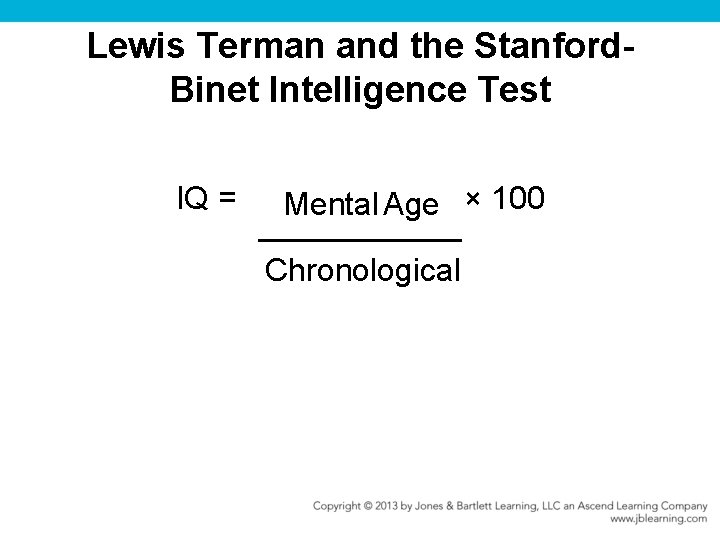
Lewis Terman and the Stanford. Binet Intelligence Test IQ = Mental Age × 100 Chronological
The Wechsler Intelligence Scales • Verbal – – – Information Comprehension Math Similarities Vocabulary Digit Span • Nonverbal – – – Lock patterns Picture arrangement Object assembly Picture completing Digit-to-symbol mapping

Group Intelligence Testing • Aptitude test: A measure of the ability to benefit from further training • Group aptitude test: A test meant to assess your ability to benefit from further training or education • Achievement test: A measure of what is already known or learned, as the outcome of education
Selecting Questions for Intelligence Tests • Most tests include a wide variety of types of questions in order to tap intelligence in differing domains. • Working memory capacity strongly predicts a person’s performance on a battery of intelligence tests that measure everything from abstract problem-solving to social intelligence.
Standardization • Standardization: Conversion of scores from the number of correct answers to a relative performance score compared to others on the same test
Reliability and Validity • Reliability: Consistency in measurement – Test-retest reliability: The likelihood of receiving a similar score when a test is repeated – Split-half reliability: Performance on one-half of the test is compared against performance on the other half. • Validity: The ability of a measure to capture what was intended – Content validity: Refers to the surface appearance of the items on the test and whether they reflect the concept of interest (also called face validity) – Predictive validity: The ability of a test to identify those who will have high scores on other measures
Intellectual Disability Potential causes of intellectual disability: • Illness • Injury • Physiological dysfunction • Socioeconomics • Cultural factors • Environment
High Intellectual Ability • Savant: An individual who is average or deficient in most areas of cognitive functioning but displays an extraordinary talent in one area • Prodigy: A child with a special skill or talent far exceeding the norm for his or her age • Gifted: A determination made by some schools and educational programs based on an intelligence test score of more than 130 • Genius: A person of extraordinary intellectual or creative capacity
Differences Within Groups and Differences Between Groups • Designed to compare individuals, intelligence test scores have sometimes been used to compare groups of people. • There is always variation within a given group, and that variation far outweighs the differences between groups.
Gender Group Differences Percentages of boys and girls found within each 5 -point band of IQ scores Women tend to earn more degrees in the social sciences, whereas men earn more in the physical sciences.
Ethnic Group Differences Estimated population of the United States by race and ethnicity, 2009
Cultural Bias in Intelligence Tests The experience of individuals is different based on • Area of the country • Schooling • Socioeconomic status • Gender • Race and ethnicity. Cultural environment includes: • how people live • what they value • what they do with their time
Stereotype Threat and Expectations Math performance by experimental condition and gender
Evidence for Heredity • Heritability: The proportion of variance in an observable trait that is due to genetic factors
Evidence for Environmental Influence Correlations between individuals by family relationship
Generational Changes • Flynn effect: The increase in intelligence test scores have over generations taking the tests
Environmental Differences • Schooling • Social/economic deprivation • Individual experience
- Slides: 25