
Chapter 9 Intellectual and Neuropsychological Assessment Intelligence Testing
- Slides: 39
Chapter 9 Intellectual and Neuropsychological Assessment
Intelligence Testing (1 of 24) Classic Theories of Intelligence • No consensus regarding definition of intelligence • Singular versus plural nature of intelligence Pomerantz, Clinical Psychology © SAGE Publishing, 2020. 2
Intelligence Testing (2 of 24) Classic Theories of Intelligence: Charles Spearman: Intelligence Is One Thing • A singular characteristic—“g” for general intelligence • Based on research that measured – Academic abilities – Sensory-discrimination tasks • Primary finding—single factor underlying strong correlation between wide range of abilities Pomerantz, Clinical Psychology © SAGE Publishing, 2020. 3
Intelligence Testing (3 of 24) Classic Theories of Intelligence: Louis Thurstone: Intelligence Is Many Things • Multiple factor analysis • Numerous distinct abilities – Verbal comprehension – Numerical ability – Spatial reasoning – Memory Pomerantz, Clinical Psychology © SAGE Publishing, 2020. 4
Intelligence Testing (4 of 24) Classic Theories of Intelligence: Louis Thurstone: Intelligence Is Many Things • Hierarchical model of intelligence – Existence of specific abilities “s” – Related to one another and to global, overall, general intelligence Pomerantz, Clinical Psychology © SAGE Publishing, 2020. 5
Intelligence Testing (5 of 24) More Contemporary Theories of Intelligence • James Cattell – Fluid intelligence – Crystallized intelligence • Theory falls between Spearman’s theory of a singular intelligence and Thurstone’s theory of many intelligences Pomerantz, Clinical Psychology © SAGE Publishing, 2020. 6
Intelligence Testing (6 of 24) More Contemporary Theories of Intelligence • John Carroll’s Three Stratum Theory of Intelligence – A single “g” at the top – Eight broad factors beneath “g” – More than 60 highly specific abilities beneath these broad factors Pomerantz, Clinical Psychology © SAGE Publishing, 2020. 7
Intelligence Testing (7 of 24) Wechsler Intelligence Tests • Three Wechsler intelligence tests – Wechsler Adult Intelligence Scale—Fourth Edition (WAIS-IV) – Wechsler Intelligence Scale for Children— Fifth Edition (WISC-V) – Wechsler Preschool and Primary Scale of Intelligence—Fourth Edition (WPPSI-IV) Pomerantz, Clinical Psychology © SAGE Publishing, 2020. 8
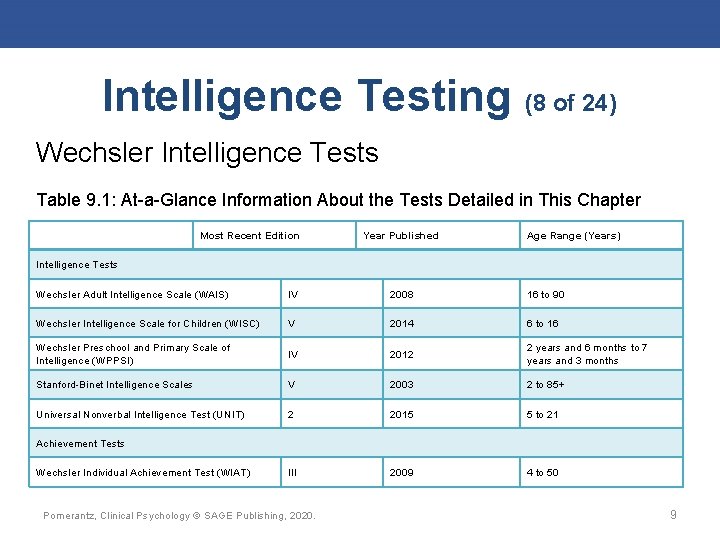
Intelligence Testing (8 of 24) Wechsler Intelligence Tests Table 9. 1: At-a-Glance Information About the Tests Detailed in This Chapter Most Recent Edition Year Published Age Range (Years) Intelligence Tests Wechsler Adult Intelligence Scale (WAIS) IV 2008 16 to 90 Wechsler Intelligence Scale for Children (WISC) V 2014 6 to 16 Wechsler Preschool and Primary Scale of Intelligence (WPPSI) IV 2012 2 years and 6 months to 7 years and 3 months Stanford-Binet Intelligence Scales V 2003 2 to 85+ Universal Nonverbal Intelligence Test (UNIT) 2 2015 5 to 21 III 2009 4 to 50 Achievement Tests Wechsler Individual Achievement Test (WIAT) Pomerantz, Clinical Psychology © SAGE Publishing, 2020. 9
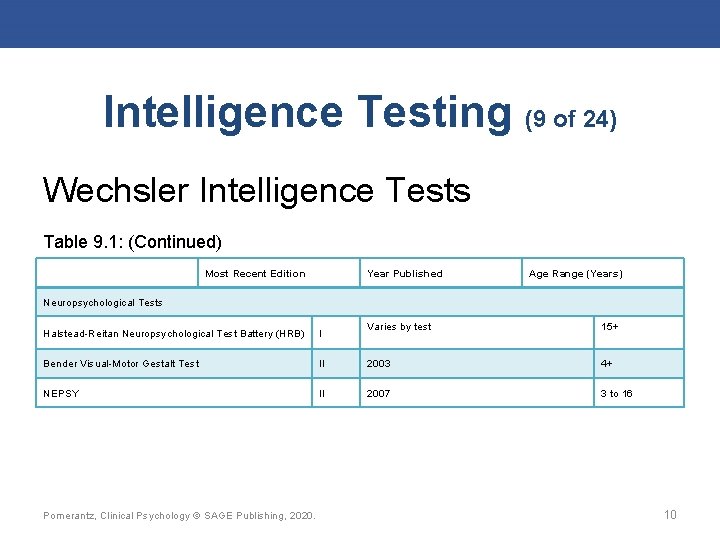
Intelligence Testing (9 of 24) Wechsler Intelligence Tests Table 9. 1: (Continued) Most Recent Edition Year Published Age Range (Years) Neuropsychological Tests Varies by test 15+ II 2003 4+ II 2007 3 to 16 Halstead-Reitan Neuropsychological Test Battery (HRB) I Bender Visual-Motor Gestalt Test NEPSY Pomerantz, Clinical Psychology © SAGE Publishing, 2020. 10
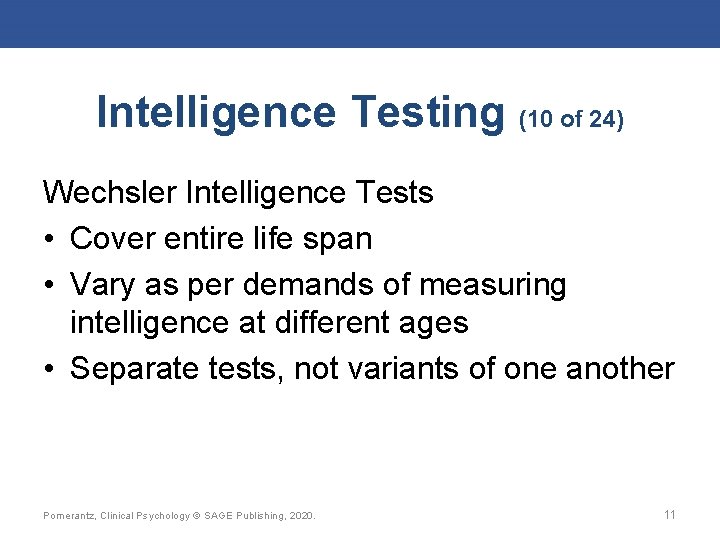
Intelligence Testing (10 of 24) Wechsler Intelligence Tests • Cover entire life span • Vary as per demands of measuring intelligence at different ages • Separate tests, not variants of one another Pomerantz, Clinical Psychology © SAGE Publishing, 2020. 11
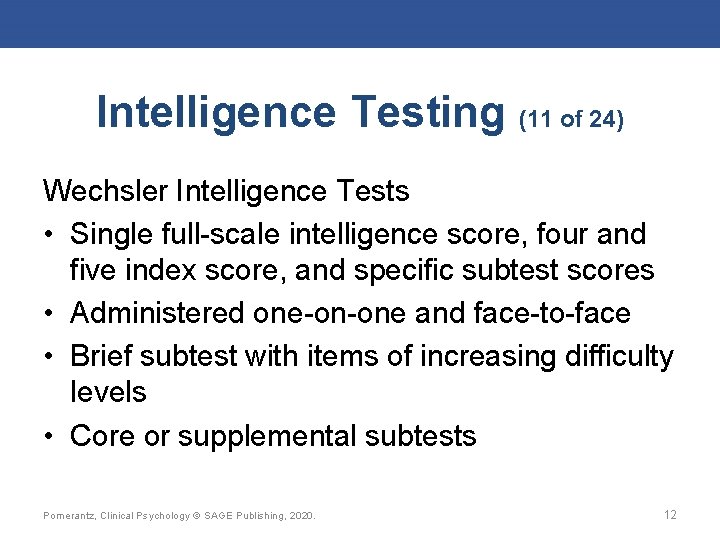
Intelligence Testing (11 of 24) Wechsler Intelligence Tests • Single full-scale intelligence score, four and five index score, and specific subtest scores • Administered one-on-one and face-to-face • Brief subtest with items of increasing difficulty levels • Core or supplemental subtests Pomerantz, Clinical Psychology © SAGE Publishing, 2020. 12
Intelligence Testing (12 of 24) Wechsler Intelligence Tests • Five categories of subtests of WISC and WPPSI – Share three with WAIS – Perceptual Reasoning Index has • Visual Spatial Index • Fluid Reasoning Index Pomerantz, Clinical Psychology © SAGE Publishing, 2020. 13
Intelligence Testing (13 of 24) Wechsler Intelligence Tests • Four categories of subtests of WAIS – Verbal Comprehension Index – Perceptual Reasoning Index – Working Memory Index – Processing Speed Index Pomerantz, Clinical Psychology © SAGE Publishing, 2020. 14
Intelligence Testing (14 of 24) Wechsler Intelligence Tests • Large sets of normative data • Scores reflect IQ • Analysis of each subtest score • Backed by impressive psychometric data • Used for wide range of clinical applications • Q-interactive system Pomerantz, Clinical Psychology © SAGE Publishing, 2020. 15
Intelligence Testing (15 of 24) Wechsler Intelligence Tests • Very familiar to most clinical psychologists • Some subtests may be culturally loaded or biased • Limited connection between tests and day-today life • Complex or subjective scoring on some subtests Pomerantz, Clinical Psychology © SAGE Publishing, 2020. 16
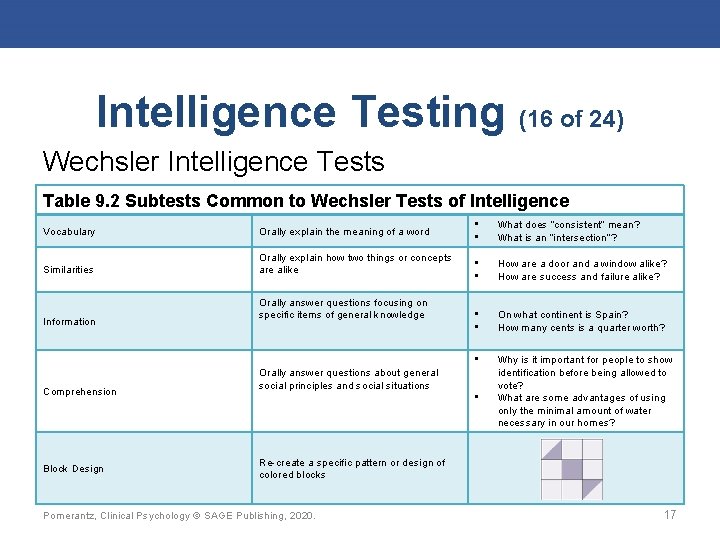
Intelligence Testing (16 of 24) Wechsler Intelligence Tests Table 9. 2 Subtests Common to Wechsler Tests of Intelligence Vocabulary Orally explain the meaning of a word Similarities Orally explain how two things or concepts are alike Information Comprehension Block Design Orally answer questions focusing on specific items of general knowledge • • What does “consistent” mean? What is an “intersection”? • • How are a door and a window alike? How are success and failure alike? • • On what continent is Spain? How many cents is a quarter worth? • Why is it important for people to show identification before being allowed to vote? What are some advantages of using only the minimal amount of water necessary in our homes? Orally answer questions about general social principles and social situations • Re-create a specific pattern or design of colored blocks Pomerantz, Clinical Psychology © SAGE Publishing, 2020. 17
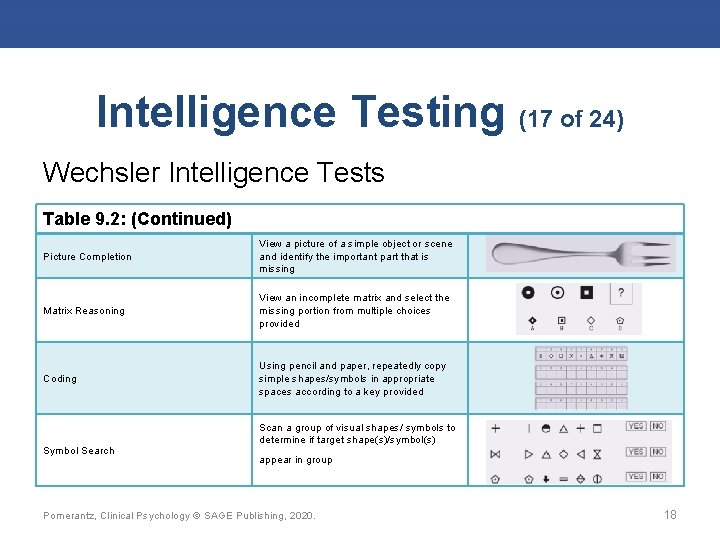
Intelligence Testing (17 of 24) Wechsler Intelligence Tests Table 9. 2: (Continued) Picture Completion View a picture of a simple object or scene and identify the important part that is missing Matrix Reasoning View an incomplete matrix and select the missing portion from multiple choices provided Coding Using pencil and paper, repeatedly copy simple shapes/symbols in appropriate spaces according to a key provided Symbol Search Scan a group of visual shapes/ symbols to determine if target shape(s)/symbol(s) appear in group Pomerantz, Clinical Psychology © SAGE Publishing, 2020. 18
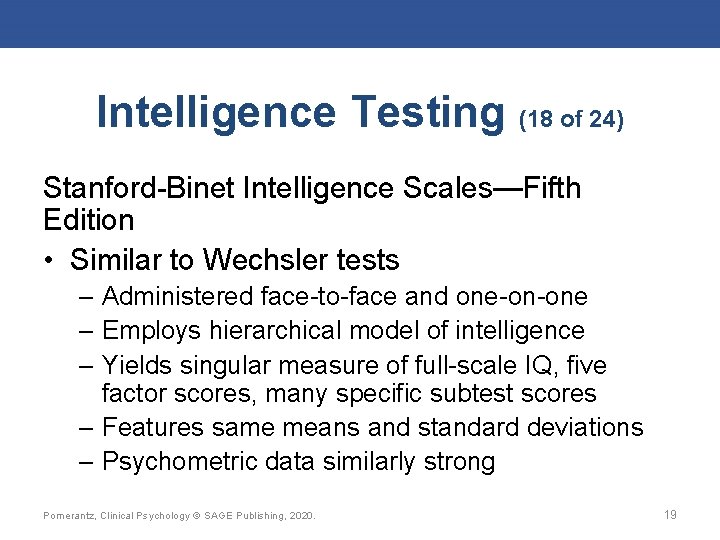
Intelligence Testing (18 of 24) Stanford-Binet Intelligence Scales—Fifth Edition • Similar to Wechsler tests – Administered face-to-face and one-on-one – Employs hierarchical model of intelligence – Yields singular measure of full-scale IQ, five factor scores, many specific subtest scores – Features same means and standard deviations – Psychometric data similarly strong Pomerantz, Clinical Psychology © SAGE Publishing, 2020. 19
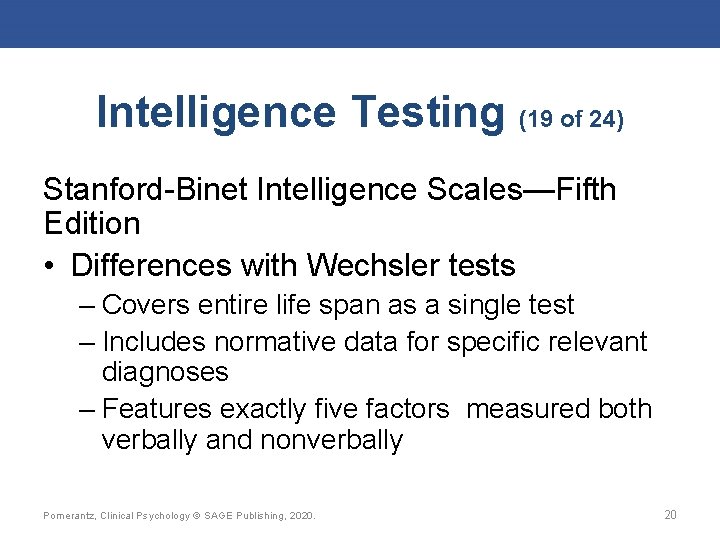
Intelligence Testing (19 of 24) Stanford-Binet Intelligence Scales—Fifth Edition • Differences with Wechsler tests – Covers entire life span as a single test – Includes normative data for specific relevant diagnoses – Features exactly five factors measured both verbally and nonverbally Pomerantz, Clinical Psychology © SAGE Publishing, 2020. 20
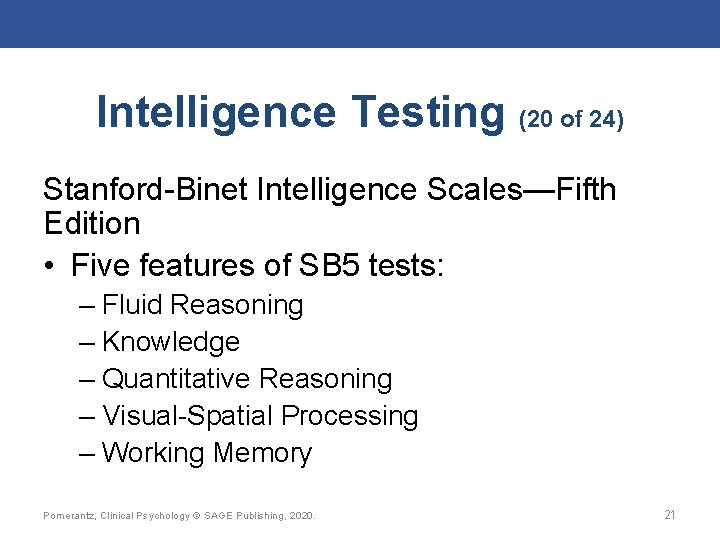
Intelligence Testing (20 of 24) Stanford-Binet Intelligence Scales—Fifth Edition • Five features of SB 5 tests: – Fluid Reasoning – Knowledge – Quantitative Reasoning – Visual-Spatial Processing – Working Memory Pomerantz, Clinical Psychology © SAGE Publishing, 2020. 21
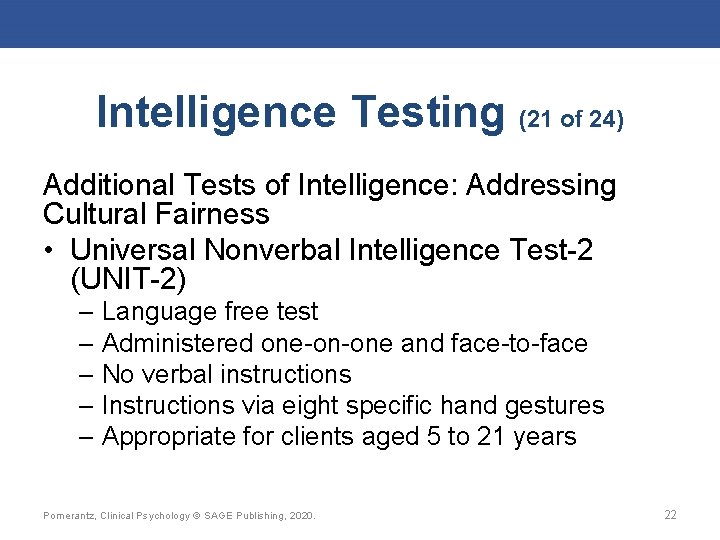
Intelligence Testing (21 of 24) Additional Tests of Intelligence: Addressing Cultural Fairness • Universal Nonverbal Intelligence Test-2 (UNIT-2) – Language free test – Administered one-on-one and face-to-face – No verbal instructions – Instructions via eight specific hand gestures – Appropriate for clients aged 5 to 21 years Pomerantz, Clinical Psychology © SAGE Publishing, 2020. 22
Intelligence Testing (22 of 24) Additional Tests of Intelligence: Addressing Cultural Fairness • Universal Nonverbal Intelligence Test-2 (UNIT-2) – Six subtests: Two tiers • Memory • Reasoning Pomerantz, Clinical Psychology © SAGE Publishing, 2020. 23
Intelligence Testing (23 of 24) Additional Tests of Intelligence: Addressing Cultural Fairness • Universal Nonverbal Intelligence Test-2 (UNIT-2) – Memory tier – Reasoning tier Pomerantz, Clinical Psychology © SAGE Publishing, 2020. 24
Intelligence Testing (24 of 24) Additional Tests of Intelligence: Addressing Cultural Fairness • Universal Nonverbal Intelligence Test-2 (UNIT-2) – Assesses limited range of abilities – Appropriate only for young clients – Limited psychometric data Pomerantz, Clinical Psychology © SAGE Publishing, 2020. 25
Achievement Testing (1 of 4) Achievement Versus Intelligence • Intelligence—cognitive capacity • Achievement—person’s accomplishments • Comparison of intelligence and achievement key factor in determining learning disabilities • Terminology changed in DSM-5 Pomerantz, Clinical Psychology © SAGE Publishing, 2020. 26
Achievement Testing (2 of 4) Achievement Versus Intelligence • Achievement Tests – Key. Math achievement test – Gray Oral Reading achievement test – Woodcock Tests of Achievement (WJ-ACH) – Kaufman Test of Educational Achievement (KTEA) – Wechsler Individual Achievement Test (WIAT) Pomerantz, Clinical Psychology © SAGE Publishing, 2020. 27
Achievement Testing (3 of 4) Wechsler Individual Achievement Test— Third Edition • For ages 4 to 50 years • Administered face-to-face and one-on-one • Measures achievements in four broad areas – Reading – Math – Oral language – Written language Pomerantz, Clinical Psychology © SAGE Publishing, 2020. 28
Achievement Testing (4 of 4) Wechsler Individual Achievement Test— Third Edition • Yields standard scores on same scale as intelligence tests • Linked to Wechsler IQ tests • Strong reliability and validity data supports WIAT-III Pomerantz, Clinical Psychology © SAGE Publishing, 2020. 29
Neuropsychological Testing (1 of 10) • Specialized area of assessment within clinical psychology • Measures cognitive functioning or impairment of the brain • Fixed-battery phase to flexible-battery phase Pomerantz, Clinical Psychology © SAGE Publishing, 2020. 30
Neuropsychological Testing (2 of 10) Full Neuropsychological Batteries • Halstead-Reitan Neuropsychological Battery (HRB) • Luria-Nebraska Neuropsychological Battery (LNNB) • NEPSY-II • Bender Visual-Motor Gestalt Test—Second Edition (Bender-Gestalt-II) Pomerantz, Clinical Psychology © SAGE Publishing, 2020. 31
Neuropsychological Testing (3 of 10) Full Neuropsychological Batteries • Rey-Osterrieth Complex Figure Test • Repeatable Battery for the Assessment of Neuropsychological Status (RBANS) • Wechsler Memory Scale—Fourth Edition (WMS-IV) Pomerantz, Clinical Psychology © SAGE Publishing, 2020. 32
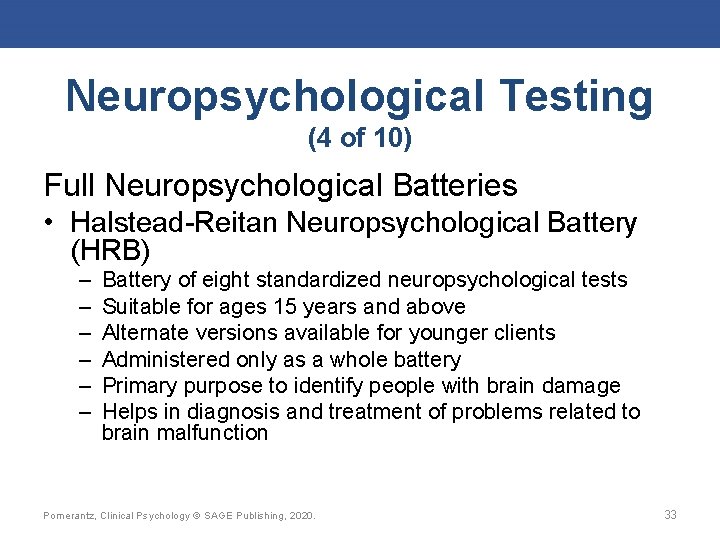
Neuropsychological Testing (4 of 10) Full Neuropsychological Batteries • Halstead-Reitan Neuropsychological Battery (HRB) – – – Battery of eight standardized neuropsychological tests Suitable for ages 15 years and above Alternate versions available for younger clients Administered only as a whole battery Primary purpose to identify people with brain damage Helps in diagnosis and treatment of problems related to brain malfunction Pomerantz, Clinical Psychology © SAGE Publishing, 2020. 33
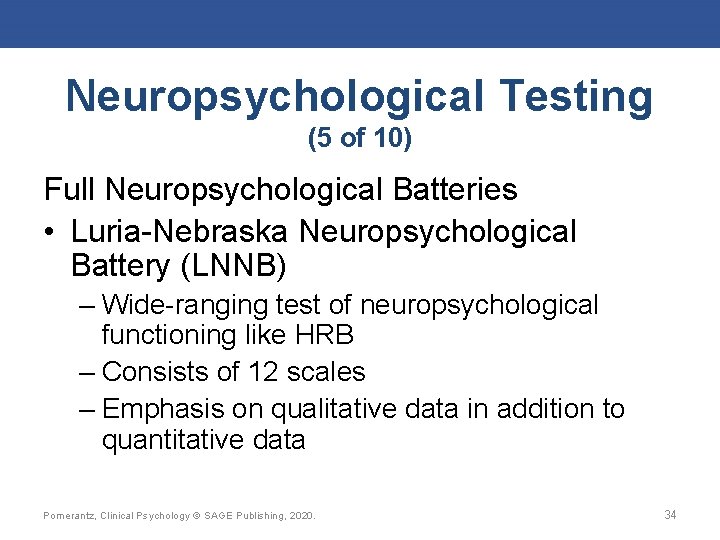
Neuropsychological Testing (5 of 10) Full Neuropsychological Batteries • Luria-Nebraska Neuropsychological Battery (LNNB) – Wide-ranging test of neuropsychological functioning like HRB – Consists of 12 scales – Emphasis on qualitative data in addition to quantitative data Pomerantz, Clinical Psychology © SAGE Publishing, 2020. 34
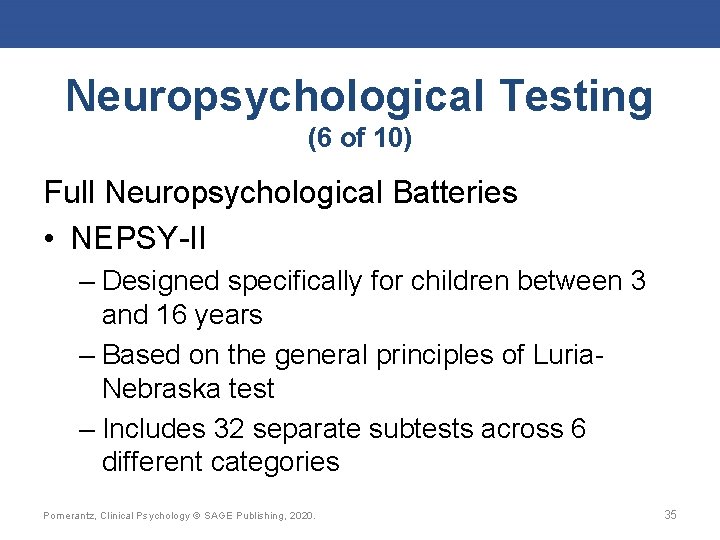
Neuropsychological Testing (6 of 10) Full Neuropsychological Batteries • NEPSY-II – Designed specifically for children between 3 and 16 years – Based on the general principles of Luria. Nebraska test – Includes 32 separate subtests across 6 different categories Pomerantz, Clinical Psychology © SAGE Publishing, 2020. 35
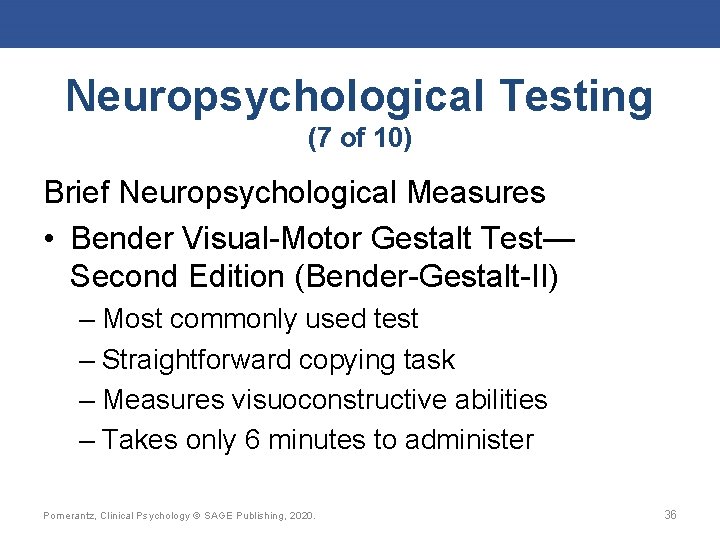
Neuropsychological Testing (7 of 10) Brief Neuropsychological Measures • Bender Visual-Motor Gestalt Test— Second Edition (Bender-Gestalt-II) – Most commonly used test – Straightforward copying task – Measures visuoconstructive abilities – Takes only 6 minutes to administer Pomerantz, Clinical Psychology © SAGE Publishing, 2020. 36
Neuropsychological Testing (8 of 10) Brief Neuropsychological Measures • Rey-Osterrieth Complex Figure Test – Brief pencil-and-paper drawing task comprisingle complex figure – Involves use of colored pencils at various points in test – Examiner can trace client’s sequential approach to complex copying task – Includes a memory component Pomerantz, Clinical Psychology © SAGE Publishing, 2020. 37
Neuropsychological Testing (9 of 10) Brief Neuropsychological Measures • Repeatable Battery for the Assessment of Neuropsychological Status (RBANS) – Focuses on a broader range of abilities than Bender-Gestalt or Rey-Osterrieth – Measures verbal skills, attention, and visual memory – Takes 20 to 30 minutes to complete – Includes 12 subtests in 5 categories Pomerantz, Clinical Psychology © SAGE Publishing, 2020. 38
Neuropsychological Testing (10 of 10) Brief Neuropsychological Measures • Wechsler Memory Scale—Fourth Edition (WMS-IV) – Often used to assess individuals between 16 and 90 years with suspected memory problems – Assesses • Visual and auditory memory across seven subtests • Immediate and delayed recall Pomerantz, Clinical Psychology © SAGE Publishing, 2020. 39