
Chapter 9 Inheritance Chapter Goals To learn about
Chapter 9 – Inheritance
Chapter Goals To learn about inheritance To implement subclasses that inherit and override superclass methods To understand the concept of polymorphism To be familiar with the common superclass Object and its methods
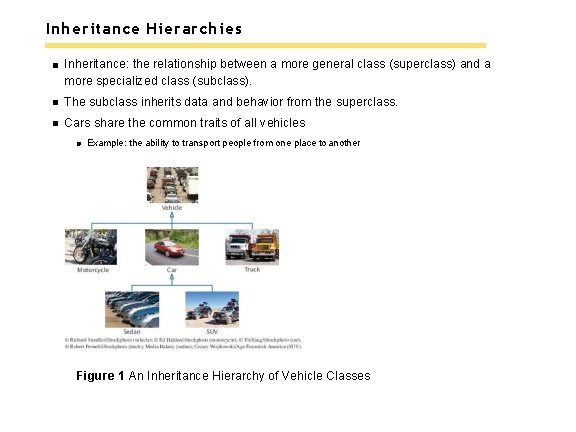
Inheritance Hierarchies Inheritance: the relationship between a more general class (superclass) and a more specialized class (subclass). The subclass inherits data and behavior from the superclass. Cars share the common traits of all vehicles Example: the ability to transport people from one place to another Figure 1 An Inheritance Hierarchy of Vehicle Classes
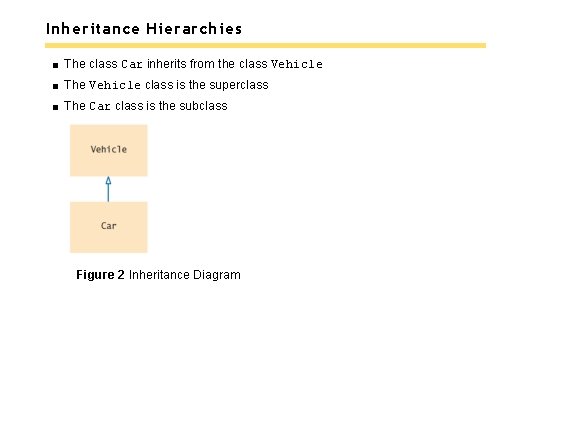
Inheritance Hierarchies The class Car inherits from the class Vehicle The Vehicle class is the superclass The Car class is the subclass Figure 2 Inheritance Diagram
Inheritance Hierarchies Inheritance lets you can reuse code instead of duplicating it. Two types of reuse A subclass inherits the methods of the superclass Because a car is a special kind of vehicle, we can use a Car object in algorithms that manipulate Vehicle objects The substitution principle: You can always use a subclass object when a superclass object is expected. A method that processes Vehicle objects can handle any kind of vehicle
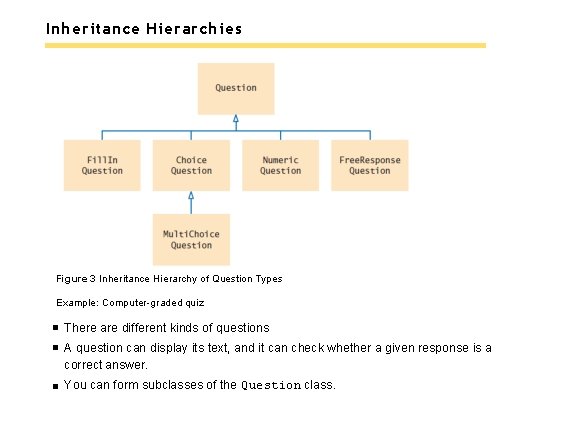
Inheritance Hierarchies Figure 3 Inheritance Hierarchy of Question Types Example: Computer-graded quiz There are different kinds of questions A question can display its text, and it can check whether a given response is a correct answer. You can form subclasses of the Question class.
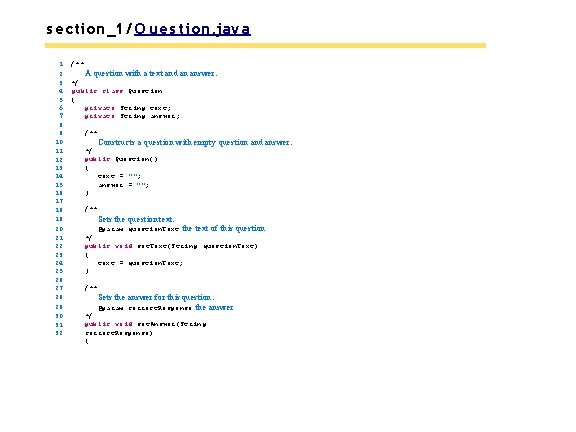
s ection_1/ Q ues tion. java 1 2 3 4 5 6 7 8 9 10 11 12 13 14 15 16 17 18 19 20 21 22 23 24 25 26 27 28 29 30 31 32 /** A question with a text and an answer. */ public class Question { private String text; private String answer; /** Constructs a question with empty question and answer. */ public Question() { text = ""; answer = ""; } /** Sets the question text. @param question. Text the text of this question */ public void set. Text(String question. Text) { text = question. Text; } /** Sets the answer for this question. @param correct. Response the answer */ public void set. Answer(String correct. Response) {
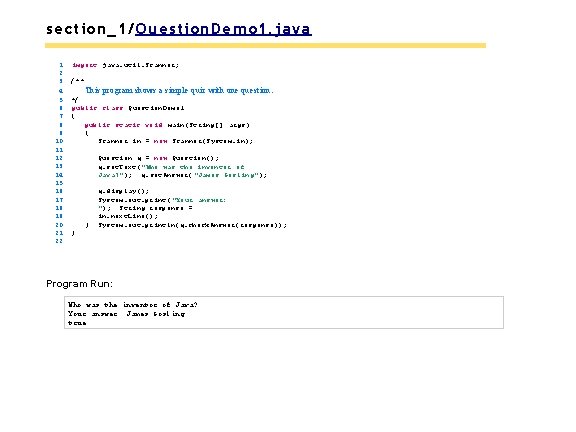
section_1/Question. Demo 1. java 1 2 3 4 5 6 7 8 9 10 11 12 13 14 15 16 17 18 19 20 21 22 import java. util. Scanner; /** This program shows a simple quiz with one question. */ public class Question. Demo 1 { public static void main(String[] args) { Scanner in = new Scanner(System. in); Question q = new Question(); q. set. Text("Who was the inventor of Java? "); q. set. Answer( "James Gosling"); } q. display(); System. out. print( "Your answer: "); String response = in. next. Line(); System. out. println(q. check. Answer(response)); } Program Run: Who was the inventor of Java? Your answer: James Gosling true
Self Check 9. 1 Consider classes Manager and Employee. Which should be the superclass and which should be the subclass? Answer: Because every manager is an employee but not the other way around, the Manager class is more specialized. It is the subclass, and Employee is the superclass.
Self Check 9. 2 What are the inheritance relationships between classes Bank. Account, Checking. Account, and Savings. Account? Answer: Checking. Account and Savings. Account both inherit from the more general class Bank. Account.
Self Check 9. 3 What are all the superclasses of the JFrame class? Consult the Java API documentation or Appendix D. Answer: The classes Frame, Window, and Component in the java. awt package, and the class Object in the java. lang package.
Self Check 9. 4 Consider the method do. Something(Car c). List all vehicle classes from Figure 1 whose objects cannot be passed to this method. Answer: Vehicle, Truck, Motorcycle
Self Check 9. 5 Should a class Quiz inherit from the class Question? Why or why not? Answer: It shouldn’t. A quiz isn’t a question; it has questions.
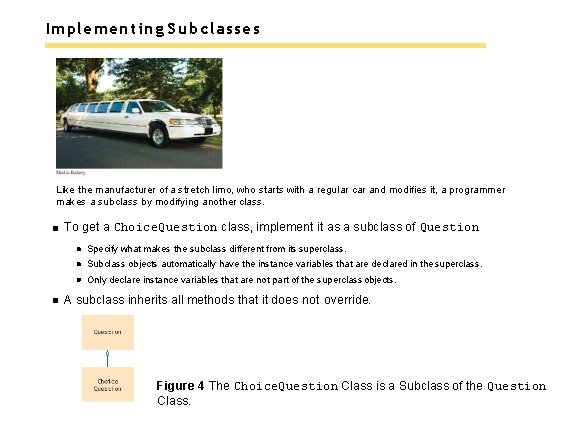
Implementing Subclasses Like the manufacturer of a stretch limo, who starts with a regular car and modifies it, a programmer makes a subclass by modifying another class. To get a Choice. Question class, implement it as a subclass of Question Specify what makes the subclass different from its superclass. Subclass objects automatically have the instance variables that are declared in the superclass. Only declare instance variables that are not part of the superclass objects. A subclass inherits all methods that it does not override. Figure 4 The Choice. Question Class is a Subclass of the Question Class.
Implementing Subclasses The subclass inherits all public methods from the superclass. You declare any methods that are new to the subclass. You change the implementation of inherited methods if the inherited behavior is not appropriate. Override a method: supply a new implementation for an inherited method
Implementing Subclasses A Choice. Question object differs from a Question object in three ways: Its objects store the various choices for the answer. There is a method for adding answer choices. The display method of the Choice. Question class shows these choices so that the respondent can choose one of them.
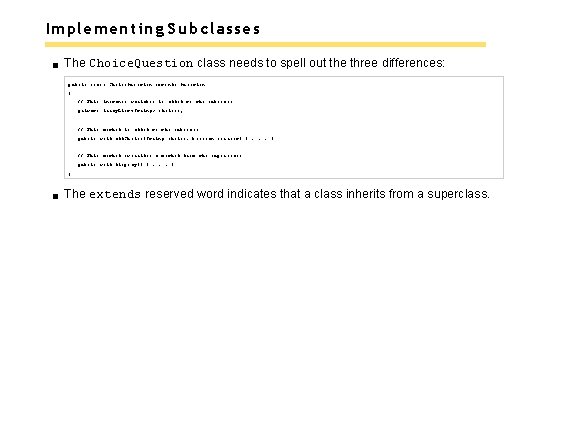
Implementing Subclasses The Choice. Question class needs to spell out the three differences: public class Choice. Question extends Question { // This instance variable is added to the subclass private Array. List<String> choices; // This method is added to the subclass public void add. Choice(String choice, boolean correct) {. . . } // This method overrides a method from the superclass public void display() {. . . } } The extends reserved word indicates that a class inherits from a superclass.
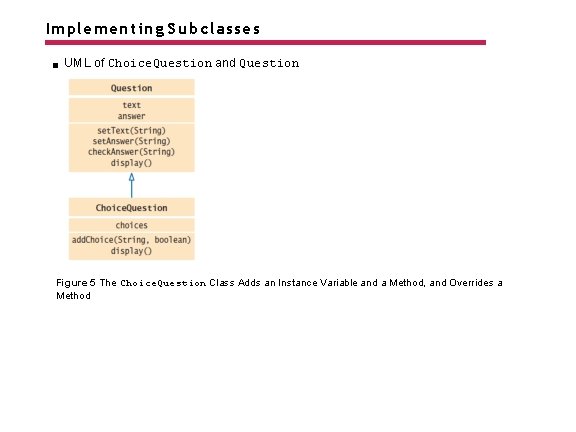
Implementing Subclasses UML of Choice. Question and Question Figure 5 The Choice. Question Class Adds an Instance Variable and a Method, and Overrides a Method
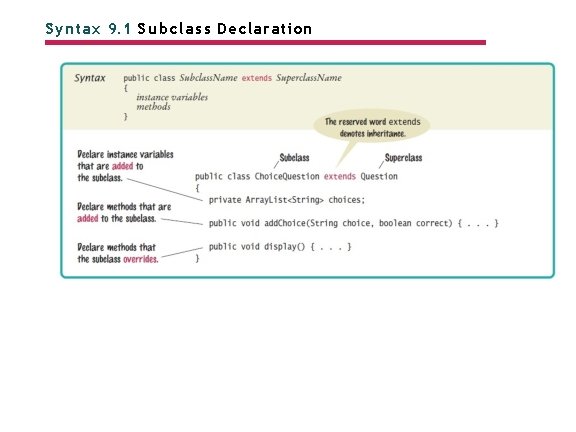
Syntax 9. 1 Subclass Declaration
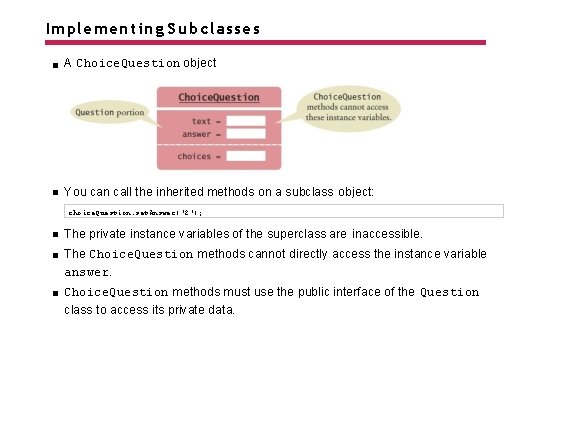
Implementing Subclasses A Choice. Question object You can call the inherited methods on a subclass object: choice. Question. set. Answer("2"); The private instance variables of the superclass are inaccessible. The Choice. Question methods cannot directly access the instance variable answer. Choice. Question methods must use the public interface of the Question class to access its private data.
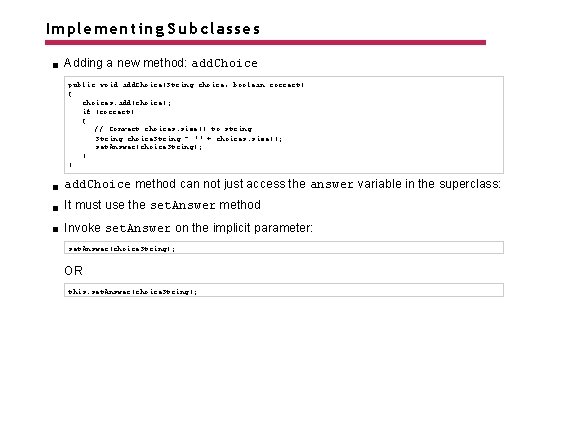
Implementing Subclasses Adding a new method: add. Choice public void add. Choice(String choice, boolean correct) { choices. add(choice); if (correct) { // Convert choices. size() to string String choice. String = "" + choices. size(); set. Answer(choice. String); } } add. Choice method can not just access the answer variable in the superclass: It must use the set. Answer method Invoke set. Answer on the implicit parameter: set. Answer(choice. String); OR this. set. Answer(choice. String);
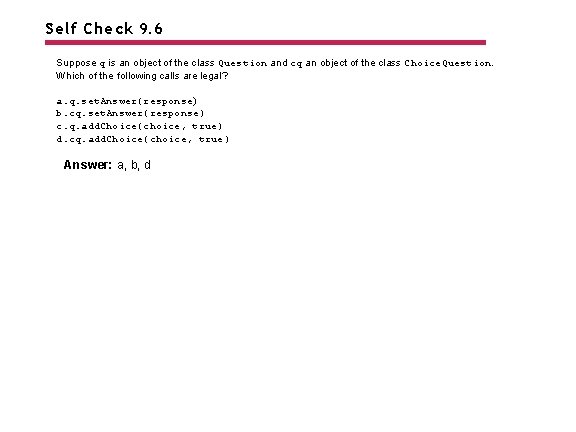
Self Check 9. 6 Suppose q is an object of the class Question and cq an object of the class Choice. Question. Which of the following calls are legal? a. q. set. Answer(response) b. cq. set. Answer(response) c. q. add. Choice(choice, true) d. cq. add. Choice(choice, true) Answer: a, b, d
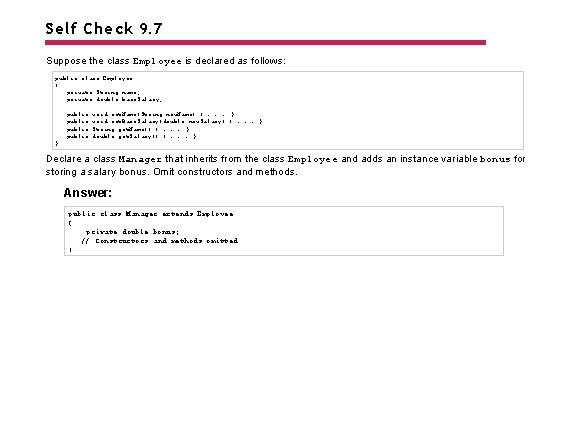
Self Check 9. 7 Suppose the class Employee is declared as follows: public class Employee { private String name; private double base. Salary; public void set. Name(String new. Name) {. . . } void set. Base. Salary(double new. Salary) {. . . } String get. Name() {. . . } double get. Salary() {. . . } } Declare a class Manager that inherits from the class Employee and adds an instance variable bonus for storing a salary bonus. Omit constructors and methods. Answer: public class Manager extends Employee { private double bonus; // Constructors and methods omitted }
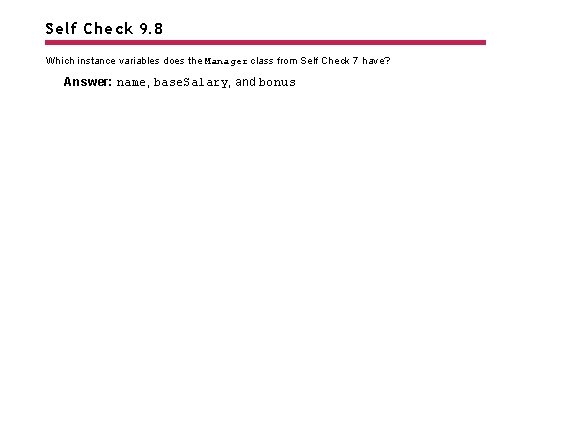
Self Check 9. 8 Which instance variables does the Manager class from Self Check 7 have? Answer: name, base. Salary, and bonus
Self Check 9. 9 In the Manager class, provide the method header (but not the implementation) for a method that overrides the get. Salary method from the class Employee. Answer: public class Manager extends Employee {. . . public double get. Salary() {. . . } }
Self Check 9. 10 Which methods does the Manager class from Self Check 9 inherit? Answer: get. Name, set. Base. Salary
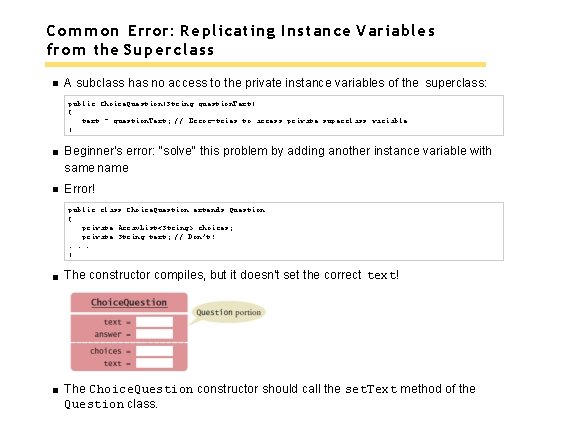
Common Error: Replicating Instance Variables from the Superclass A subclass has no access to the private instance variables of the superclass: public Choice. Question(String question. Text) { text = question. Text; // Error—tries to access private superclass variable } Beginner's error: "solve" this problem by adding another instance variable with same name Error! public class Choice. Question extends Question { private Array. List<String> choices; private String text; // Don’t!. . . } The constructor compiles, but it doesn’t set the correct text! The Choice. Question constructor should call the set. Text method of the Question class.
Overriding Methods If you are not satisfied with the behavior of an inherited method, you override it by specifying a new implementation in the subclass. An overriding method can extend or replace the functionality of the superclass method. The display method of the Choice. Question class needs to: Display the question text. Display the answer choices.
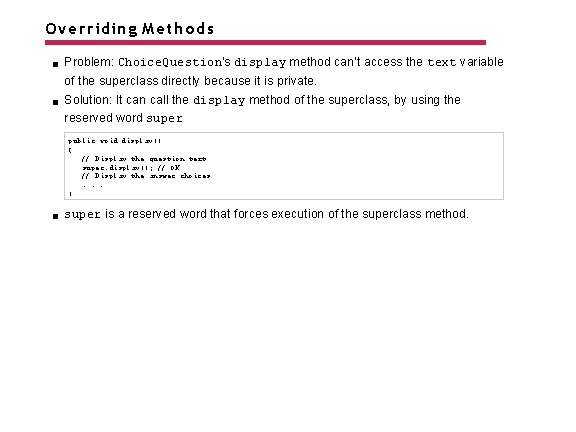
Overriding Methods Problem: Choice. Question's display method can’t access the text variable of the superclass directly because it is private. Solution: It can call the display method of the superclass, by using the reserved word super public void display() { // Display the question text super. display(); // OK // Display the answer choices. . . } super is a reserved word that forces execution of the superclass method.
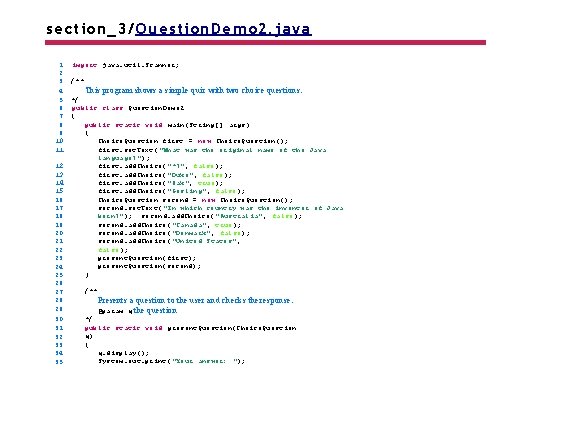
section_3/Question. Demo 2. java 1 2 3 4 5 6 7 8 9 10 11 12 13 14 15 16 17 18 19 20 21 22 23 24 25 26 27 28 29 30 31 32 33 34 35 import java. util. Scanner; /** This program shows a simple quiz with two choice questions. */ public class Question. Demo 2 { public static void main(String[] args) { Choice. Question first = new Choice. Question(); first. set. Text( "What was the original name of the Java language? "); first. add. Choice( "*7", false); first. add. Choice( "Duke", false); first. add. Choice( "Oak", true); first. add. Choice( "Gosling", false); Choice. Question second = new Choice. Question(); second. set. Text( "In which country was the inventor of Java born? "); second. add. Choice( "Australia", false); second. add. Choice( "Canada", true); second. add. Choice( "Denmark", false); second. add. Choice( "United States" , false); present. Question(first); present. Question(second); } /** Presents a question to the user and checks the response. @param q the question */ public static void present. Question(Choice. Question q) { q. display(); System. out. print( "Your answer: ");
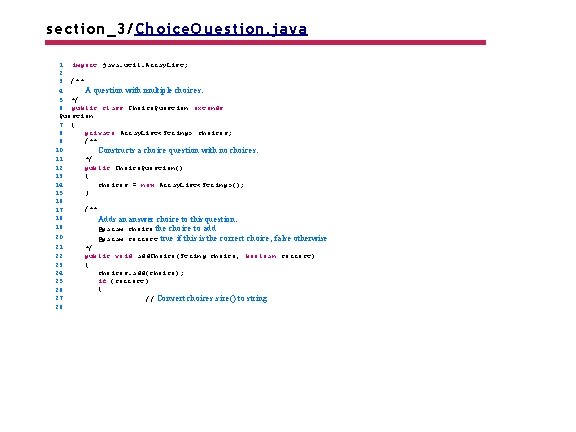
section_3/Choice. Question. java 1 import java. util. Array. List; 2 3 /** 4 A question with multiple choices. 5 */ 6 public class Choice. Question extends Question 7 { 8 private Array. List<String> choices; /** 9 10 Constructs a choice question with no choices. 11 */ public Choice. Question() 12 { 13 choices = new Array. List<String>(); 14 } 15 16 /** 17 18 Adds an answer choice to this question. 19 @param choice the choice to add 20 @param correct true if this is the correct choice, false otherwise 21 */ public void add. Choice(String choice, boolean correct) 22 { 23 24 choices. add(choice); 25 if (correct) { 26 27 // Convert choices. size() to string 28
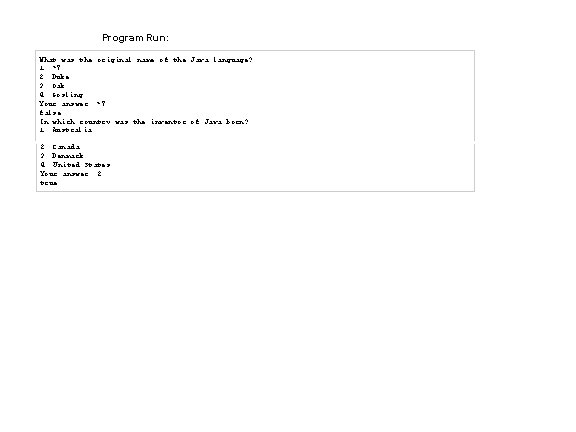
Program Run: What was the original name of the Java language? 1: *7 2: Duke 3: Oak 4: Gosling Your answer: *7 false In which country was the inventor of Java born? 1: Australia 2: Canada 3: Denmark 4: United States Your answer: 2 true
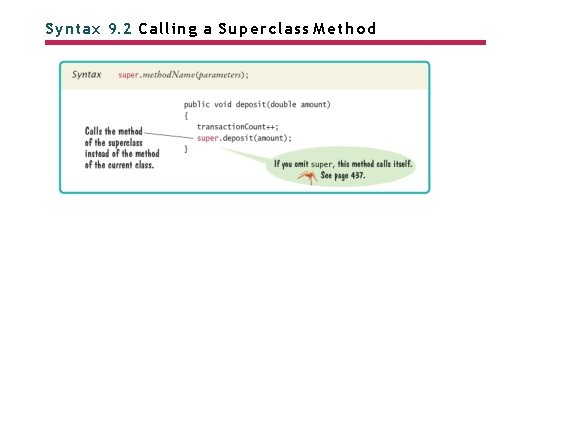
Syntax 9. 2 Calling a Superclass Method
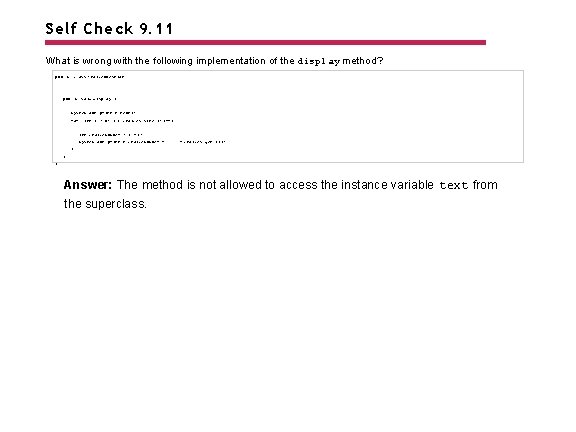
Self Check 9. 11 What is wrong with the following implementation of the display method? public class Choice. Question {. . . public void display() { System. out. println(text); for (int i = 0; i < choices. size(); i++) { int choice. Number = i + 1; System. out. println(choice. Number + ": " + choices. get(i)); } } } Answer: The method is not allowed to access the instance variable text from the superclass.
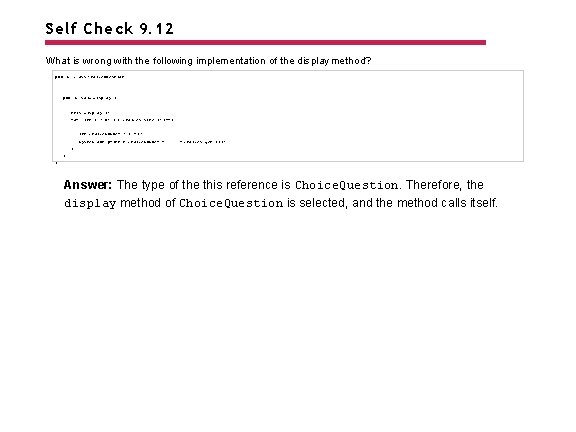
Self Check 9. 12 What is wrong with the following implementation of the display method? public class Choice. Question {. . . public void display() { this. display(); for (int i = 0; i < choices. size(); i++) { int choice. Number = i + 1; System. out. println(choice. Number + ": " + choices. get(i)); } } } Answer: The type of the this reference is Choice. Question. Therefore, the display method of Choice. Question is selected, and the method calls itself.
Self Check 9. 13 Look again at the implementation of the add. Choice method that calls the set. Answer method of the superclass. Why don’t you need to call super. set. Answer? Answer: Because there is no ambiguity. The subclass doesn’t have a set. Answer method.
Self Check 9. 14 In the Manager class of Self Check 7, override the get. Name method so that managers have a * before their name (such as *Lin, Sally). Answer: public String get. Name() { return "*" + super. get. Name(); }
Self Check 9. 15 In the Manager class of Self Check 9, override the get. Salary method so that it returns the sum of the salary and the bonus. Answer: public double get. Salary() { return super. get. Salary() + bonus; }
Common Error: Accidental Overloading: when two methods have the same name but different parameter types. Overriding: when a subclass method provides an implementation of a superclass method whose parameter variables have the same types. When overriding a method, the types of the parameter variables must match exactly.
Common Error: Forgetting to Use super When Invoking Superclass Method Use super when extending Employee functionality to Manager class public class Manager {. . . public double get. Salary() { double base. Salary = get. Salary(); // Error: should be super. get. Salary() return base. Salary + bonus; } }
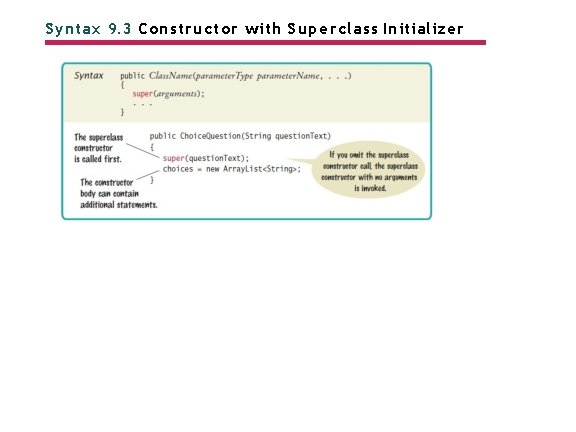
Syntax 9. 3 Constructor with Superclass Initializer
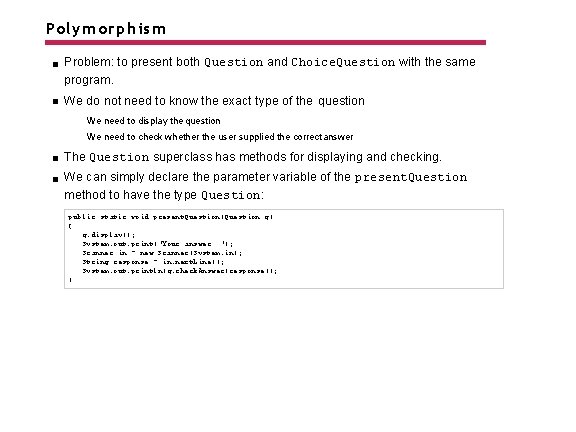
Polym orphis m Problem: to present both Question and Choice. Question with the same program. We do not need to know the exact type of the question We need to display the question We need to check whether the user supplied the correct answer The Question superclass has methods for displaying and checking. We can simply declare the parameter variable of the present. Question method to have the type Question: public static void present. Question(Question q) { q. display(); System. out. print("Your answer: "); Scanner in = new Scanner(System. in); String response = in. next. Line(); System. out. println(q. check. Answer(response)); }
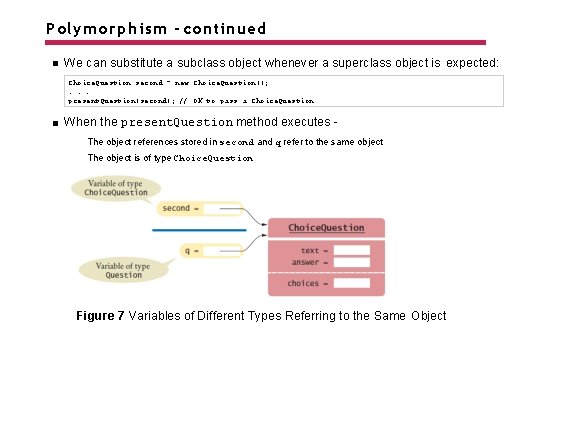
Polymorphism - continued We can substitute a subclass object whenever a superclass object is expected: Choice. Question second = new Choice. Question(); . . . present. Question(second); // OK to pass a Choice. Question When the present. Question method executes The object references stored in second and q refer to the same object The object is of type Choice. Question Figure 7 Variables of Different Types Referring to the Same Object
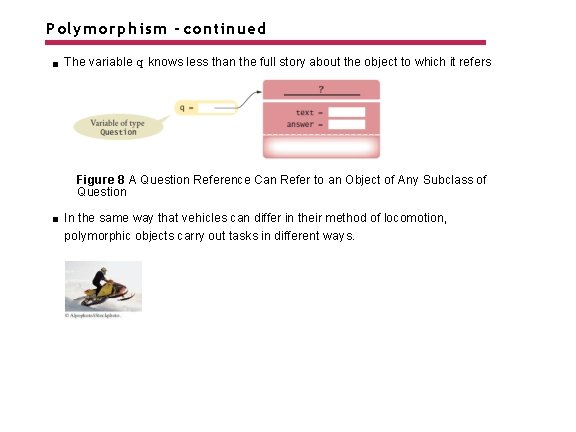
Polymorphism - continued The variable q knows less than the full story about the object to which it refers Figure 8 A Question Reference Can Refer to an Object of Any Subclass of Question In the same way that vehicles can differ in their method of locomotion, polymorphic objects carry out tasks in different ways.
Polymorphism - continued When the virtual machine calls an instance method It locates the method of the implicit parameter’s class. This is called dynamic method lookup Dynamic method lookup allows us to treat objects of different classes in a uniform way. This feature is called polymorphism. We ask multiple objects to carry out a task, and each object does so in its own way. Polymorphism means “having multiple forms” It allows us to manipulate objects that share a set of tasks, even though the tasks are executed in different ways.
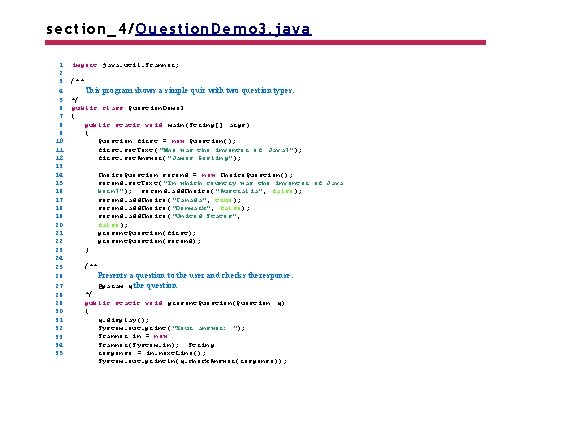
section_4/Question. Demo 3. java 1 2 3 4 5 6 7 8 9 10 11 12 13 14 15 16 17 18 19 20 21 22 23 24 25 26 27 28 29 30 31 32 33 34 35 import java. util. Scanner; /** This program shows a simple quiz with two question types. */ public class Question. Demo 3 { public static void main(String[] args) { Question first = new Question(); first. set. Text( "Who was the inventor of Java? "); first. set. Answer( "James Gosling"); Choice. Question second = new Choice. Question(); second. set. Text( "In which country was the inventor of Java born? "); second. add. Choice( "Australia", false); second. add. Choice( "Canada", true); second. add. Choice( "Denmark", false); second. add. Choice( "United States" , false); present. Question(first); present. Question(second); } /** Presents a question to the user and checks the response. @param q the question */ public static void present. Question(Question q) { q. display(); System. out. print( "Your answer: "); Scanner in = new Scanner(System. in); String response = in. next. Line(); System. out. println(q. check. Answer(response));
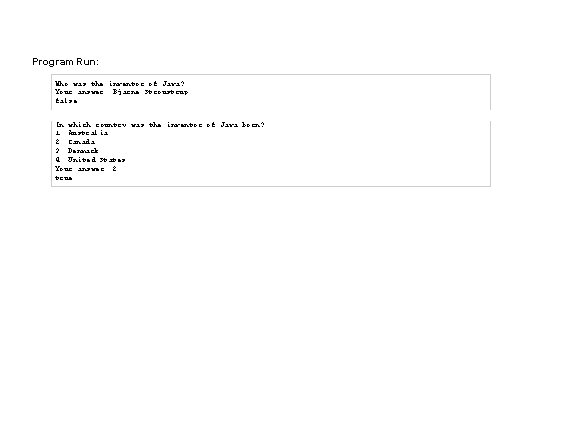
Program Run: Who was the inventor of Java? Your answer: Bjarne Stroustrup false In which country was the inventor of Java born? 1: Australia 2: Canada 3: Denmark 4: United States Your answer: 2 true
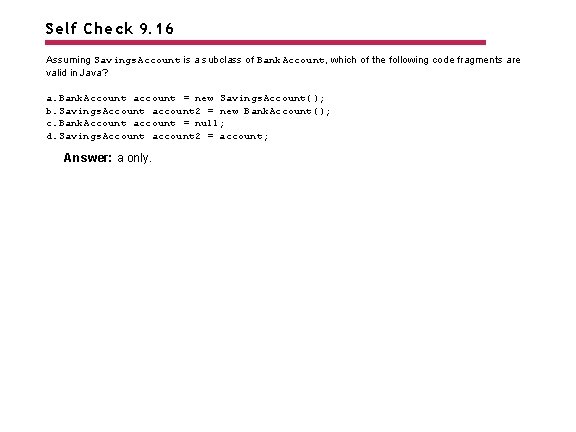
Self Check 9. 16 Assuming Savings. Account is a subclass of Bank. Account, which of the following code fragments are valid in Java? a. Bank. Account account = new Savings. Account(); b. Savings. Account account 2 = new Bank. Account(); c. Bank. Account account = null; d. Savings. Account account 2 = account; Answer: a only.
Self Check 9. 17 If account is a variable of type Bank. Account that holds a non-null reference, what do you know about the object to which account refers? Answer: It belongs to the class Bank. Account or one of its subclasses.
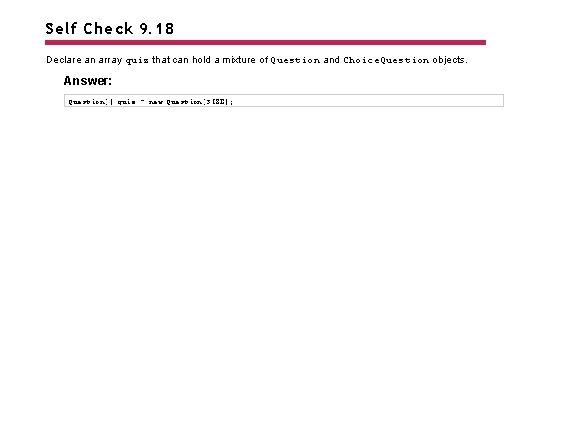
Self Check 9. 18 Declare an array quiz that can hold a mixture of Question and Choice. Question objects. Answer: Question[] quiz = new Question[SIZE];
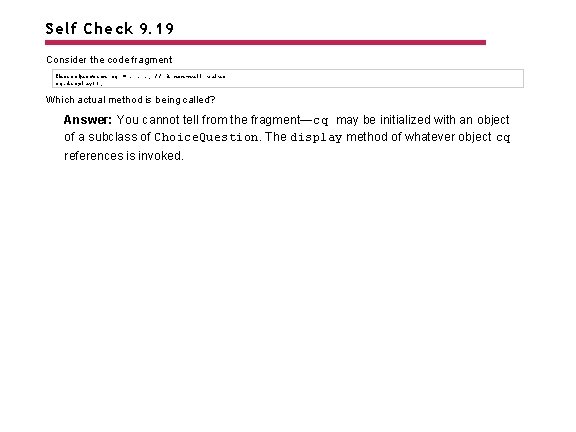
Self Check 9. 19 Consider the code fragment Choice. Question cq =. . . ; // A non-null value cq. display(); Which actual method is being called? Answer: You cannot tell from the fragment—cq may be initialized with an object of a subclass of Choice. Question. The display method of whatever object cq references is invoked.
Self Check 9. 20 Is the method call Math. sqrt(2) resolved through dynamic method lookup? Answer: No. This is a static method of the Math class. There is no implicit parameter object that could be used to dynamically look up a method.
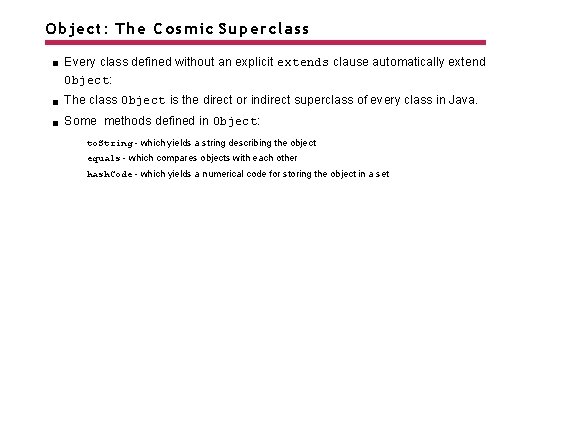
Object: The Cosmic Superclass Every class defined without an explicit extends clause automatically extend Object: The class Object is the direct or indirect superclass of every class in Java. Some methods defined in Object: to. String - which yields a string describing the object equals - which compares objects with each other hash. Code - which yields a numerical code for storing the object in a set
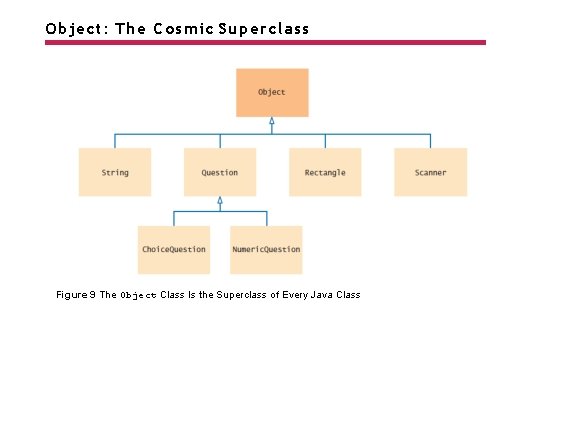
Object: The Cosmic Superclass Figure 9 The Object Class Is the Superclass of Every Java Class
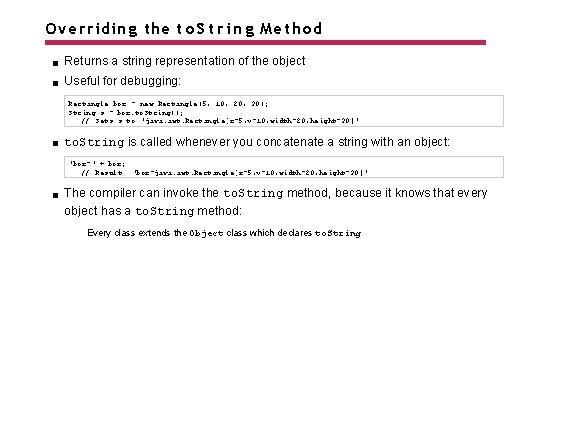
Overriding the t o S t r i n g Method Returns a string representation of the object Useful for debugging: Rectangle box = new Rectangle(5, 10, 20, 30); String s = box. to. String(); // Sets s to "java. awt. Rectangle[x=5, y=10, width=20, height=30]" to. String is called whenever you concatenate a string with an object: "box=" + box; // Result: "box=java. awt. Rectangle[x=5, y=10, width=20, height=30]" The compiler can invoke the to. String method, because it knows that every object has a to. String method: Every class extends the Object class which declares to. String
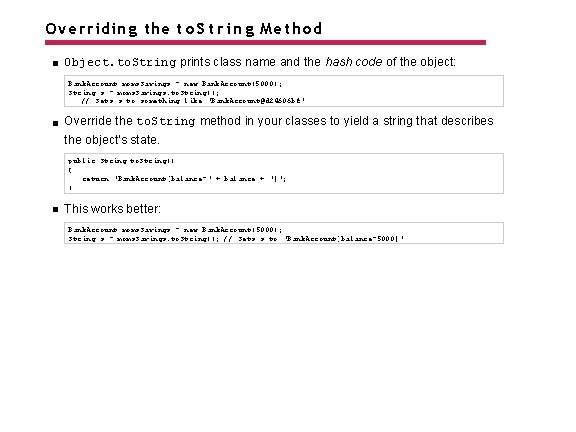
Overriding the t o S t r i n g Method Object. to. String prints class name and the hash code of the object: Bank. Account moms. Savings = new Bank. Account(5000); String s = moms. Savings. to. String(); // Sets s to something like "Bank. Account@d 24606 bf" Override the to. String method in your classes to yield a string that describes the object’s state. public String to. String() { return "Bank. Account[balance=" + balance + "]"; } This works better: Bank. Account moms. Savings = new Bank. Account(5000); String s = moms. Savings. to. String(); // Sets s to "Bank. Account[balance=5000]"
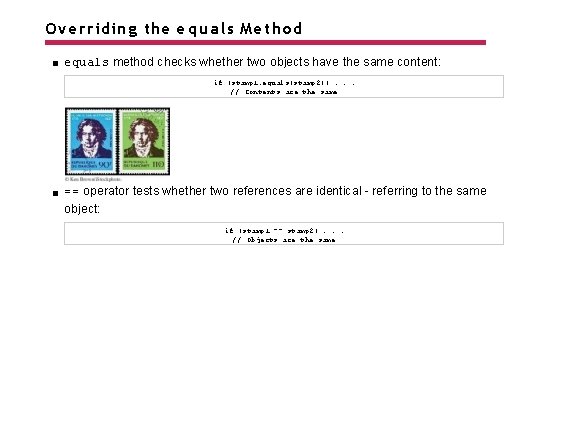
Overriding the e q u a l s Method equals method checks whether two objects have the same content: if (stamp 1. equals(stamp 2)). . . // Contents are the same == operator tests whether two references are identical - referring to the same object: if (stamp 1 == stamp 2). . . // Objects are the same
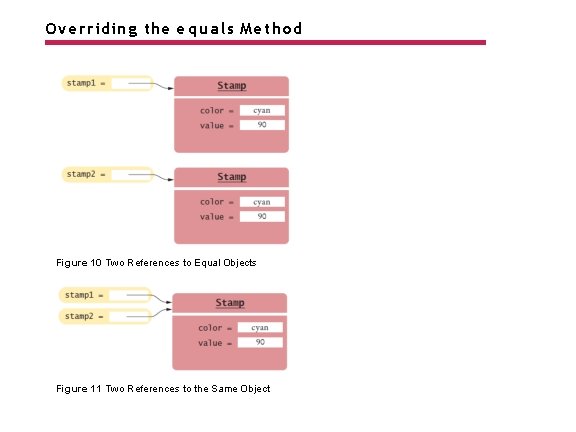
Overriding the e q u a l s Method Figure 10 Two References to Equal Objects Figure 11 Two References to the Same Object
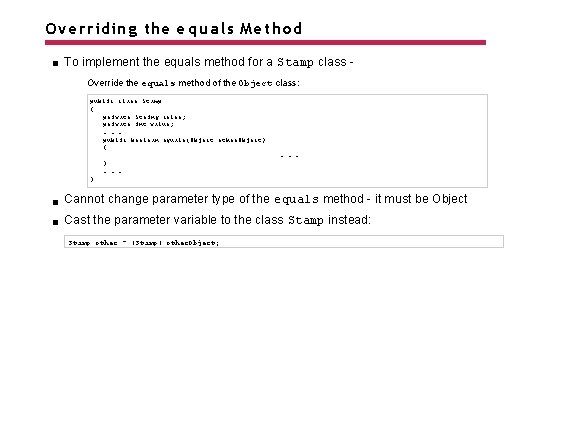
Overriding the e q u a l s Method To implement the equals method for a Stamp class Override the equals method of the Object class: public class Stamp { private String color; private int value; . . . public boolean equals(Object other. Object) {. . . } Cannot change parameter type of the equals method - it must be Object Cast the parameter variable to the class Stamp instead: Stamp other = (Stamp) other. Object;
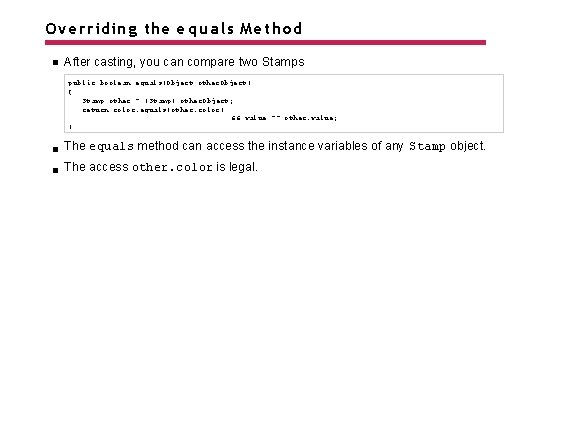
Overriding the e q u a l s Method After casting, you can compare two Stamps public boolean equals(Object other. Object) { Stamp other = (Stamp) other. Object; return color. equals(other. color) && value == other. value; } The equals method can access the instance variables of any Stamp object. The access other. color is legal.
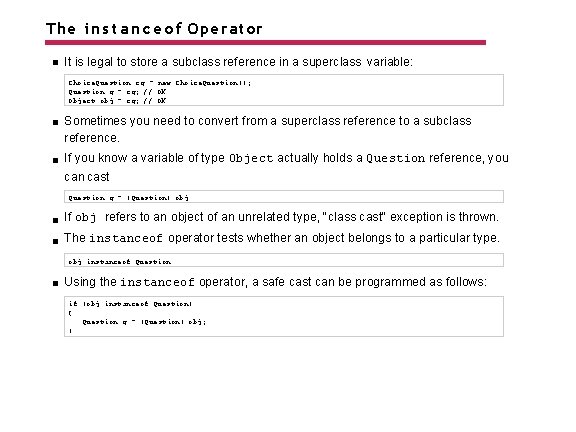
The i n s t a n c e o f Operator It is legal to store a subclass reference in a superclass variable: Choice. Question cq = new Choice. Question(); Question q = cq; // OK Object obj = cq; // OK Sometimes you need to convert from a superclass reference to a subclass reference. If you know a variable of type Object actually holds a Question reference, you can cast Question q = (Question) obj If obj refers to an object of an unrelated type, "class cast" exception is thrown. The instanceof operator tests whether an object belongs to a particular type. obj instanceof Question Using the instanceof operator, a safe cast can be programmed as follows: if (obj instanceof Question) { Question q = (Question) obj; }
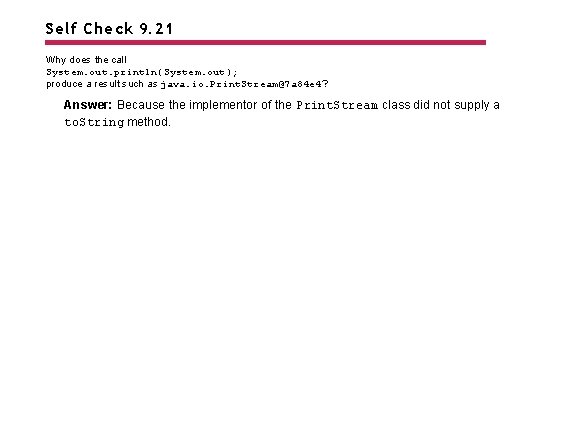
Self Check 9. 21 Why does the call System. out. println(System. out); produce a result such as java. io. Print. Stream@7 a 84 e 4? Answer: Because the implementor of the Print. Stream class did not supply a to. String method.
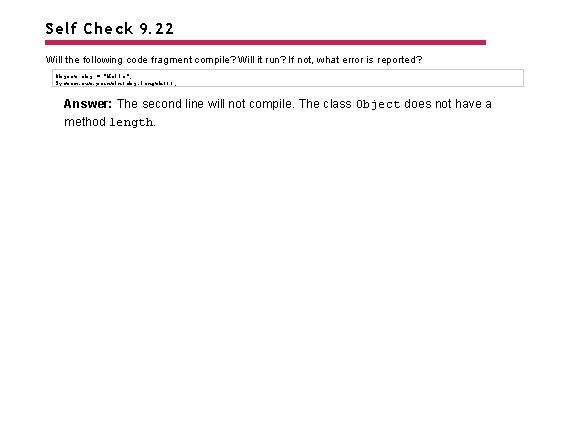
Self Check 9. 22 Will the following code fragment compile? Will it run? If not, what error is reported? Object obj = "Hello"; System. out. println(obj. length()); Answer: The second line will not compile. The class Object does not have a method length.
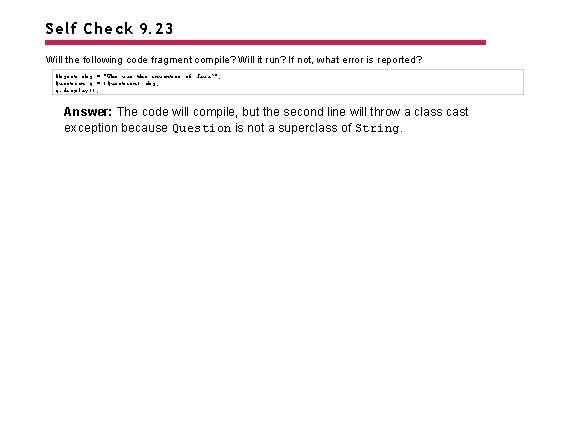
Self Check 9. 23 Will the following code fragment compile? Will it run? If not, what error is reported? Object obj = "Who was the inventor of Java? "; Question q = (Question) obj; q. display(); Answer: The code will compile, but the second line will throw a class cast exception because Question is not a superclass of String.
Self Check 9. 24 Why don’t we simply store all objects in variables of type Object? Answer: There are only a few methods that can be invoked on variables of type Object.
Self Check 9. 25 Assuming that x is an object reference, what is the value of x instanceof Object? Answer: The value is false if x is null and true otherwise.
- Slides: 66