
CHAPTER 9 INFERENTIAL STATISTICS THE TTESTS Understanding Statistics
- Slides: 6
CHAPTER 9 INFERENTIAL STATISTICS: THE T-TESTS Understanding Statistics for International Social Work and Other Behavioral Sciences Serge Lee, Maria C. Silveira Nunes Dinis, Lois Lowe, and Kelly Anders (2015). Oxford University Press
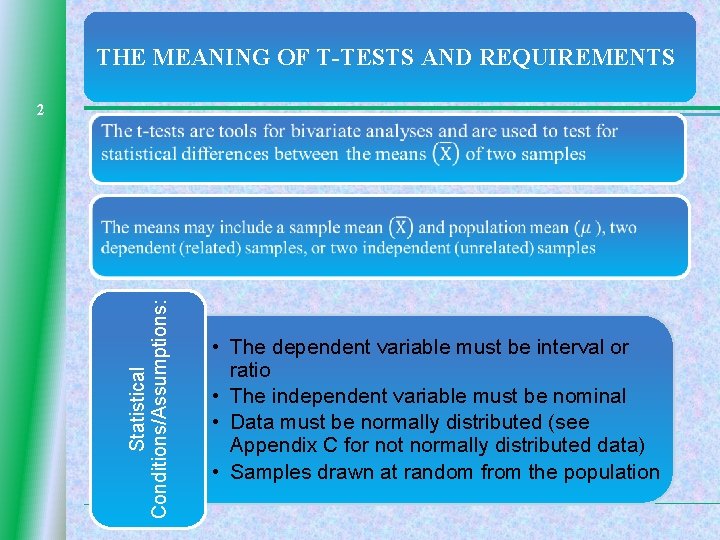
THE MEANING OF T-TESTS AND REQUIREMENTS Statistical Conditions/Assumptions: 2 • The dependent variable must be interval or ratio • The independent variable must be nominal • Data must be normally distributed (see Appendix C for not normally distributed data) • Samples drawn at random from the population
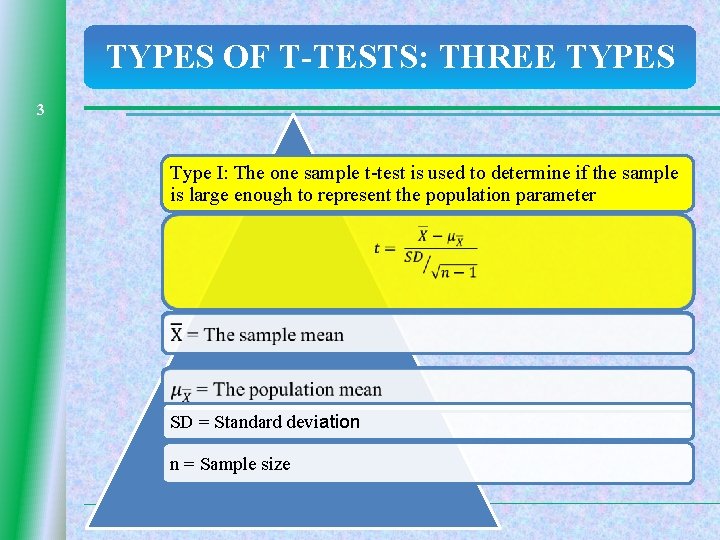
TYPES OF T-TESTS: THREE TYPES 3 Type I: The one sample t-test is used to determine if the sample is large enough to represent the population parameter SD = Standard deviation n = Sample size
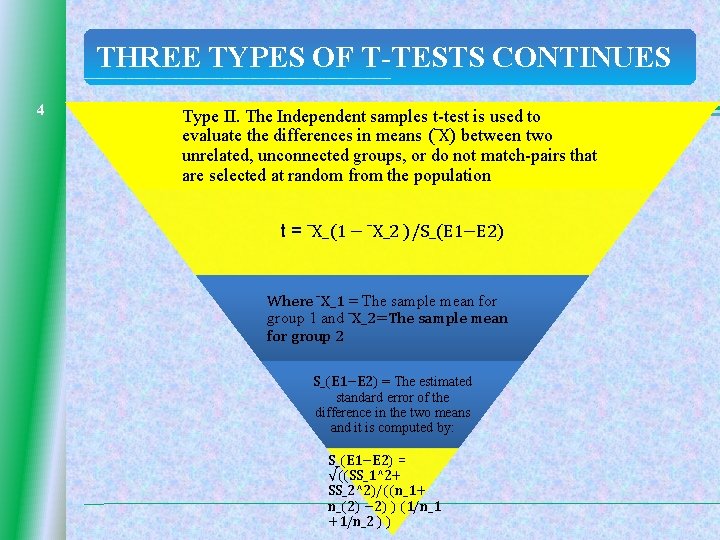
THREE TYPES OF T-TESTS CONTINUES 4 Type II. The Independent samples t-test is used to evaluate the differences in means (¯X) between two unrelated, unconnected groups, or do not match-pairs that are selected at random from the population t = ¯X_(1 − ¯X_2 )/S_(E 1−E 2) Where ¯X_1 = The sample mean for group 1 and ¯X_2=The sample mean for group 2 S_(E 1−E 2) = The estimated standard error of the difference in the two means and it is computed by: S_(E 1−E 2) = √((SS_1^2+ SS_2^2)/((n_1+ n_(2) − 2) ) (1/n_1 +1/n_2 ) )
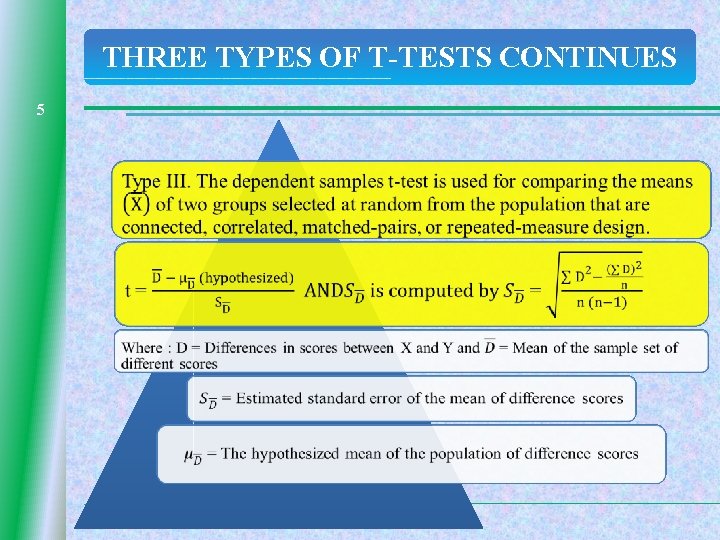
THREE TYPES OF T-TESTS CONTINUES 5
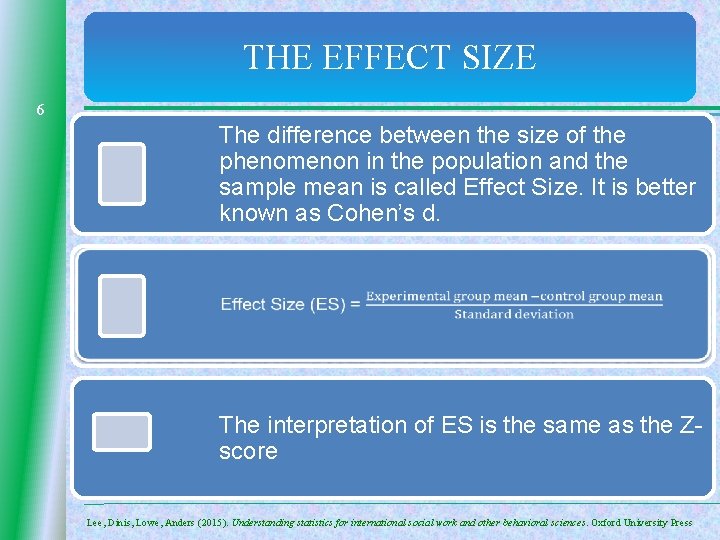
THE EFFECT SIZE 6 The difference between the size of the phenomenon in the population and the sample mean is called Effect Size. It is better known as Cohen’s d. The interpretation of ES is the same as the Zscore Lee, Dinis, Lowe, Anders (2015). Understanding statistics for international social work and other behavioral sciences. Oxford University Press