
Chapter 9 Individual Decision Making By Michael R
Chapter 9 Individual Decision Making By Michael R. Solomon Consumer Behavior Buying, Having, and Being Sixth Edition
Consumers As Problem Solvers • A consumer purchase is a response to a problem. • Steps in the decision process: – (1) Problem recognition – (2) Information search – (3) Evaluation of alternatives – (4) Product choice • Amount of effort put into a purchase decision differs with each purchase.
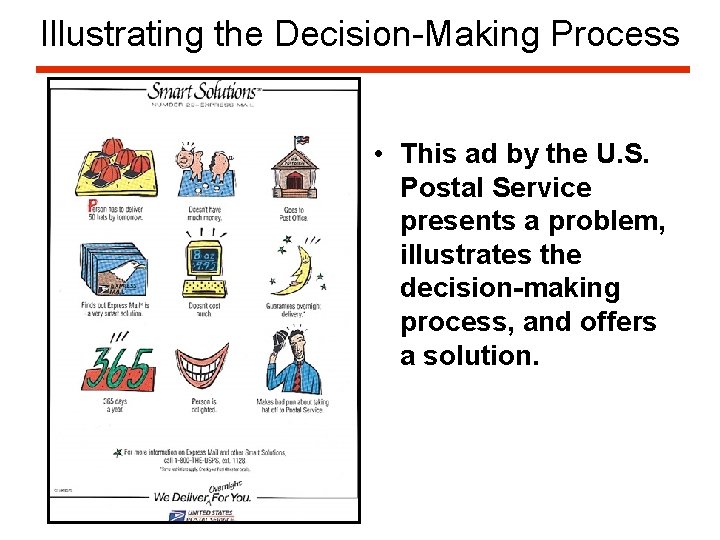
Illustrating the Decision-Making Process • This ad by the U. S. Postal Service presents a problem, illustrates the decision-making process, and offers a solution.
Perspectives on Decision Making • Rational Perspective: – Consumers integrate as much info as possible, weigh pluses and minuses, arrive at a decision – Purchase Momentum: • Initial impulses increase the likelihood of buying more – Constructive Processing: • Sequence of events by which the consumer evaluates the effort needed to make a choice and then chooses a strategy based on the level of effort required
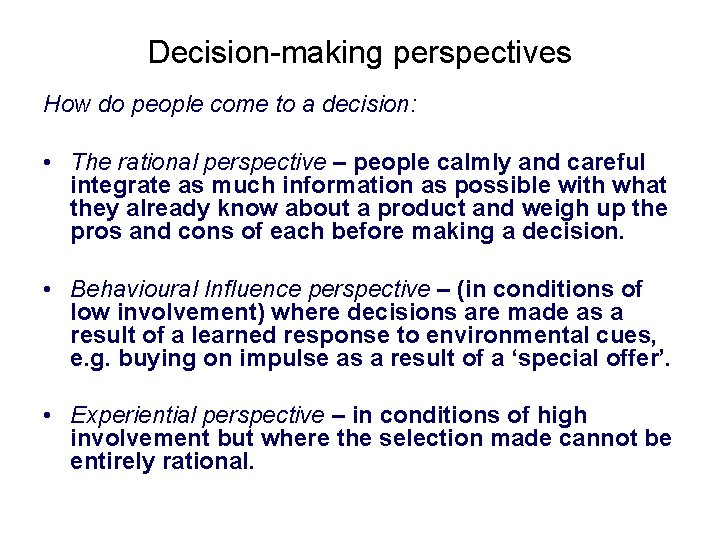
Decision-making perspectives How do people come to a decision: • The rational perspective – people calmly and careful integrate as much information as possible with what they already know about a product and weigh up the pros and cons of each before making a decision. • Behavioural Influence perspective – (in conditions of low involvement) where decisions are made as a result of a learned response to environmental cues, e. g. buying on impulse as a result of a ‘special offer’. • Experiential perspective – in conditions of high involvement but where the selection made cannot be entirely rational.
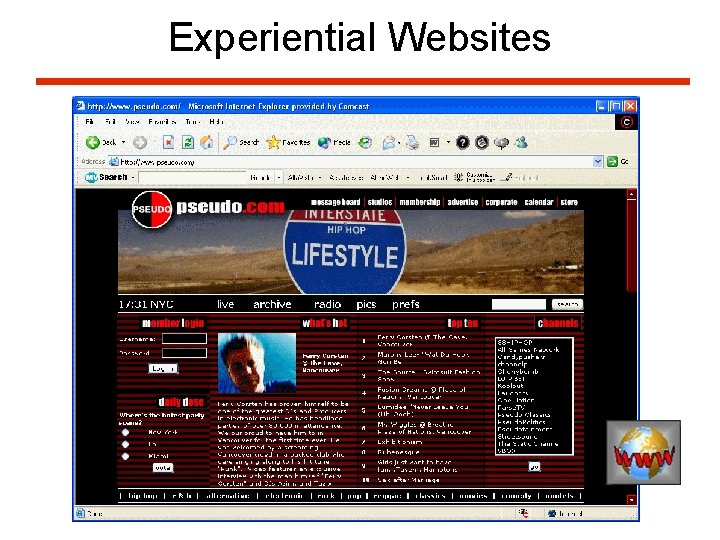
Experiential Websites
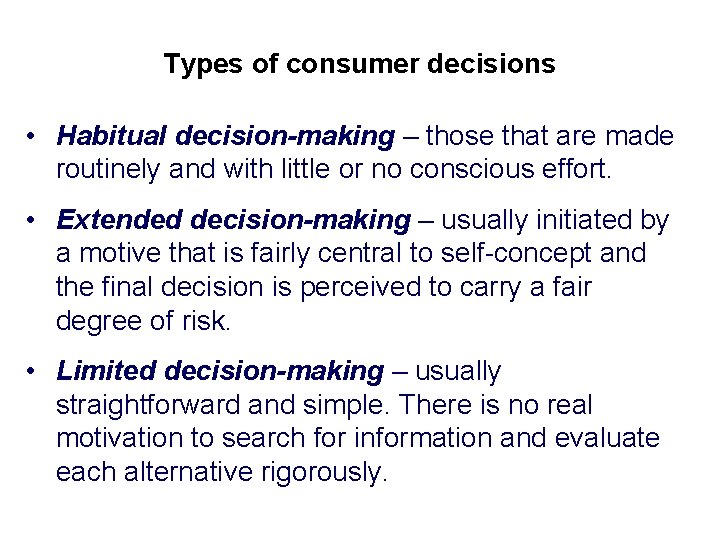
Types of consumer decisions • Habitual decision-making – those that are made routinely and with little or no conscious effort. • Extended decision-making – usually initiated by a motive that is fairly central to self-concept and the final decision is perceived to carry a fair degree of risk. • Limited decision-making – usually straightforward and simple. There is no real motivation to search for information and evaluate each alternative rigorously.
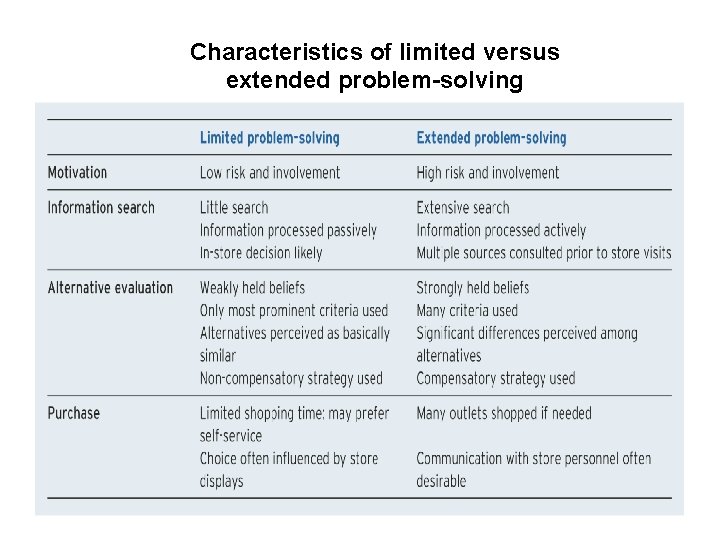
Characteristics of limited versus extended problem-solving
Problem Recognition • Problem recognition: – Occurs whenever the consumer sees a significant difference between his or her current state of affairs and some desired or ideal state • Need recognition: The quality of the consumer’s actual state moves downward • Opportunity recognition: The consumer’s ideal state moves upward – Primary demand: Consumers are encouraged to use a product or service regardless of the brand they choose – Secondary demand: Consumers are encouraged to use a specific brand – can only occur if primary demand exists
Information Search • Types of Information Search: – Prepurchase search: Consumer recognizes a need and then searches the marketplace for specific information – Ongoing search: Browsing for fun or staying up-to-date on what’s happening in the market • Internal Versus External Search: – Internal search: Scanning our own memory banks for information about product alternatives – External search: Obtaining product information from advertisements, friends, or by observing others
How Much Search Occurs? • As a general rule, search activity is greater when: • (1) The purchase is important. • (2) When there is a need to learn more about the purchase. • (3) When the relevant information is easily obtained and utilized. • (4) Females search more than men. • (5) Younger, better educated search more than others. • (6) Those who enjoy shopping search more.
Expertise. . . The consumer’s prior expertise can also affect the search and shopping process. • (1) Search tends to be greatest among those consumers who are moderately knowledgeable about the product. • (2) The type of search varies with varying levels of expertise: • (a) Experts use selective search. • (b) Novices rely on opinions of others.
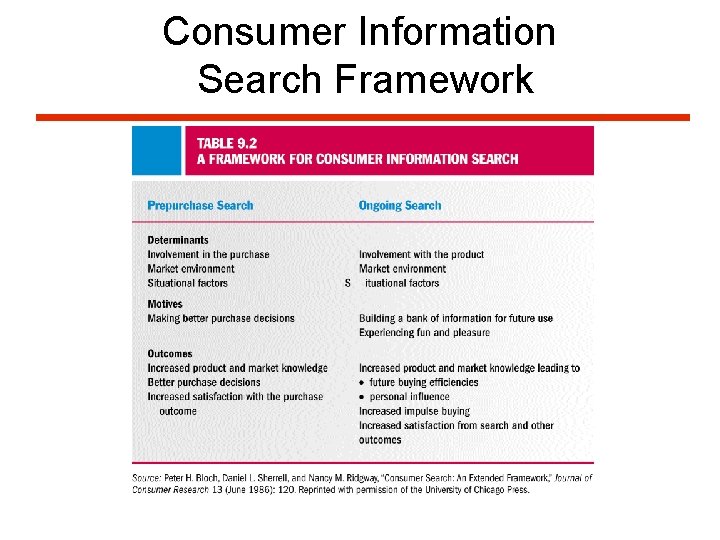
Consumer Information Search Framework
Other Types of Information Search • Deliberate Versus “Accidental” Search: – Directed Learning: Results from existing knowledge from previous active acquisition of information – Incidental Learning: Passive acquisition of information through exposure to advertising, packaging, and sales promotion activities • The Economics of Information: – Approach that assumes consumers will gather as much data as needed to make a decision – Utility: the most valuable units of information will be – collected first. – Variety Seeking: Desire to choose new alternatives over familiar ones
Do Consumers Always Search Rationally? • Consumers don’t necessarily engage in a rational search process. • Low-income consumers search the least. • Brand Switching: – Changing brands even if the current brand satisfies the consumer’s needs – Variety seeking • Sensory-specific satiety: – A cause of variety seeking when there is relatively little stimulation in the consumer’s environment
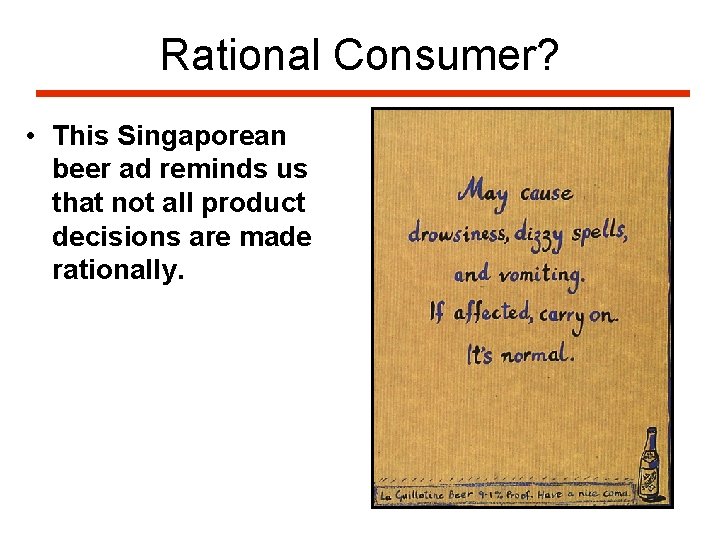
Rational Consumer? • This Singaporean beer ad reminds us that not all product decisions are made rationally.
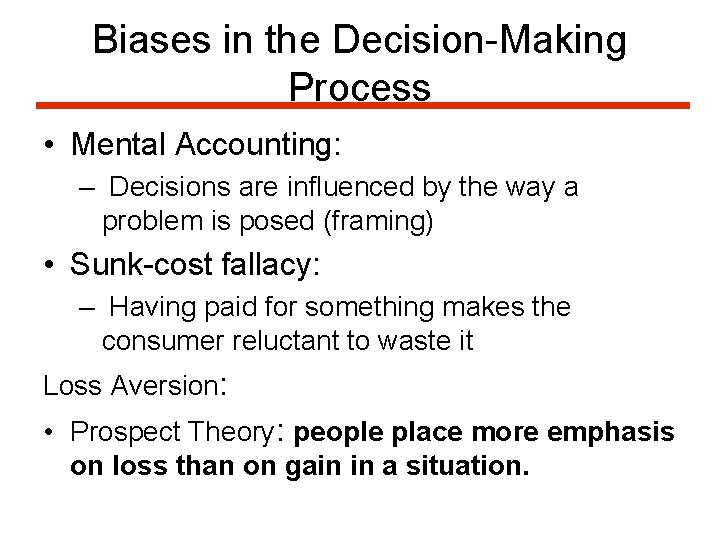
Biases in the Decision-Making Process • Mental Accounting: – Decisions are influenced by the way a problem is posed (framing) • Sunk-cost fallacy: – Having paid for something makes the consumer reluctant to waste it Loss Aversion: • Prospect Theory: people place more emphasis on loss than on gain in a situation.
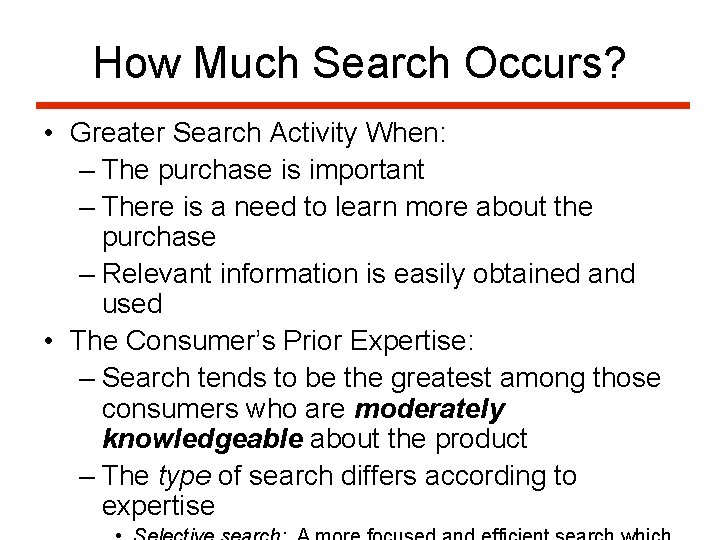
How Much Search Occurs? • Greater Search Activity When: – The purchase is important – There is a need to learn more about the purchase – Relevant information is easily obtained and used • The Consumer’s Prior Expertise: – Search tends to be the greatest among those consumers who are moderately knowledgeable about the product – The type of search differs according to expertise
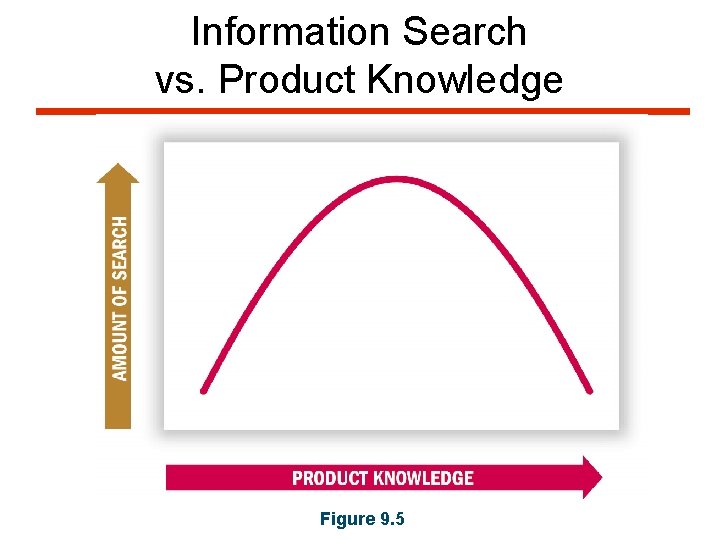
Information Search vs. Product Knowledge Figure 9. 5
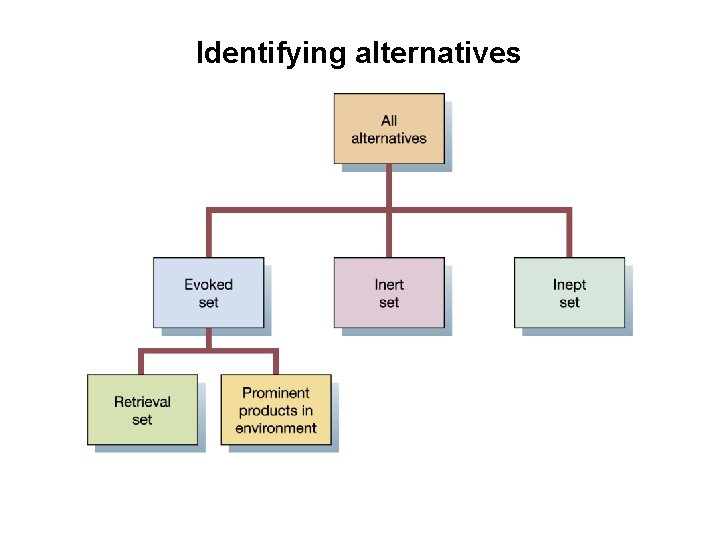
Identifying alternatives
Alternatives. . . The alternatives actively considered during a consumer’s choice process are his or her • Evoked set. In reality, this can be a very small set. Marketers want their products to be in the evoked set. • (1) The evoked set is composed of those products already in memory (the retrieval set), plus those prominent in the retail environment. • (2) The alternatives that the consumer is aware of but would not consider buying are his or her inept set. • (3) Those products not entering his or her consideration comprise the inert set.
Evaluation of Alternatives • Identifying Alternatives: – Evoked Set: Products already in memory (the retrieval set) plus those prominent in the retail environment • Product Categorization: – Categorization: Mentally placing a product with a set of other comparable products - (the factual knowledge about products [beliefs] and the way these beliefs are organized in people’s minds). • Levels of Categorization: – Basic level category - items have much in common but a number of alternatives exist. – Superordinate category - abstract concepts. – Subordinate category - individual brands.
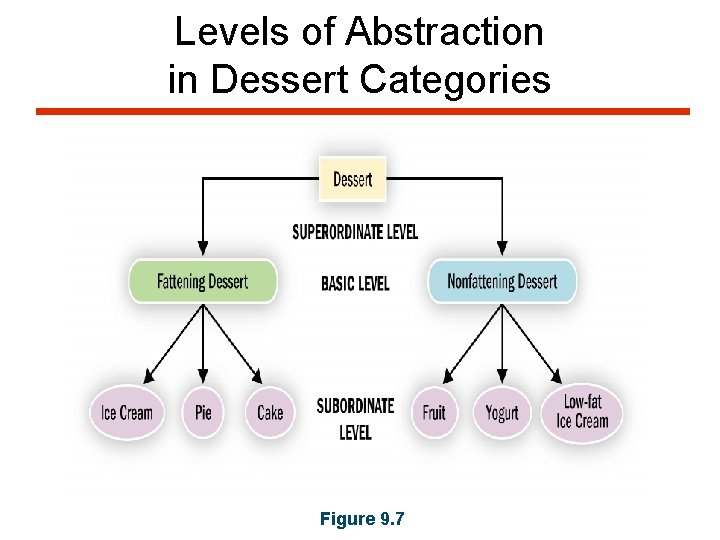
Levels of Abstraction in Dessert Categories Figure 9. 7
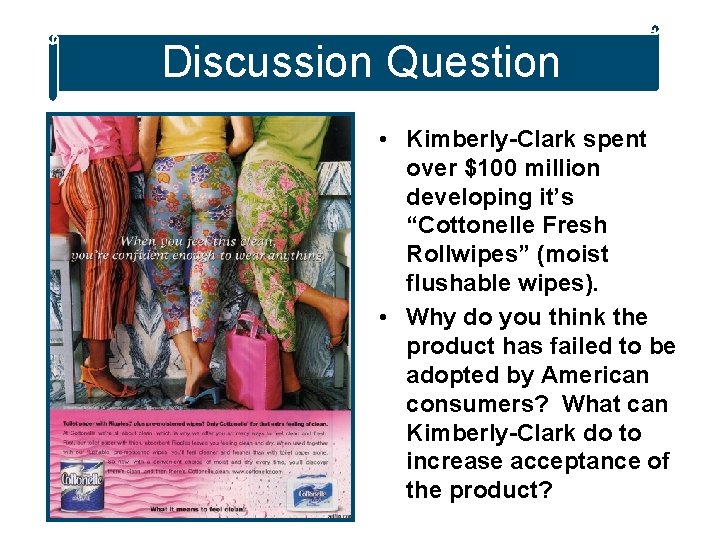
Discussion Question • Kimberly-Clark spent over $100 million developing it’s “Cottonelle Fresh Rollwipes” (moist flushable wipes). • Why do you think the product has failed to be adopted by American consumers? What can Kimberly-Clark do to increase acceptance of the product?
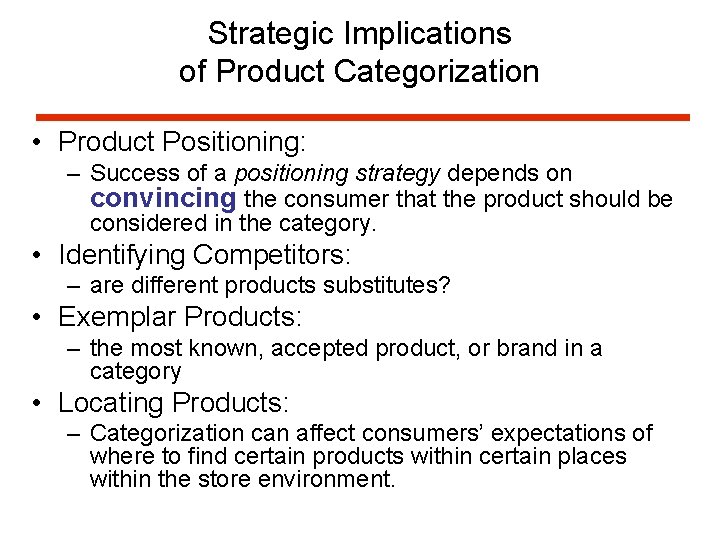
Strategic Implications of Product Categorization • Product Positioning: – Success of a positioning strategy depends on convincing the consumer that the product should be considered in the category. • Identifying Competitors: – are different products substitutes? • Exemplar Products: – the most known, accepted product, or brand in a category • Locating Products: – Categorization can affect consumers’ expectations of where to find certain products within certain places within the store environment.
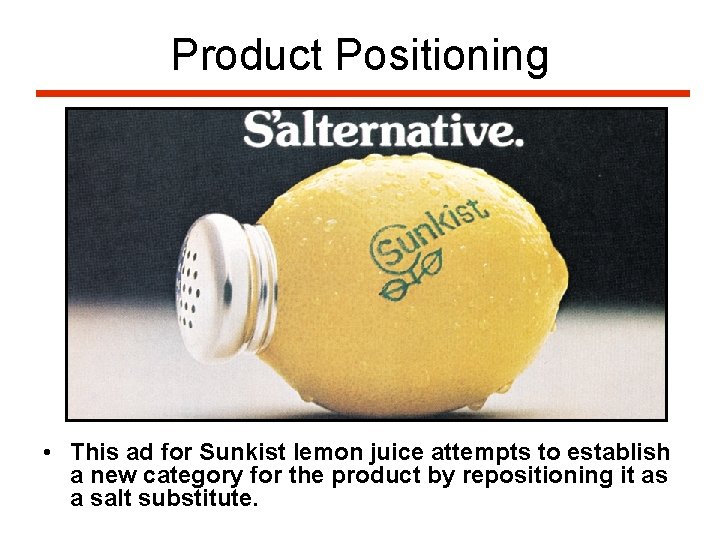
Product Positioning • This ad for Sunkist lemon juice attempts to establish a new category for the product by repositioning it as a salt substitute.
How to judge. . . • Evaluative criteria are the dimensions used to judge the merits of competing options. Forms can be: • (1) Differences – significant differences among brands on an attribute (anti-lock brakes). • (2) Supplying the consumer with decisionmaking rules. Convey a rule that can be integrated with how the person has made this decision in the past
Heuristics • Mental rule of thumbs that are used to simplify decision-making and lead to speedy decisions. • The rules vary from the very general to very specific. • Shortcuts include – relying on a product signal, relying on well-known brand names as a signal of quality and believing market beliefs. • When a brand is consistently purchased over time, this pattern may be due to true brand identity or inertia because it is the easiest thing to do.
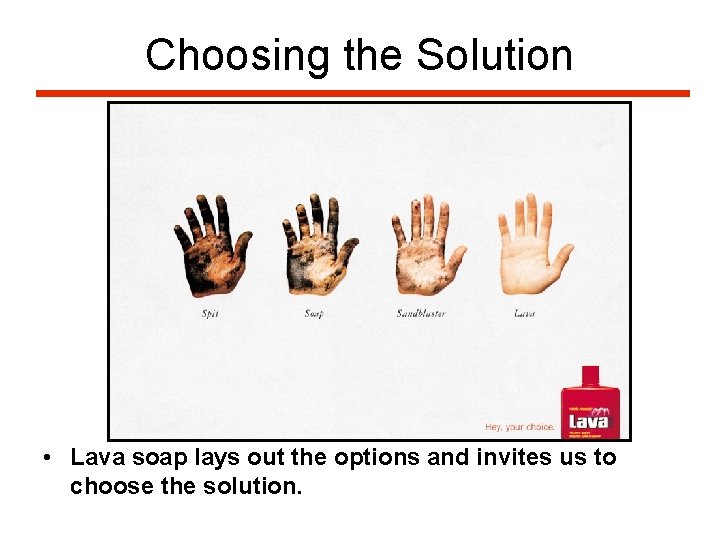
Choosing the Solution • Lava soap lays out the options and invites us to choose the solution.
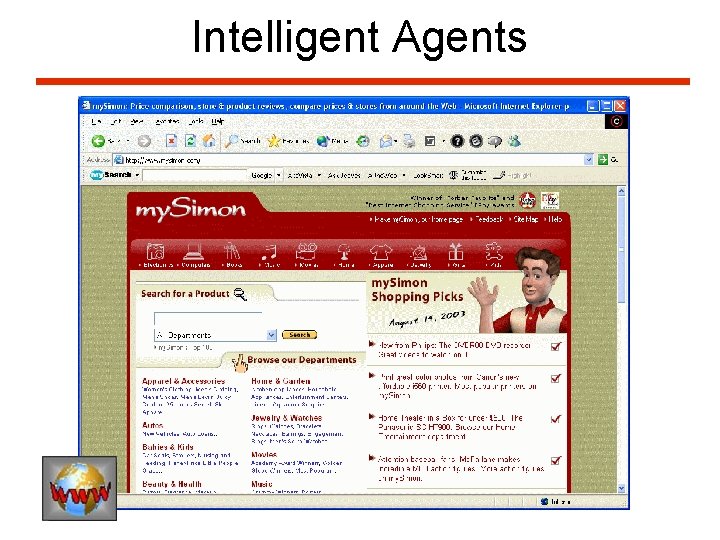
Intelligent Agents
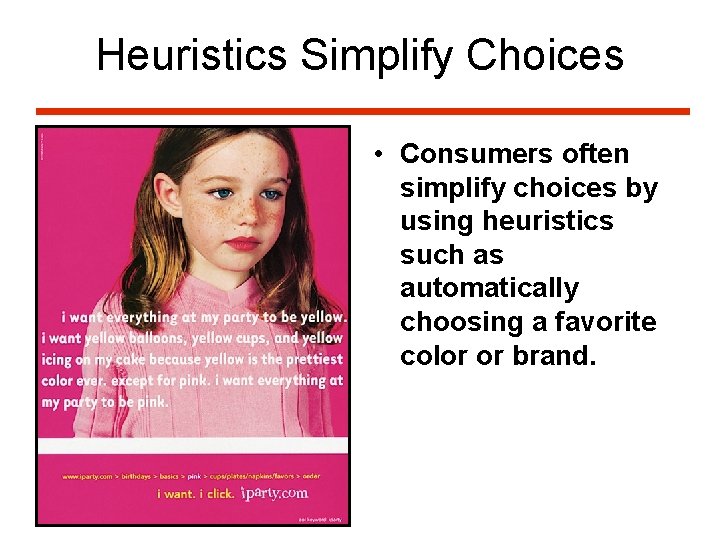
Heuristics Simplify Choices • Consumers often simplify choices by using heuristics such as automatically choosing a favorite color or brand.
Heuristics (cont. ) • Country-of-Origin as a Product Signal – Roper Starch Worldwide categorization of people’s level of cultural attachment • Nationalists • Internationalists • Disengaged – Country-of-origin: Can be an important piece of information in the decision-making process – Stereotype: A knowledge structure based on inferences across products – Ethnocentrism: Tendency to prefer products or people of one’s own culture. – Consumer Ethnocentrism Scale (CETSCALE): Measures ethnocentrism
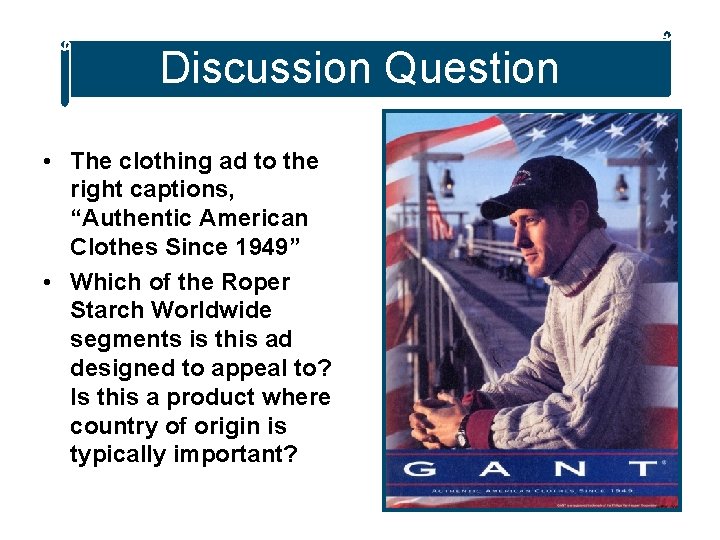
Discussion Question • The clothing ad to the right captions, “Authentic American Clothes Since 1949” • Which of the Roper Starch Worldwide segments is this ad designed to appeal to? Is this a product where country of origin is typically important?
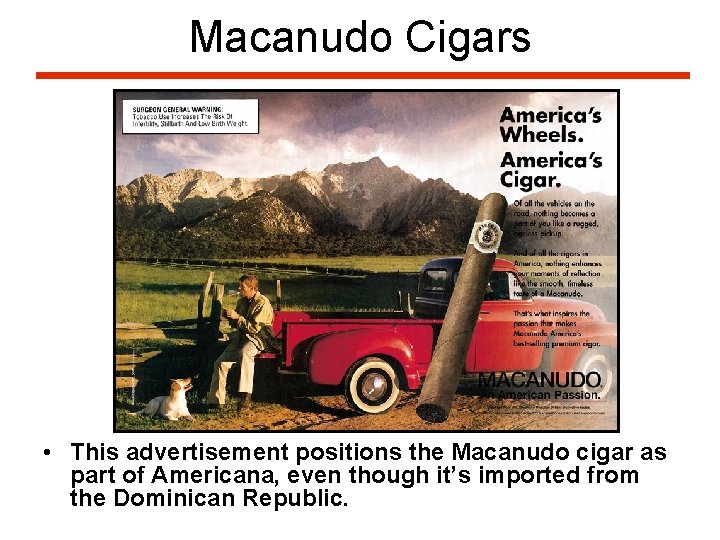
Macanudo Cigars • This advertisement positions the Macanudo cigar as part of Americana, even though it’s imported from the Dominican Republic.
Heuristics (conc. ) • Choosing Familiar Brand Names: Loyalty or Habit? – Brand loyalty is prized by marketers – Brand equity can be defined as the difference between the market value and the book value of a brand. • Inertia: the lazy consumer – Inertia: A brand is bought out of habit because less effort is required • Brand Loyalty: A “Friend, ” Tried-and-True: – Brand parity: Consumers’ beliefs that there are no significant differences between brands
Decision Rules • Noncompensatory Decision Rules: – Choice shortcuts where a product with a low standing on one attribute cannot compensate by being better on another attribute • The Lexographic Rule • The Elimination by Aspects Rule • The Conjunctive Rule • Compensatory Decision Rules: – Give a product a chance to make up for its shortcomings • Simple Additive Rule • Weighted Additive Rule
Non-compensatory decision rules, • (1) The lexicographic rule – the brand with the best attribute is selected. • (2) The elimination-by-aspects rule – must have a specific feature to be chosen. • (3) The conjunctive rule – the consumer processes products by brand.
Compensatory rules. . . Unlike non-compensatory decision rules, compensatory decision rules give a product a chance to make up for its shortcomings. You weight the good points against the bad. There are two basic types of compensatory decision rules: • (a) Simple additive rules – the consumer merely chooses the alternative having the largest number of positive attributes. • (b) Weighted additive rules – the consumer considers the relative importance of positive attributes.
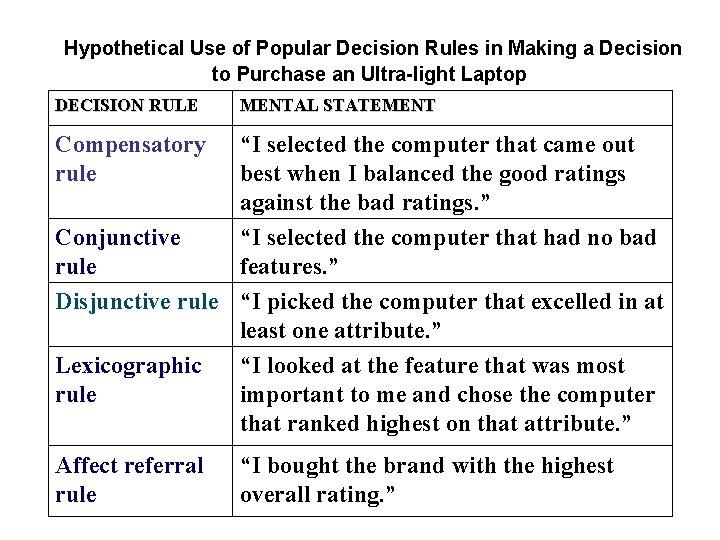
Hypothetical Use of Popular Decision Rules in Making a Decision to Purchase an Ultra-light Laptop DECISION RULE MENTAL STATEMENT Compensatory rule “I selected the computer that came out best when I balanced the good ratings against the bad ratings. ” Conjunctive “I selected the computer that had no bad rule features. ” Disjunctive rule “I picked the computer that excelled in at least one attribute. ” Lexicographic “I looked at the feature that was most rule important to me and chose the computer that ranked highest on that attribute. ” Affect referral rule “I bought the brand with the highest overall rating. ”
- Slides: 39