
Chapter 9 Imperfect Competition Imperfectly competitive firms have
- Slides: 22
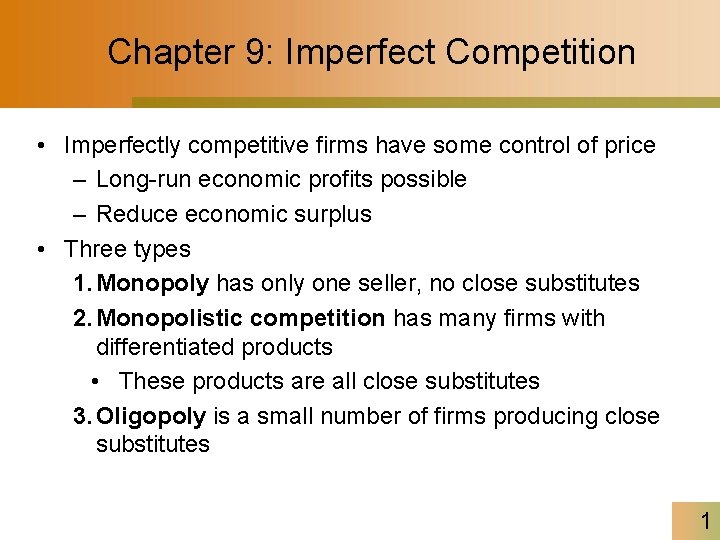
Chapter 9: Imperfect Competition • Imperfectly competitive firms have some control of price – Long-run economic profits possible – Reduce economic surplus • Three types 1. Monopoly has only one seller, no close substitutes 2. Monopolistic competition has many firms with differentiated products • These products are all close substitutes 3. Oligopoly is a small number of firms producing close substitutes 1
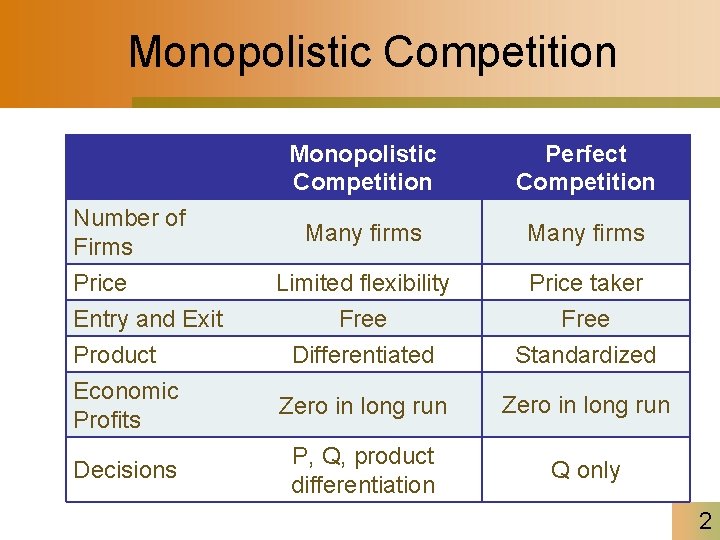
Monopolistic Competition Number of Firms Price Entry and Exit Product Economic Profits Decisions Monopolistic Competition Perfect Competition Many firms Limited flexibility Free Differentiated Price taker Free Standardized Zero in long run P, Q, product differentiation Q only 2
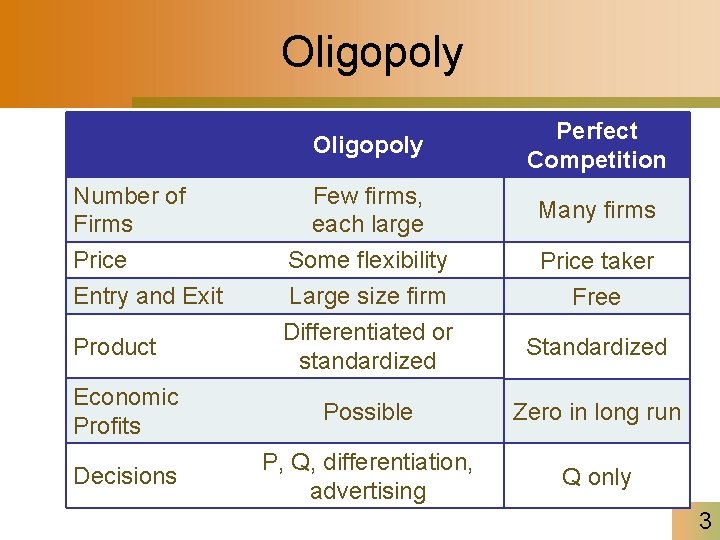
Oligopoly Perfect Competition Few firms, each large Many firms Price Some flexibility Price taker Entry and Exit Large size firm Differentiated or standardized Free Number of Firms Product Standardized Economic Profits Possible Zero in long run Decisions P, Q, differentiation, advertising Q only 3
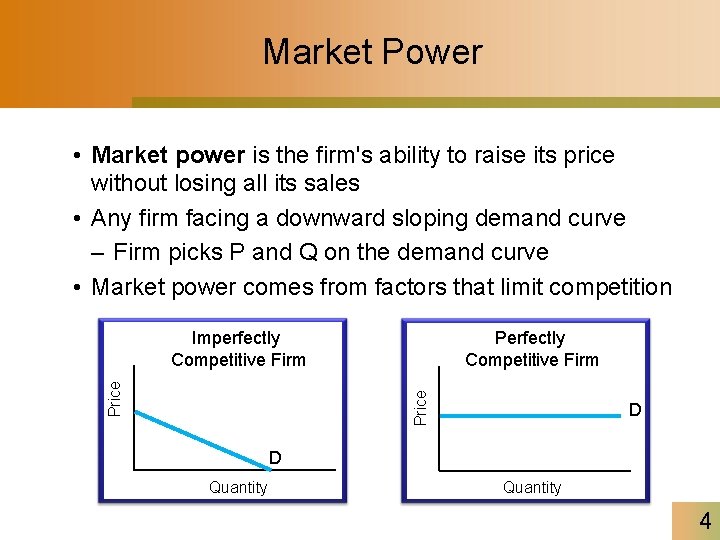
Market Power • Market power is the firm's ability to raise its price without losing all its sales • Any firm facing a downward sloping demand curve – Firm picks P and Q on the demand curve • Market power comes from factors that limit competition Perfectly Competitive Firm Price Imperfectly Competitive Firm D D Quantity 4
Five Sources of Market Power 1. Exclusive control over inputs 2. Patents and copyrights 3. Government licenses or franchises 4. Economies of scale (natural monopolies) 5. Network economies 5
Economies of Scale • Returns to scale refers to the percentage change in output from a given percentage change in ALL inputs – Long-run idea – Constant returns to scale: doubling all inputs doubles output – Increasing returns to scale: output increases by a greater percentage than the increase in inputs • Average costs decrease as output increases • Natural monopoly: a monopoly that results from economies of scale 6
Network Economies • Network economies occur when the value of the product increases as the number of users increases – VHS format for video tapes, Blu-ray for DVDs – Telephones – Windows operating system – e. Bay – Facebook and My. Space 7
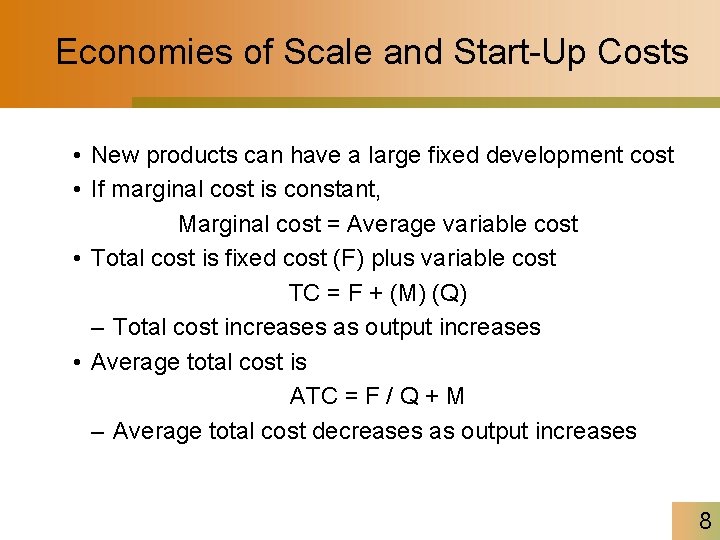
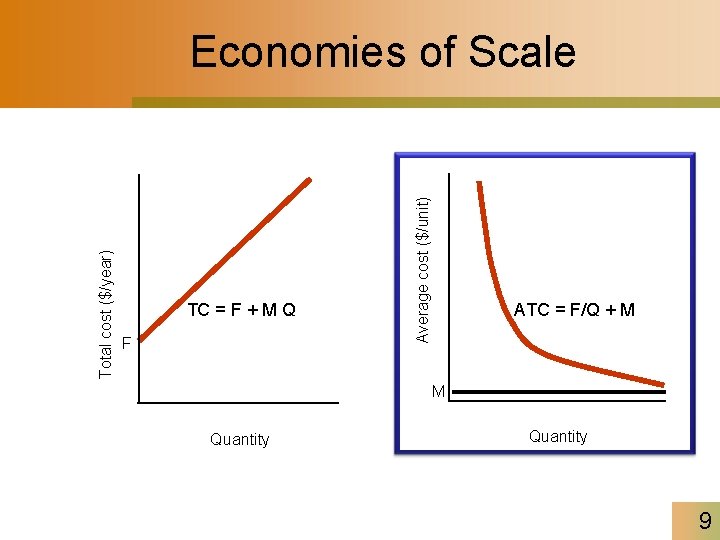
Economies of Scale and Start-Up Costs • New products can have a large fixed development cost • If marginal cost is constant, Marginal cost = Average variable cost • Total cost is fixed cost (F) plus variable cost TC = F + (M) (Q) – Total cost increases as output increases • Average total cost is ATC = F / Q + M – Average total cost decreases as output increases 8
TC = F + M Q F Average cost ($/unit) Total cost ($/year) Economies of Scale ATC = F/Q + M M Quantity 9
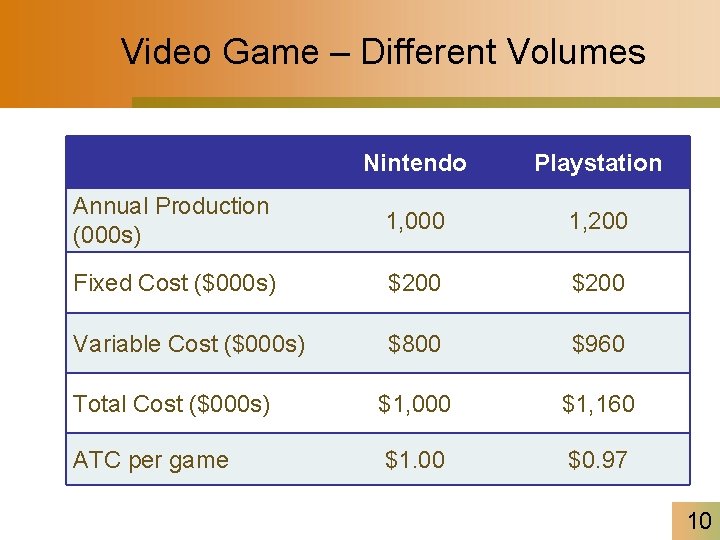
Video Game – Different Volumes Nintendo Playstation Annual Production (000 s) 1, 000 1, 200 Fixed Cost ($000 s) $200 Variable Cost ($000 s) $800 $960 Total Cost ($000 s) $1, 000 $1, 160 ATC per game $1. 00 $0. 97 10
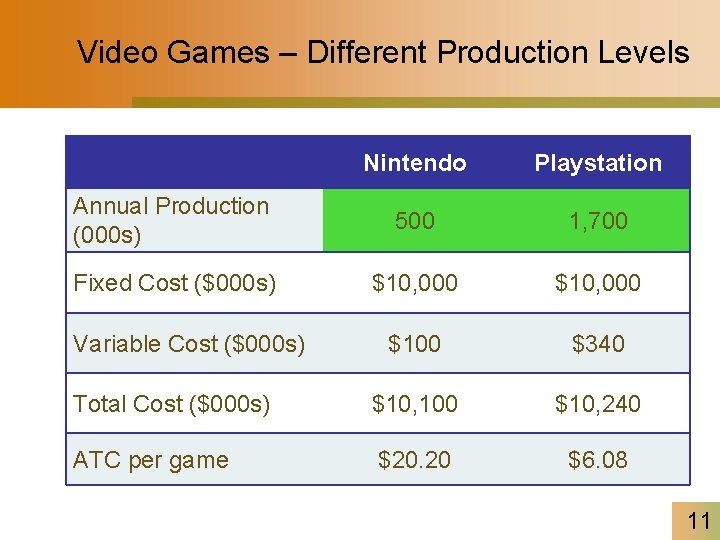
Video Games – Different Production Levels Nintendo Playstation Annual Production (000 s) 500 1, 700 Fixed Cost ($000 s) $10, 000 $100 $340 Total Cost ($000 s) $10, 100 $10, 240 ATC per game $20. 20 $6. 08 Variable Cost ($000 s) 11
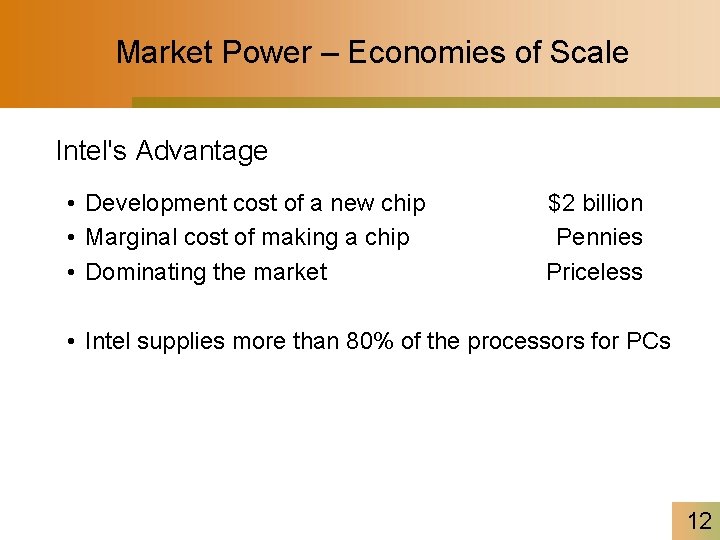
Market Power – Economies of Scale Intel's Advantage • Development cost of a new chip • Marginal cost of making a chip • Dominating the market $2 billion Pennies Priceless • Intel supplies more than 80% of the processors for PCs 12
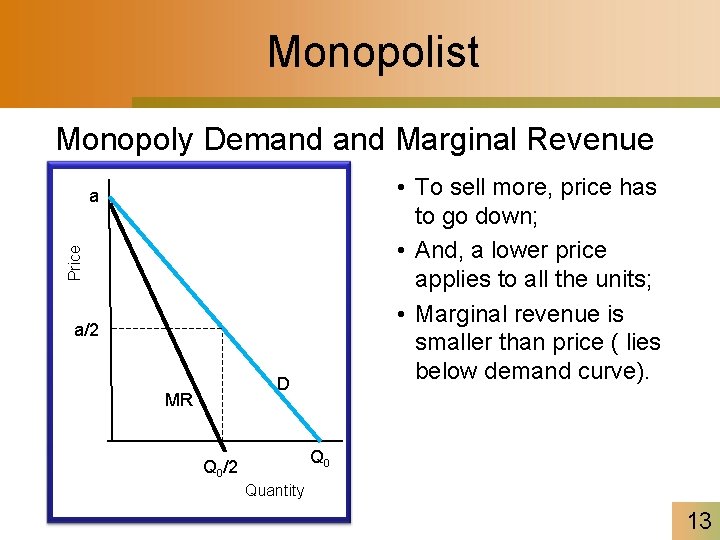
Monopolist Monopoly Demand Marginal Revenue • To sell more, price has to go down; • And, a lower price applies to all the units; • Marginal revenue is smaller than price ( lies below demand curve). Price a a/2 D MR Q 0/2 Quantity 13
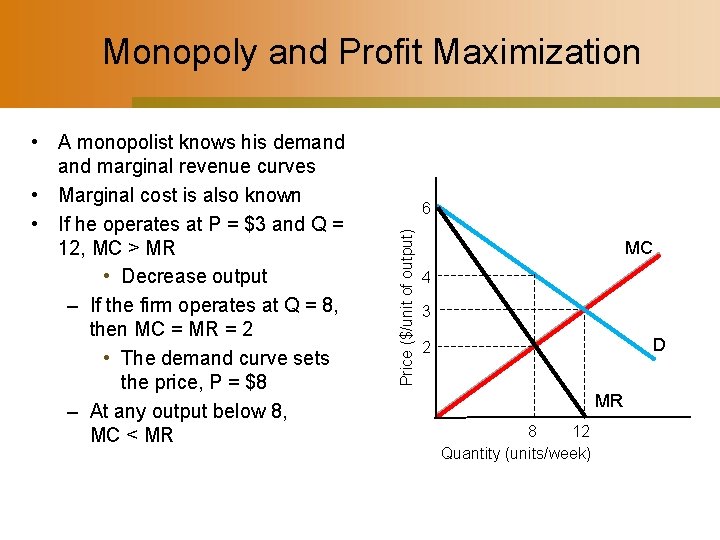
Monopoly and Profit Maximization 6 Price ($/unit of output) • A monopolist knows his demand marginal revenue curves • Marginal cost is also known • If he operates at P = $3 and Q = 12, MC > MR • Decrease output – If the firm operates at Q = 8, then MC = MR = 2 • The demand curve sets the price, P = $8 – At any output below 8, MC < MR MC 4 3 D 2 MR 12 8 Quantity (units/week)
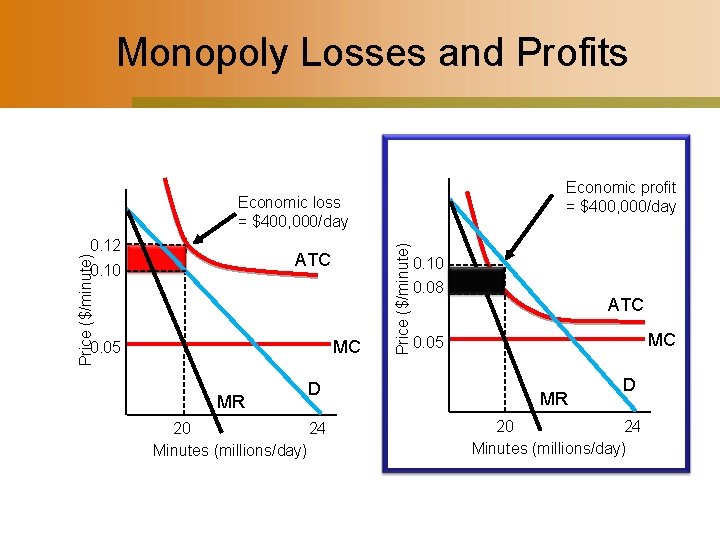
Monopoly Losses and Profits Economic profit = $400, 000/day 0. 12 Price ($/minute) ATC 0. 10 MC 0. 05 MR D 20 24 Minutes (millions/day) Price ($/minute) Economic loss = $400, 000/day 0. 10 0. 08 ATC MC 0. 05 MR D 20 24 Minutes (millions/day)
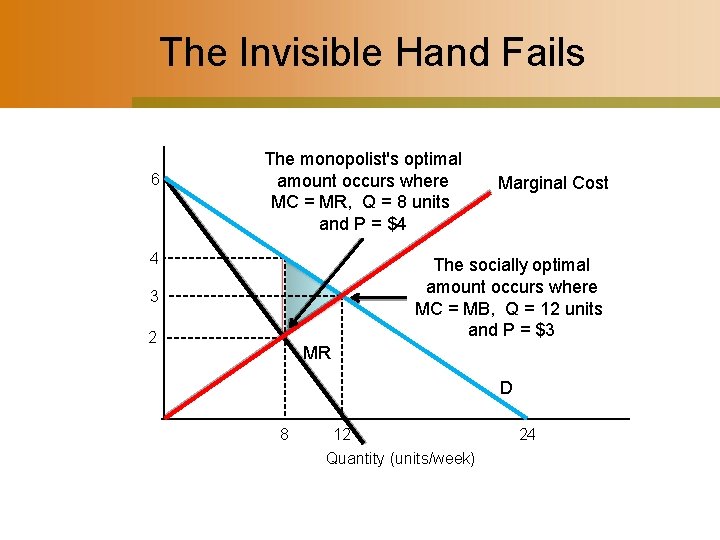
The Invisible Hand Fails 6 The monopolist's optimal amount occurs where MC = MR, Q = 8 units and P = $4 4 Marginal Cost The socially optimal amount occurs where MC = MB, Q = 12 units and P = $3 3 2 MR D 8 12 Quantity (units/week) 24
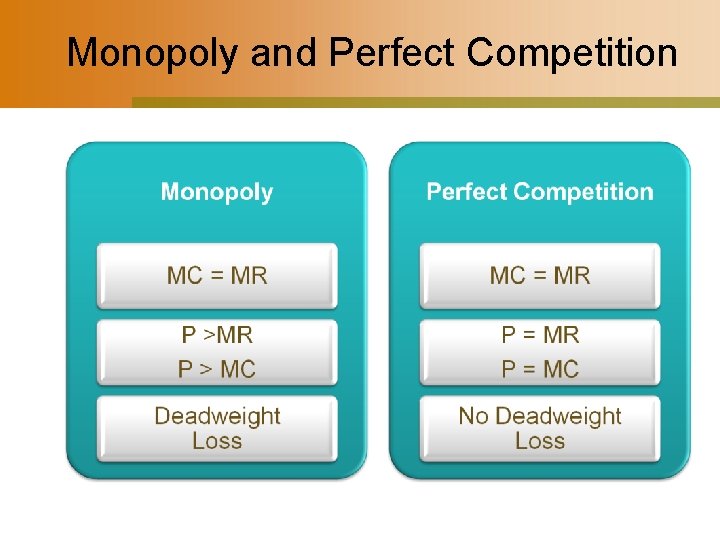
Monopoly and Perfect Competition
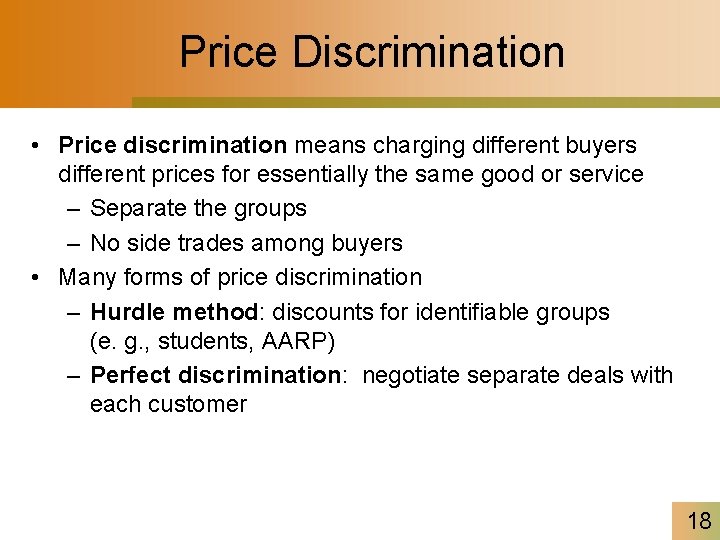
Price Discrimination • Price discrimination means charging different buyers different prices for essentially the same good or service – Separate the groups – No side trades among buyers • Many forms of price discrimination – Hurdle method: discounts for identifiable groups (e. g. , students, AARP) – Perfect discrimination: negotiate separate deals with each customer 18
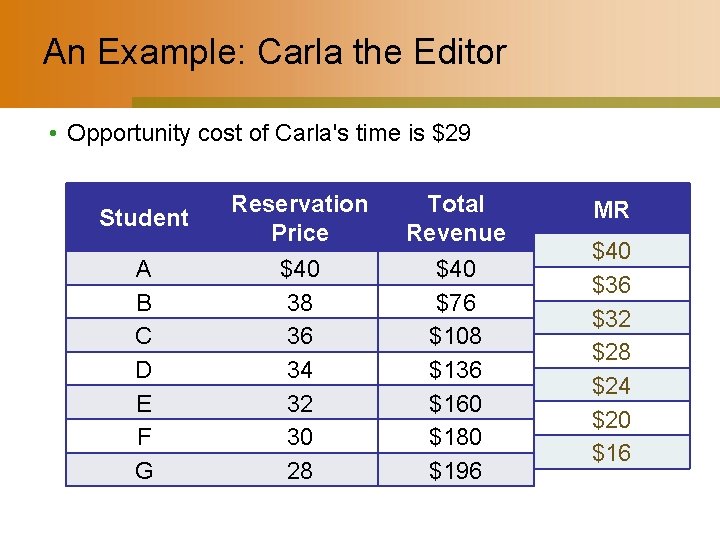
An Example: Carla the Editor • Opportunity cost of Carla's time is $29 Student A B C D E F G Reservation Price Total Revenue $40 38 36 34 32 30 28 $40 $76 $108 $136 $160 $180 $196 MR $40 $36 $32 $28 $24 $20 $16
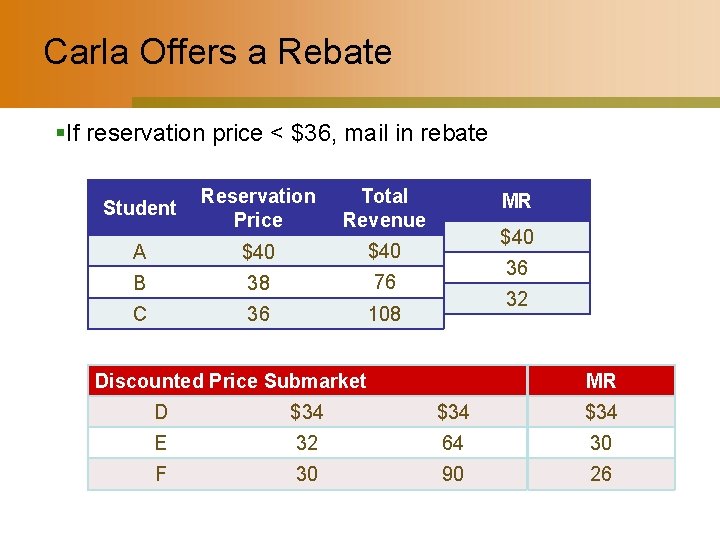
Carla Offers a Rebate §If reservation price < $36, mail in rebate Reservation Price Total Revenue A $40 B 38 76 C 36 108 Student MR $40 36 32 Discounted Price Submarket MR D $34 $34 E 32 64 30 F 30 90 26
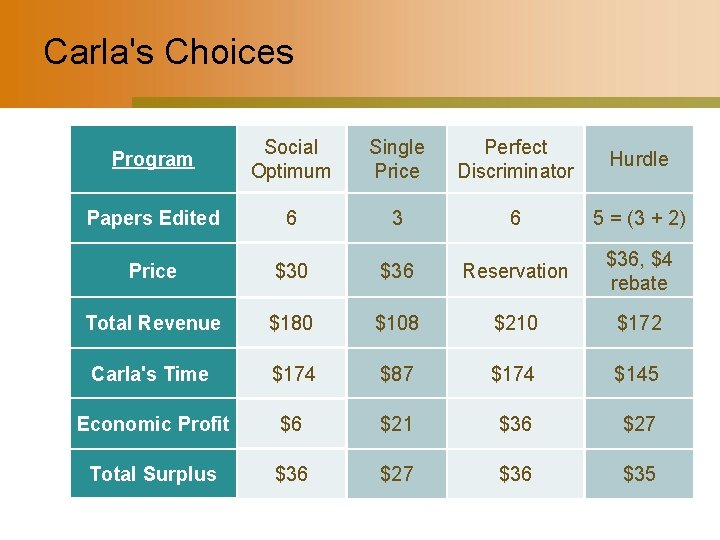
Carla's Choices Program Social Optimum Single Price Perfect Discriminator Hurdle Papers Edited 6 3 6 5 = (3 + 2) Price $30 $36 Reservation $36, $4 rebate Total Revenue $180 $108 $210 $172 Carla's Time $174 $87 $174 $145 Economic Profit $6 $21 $36 $27 Total Surplus $36 $27 $36 $35
Hurdle Method of Price Discrimination • The hurdle method of price discrimination is the practice of offering a discount to all buyers who overcome some obstacle. – Temporary Sales – Hard cover and paperback books – Multiple car models from one manufacturer – Commercial air carriers – Movie producers and phased releases – Scratch and Dent appliance sales