
CHAPTER 9 Ignition Systems Learning Objectives Describe the
CHAPTER 9 Ignition Systems
Learning Objectives • Describe the primary purpose of the ignition system. • Identify the components in a typical magneto system and describe the function of each part. • Identify the three general classifications of magneto ignition systems and explain the operation of each. • Describe the operation of a battery ignition system. © Goodheart-Willcox Co. , Inc. Permission granted to reproduce for educational use only.
Ignition Systems • Provide voltage to discharge spark – Jumps spark plug gap – Ignites compressed air-fuel mixture – 30, 000 volts • Magneto systems – No outside primary source of electricity © Goodheart-Willcox Co. , Inc. Permission granted to reproduce for educational use only.
Magneto System • Components – Magnets – Spark plug wire – Ignition coil – Switching device © Goodheart-Willcox Co. , Inc. Permission granted to reproduce for educational use only.
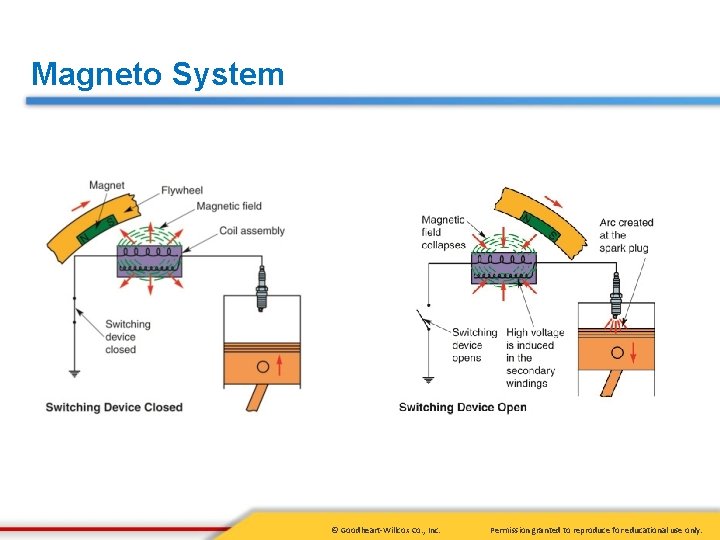
Magneto System © Goodheart-Willcox Co. , Inc. Permission granted to reproduce for educational use only.
Ignition Coil • Operates like transformer • Two separate windings – Primary windings have relatively few turns – Secondary windings have many turns – High voltage produced in secondary windings – Secondary voltage causes spark © Goodheart-Willcox Co. , Inc. Permission granted to reproduce for educational use only.
Spark Plug • • • Inserted into combustion chamber Ignites compressed air-fuel mixture Many variations Ribs on insulator prevent flashover Center electrode carries high voltage to the spark plug gap • Spark plug reach varies from one type of plug to another © Goodheart-Willcox Co. , Inc. Permission granted to reproduce for educational use only.
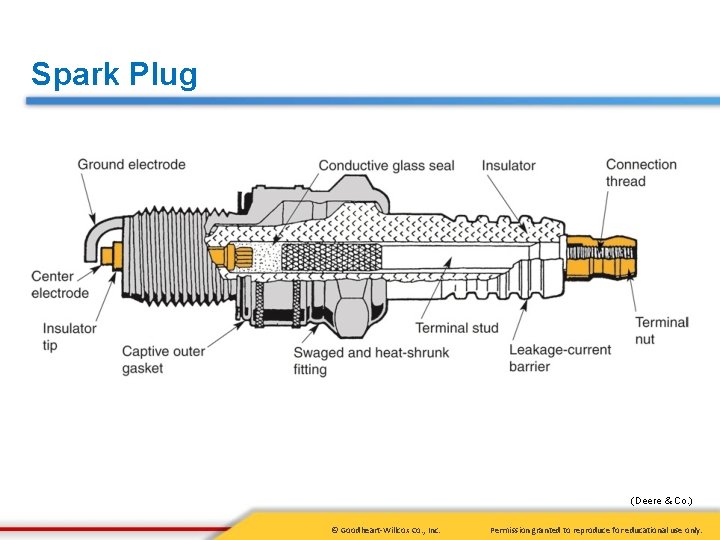
Spark Plug (Deere & Co. ) © Goodheart-Willcox Co. , Inc. Permission granted to reproduce for educational use only.

Spark Plug Heat Transfer • Spark plugs manufactured in various heat ranges – Cold plugs transfer heat readily – Length of insulator nose determines how well heat travels – Insulator nose tip hottest part of plug • Can cause preignition or plug fouling © Goodheart-Willcox Co. , Inc. Permission granted to reproduce for educational use only.
Spark Plug Wire • Connects ignition coil output to spark plug • Heavily insulated – Deteriorated insulation leads to arcing • Spark plug connections – Exposed clip – Boot type © Goodheart-Willcox Co. , Inc. Permission granted to reproduce for educational use only.
Switching Devices • Control primary current to coil – Mechanical or electronic • Mechanical breaker points – Tungsten contacts • Electronic switching devices – No moving parts to burn or wear out © Goodheart-Willcox Co. , Inc. Permission granted to reproduce for educational use only.
Magneto Ignition System • Classified by type of switching device – Capacitor discharge ignition – Transistor-controlled ignition – Mechanical breaker point ignition • Mechanical or solid state – Solid state used in all late-model engines © Goodheart-Willcox Co. , Inc. Permission granted to reproduce for educational use only.
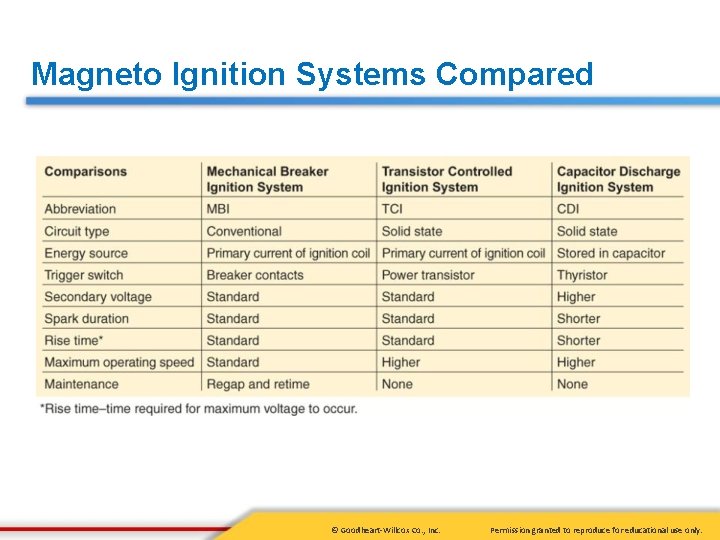
Magneto Ignition Systems Compared © Goodheart-Willcox Co. , Inc. Permission granted to reproduce for educational use only.
Advantage of Solid State Ignition • • • Adjustments not required Increased plug live Easy starting Uniform performance Improved idling and smoother operation under load © Goodheart-Willcox Co. , Inc. Permission granted to reproduce for educational use only.
Capacitive Discharge Ignition (CDI) • Stores primary energy in capacitor • Uses semiconductors for triggering system and timing • Compact and maintenance free – Flywheel magnets only moving parts © Goodheart-Willcox Co. , Inc. Permission granted to reproduce for educational use only.
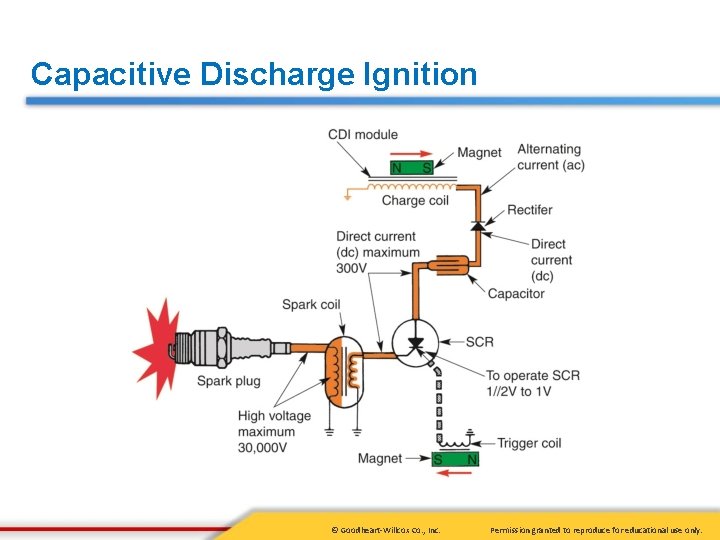
Capacitive Discharge Ignition © Goodheart-Willcox Co. , Inc. Permission granted to reproduce for educational use only.
Transistor-Controlled Ignition System • Inductive system • Transistors used for triggering • Many variations – Unique characteristics © Goodheart-Willcox Co. , Inc. Permission granted to reproduce for educational use only.
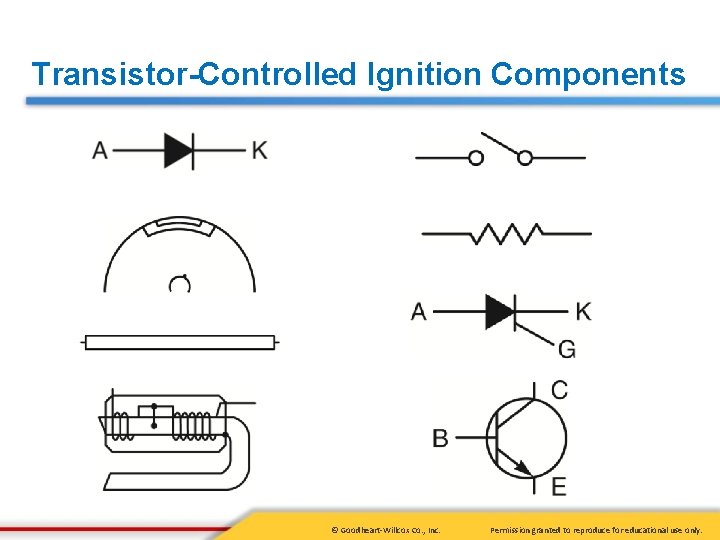
Transistor-Controlled Ignition Components © Goodheart-Willcox Co. , Inc. Permission granted to reproduce for educational use only.
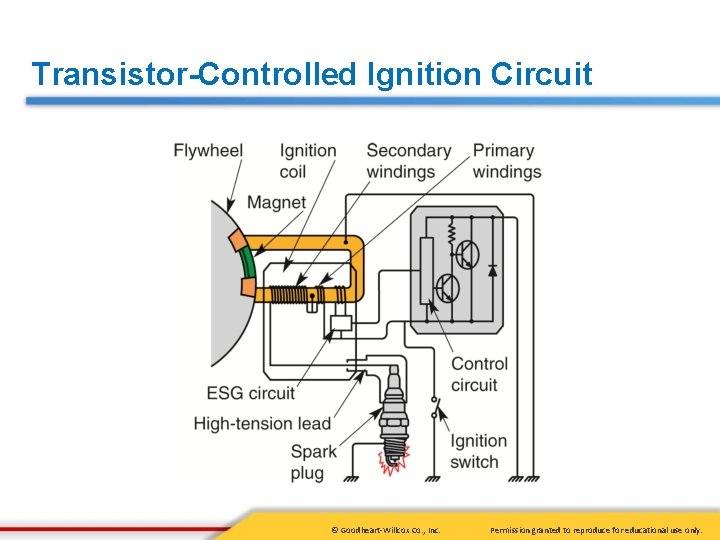
Transistor-Controlled Ignition Circuit © Goodheart-Willcox Co. , Inc. Permission granted to reproduce for educational use only.
Mechanical Breaker Point Ignition System • Components – Coil – Condenser • Prevents arcing – Breaker points • Mechanically actuated – Flywheel Magnets • Alnico © Goodheart-Willcox Co. , Inc. Permission granted to reproduce for educational use only.
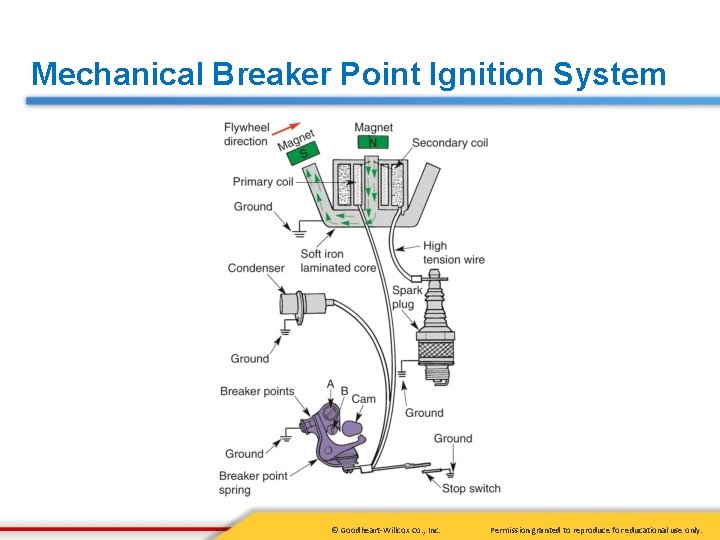
Mechanical Breaker Point Ignition System © Goodheart-Willcox Co. , Inc. Permission granted to reproduce for educational use only.
Dwell (Cam Angle) • Time breaker points stay closed during one revolution of cam • Measured in degrees of cam rotation from point closing to point opening • Inverse relationship between point gap and dwell – Large point produces short dwell – Small point opening produces larger dwell • Changing point setting can change spark timing © Goodheart-Willcox Co. , Inc. Permission granted to reproduce for educational use only.
Ignition Advance Systems • Some engines with MBI systems have mechanical ignition advance systems – Retard occurrence of spark for timing – Cause spark to occur earlier in cycle for intermediate and high-speed operation © Goodheart-Willcox Co. , Inc. Permission granted to reproduce for educational use only.
Magneto Ignition System for Two-Cylinder Engines • Two coil assemblies located 180 degrees apart – As flywheel passes one of the coils, corresponding spark plug fires • Waste spark system – Single coil assembly with two secondary outputs – Both plugs fire at same time – One piston on compression stroke and other on exhaust stroke © Goodheart-Willcox Co. , Inc. Permission granted to reproduce for educational use only.
Battery Ignition System • Major Components – Coil – Switching device – Spark plug – Battery • Lead-acid battery is the source of primary current © Goodheart-Willcox Co. , Inc. Permission granted to reproduce for educational use only.
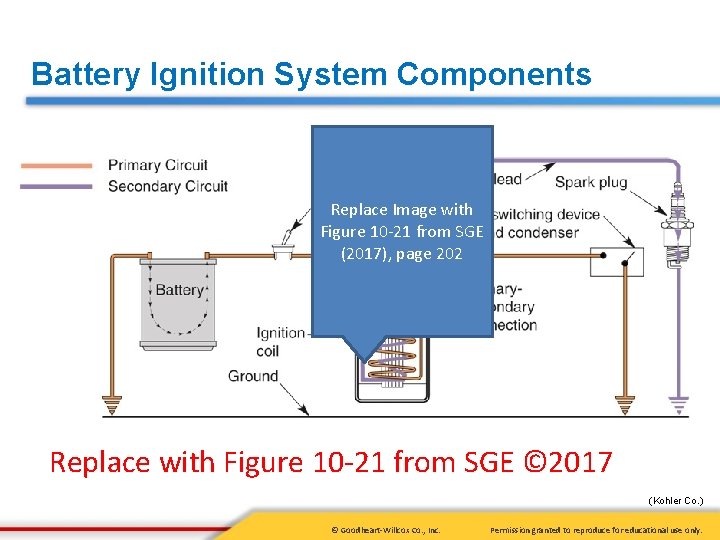
Battery Ignition System Components Replace Image with Figure 10 -21 from SGE (2017), page 202 Replace with Figure 10 -21 from SGE © 2017 (Kohler Co. ) © Goodheart-Willcox Co. , Inc. Permission granted to reproduce for educational use only.
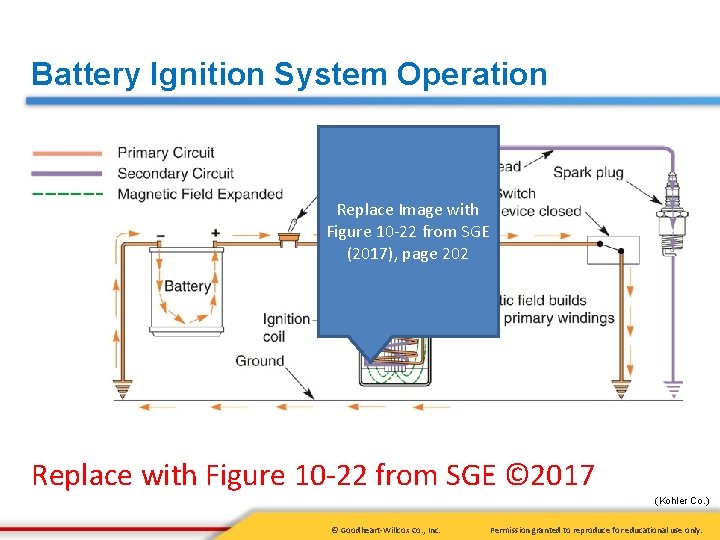
Battery Ignition System Operation Replace Image with Figure 10 -22 from SGE (2017), page 202 Replace with Figure 10 -22 from SGE © 2017 (Kohler Co. ) © Goodheart-Willcox Co. , Inc. Permission granted to reproduce for educational use only.
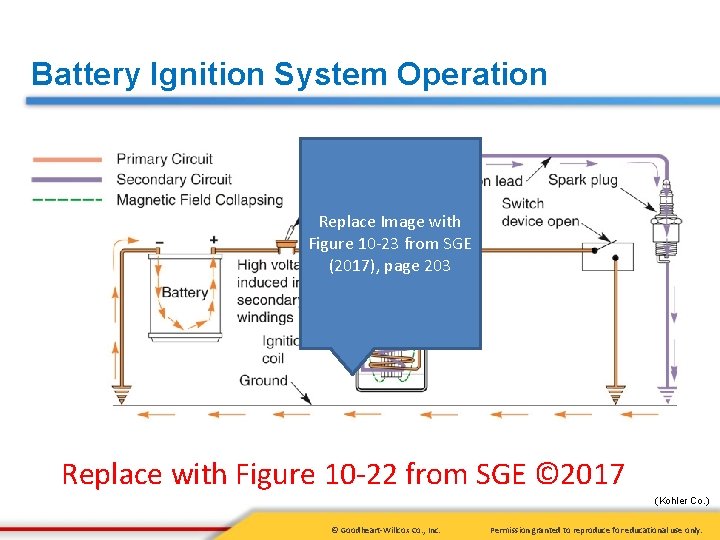
Battery Ignition System Operation Replace Image with Figure 10 -23 from SGE (2017), page 203 Replace with Figure 10 -22 from SGE © 2017 (Kohler Co. ) © Goodheart-Willcox Co. , Inc. Permission granted to reproduce for educational use only.
Ignition Coil • Serves as step-up transformer • Increases low primary voltage into high voltage • Primary winding consists of approximately 200 turns of heavy wire • Secondary winding has 20, 000 turns of fine wire © Goodheart-Willcox Co. , Inc. Permission granted to reproduce for educational use only.
Lead-Acid Battery • Sole source of energy in battery ignition system – Wet-charged batteries supplied with electrolyte in them – Dry-charged batteries must have electrolyte installed after purchase • Generator replenishes energy in battery © Goodheart-Willcox Co. , Inc. Permission granted to reproduce for educational use only.
Battery Construction • Hard rubber case • Six cells – Cells contain specific number of positive and negative plates – Positive plates have lead oxide covering – Negative plates have porous surface • The more plates per cell, the higher the amperehour rating of the battery © Goodheart-Willcox Co. , Inc. Permission granted to reproduce for educational use only.
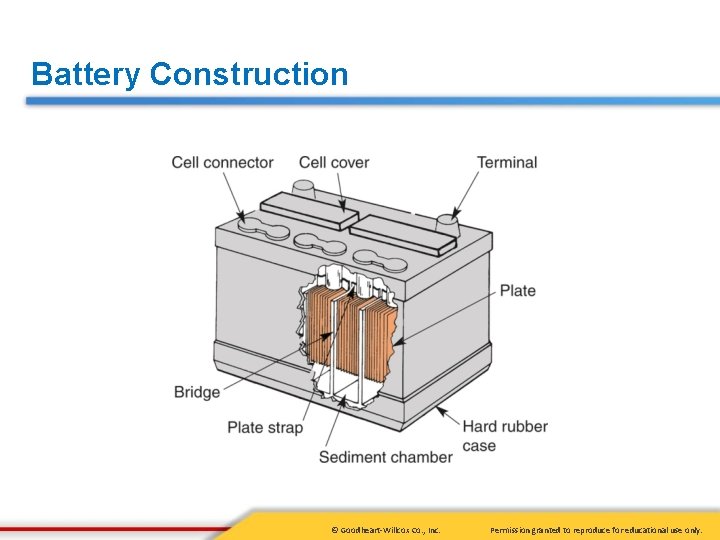
Battery Construction © Goodheart-Willcox Co. , Inc. Permission granted to reproduce for educational use only.
Battery Discharging/Charging Cycle • Discharging – Chemical reaction between plates and electrolyte – Battery attempts to equalize potential difference between plates • Charging – Direct current passes through battery in reverse direction – Current causes a reversal in chemical reaction and restores plates and electrolyte © Goodheart-Willcox Co. , Inc. Permission granted to reproduce for educational use only.
- Slides: 34