
Chapter 9 Identification Assessment and Evaluation The Law
![Assessment • “It is difficult to overstate the importance of a full [assessment] of](https://slidetodoc.com/presentation_image_h/c288eb6917dd3ce0408df60bb3e18728/image-3.jpg "Assessment • “It is difficult to overstate the importance of a full [assessment] of")
- Slides: 16
Chapter 9 Identification, Assessment, and Evaluation The Law and Special Education, 3 rd Edition © 2012 Pearson Education, Inc. All rights reserved.
Protection in Evaluation LEAs shall conduct a full and individual evaluation before the initial provision of special education and related services to a child with a disability (IDEA, 20 U. S. C. 1414(a)(1)) In addition to determining eligibility, the evaluation must also be used to determine the student’s educational needs The Law and Special Education, 3 rd Edition Mitchell L. Yell 2 © 2012 Pearson Education, Inc. All Rights Reserved.
Assessment • “It is difficult to overstate the importance of a full [assessment] of the child prior to the development of the IEP. An accurate evaluation of the child’s strengths, weaknesses, and current levels of performance is the basis of all that will follow” (Huefner, 2000, p. 156) The Law and Special Education, 3 rd Edition Mitchell L. Yell 3 © 2012 Pearson Education, Inc. All Rights Reserved.
Definition of Assessment n n Assessment is the process of collecting information for the purpose of making decisions about students (Salvia, Ysseldyke, & Bolt, 2006) Assessment decisions n n Prereferral decisions Entitlement decisions Programming decisions Accountability/outcome decisions The Law and Special Education, 3 rd Edition Mitchell L. Yell 4 © 2012 Pearson Education, Inc. All Rights Reserved.
Requesting an Assessment/Evaluation n IDEA 2004 includes language that allows either a parent, the SEA, another state agency, or school district personnel may initiate a request for an initial evaluation (IDEA, 1414 (a)(1)(B)) The IEP and other qualified professionals review existing data, determine if additional tests are required, interpret all evaluation data and determine eligibility based on the data. Assessment/evaluation data must lead to intervention The Law and Special Education, 3 rd Edition Mitchell L. Yell 5 © 2012 Pearson Education, Inc. All Rights Reserved.
The Assessment/Evaluation Process n n Procedural requirements Substantive requirements n n The assessment must consist of a full and individualized examination A team of knowledgeable persons must make decision about assessment Assessment information must lead to intervention The IEP team must collect meaningful data to monitor student progress The Law and Special Education, 3 rd Edition Mitchell L. Yell 6 © 2012 Pearson Education, Inc. All Rights Reserved.
Protection in Evaluation Procedures n n n n Child find Parental consent Prereferral evaluation Preplacement evaluation Comprehensiveness of the evaluation Qualifications of examiners Evaluation materials and procedures Reevaluation The Law and Special Education, 3 rd Edition Mitchell L. Yell 7 © 2012 Pearson Education, Inc. All Rights Reserved.
Triennial Reevaluation n Three-year reevaluation may be conducted to determine n n If the student is still eligible for services under IDEA Determine the student’s present levels of academic achievement and functional needs Whether any additions or modifications to the special education services in a student’s IEP are needed When a student’s academic and functional needs warrant it, a reevaluation should be performed more frequently than three years The Law and Special Education, 3 rd Edition Mitchell L. Yell 8 © 2012 Pearson Education, Inc. All Rights Reserved.
Reevaluation of Students Who Graduate n When a student in special education graduates with a diploma, or ages out of special education, although the school does not need to conduct a formal evaluation, it must provide a summary of the child’s academic achievement and functional performance, which shall include recommendations on how to assist the child in meeting his or her postsecondary goals The Law and Special Education, 3 rd Edition Mitchell L. Yell 9 © 2012 Pearson Education, Inc. All Rights Reserved.
Special Rules for Determining Eligibility in IDEA 2004 n A child will not be determined to be a child with a disability if the basis of the child’s problem is lack of scientifically based instruction in reading, lack of appropriate teaching in math, or LEP n Scientifically based reading instruction addresses the essential components of reading as listed by the National Reading Panel The Law and Special Education, 3 rd Edition Mitchell L. Yell 10 © 2012 Pearson Education, Inc. All Rights Reserved.
Nondiscriminatory Evaluation n Larry P. v. Riles, 1979 Parents in Action in Special Education v. Hannon, 1980 Crawford v. Honig, 1994 The Law and Special Education, 3 rd Edition Mitchell L. Yell 11 © 2012 Pearson Education, Inc. All Rights Reserved.
Interpreting Evaluation Data n When interpreting evaluation data, the MDT must: n n Draw on information from a variety of sources, including aptitude and achievement tests, teacher recommendations, physical condition, social or cultural background, and adaptive behavior Ensure that information is documented and carefully considered Ensure that decisions are made by a team, including a person knowledgeable about the student, the meaning of the evaluation data, and the placement options ensure that the placement decision is made in accordance with LRE requirements The Law and Special Education, 3 rd Edition Mitchell L. Yell 12 © 2012 Pearson Education, Inc. All Rights Reserved.
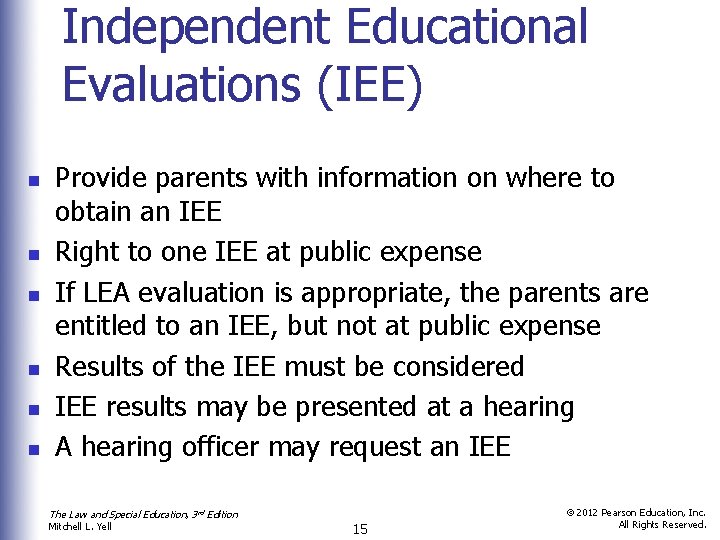
Independent Educational Evaluations n n n Schools must, on request, provide parents information on where to obtain an IEE If parents disagree with the school’s evaluation, they have the right to an IEE at public expense If school personnel believe their evaluation is appropriate, they may initiate a hearing. If a hearing officer finds the evaluation appropriate, parents are still entitled to IEE, but not at public expense The results of the IEE, even if paid for by the parents, must be considered in the special education decision-making process The results of the IEE, even if paid for by the parents, may be presented as evidence at a hearing A hearing officer may request an IEE as part of a due process hearing. This IEE must be performed at public expense The Law and Special Education, 3 rd Edition Mitchell L. Yell 13 © 2012 Pearson Education, Inc. All Rights Reserved.
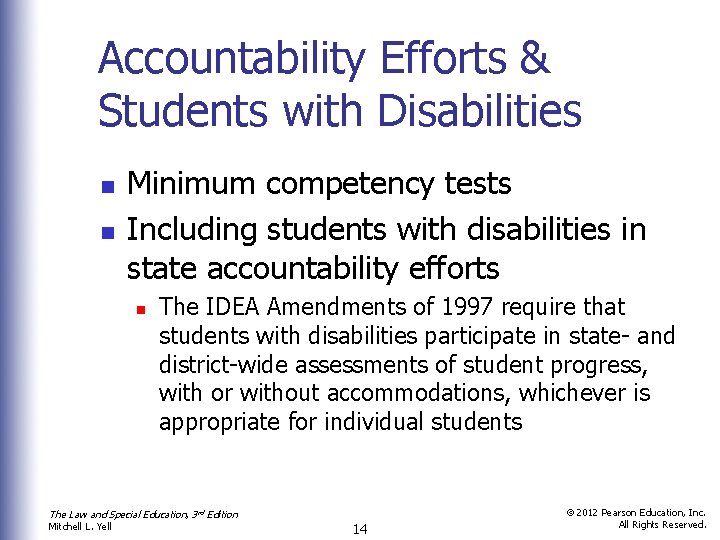
Accountability Efforts & Students with Disabilities n n Minimum competency tests Including students with disabilities in state accountability efforts n The IDEA Amendments of 1997 require that students with disabilities participate in state- and district-wide assessments of student progress, with or without accommodations, whichever is appropriate for individual students The Law and Special Education, 3 rd Edition Mitchell L. Yell 14 © 2012 Pearson Education, Inc. All Rights Reserved.
Independent Educational Evaluations (IEE) n n n Provide parents with information on where to obtain an IEE Right to one IEE at public expense If LEA evaluation is appropriate, the parents are entitled to an IEE, but not at public expense Results of the IEE must be considered IEE results may be presented at a hearing A hearing officer may request an IEE The Law and Special Education, 3 rd Edition Mitchell L. Yell 15 © 2012 Pearson Education, Inc. All Rights Reserved.
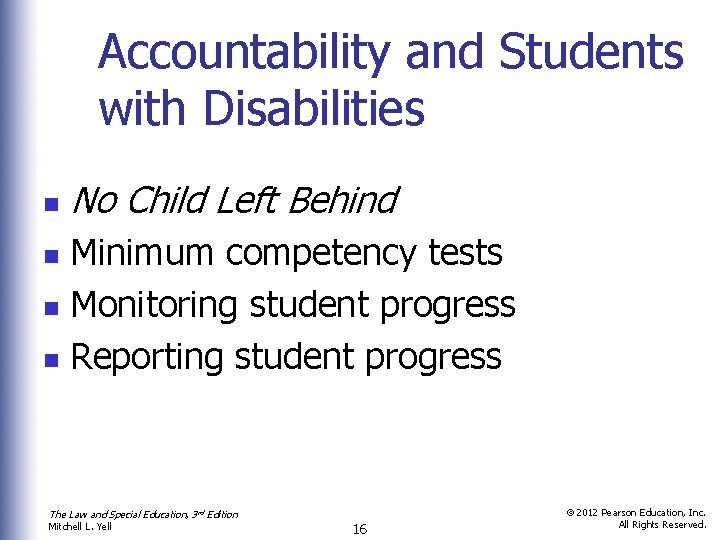
Accountability and Students with Disabilities n No Child Left Behind Minimum competency tests n Monitoring student progress n Reporting student progress n The Law and Special Education, 3 rd Edition Mitchell L. Yell 16 © 2012 Pearson Education, Inc. All Rights Reserved.