
CHAPTER 9 HYPOTHESIS TESTS ABOUT THE MEAN AND
CHAPTER 9 HYPOTHESIS TESTS ABOUT THE MEAN AND PROPORTION (One Population) Prem Mann, Introductory Statistics, 7/E Copyright © 2010 John Wiley & Sons. All right reserved
Two Hypotheses Definition A null hypothesis is a claim (or statement) about a population parameter that is assumed to be true until it is declared false. Prem Mann, Introductory Statistics, 7/E Copyright © 2010 John Wiley & Sons. All right reserved
Two Hypotheses Definition An alternative hypothesis is a claim about a population parameter that will be true if the null hypothesis is false. Alternative hypothesis is a hypothesis that a data analyst wants to support. Prem Mann, Introductory Statistics, 7/E Copyright © 2010 John Wiley & Sons. All right reserved
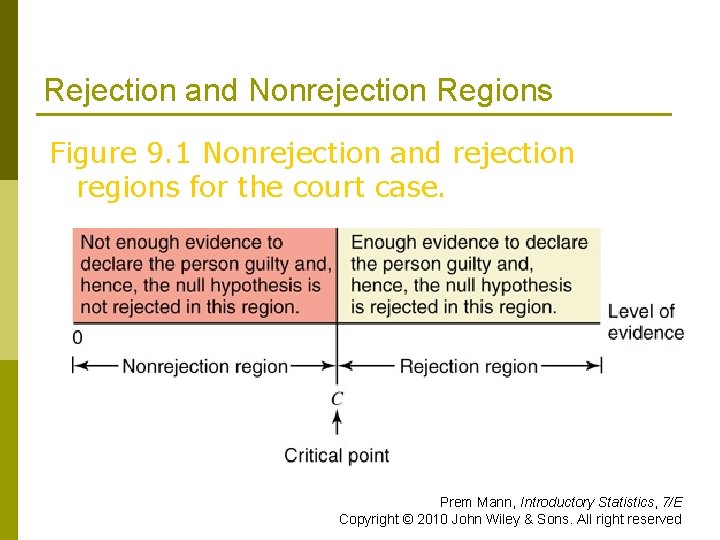
Rejection and Nonrejection Regions Figure 9. 1 Nonrejection and rejection regions for the court case. Prem Mann, Introductory Statistics, 7/E Copyright © 2010 John Wiley & Sons. All right reserved
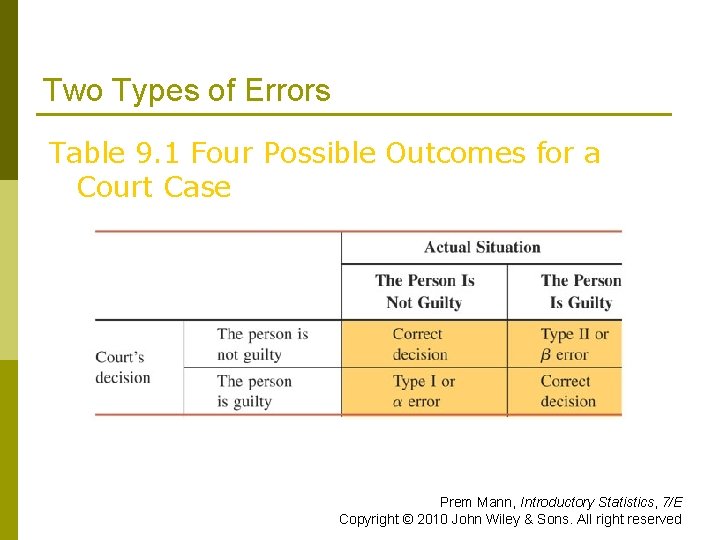
Two Types of Errors Table 9. 1 Four Possible Outcomes for a Court Case Prem Mann, Introductory Statistics, 7/E Copyright © 2010 John Wiley & Sons. All right reserved
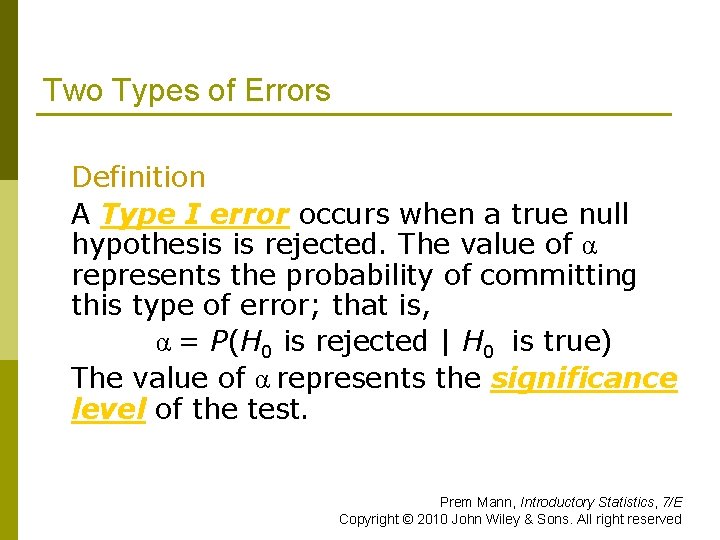
Two Types of Errors Definition A Type I error occurs when a true null hypothesis is rejected. The value of α represents the probability of committing this type of error; that is, α = P(H 0 is rejected | H 0 is true) The value of α represents the significance level of the test. Prem Mann, Introductory Statistics, 7/E Copyright © 2010 John Wiley & Sons. All right reserved
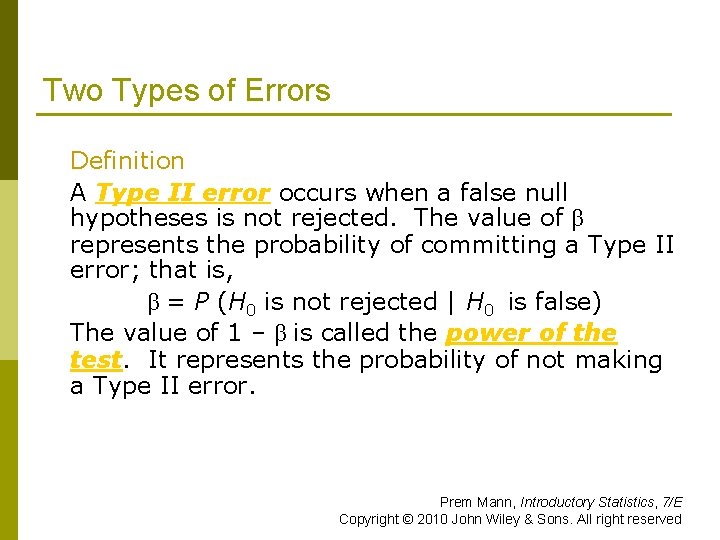
Two Types of Errors Definition A Type II error occurs when a false null hypotheses is not rejected. The value of β represents the probability of committing a Type II error; that is, β = P (H 0 is not rejected | H 0 is false) The value of 1 – β is called the power of the test. It represents the probability of not making a Type II error. Prem Mann, Introductory Statistics, 7/E Copyright © 2010 John Wiley & Sons. All right reserved
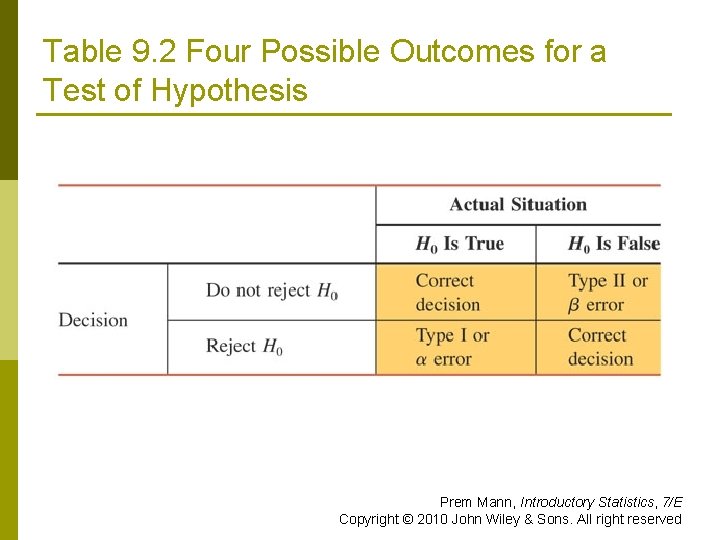
Table 9. 2 Four Possible Outcomes for a Test of Hypothesis Prem Mann, Introductory Statistics, 7/E Copyright © 2010 John Wiley & Sons. All right reserved
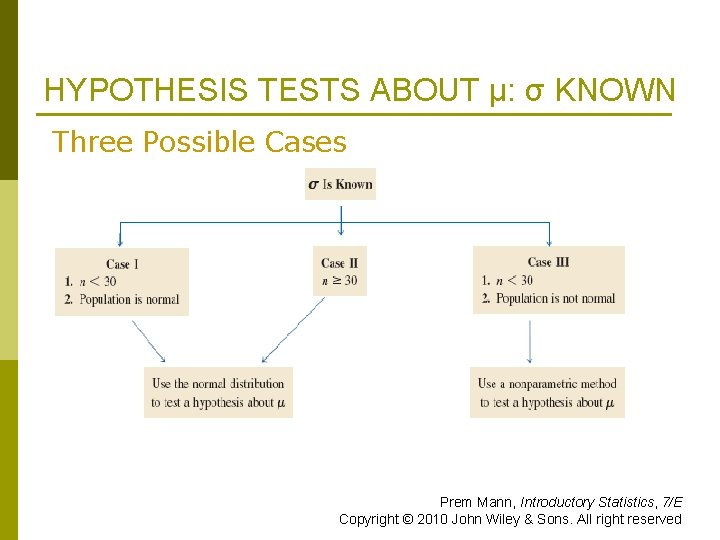
HYPOTHESIS TESTS ABOUT μ: σ KNOWN Three Possible Cases Prem Mann, Introductory Statistics, 7/E Copyright © 2010 John Wiley & Sons. All right reserved

A Two-Tailed H 1 p p According to a survey by Consumer Reports magazine conducted in 2008, a sample of sixth graders selected from New York schools showed that their backpacks weighed an average of 18. 4 pounds (USA TODAY, August 3, 2009). Another magazine wants to check whether or not this mean has changed since that survey. The key word here is changed. The mean weight of backpacks for sixth-graders in New York has changed if it has either increased or decreased since 2008. This is an example of a two tailed test. Prem Mann, Introductory Statistics, 7/E Copyright © 2010 John Wiley & Sons. All right reserved
A Two-Tailed H 1 p Let μ be the weight of backpacks for the current sixth-graders in New York. The two possible decisions are n n H 0 : μ = 18. 4 pounds (The mean weight of backpacks for sixth-graders in New York has not changed) H 1 : μ ≠ 18. 4 pounds (The mean weight of backpacks for sixth-graders in New York has changed) Prem Mann, Introductory Statistics, 7/E Copyright © 2010 John Wiley & Sons. All right reserved
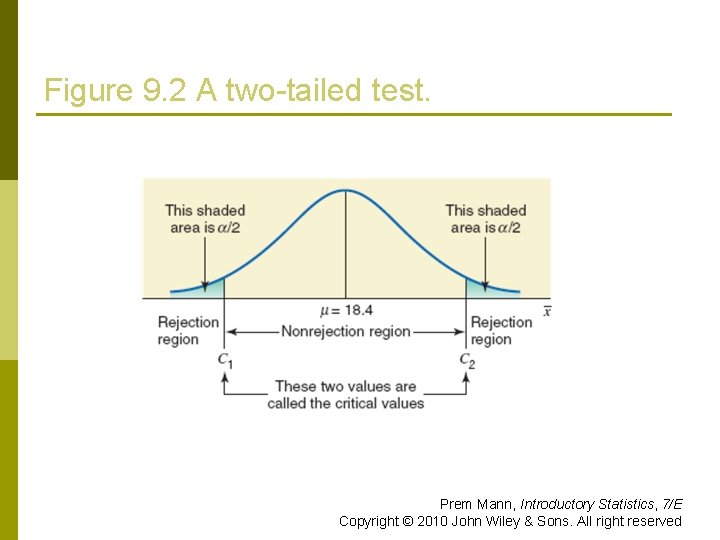
Figure 9. 2 A two-tailed test. Prem Mann, Introductory Statistics, 7/E Copyright © 2010 John Wiley & Sons. All right reserved
A Left-Tailed H 1 Reconsider the example of the mean amount of soda in all soft-drink cans produced by a company. The company claims that these cans, on average, contain 12 ounces of soda. However, if these cans contain less than the claimed amount of soda, then the company can be accused of cheating. Suppose a consumer agency wants to test whether the mean amount of soda per can is less than 12 ounces. Note that the key phrase this time is less than, which indicates a left-tailed test. Prem Mann, Introductory Statistics, 7/E Copyright © 2010 John Wiley & Sons. All right reserved
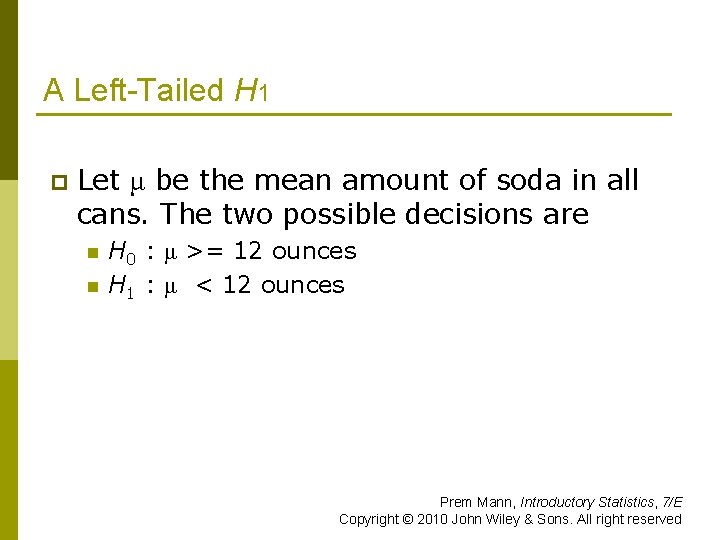
A Left-Tailed H 1 p Let μ be the mean amount of soda in all cans. The two possible decisions are n n H 0 : μ >= 12 ounces H 1 : μ < 12 ounces Prem Mann, Introductory Statistics, 7/E Copyright © 2010 John Wiley & Sons. All right reserved
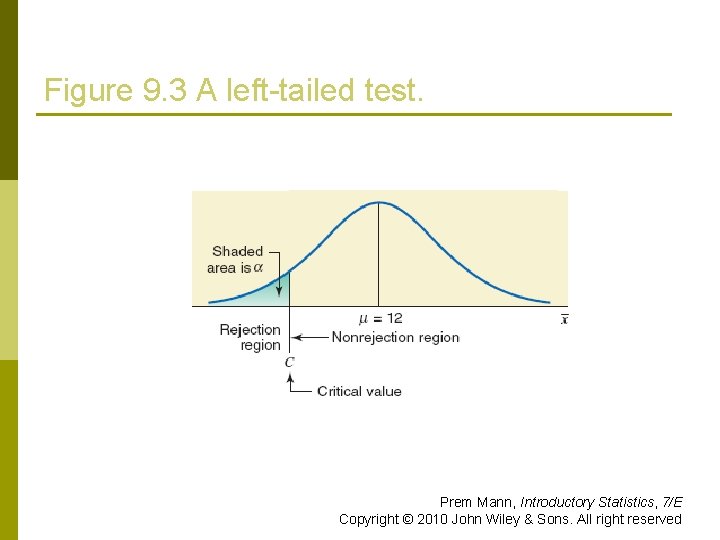
Figure 9. 3 A left-tailed test. Prem Mann, Introductory Statistics, 7/E Copyright © 2010 John Wiley & Sons. All right reserved

A Right-Tailed H 1 According to www. city-data. com, the average price of homes in West Orange, New Jersey, was $461, 216 in 2007. Suppose a real estate researcher wants to check whether the current mean price of homes in this town is higher than $461, 216. The key phrase in this case is higher than, which indicates a right-tailed test. Prem Mann, Introductory Statistics, 7/E Copyright © 2010 John Wiley & Sons. All right reserved
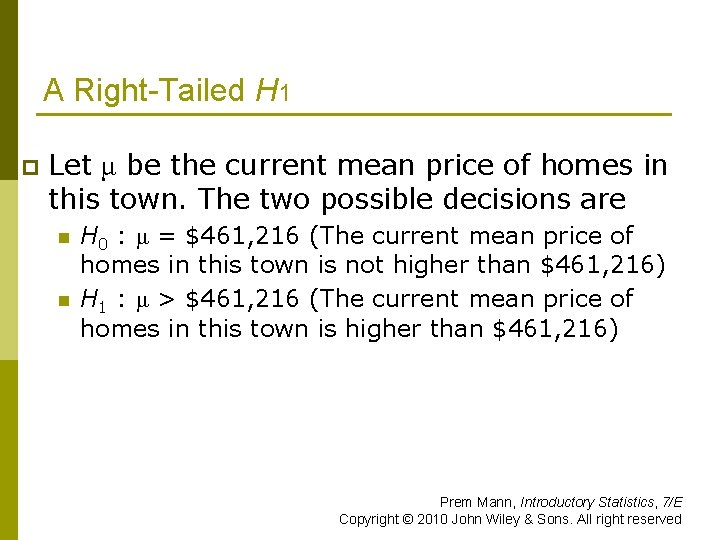
A Right-Tailed H 1 p Let μ be the current mean price of homes in this town. The two possible decisions are n n H 0 : μ = $461, 216 (The current mean price of homes in this town is not higher than $461, 216) H 1 : μ > $461, 216 (The current mean price of homes in this town is higher than $461, 216) Prem Mann, Introductory Statistics, 7/E Copyright © 2010 John Wiley & Sons. All right reserved
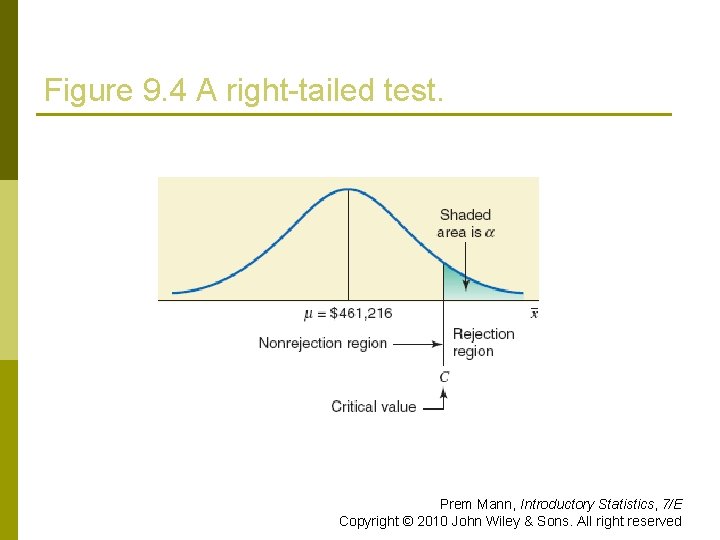
Figure 9. 4 A right-tailed test. Prem Mann, Introductory Statistics, 7/E Copyright © 2010 John Wiley & Sons. All right reserved
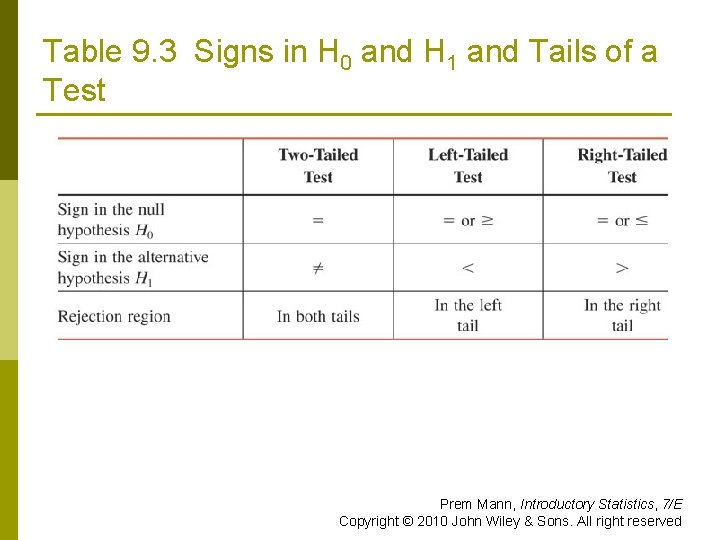
Table 9. 3 Signs in H 0 and H 1 and Tails of a Test Prem Mann, Introductory Statistics, 7/E Copyright © 2010 John Wiley & Sons. All right reserved
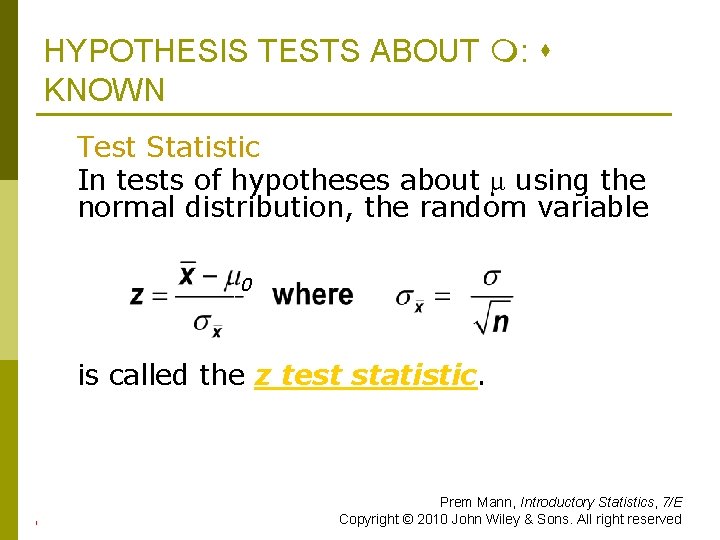
HYPOTHESIS TESTS ABOUT : KNOWN Test Statistic In tests of hypotheses about μ using the normal distribution, the random variable 0 is called the z test statistic. Prem Mann, Introductory Statistics, 7/E Copyright © 2010 John Wiley & Sons. All right reserved
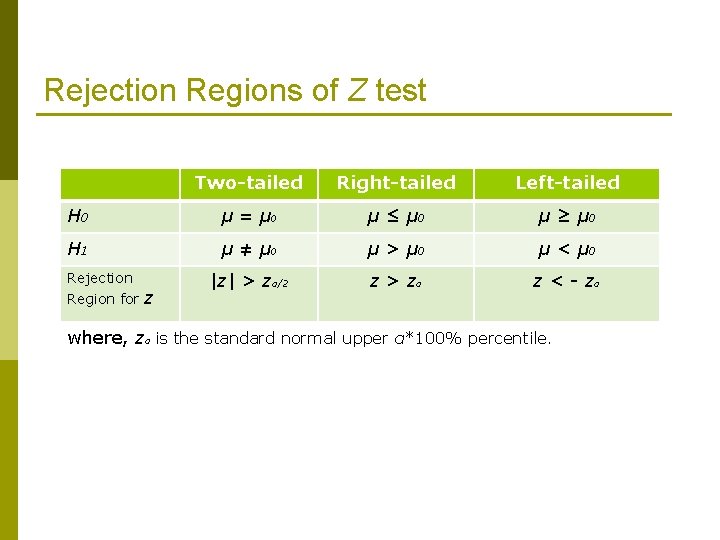
Rejection Regions of Z test Two-tailed Right-tailed Left-tailed H 0 µ = µ 0 µ ≤ µ 0 µ ≥ µ 0 H 1 µ ≠ µ 0 µ > µ 0 µ < µ 0 |z| > zα/2 z > zα z < - zα Rejection Region for z where, zα is the standard normal upper α*100% percentile.
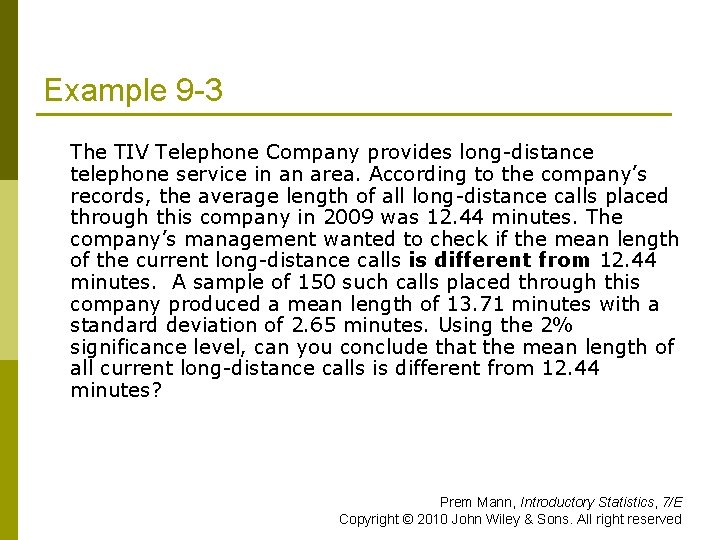
Example 9 -3 The TIV Telephone Company provides long-distance telephone service in an area. According to the company’s records, the average length of all long-distance calls placed through this company in 2009 was 12. 44 minutes. The company’s management wanted to check if the mean length of the current long-distance calls is different from 12. 44 minutes. A sample of 150 such calls placed through this company produced a mean length of 13. 71 minutes with a standard deviation of 2. 65 minutes. Using the 2% significance level, can you conclude that the mean length of all current long-distance calls is different from 12. 44 minutes? Prem Mann, Introductory Statistics, 7/E Copyright © 2010 John Wiley & Sons. All right reserved
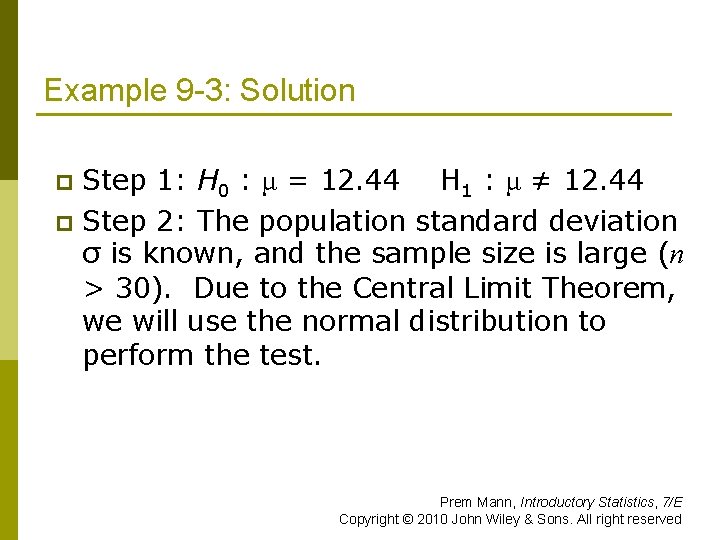
Example 9 -3: Solution Step 1: H 0 : μ = 12. 44 H 1 : μ ≠ 12. 44 p Step 2: The population standard deviation σ is known, and the sample size is large (n > 30). Due to the Central Limit Theorem, we will use the normal distribution to perform the test. p Prem Mann, Introductory Statistics, 7/E Copyright © 2010 John Wiley & Sons. All right reserved
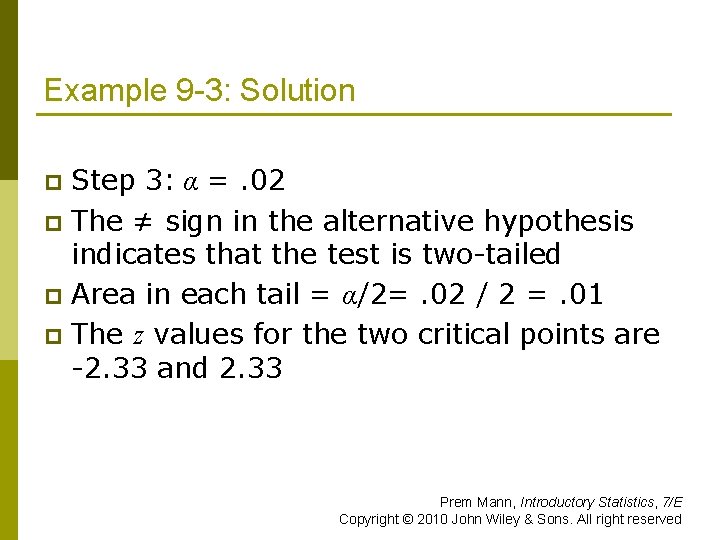
Example 9 -3: Solution Step 3: α =. 02 p The ≠ sign in the alternative hypothesis indicates that the test is two-tailed p Area in each tail = α/2=. 02 / 2 =. 01 p The z values for the two critical points are -2. 33 and 2. 33 p Prem Mann, Introductory Statistics, 7/E Copyright © 2010 John Wiley & Sons. All right reserved
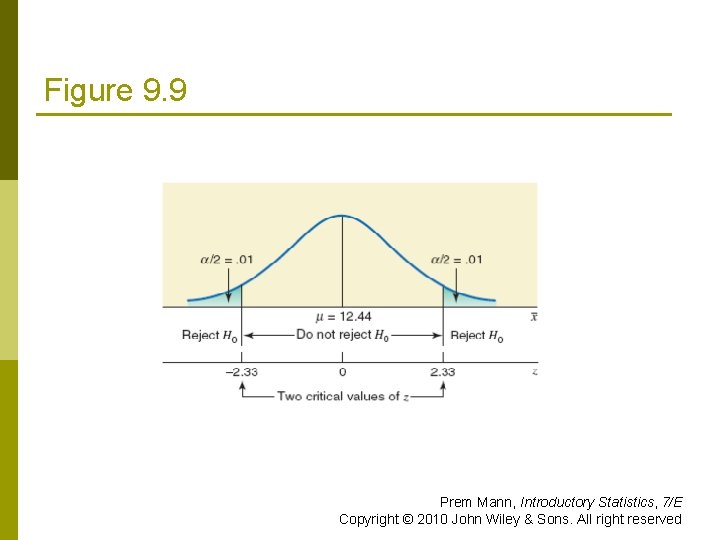
Figure 9. 9 Prem Mann, Introductory Statistics, 7/E Copyright © 2010 John Wiley & Sons. All right reserved
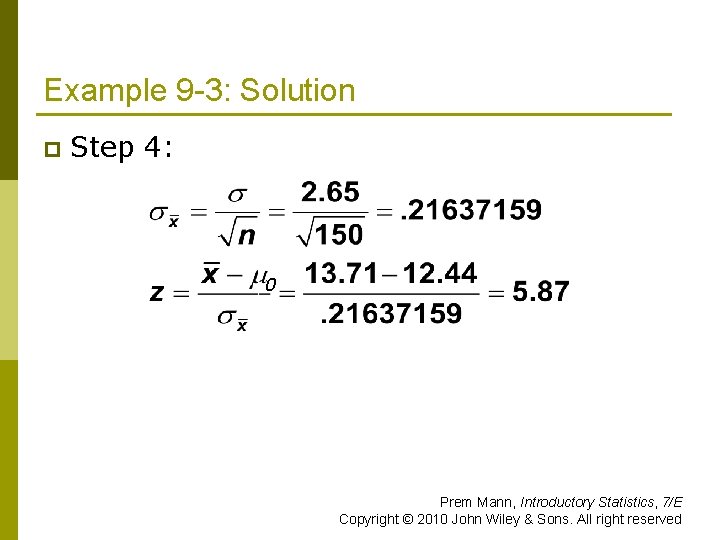
Example 9 -3: Solution p Step 4: 0 Prem Mann, Introductory Statistics, 7/E Copyright © 2010 John Wiley & Sons. All right reserved
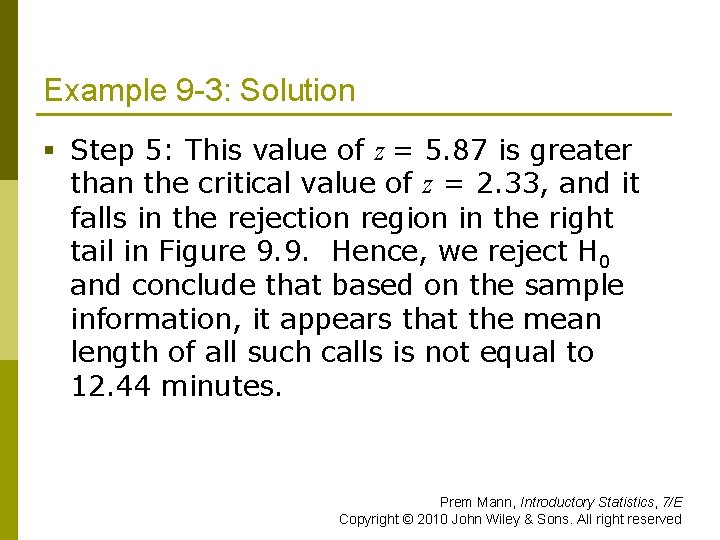
Example 9 -3: Solution § Step 5: This value of z = 5. 87 is greater than the critical value of z = 2. 33, and it falls in the rejection region in the right tail in Figure 9. 9. Hence, we reject H 0 and conclude that based on the sample information, it appears that the mean length of all such calls is not equal to 12. 44 minutes. Prem Mann, Introductory Statistics, 7/E Copyright © 2010 John Wiley & Sons. All right reserved
Example 9 -4 The mayor of a large city claims that the average net worth of families living in this city is at least $300, 000. A random sample of 25 families selected from this city produced a mean net worth of $288, 000. Assume that the net worth of all families in this city have a normal distribution with the population standard deviation of $80, 000. Using the 2. 5% significance level, can you conclude against the mayor’s claim (H 0)? Prem Mann, Introductory Statistics, 7/E Copyright © 2010 John Wiley & Sons. All right reserved
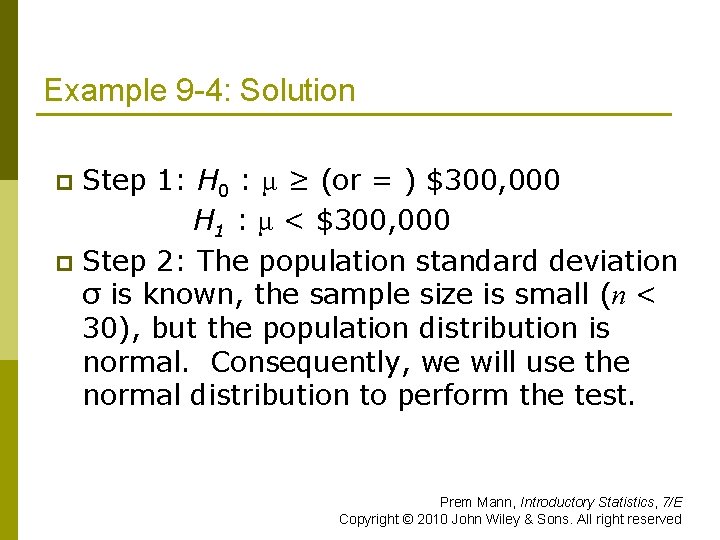
Example 9 -4: Solution Step 1: H 0 : μ ≥ (or = ) $300, 000 H 1 : μ < $300, 000 p Step 2: The population standard deviation σ is known, the sample size is small (n < 30), but the population distribution is normal. Consequently, we will use the normal distribution to perform the test. p Prem Mann, Introductory Statistics, 7/E Copyright © 2010 John Wiley & Sons. All right reserved
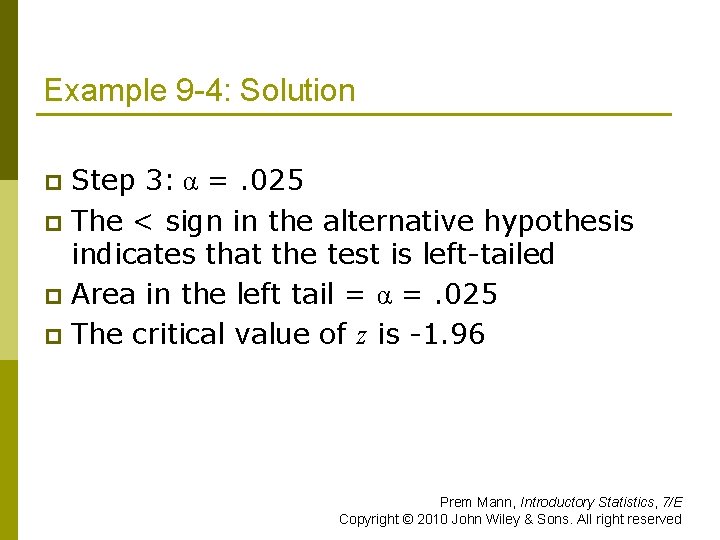
Example 9 -4: Solution Step 3: α =. 025 p The < sign in the alternative hypothesis indicates that the test is left-tailed p Area in the left tail = α =. 025 p The critical value of z is -1. 96 p Prem Mann, Introductory Statistics, 7/E Copyright © 2010 John Wiley & Sons. All right reserved
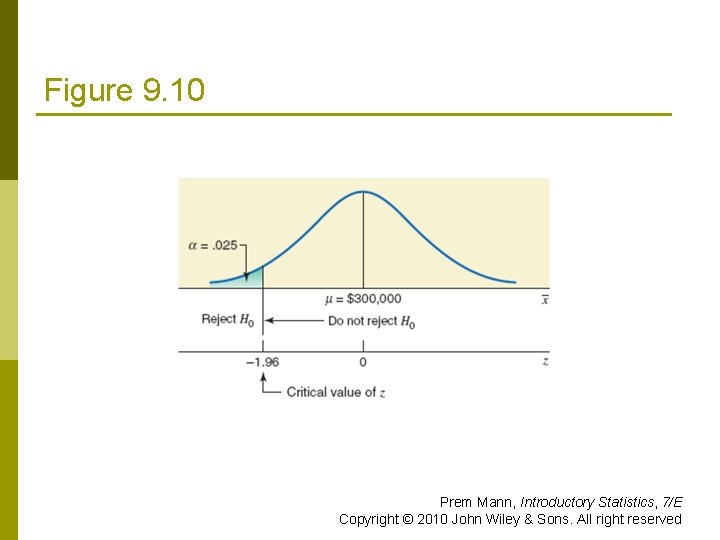
Figure 9. 10 Prem Mann, Introductory Statistics, 7/E Copyright © 2010 John Wiley & Sons. All right reserved
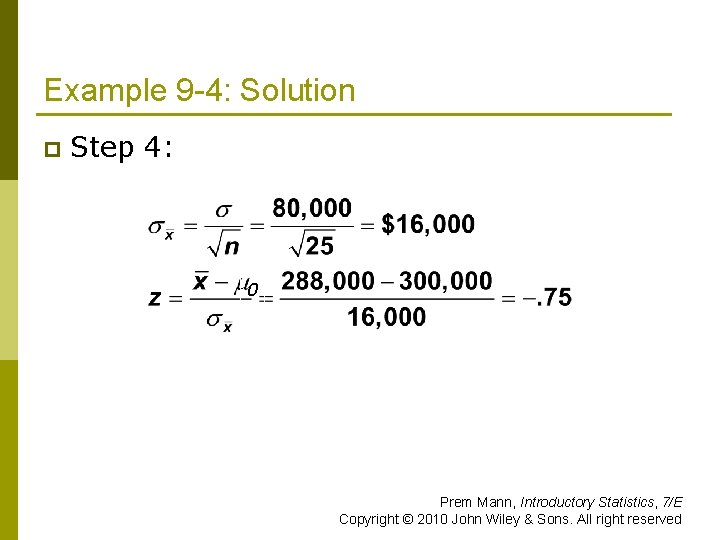
Example 9 -4: Solution p Step 4: 0 Prem Mann, Introductory Statistics, 7/E Copyright © 2010 John Wiley & Sons. All right reserved
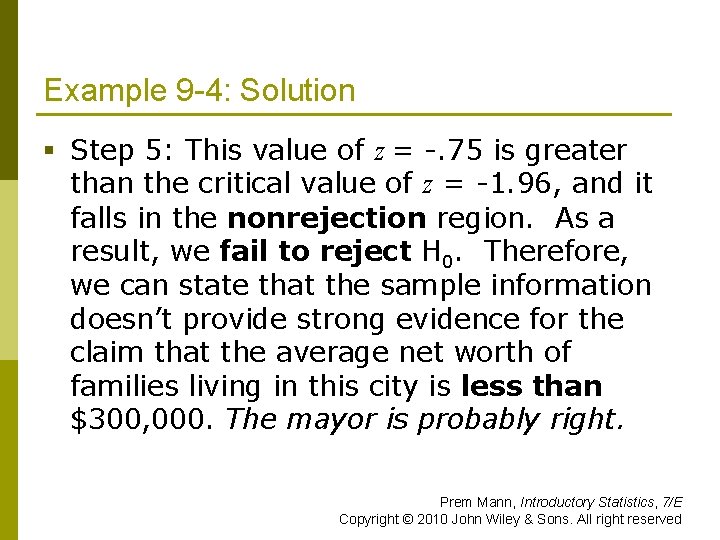
Example 9 -4: Solution § Step 5: This value of z = -. 75 is greater than the critical value of z = -1. 96, and it falls in the nonrejection region. As a result, we fail to reject H 0. Therefore, we can state that the sample information doesn’t provide strong evidence for the claim that the average net worth of families living in this city is less than $300, 000. The mayor is probably right. Prem Mann, Introductory Statistics, 7/E Copyright © 2010 John Wiley & Sons. All right reserved
Definition of p-value Assuming that the null hypothesis is true, the pvalue can be defined as the probability that a sample statistic (such as the sample mean) is at least as far away from the hypothesized value in the direction of the alternative hypothesis as the one obtained from the sample data under consideration. Note that the p–value is the smallest significance level at which the null hypothesis is rejected. Prem Mann, Introductory Statistics, 7/E Copyright © 2010 John Wiley & Sons. All right reserved
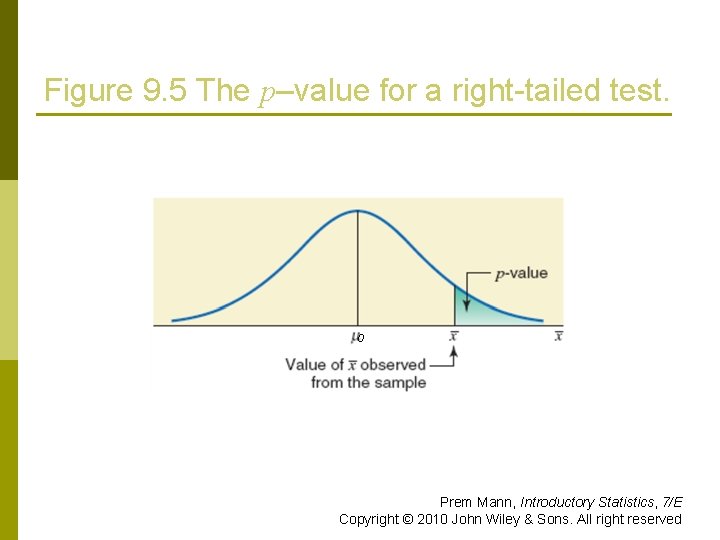
Figure 9. 5 The p–value for a right-tailed test. 0 Prem Mann, Introductory Statistics, 7/E Copyright © 2010 John Wiley & Sons. All right reserved
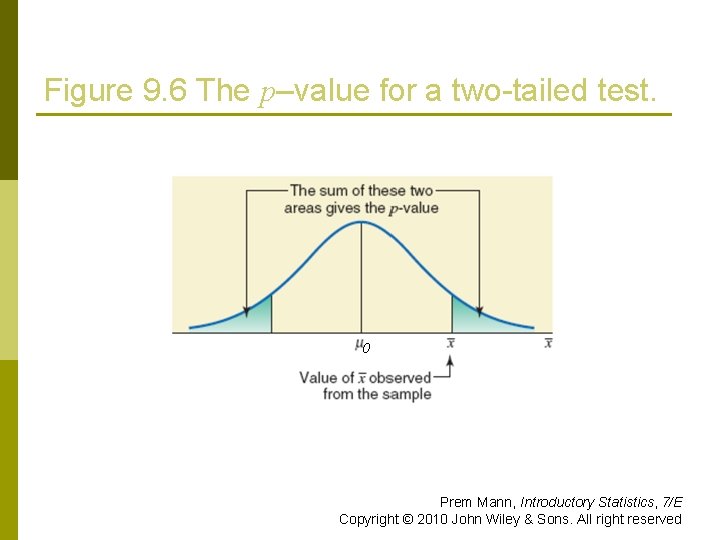
Figure 9. 6 The p–value for a two-tailed test. 0 Prem Mann, Introductory Statistics, 7/E Copyright © 2010 John Wiley & Sons. All right reserved
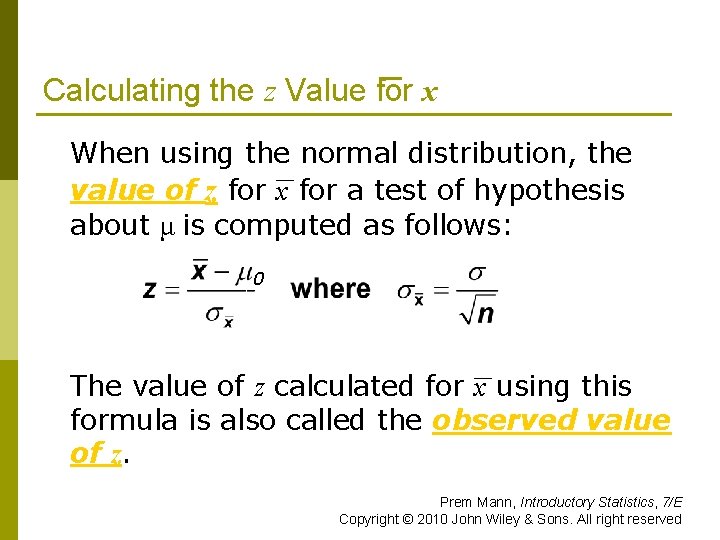
Calculating the z Value for x When using the normal distribution, the value of z for x for a test of hypothesis about μ is computed as follows: 0 The value of z calculated for x using this formula is also called the observed value of z. Prem Mann, Introductory Statistics, 7/E Copyright © 2010 John Wiley & Sons. All right reserved
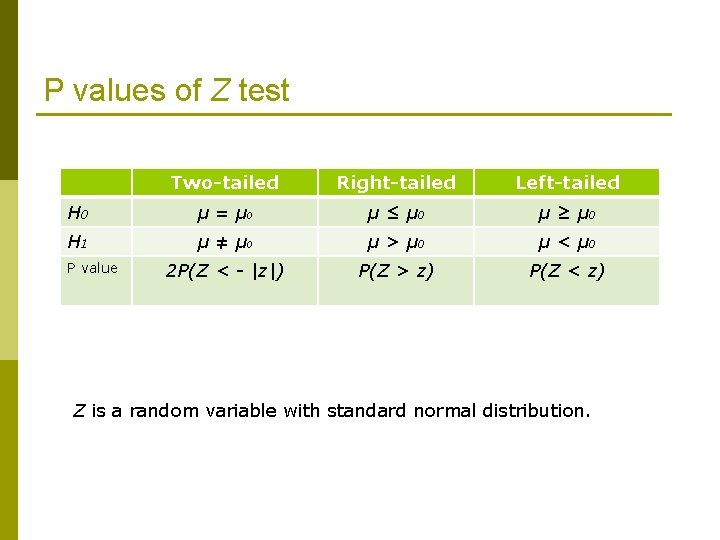
P values of Z test Two-tailed Right-tailed Left-tailed H 0 µ = µ 0 µ ≤ µ 0 µ ≥ µ 0 H 1 µ ≠ µ 0 µ > µ 0 µ < µ 0 2 P(Z < - |z|) P(Z > z) P(Z < z) P value Z is a random variable with standard normal distribution.

Example 9 -1 At Canon Food Corporation, it used to take an average of 90 minutes for new workers to learn a food processing job. Recently the company installed a new food processing machine. The supervisor at the company wants to find if the mean time taken by new workers to learn the food processing procedure on this new machine is different from 90 minutes. A sample of 20 workers showed that it took, on average, 85 minutes for them to learn the food processing procedure on the new machine. It is known that the learning times for all new workers are normally distributed with a population standard deviation of 7 minutes. Find the p–value for the test that the mean learning time for the food processing procedure on the new machine is different from 90 minutes. What will your conclusion be if α =. 01? Prem Mann, Introductory Statistics, 7/E Copyright © 2010 John Wiley & Sons. All right reserved
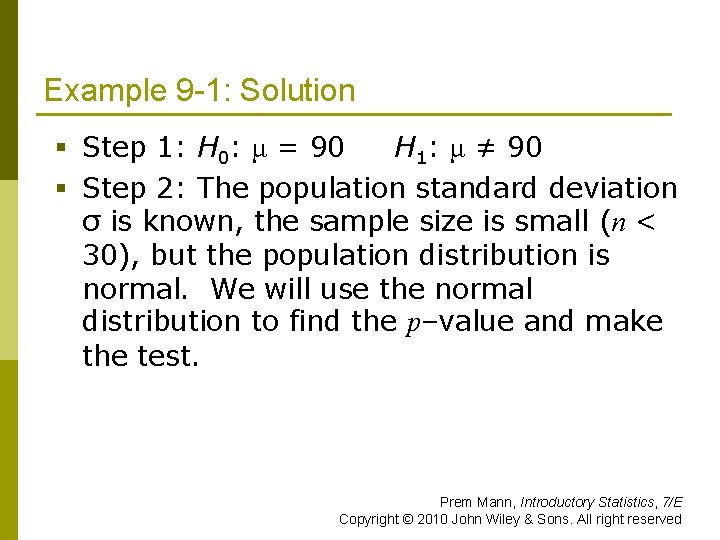
Example 9 -1: Solution § Step 1: H 0: μ = 90 H 1: μ ≠ 90 § Step 2: The population standard deviation σ is known, the sample size is small (n < 30), but the population distribution is normal. We will use the normal distribution to find the p–value and make the test. Prem Mann, Introductory Statistics, 7/E Copyright © 2010 John Wiley & Sons. All right reserved
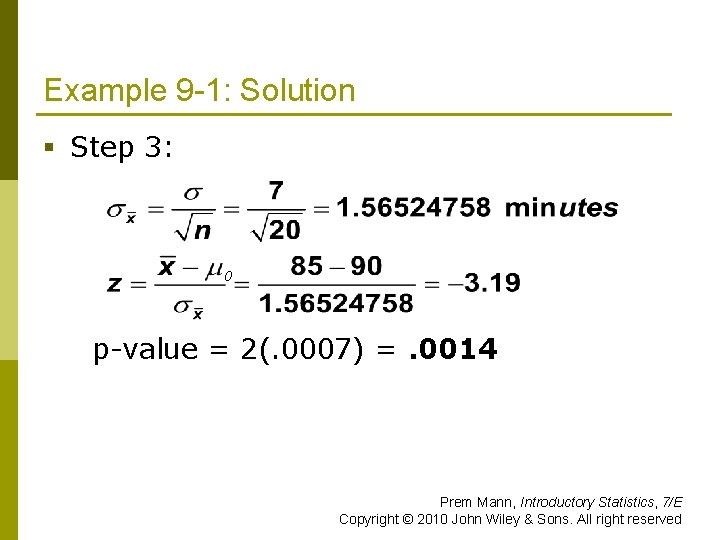
Example 9 -1: Solution § Step 3: 0 p-value = 2(. 0007) =. 0014 Prem Mann, Introductory Statistics, 7/E Copyright © 2010 John Wiley & Sons. All right reserved
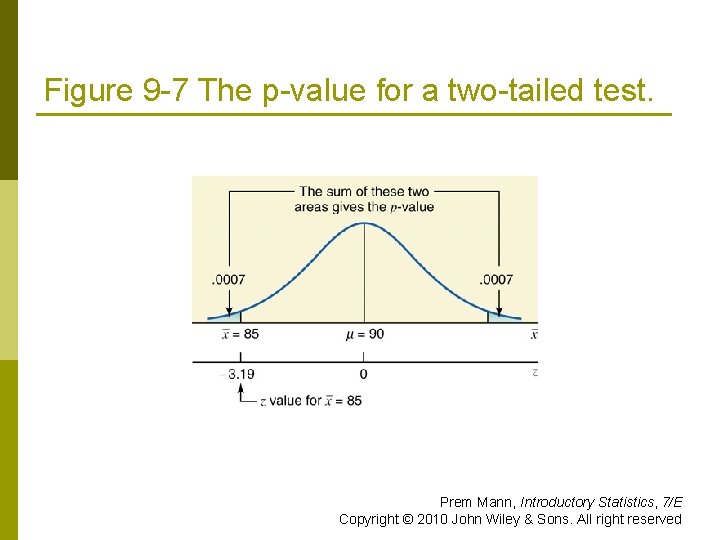
Figure 9 -7 The p-value for a two-tailed test. Prem Mann, Introductory Statistics, 7/E Copyright © 2010 John Wiley & Sons. All right reserved
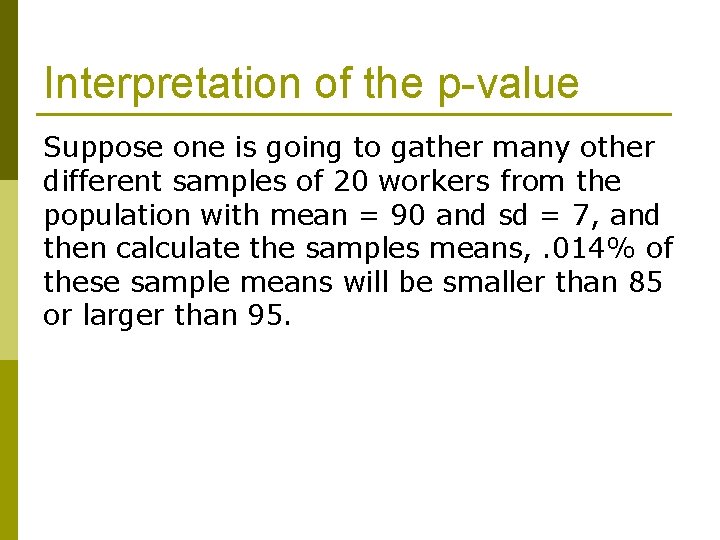
Interpretation of the p-value Suppose one is going to gather many other different samples of 20 workers from the population with mean = 90 and sd = 7, and then calculate the samples means, . 014% of these sample means will be smaller than 85 or larger than 95.
Example 9 -1: Solution § Step 4: Because α =. 01 is greater than the p-value of. 0014, we reject the null hypothesis at this significance level. Therefore, we conclude that the mean time for learning the food processing procedure on the new machine is different from 90 minutes. Prem Mann, Introductory Statistics, 7/E Copyright © 2010 John Wiley & Sons. All right reserved
Example 9 -2 The management of Priority Health Club claims that its members lose an average of 10 pounds or more within the first month after joining the club. A consumer agency that wanted to check this claim took a random sample of 36 members of this health club and found that they lost an average of 9. 2 pounds within the first month of membership. It is known that a standard deviation of 2. 4 pounds. Find the p–value for this test. What will you decision be if α =. 01? What if α =. 05? Prem Mann, Introductory Statistics, 7/E Copyright © 2010 John Wiley & Sons. All right reserved
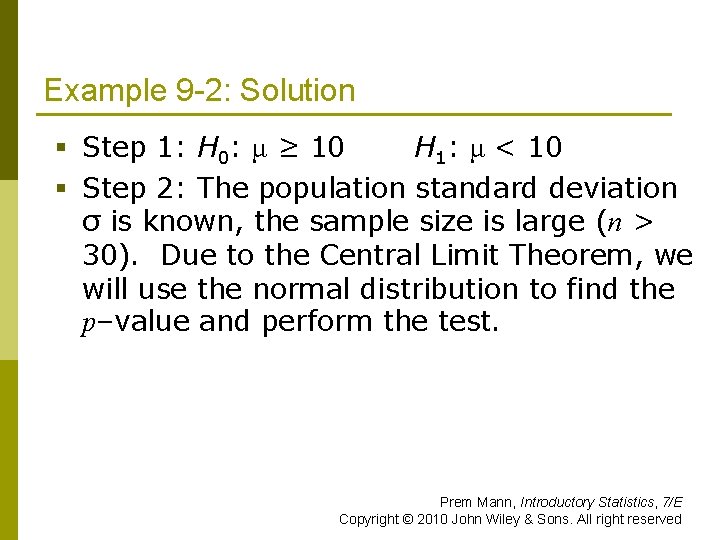
Example 9 -2: Solution § Step 1: H 0: μ ≥ 10 H 1: μ < 10 § Step 2: The population standard deviation σ is known, the sample size is large (n > 30). Due to the Central Limit Theorem, we will use the normal distribution to find the p–value and perform the test. Prem Mann, Introductory Statistics, 7/E Copyright © 2010 John Wiley & Sons. All right reserved
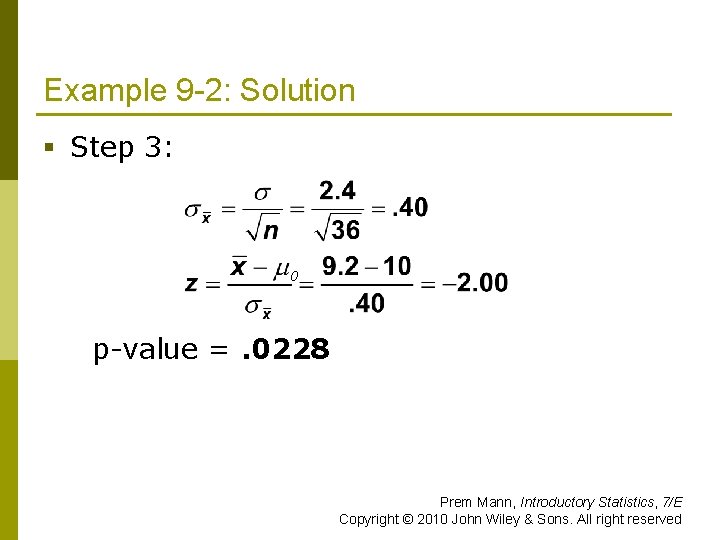
Example 9 -2: Solution § Step 3: 0 p-value =. 0228 Prem Mann, Introductory Statistics, 7/E Copyright © 2010 John Wiley & Sons. All right reserved
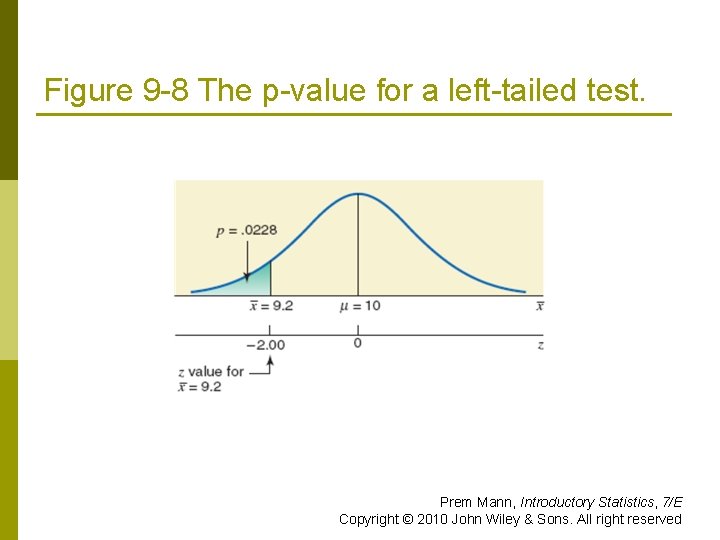
Figure 9 -8 The p-value for a left-tailed test. Prem Mann, Introductory Statistics, 7/E Copyright © 2010 John Wiley & Sons. All right reserved
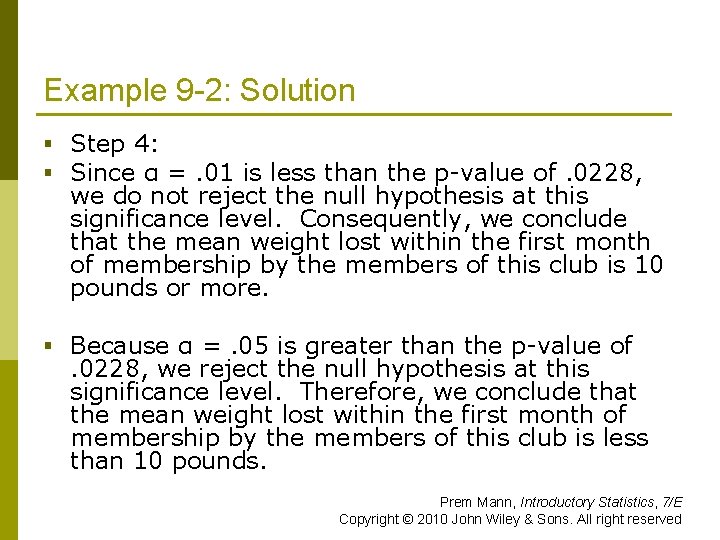
Example 9 -2: Solution § Step 4: § Since α =. 01 is less than the p-value of. 0228, we do not reject the null hypothesis at this significance level. Consequently, we conclude that the mean weight lost within the first month of membership by the members of this club is 10 pounds or more. § Because α =. 05 is greater than the p-value of . 0228, we reject the null hypothesis at this significance level. Therefore, we conclude that the mean weight lost within the first month of membership by the members of this club is less than 10 pounds. Prem Mann, Introductory Statistics, 7/E Copyright © 2010 John Wiley & Sons. All right reserved
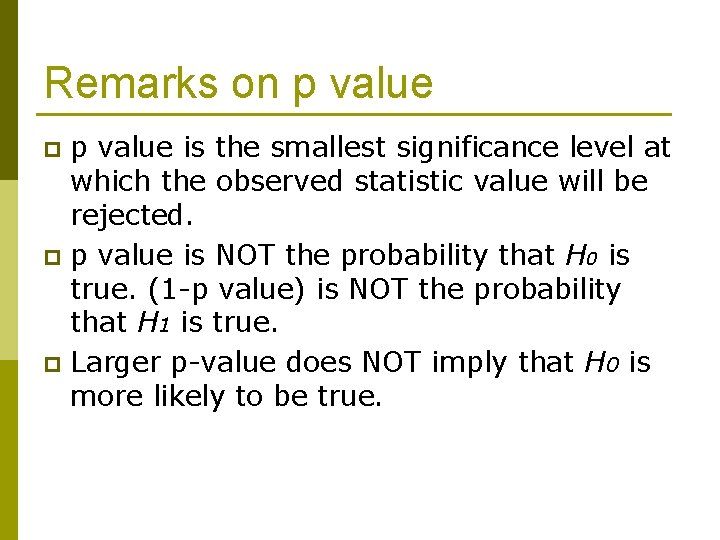
Remarks on p value is the smallest significance level at which the observed statistic value will be rejected. p p value is NOT the probability that H 0 is true. (1 -p value) is NOT the probability that H 1 is true. p Larger p-value does NOT imply that H 0 is more likely to be true. p
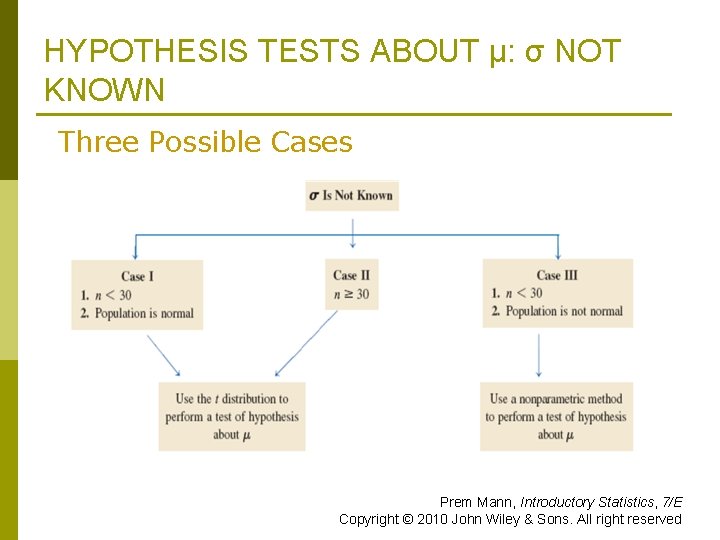
HYPOTHESIS TESTS ABOUT μ: σ NOT KNOWN Three Possible Cases Prem Mann, Introductory Statistics, 7/E Copyright © 2010 John Wiley & Sons. All right reserved
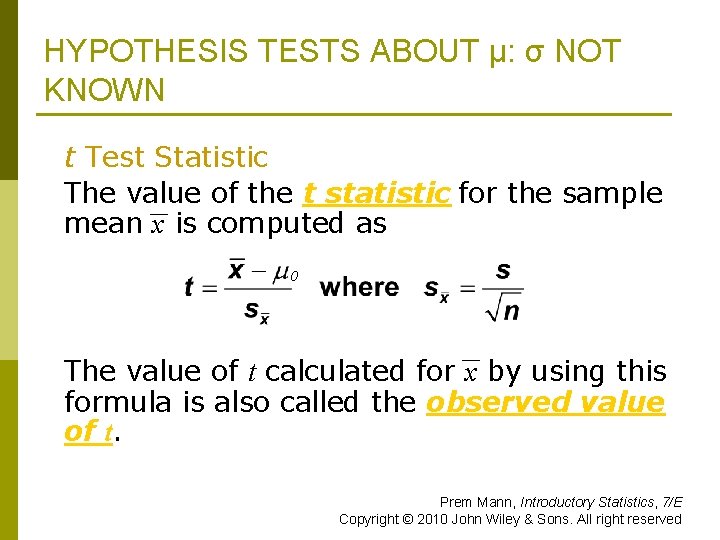
HYPOTHESIS TESTS ABOUT μ: σ NOT KNOWN t Test Statistic The value of the t statistic for the sample mean x is computed as 0 The value of t calculated for x by using this formula is also called the observed value of t. Prem Mann, Introductory Statistics, 7/E Copyright © 2010 John Wiley & Sons. All right reserved
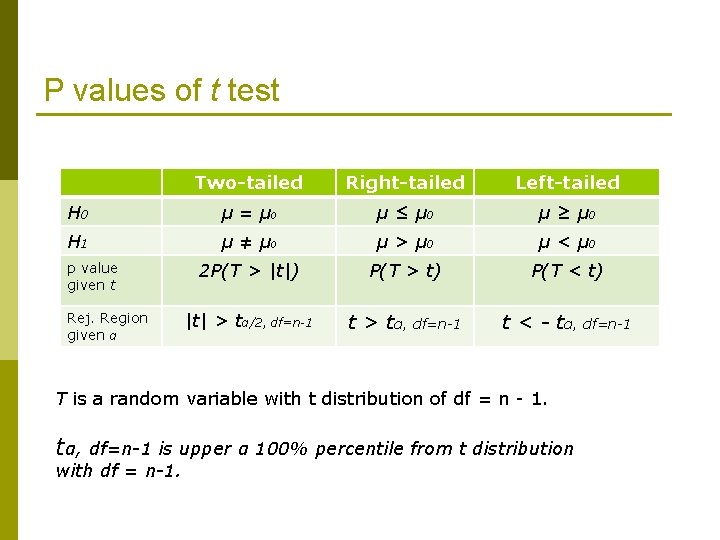
P values of t test Two-tailed Right-tailed Left-tailed H 0 µ = µ 0 µ ≤ µ 0 µ ≥ µ 0 H 1 µ ≠ µ 0 µ > µ 0 µ < µ 0 2 P(T > |t|) P(T > t) P(T < t) |t| > tα/2, df=n-1 t > tα, df=n-1 t < - tα, df=n-1 p value given t Rej. Region given α T is a random variable with t distribution of df = n - 1. tα, df=n-1 is upper α 100% percentile from t distribution with df = n-1.
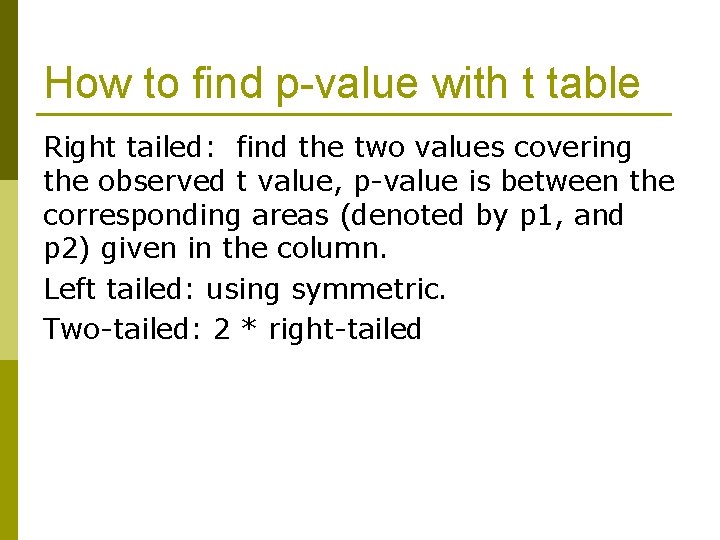
How to find p-value with t table Right tailed: find the two values covering the observed t value, p-value is between the corresponding areas (denoted by p 1, and p 2) given in the column. Left tailed: using symmetric. Two-tailed: 2 * right-tailed
Example 9 -5 A psychologist claims that the mean age at which children start walking is 12. 5 months. Carol wanted to check if this claim is true. She took a random sample of 18 children and found that the mean age at which these children started walking was 12. 9 months with a standard deviation of. 80 month. It is known that the ages at which all children start walking are approximately normal distributed. Find the p-value for the test that the mean age at which all children start walking is different from 12. 5 months. What will your conclusion be if the significance level is 1%? Prem Mann, Introductory Statistics, 7/E Copyright © 2010 John Wiley & Sons. All right reserved
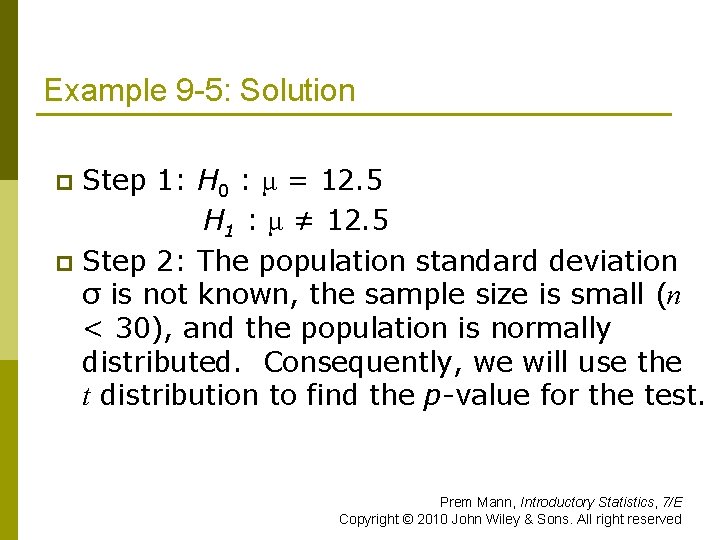
Example 9 -5: Solution Step 1: H 0 : μ = 12. 5 H 1 : μ ≠ 12. 5 p Step 2: The population standard deviation σ is not known, the sample size is small (n < 30), and the population is normally distributed. Consequently, we will use the t distribution to find the p-value for the test. p Prem Mann, Introductory Statistics, 7/E Copyright © 2010 John Wiley & Sons. All right reserved
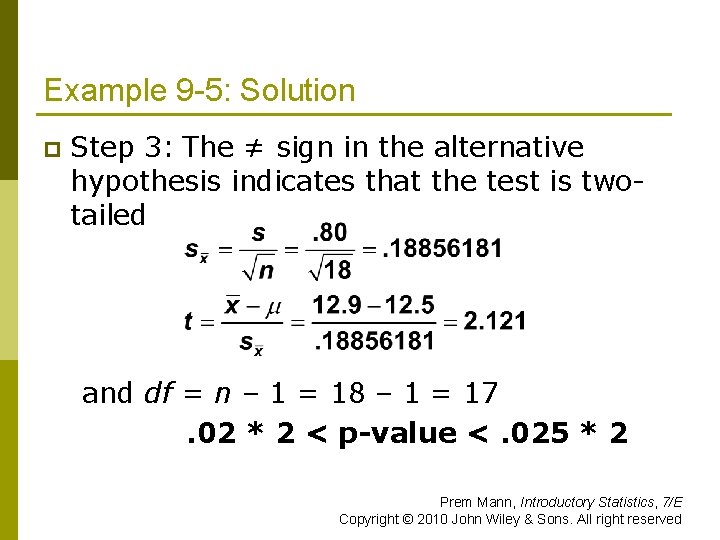
Example 9 -5: Solution p Step 3: The ≠ sign in the alternative hypothesis indicates that the test is twotailed and df = n – 1 = 18 – 1 = 17. 02 * 2 < p-value <. 025 * 2 Prem Mann, Introductory Statistics, 7/E Copyright © 2010 John Wiley & Sons. All right reserved
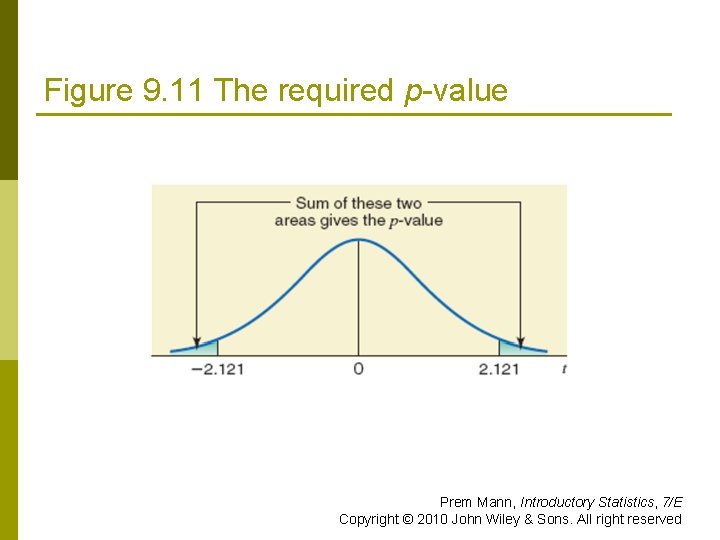
Figure 9. 11 The required p-value Prem Mann, Introductory Statistics, 7/E Copyright © 2010 John Wiley & Sons. All right reserved
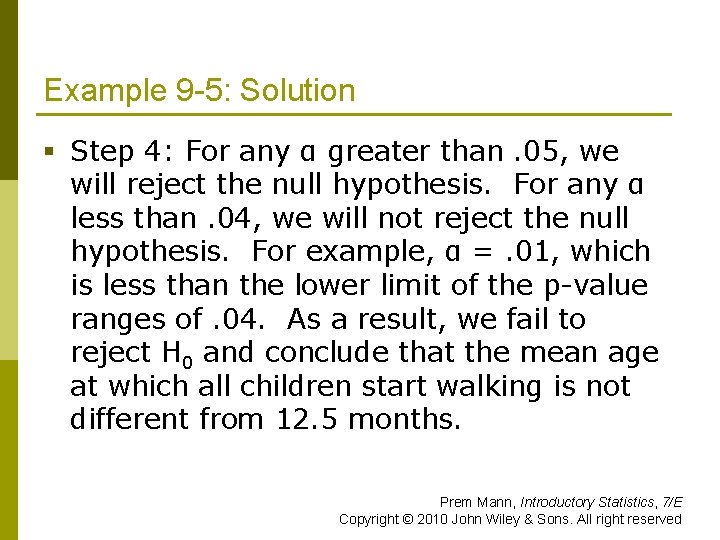
Example 9 -5: Solution § Step 4: For any α greater than. 05, we will reject the null hypothesis. For any α less than. 04, we will not reject the null hypothesis. For example, α =. 01, which is less than the lower limit of the p-value ranges of. 04. As a result, we fail to reject H 0 and conclude that the mean age at which all children start walking is not different from 12. 5 months. Prem Mann, Introductory Statistics, 7/E Copyright © 2010 John Wiley & Sons. All right reserved

Example 9 -6 Grand Auto Corporation produces auto batteries. The company claims that its top-of-the-line Never Die batteries are good, on average, for at least 65 months. A consumer protection agency tested 45 such batteries to check this claim. It found the mean life of these 45 batteries to be 63. 4 months with a standard deviation of 3 months. Find the p -value for the test that mean life of all such batteries is less than 65 months. What will your conclusion be if the significance level is 2. 5%? Prem Mann, Introductory Statistics, 7/E Copyright © 2010 John Wiley & Sons. All right reserved
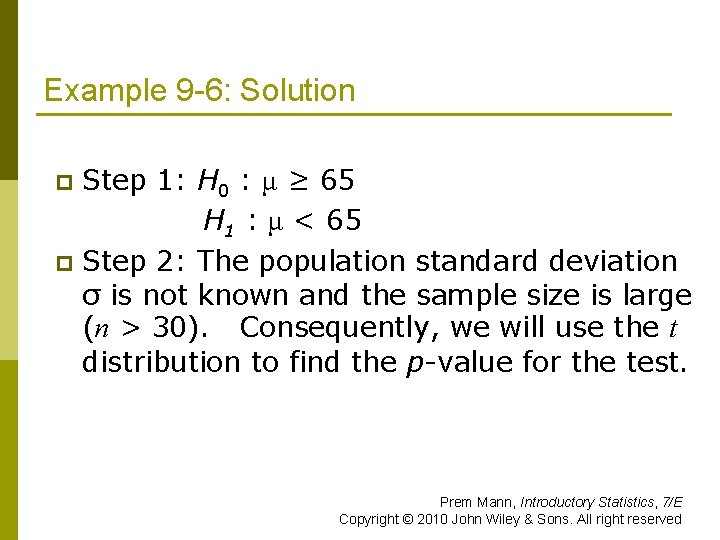
Example 9 -6: Solution Step 1: H 0 : μ ≥ 65 H 1 : μ < 65 p Step 2: The population standard deviation σ is not known and the sample size is large (n > 30). Consequently, we will use the t distribution to find the p-value for the test. p Prem Mann, Introductory Statistics, 7/E Copyright © 2010 John Wiley & Sons. All right reserved
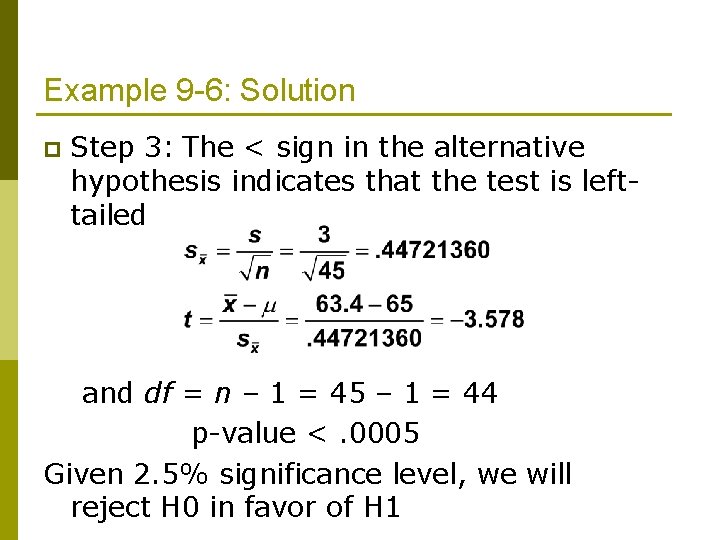
Example 9 -6: Solution p Step 3: The < sign in the alternative hypothesis indicates that the test is lefttailed and df = n – 1 = 45 – 1 = 44 p-value <. 0005 Given 2. 5% significance level, we will reject H 0 in favor of H 1
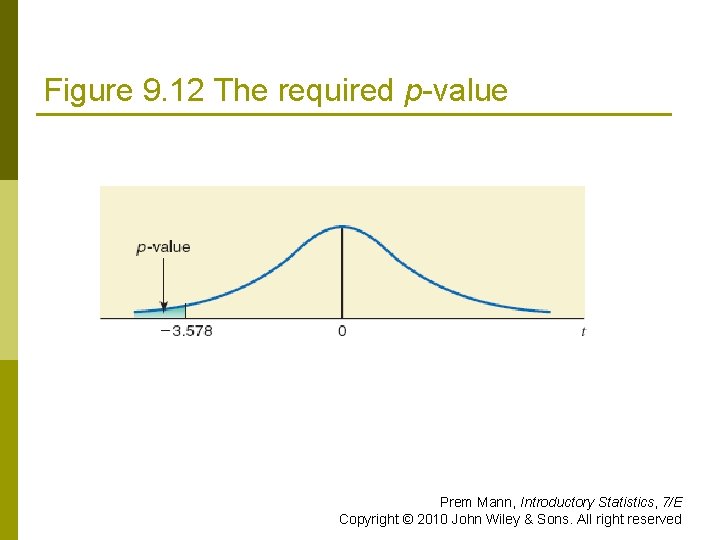
Figure 9. 12 The required p-value Prem Mann, Introductory Statistics, 7/E Copyright © 2010 John Wiley & Sons. All right reserved
Tests of Hypothesis for μ Using the t Distribution What If the Sample Size Is Too Large? 1. Use the t value from the last row (the row of ∞) in Table V of Appendix C. 2. Use the normal distribution as an approximation to the t distribution. Prem Mann, Introductory Statistics, 7/E Copyright © 2010 John Wiley & Sons. All right reserved
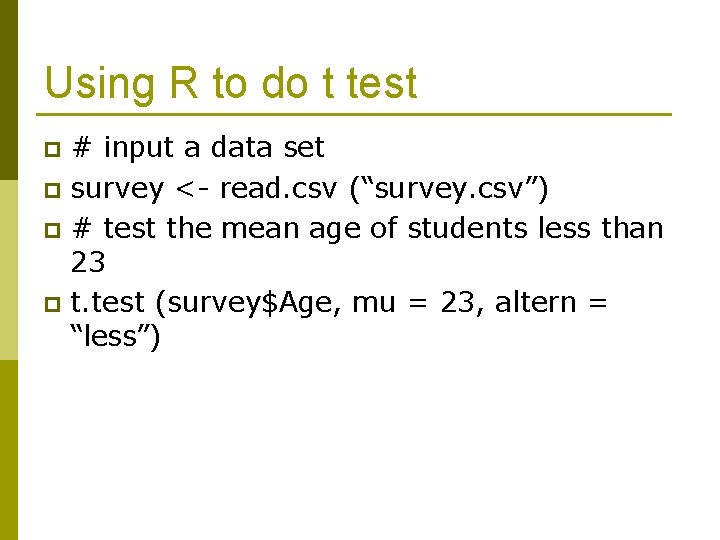
Using R to do t test # input a data set p survey <- read. csv (“survey. csv”) p # test the mean age of students less than 23 p t. test (survey$Age, mu = 23, altern = “less”) p
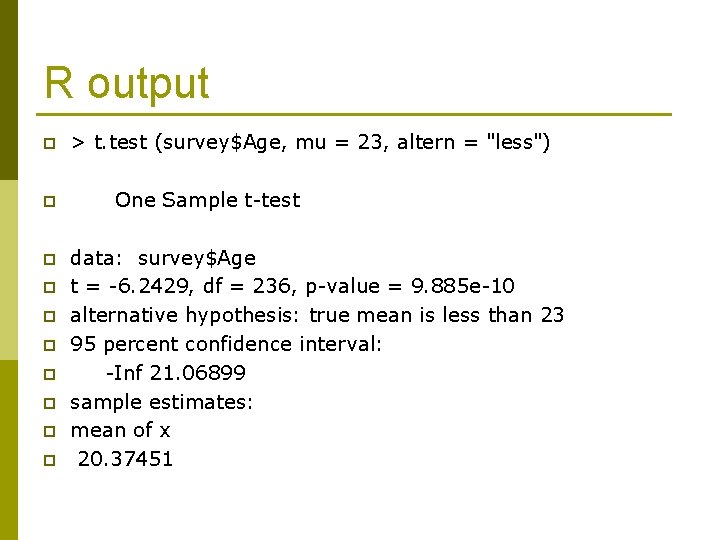
R output p p p p p > t. test (survey$Age, mu = 23, altern = "less") One Sample t-test data: survey$Age t = -6. 2429, df = 236, p-value = 9. 885 e-10 alternative hypothesis: true mean is less than 23 95 percent confidence interval: -Inf 21. 06899 sample estimates: mean of x 20. 37451
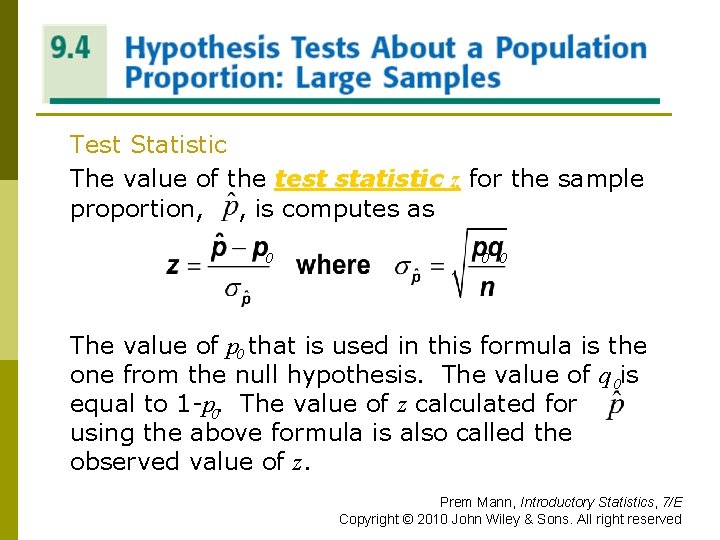
HYPOTHESIS TESTS ABOUT A POPULATION PROPORTION: LARGE SAMPLES Test Statistic The value of the test statistic z for the sample proportion, , is computes as 0 0 0 The value of p 0 that is used in this formula is the one from the null hypothesis. The value of q 0 is equal to 1 -p. The value of z calculated for 0 using the above formula is also called the observed value of z. Prem Mann, Introductory Statistics, 7/E Copyright © 2010 John Wiley & Sons. All right reserved
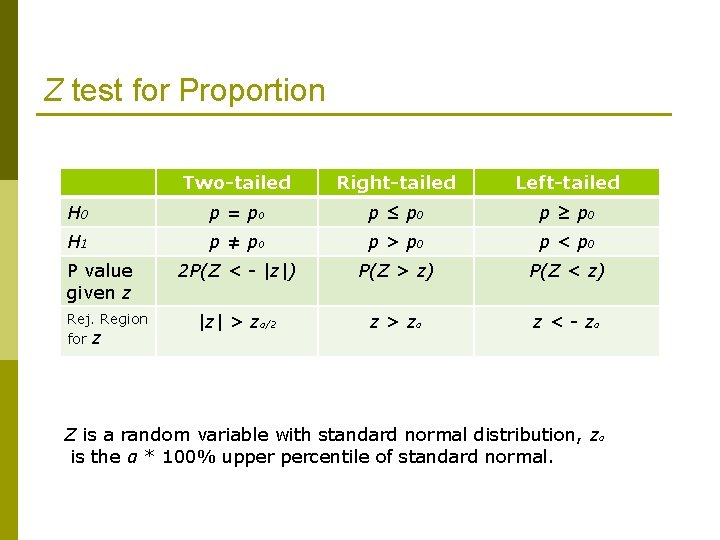
Z test for Proportion Two-tailed Right-tailed Left-tailed H 0 p = p 0 p ≤ p 0 p ≥ p 0 H 1 p ≠ p 0 p > p 0 p < p 0 2 P(Z < - |z|) P(Z > z) P(Z < z) |z| > zα/2 z > zα z < - zα P value given z Rej. Region for z Z is a random variable with standard normal distribution, zα is the α * 100% upper percentile of standard normal.

Example 9 -9 According to a Nationwide Mutual Insurance Company Driving While Distracted Survey conducted in 2008, 81% of the drivers interviewed said that they have talked on their cell phones while driving (The New York Times, July 19, 2009). The survey included drivers aged 16 to 61 years selected from 48 states. Assume that this result holds true for the 2008 population of all such drivers in the United States. In a recent random sample of 1600 drivers aged 16 to 61 years selected from the United States, 83% said that they have talked on their cell phones while driving. Prem Mann, Introductory Statistics, 7/E Copyright © 2010 John Wiley & Sons. All right reserved
Example 9 -9 Find the p-value to test the hypothesis that the current percentage of such drivers who have talked on their cell phones while driving is different from 81%. What is your conclusion if the significance level is 5%? Prem Mann, Introductory Statistics, 7/E Copyright © 2010 John Wiley & Sons. All right reserved
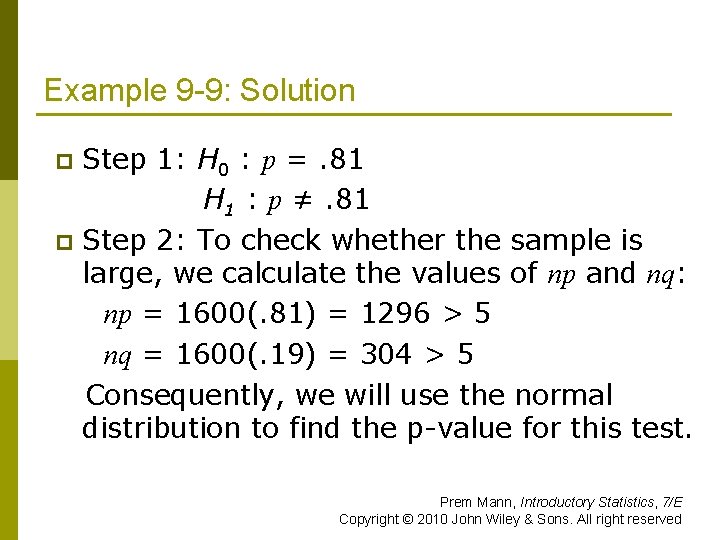
Example 9 -9: Solution Step 1: H 0 : p =. 81 H 1 : p ≠. 81 p Step 2: To check whether the sample is large, we calculate the values of np and nq: np = 1600(. 81) = 1296 > 5 nq = 1600(. 19) = 304 > 5 Consequently, we will use the normal distribution to find the p-value for this test. p Prem Mann, Introductory Statistics, 7/E Copyright © 2010 John Wiley & Sons. All right reserved
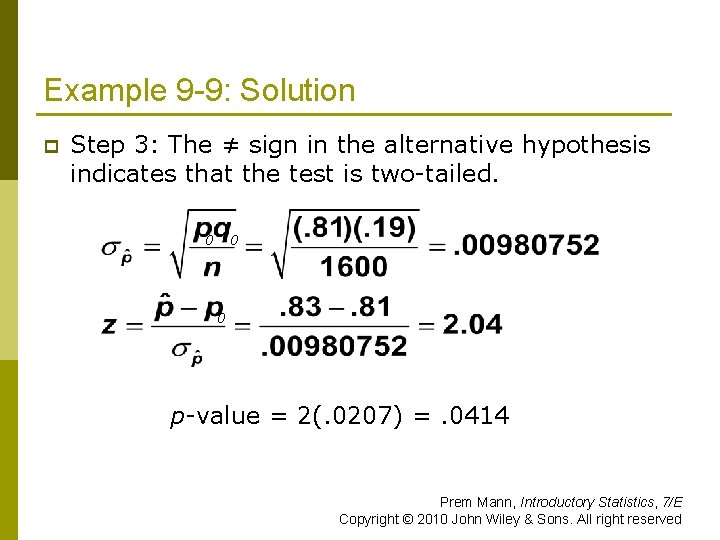
Example 9 -9: Solution p Step 3: The ≠ sign in the alternative hypothesis indicates that the test is two-tailed. 0 0 0 p-value = 2(. 0207) =. 0414 Prem Mann, Introductory Statistics, 7/E Copyright © 2010 John Wiley & Sons. All right reserved
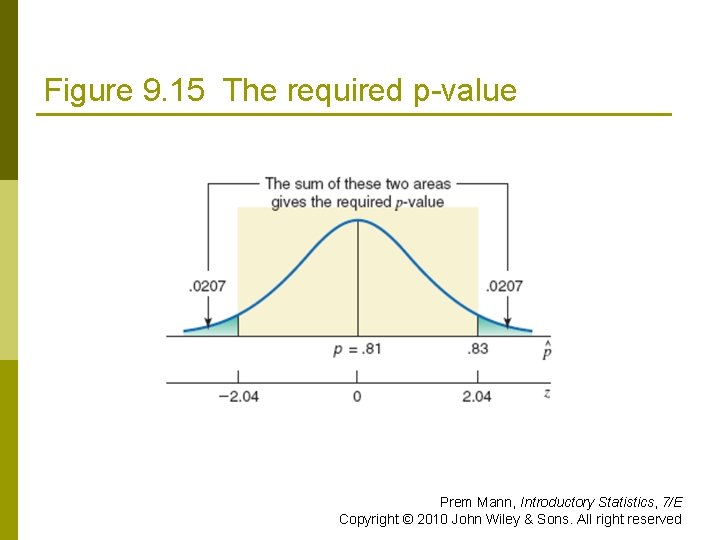
Figure 9. 15 The required p-value Prem Mann, Introductory Statistics, 7/E Copyright © 2010 John Wiley & Sons. All right reserved

Example 9 -11 Refer to Example 9 -9. According to a Nationwide Mutual Insurance Company Driving While Distracted Survey conducted in 2008, 81% of the drivers interviewed said that they have talked on their cell phones while driving (The New York Times, July 19, 2009). The survey included drivers aged 16 to 61 years selected from 48 states. Assume that this result holds true for the 2008 population of all such drivers in the United States. In a recent random sample of 1600 drivers aged 16 to 61 years selected from the United States, 83% said that they have talked on their cell phones while driving. Prem Mann, Introductory Statistics, 7/E Copyright © 2010 John Wiley & Sons. All right reserved
Example 9 -11 Using the 5% significance level, can you conclude that the current percentage of such drivers who have talked on their cell phones while driving is different from 81%. Prem Mann, Introductory Statistics, 7/E Copyright © 2010 John Wiley & Sons. All right reserved
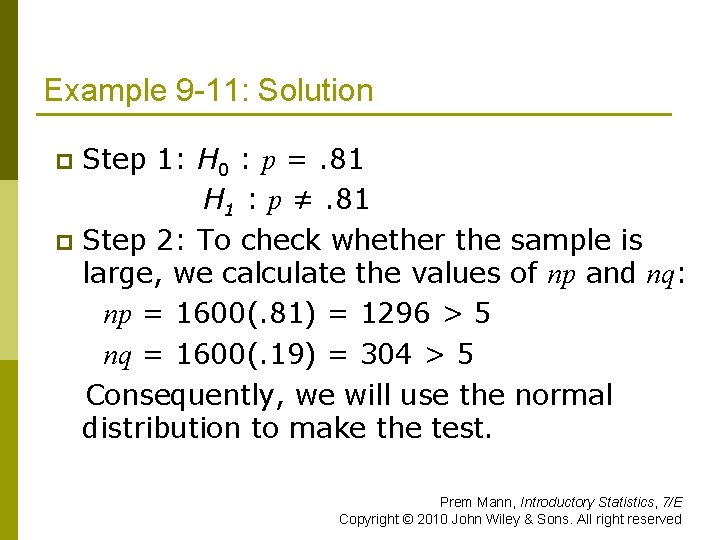
Example 9 -11: Solution Step 1: H 0 : p =. 81 H 1 : p ≠. 81 p Step 2: To check whether the sample is large, we calculate the values of np and nq: np = 1600(. 81) = 1296 > 5 nq = 1600(. 19) = 304 > 5 Consequently, we will use the normal distribution to make the test. p Prem Mann, Introductory Statistics, 7/E Copyright © 2010 John Wiley & Sons. All right reserved
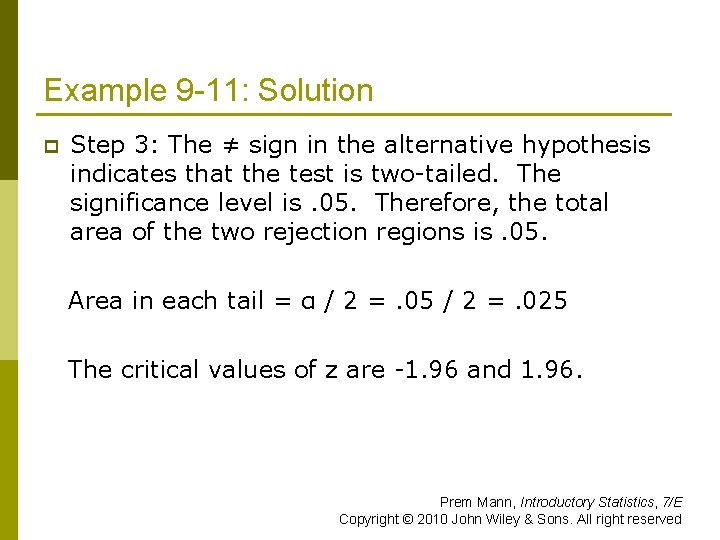
Example 9 -11: Solution p Step 3: The ≠ sign in the alternative hypothesis indicates that the test is two-tailed. The significance level is. 05. Therefore, the total area of the two rejection regions is. 05. Area in each tail = α / 2 =. 05 / 2 =. 025 The critical values of z are -1. 96 and 1. 96. Prem Mann, Introductory Statistics, 7/E Copyright © 2010 John Wiley & Sons. All right reserved
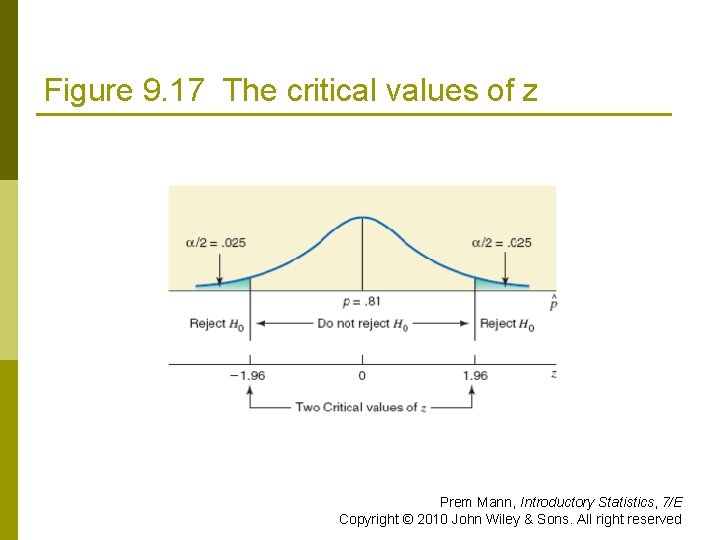
Figure 9. 17 The critical values of z Prem Mann, Introductory Statistics, 7/E Copyright © 2010 John Wiley & Sons. All right reserved
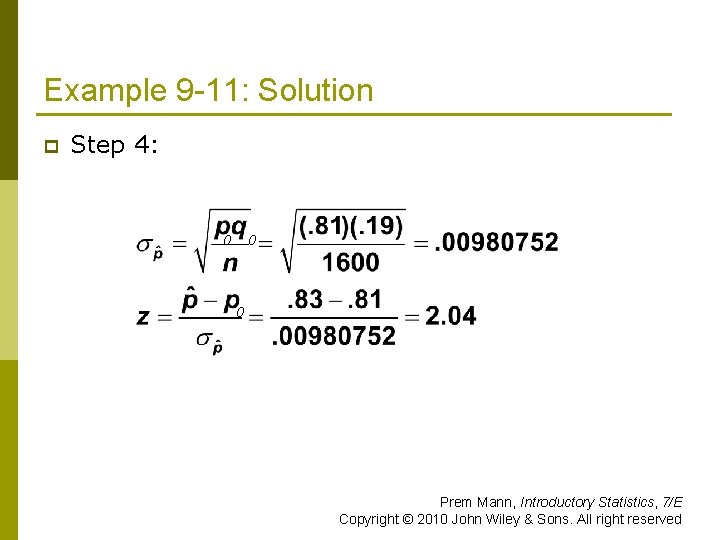
Example 9 -11: Solution p Step 4: 0 0 0 Prem Mann, Introductory Statistics, 7/E Copyright © 2010 John Wiley & Sons. All right reserved
Example 9 -11: Solution p Step 5: the value of test statistic z = 2. 04 falls in the rejection region. As a result, we reject H 0 and conclude that the current percentage of all U. S. drivers aged 16 to 61 years who have talked on their cell phones while driving is different from. 81. Prem Mann, Introductory Statistics, 7/E Copyright © 2010 John Wiley & Sons. All right reserved

Example 9 -12 Direct Mailing Company sells computers and computer parts by mail. The company claims that at least 90% of all orders are mailed within 72 hours after they are received. The quality control department at the company often takes samples to check if this claim is valid. A recently taken sample of 150 orders showed that 129 of them were mailed within 72 hours. Do you think the company’s claim is true? Use a 2. 5% significance level. Prem Mann, Introductory Statistics, 7/E Copyright © 2010 John Wiley & Sons. All right reserved
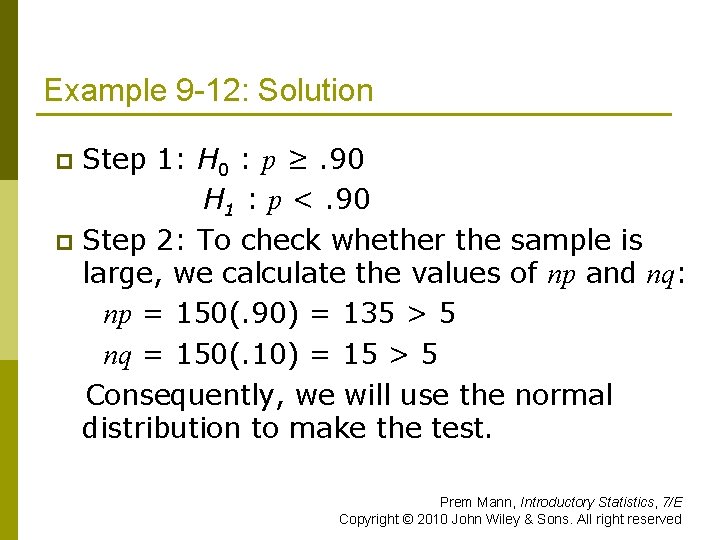
Example 9 -12: Solution Step 1: H 0 : p ≥. 90 H 1 : p <. 90 p Step 2: To check whether the sample is large, we calculate the values of np and nq: np = 150(. 90) = 135 > 5 nq = 150(. 10) = 15 > 5 Consequently, we will use the normal distribution to make the test. p Prem Mann, Introductory Statistics, 7/E Copyright © 2010 John Wiley & Sons. All right reserved
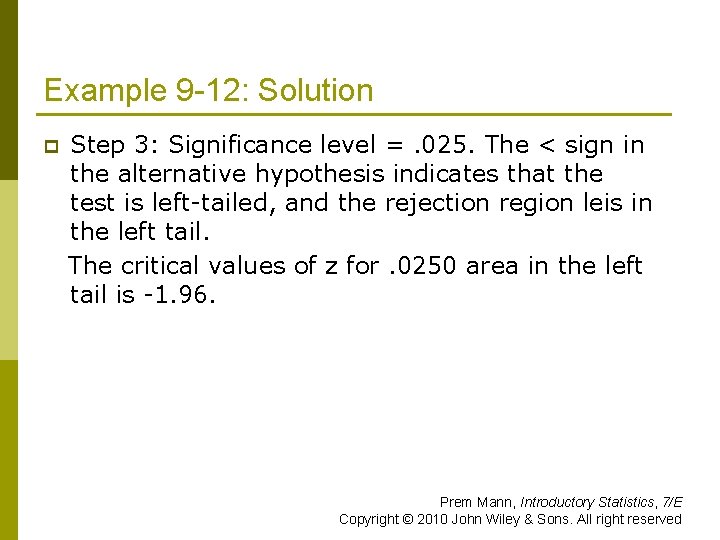
Example 9 -12: Solution p Step 3: Significance level =. 025. The < sign in the alternative hypothesis indicates that the test is left-tailed, and the rejection region leis in the left tail. The critical values of z for. 0250 area in the left tail is -1. 96. Prem Mann, Introductory Statistics, 7/E Copyright © 2010 John Wiley & Sons. All right reserved
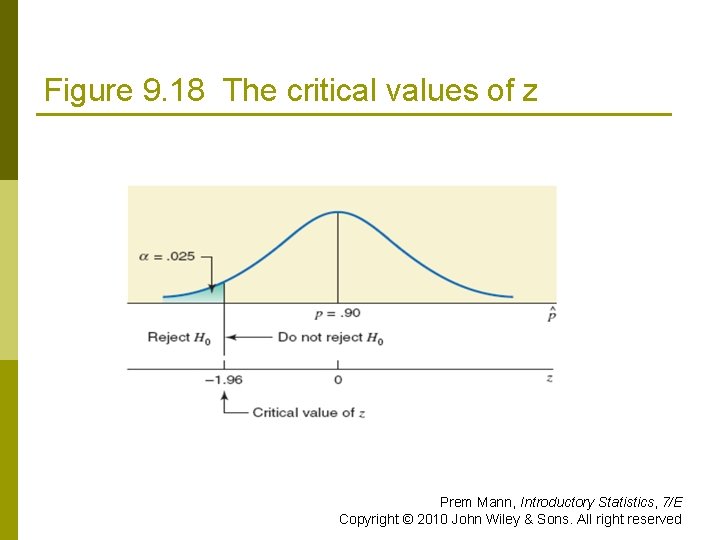
Figure 9. 18 The critical values of z Prem Mann, Introductory Statistics, 7/E Copyright © 2010 John Wiley & Sons. All right reserved
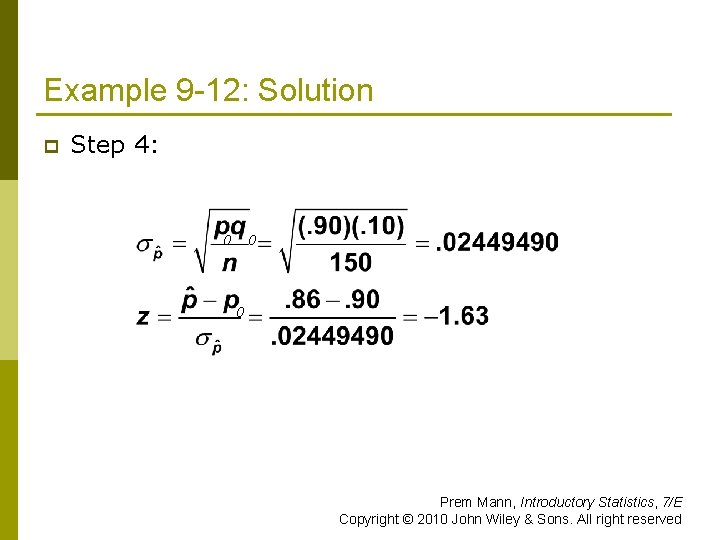
Example 9 -12: Solution p Step 4: 0 0 0 Prem Mann, Introductory Statistics, 7/E Copyright © 2010 John Wiley & Sons. All right reserved
Example 9 -12: Solution p Step 5: The value of test statistic z = -1. 63 is greater than the critical value of z = -1. 96, and it falls in the nonrejection region. Therefore, we fail to reject H 0. We can state that the difference between the sample proportion and the hypothesized value of the population proportion is small, and this difference may have occurred owing to the chance alone. Prem Mann, Introductory Statistics, 7/E Copyright © 2010 John Wiley & Sons. All right reserved
Steps to Do Hypothesis Testing Identify the statistic to use, and state H 0 and H 1 2) Compute value of Statistic 3) 3. 1) Find Critical value OR 3. 2) Find pvalue 4) 4. 1) Check whether the statistic value in rejection region OR 4. 2) Check whether p-value is less than significance level a. 1)
- Slides: 87