
Chapter 9 hydrostatics Hydrostatics is the study of


- Slides: 12
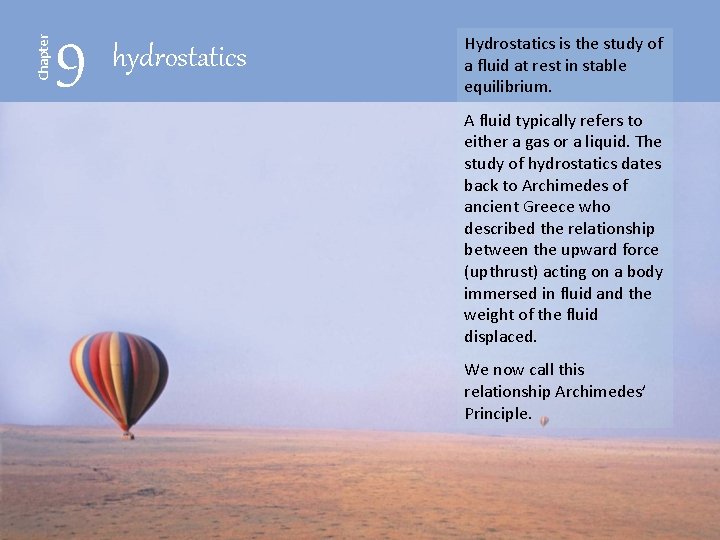
Chapter 9 hydrostatics Hydrostatics is the study of a fluid at rest in stable equilibrium. A fluid typically refers to either a gas or a liquid. The study of hydrostatics dates back to Archimedes of ancient Greece who described the relationship between the upward force (upthrust) acting on a body immersed in fluid and the weight of the fluid displaced. We now call this relationship Archimedes’ Principle.
Chapter 9: Hydrostatics
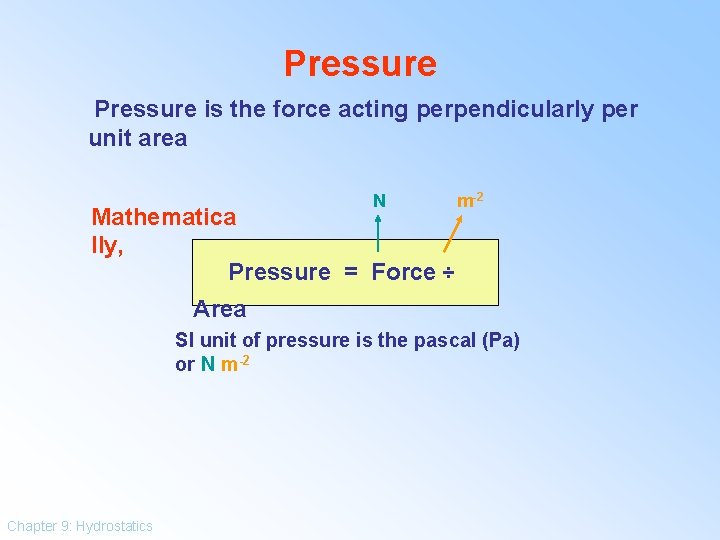
Pressure is the force acting perpendicularly per unit area N Mathematica lly, Pressure = Force ÷ m-2 Area SI unit of pressure is the pascal (Pa) or N m-2 Chapter 9: Hydrostatics
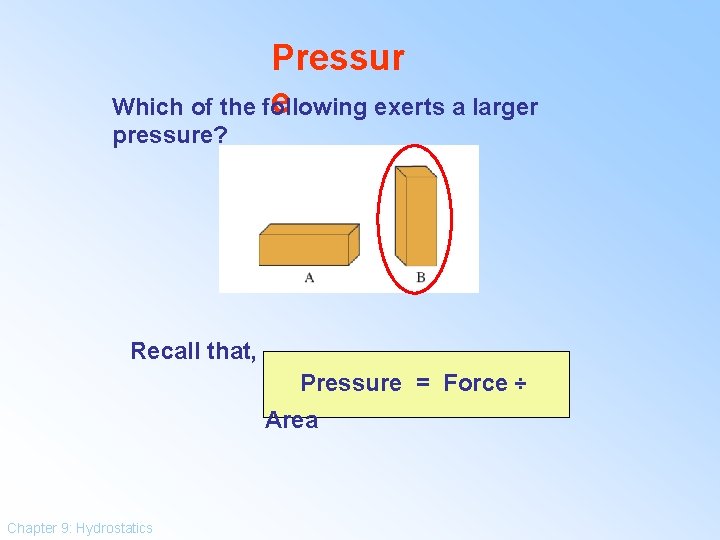
Pressur e Which of the following exerts a larger pressure? Recall that, Pressure = Force ÷ Area Chapter 9: Hydrostatics
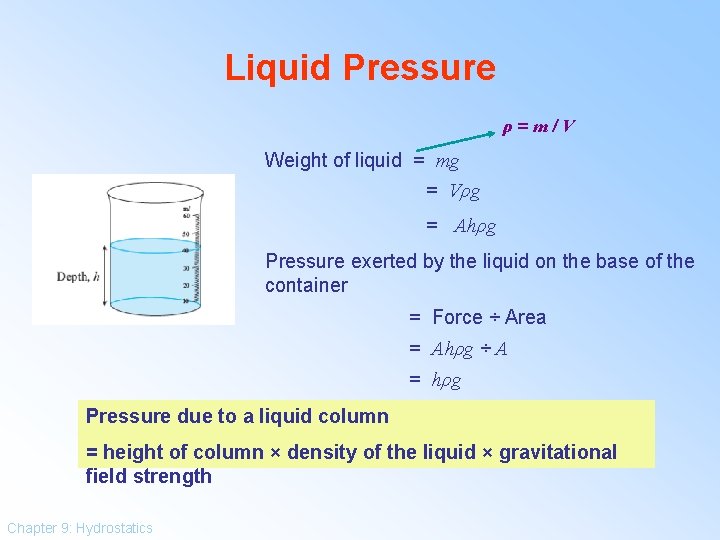
Liquid Pressure ρ=m/V Weight of liquid = mg = Vρg = Ahρg Pressure exerted by the liquid on the base of the container = Force ÷ Area = Ahρg ÷ A = hρg Pressure due to a liquid column = height of column × density of the liquid × gravitational field strength Chapter 9: Hydrostatics
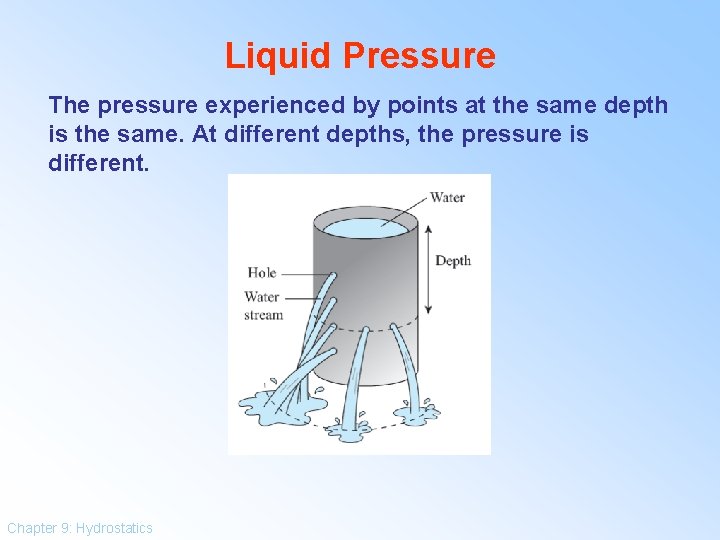
Liquid Pressure The pressure experienced by points at the same depth is the same. At different depths, the pressure is different. Chapter 9: Hydrostatics
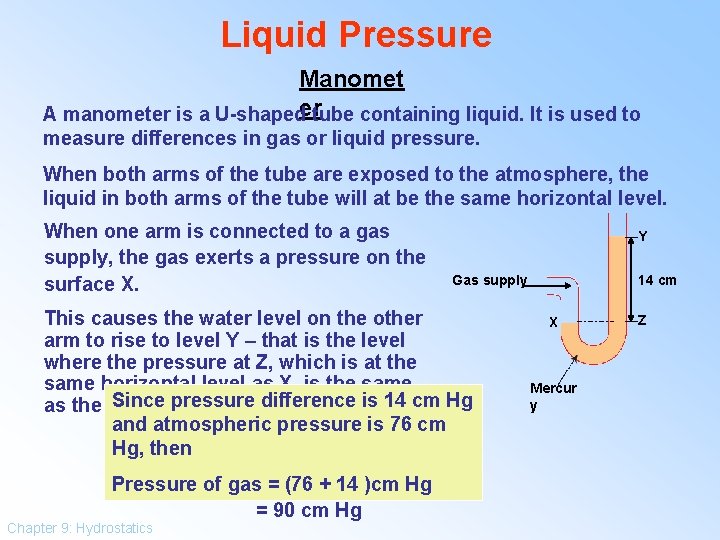
Liquid Pressure Manomet A manometer is a U-shapedertube containing liquid. It is used to measure differences in gas or liquid pressure. When both arms of the tube are exposed to the atmosphere, the liquid in both arms of the tube will at be the same horizontal level. When one arm is connected to a gas supply, the gas exerts a pressure on the surface X. Y Gas supply This causes the water level on the other arm to rise to level Y – that is the level where the pressure at Z, which is at the same horizontal level as X, is the same Since pressure as the pressure at X. difference is 14 cm Hg and atmospheric pressure is 76 cm Hg, then Pressure of gas = (76 + 14 )cm Hg = 90 cm Hg Chapter 9: Hydrostatics 14 cm X Mercur y Z
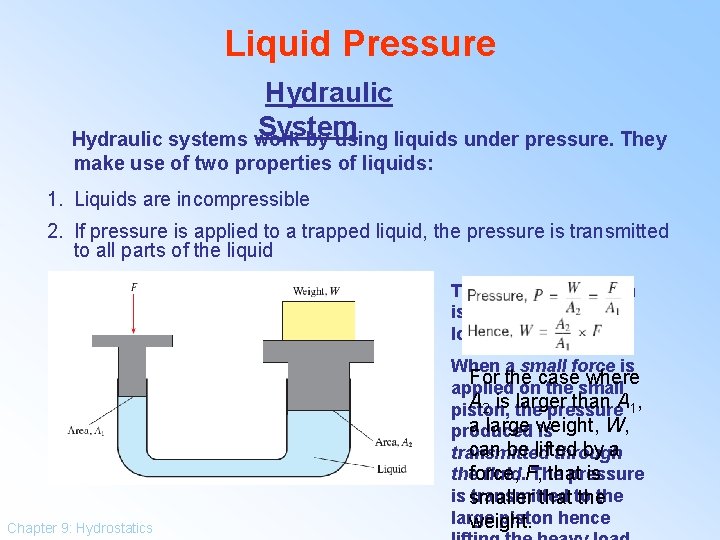
Liquid Pressure Hydraulic System Hydraulic systems work by using liquids under pressure. They make use of two properties of liquids: 1. Liquids are incompressible 2. If pressure is applied to a trapped liquid, the pressure is transmitted to all parts of the liquid The hydraulic system is used to lift heavy loads. Chapter 9: Hydrostatics When a small force is For the case where applied on the small A 2 is the larger than A 1, piston, pressure a large weight, W, produced is can be lifted by a transmitted through that is theforce, fluid. F, The pressure is smaller transmitted that to thethe large piston hence weight.
Chapter 9: Hydrostatics
An object that is fully or partially submerged in a fluid will experience an upward force (upthrust) equal to the weight of the fluid displaced. Weight of the object = Upthrust exerted on the object by fluid (for floating) Hence, the weight of the fluid displaced is the same as the weight of the floating object. (This is the law of floatation) Chapter 9: Hydrostatics
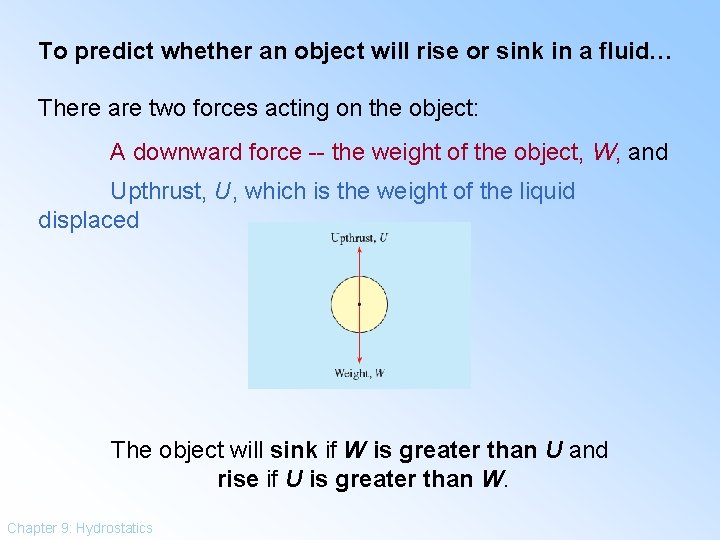
To predict whether an object will rise or sink in a fluid… There are two forces acting on the object: A downward force -- the weight of the object, W, and Upthrust, U, which is the weight of the liquid displaced The object will sink if W is greater than U and rise if U is greater than W. Chapter 9: Hydrostatics
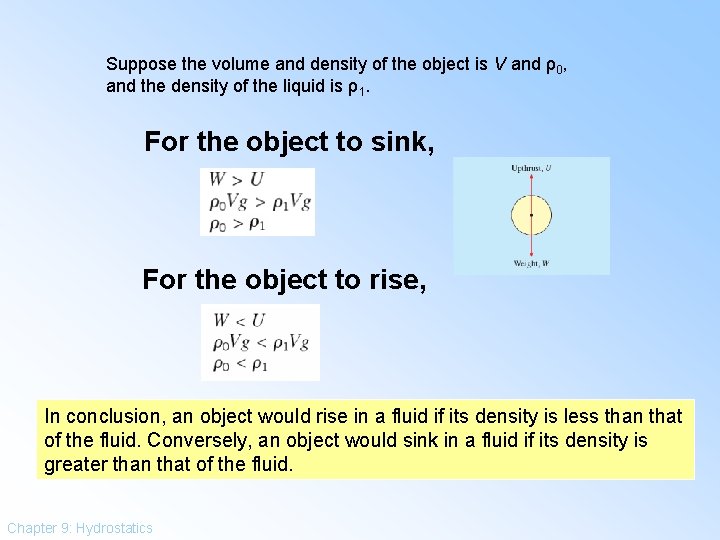
Suppose the volume and density of the object is V and ρ0, and the density of the liquid is ρ1. For the object to sink, For the object to rise, In conclusion, an object would rise in a fluid if its density is less than that of the fluid. Conversely, an object would sink in a fluid if its density is greater than that of the fluid. Chapter 9: Hydrostatics