
Chapter 9 Group Processes Influence in Social Groups




- Slides: 39
Chapter 9 Group Processes: Influence in Social Groups Copyright © 2016, 2013, 2010 Pearson Education, Inc. All Rights Reserved
Defining a Group � Two or more people who interact and are interdependent in the sense that their needs and goals cause them to influence each other Copyright © 2016, 2013, 2010 Pearson Education, Inc. All Rights Reserved
Why Do People Join Groups? � Group benefits: ◦ Important source of information: �Help us resolve ambiguity in social world ◦ Important aspect of identity: �Help us define who we are �Help us feel distinct from other groups ◦ Establishment of social norms Copyright © 2016, 2013, 2010 Pearson Education, Inc. All Rights Reserved
Social Roles Shared expectations in a group about how particular people are supposed to behave in that group Copyright © 2016, 2013, 2010 Pearson Education, Inc. All Rights Reserved
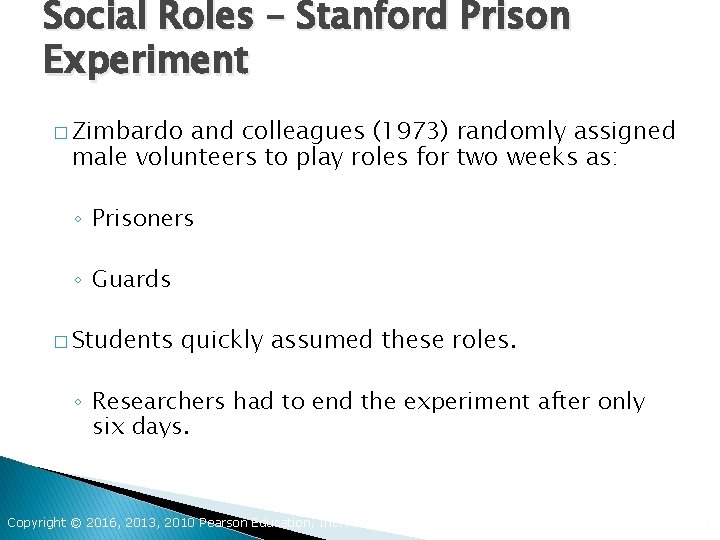
Social Roles – Stanford Prison Experiment � Zimbardo and colleagues (1973) randomly assigned male volunteers to play roles for two weeks as: ◦ Prisoners ◦ Guards � Students quickly assumed these roles. ◦ Researchers had to end the experiment after only six days. Copyright © 2016, 2013, 2010 Pearson Education, Inc. All Rights Reserved
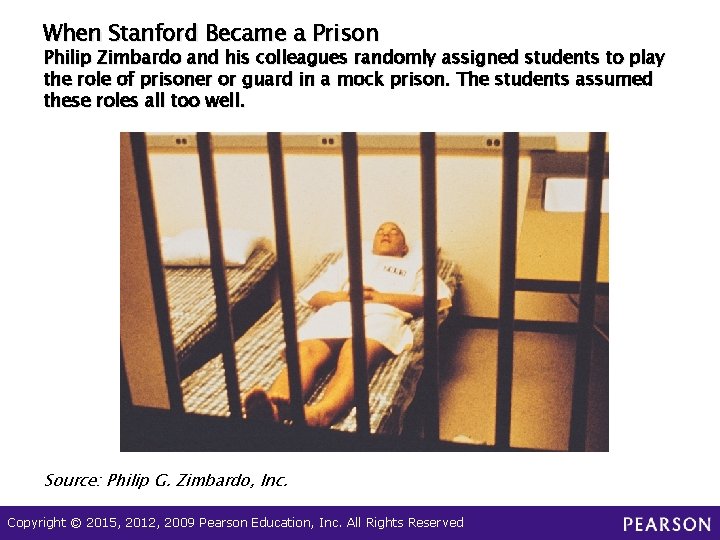
When Stanford Became a Prison Philip Zimbardo and his colleagues randomly assigned students to play the role of prisoner or guard in a mock prison. The students assumed these roles all too well. Source: Philip G. Zimbardo, Inc. Copyright © 2015, 2012, 2009 Pearson Education, Inc. All Rights Reserved
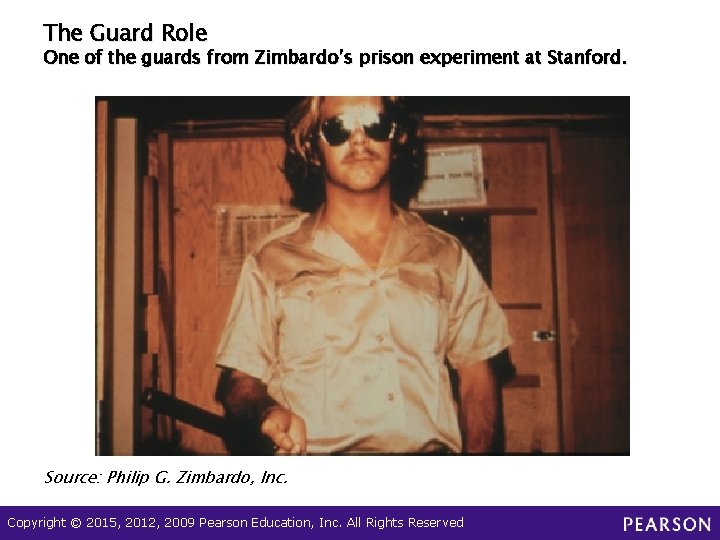
The Guard Role One of the guards from Zimbardo’s prison experiment at Stanford. Source: Philip G. Zimbardo, Inc. Copyright © 2015, 2012, 2009 Pearson Education, Inc. All Rights Reserved
Group Cohesiveness � The more cohesive a group is, the more its members are likely to: ◦ Stay in the group ◦ Take part in group activities ◦ Try to recruit new like-minded members Group Cohesiveness Qualities of a group that bind members together and promote liking between members Copyright © 2016, 2013, 2010 Pearson Education, Inc. All Rights Reserved
Group Diversity (1 of 2) � Group members tend to be alike in age, sex, beliefs and opinions � Why are they similar? ◦ Attracted to and likely to recruit similar others ◦ Groups operate in ways that encourage similarity in the members Copyright © 2016, 2013, 2010 Pearson Education, Inc. All Rights Reserved
Group Diversity (2 of 2) � Homogenous � Diverse groups are more cohesive groups perform better Copyright © 2016, 2013, 2010 Pearson Education, Inc. All Rights Reserved
Individual Behavior in a Group Setting 9. 2 In what ways do individuals perform differently when others are around? Copyright © 2016, 2013, 2010 Pearson Education, Inc. All Rights Reserved
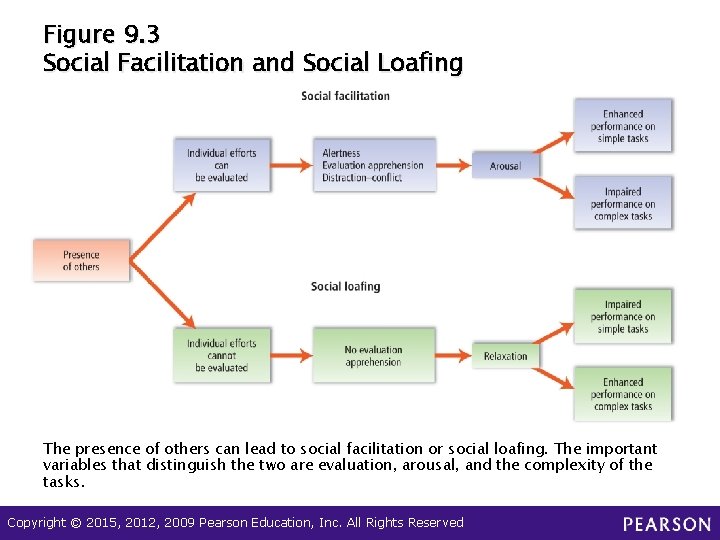
Social Facilitation � Social Facilitation ◦ People do better on simple tasks, and worse on complex tasks, when they are in the presence of others and their individual performance can be evaluated Copyright © 2016, 2013, 2010 Pearson Education, Inc. All Rights Reserved
A Crowded-Classroom Benefit Research on social facilitation finds that people do better on a welllearned task when in the presence of others than when they are alone. If students have studied hard and know the material well, they might be better off taking an exam in a room with lots of other people. Source: wavebreakmedia/Shutterstock Copyright © 2015, 2012, 2009 Pearson Education, Inc. All Rights Reserved
Social Loafing (3 of 3) � Social Loafing ◦ People do worse on simple tasks but better on complex tasks when they are in the presence of others and their individual performance cannot be evaluated Copyright © 2016, 2013, 2010 Pearson Education, Inc. All Rights Reserved
Figure 9. 3 Social Facilitation and Social Loafing The presence of others can lead to social facilitation or social loafing. The important variables that distinguish the two are evaluation, arousal, and the complexity of the tasks. Copyright © 2015, 2012, 2009 Pearson Education, Inc. All Rights Reserved
Deindividuation: Getting Lost in the Crowd (1 of 2) � Deindividuation ◦ The loosening of normal constraints on behavior when people cannot be differentiated (such as when they are in a crowd), leading to an increase in impulsive and deviant acts Copyright © 2016, 2013, 2010 Pearson Education, Inc. All Rights Reserved
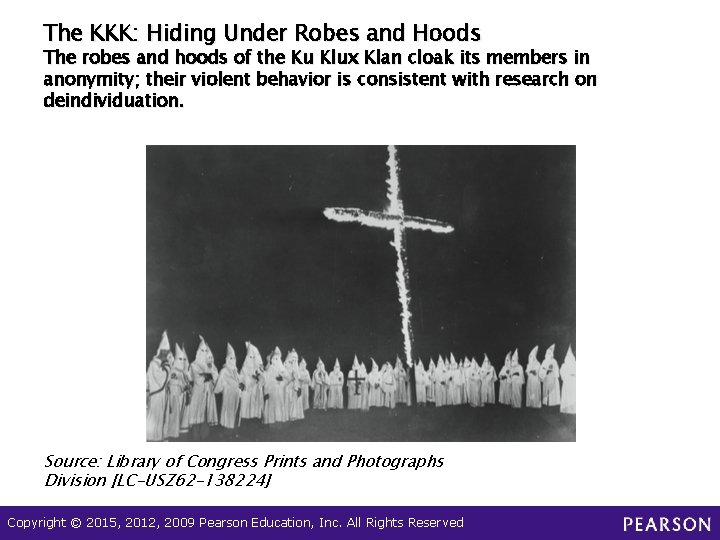
The KKK: Hiding Under Robes and Hoods The robes and hoods of the Ku Klux Klan cloak its members in anonymity; their violent behavior is consistent with research on deindividuation. Source: Library of Congress Prints and Photographs Division [LC-USZ 62 -138224] Copyright © 2015, 2012, 2009 Pearson Education, Inc. All Rights Reserved
Deindividuation Makes People Feel Less Accountable � Why does deindividuation lead to impulsive and sometime violent acts? ◦ Makes people feel less accountable ◦ Increases obedience to group norms Copyright © 2016, 2013, 2010 Pearson Education, Inc. All Rights Reserved
Deindividuation Online (1 of 2) � Deindividuation contact does not require face-to-face ◦ Example: feeling less inhibited on social media that’s anonymous Copyright © 2016, 2013, 2010 Pearson Education, Inc. All Rights Reserved
Deindividuation Copyright © 2016, 2013, 2010 Pearson Education, Inc. All Rights Reserved
Group Decisions: Are Two (or More) Heads Better Than One? 9. 3 Are two (or more) heads better than one in decision making, and how do leaders shape group outcomes? Copyright © 2016, 2013, 2010 Pearson Education, Inc. All Rights Reserved
Process Loss � Any aspect of group interaction that inhibits good problem solving Copyright © 2016, 2013, 2010 Pearson Education, Inc. All Rights Reserved
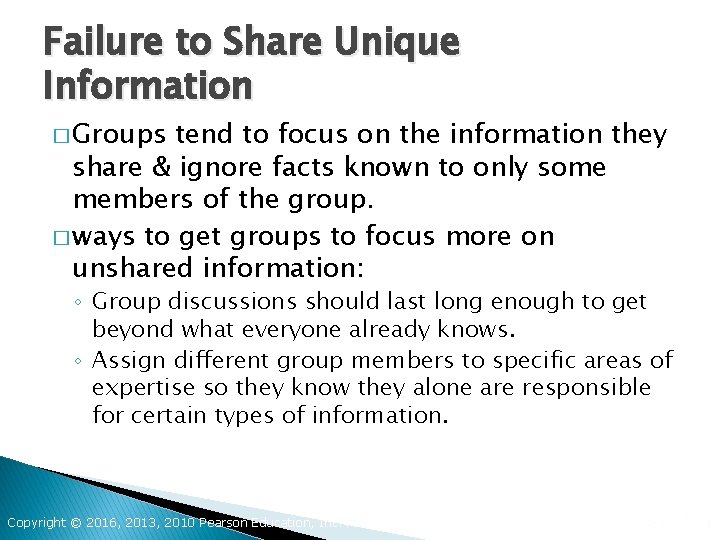
Failure to Share Unique Information � Groups tend to focus on the information they share & ignore facts known to only some members of the group. � ways to get groups to focus more on unshared information: ◦ Group discussions should last long enough to get beyond what everyone already knows. ◦ Assign different group members to specific areas of expertise so they know they alone are responsible for certain types of information. Copyright © 2016, 2013, 2010 Pearson Education, Inc. All Rights Reserved
Groupthink �A kind of thinking in which maintaining group cohesiveness and solidarity is more important than considering the facts in a realistic manner Copyright © 2016, 2013, 2010 Pearson Education, Inc. All Rights Reserved
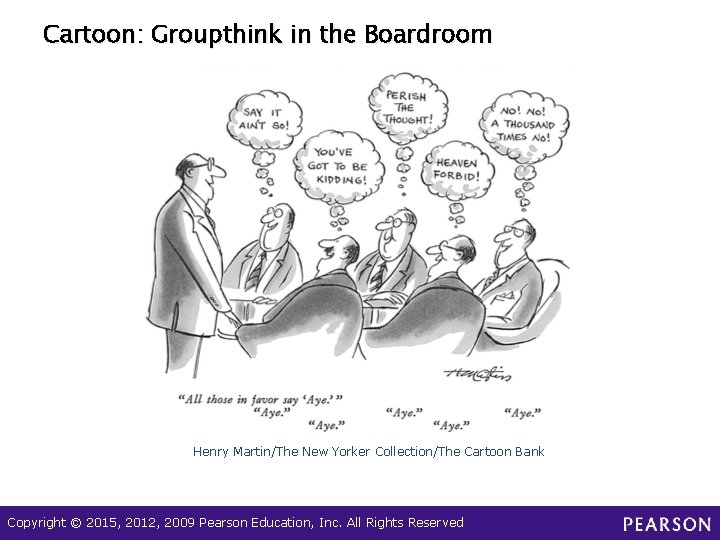
Cartoon: Groupthink in the Boardroom Henry Martin/The New Yorker Collection/The Cartoon Bank Copyright © 2015, 2012, 2009 Pearson Education, Inc. All Rights Reserved
Figure 9. 4 Groupthink: Antecedents, Symptoms, and Consequences Under some conditions, maintaining group cohesiveness and solidarity is more important to a group than considering the facts in a realistic manner (see “Antecedents”). When this happens, certain symptoms of groupthink occur, such as the illusion of invulnerability (see “Symptoms”). These symptoms lead to defective decision making. (Based on data in Janis & Mann, 1977. ) Copyright © 2015, 2012, 2009 Pearson Education, Inc. All Rights Reserved
Avoiding the Groupthink Trap �A wise leader can take several steps to avoid groupthink: ◦ Remain impartial ◦ Seek outside opinions ◦ Create subgroups ◦ Seek anonymous opinions Copyright © 2016, 2013, 2010 Pearson Education, Inc. All Rights Reserved
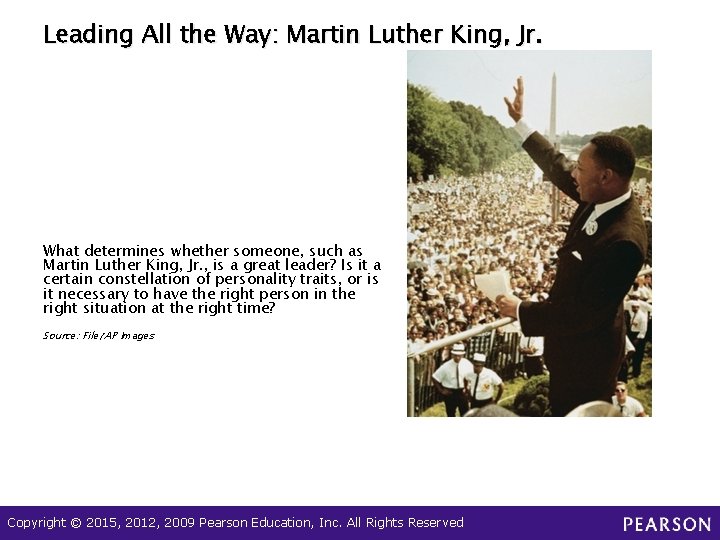
Leading All the Way: Martin Luther King, Jr. What determines whether someone, such as Martin Luther King, Jr. , is a great leader? Is it a certain constellation of personality traits, or is it necessary to have the right person in the right situation at the right time? Source: File/AP Images Copyright © 2015, 2012, 2009 Pearson Education, Inc. All Rights Reserved
Leadership Styles � Transactional Leaders ◦ Leaders who set clear, short-term goals and reward people who meet them � Transformational Leaders ◦ Leaders who inspire followers to focus on common, long-term goals Copyright © 2016, 2013, 2010 Pearson Education, Inc. All Rights Reserved
The Right Person in the Right Situation � Contingency Theory of Leadership ◦ The idea that leadership effectiveness depends both on how task-oriented or relationship-oriented the leader is and on the amount of control and influence the leader has over the group Copyright © 2016, 2013, 2010 Pearson Education, Inc. All Rights Reserved
Contingency Theory of Leadership (1 of 3) � Two basic types 1. Task-Oriented Leader �A leader concerned more with getting the job done than with workers’ feelings and relationships 2. Relationship-Oriented Leader �A leader who is concerned primarily with workers’ feelings and relationships Copyright © 2016, 2013, 2010 Pearson Education, Inc. All Rights Reserved
Gender and Leadership � Double bind for women leaders: ◦ If warm and communal, �Perceived as having low leadership potential ◦ If agentic and forceful �Often perceived negatively for not “acting like a woman should” Copyright © 2016, 2013, 2010 Pearson Education, Inc. All Rights Reserved
Gender and Leadership (3 of 3) � Glass cliff ◦ Women are thought to be better at managing crises (especially interpersonal ones) �Puts them in precarious positions where difficult to succeed Copyright © 2016, 2013, 2010 Pearson Education, Inc. All Rights Reserved
GM’s First Female CEO Inherits a Recall In 2014, Mary Barra became the first female CEO of a major global automaker, in this case General Motors. Within months, she had to announce plans for GM to recall over 11 million cars due to defective design components that the company had known about for nearly 10 years. Could Barra become another example of a woman who broke through a “glass ceiling” only to find herself on a “glass cliff”? Source: US Senate/Alamy Copyright © 2015, 2012, 2009 Pearson Education, Inc. All Rights Reserved
Conflict and Cooperation 9. 4 What determines the likelihood that individual or group conflict will escalate or be resolved? Copyright © 2016, 2013, 2010 Pearson Education, Inc. All Rights Reserved
Social Dilemmas �A conflict in which the most beneficial action for an individual, if chosen by most people, will have harmful effects on everyone Copyright © 2016, 2013, 2010 Pearson Education, Inc. All Rights Reserved
Negotiation and Bargaining (1 of 3) � Negotiation ◦ A form of communication between opposing sides in a conflict in which offers and counteroffers are made and a solution occurs only when both parties agree Copyright © 2016, 2013, 2010 Pearson Education, Inc. All Rights Reserved
Negotiation and Bargaining (2 of 3) � Integrative Solution ◦ A solution to conflict whereby parties make tradeoffs on issues according to their different interests; each side concedes the most on issues that are unimportant to it but important to the other side Copyright © 2016, 2013, 2010 Pearson Education, Inc. All Rights Reserved
Negotiation and Bargaining (3 of 3) � When negotiating, integrative solutions are often available: ◦ Work on gaining trust and communicating. ◦ Remember people often construe situation differently. ◦ Neutral mediators often help solve labor disputes, legal battles, and divorce proceedings by recognizing that there are mutually agreeable solutions to a conflict. Copyright © 2016, 2013, 2010 Pearson Education, Inc. All Rights Reserved