
Chapter 9 Games with Imperfect Information Bayesian Games
Chapter 9 Games with Imperfect Information Bayesian Games

Complete versus Incomplete Information • So far we have assumed that players hold the correct belief about the other players’ actions. • In many situations, this is not realistic. Players’ payoffs may NOT be common knowledge. You may be participating in an auction where you do not know the valuations of the other bidders. Firms may not know their competitors’ cost functions. • In Bayesian games, we analyze situations in which each player is imperfectly informed about an aspect of her environment that is relevant to her choice of action.
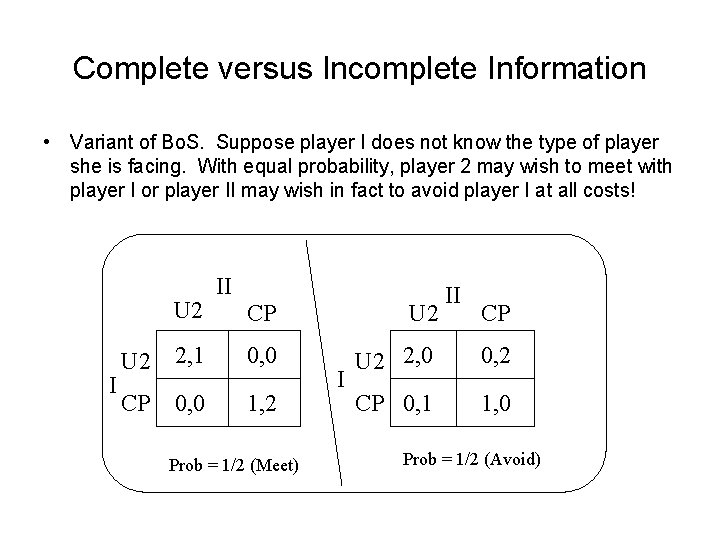
Complete versus Incomplete Information • Variant of Bo. S. Suppose player I does not know the type of player she is facing. With equal probability, player 2 may wish to meet with player I or player II may wish in fact to avoid player I at all costs! U 2 I II II CP U 2 2, 0 0, 2 CP 0, 1 1, 0 U 2 2, 1 0, 0 CP 0, 0 1, 2 Prob = 1/2 (Meet) I CP Prob = 1/2 (Avoid)
Complete versus Incomplete Information • Perfect Information: at each move in the game the player with the move knows the full history of the game thus far. • Imperfect information: at some move of the game the player with the move does Not know the history of the game.
Complete versus Incomplete Information Definition: an information set for a player is a collection of decision nodes satisfying: – The player has the move at every node in the information set, and – When the play of the game reaches a node in the information set, the player with the move does not know which node in the information set has (or has not) been reached
Equivalent Definitions • Perfect Information: every information set is a singleton. • Imperfect Information: there is at least one nonsingleton information set.
Incomplete Information Definition: a subgame in an extensive game (account for imperfect information) – Begins at a decision x node that is a singleton information set – Includes all the decision and terminal nodes following x in the game tree (but no nodes that do not follow x), and – Does not cut any information set.
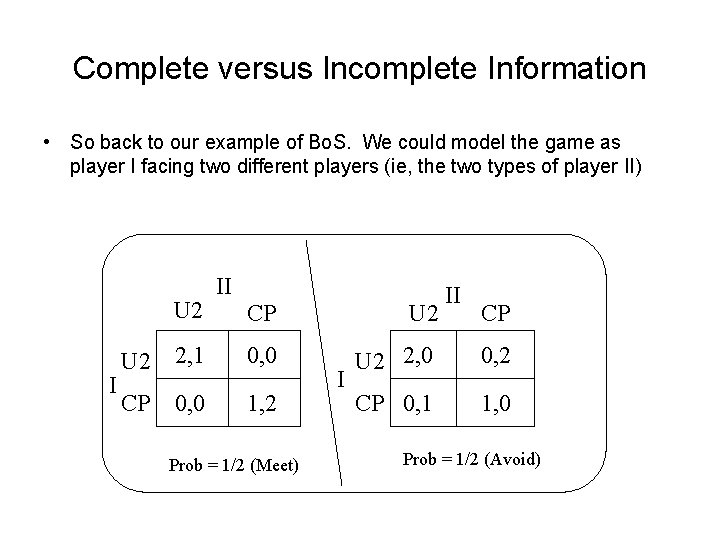
Complete versus Incomplete Information • So back to our example of Bo. S. We could model the game as player I facing two different players (ie, the two types of player II) U 2 I II II CP U 2 2, 0 0, 2 CP 0, 1 1, 0 U 2 2, 1 0, 0 CP 0, 0 1, 2 Prob = 1/2 (Meet) I CP Prob = 1/2 (Avoid)
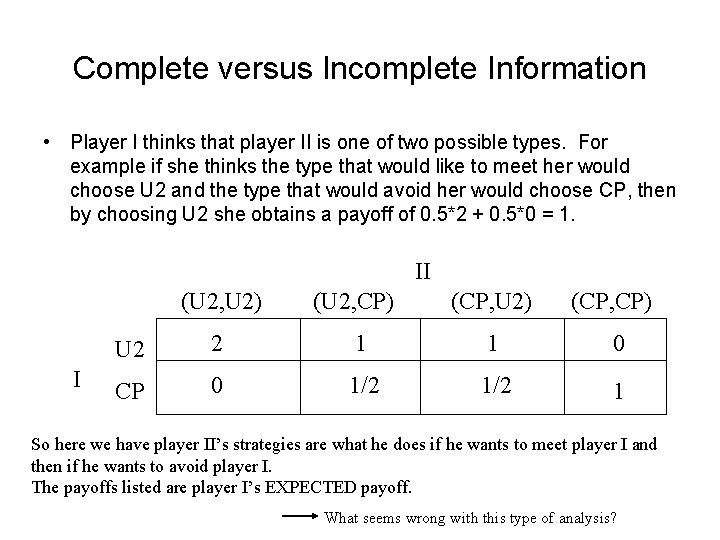
Complete versus Incomplete Information • Player I thinks that player II is one of two possible types. For example if she thinks the type that would like to meet her would choose U 2 and the type that would avoid her would choose CP, then by choosing U 2 she obtains a payoff of 0. 5*2 + 0. 5*0 = 1. II (U 2, U 2) I (U 2, CP) (CP, U 2) (CP, CP) U 2 2 1 1 0 CP 0 1/2 1 So here we have player II’s strategies are what he does if he wants to meet player I and then if he wants to avoid player I. The payoffs listed are player I’s EXPECTED payoff. What seems wrong with this type of analysis?
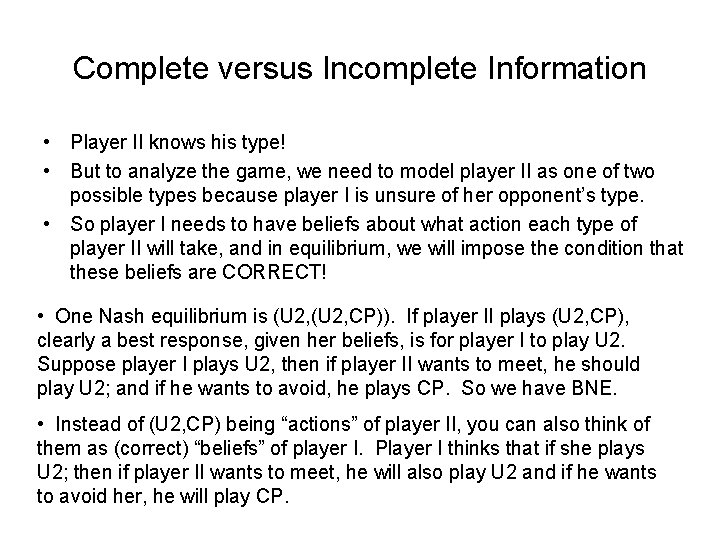
Complete versus Incomplete Information • Player II knows his type! • But to analyze the game, we need to model player II as one of two possible types because player I is unsure of her opponent’s type. • So player I needs to have beliefs about what action each type of player II will take, and in equilibrium, we will impose the condition that these beliefs are CORRECT! • One Nash equilibrium is (U 2, CP)). If player II plays (U 2, CP), clearly a best response, given her beliefs, is for player I to play U 2. Suppose player I plays U 2, then if player II wants to meet, he should play U 2; and if he wants to avoid, he plays CP. So we have BNE. • Instead of (U 2, CP) being “actions” of player II, you can also think of them as (correct) “beliefs” of player I. Player I thinks that if she plays U 2; then if player II wants to meet, he will also play U 2 and if he wants to avoid her, he will play CP.
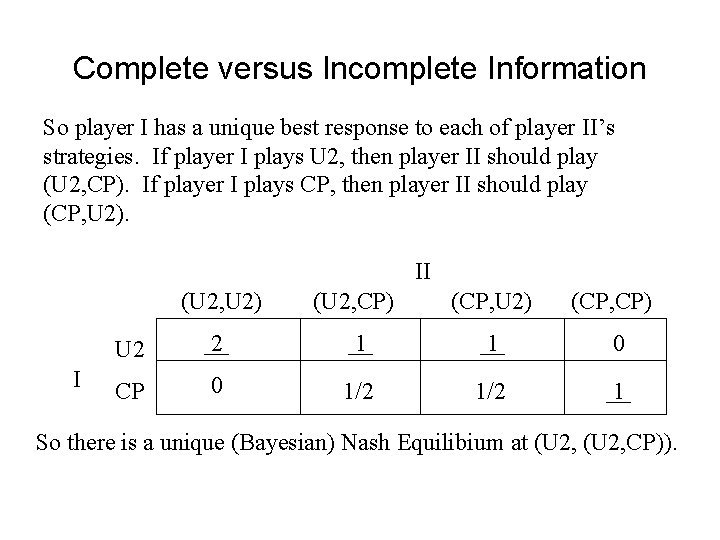
Complete versus Incomplete Information So player I has a unique best response to each of player II’s strategies. If player I plays U 2, then player II should play (U 2, CP). If player I plays CP, then player II should play (CP, U 2). II (U 2, U 2) I (U 2, CP) (CP, U 2) (CP, CP) U 2 2 1 1 0 CP 0 1/2 1 So there is a unique (Bayesian) Nash Equilibium at (U 2, CP)).
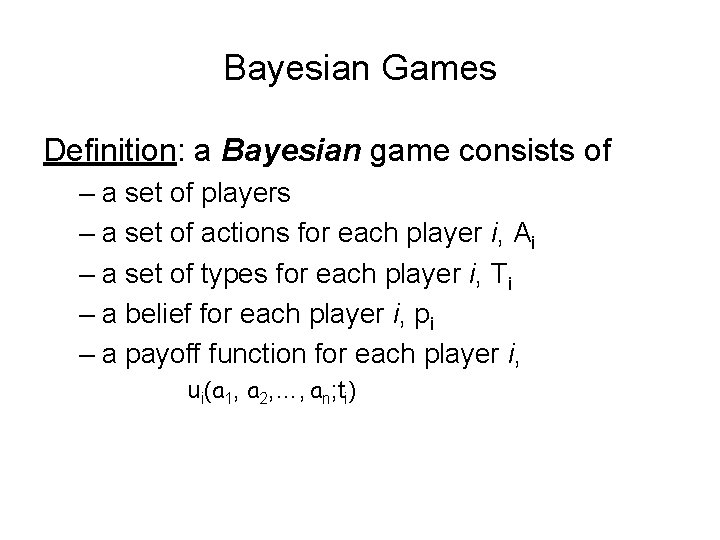
Bayesian Games Definition: a Bayesian game consists of – a set of players – a set of actions for each player i, Ai – a set of types for each player i, Ti – a belief for each player i, pi – a payoff function for each player i, ui(a 1, a 2, …, an; ti)
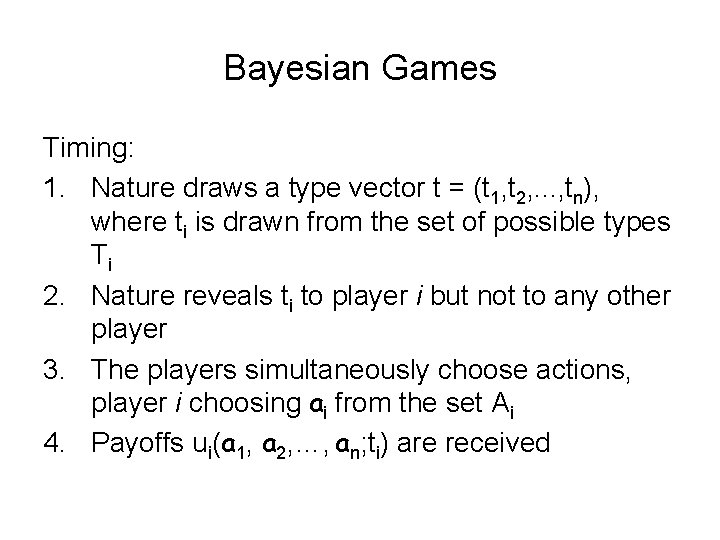
Bayesian Games Timing: 1. Nature draws a type vector t = (t 1, t 2, . . . , tn), where ti is drawn from the set of possible types Ti 2. Nature reveals ti to player i but not to any other player 3. The players simultaneously choose actions, player i choosing ai from the set Ai 4. Payoffs ui(a 1, a 2, …, an; ti) are received
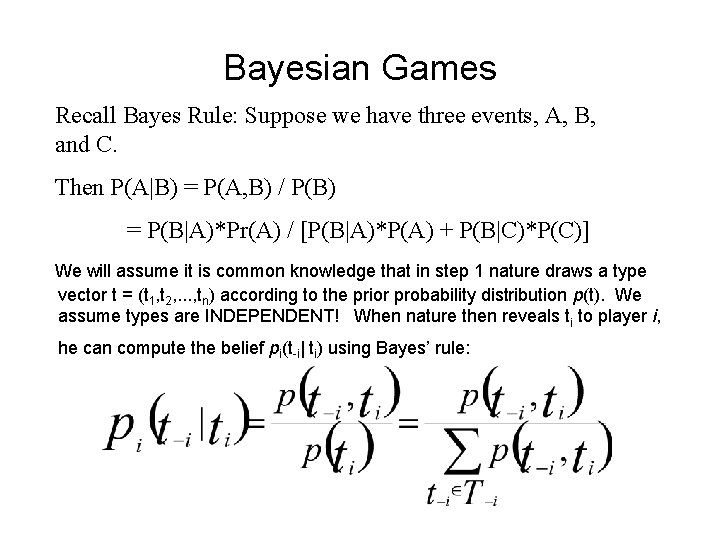
Bayesian Games Recall Bayes Rule: Suppose we have three events, A, B, and C. Then P(A|B) = P(A, B) / P(B) = P(B|A)*Pr(A) / [P(B|A)*P(A) + P(B|C)*P(C)] We will assume it is common knowledge that in step 1 nature draws a type vector t = (t 1, t 2, . . . , tn) according to the prior probability distribution p(t). We assume types are INDEPENDENT! When nature then reveals ti to player i, he can compute the belief pi(t-i| ti) using Bayes’ rule:
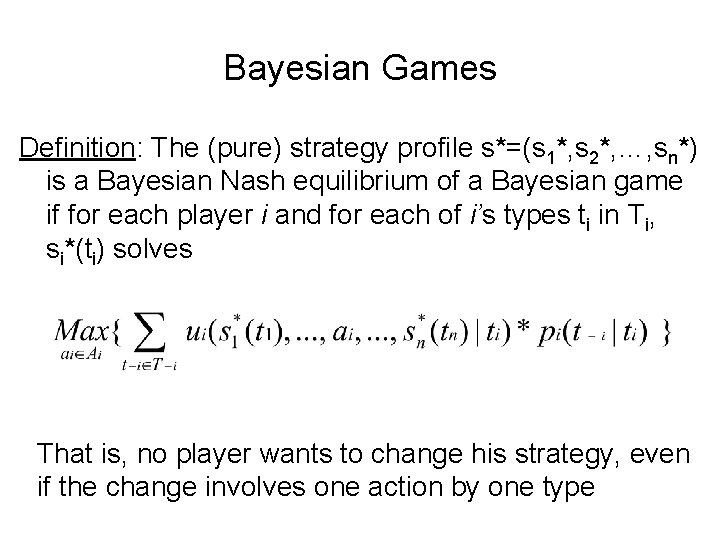
Bayesian Games Definition: The (pure) strategy profile s*=(s 1*, s 2*, …, sn*) is a Bayesian Nash equilibrium of a Bayesian game if for each player i and for each of i’s types ti in Ti, si*(ti) solves That is, no player wants to change his strategy, even if the change involves one action by one type
Bayesian Games • So in a strategic game, (simultaneous with perfect information), each player chose an action. In a Bayesian game, each type of each player chooses an action. In a NE of a Bayesian game, the action chosen by each type of each player is optimal, given the actions chosen by every type of every other player. • Fighting an Opponent of Unknown Strength (282. 1) • First Price Sealed Bid Auction (N=2) • Cournot game pg 285.
- Slides: 16