
Chapter 9 Fundamentals of Capital Budgeting Chapter Outline

Chapter 9 Fundamentals of Capital Budgeting
Chapter Outline 9. 1 The Capital Budgeting Process 9. 2 Forecasting Incremental Earnings 9. 3 Determining Incremental Free Cash Flow 9. 4 Other Effects on Incremental Free Cash Flows 9. 5 Analyzing the Project 9. 6 Real Options in Capital Budgeting Copyright © 2015 Pearson Education, Inc. All rights reserved. 9 -2
Learning Objectives • Identify the types of cash flows needed in the capital budgeting process • Forecast incremental earnings in a pro forma earnings statement for a project • Convert forecasted earnings to free cash flows and compute a project’s NPV • Recognize common pitfalls that arise in identifying a project’s incremental free cash flows • Assess the sensitivity of a project’s NPV to changes in your assumptions • Identify the most common options available to managers in projects and understand why these options can be valuable Copyright © 2015 Pearson Education, Inc. All rights reserved. 9 -3
9. 1 The Capital Budgeting Process • Capital Budgeting • Incremental Earnings Copyright © 2015 Pearson Education, Inc. All rights reserved. 9 -4
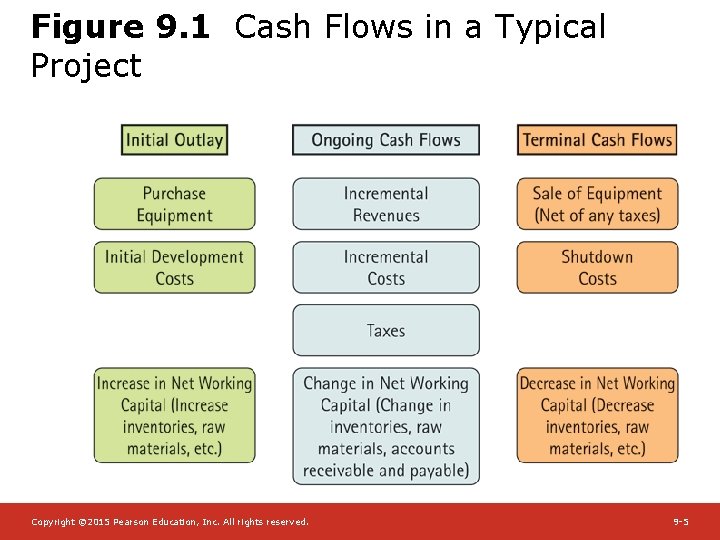
Figure 9. 1 Cash Flows in a Typical Project Copyright © 2015 Pearson Education, Inc. All rights reserved. 9 -5
9. 2 Forecasting Incremental Earnings • Operating Expenses Versus Capital Expenditures – Operating Expenses – Capital Expenditures Copyright © 2015 Pearson Education, Inc. All rights reserved. 9 -6

9. 2 Forecasting Incremental Earnings • Operating Expenses Versus Capital Expenditures – Depreciation • Depreciation expenses do not correspond to actual cash outflows – Straight-Line Depreciation Copyright © 2015 Pearson Education, Inc. All rights reserved. 9 -7
9. 2 Forecasting Incremental Earnings • Incremental Revenue and Cost Estimates – Factors to consider when estimating a project’s revenues and costs: 1. A new product typically has lower sales initially 2. The average selling price of a product and its cost of production will generally change over time 3. For most industries, competition tends to reduce profit margins over time Copyright © 2015 Pearson Education, Inc. All rights reserved. 9 -8
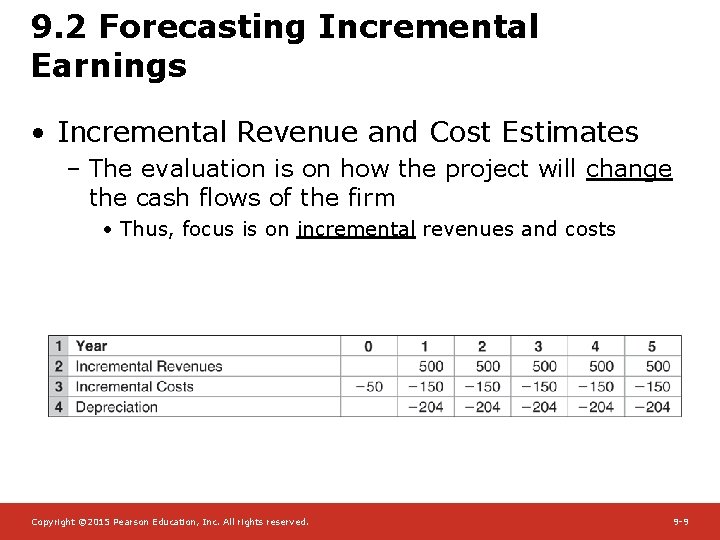
9. 2 Forecasting Incremental Earnings • Incremental Revenue and Cost Estimates – The evaluation is on how the project will change the cash flows of the firm • Thus, focus is on incremental revenues and costs Copyright © 2015 Pearson Education, Inc. All rights reserved. 9 -9
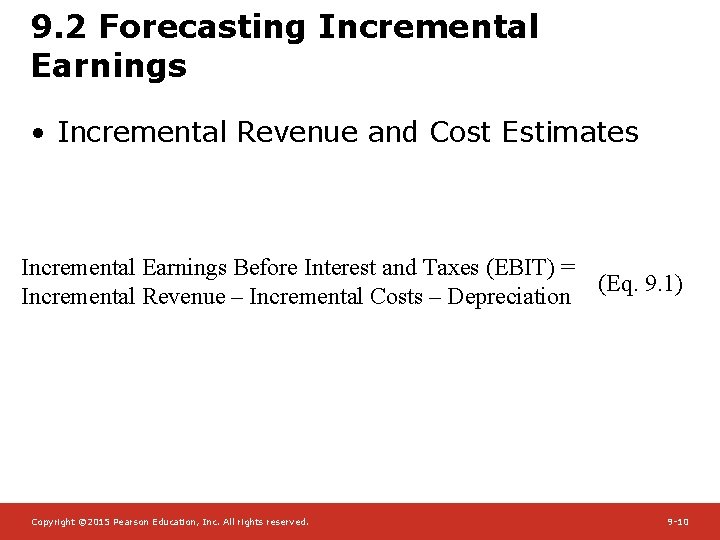
9. 2 Forecasting Incremental Earnings • Incremental Revenue and Cost Estimates Incremental Earnings Before Interest and Taxes (EBIT) = (Eq. 9. 1) Incremental Revenue – Incremental Costs – Depreciation Copyright © 2015 Pearson Education, Inc. All rights reserved. 9 -10

9. 2 Forecasting Incremental Earnings • Taxes – Marginal Corporate Tax Rate • The tax rate a firm will pay on an incremental dollar of pre-tax income Income Tax = EBIT The Firm’s Marginal Corporate Tax Rate Copyright © 2015 Pearson Education, Inc. All rights reserved. (Eq. 9. 2) 9 -11
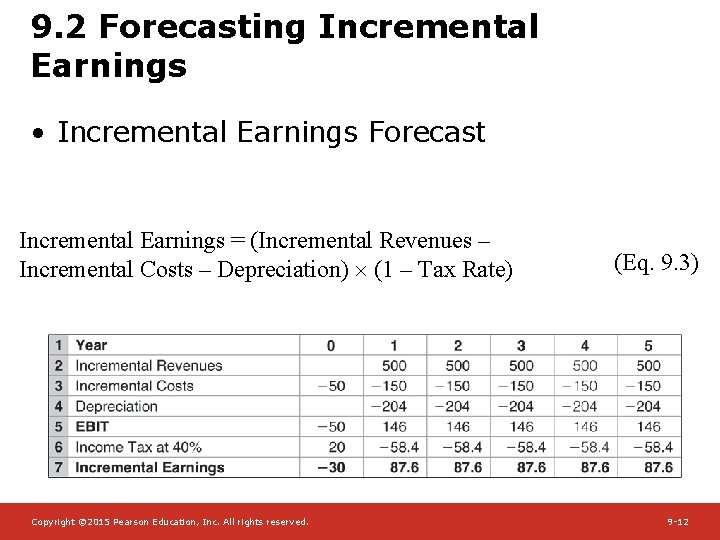
9. 2 Forecasting Incremental Earnings • Incremental Earnings Forecast Incremental Earnings = (Incremental Revenues – Incremental Costs – Depreciation) (1 – Tax Rate) Copyright © 2015 Pearson Education, Inc. All rights reserved. (Eq. 9. 3) 9 -12

Example 9. 1 Incremental Earnings Problem: • Suppose that Linksys is considering the development of a wireless home networking appliance, called Home. Net, that will provide both the hardware and the software necessary to run an entire home from any Internet connection. Home. Net will also control new Internet-capable stereos, digital video recorders, heating and air-conditioning units, major appliances, telephone and security systems, office equipment, and so on. The major competitor for Home. Net is a product being developed by Brandt-Quigley Corporation. Copyright © 2015 Pearson Education, Inc. All rights reserved. 9 -13
Example 9. 1 Incremental Earnings Problem: • Based on extensive marketing surveys, the sales forecast for Home. Net is 50, 000 units per year. Given the pace of technological change, Linksys expects the product will have a four-year life and an expected wholesale price of $260 (the price Linksys will receive from stores). Actual production will be outsourced at a cost (including packaging) of $110 per unit. Copyright © 2015 Pearson Education, Inc. All rights reserved. 9 -14
Example 9. 1 Incremental Earnings Problem (cont'd): • To verify the compatibility of new consumer Internet-ready appliances with the Home. Net system as they become available, Linksys must also establish a new lab for testing purposes. They will rent the lab space, but will need to purchase $7. 5 million of new equipment. The equipment will be depreciated using the straight-line method over a 5 -year life. Linksys' marginal tax rate is 40%. Copyright © 2015 Pearson Education, Inc. All rights reserved. 9 -15
Example 9. 1 Incremental Earnings Problem (cont'd): • The lab will be operational at the end of one year. At that time, Home. Net will be ready to ship. Linksys expects to spend $2. 8 million per year on rental costs for the lab space, as well as rent marketing and support for this product. Forecast the incremental earnings from the Home. Net project. Copyright © 2015 Pearson Education, Inc. All rights reserved. 9 -16
Example 9. 1 Incremental Earnings Solution: Plan: • We need 4 items to calculate incremental earnings: (1) incremental revenues, (2) incremental costs, (3) depreciation, and (4) the marginal tax rate: – Incremental Revenues are: additional units sold price = 50, 000 $260 = $13, 000 – Incremental Costs are: additional units sold production costs = 50, 000 $110 = $5, 500, 000 Copyright © 2015 Pearson Education, Inc. All rights reserved. 9 -17
Example 9. 1 Incremental Earnings Plan: • Selling, General and Administrative = $2, 800, 000 for marketing and support • Depreciation is: Depreciable basis / Depreciable Life = $7, 500, 000 / 5 = $1, 500, 000 • Marginal Tax Rate: 40% • Note that even though the project lasts for 4 years, the equipment has a 5 -year life, so we must account for the final depreciation charge in the 5 th year. Copyright © 2015 Pearson Education, Inc. All rights reserved. 9 -18
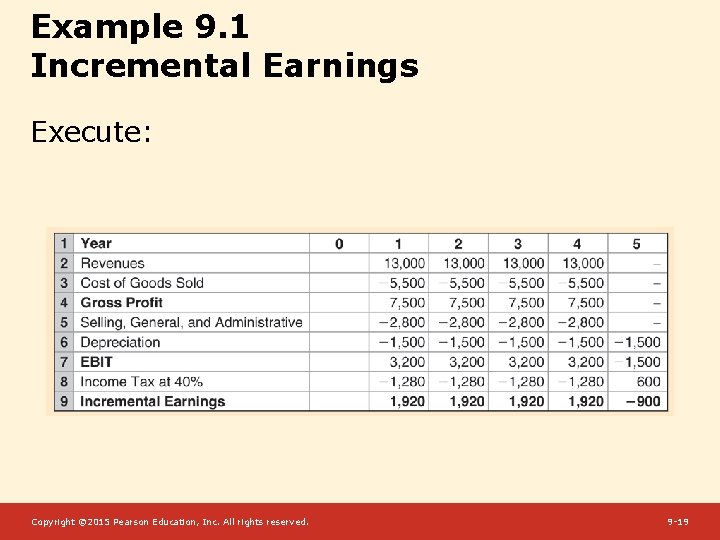
Example 9. 1 Incremental Earnings Execute: Copyright © 2015 Pearson Education, Inc. All rights reserved. 9 -19
Example 9. 1 Incremental Earnings Evaluate: • These incremental earnings are an intermediate step on the way to calculating the incremental cash flows that would form the basis of any analysis of the Home. Net project. The cost of the equipment does not affect earnings in the year it is purchased, but does so through the depreciation expense in the following five years. Copyright © 2015 Pearson Education, Inc. All rights reserved. 9 -20
Example 9. 1 Incremental Earnings Evaluate (cont'd): • Note that the depreciable life, which is based on accounting rules, does not have to be the same as the economic life of the asset—the period over which it will have value. Here the firm will use the equipment for four years, but depreciates it over five years. Copyright © 2015 Pearson Education, Inc. All rights reserved. 9 -21

Example 9. 1 a Incremental Earnings Problem: • Suppose that Linksys is considering the development of a wireless home networking appliance, called Home. Net, that will provide both the hardware and the software necessary to run an entire home from any Internet connection. Home. Net will also control new Internet-capable stereos, digital video recorders, heating and air-conditioning units, major appliances, telephone and security systems, office equipment, and so on. The major competitor for Home. Net is a product being developed by Brandt-Quigley Corporation. Copyright © 2015 Pearson Education, Inc. All rights reserved. 9 -22
Example 9. 1 a Incremental Earnings Problem: • Based on extensive marketing surveys, the sales forecast for Home. Net is 40, 000 units per year. Given the pace of technological change, Linksys expects the product will have a four-year life and an expected wholesale price of $200 (the price Linksys will receive from stores). Actual production will be outsourced at a cost (including packaging) of $90 per unit. Copyright © 2015 Pearson Education, Inc. All rights reserved. 9 -23
Example 9. 1 a Incremental Earnings Problem (cont'd): • To verify the compatibility of new consumer Internet-ready appliances with the Home. Net system as they become available, Linksys must also establish a new lab for testing purposes. They will rent the lab space, but will need to purchase $6. 5 million of new equipment. The equipment will be depreciated using the straight-line method over a 5 -year life. Copyright © 2015 Pearson Education, Inc. All rights reserved. 9 -24
Example 9. 1 a Incremental Earnings Problem (cont'd): • The lab will be operational at the end of one year. At that time, Home. Net will be ready to ship. Linksys expects to spend $2. 0 million per year on rental costs for the lab space, as well as marketing and support for this product. Forecast the incremental earnings from the Home. Net project. Copyright © 2015 Pearson Education, Inc. All rights reserved. 9 -25
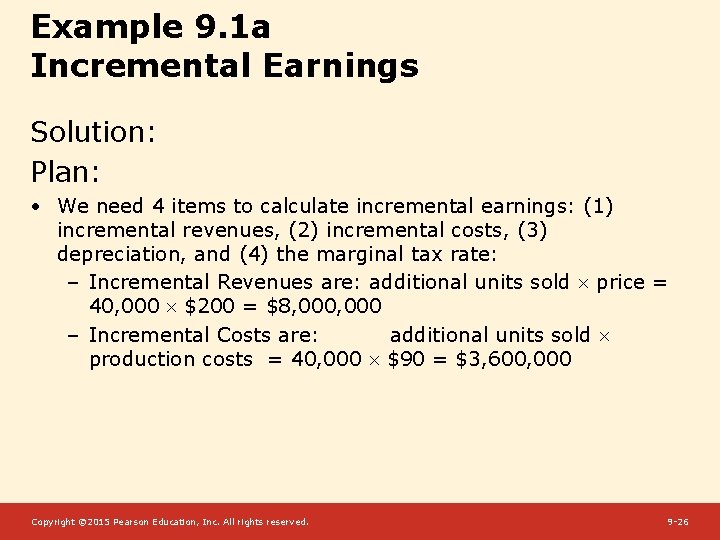
Example 9. 1 a Incremental Earnings Solution: Plan: • We need 4 items to calculate incremental earnings: (1) incremental revenues, (2) incremental costs, (3) depreciation, and (4) the marginal tax rate: – Incremental Revenues are: additional units sold price = 40, 000 $200 = $8, 000 – Incremental Costs are: additional units sold production costs = 40, 000 $90 = $3, 600, 000 Copyright © 2015 Pearson Education, Inc. All rights reserved. 9 -26
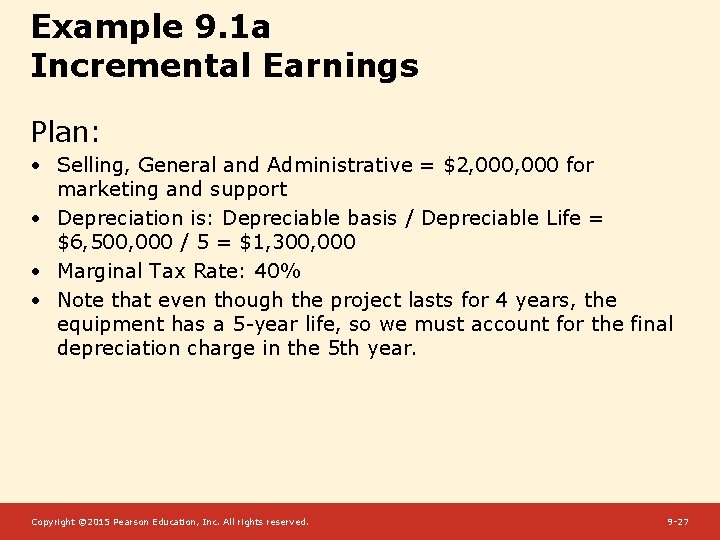
Example 9. 1 a Incremental Earnings Plan: • Selling, General and Administrative = $2, 000 for marketing and support • Depreciation is: Depreciable basis / Depreciable Life = $6, 500, 000 / 5 = $1, 300, 000 • Marginal Tax Rate: 40% • Note that even though the project lasts for 4 years, the equipment has a 5 -year life, so we must account for the final depreciation charge in the 5 th year. Copyright © 2015 Pearson Education, Inc. All rights reserved. 9 -27
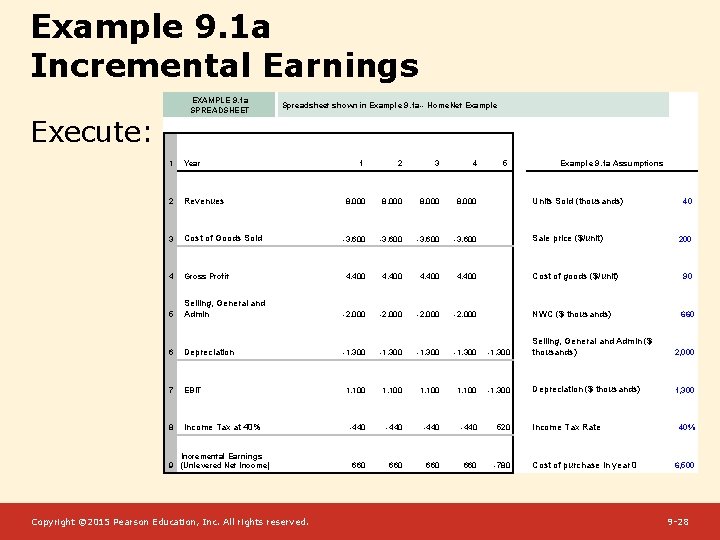
Example 9. 1 a Incremental Earnings Execute: EXAMPLE 9. 1 a SPREADSHEET Spreadsheet shown in Example 9. 1 a-- Home. Net Example 1 Year 2 Revenues 3 Cost of Goods Sold 4 Gross Profit 5 3 4 8, 000 Units Sold (thousands) -3, 600 Sale price ($/unit) 4, 400 Cost of goods ($/unit) 90 Selling, General and Admin -2, 000 NWC ($ thousands) 660 6 Depreciation -1, 300 -1, 300 Selling, General and Admin ($ thousands) 2, 000 7 EBIT 1, 100 -1, 300 Depreciation ($ thousands) 1, 300 8 Income Tax at 40% -440 520 Income Tax Rate 660 660 -780 Cost of purchase in year 0 Copyright © 2015 Pearson Education, Inc. All rights reserved. 1 2 Incremental Earnings 9 (Unlevered Net Income) Example 9. 1 a Assumptions 40 200 40% 6, 500 9 -28
Example 9. 1 a Incremental Earnings Evaluate: • These incremental earnings are an intermediate step on the way to calculating the incremental cash flows that would form the basis of any analysis of the Home. Net project. The cost of the equipment does not affect earnings in the year it is purchased, but does so through the depreciation expense in the following five years. Copyright © 2015 Pearson Education, Inc. All rights reserved. 9 -29
Example 9. 1 a Incremental Earnings Evaluate (cont'd): • Note that the depreciable life, which is based on accounting rules, does not have to be the same as the economic life of the asset—the period over which it will have value. Here the firm will use the equipment for four years, but depreciates it over five years. Copyright © 2015 Pearson Education, Inc. All rights reserved. 9 -30
9. 2 Forecasting Incremental Earnings • Incremental Earnings Forecast – Pro Forma Statement – Taxes and Negative EBIT – Interest Expense • Unlevered Net Income Copyright © 2015 Pearson Education, Inc. All rights reserved. 9 -31

Example 9. 2 Taxing Losses for Projects in Profitable Companies Problem: • Kellogg Company plans to launch a new line of high-fiber, zero-trans-fat breakfast pastries. The heavy advertising expenses associated with the new product launch will generate operating losses of $15 million next year for the product. Kellogg expects to earn pre-tax income of $460 million from operations other than the new pastries next year. If Kellogg pays a 40% tax rate on its pre-tax income, what will it owe in taxes next year without the new pastry product? What will it owe with the new pastries? Copyright © 2015 Pearson Education, Inc. All rights reserved. 9 -32
Example 9. 2 Taxing Losses for Projects in Profitable Companies Solution: Plan: • We need Kellogg’s pre-tax income with and without the new product losses and its tax rate of 40%. We can then compute the tax without the losses and compare it to the tax with the losses. Copyright © 2015 Pearson Education, Inc. All rights reserved. 9 -33
Example 9. 2 Taxing Losses for Projects in Profitable Companies Execute: • Without the new pastries, Kellogg will owe $460 million 40% = $184 million in corporate taxes next year. With the new pastries, Kellogg’s pre-tax income next year will be only $460 million - $15 million = $445 million, and it will owe $445 million 40% = $178 million in tax. Copyright © 2015 Pearson Education, Inc. All rights reserved. 9 -34
Example 9. 2 Taxing Losses for Projects in Profitable Companies Evaluate: • Thus, launching the new product reduces Kellogg’s taxes next year by $184 million - $178 million = $6 million. Because the losses on the new product reduce Kellogg’s taxable income dollar for dollar, it is the same as if the new product had a tax bill of negative $6 million. Copyright © 2015 Pearson Education, Inc. All rights reserved. 9 -35

Example 9. 2 a Taxing Losses for Projects in Profitable Companies Problem: • Kellogg Company plans to launch a new line of high-fiber, zero-trans-fat breakfast pastries. The heavy advertising expenses associated with the new product launch will generate operating losses of $10 million next year for the product. Kellogg expects to earn pre-tax income of $320 million from operations other than the new pastries next year. If Kellogg pays a 40% tax rate on its pre-tax income, what will it owe in taxes next year without the new pastry product? What will it owe with the new pastries? Copyright © 2015 Pearson Education, Inc. All rights reserved. 9 -36
Example 9. 2 a Taxing Losses for Projects in Profitable Companies Solution: Plan: • We need Kellogg’s pre-tax income with and without the new product losses and its tax rate of 40%. We can then compute the tax without the losses and compare it to the tax with the losses. Copyright © 2015 Pearson Education, Inc. All rights reserved. 9 -37
Example 9. 2 a Taxing Losses for Projects in Profitable Companies Execute: • Without the new pastries, Kellogg will owe $320 million 40% = $128 million in corporate taxes next year. With the new pastries, Kellogg’s pre-tax income next year will be only $320 million - $10 million = $310 million, and it will owe $310 million 40% = $124 million in tax. Copyright © 2015 Pearson Education, Inc. All rights reserved. 9 -38
Example 9. 2 a Taxing Losses for Projects in Profitable Companies Evaluate: • Thus, launching the new product reduces Kellogg’s taxes next year by $128 million - $124 million = $4 million. Because the losses on the new product reduce Kellogg’s taxable income dollar for dollar, it is the same as if the new product had a tax bill of negative $4 million. Copyright © 2015 Pearson Education, Inc. All rights reserved. 9 -39
9. 3 Determining Incremental Free Cash Flow • Converting from Earnings to Free Cash Flow – Free Cash Flow • The incremental effect of a project on a firm’s available cash – Capital Expenditures and Depreciation Copyright © 2015 Pearson Education, Inc. All rights reserved. 9 -40
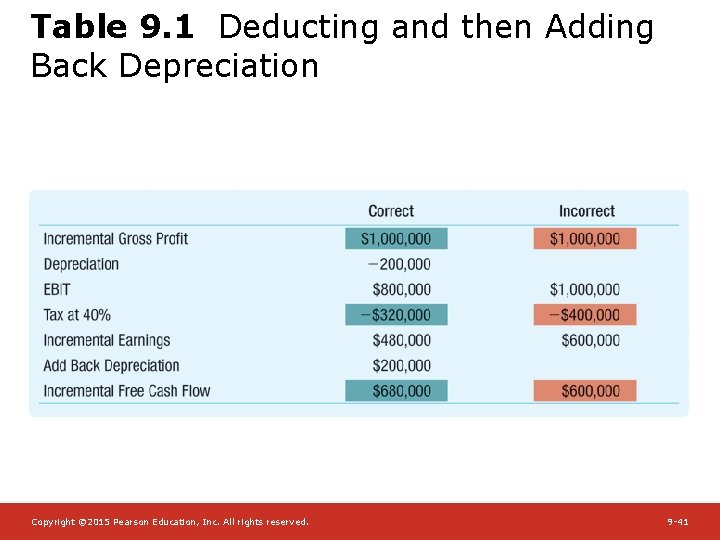
Table 9. 1 Deducting and then Adding Back Depreciation Copyright © 2015 Pearson Education, Inc. All rights reserved. 9 -41
Example 9. 3 Incremental Free Cash Flows Problem: • Let’s return to the Home. Net example. In Example 9. 1, we computed the incremental earnings for Home. Net, but we need the incremental free cash flows to decide whether Linksys should proceed with the project. Copyright © 2015 Pearson Education, Inc. All rights reserved. 9 -42
Example 9. 3 Incremental Free Cash Flows Solution: Plan: • The difference between the incremental earnings and incremental free cash flows in the Home. Net example will be driven by the equipment purchased for the lab. We need to recognize the $7. 5 million cash outflow associated with the purchase in year 0 and add back the $1. 5 million depreciation expenses from year 1 to 5 as they are not actually cash outflows. Copyright © 2015 Pearson Education, Inc. All rights reserved. 9 -43
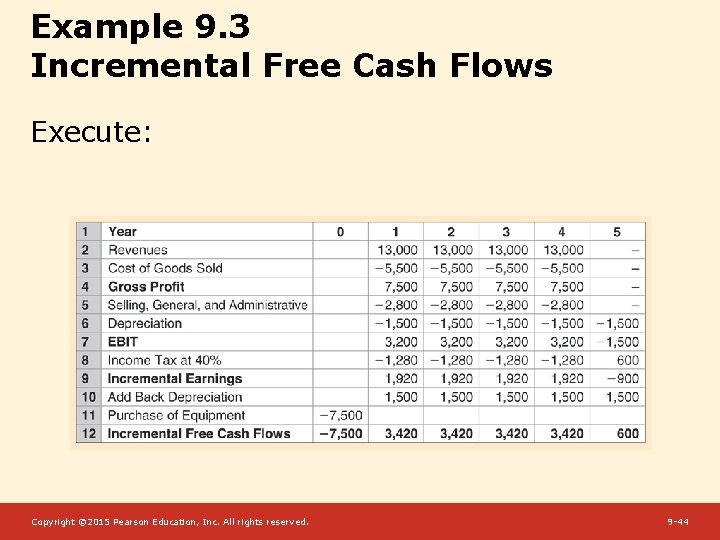
Example 9. 3 Incremental Free Cash Flows Execute: Copyright © 2015 Pearson Education, Inc. All rights reserved. 9 -44
Example 9. 3 Incremental Free Cash Flows Evaluate • By recognizing the outflow from purchasing the equipment in year 0, we account for the fact that $7. 5 million left the firm at that time. By adding back the $1. 5 million depreciation expenses in years 1 – 5, we adjust the incremental earnings to reflect the fact that the depreciation expense is not a cash outflow. Copyright © 2015 Pearson Education, Inc. All rights reserved. 9 -45
Example 9. 3 a Incremental Free Cash Flows Problem: • Let’s return to the Home. Net example. In Example 9. 1 a, we computed the incremental earnings for Home. Net, but we need the incremental free cash flows to decide whether Linksys should proceed with the project. Copyright © 2015 Pearson Education, Inc. All rights reserved. 9 -46
Example 9. 3 a Incremental Free Cash Flows Solution: Plan: • The difference between the incremental earnings and incremental free cash flows in the Home. Net example will be driven by the equipment purchased for the lab. We need to recognize the $6. 5 million cash outflow associated with the purchase in year 0 and add back the $1. 3 million depreciation expenses from year 1 to 5 as they are not actually cash outflows. Copyright © 2015 Pearson Education, Inc. All rights reserved. 9 -47
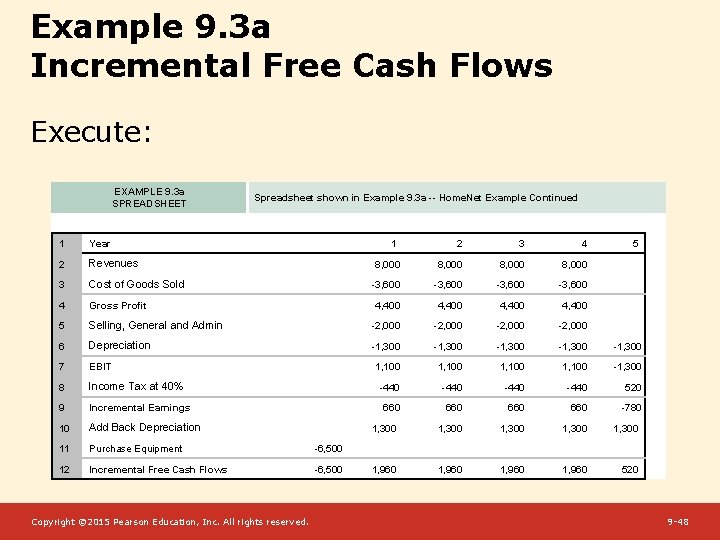
Example 9. 3 a Incremental Free Cash Flows Execute: EXAMPLE 9. 3 a SPREADSHEET Spreadsheet shown in Example 9. 3 a -- Home. Net Example Continued 1 Year 2 Revenues 3 Cost of Goods Sold 4 Gross Profit 5 3 4 8, 000 -3, 600 4, 400 Selling, General and Admin -2, 000 6 Depreciation -1, 300 -1, 300 7 EBIT 1, 100 -1, 300 8 Income Tax at 40% -440 520 9 Incremental Earnings 660 660 -780 10 Add Back Depreciation 1, 300 11 Purchase Equipment 12 Incremental Free Cash Flows 1, 300 -6, 500 1, 960 5 2 Copyright © 2015 Pearson Education, Inc. All rights reserved. 1 1, 300 1, 960 520 9 -48
Example 9. 3 a Incremental Free Cash Flows Evaluate: • By recognizing the outflow from purchasing the equipment in year 0, we account for the fact that $6. 5 million left the firm at that time. By adding back the $1. 3 million depreciation expenses in years 1 – 5, we adjust the incremental earnings to reflect the fact that the depreciation expense is not a cash outflow. Copyright © 2015 Pearson Education, Inc. All rights reserved. 9 -49
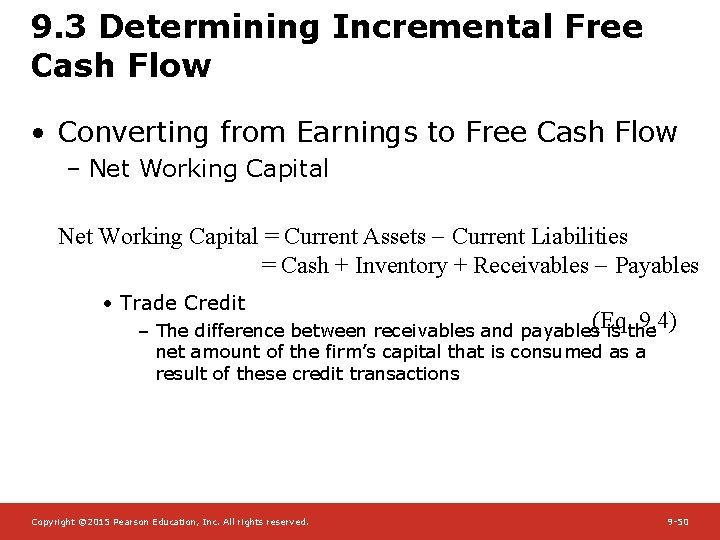
9. 3 Determining Incremental Free Cash Flow • Converting from Earnings to Free Cash Flow – Net Working Capital = Current Assets Current Liabilities = Cash + Inventory + Receivables Payables • Trade Credit (Eq. 9. 4) – The difference between receivables and payables is the net amount of the firm’s capital that is consumed as a result of these credit transactions Copyright © 2015 Pearson Education, Inc. All rights reserved. 9 -50
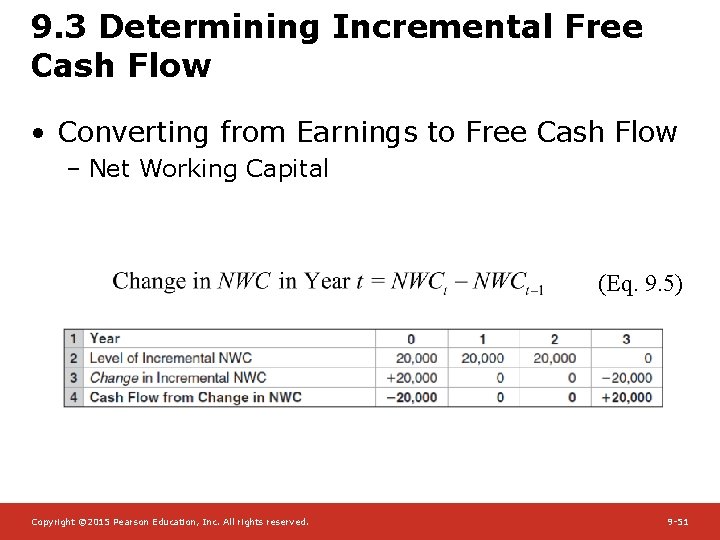
9. 3 Determining Incremental Free Cash Flow • Converting from Earnings to Free Cash Flow – Net Working Capital (Eq. 9. 5) Copyright © 2015 Pearson Education, Inc. All rights reserved. 9 -51

Example 9. 4 Incorporating Changes in Net Working Capital Problem: • Suppose that Home. Net will have no incremental cash or inventory requirements (products will be shipped directly from the contract manufacturer to customers). However, receivables related to Home. Net are expected to account for 15% of annual sales, and payables are expected to be 15% of the annual cost of goods sold (COGS). Fifteen percent of $13 million in sales is $1. 95 million and 15% of $5. 5 million in COGS is $825, 000. Home. Net’s net working capital requirements are shown in the following table. Copyright © 2015 Pearson Education, Inc. All rights reserved. 9 -52
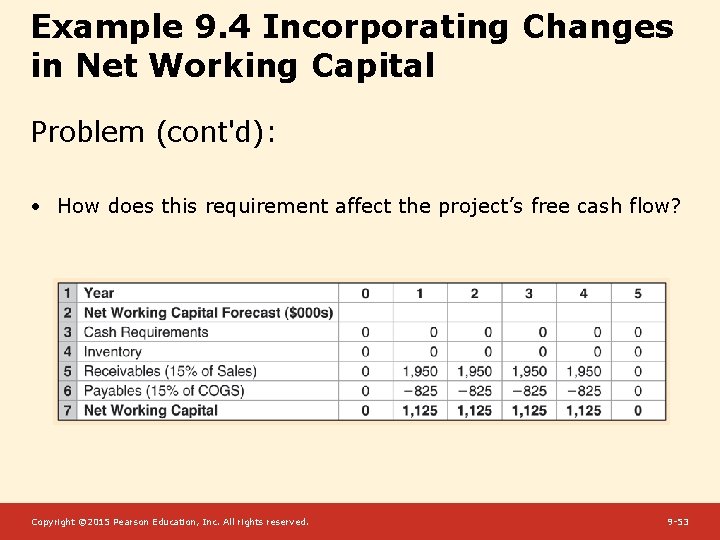
Example 9. 4 Incorporating Changes in Net Working Capital Problem (cont'd): • How does this requirement affect the project’s free cash flow? Copyright © 2015 Pearson Education, Inc. All rights reserved. 9 -53
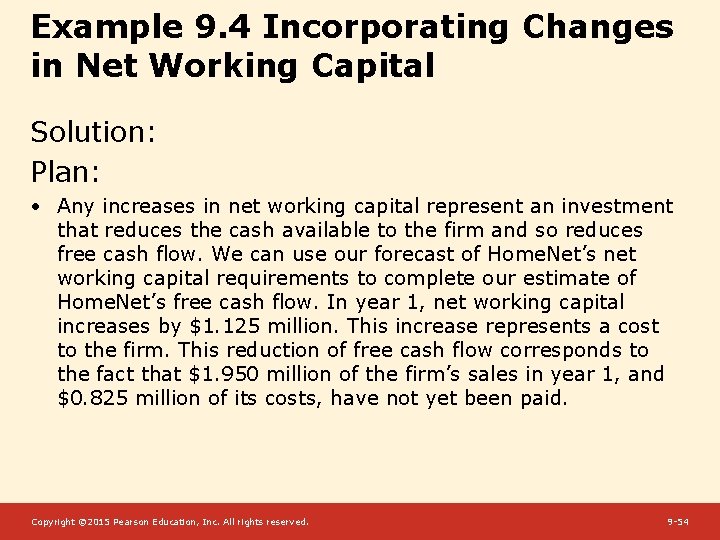
Example 9. 4 Incorporating Changes in Net Working Capital Solution: Plan: • Any increases in net working capital represent an investment that reduces the cash available to the firm and so reduces free cash flow. We can use our forecast of Home. Net’s net working capital requirements to complete our estimate of Home. Net’s free cash flow. In year 1, net working capital increases by $1. 125 million. This increase represents a cost to the firm. This reduction of free cash flow corresponds to the fact that $1. 950 million of the firm’s sales in year 1, and $0. 825 million of its costs, have not yet been paid. Copyright © 2015 Pearson Education, Inc. All rights reserved. 9 -54
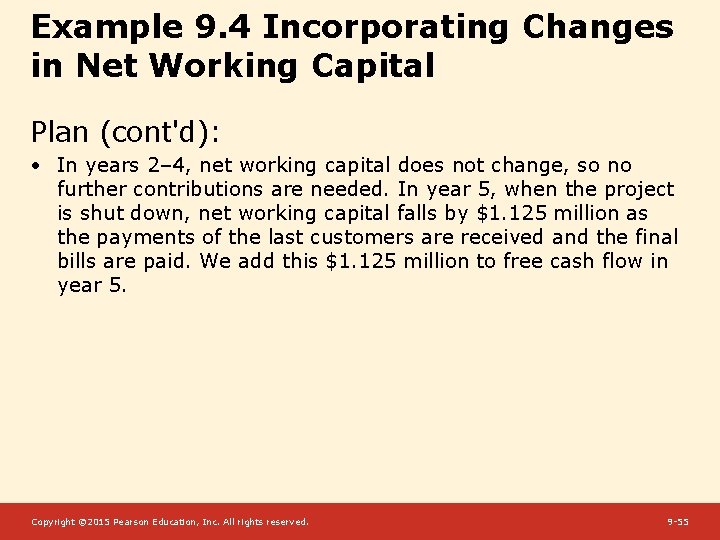
Example 9. 4 Incorporating Changes in Net Working Capital Plan (cont'd): • In years 2– 4, net working capital does not change, so no further contributions are needed. In year 5, when the project is shut down, net working capital falls by $1. 125 million as the payments of the last customers are received and the final bills are paid. We add this $1. 125 million to free cash flow in year 5. Copyright © 2015 Pearson Education, Inc. All rights reserved. 9 -55
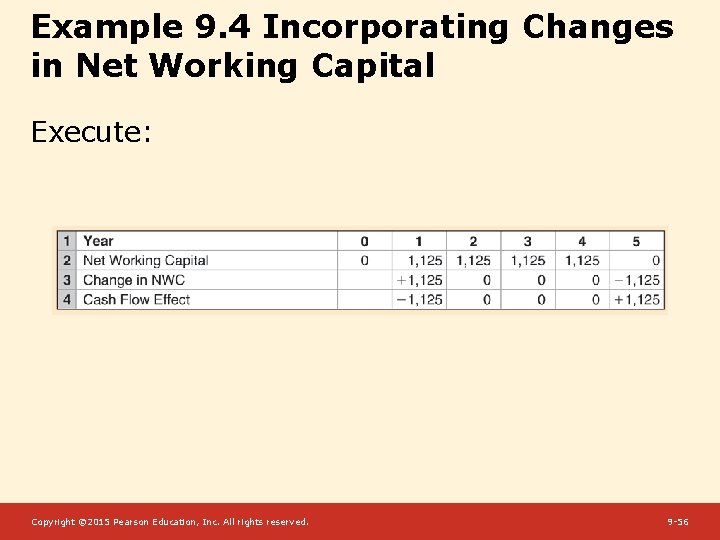
Example 9. 4 Incorporating Changes in Net Working Capital Execute: Copyright © 2015 Pearson Education, Inc. All rights reserved. 9 -56
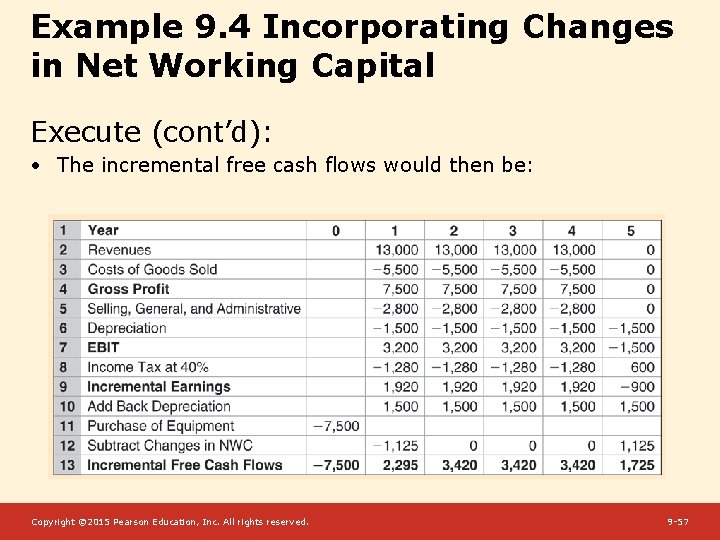
Example 9. 4 Incorporating Changes in Net Working Capital Execute (cont’d): • The incremental free cash flows would then be: Copyright © 2015 Pearson Education, Inc. All rights reserved. 9 -57
Example 9. 4 Incorporating Changes in Net Working Capital Evaluate: • The free cash flows differ from unlevered net income by reflecting the cash flow effects of capital expenditures on equipment, depreciation and changes in net working capital. Note that in the first year, free cash flow is lower than unlevered net income (incremental earnings), reflecting the upfront investment in equipment. In later years, free cash flow exceeds unlevered net income because depreciation is not a cash expense. In the last year, the firm ultimately recovers the investment in net working capital, which adds to the free cash flow. Copyright © 2015 Pearson Education, Inc. All rights reserved. 9 -58

Example 9. 4 a Incorporating Changes in Net Working Capital Problem: • Suppose that Home. Net will have no incremental cash or inventory requirements (products will be shipped directly from the contract manufacturer to customers). However, receivables related to Home. Net are expected to account for 15% of annual sales, and payables are expected to be 15% of the annual cost of goods sold (COGS). Fifteen percent of $8 million in sales is $1. 2 million and 15% of $3. 6 million in COGS is $540, 000. Home. Net’s net working capital requirements are shown in the following table. Copyright © 2015 Pearson Education, Inc. All rights reserved. 9 -59
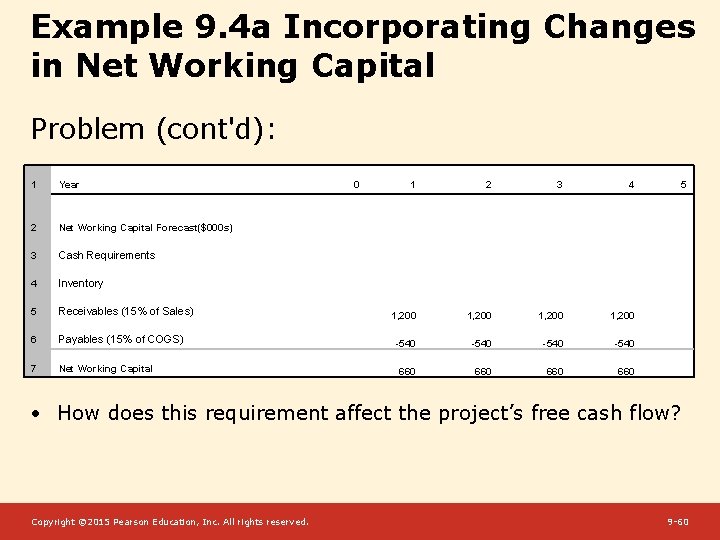
Example 9. 4 a Incorporating Changes in Net Working Capital Problem (cont'd): 1 Year 2 Net Working Capital Forecast($000 s) 3 Cash Requirements 4 0 1 2 3 4 5 Inventory 5 Receivables (15% of Sales) 1, 200 6 Payables (15% of COGS) -540 7 Net Working Capital 660 660 • How does this requirement affect the project’s free cash flow? Copyright © 2015 Pearson Education, Inc. All rights reserved. 9 -60
Example 9. 4 a Incorporating Changes in Net Working Capital Solution: Plan: • Any increases in net working capital represent an investment that reduces the cash available to the firm and so reduces free cash flow. We can use our forecast of Home. Net’s net working capital requirements to complete our estimate of Home. Net’s free cash flow. In year 1, net working capital increases by $0. 660 million. This increase represents a cost to the firm. This reduction of free cash flow corresponds to the fact that $1. 2 million of the firm’s sales in year 1, and $0. 540 million of its costs, have not yet been paid. Copyright © 2015 Pearson Education, Inc. All rights reserved. 9 -61
Example 9. 4 a Incorporating Changes in Net Working Capital Plan (cont'd): • In years 2– 4, net working capital does not change, so no further contributions are needed. In year 5, when the project is shut down, net working capital falls by $0. 660 million as the payments of the last customers are received and the final bills are paid. We add this $0. 660 million to free cash flow in year 5. Copyright © 2015 Pearson Education, Inc. All rights reserved. 9 -62
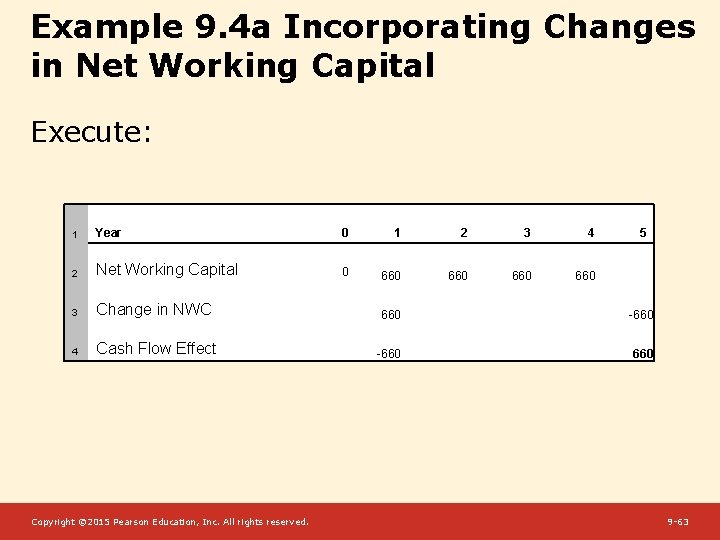
Example 9. 4 a Incorporating Changes in Net Working Capital Execute: 1 Year 0 1 2 3 2 Net Working Capital 0 660 660 3 Change in NWC 660 4 Cash Flow Effect -660 Copyright © 2015 Pearson Education, Inc. All rights reserved. 4 5 660 -660 9 -63
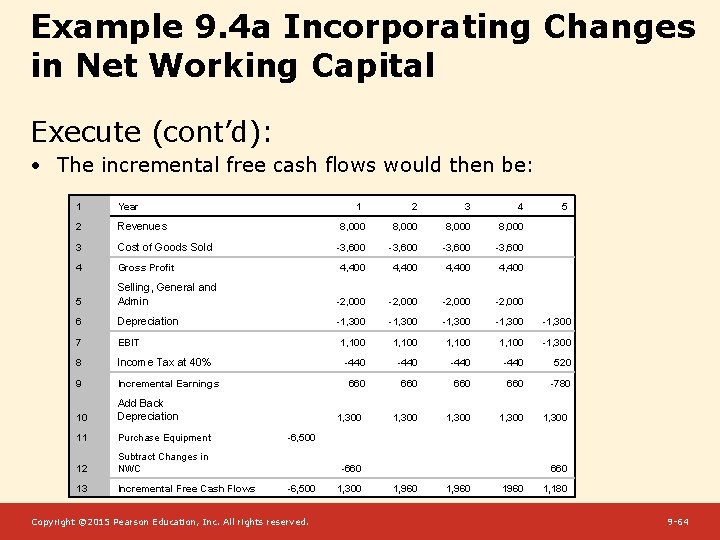
Example 9. 4 a Incorporating Changes in Net Working Capital Execute (cont’d): • The incremental free cash flows would then be: 1 Year 2 Revenues 3 Cost of Goods Sold 4 Gross Profit 2 3 4 8, 000 -3, 600 4, 400 5 Selling, General and Admin -2, 000 6 Depreciation -1, 300 -1, 300 7 EBIT 1, 100 -1, 300 8 Income Tax at 40% -440 520 9 Incremental Earnings 660 660 -780 10 Add Back Depreciation 1, 300 11 Purchase Equipment -6, 500 12 Subtract Changes in NWC 13 Incremental Free Cash Flows -6, 500 Copyright © 2015 Pearson Education, Inc. All rights reserved. 1 1, 300 -660 1, 300 1, 960 5 1, 300 660 1960 1, 180 9 -64
Example 9. 4 a Incorporating Changes in Net Working Capital Evaluate: • The free cash flows differ from unlevered net income by reflecting the cash flow effects of capital expenditures on equipment, depreciation and changes in net working capital. Note that in the first year, free cash flow is lower than unlevered net income (incremental earnings), reflecting the upfront investment in equipment. In later years, free cash flow exceeds unlevered net income because depreciation is not a cash expense. In the last year, the firm ultimately recovers the investment in net working capital, which adds to the free cash flow. Copyright © 2015 Pearson Education, Inc. All rights reserved. 9 -65
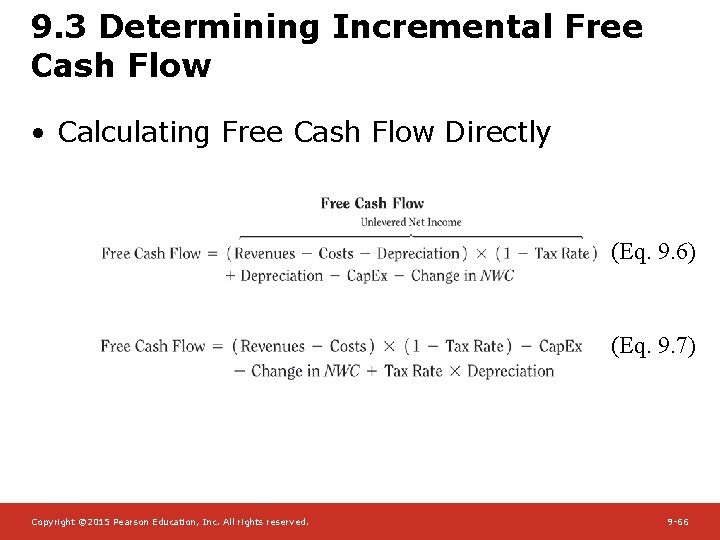
9. 3 Determining Incremental Free Cash Flow • Calculating Free Cash Flow Directly (Eq. 9. 6) (Eq. 9. 7) Copyright © 2015 Pearson Education, Inc. All rights reserved. 9 -66
9. 3 Determining Incremental Free Cash Flow • Calculating Free Cash Flow Directly – Depreciation Tax Shield • Tax Rate x Depreciation Copyright © 2015 Pearson Education, Inc. All rights reserved. 9 -67
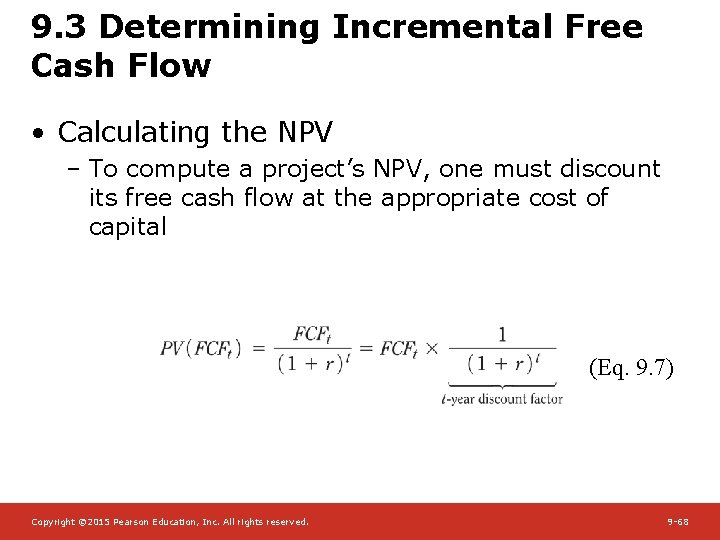
9. 3 Determining Incremental Free Cash Flow • Calculating the NPV – To compute a project’s NPV, one must discount its free cash flow at the appropriate cost of capital (Eq. 9. 7) Copyright © 2015 Pearson Education, Inc. All rights reserved. 9 -68
Example 9. 5 Calculating the Project’s NPV Problem: • Assume that Linksys’s managers believe that the Home. Net project has risks similar to its existing projects, for which it has a cost of capital of 12%. Compute the NPV of the Home. Net project. Copyright © 2015 Pearson Education, Inc. All rights reserved. 9 -69
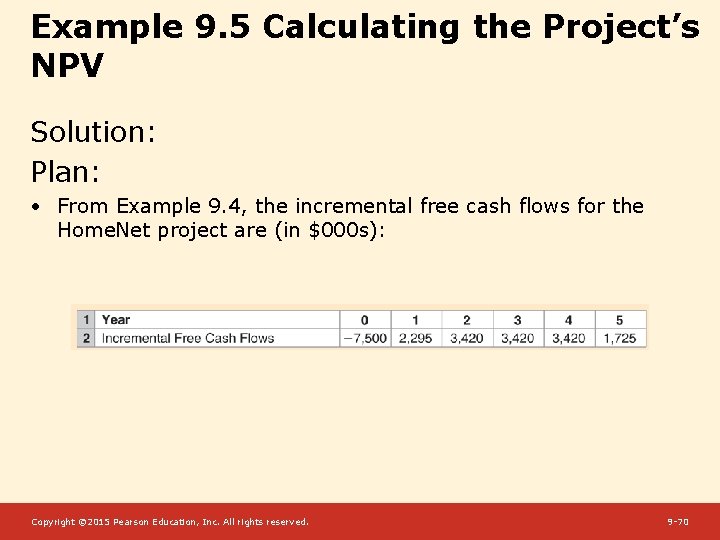
Example 9. 5 Calculating the Project’s NPV Solution: Plan: • From Example 9. 4, the incremental free cash flows for the Home. Net project are (in $000 s): Copyright © 2015 Pearson Education, Inc. All rights reserved. 9 -70
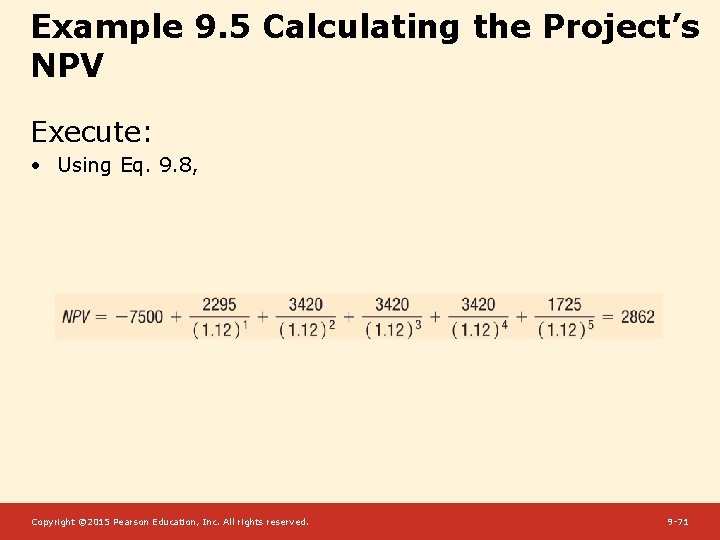
Example 9. 5 Calculating the Project’s NPV Execute: • Using Eq. 9. 8, Copyright © 2015 Pearson Education, Inc. All rights reserved. 9 -71
Example 9. 5 Calculating the Project’s NPV Evaluate: • Based on our estimates, Home. Net’s NPV is $2. 862 million. While Home. Net’s upfront cost is $7. 5 million, the present value of the additional free cash flow that Linksys will receive from the project is $10. 362 million. Thus, taking the Home. Net project is equivalent to Linksys having an extra $2. 862 million in the bank today. Copyright © 2015 Pearson Education, Inc. All rights reserved. 9 -72
9. 4 Other Effects on Incremental Free Cash Flows • Opportunity Costs • Project Externalities – Cannibalization • Sunk Costs – Fixed Overhead Expenses – Past Research and Development Copyright © 2015 Pearson Education, Inc. All rights reserved. 9 -73
9. 4 Other Effects on Incremental Free Cash Flows • Adjusting Free Cash Flow – Time of Cash Flows – Accelerated Depreciation • MACRS – Modified Accelerated Cost Recovery System Copyright © 2015 Pearson Education, Inc. All rights reserved. 9 -74
Example 9. 6 Computing Accelerated Depreciation Problem: • What depreciation deduction would be allowed for Home. Net’s $7. 5 million lab equipment using the MACRS method, assuming the lab equipment is designated to have a five-year recovery period? Copyright © 2015 Pearson Education, Inc. All rights reserved. 9 -75
Example 9. 6 Computing Accelerated Depreciation Solution: Plan: • Table 9. 4 in this chapter’s Appendix A provides the percentage of the cost that can be depreciated each year. Under MACRS, we take the percentage in the table for each year and multiply it by the original purchase price of the equipment to calculate the depreciation for that year. Copyright © 2015 Pearson Education, Inc. All rights reserved. 9 -76
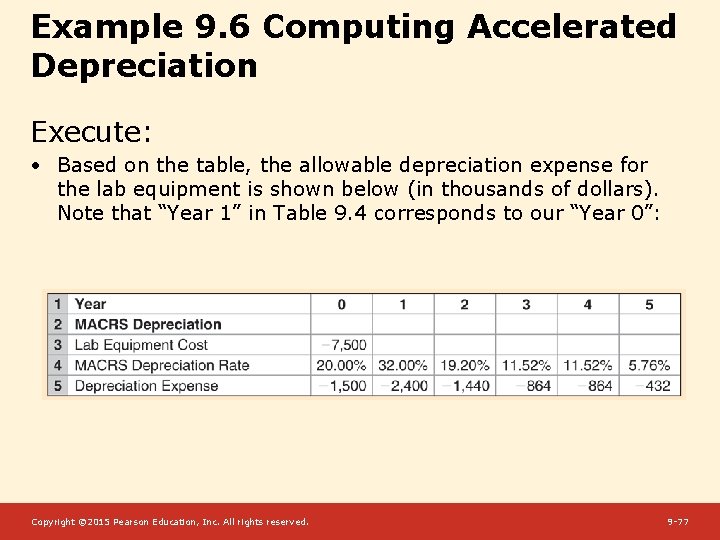
Example 9. 6 Computing Accelerated Depreciation Execute: • Based on the table, the allowable depreciation expense for the lab equipment is shown below (in thousands of dollars). Note that “Year 1” in Table 9. 4 corresponds to our “Year 0”: Copyright © 2015 Pearson Education, Inc. All rights reserved. 9 -77
Example 9. 6 Computing Accelerated Depreciation Evaluate: • Compared with straight-line depreciation, the MACRS method allows for larger depreciation deductions earlier in the asset’s life, which increases the present value of the depreciation tax shield and so will raise the project’s NPV. In the case of Home. Net, computing the NPV using MACRS depreciation leads to an NPV of $3. 179 million. Copyright © 2015 Pearson Education, Inc. All rights reserved. 9 -78
Example 9. 6 a Computing Accelerated Depreciation Problem: • What depreciation deduction would be allowed for Home. Net’s $6. 5 million lab equipment using the MACRS method, assuming the lab equipment is designated to have a five-year recovery period? Copyright © 2015 Pearson Education, Inc. All rights reserved. 9 -79
Example 9. 6 a Computing Accelerated Depreciation Solution: Plan: • Table 9. 4 in this chapter’s Appendix A provides the percentage of the cost that can be depreciated each year. Under MACRS, we take the percentage in the table for each year and multiply it by the original purchase price of the equipment to calculate the depreciation for that year. Copyright © 2015 Pearson Education, Inc. All rights reserved. 9 -80
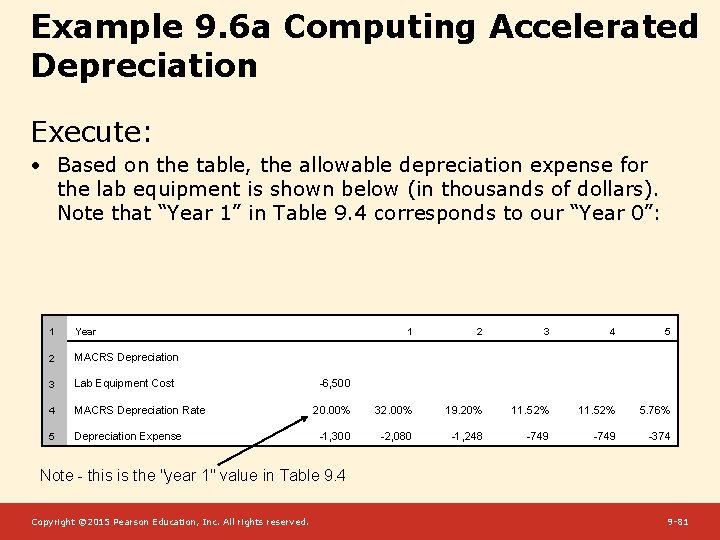
Example 9. 6 a Computing Accelerated Depreciation Execute: • Based on the table, the allowable depreciation expense for the lab equipment is shown below (in thousands of dollars). Note that “Year 1” in Table 9. 4 corresponds to our “Year 0”: 1 Year 2 MACRS Depreciation 3 Lab Equipment Cost -6, 500 4 MACRS Depreciation Rate 20. 00% 32. 00% 19. 20% 11. 52% 5. 76% 5 Depreciation Expense -1, 300 -2, 080 -1, 248 -749 -374 1 2 3 4 5 Note - this is the "year 1" value in Table 9. 4 Copyright © 2015 Pearson Education, Inc. All rights reserved. 9 -81
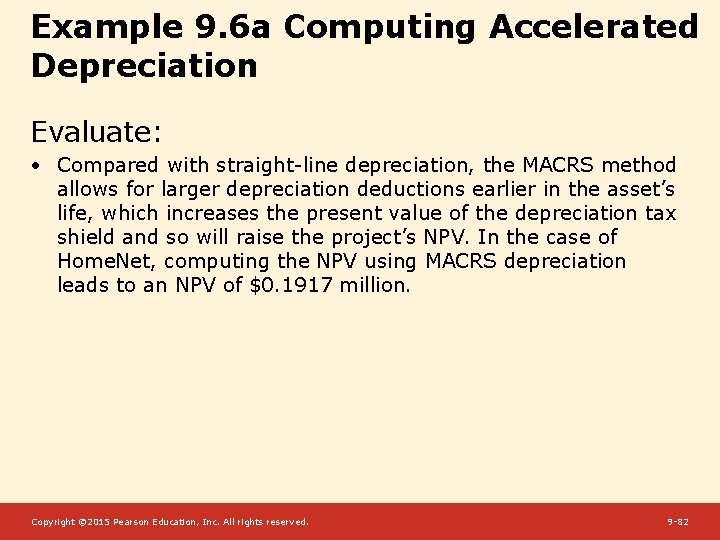
Example 9. 6 a Computing Accelerated Depreciation Evaluate: • Compared with straight-line depreciation, the MACRS method allows for larger depreciation deductions earlier in the asset’s life, which increases the present value of the depreciation tax shield and so will raise the project’s NPV. In the case of Home. Net, computing the NPV using MACRS depreciation leads to an NPV of $0. 1917 million. Copyright © 2015 Pearson Education, Inc. All rights reserved. 9 -82
Example 9. 6 b Computing Accelerated Depreciation Problem: • You are the production manager of a firm. What depreciation deduction would be allowed for $15 million worth of equipment using the MACRS method, assuming the equipment is designated to have a five-year recovery period? How does this compare to straight-line depreciation over five years? Copyright © 2015 Pearson Education, Inc. All rights reserved. 9 -83
Example 9. 6 b Computing Accelerated Depreciation Solution: Plan: • Table 9. 4 in this chapter’s Appendix A provides the percentage of the cost that can be depreciated each year. Under MACRS, we take the percentage in the table for each year and multiply it by the original purchase price of the equipment to calculate the depreciation for that year. Copyright © 2015 Pearson Education, Inc. All rights reserved. 9 -84
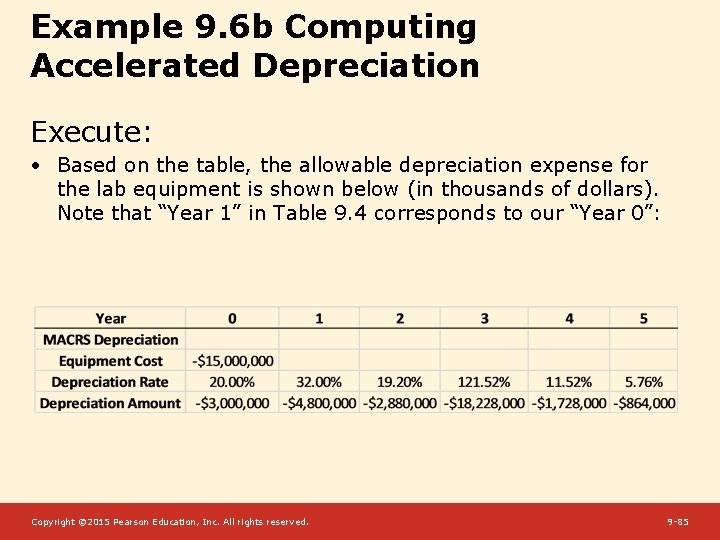
Example 9. 6 b Computing Accelerated Depreciation Execute: • Based on the table, the allowable depreciation expense for the lab equipment is shown below (in thousands of dollars). Note that “Year 1” in Table 9. 4 corresponds to our “Year 0”: Copyright © 2015 Pearson Education, Inc. All rights reserved. 9 -85
Example 9. 6 b Computing Accelerated Depreciation Evaluate: • Compared with straight-line depreciation ($15, 000/5 years = $3, 000 per year), the MACRS method allows for larger depreciation deductions earlier in the asset’s life, which increases the present value of the depreciation tax shield and thus will raise the project’s NPV. Copyright © 2015 Pearson Education, Inc. All rights reserved. 9 -86
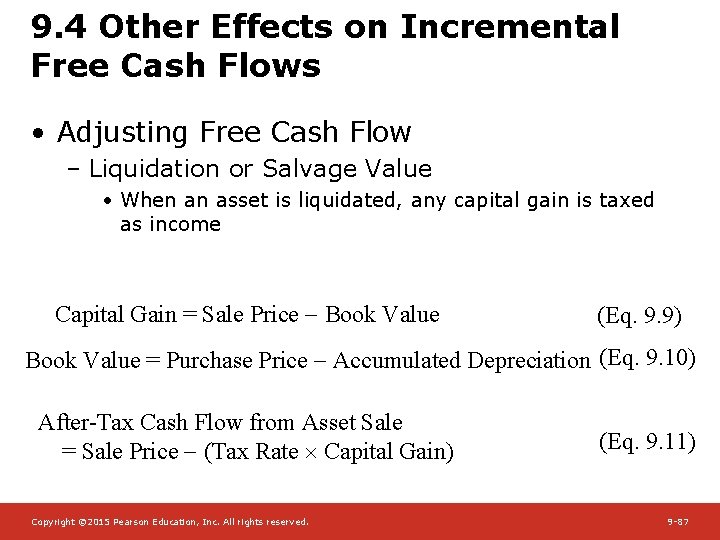
9. 4 Other Effects on Incremental Free Cash Flows • Adjusting Free Cash Flow – Liquidation or Salvage Value • When an asset is liquidated, any capital gain is taxed as income Capital Gain = Sale Price Book Value (Eq. 9. 9) Book Value = Purchase Price Accumulated Depreciation (Eq. 9. 10) After-Tax Cash Flow from Asset Sale = Sale Price (Tax Rate Capital Gain) Copyright © 2015 Pearson Education, Inc. All rights reserved. (Eq. 9. 11) 9 -87
Example 9. 7 Computing After-Tax Cash flows from an Asset Sale Problem: • As production manager, you are overseeing the shutdown of a production line for a discontinued product. Some of the equipment can be sold for a total price of $50, 000. The equipment was originally purchased 4 years ago for $500, 000 and is being depreciated according to the 5 -year MACRS schedule. If your tax rate is 35%, what is the after-tax cash flow you can expect from selling the equipment? Copyright © 2015 Pearson Education, Inc. All rights reserved. 9 -88
Example 9. 7 Computing After-Tax Cash flows from an Asset Sale Solution: Plan: • In order to compute the after-tax cash flow, you will need to compute the capital gain, which, as Eq. (9. 9) shows requires you to know the book value of the equipment. The book value is given in Eq. (9. 10) as the original purchase price of the equipment less accumulated depreciation. Thus, you need to follow these steps: Copyright © 2015 Pearson Education, Inc. All rights reserved. 9 -89
Example 9. 7 Computing After-tax Cash flows from an Asset Sale Plan: 1. Use the MACRS schedule to determine the accumulated depreciation. 2. Determine the book value as purchase price minus accumulated depreciation 3. Determine the capital gain as the sale price less the book value. 4. Compute the tax owed on the capital gain and subtract it from the sale price, following Eq. (9. 11). Copyright © 2015 Pearson Education, Inc. All rights reserved. 9 -90
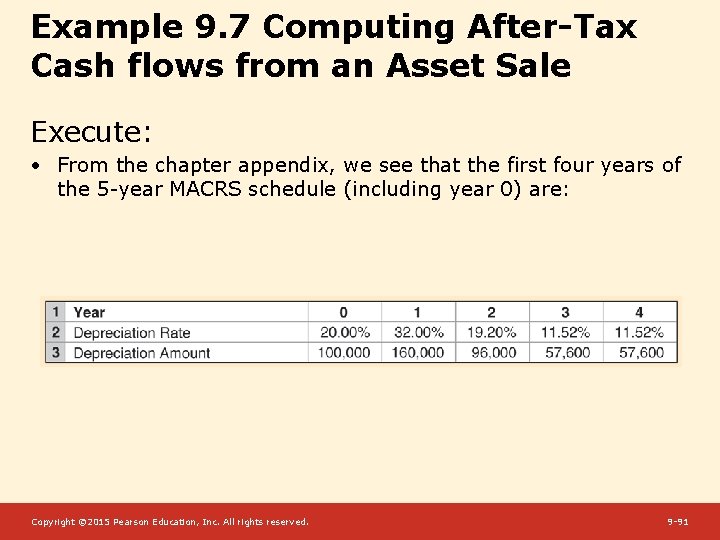
Example 9. 7 Computing After-Tax Cash flows from an Asset Sale Execute: • From the chapter appendix, we see that the first four years of the 5 -year MACRS schedule (including year 0) are: Copyright © 2015 Pearson Education, Inc. All rights reserved. 9 -91
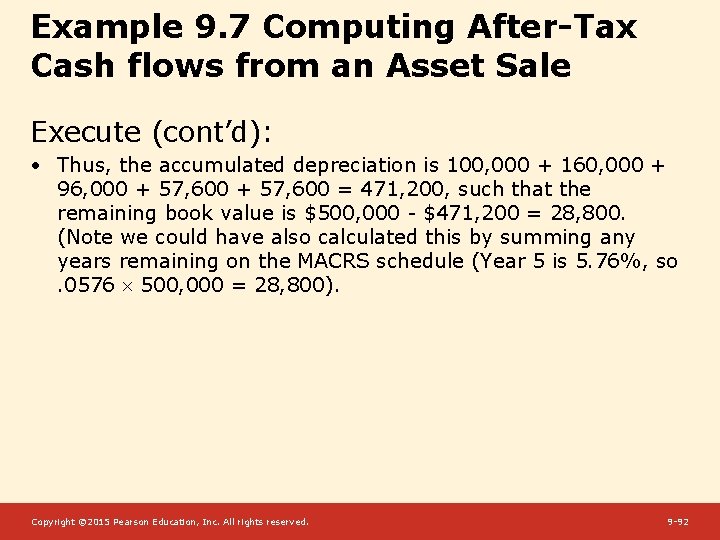
Example 9. 7 Computing After-Tax Cash flows from an Asset Sale Execute (cont’d): • Thus, the accumulated depreciation is 100, 000 + 160, 000 + 96, 000 + 57, 600 = 471, 200, such that the remaining book value is $500, 000 - $471, 200 = 28, 800. (Note we could have also calculated this by summing any years remaining on the MACRS schedule (Year 5 is 5. 76%, so . 0576 500, 000 = 28, 800). Copyright © 2015 Pearson Education, Inc. All rights reserved. 9 -92
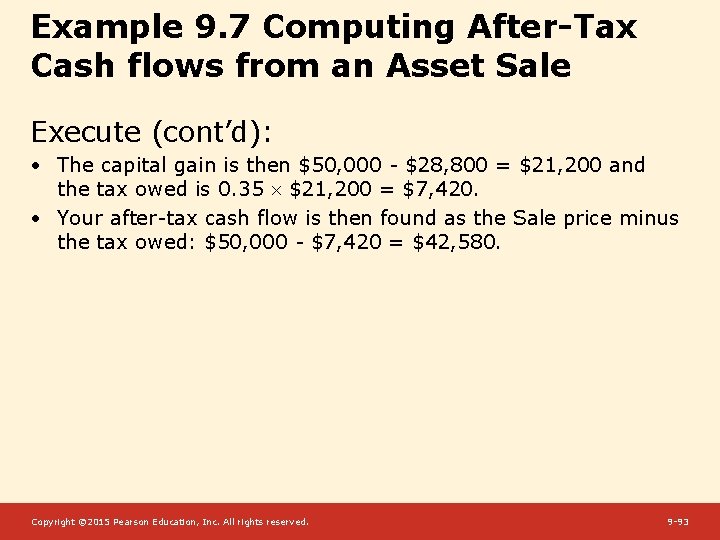
Example 9. 7 Computing After-Tax Cash flows from an Asset Sale Execute (cont’d): • The capital gain is then $50, 000 - $28, 800 = $21, 200 and the tax owed is 0. 35 $21, 200 = $7, 420. • Your after-tax cash flow is then found as the Sale price minus the tax owed: $50, 000 - $7, 420 = $42, 580. Copyright © 2015 Pearson Education, Inc. All rights reserved. 9 -93
Example 9. 7 Computing After-Tax Cash flows from an Asset Sale Evaluate: • Because you are only taxed on the capital gain portion of the sale price, figuring the after-tax cash flow is not as simple as subtracting the tax rate multiplied by the sales price. Instead, you have to determine the portion of the sales price that represents a gain and compute the tax from there. The same procedure holds for selling equipment at a loss relative to book value—the loss creates a deduction for taxable income elsewhere in the company. Copyright © 2015 Pearson Education, Inc. All rights reserved. 9 -94
Example 9. 7 a Computing After-Tax Cash flows from an Asset Sale Problem: • As production manager, you are overseeing the shutdown of a production line for a discontinued product. Some of the equipment can be sold for a total price of $25, 000. The equipment was originally purchased 4 years ago for $800, 000 and is being depreciated according to the 5 -year MACRS schedule. If your tax rate is 40%, what is the after-tax cash flow you can expect from selling the equipment? Copyright © 2015 Pearson Education, Inc. All rights reserved. 9 -95
Example 9. 7 a Computing After-Tax Cash flows from an Asset Sale • Solution: • Plan: • In order to compute the after-tax cash flow, you will need to compute the capital gain, which, as Eq. (9. 9) shows requires you to know the book value of the equipment. The book value is given in Eq. (9. 10) as the original purchase price of the equipment less accumulated depreciation. Thus, you need to follow these steps: Copyright © 2015 Pearson Education, Inc. All rights reserved. 9 -96
Example 9. 7 a Computing After-tax Cash flows from an Asset Sale Plan: 1. Use the MACRS schedule to determine the accumulated depreciation. 2. Determine the book value as purchase price minus accumulated depreciation 3. Determine the capital gain as the sale price less the book value. 4. Compute the tax owed on the capital gain and subtract it from the sale price, following Eq. (9. 11). Copyright © 2015 Pearson Education, Inc. All rights reserved. 9 -97
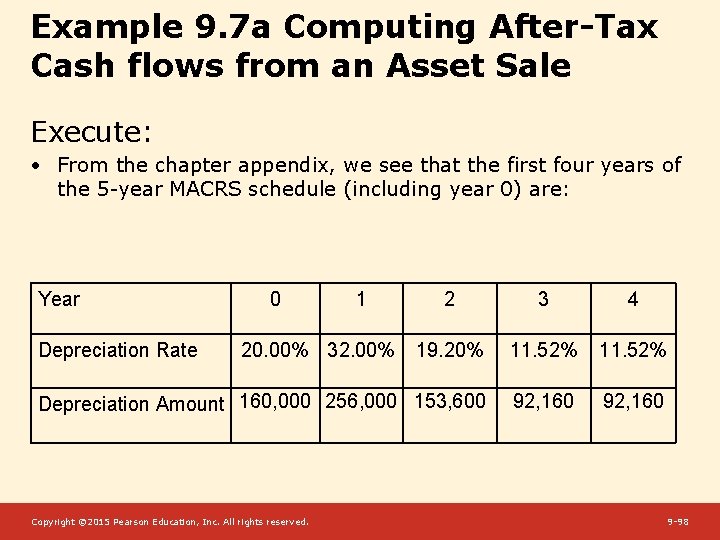
Example 9. 7 a Computing After-Tax Cash flows from an Asset Sale Execute: • From the chapter appendix, we see that the first four years of the 5 -year MACRS schedule (including year 0) are: Year 2 3 4 19. 20% 11. 52% Depreciation Amount 160, 000 256, 000 153, 600 92, 160 Depreciation Rate 0 1 20. 00% 32. 00% Copyright © 2015 Pearson Education, Inc. All rights reserved. 9 -98
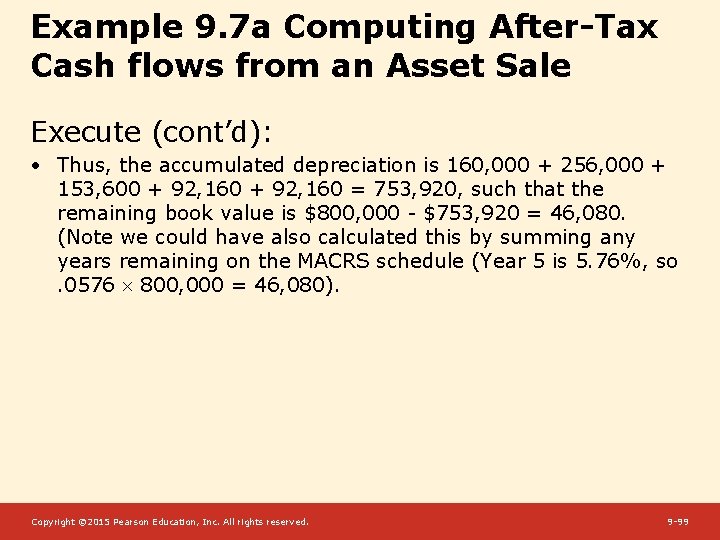
Example 9. 7 a Computing After-Tax Cash flows from an Asset Sale Execute (cont’d): • Thus, the accumulated depreciation is 160, 000 + 256, 000 + 153, 600 + 92, 160 = 753, 920, such that the remaining book value is $800, 000 - $753, 920 = 46, 080. (Note we could have also calculated this by summing any years remaining on the MACRS schedule (Year 5 is 5. 76%, so . 0576 800, 000 = 46, 080). Copyright © 2015 Pearson Education, Inc. All rights reserved. 9 -99
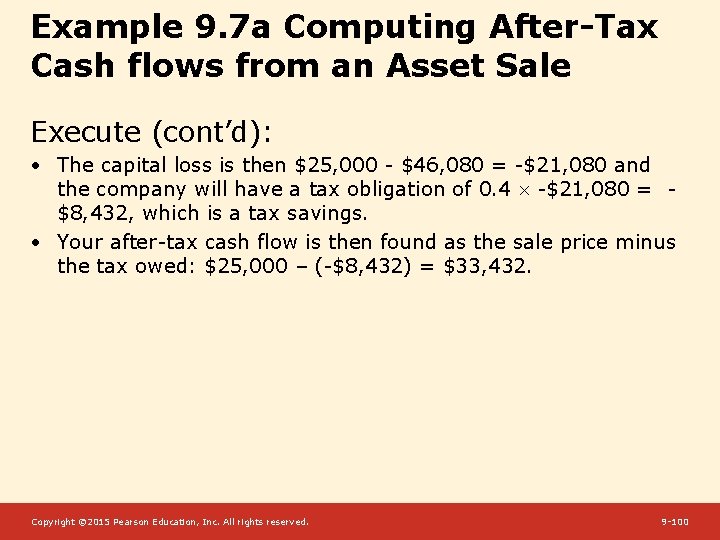
Example 9. 7 a Computing After-Tax Cash flows from an Asset Sale Execute (cont’d): • The capital loss is then $25, 000 - $46, 080 = -$21, 080 and the company will have a tax obligation of 0. 4 -$21, 080 = $8, 432, which is a tax savings. • Your after-tax cash flow is then found as the sale price minus the tax owed: $25, 000 – (-$8, 432) = $33, 432. Copyright © 2015 Pearson Education, Inc. All rights reserved. 9 -100
Example 9. 7 a Computing After-Tax Cash flows from an Asset Sale Evaluate: • Because you are only taxed on the capital gain portion of the sale price, figuring the after-tax cash flow is not as simple as subtracting the tax rate multiplied by the sales price. Instead, you have to determine the portion of the sales price that represents a gain and compute the tax from there. The same procedure holds for selling equipment at a loss relative to book value—the loss creates a deduction for taxable income elsewhere in the company. Copyright © 2015 Pearson Education, Inc. All rights reserved. 9 -101
Example 9. 7 b Computing After-Tax Cash flows from an Asset Sale Problem: • Your are in charge of closing a factory. Some of the equipment can be sold for a total price of $2, 000. The equipment was originally purchased 2 years ago for $15, 000 and is being depreciated according to the 5 -year MACRS schedule. If your tax rate is 40%, what is the aftertax cash flow you can expect from selling the equipment? Copyright © 2015 Pearson Education, Inc. All rights reserved. 9 -102
Example 9. 7 b Computing After-Tax Cash flows from an Asset Sale Solution: Plan: • In order to compute the after-tax cash flow, you will need to compute the capital gain, which, as Eq. (9. 9) shows requires you to know the book value of the equipment. The book value is given in Eq. (9. 10) as the original purchase price of the equipment less accumulated depreciation. Thus, you need to follow these steps: Copyright © 2015 Pearson Education, Inc. All rights reserved. 9 -103
Example 9. 7 b Computing After-tax Cash flows from an Asset Sale Plan: 1. Use the MACRS schedule to determine the accumulated depreciation. 2. Determine the book value as purchase price minus accumulated depreciation 3. Determine the capital gain as the sale price less the book value. 4. Compute the tax owed on the capital gain and subtract it from the sale price, following Eq. (9. 11). Copyright © 2015 Pearson Education, Inc. All rights reserved. 9 -104
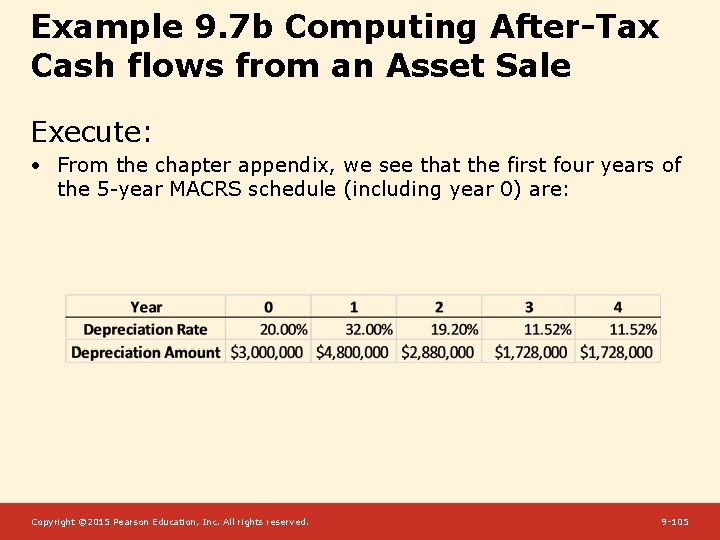
Example 9. 7 b Computing After-Tax Cash flows from an Asset Sale Execute: • From the chapter appendix, we see that the first four years of the 5 -year MACRS schedule (including year 0) are: Copyright © 2015 Pearson Education, Inc. All rights reserved. 9 -105
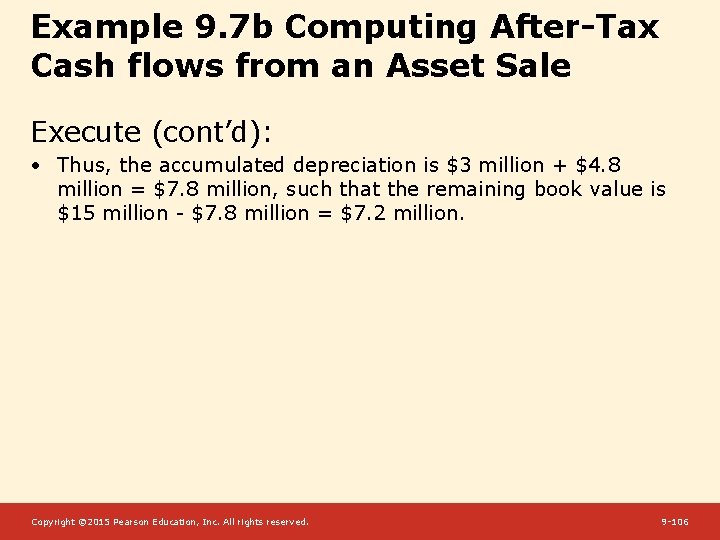
Example 9. 7 b Computing After-Tax Cash flows from an Asset Sale Execute (cont’d): • Thus, the accumulated depreciation is $3 million + $4. 8 million = $7. 8 million, such that the remaining book value is $15 million - $7. 8 million = $7. 2 million. Copyright © 2015 Pearson Education, Inc. All rights reserved. 9 -106
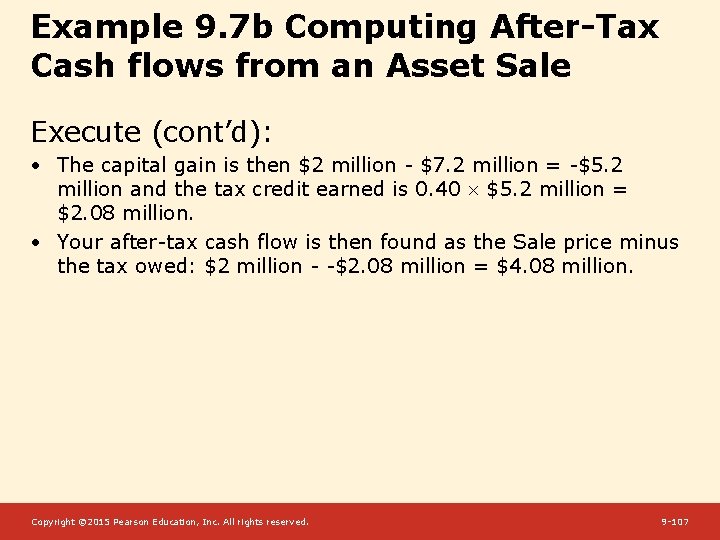
Example 9. 7 b Computing After-Tax Cash flows from an Asset Sale Execute (cont’d): • The capital gain is then $2 million - $7. 2 million = -$5. 2 million and the tax credit earned is 0. 40 $5. 2 million = $2. 08 million. • Your after-tax cash flow is then found as the Sale price minus the tax owed: $2 million - -$2. 08 million = $4. 08 million. Copyright © 2015 Pearson Education, Inc. All rights reserved. 9 -107
Example 9. 7 b Computing After-Tax Cash flows from an Asset Sale Evaluate: • Selling the equipment at a loss relative to book value loss creates a deduction for taxable income elsewhere in the company. Copyright © 2015 Pearson Education, Inc. All rights reserved. 9 -108
9. 4 Other Effects on Incremental Free Cash Flows • Adjusting Free Cash Flow – Tax Loss Carryforwards/Tax Loss Carrybacks • Allow corporations to take losses during a current year and offset them against gains in nearby years Copyright © 2015 Pearson Education, Inc. All rights reserved. 9 -109
9. 4 Other Effects on Incremental Free Cash Flows • Replacement Decisions – Often the financial manager must decide whether to replace an existing piece of equipment • The new equipment may allow increased production, resulting in incremental revenue, or it may simply be more efficient, lowering costs Copyright © 2015 Pearson Education, Inc. All rights reserved. 9 -110
Example 9. 8 Replacing an Existing Machine Problem: • You are trying to decide whether to replace a machine on your production line. The new machine will cost $1 million, but will be more efficient than the old machine, reducing costs by $500, 000 per year. Your old machine is fully depreciated, but you could sell it for $50, 000. You would depreciate the new machine over a 5 -year life using MACRS. The new machine will not change your working capital needs. Your tax rate is 35%, and your cost of capital is 9%. Should you replace the machine? Copyright © 2015 Pearson Education, Inc. All rights reserved. 9 -111
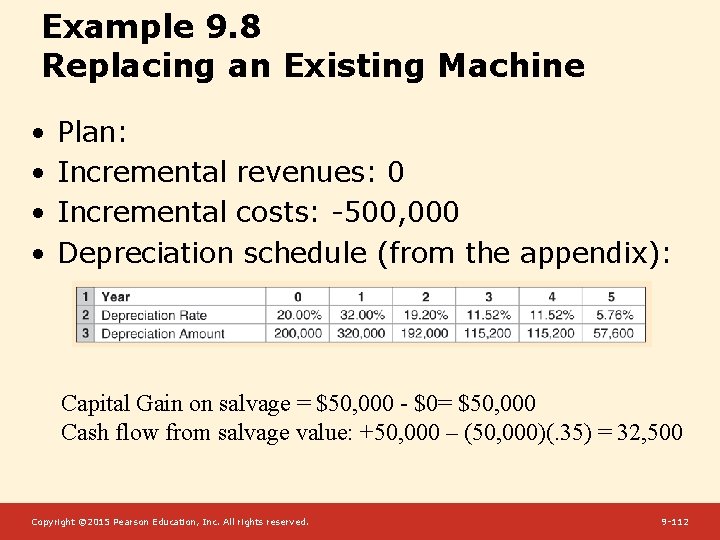
Example 9. 8 Replacing an Existing Machine • • Plan: Incremental revenues: 0 Incremental costs: -500, 000 Depreciation schedule (from the appendix): Capital Gain on salvage = $50, 000 - $0= $50, 000 Cash flow from salvage value: +50, 000 – (50, 000)(. 35) = 32, 500 Copyright © 2015 Pearson Education, Inc. All rights reserved. 9 -112
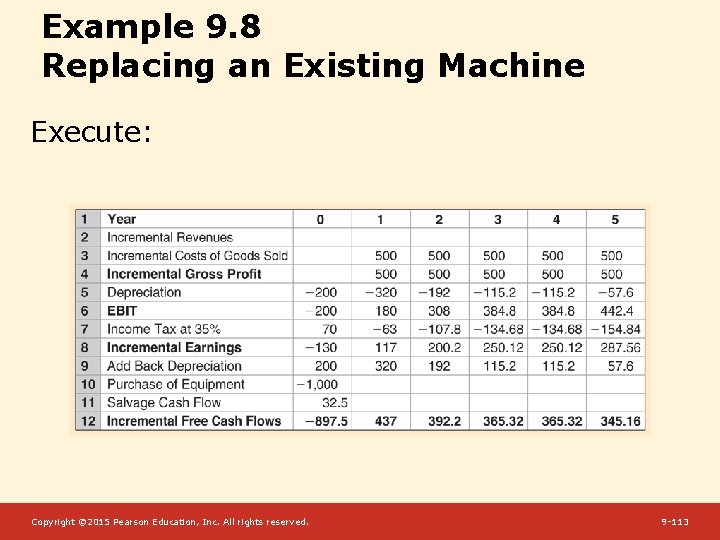
Example 9. 8 Replacing an Existing Machine Execute: Copyright © 2015 Pearson Education, Inc. All rights reserved. 9 -113
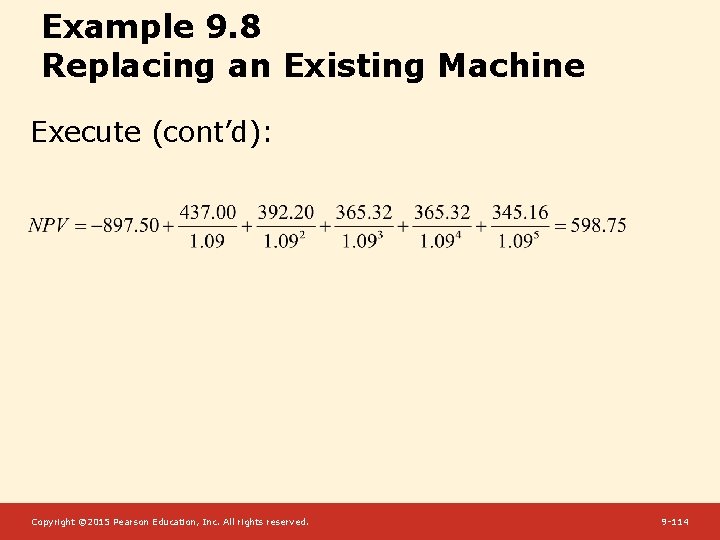
Example 9. 8 Replacing an Existing Machine Execute (cont’d): Copyright © 2015 Pearson Education, Inc. All rights reserved. 9 -114
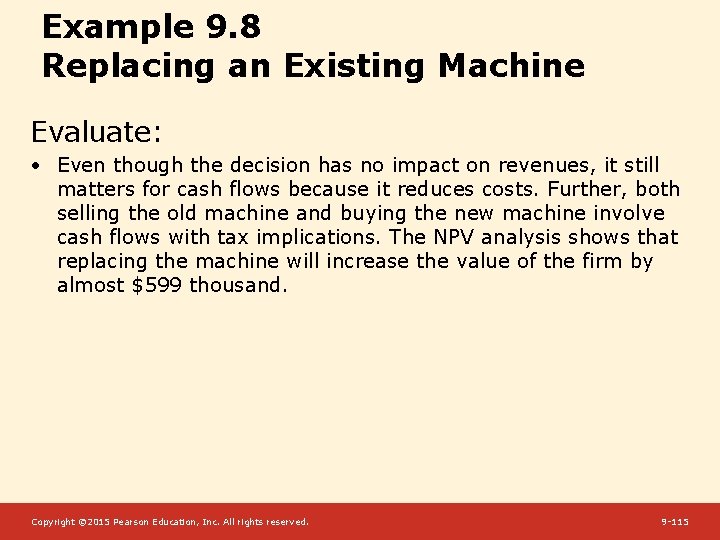
Example 9. 8 Replacing an Existing Machine Evaluate: • Even though the decision has no impact on revenues, it still matters for cash flows because it reduces costs. Further, both selling the old machine and buying the new machine involve cash flows with tax implications. The NPV analysis shows that replacing the machine will increase the value of the firm by almost $599 thousand. Copyright © 2015 Pearson Education, Inc. All rights reserved. 9 -115
Example 9. 8 a Replacing an Existing Machine Problem: • You are trying to decide whether to replace a machine on your production line. The new machine will cost $5 million, but will be more efficient than the old machine, reducing costs by $1, 500, 000 per year. Your old machine is fully depreciated, but you could sell it for $100, 000. You would depreciate the new machine over a 5 -year life using MACRS. The new machine will not change your working capital needs. Your tax rate is 40%and your cost of capital is 9%. Should you replace the machine? Copyright © 2015 Pearson Education, Inc. All rights reserved. 9 -116
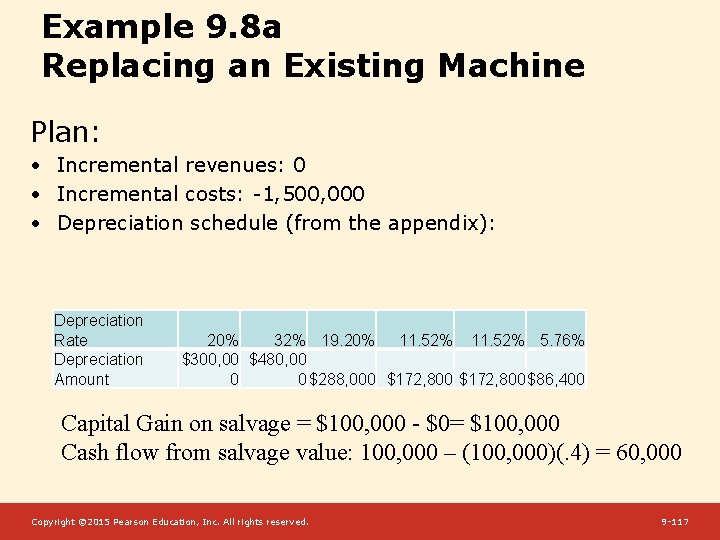
Example 9. 8 a Replacing an Existing Machine Plan: • Incremental revenues: 0 • Incremental costs: -1, 500, 000 • Depreciation schedule (from the appendix): Depreciation Rate Depreciation Amount 20% 32% 19. 20% 11. 52% 5. 76% $300, 00 $480, 00 0 0 $288, 000 $172, 800 $86, 400 Capital Gain on salvage = $100, 000 - $0= $100, 000 Cash flow from salvage value: 100, 000 – (100, 000)(. 4) = 60, 000 Copyright © 2015 Pearson Education, Inc. All rights reserved. 9 -117
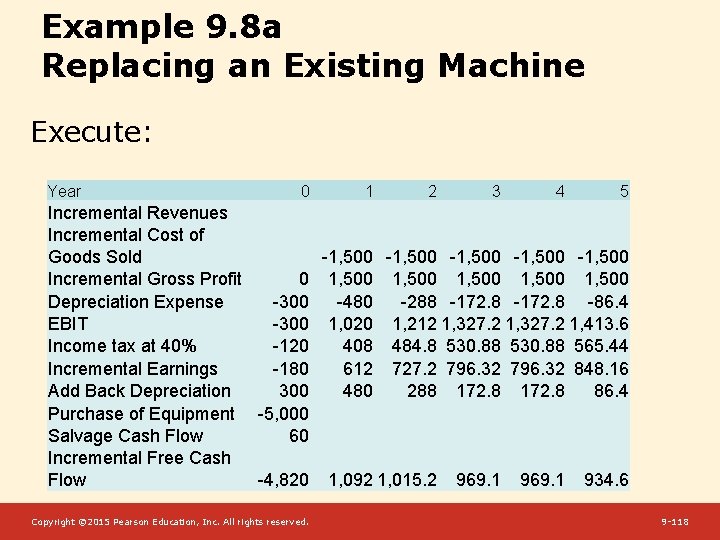
Example 9. 8 a Replacing an Existing Machine Execute: Year 0 1 2 3 4 5 Incremental Revenues Incremental Cost of Goods Sold -1, 500 -1, 500 Incremental Gross Profit 0 1, 500 1, 500 Depreciation Expense -300 -480 -288 -172. 8 -86. 4 EBIT -300 1, 020 1, 212 1, 327. 2 1, 413. 6 Income tax at 40% -120 408 484. 8 530. 88 565. 44 Incremental Earnings -180 612 727. 2 796. 32 848. 16 Add Back Depreciation 300 480 288 172. 8 86. 4 Purchase of Equipment -5, 000 Salvage Cash Flow 60 Incremental Free Cash Flow -4, 820 1, 092 1, 015. 2 969. 1 934. 6 Copyright © 2015 Pearson Education, Inc. All rights reserved. 9 -118
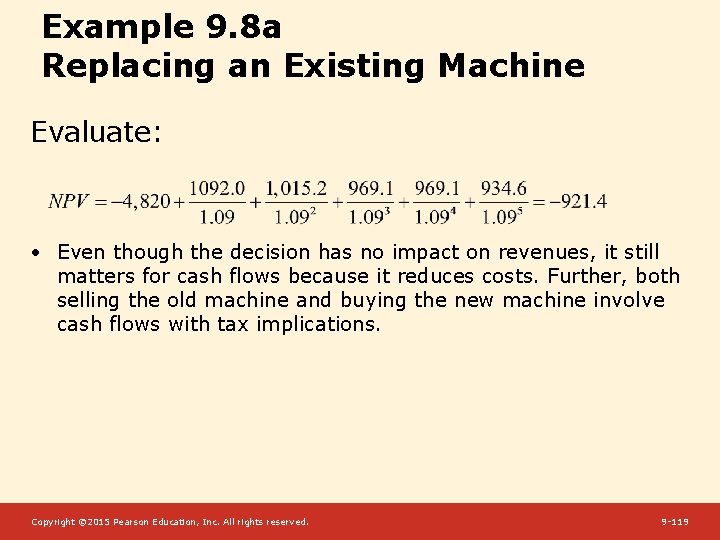
Example 9. 8 a Replacing an Existing Machine Evaluate: • Even though the decision has no impact on revenues, it still matters for cash flows because it reduces costs. Further, both selling the old machine and buying the new machine involve cash flows with tax implications. Copyright © 2015 Pearson Education, Inc. All rights reserved. 9 -119
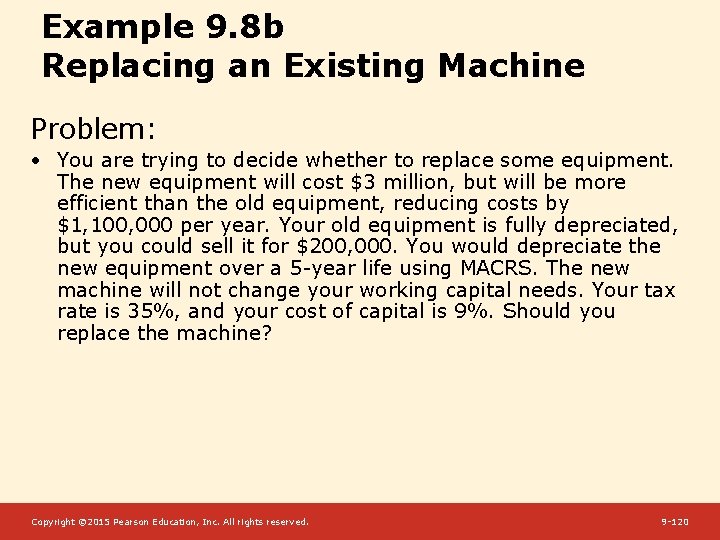
Example 9. 8 b Replacing an Existing Machine Problem: • You are trying to decide whether to replace some equipment. The new equipment will cost $3 million, but will be more efficient than the old equipment, reducing costs by $1, 100, 000 per year. Your old equipment is fully depreciated, but you could sell it for $200, 000. You would depreciate the new equipment over a 5 -year life using MACRS. The new machine will not change your working capital needs. Your tax rate is 35%, and your cost of capital is 9%. Should you replace the machine? Copyright © 2015 Pearson Education, Inc. All rights reserved. 9 -120
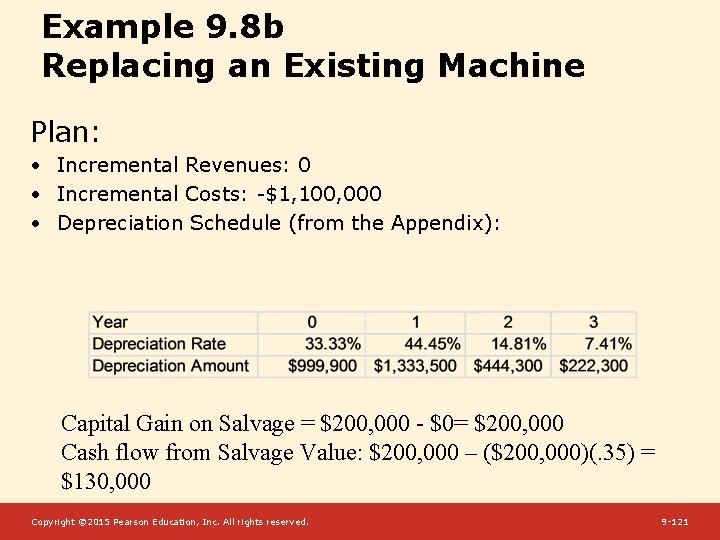
Example 9. 8 b Replacing an Existing Machine Plan: • Incremental Revenues: 0 • Incremental Costs: -$1, 100, 000 • Depreciation Schedule (from the Appendix): Capital Gain on Salvage = $200, 000 - $0= $200, 000 Cash flow from Salvage Value: $200, 000 – ($200, 000)(. 35) = $130, 000 Copyright © 2015 Pearson Education, Inc. All rights reserved. 9 -121
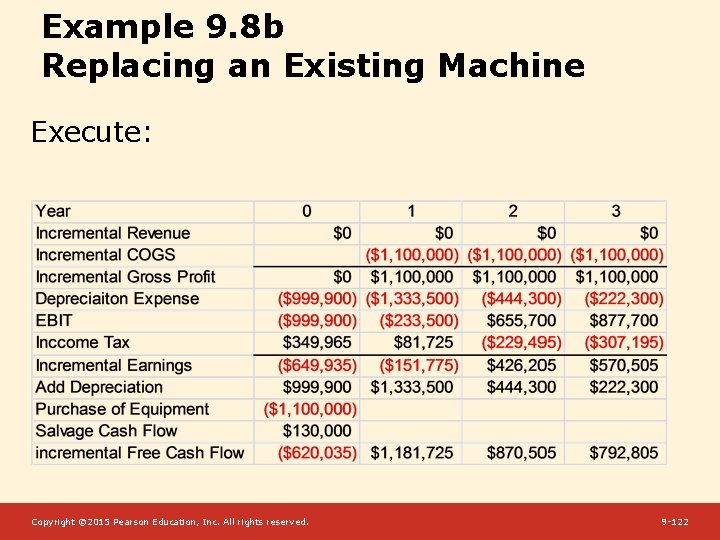
Example 9. 8 b Replacing an Existing Machine Execute: Copyright © 2015 Pearson Education, Inc. All rights reserved. 9 -122
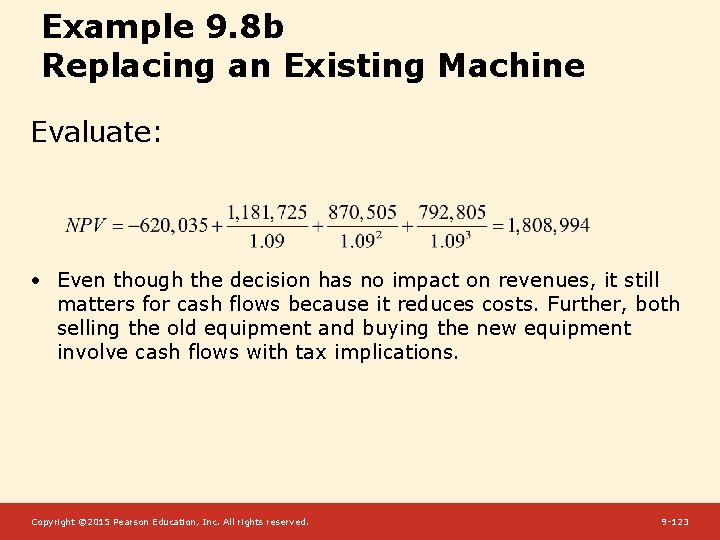
Example 9. 8 b Replacing an Existing Machine Evaluate: • Even though the decision has no impact on revenues, it still matters for cash flows because it reduces costs. Further, both selling the old equipment and buying the new equipment involve cash flows with tax implications. Copyright © 2015 Pearson Education, Inc. All rights reserved. 9 -123
9. 5 Analyzing the Project • Sensitivity Analysis – A capital budgeting tool that determines how the NPV varies as a single underlying assumption is changed Copyright © 2015 Pearson Education, Inc. All rights reserved. 9 -124
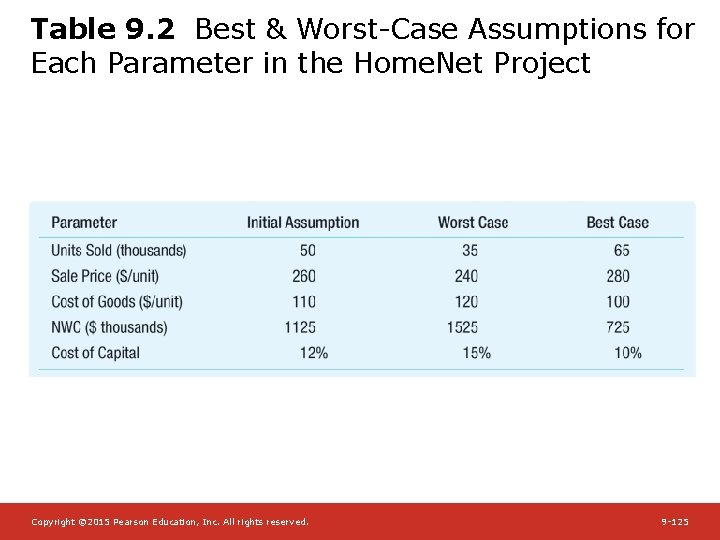
Table 9. 2 Best & Worst-Case Assumptions for Each Parameter in the Home. Net Project Copyright © 2015 Pearson Education, Inc. All rights reserved. 9 -125
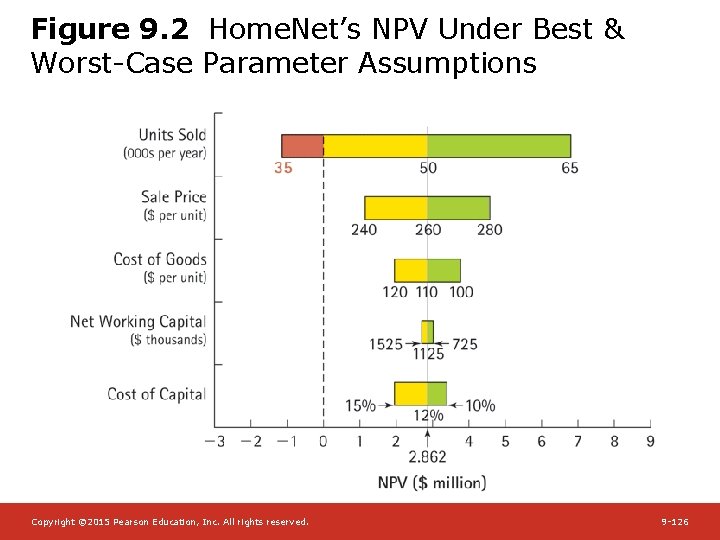
Figure 9. 2 Home. Net’s NPV Under Best & Worst-Case Parameter Assumptions Copyright © 2015 Pearson Education, Inc. All rights reserved. 9 -126
9. 5 Analyzing the Project • Break-Even Analysis – Break Even • The level of a parameter for which an investment has an NPV of zero Copyright © 2015 Pearson Education, Inc. All rights reserved. 9 -127
9. 5 Analyzing the Project • Break-Even Analysis – Accounting Break-Even • EBIT Break-Even – The level of a particular parameter for which a project’s EBIT is zero Units Sold × (Sale Price - Cost per Unit) - SG&A - Depreciation = 0 Copyright © 2015 Pearson Education, Inc. All rights reserved. 9 -128
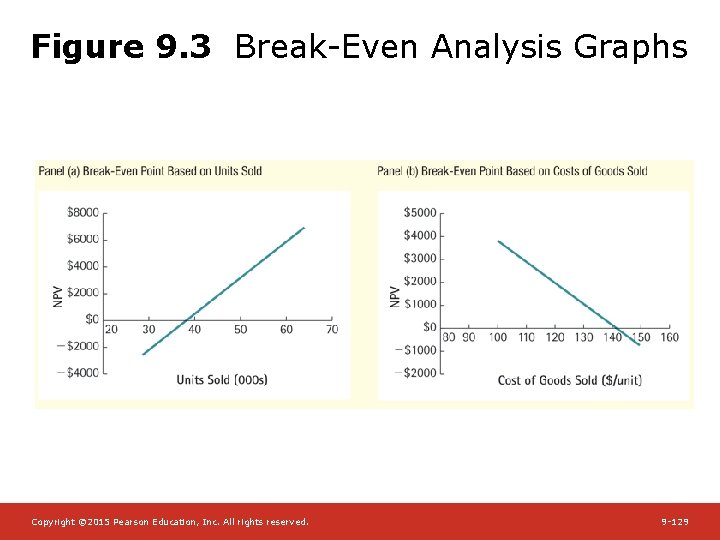
Figure 9. 3 Break-Even Analysis Graphs Copyright © 2015 Pearson Education, Inc. All rights reserved. 9 -129
9. 5 Analyzing the Project • Scenario Analysis – A capital budgeting tool that determines how the NPV varies as a number of the underlying assumptions are changed simultaneously Copyright © 2015 Pearson Education, Inc. All rights reserved. 9 -130
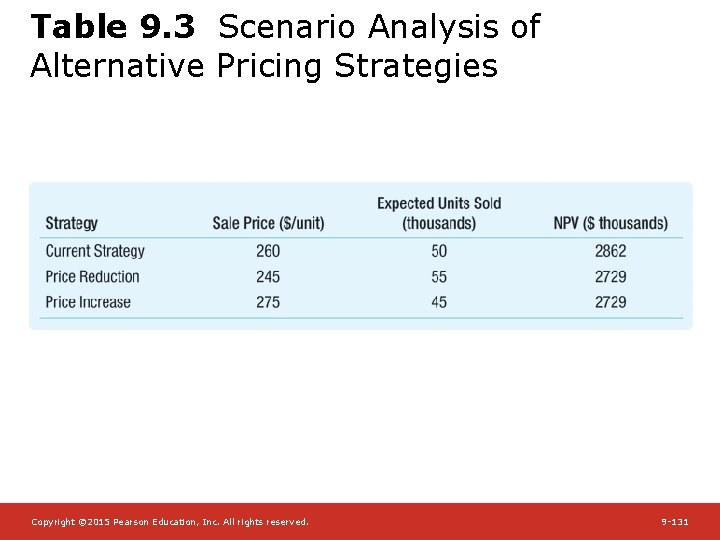
Table 9. 3 Scenario Analysis of Alternative Pricing Strategies Copyright © 2015 Pearson Education, Inc. All rights reserved. 9 -131
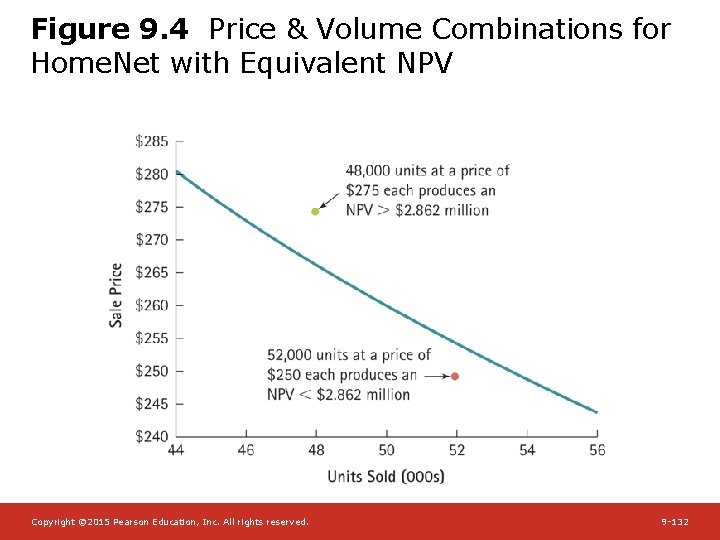
Figure 9. 4 Price & Volume Combinations for Home. Net with Equivalent NPV Copyright © 2015 Pearson Education, Inc. All rights reserved. 9 -132
9. 6 Real Options in Capital Budgeting • Real Option – The right, but not the obligation, to take a particular business action • Option to Delay • Option to Expand • Option to Abandon Copyright © 2015 Pearson Education, Inc. All rights reserved. 9 -133
Chapter Quiz 1. What is capital budgeting, and what is its goal? 2. Why do we focus only on incremental revenues and costs, rather than all revenues and costs of the firm? 3. Why does an increase in net working capital represent a cash outflow? Copyright © 2015 Pearson Education, Inc. All rights reserved. 9 -134
Chapter Quiz (cont’d) 4. Explain why it is advantageous for a firm to use the most accelerated depreciation schedule possible for tax purposes? 5. How does scenario analysis differ from sensitivity analysis? 6. Why do real options increase the NPV of the project? Copyright © 2015 Pearson Education, Inc. All rights reserved. 9 -135
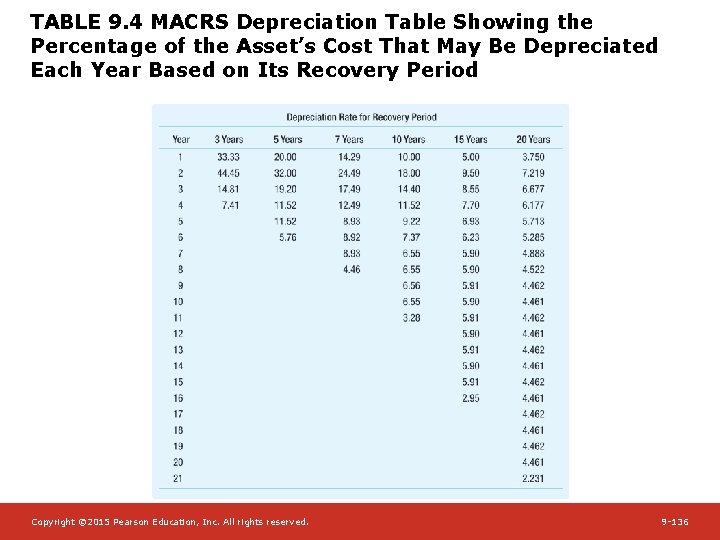
TABLE 9. 4 MACRS Depreciation Table Showing the Percentage of the Asset’s Cost That May Be Depreciated Each Year Based on Its Recovery Period Copyright © 2015 Pearson Education, Inc. All rights reserved. 9 -136
- Slides: 136