
Chapter 9 Foundations of Group Behavior 1 Learning

Chapter 9 Foundations of Group Behavior 1
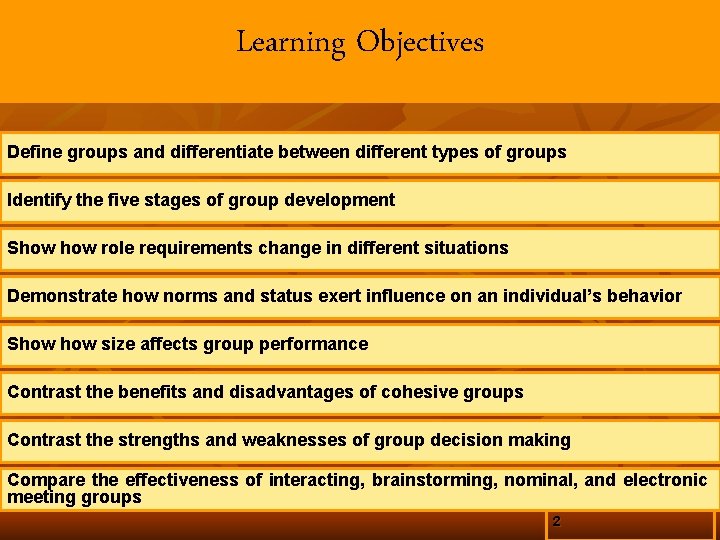
Learning Objectives Define groups and differentiate between different types of groups Identify the five stages of group development Show role requirements change in different situations Demonstrate how norms and status exert influence on an individual’s behavior Show size affects group performance Contrast the benefits and disadvantages of cohesive groups Contrast the strengths and weaknesses of group decision making Compare the effectiveness of interacting, brainstorming, nominal, and electronic meeting groups 2
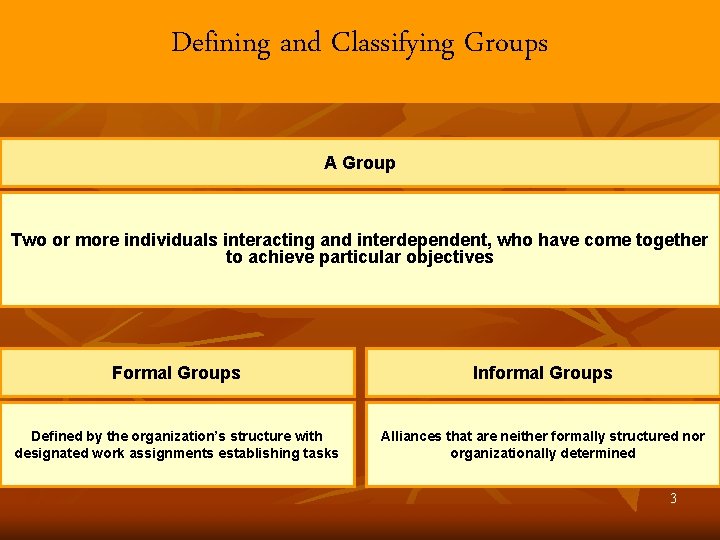
Defining and Classifying Groups A Group Two or more individuals interacting and interdependent, who have come together to achieve particular objectives Formal Groups Informal Groups Defined by the organization’s structure with designated work assignments establishing tasks Alliances that are neither formally structured nor organizationally determined 3
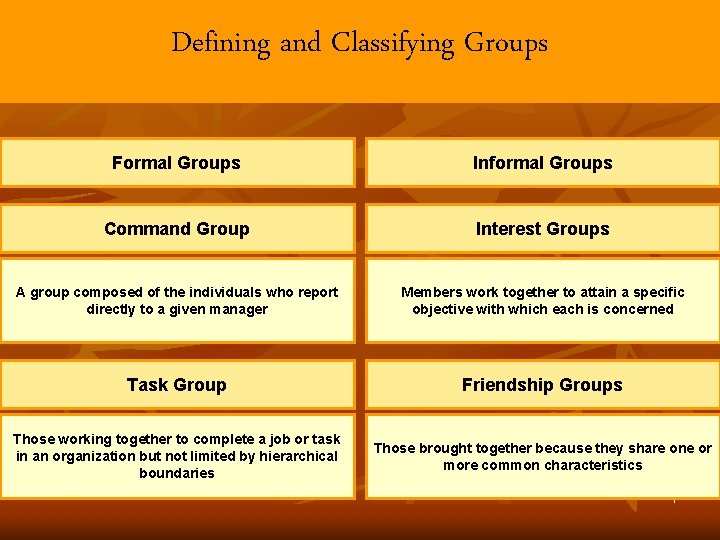
Defining and Classifying Groups Formal Groups Informal Groups Command Group Interest Groups A group composed of the individuals who report directly to a given manager Members work together to attain a specific objective with which each is concerned Task Group Friendship Groups Those working together to complete a job or task in an organization but not limited by hierarchical boundaries Those brought together because they share one or more common characteristics 4
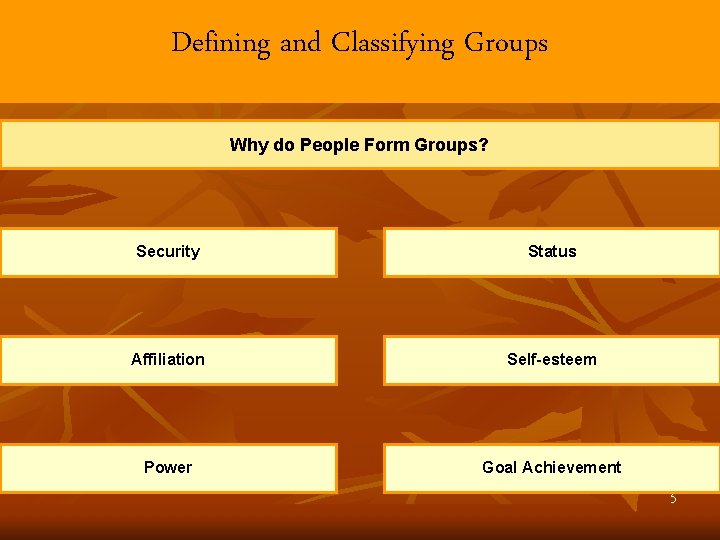
Defining and Classifying Groups Why do People Form Groups? Security Status Affiliation Self-esteem Power Goal Achievement 5

Defining and Classifying Groups Why do People Form Groups? Social Identity Theory Perspective that considers when and why individuals consider themselves members of groups. Ingroup Favoritism Perspective in which we see members of our ingroup as better than other people, and people not in our group as all the same. Similarity Distinctiveness Status Uncertainty reduction 6
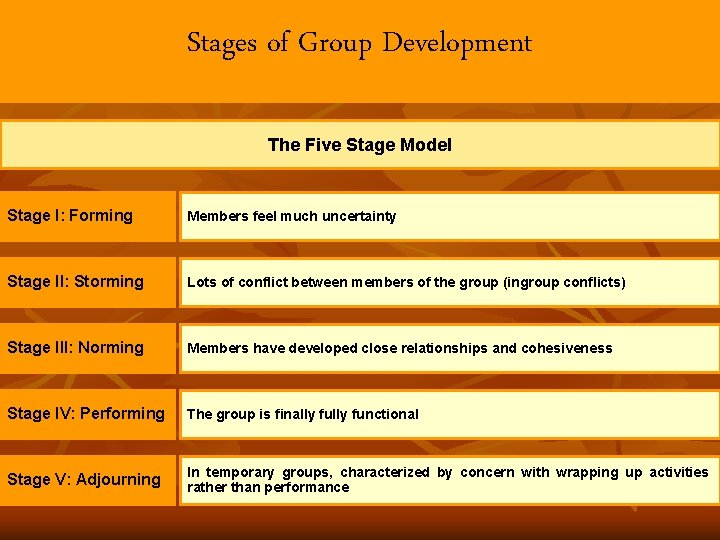
Stages of Group Development The Five Stage Model Stage I: Forming Members feel much uncertainty Stage II: Storming Lots of conflict between members of the group (ingroup conflicts) Stage III: Norming Members have developed close relationships and cohesiveness Stage IV: Performing The group is finally functional Stage V: Adjourning In temporary groups, characterized by concern with wrapping up activities rather than performance 7
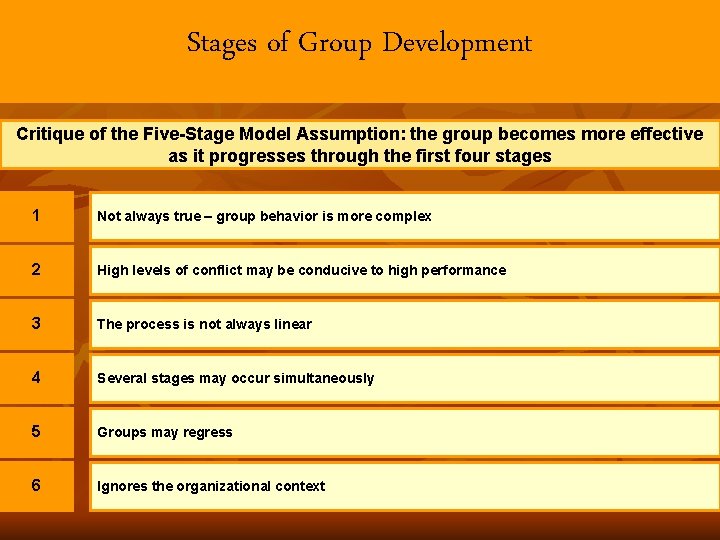
Stages of Group Development Critique of the Five-Stage Model Assumption: the group becomes more effective as it progresses through the first four stages 1 Not always true – group behavior is more complex 2 High levels of conflict may be conducive to high performance 3 The process is not always linear 4 Several stages may occur simultaneously 5 Groups may regress 6 Ignores the organizational context 8
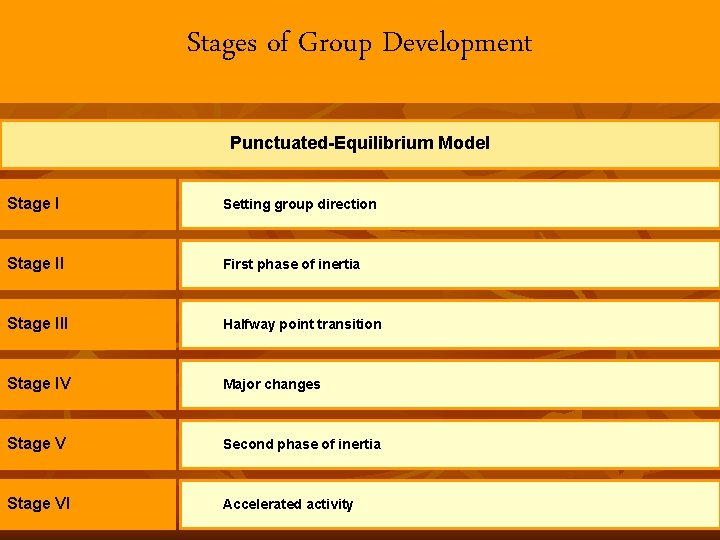
Stages of Group Development Punctuated-Equilibrium Model Stage I Setting group direction Stage II First phase of inertia Stage III Halfway point transition Stage IV Major changes Stage V Second phase of inertia Stage VI Accelerated activity 9
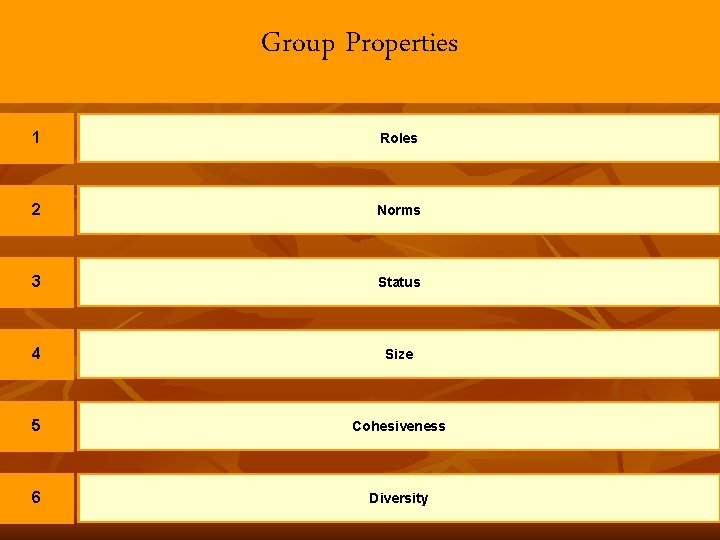
Group Properties 1 Roles 2 Norms 3 Status 4 Size 5 Cohesiveness 6 Diversity 10
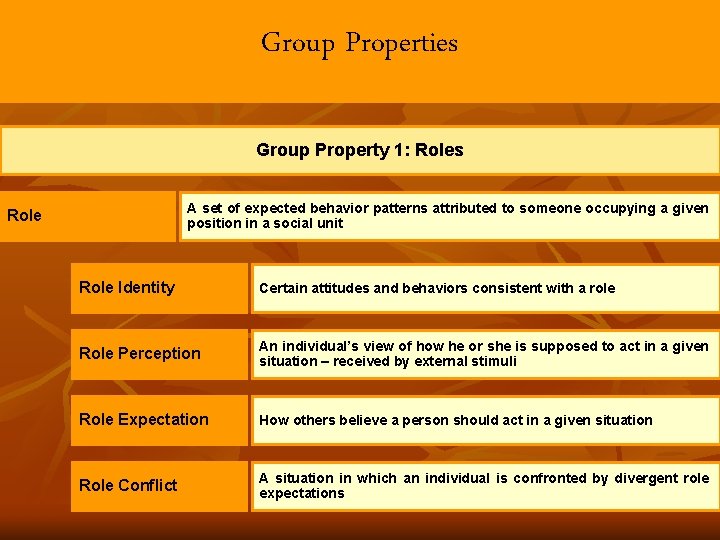
Group Properties Group Property 1: Roles A set of expected behavior patterns attributed to someone occupying a given position in a social unit Role Identity Certain attitudes and behaviors consistent with a role Role Perception An individual’s view of how he or she is supposed to act in a given situation – received by external stimuli Role Expectation How others believe a person should act in a given situation Role Conflict A situation in which an individual is confronted by divergent role expectations 11
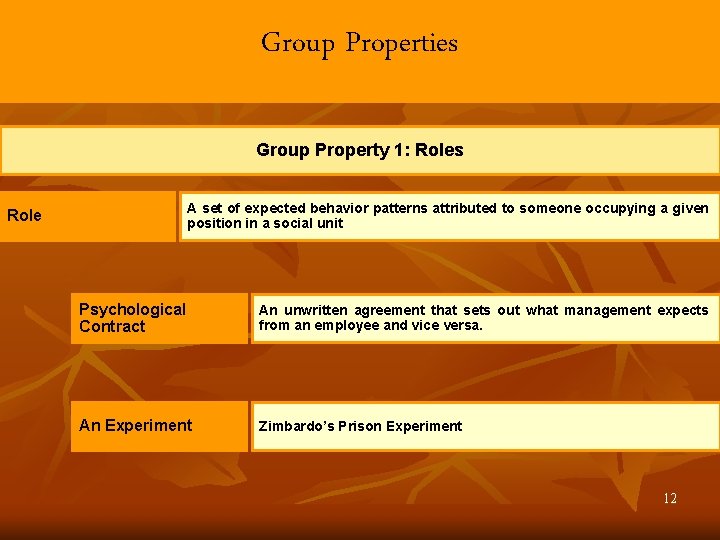
Group Properties Group Property 1: Roles A set of expected behavior patterns attributed to someone occupying a given position in a social unit Role Psychological Contract An unwritten agreement that sets out what management expects from an employee and vice versa. An Experiment Zimbardo’s Prison Experiment 12
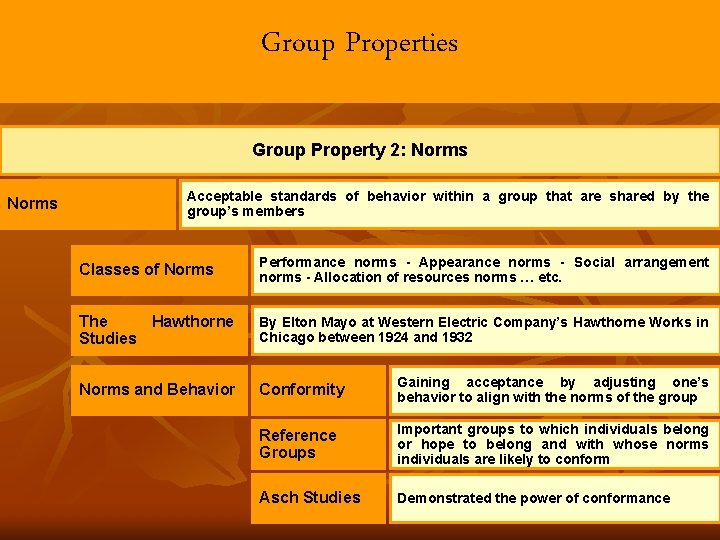
Group Properties Group Property 2: Norms Acceptable standards of behavior within a group that are shared by the group’s members Classes of Norms Performance norms - Appearance norms - Social arrangement norms - Allocation of resources norms … etc. The Hawthorne Studies By Elton Mayo at Western Electric Company’s Hawthorne Works in Chicago between 1924 and 1932 Norms and Behavior Conformity Gaining acceptance by adjusting one’s behavior to align with the norms of the group Reference Groups Important groups to which individuals belong or hope to belong and with whose norms individuals are likely to conform Asch Studies Demonstrated the power of conformance 13
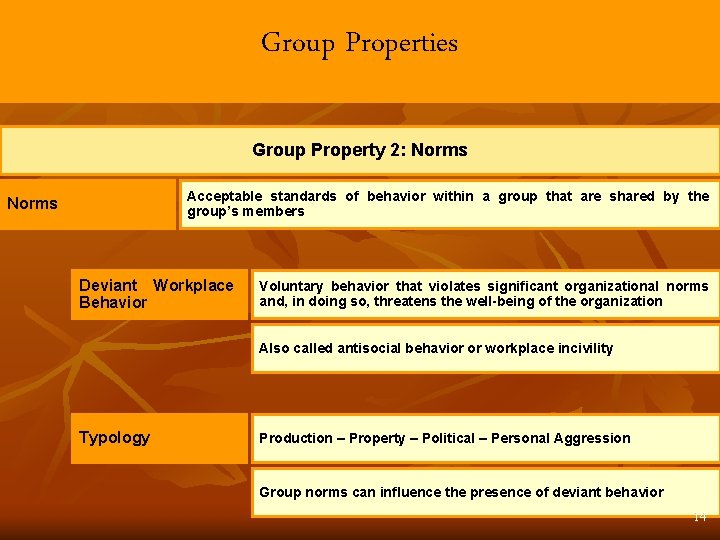
Group Properties Group Property 2: Norms Acceptable standards of behavior within a group that are shared by the group’s members Norms Deviant Workplace Behavior Voluntary behavior that violates significant organizational norms and, in doing so, threatens the well-being of the organization Also called antisocial behavior or workplace incivility Typology Production – Property – Political – Personal Aggression Group norms can influence the presence of deviant behavior 14
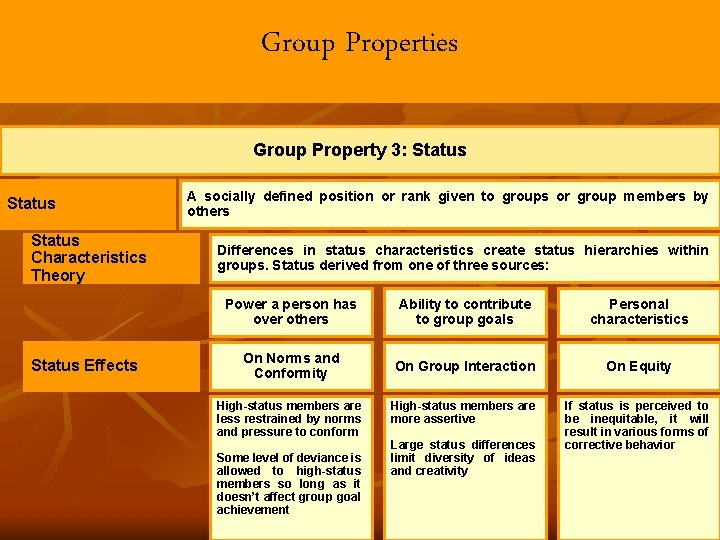
Group Properties Group Property 3: Status Characteristics Theory Status Effects A socially defined position or rank given to groups or group members by others Differences in status characteristics create status hierarchies within groups. Status derived from one of three sources: Power a person has over others Ability to contribute to group goals Personal characteristics On Norms and Conformity On Group Interaction On Equity High-status members are more assertive If status is perceived to be inequitable, it will result in various forms of corrective behavior High-status members are less restrained by norms and pressure to conform Some level of deviance is allowed to high-status members so long as it doesn’t affect group goal achievement Large status differences limit diversity of ideas and creativity 15
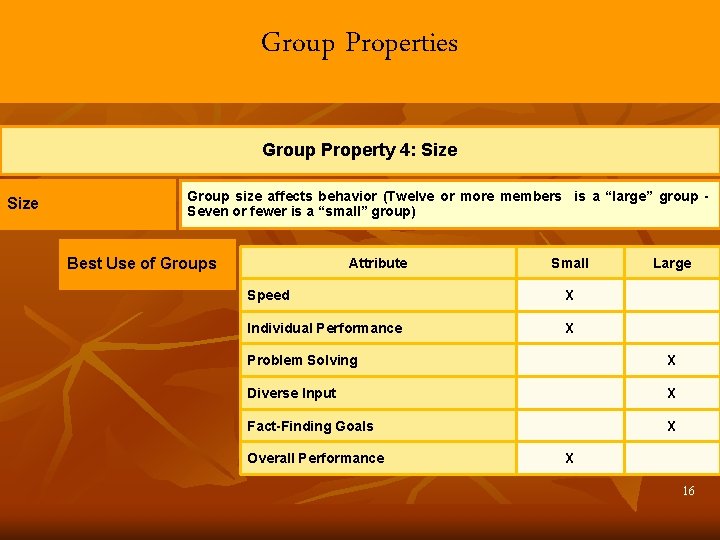
Group Properties Group Property 4: Size Group size affects behavior (Twelve or more members is a “large” group Seven or fewer is a “small” group) Attribute Best Use of Groups Small Speed X Individual Performance X Large Problem Solving X Diverse Input X Fact-Finding Goals X Overall Performance X 16
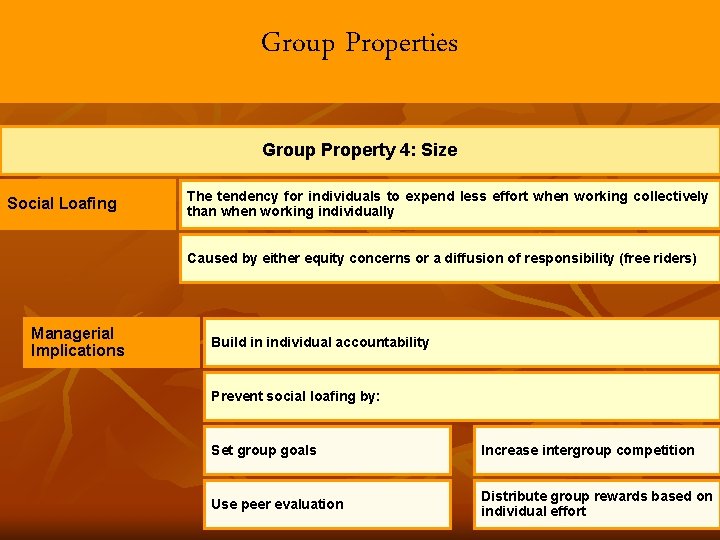
Group Properties Group Property 4: Size Social Loafing The tendency for individuals to expend less effort when working collectively than when working individually Caused by either equity concerns or a diffusion of responsibility (free riders) Managerial Implications Build in individual accountability Prevent social loafing by: Set group goals Increase intergroup competition Use peer evaluation Distribute group rewards based on individual effort 17
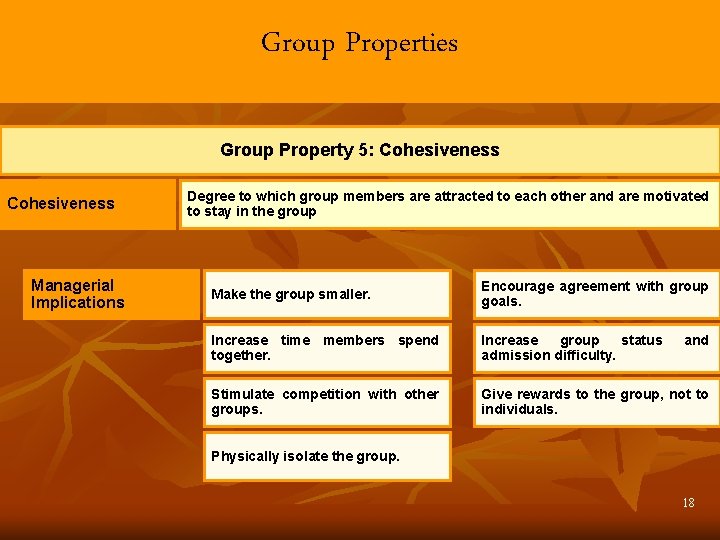
Group Properties Group Property 5: Cohesiveness Managerial Implications Degree to which group members are attracted to each other and are motivated to stay in the group Make the group smaller. Encourage agreement with group goals. Increase time members spend together. Increase group status admission difficulty. Stimulate competition with other groups. Give rewards to the group, not to individuals. and Physically isolate the group. 18
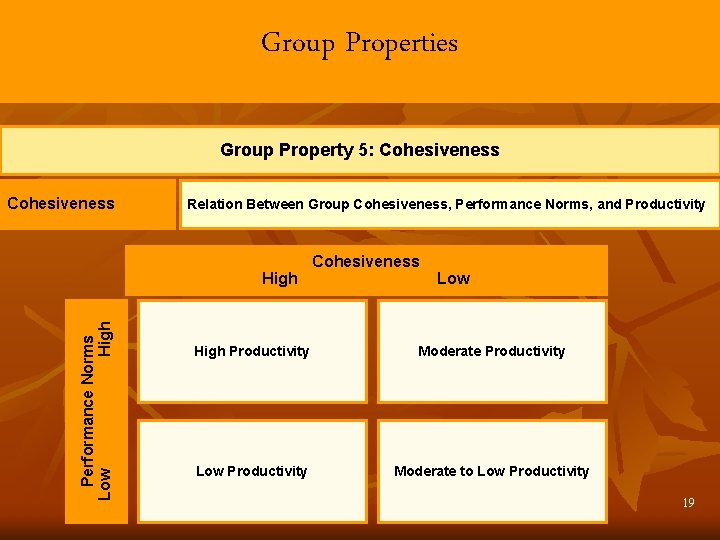
Group Properties Group Property 5: Cohesiveness Relation Between Group Cohesiveness, Performance Norms, and Productivity Performance Norms Low High Cohesiveness Low High Productivity Moderate Productivity Low Productivity Moderate to Low Productivity 19
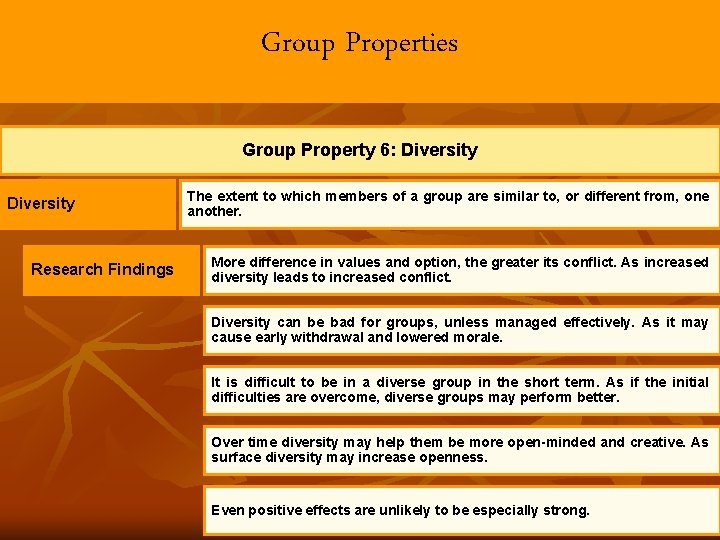
Group Properties Group Property 6: Diversity Research Findings The extent to which members of a group are similar to, or different from, one another. More difference in values and option, the greater its conflict. As increased diversity leads to increased conflict. Diversity can be bad for groups, unless managed effectively. As it may cause early withdrawal and lowered morale. It is difficult to be in a diverse group in the short term. As if the initial difficulties are overcome, diverse groups may perform better. Over time diversity may help them be more open-minded and creative. As surface diversity may increase openness. Even positive effects are unlikely to be especially strong. 20
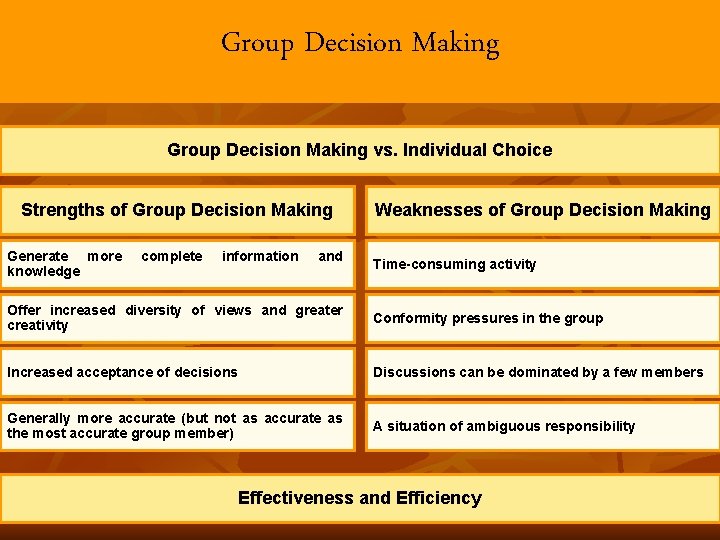
Group Decision Making vs. Individual Choice Strengths of Group Decision Making Generate more knowledge complete information and Weaknesses of Group Decision Making Time-consuming activity Offer increased diversity of views and greater creativity Conformity pressures in the group Increased acceptance of decisions Discussions can be dominated by a few members Generally more accurate (but not as accurate as the most accurate group member) A situation of ambiguous responsibility Effectiveness and Efficiency 21
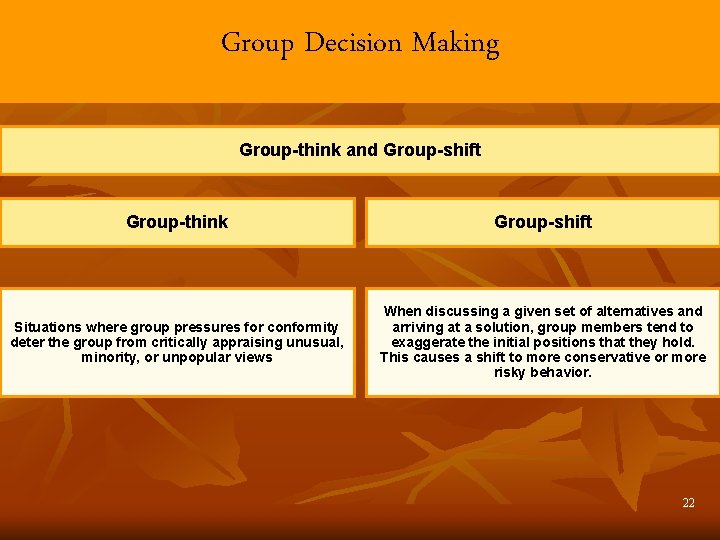
Group Decision Making Group-think and Group-shift Group-think Group-shift Situations where group pressures for conformity deter the group from critically appraising unusual, minority, or unpopular views When discussing a given set of alternatives and arriving at a solution, group members tend to exaggerate the initial positions that they hold. This causes a shift to more conservative or more risky behavior. 22
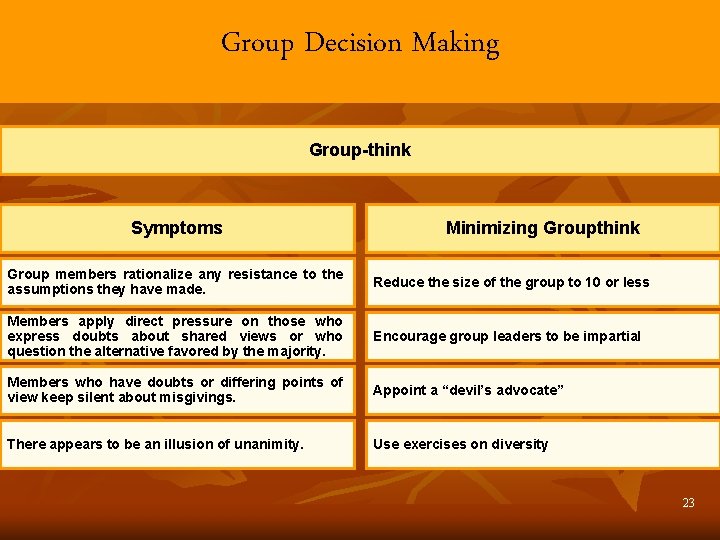
Group Decision Making Group-think Symptoms Minimizing Groupthink Group members rationalize any resistance to the assumptions they have made. Reduce the size of the group to 10 or less Members apply direct pressure on those who express doubts about shared views or who question the alternative favored by the majority. Encourage group leaders to be impartial Members who have doubts or differing points of view keep silent about misgivings. Appoint a “devil’s advocate” There appears to be an illusion of unanimity. Use exercises on diversity 23

Group Decision Making Techniques Interacting Groups where members meet face-to-face and rely on verbal and nonverbal communication Brainstorming An idea-generating process designed to overcome pressure for conformity Nominal Group Technique (NGT) Works by restricting discussion during the decision-making process Members are physically present but operate independently Electronic Meeting Uses computers to hold large meetings of up to 50 people 24
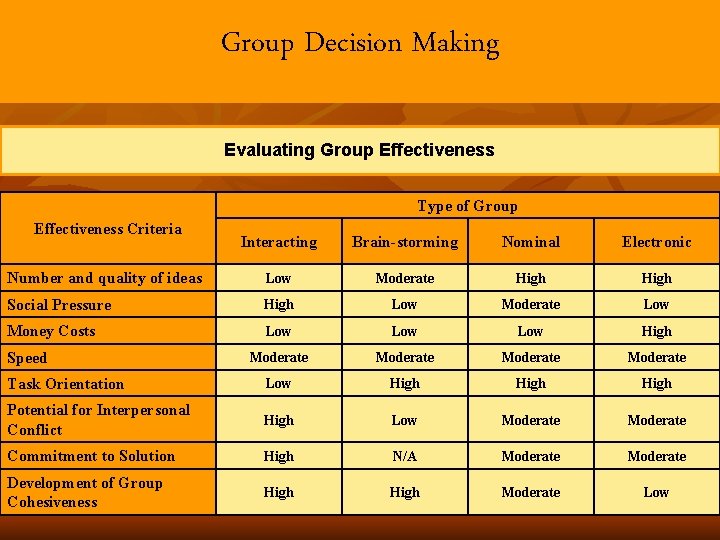
Group Decision Making Evaluating Group Effectiveness Type of Group Effectiveness Criteria Interacting Brain-storming Nominal Electronic Number and quality of ideas Low Moderate High Social Pressure High Low Moderate Low Money Costs Low Low High Moderate Task Orientation Low High Potential for Interpersonal Conflict High Low Moderate Commitment to Solution High N/A Moderate Development of Group Cohesiveness High Moderate Low Speed 25

Summary and Managerial Implications How to Increase Performance? clear role perception, appropriate norms, low status differences, and smaller, more cohesive groups lead to higher performance How to Increase Satisfaction? High congruence between boss’s and employees’ perceptions about the job Not being forced to communicate with lower-status employees Smaller group size 26
- Slides: 26