
CHAPTER 9 Facilitating Fluency for Preschool and SchoolAge
- Slides: 40
CHAPTER 9 Facilitating Fluency for Preschool and School-Age Children Copyright 2010 Delmar, a part of Cengage Learning. ALL RIGHTS RESERVED. 1
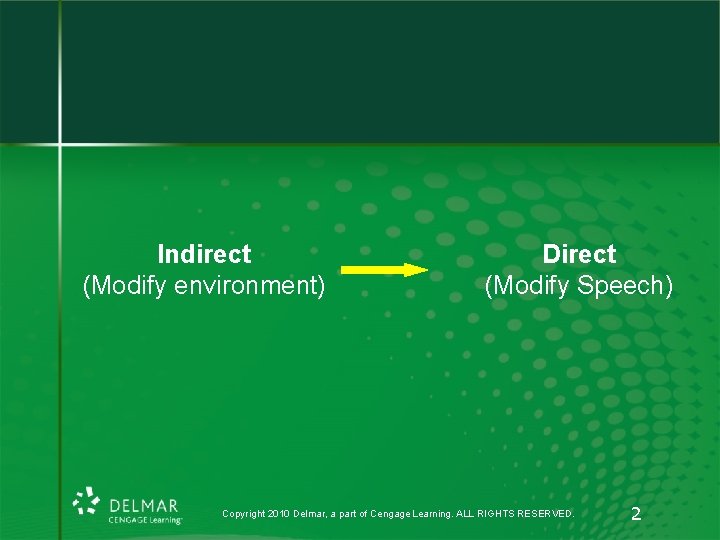
Indirect (Modify environment) Direct (Modify Speech) Copyright 2010 Delmar, a part of Cengage Learning. ALL RIGHTS RESERVED. 2
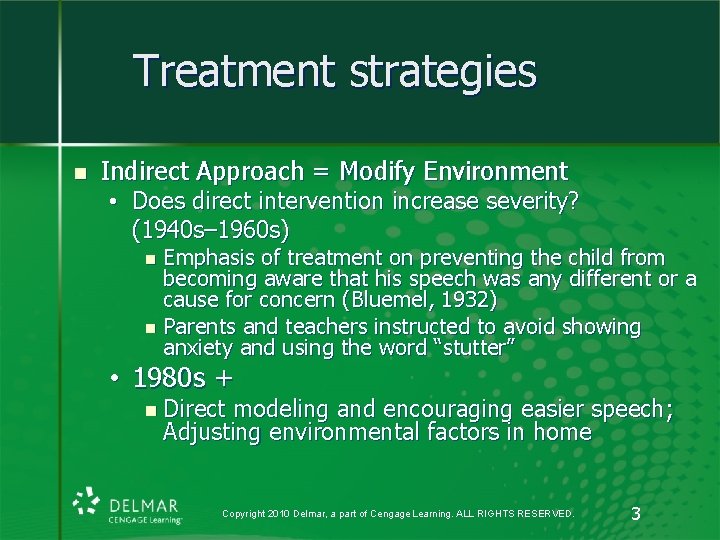
Treatment strategies n Indirect Approach = Modify Environment • Does direct intervention increase severity? (1940 s– 1960 s) Emphasis of treatment on preventing the child from becoming aware that his speech was any different or a cause for concern (Bluemel, 1932) n Parents and teachers instructed to avoid showing anxiety and using the word “stutter” n • 1980 s + n Direct modeling and encouraging easier speech; Adjusting environmental factors in home Copyright 2010 Delmar, a part of Cengage Learning. ALL RIGHTS RESERVED. 3
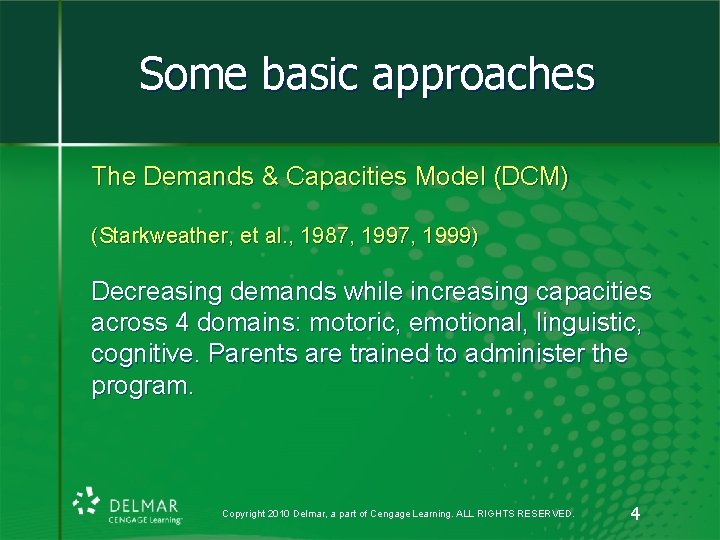
Some basic approaches The Demands & Capacities Model (DCM) (Starkweather, et al. , 1987, 1999) Decreasing demands while increasing capacities across 4 domains: motoric, emotional, linguistic, cognitive. Parents are trained to administer the program. Copyright 2010 Delmar, a part of Cengage Learning. ALL RIGHTS RESERVED. 4
Some basic approaches (continued) Lidcombe Program for preschool children Onslow, M, Packman, A. , and Harrison, E. , (2003) The Lidcombe program of early stuttering intervention: A clinician’s guide. Austin, TX: Pro-Ed. The child’s fluent speech is followed by praise or acknowledgment, disfluent speech by encouragement of a fluent correction or by acknowledgement. Parents are trained to administer the program. Copyright 2010 Delmar, a part of Cengage Learning. ALL RIGHTS RESERVED. 5
Evidence of therapeutic change for children Franken, C-M. , Van der Shalk, K. , Boelens, H. (2005). Experimental treatment of early stuttering: A preliminary study. J. Fluency Disorders, 30, 189199. Purpose: to consider the feasibility of comparing the response of two groups of preschool children who were randomly assigned to The Lidcombe Program (n = 12) and the current standard treatment program in the Netherlands, The Demands and Capacities-Based treatment program (n = 15). Copyright 2010 Delmar, a part of Cengage Learning. ALL RIGHTS RESERVED. 6
Evidence of therapeutic change for children (continued) Method: Stuttering frequencies and severity ratings were obtained immediately before and after treatment (12 weeks). Copyright 2010 Delmar, a part of Cengage Learning. ALL RIGHTS RESERVED. 7
Franken, et al. results Results: n Stuttering frequencies and severity ratings significantly decreased for both treatment groups. n No differences between groups for either measure n Parents of children in both groups were cooperative and no differences were found on scales that measured their satisfaction with the two treatments. n Next: analysis to determine contributions of treatment components Copyright 2010 Delmar, a part of Cengage Learning. ALL RIGHTS RESERVED. 8
Common components for DCM and Lidcombe Programs (from Ratner & Guitar, 2006) n n n Active role of the parents in therapeutic process Parents levels of understanding, learning, & commitment Parent’s active participation & resulting reduction of anxiety Parent’s increased parental locus of control Parents openly acknowledge and normalize stuttering Praise demonstrates the child has a choice about how they speak Copyright 2010 Delmar, a part of Cengage Learning. ALL RIGHTS RESERVED. 9
Common components for DCM and Lidcombe Programs (from Ratner & Guitar, 2006) (continued) n Bonding of the parent and child during treatment takes place in the child’s everyday environment n Reduction in expressive language to more ageappropriate levels n Focus on the child’s fluent speech may foster the development of an alternative story that is not focused on stuttering. (Dilollo & Manning, 2006) Copyright 2010 Delmar, a part of Cengage Learning. ALL RIGHTS RESERVED. 10
Key qualities of a clinician treating younger speakers n Understands the nature of stuttering; willing to help child experiment & vary forms of nonfluent speech. n Provides supportive therapeutic experience, enabling the child to become desensitized to their stuttering. n Allows child to understand control the basic features of speech → effortless, forward-flowing speech. n Obtain the understanding and support of the parents and other important people in child’s life. Copyright 2010 Delmar, a part of Cengage Learning. ALL RIGHTS RESERVED. 11
Treatment goals for young speakers • Reduce frequency and change the form of stuttering • Reduce negative feelings and thoughts about stuttering • Decrease avoidance • Involve the parents in altering the child’s environment • Enhance the child’s abilities and enjoyment of verbally communicating Copyright 2010 Delmar, a part of Cengage Learning. ALL RIGHTS RESERVED. 12
Choosing a treatment approach n Be aware of many approaches & techniques n Each approach will be different depending on clinician—academic/clinical background, experience, interactive style n Children will respond in different ways n No one method works for all children Copyright 2010 Delmar, a part of Cengage Learning. ALL RIGHTS RESERVED. 13
You just have to find the right rocks When I was climbing, my partner and I were giving each other advice about which way to go and which rock might be the best one to go to next. In learning to manage my stuttering, I have found that I need to find the things that work for me. I need to use my own best words to express myself, find my best chances or opportunities to talk, and discover which tools work best for me. Other people can guide me, but I have to find my own “right rocks. ” Copyright 2010 Delmar, a part of Cengage Learning. ALL RIGHTS RESERVED. 14
When working with children n Use basic and understandable terms n Model targets (rather than tell) n Model slow and easy speech n Model slow and easy body movements n Reinforce child’s accomplishments and feelings of self-worth 1995) (Ramig and Bennett, Copyright 2010 Delmar, a part of Cengage Learning. ALL RIGHTS RESERVED. 15
Selected techniques • Parents’ rate, turn-taking, pausing • Maybe fewer questions • Communication disruptors (interruptions, overtalking, lack of interest in what the child says, over- stimulation) • Slowing parent’s rate of speech—Mr. Roger’s speech Copyright 2010 Delmar, a part of Cengage Learning. ALL RIGHTS RESERVED. 16
Selected techniques (continued) • Use analogies (bumpy-smooth/stretchy, hose) • Cursive handwriting for slow and easy speech • Combining forms of play with sound production • Slowing down your own speech rate Copyright 2010 Delmar, a part of Cengage Learning. ALL RIGHTS RESERVED. 17
Since we last met. . . What have you learned about stuttering? n What new question do you have about stuttering? n What action have you taken this week? n What new ways have you problem solved? n What would be a good next step for you? → What are some of your “right rocks” Copyright 2010 Delmar, a part of Cengage Learning. ALL RIGHTS RESERVED. 18
Superfluency (Guitar, 2006) n n Flexible rate—show child how to slow only the initial syllables of a word or syllable Easy onsets—emphasize gradual onset of voicing and airflow. Light contacts—modeling easy articulatory postures Proprioception—heightened feedback for articulatory movements and extent of contact Then, expand from three-word utterances to longer sentences Copyright 2010 Delmar, a part of Cengage Learning. ALL RIGHTS RESERVED. 19
Indicators of successful therapy n Slower rate of repetitions n Continuation of airflow and voicing n Easy articulatory contacts n Smooth transitions through sounds and syllables n Child takes part in communicating Copyright 2010 Delmar, a part of Cengage Learning. ALL RIGHTS RESERVED. 20
Recommended resources • Chmela, K. , & Reardon, N. (2002). The school-age child who stutters: Working effectively with attitudes and emotions. (Pub. # 5) Memphis, TN: Stuttering Foundation. • Manning, W. (2004). Clinical decision making with adolescents who stutter. ASHA Continuing Education Series, Rockville, MD. (2 CDs) • Ramig, P. , & Dodge, D. (2005). The child and adolescent stuttering treatment and activity resource guide. Clifton Park, NY: Thomson Delmar Learning. • Reitzes, P. (2006). 50 great activities for children who stutter. Austin, TX: Pro-Ed. • Ratner N, & Sisskin, V. (2002). Intervention strategies for children who stutter. ASHA Continuing Education Series, Rockville, MD. (2 video tapes) Copyright 2010 Delmar, a part of Cengage Learning. ALL RIGHTS RESERVED. 21
Addressing desensitization and cognitive restructuring n n n n Learn about stuttering Learn about other people who stutter Explore and learn to tolerate moments of stuttering Change negative self-talk Self-acknowledgement to friends, teacher, and classmates Help parents to make stuttering an acceptable topic of discussion Parent group meetings can be very useful (NSA, Friends) Copyright 2010 Delmar, a part of Cengage Learning. ALL RIGHTS RESERVED. 22
Teasing vs. bullying n Bullying—Conscious effort to hurt or control someone Negative effects: lowered self-esteem, depression, loneliness, anxiousness, insecurities, social failure, academic issues n Teasing—Good-natured exchange between friends. No intention to harm someone. Copyright 2010 Delmar, a part of Cengage Learning. ALL RIGHTS RESERVED. 23
Possible effects of teasing and bullying n n n Shame—major affect on one’s overall self- interpretation Teasing is one way in which shame becomes attached to stuttering. Results in increased stuttering and a high degree of social inhibition. 60% children who stutter (7– 15 yrs) experience this negative treatment. The effects may continue into adulthood Copyright 2010 Delmar, a part of Cengage Learning. ALL RIGHTS RESERVED. 24
Developing effective responses to bullying n n n Distinguish between hurtful and inquisitive comments Instruct about the nature of bullying and those who do it Role-play activities Copyright 2010 Delmar, a part of Cengage Learning. ALL RIGHTS RESERVED. 25
Role-playing activities n n Provide child with opportunity to vent anger and frustration Allow child to become desensitized Help child learn to defuse negative comments Possible responses • • Shrug: “I don’t care, So what. ” Broken Record: “Because I want to!” Mighty Might : “You might be right. ” So? Copyright 2010 Delmar, a part of Cengage Learning. ALL RIGHTS RESERVED. 26
When coexisting problems occur n Recognize that demands for phonological and grammatical processing compete with resources that permit fluent speech n Organize treatment hierarchy n Structure intervention with minimum overt feedback n Determine whether the impairments should be treated concurrently, sequentially, or cyclically Copyright 2010 Delmar, a part of Cengage Learning. ALL RIGHTS RESERVED. 27
Problems that reduce or impact fluency n n Co-occurring speech and language problems influence the clinician’s decision for providing treatment for children who stutter, but there also a variety of neurological and behavioral conditions. The more serious problems involve executive function or regulatory activities associated with the basal ganglia. Copyright 2010 Delmar, a part of Cengage Learning. ALL RIGHTS RESERVED. 28
Problems that reduce or impact fluency (continued) n Tourette’s Syndrome (TS) n Autism Spectrum Disorder (ASD) and Asperger Syndrome n Attention Deficit Hyperactivity Disorder (ADHD) n Down Syndrome Copyright 2010 Delmar, a part of Cengage Learning. ALL RIGHTS RESERVED. 29
Tourette’s syndrome n A neurologic disorder with childhood onset and is thought to be secondary to abnormal metabolism of the neurotransmitter dopamine. n By age 7, TS children exhibit motor, phonic, and mental tics that are repetitive and involve rapid, involuntary movements or vocalizations (e. g. , facial grimaces, eye-blinking, shrugging, head jerking, face-rubbing, lip-licking). n Intelligibility is often impaired due to rapid speech problems. Copyright 2010 Delmar, a part of Cengage Learning. ALL RIGHTS RESERVED. 30
Tourette’s syndrome (continued) n Most disfluencies are not SLDs typical of developmental stuttering, but rather fillers, phrase repetitions, and sentence revisions. n Speech characteristics are similar to cluttering. n Recommended intervention strategies: • focus on teaching the child to monitor speech during structured interactions and increase ability to read social cues. Copyright 2010 Delmar, a part of Cengage Learning. ALL RIGHTS RESERVED. 31
Tourette’s syndrome (continued) n Recommended intervention strategies (Continued): • Speech rate addressed by emphasizing clear articulation with natural speech prosody. • Other goals may include enhancing the child’s ability to comprehend abstract or figurative language, accurately process verbal information, and formulate ideas. Copyright 2010 Delmar, a part of Cengage Learning. ALL RIGHTS RESERVED. 32
Autism spectrum disorder (ASD) including Asperger syndrome n n n Describes an assortment of developmental problems including impairments in social interaction, communication, play and imagination, and restricted interests and activities. Disfluencies, including SLDs, are common. Asperger Syndrome is regarded as a milder form of autism and is characterized by no delay in general language ability or cognitive development (they may score in the superior range on standardized IQ tests). Copyright 2010 Delmar, a part of Cengage Learning. ALL RIGHTS RESERVED. 33
Attention deficit hyperactivity disorder (ADHD) n Hallmark of these children is “consistent inconsistency” in two or more environments such as school, home, and other social settings and is characterized by inattention, hyperactivity, and impulsivity n Classified into 3 categories • Primarily hyperactive-impulsive(without inattention) • Predominately inattentive type (without significant hyperactivity) Copyright 2010 Delmar, a part of Cengage Learning. ALL RIGHTS RESERVED. 34
Attention deficit hyperactivity disorder (ADHD) (continued) n Classified into 3 categories (Continued) • Combination of these two n Most children who stutter do not have ADHD n Medication has been found to increase disfluencies Copyright 2010 Delmar, a part of Cengage Learning. ALL RIGHTS RESERVED. 35
Down syndrome n Stuttering more frequent for individuals of less intelligence (30 -40%) n In the specific instance of the most common cause of intellectual disability, Down syndrome, the occurrence of stuttering occurs with greater frequency n Characteristics of children who stutter with Down syndrome… Copyright 2010 Delmar, a part of Cengage Learning. ALL RIGHTS RESERVED. 36
Down syndrome (continued) n n n Onset age 8– 10 (sequencing 2– 3 words) Unaware initially, same avoidance later Many characteristics of cluttering (fast rate, poor intelligibility) High frequency of whole and part-word reps and prolongations Difficulty monitoring, poor motor coordination, word finding, and language formulation Copyright 2010 Delmar, a part of Cengage Learning. ALL RIGHTS RESERVED. 37
Classroom teachers n n Create a workshop, S. Foundation video, handouts, SLDs Basic message: Will not harm or make worse Reinforce small & large victories Consult with SLP, child, parents, peers • Letter to teacher(s) (see p. 356) n n n Observe basic techniques of treatment Be an advocate for the child Note Figure 9 -1, Reardon’s Teacher Checklist Copyright 2010 Delmar, a part of Cengage Learning. ALL RIGHTS RESERVED. 38
Classroom teachers (continued) n Participation & nonavoidance Reward modification, open stuttering Be calm and interested in child’s speech Call on child early; short answers Do not allow interruption by others Paraphrase (non)fluent speech Advertising/educating classmates n Note Box 9 -1, Sample Letter to Teachers n n n Copyright 2010 Delmar, a part of Cengage Learning. ALL RIGHTS RESERVED. 39
Transfer and termination n Critical to transfer skills to daily situations n Gradual transfer of self-cuing to the child and parents n Relapse less likely with preschool children n School-age children more likely to regress and may need booster sessions Copyright 2010 Delmar, a part of Cengage Learning. ALL RIGHTS RESERVED. 40