
Chapter 9 Etiquette of International Business Negotiation Learning
Chapter 9 Etiquette of International Business Negotiation
Learning Objectives By the end of this chapter, you will know: • What implication business etiquette has for international business negotiation. • What role and functions business etiquette performs in international business negotiation. • What are the basic rules about the etiquette for international business negotiation. • What business etiquette has to be addressed in international business negotiation.
Lead-in Business Negotiation Etiquette 1. Stay Genuine and Respectful 2. Be Patient and Listen 3. Stick to Your Bottom Line 4. Know When to Back Down 5. Observe International Business Etiquette
Contents 9. 1 Implication of Etiquette for International Business Negotiation 9. 2 Basic Rules About Etiquette for International Business Negotiation 9. 3 Etiquette in International Business Negotiation.
9. 1 Implication of Etiquette for International Business Negotiation • Business negotiations are not likely to be immune to the cultural factors in foreign countries where culturally-embedded professional etiquette appears to be even more important. • Business etiquette is an integral part of different countries' and regions' business culture. • Proper manners and business etiquette are crucial to the success of your business negotiations because they will influence how the other party perceives you. • A firm grasp of business etiquette is essential if you negotiate in international or cross-cultural settings.

9. 1 Implication of Etiquette for International Business Negotiation The role of etiquette in international business negotiation 1. Help enhance corporate image. 2. Help improve workplace relations 3. Help improve communication and coordination. 4. Help grow business 5. Help establish rapport

9. 2 Basic Rules About Etiquette for International Business Negotiation The following rules about negotiation etiquette are strongly suggested to be observed. Non-confrontational attitude. Advance notice. Clearly communicate your needs. Be fair and reciprocal. Be attentive. End gracefully.
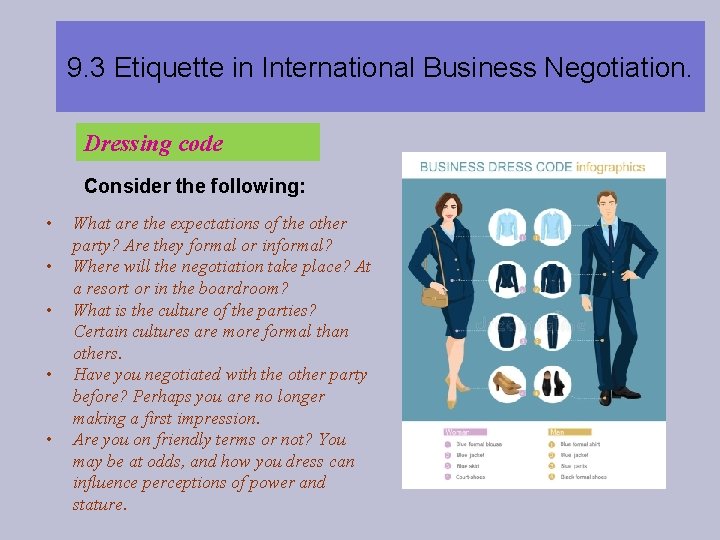
9. 3 Etiquette in International Business Negotiation. Dressing code Consider the following: • • • What are the expectations of the other party? Are they formal or informal? Where will the negotiation take place? At a resort or in the boardroom? What is the culture of the parties? Certain cultures are more formal than others. Have you negotiated with the other party before? Perhaps you are no longer making a first impression. Are you on friendly terms or not? You may be at odds, and how you dress can influence perceptions of power and stature.

9. 3 Etiquette in International Business Negotiation. Dressing code---Tips Stay away from synthetic materials Red for good luck Jeans and t-shirts are out of the question Grooming Flashy accessories Don’t show too much skin
9. 3 Etiquette in International Business Negotiation. Greeting Addressing People • You should make sure beforehand how your business partner is expected to be addressed, by using his/her family name, first name or professional title. • Be sure that you have understood and can say the name of your negotiating partner properly. • If you keep the name of your negotiating partner in mind and speak it again, it can make a discreet but very effective compliment.
9. 3 Etiquette in International Business Negotiation. Greeting Using Titles • You should address someone who ranks highly in the company or address a client by the proper professional title. Handshake • Handshake can communicate the motives and intentions. • Handshake induces greater openness about negotiators' preferences on contentious issues and improves joint outcomes. • The best andshake should not be too soft and not too firm and not take too long. • Make a handshake matter---eye contact, good grip, elbow erring toward a right angle.
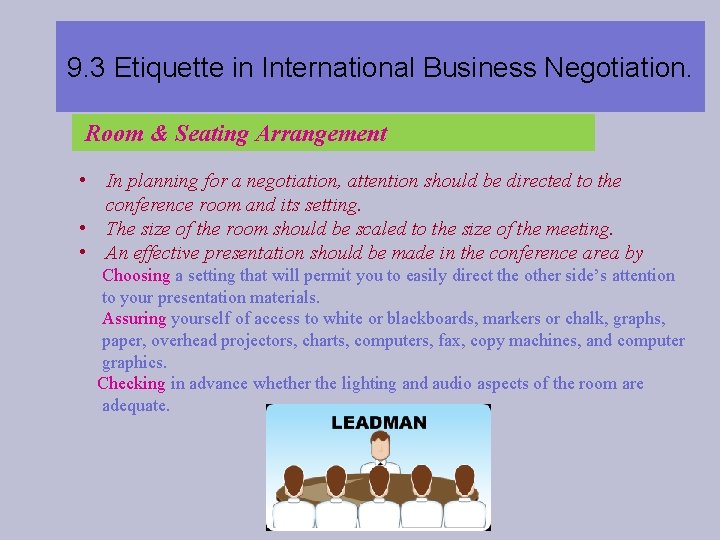
9. 3 Etiquette in International Business Negotiation. Room & Seating Arrangement • In planning for a negotiation, attention should be directed to the conference room and its setting. • The size of the room should be scaled to the size of the meeting. • An effective presentation should be made in the conference area by Choosing a setting that will permit you to easily direct the other side’s attention to your presentation materials. Assuring yourself of access to white or blackboards, markers or chalk, graphs, paper, overhead projectors, charts, computers, fax, copy machines, and computer graphics. Checking in advance whether the lighting and audio aspects of the room are adequate.

9. 3 Etiquette in International Business Negotiation. Room & Seating Arrangement • Someone should be in charge of hotel arrangements, travel coordination, backup materials, charts, calculators, computers and other aids and comforts. • Good etiquette is of paramount importance when it comes to seating arrangements in business. Follow the useful tips provided in the textbook.
9. 3 Etiquette in International Business Negotiation. Punctuality • Punctuality is often the key to completing projects and assignments quickly and effectively. • When you're on time for negotiation meetings and conference calls, you show others that you have team-centered work goals. • Punctuality is a sign of professionalism and helps you stand out as a reliable and trustworthy negotiator. • The importance of punctuality is not universal and varies from culture to culture. • A general rule for punctuality in business negotiation suggests you should arrive for business meetings somewhere between 5 -10 minutes before the scheduled time regardless of the country you will be visiting.

9. 3 Etiquette in International Business Negotiation. Exchanging business cards • The card serves as a method of introduction and often includes a simple statement or selling point about your business or service. • Do not thrust you business card on anyone. • When introducing a card, you should turn it side up to make it available for reading: this gesture represents courtesy and attention to a recipient. • It’s extremely inappropriate to take your business card from a pocket of your pants. • In different cultures, the practice of exchanging business cards is distinct from each other. • You should folllow General Business Card Etiquette Tips.
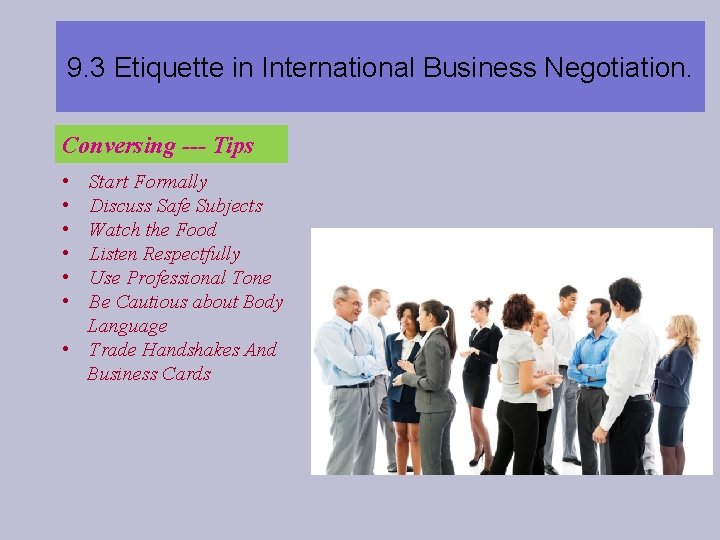
9. 3 Etiquette in International Business Negotiation. Conversing --- Tips • • • Start Formally Discuss Safe Subjects Watch the Food Listen Respectfully Use Professional Tone Be Cautious about Body Language • Trade Handshakes And Business Cards
9. 3 Etiquette in International Business Negotiation. Gift giving • When giving a gift, you have to make sure to offer it at the appropriate time and within a reasonable price range. • It is important to find out when and to whom gifts are given when working with an international firm. • Although flowers make appropriate gifts, there are many cultural taboos related to color, variety, and number. • Notify those who are involved in the gift-giving-receiving process of the related corporate policy; encourage employees to consider the ethical implications before giving and receiving gifts; and offer additional support for those who work in cultures with different gift-giving norms.
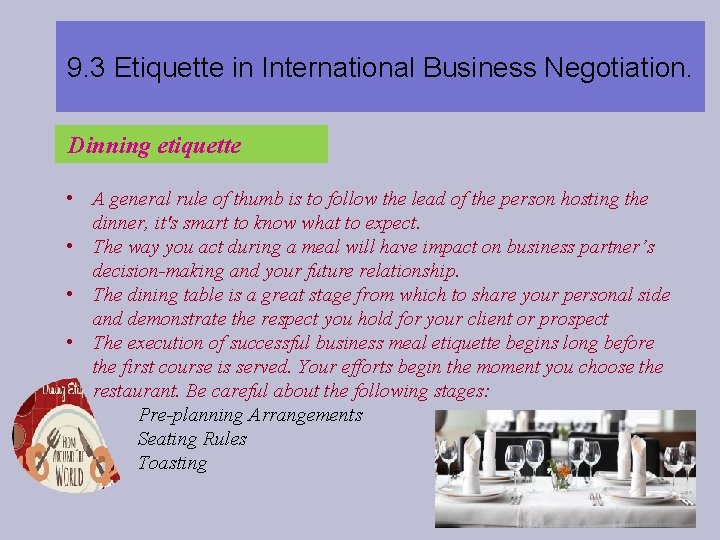
9. 3 Etiquette in International Business Negotiation. Dinning etiquette • A general rule of thumb is to follow the lead of the person hosting the dinner, it's smart to know what to expect. • The way you act during a meal will have impact on business partner’s decision-making and your future relationship. • The dining table is a great stage from which to share your personal side and demonstrate the respect you hold for your client or prospect • The execution of successful business meal etiquette begins long before the first course is served. Your efforts begin the moment you choose the restaurant. Be careful about the following stages: Pre-planning Arrangements Seating Rules Toasting
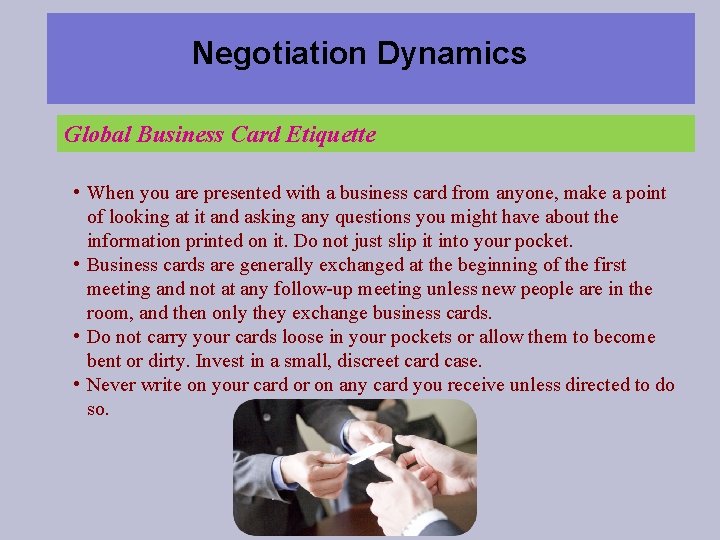
Negotiation Dynamics Global Business Card Etiquette • When you are presented with a business card from anyone, make a point of looking at it and asking any questions you might have about the information printed on it. Do not just slip it into your pocket. • Business cards are generally exchanged at the beginning of the first meeting and not at any follow-up meeting unless new people are in the room, and then only they exchange business cards. • Do not carry your cards loose in your pockets or allow them to become bent or dirty. Invest in a small, discreet card case. • Never write on your card or on any card you receive unless directed to do so.
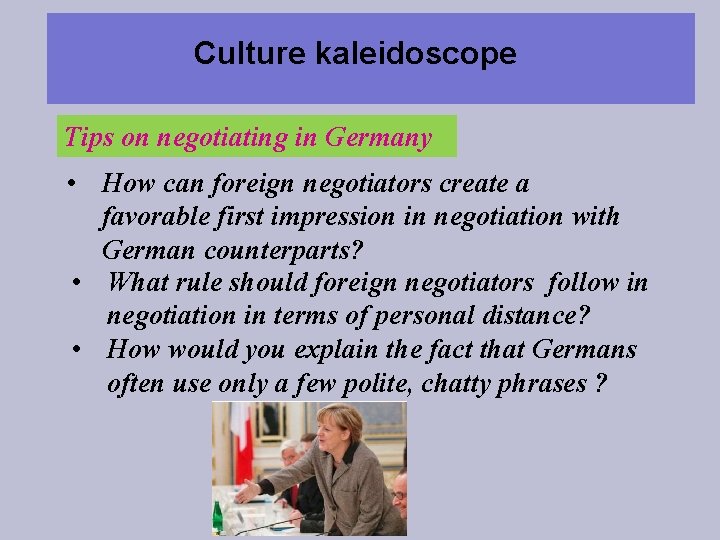
Culture kaleidoscope Tips on negotiating in Germany • How can foreign negotiators create a favorable first impression in negotiation with German counterparts? • What rule should foreign negotiators follow in negotiation in terms of personal distance? • How would you explain the fact that Germans often use only a few polite, chatty phrases ?
Key Terms Business negotiation etiquette Establish rapport Non-confrontational attitude Dressing code Greeting Room and seating arrangement Punctuality Exchange business cards Global business card etiquette Conversing Gift-giving Dinning etiquette 商务谈判礼仪 建立密切关系 非对抗性态度 着装要求 问候/招呼 房间及座位安排 守时 交换名片 全球名片礼仪 会话/交谈 馈赠礼物 餐桌礼仪
Chapter Summary • Observing business etiquette in international business negotiation has profound implication for international business negotiation. A firm grasp of business etiquette is essential in that business etiquette helps to enhance corporate image; improve workplace relations; facilitate communication and coordination; grow business and establish rapport. • Although business etiquette in different parts of the world may appear distinctive, certain basic rules are common in terms of dressing code, greeting, room and seating arrangement, punctuality, exchanging business cards, conversing, gifting giving and dinning. • Moving abroad can present considerable cross-cultural communication challenges. Obtaining a strong understanding and appreciation of a country’s business culture, protocol and etiquette is important in establishing good business relationships.
Exercises I. Review and Critical Thinking Questions II. Case Study III. Suggested Reading
- Slides: 24