
Chapter 9 Estimating Population Values Business Statistics A
Chapter 9 Estimating Population Values Business Statistics: A Decision-Making Approach, 6 e © 2005 Prentice-Hall, Inc. Chap 7 -1
Confidence Intervals Content of this chapter n Confidence Intervals for the Population Mean, n n when Population Standard Deviation is Known when Population Standard Deviation is Unknown Determining the Required Sample Size Confidence Intervals for the Population Proportion, p Business Statistics: A Decision-Making Approach, 6 e © 2005 Prentice-Hall, Inc. 2
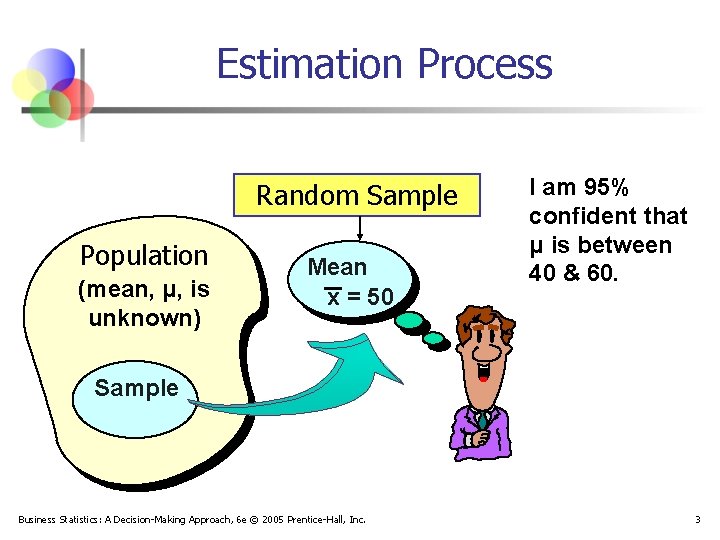
Estimation Process Random Sample Population (mean, μ, is unknown) Mean x = 50 I am 95% confident that μ is between 40 & 60. Sample Business Statistics: A Decision-Making Approach, 6 e © 2005 Prentice-Hall, Inc. 3
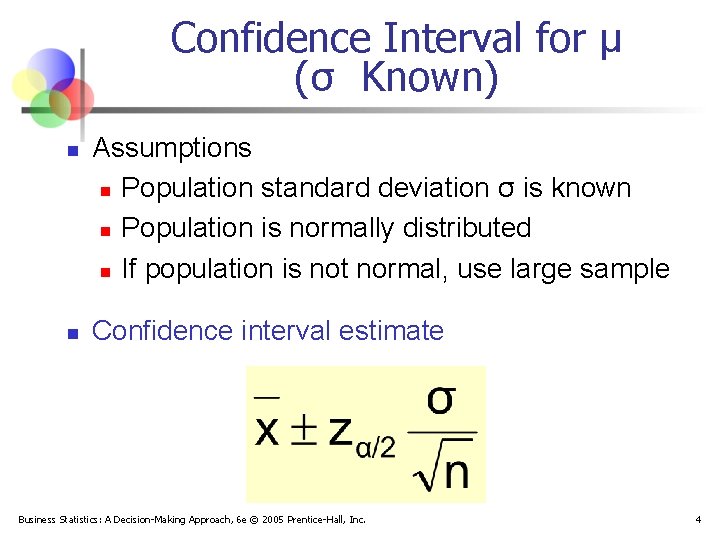
Confidence Interval for μ (σ Known) n n Assumptions n Population standard deviation σ is known n Population is normally distributed n If population is not normal, use large sample Confidence interval estimate Business Statistics: A Decision-Making Approach, 6 e © 2005 Prentice-Hall, Inc. 4
Example n n A sample of 11 circuits from a large normal population has a mean resistance of 2. 20 ohms. We know from past testing that the population standard deviation is. 35 ohms. Determine a 95% confidence interval for the true mean resistance of the population. Business Statistics: A Decision-Making Approach, 6 e © 2005 Prentice-Hall, Inc. 5
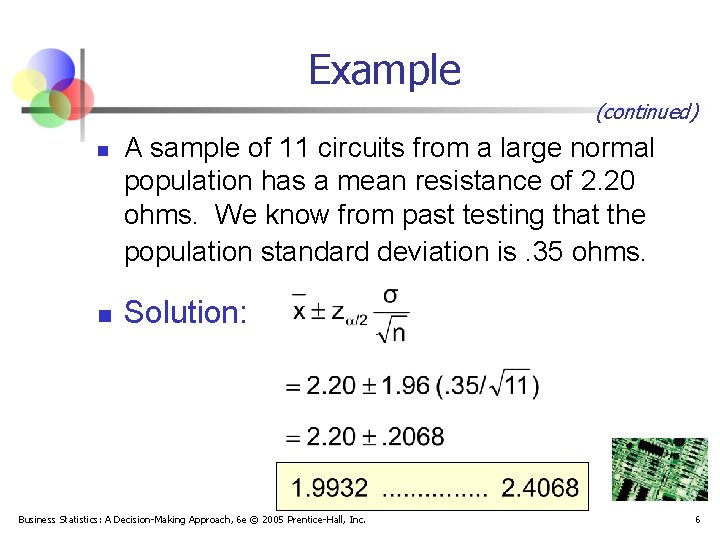
Example (continued) n n A sample of 11 circuits from a large normal population has a mean resistance of 2. 20 ohms. We know from past testing that the population standard deviation is. 35 ohms. Solution: Business Statistics: A Decision-Making Approach, 6 e © 2005 Prentice-Hall, Inc. 6
Interpretation n We are 98% confident that the true mean resistance is between 1. 9932 and 2. 4068 ohms Although the true mean may or may not be in this interval, 98% of intervals formed in this manner will contain the true mean An incorrect interpretation is that there is 98% probability that this interval contains the true population mean. (This interval either does or does not contain the true mean, there is no probability for a single interval) Business Statistics: A Decision-Making Approach, 6 e © 2005 Prentice-Hall, Inc. 7
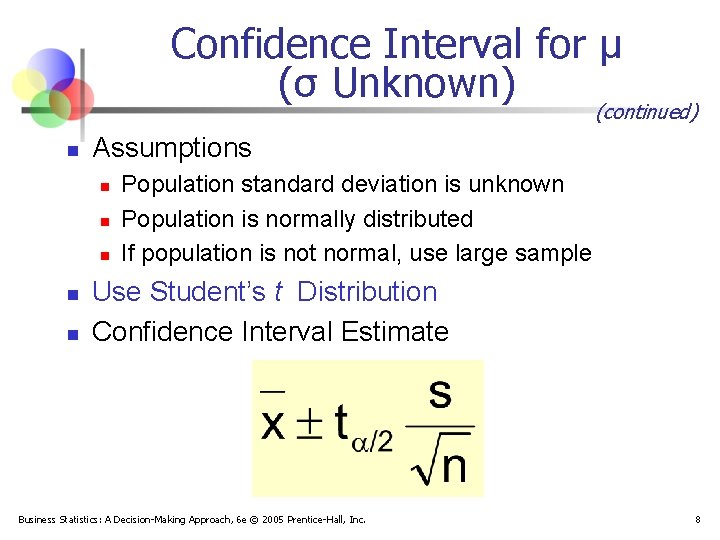
Confidence Interval for μ (σ Unknown) (continued) n Assumptions n n n Population standard deviation is unknown Population is normally distributed If population is not normal, use large sample Use Student’s t Distribution Confidence Interval Estimate Business Statistics: A Decision-Making Approach, 6 e © 2005 Prentice-Hall, Inc. 8
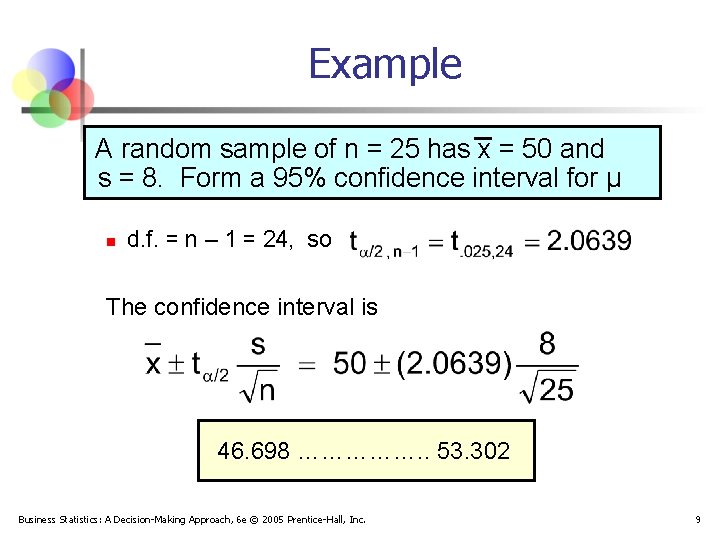
Example A random sample of n = 25 has x = 50 and s = 8. Form a 95% confidence interval for μ n d. f. = n – 1 = 24, so The confidence interval is 46. 698 ……………. . 53. 302 Business Statistics: A Decision-Making Approach, 6 e © 2005 Prentice-Hall, Inc. 9

Approximation for Large Samples n Since t approaches z as the sample size increases, an approximation is sometimes used when n 30: Technically correct Business Statistics: A Decision-Making Approach, 6 e © 2005 Prentice-Hall, Inc. Approximation for large n 10
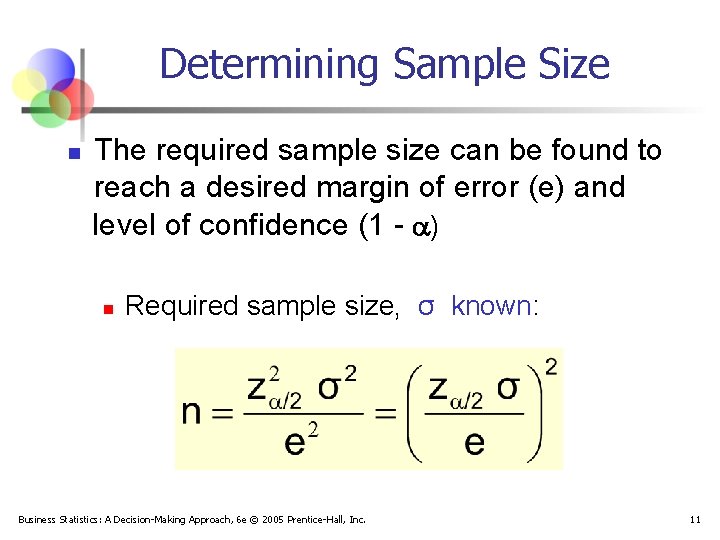
Determining Sample Size n The required sample size can be found to reach a desired margin of error (e) and level of confidence (1 - ) n Required sample size, σ known: Business Statistics: A Decision-Making Approach, 6 e © 2005 Prentice-Hall, Inc. 11
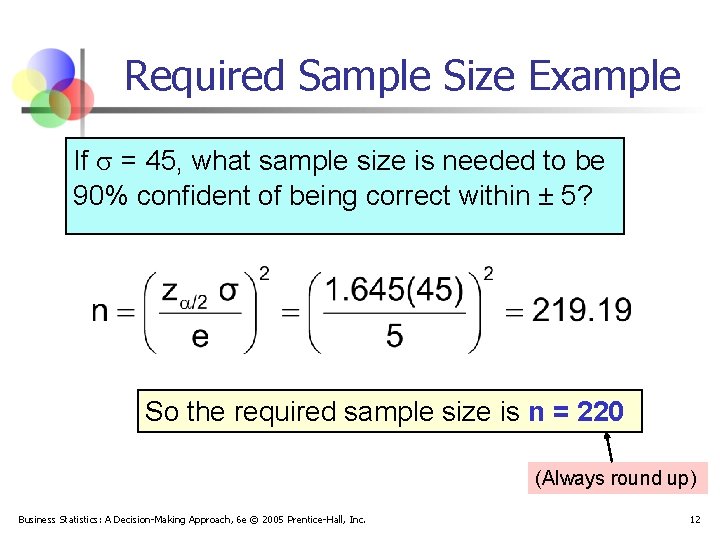
Required Sample Size Example If = 45, what sample size is needed to be 90% confident of being correct within ± 5? So the required sample size is n = 220 (Always round up) Business Statistics: A Decision-Making Approach, 6 e © 2005 Prentice-Hall, Inc. 12
Confidence Intervals for the Population Proportion, p n An interval estimate for the population proportion ( p ) can be calculated by adding an allowance for uncertainty to the sample proportion ( p ) Business Statistics: A Decision-Making Approach, 6 e © 2005 Prentice-Hall, Inc. 13
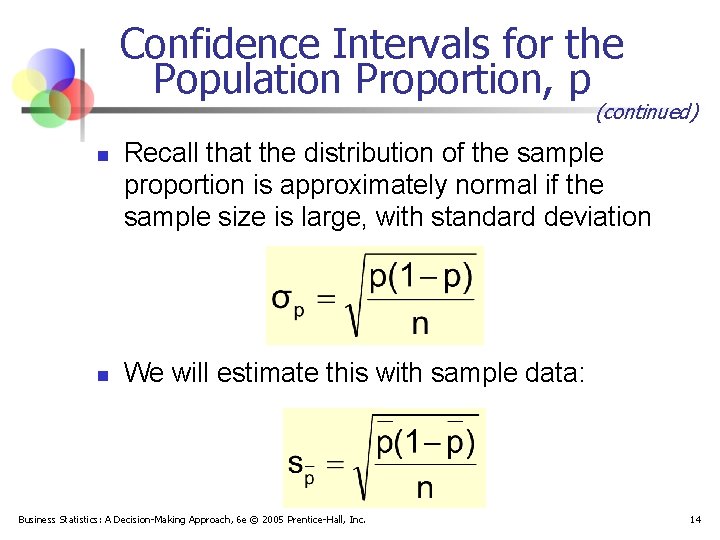
Confidence Intervals for the Population Proportion, p (continued) n n Recall that the distribution of the sample proportion is approximately normal if the sample size is large, with standard deviation We will estimate this with sample data: Business Statistics: A Decision-Making Approach, 6 e © 2005 Prentice-Hall, Inc. 14
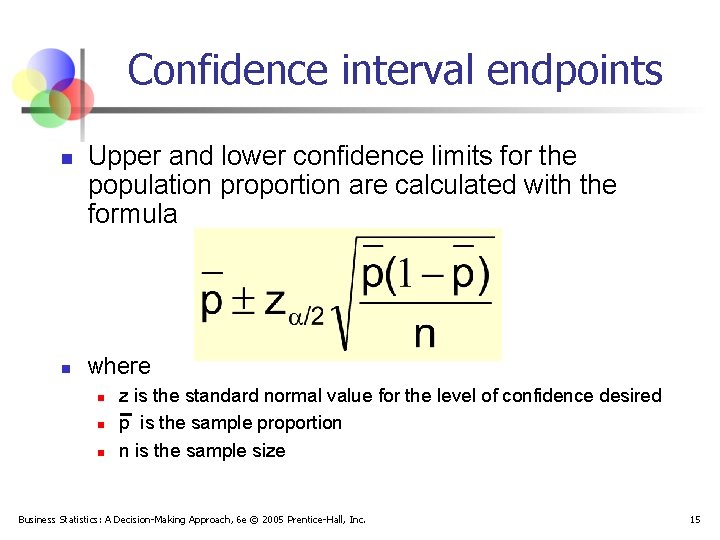
Confidence interval endpoints n n Upper and lower confidence limits for the population proportion are calculated with the formula where n n n z is the standard normal value for the level of confidence desired p is the sample proportion n is the sample size Business Statistics: A Decision-Making Approach, 6 e © 2005 Prentice-Hall, Inc. 15
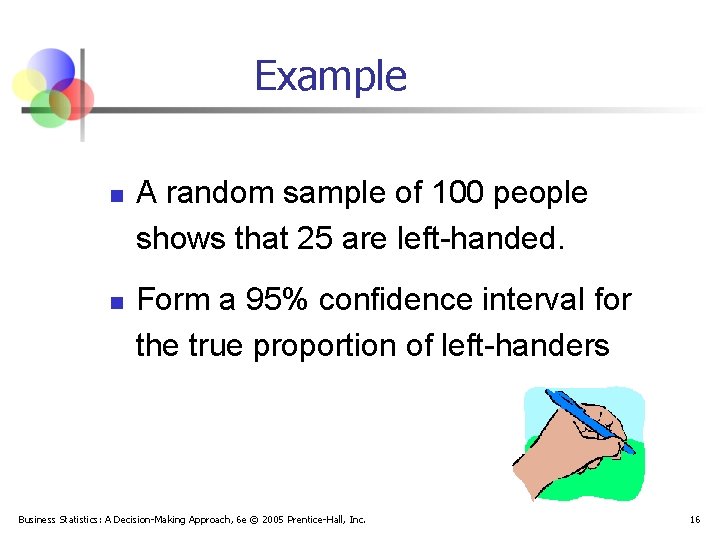
Example n n A random sample of 100 people shows that 25 are left-handed. Form a 95% confidence interval for the true proportion of left-handers Business Statistics: A Decision-Making Approach, 6 e © 2005 Prentice-Hall, Inc. 16
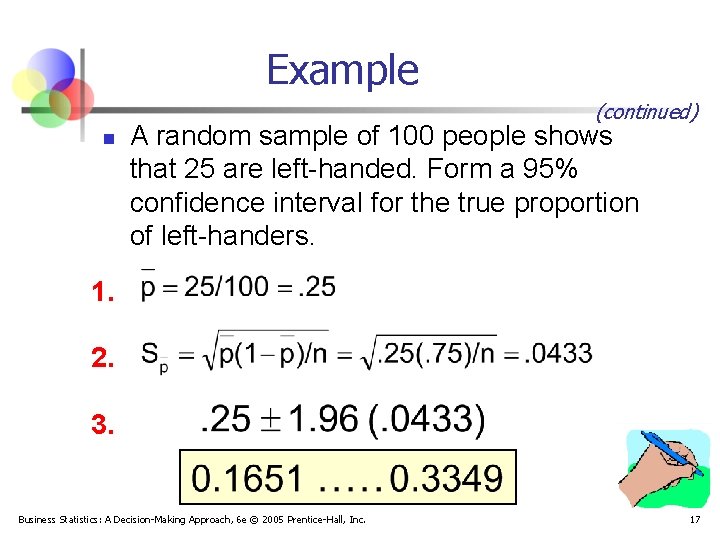
Example (continued) n A random sample of 100 people shows that 25 are left-handed. Form a 95% confidence interval for the true proportion of left-handers. 1. 2. 3. Business Statistics: A Decision-Making Approach, 6 e © 2005 Prentice-Hall, Inc. 17
Interpretation n n We are 95% confident that the true percentage of left-handers in the population is between 16. 51% and 33. 49%. Although this range may or may not contain the true proportion, 95% of intervals formed from samples of size 100 in this manner will contain the true proportion. Business Statistics: A Decision-Making Approach, 6 e © 2005 Prentice-Hall, Inc. 18
- Slides: 18