
Chapter 9 Energy and Energy Resources What is
- Slides: 60
Chapter 9: Energy and Energy Resources What is Energy?
Energy EQ’s • What is the relationship between potential and kinetic energy? • What are the characteristics of the different forms of energy? • How does the Law of Conservation of Energy relate to the energy transformations?
Energy: Ability to do work. Objects can GAIN energy by work being done on them. Objects can TRANSFER energy by doing work, which is the same as CONVERTING energy from one form to another. Energy is measured in joules. v How does • Work is a transfer of energy…. ENERGY and ü WHEN WORK IS DONE…. . WORK, work THE SAME AMOUNT OF ENERGY IS INVOLVED. together?
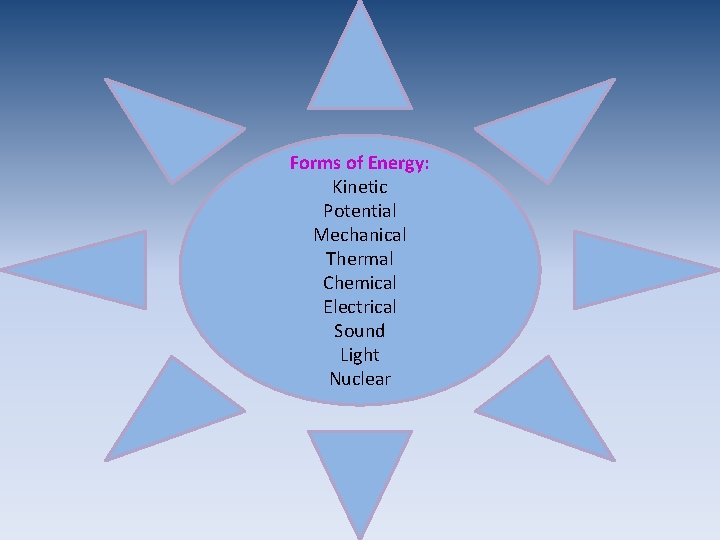
Forms of Energy: Kinetic Potential Mechanical Thermal Chemical Electrical Sound Light Nuclear
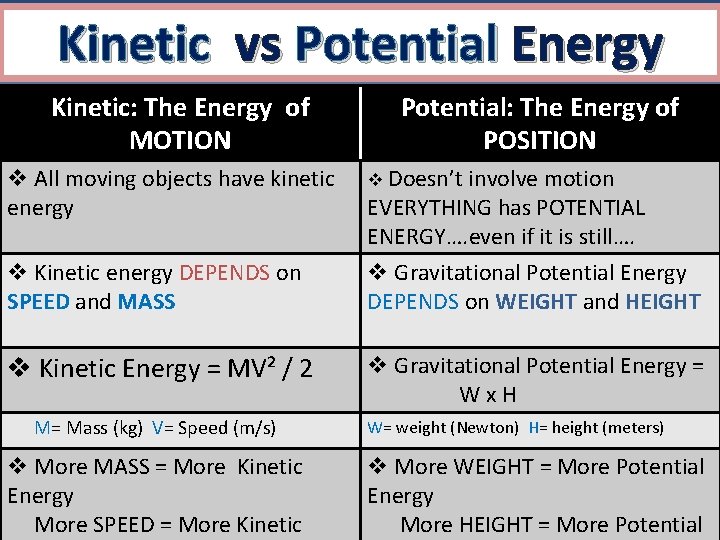
Kinetic vs Potential Energy Kinetic: The Energy of MOTION Potential: The Energy of POSITION v All moving objects have kinetic energy v Doesn’t involve motion v Kinetic energy DEPENDS on SPEED and MASS v Gravitational Potential Energy DEPENDS on WEIGHT and HEIGHT v Kinetic Energy = MV² / 2 v Gravitational Potential Energy = Wx. H M= Mass (kg) V= Speed (m/s) v More MASS = More Kinetic Energy More SPEED = More Kinetic EVERYTHING has POTENTIAL ENERGY…. even if it is still…. W= weight (Newton) H= height (meters) v More WEIGHT = More Potential Energy More HEIGHT = More Potential
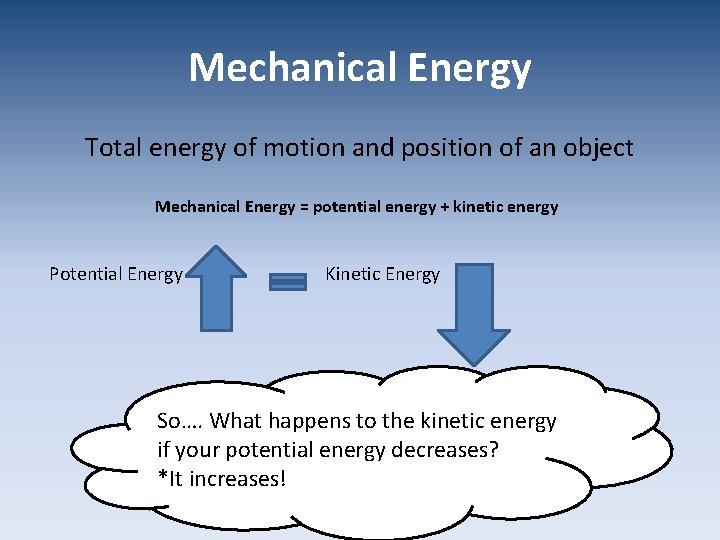
Mechanical Energy Total energy of motion and position of an object Mechanical Energy = potential energy + kinetic energy Potential Energy Kinetic Energy So…. What happens to the kinetic energy if your potential energy decreases? *It increases!
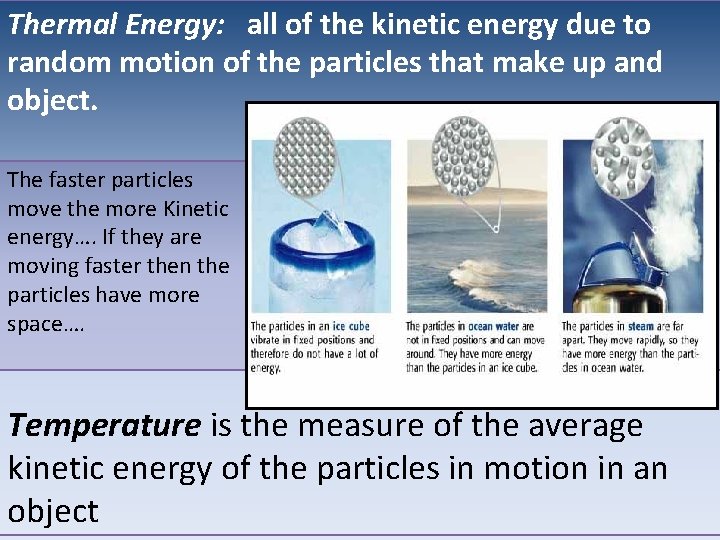
Thermal Energy: all of the kinetic energy due to random motion of the particles that make up and object. The faster particles move the more Kinetic energy…. If they are moving faster then the particles have more space…. Temperature is the measure of the average kinetic energy of the particles in motion in an object
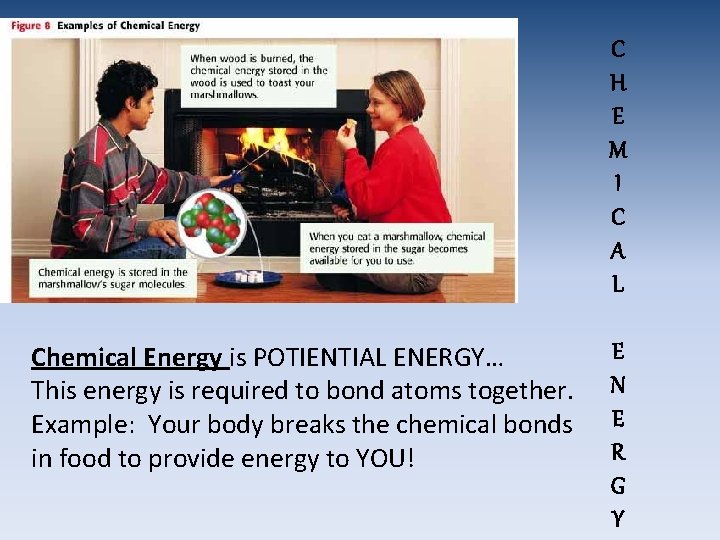
C H E M I C A L Chemical Energy is POTIENTIAL ENERGY… This energy is required to bond atoms together. Example: Your body breaks the chemical bonds in food to provide energy to YOU! E N E R G Y
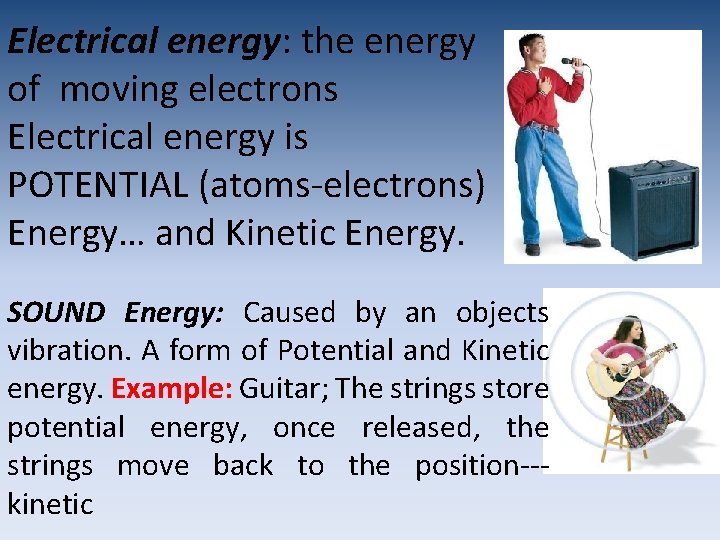
Electrical energy: the energy of moving electrons Electrical energy is POTENTIAL (atoms-electrons) Energy… and Kinetic Energy. SOUND Energy: Caused by an objects vibration. A form of Potential and Kinetic energy. Example: Guitar; The strings store potential energy, once released, the strings move back to the position--kinetic
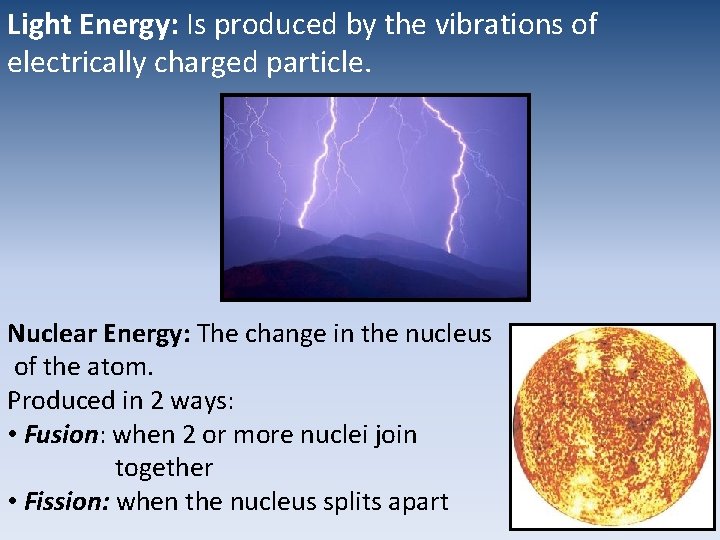
Light Energy: Is produced by the vibrations of electrically charged particle. Nuclear Energy: The change in the nucleus of the atom. Produced in 2 ways: • Fusion: when 2 or more nuclei join together • Fission: when the nucleus splits apart
Chapter 9 Energy Conversions
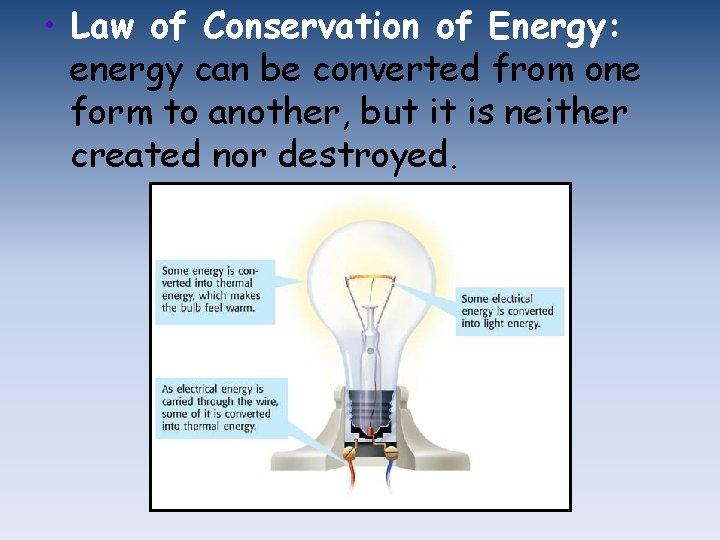
• Law of Conservation of Energy: energy can be converted from one form to another, but it is neither created nor destroyed.
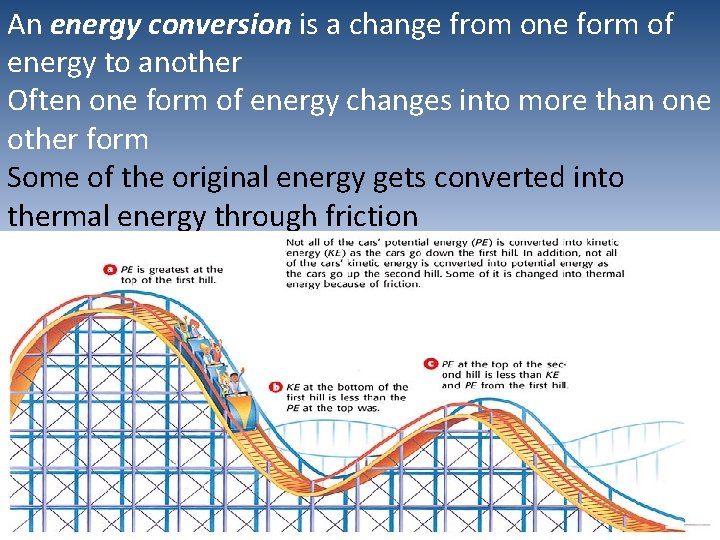
An energy conversion is a change from one form of energy to another Often one form of energy changes into more than one other form Some of the original energy gets converted into thermal energy through friction
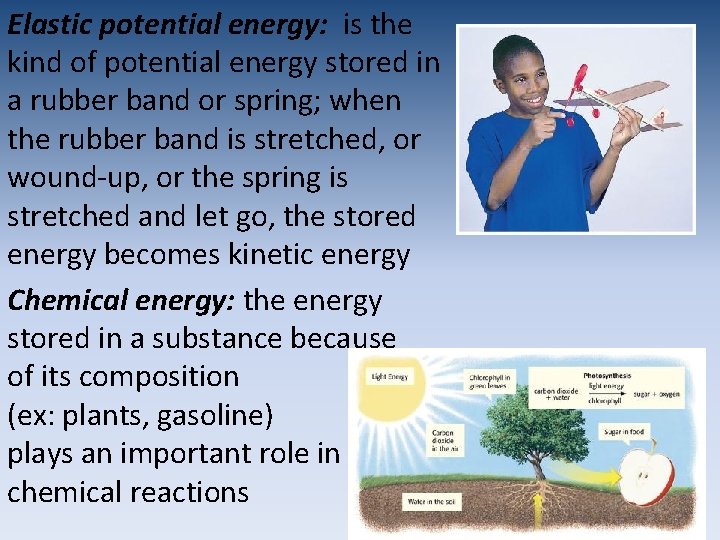
Elastic potential energy: is the kind of potential energy stored in a rubber band or spring; when the rubber band is stretched, or wound-up, or the spring is stretched and let go, the stored energy becomes kinetic energy Chemical energy: the energy stored in a substance because of its composition (ex: plants, gasoline) plays an important role in chemical reactions
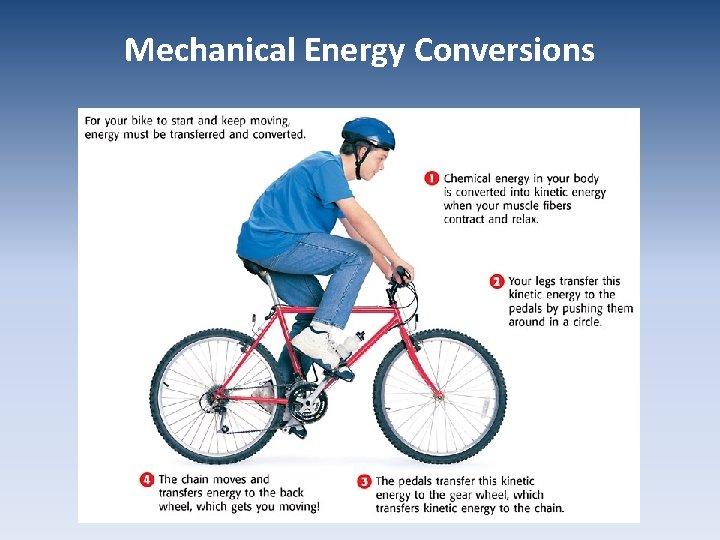
Mechanical Energy Conversions
Energy Resources Energy resource: is a natural resource that can be converted into other form of energy in order to do useful work 2 types: • Nonrenewable: resources that cannot be replaced, or are replaced much more slowly than they are used • Renewable: resources that are naturally replaced more quickly than they are used
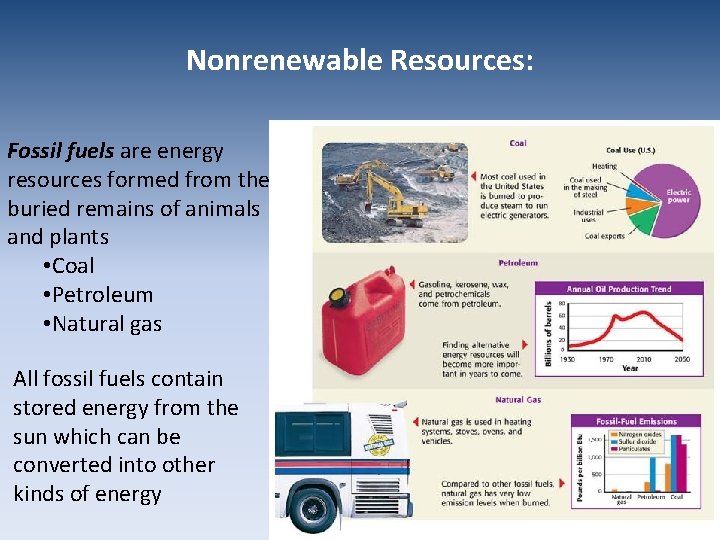
Nonrenewable Resources: Fossil fuels are energy resources formed from the buried remains of animals and plants • Coal • Petroleum • Natural gas All fossil fuels contain stored energy from the sun which can be converted into other kinds of energy
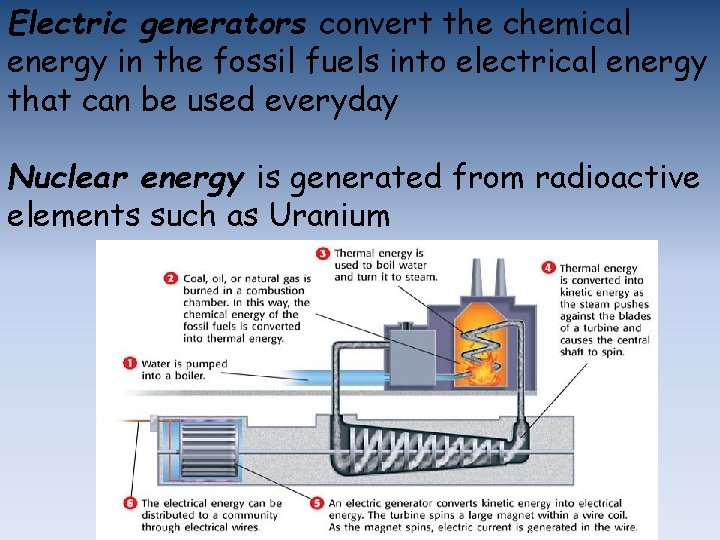
Electric generators convert the chemical energy in the fossil fuels into electrical energy that can be used everyday Nuclear energy is generated from radioactive elements such as Uranium
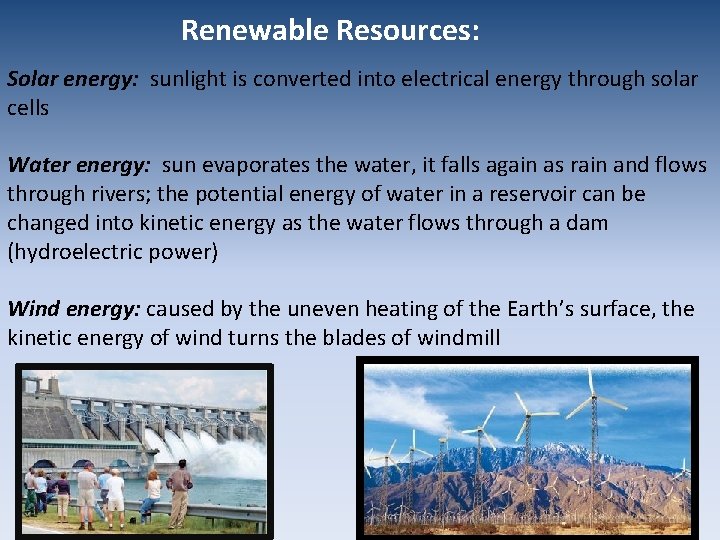
Renewable Resources: Solar energy: sunlight is converted into electrical energy through solar cells Water energy: sun evaporates the water, it falls again as rain and flows through rivers; the potential energy of water in a reservoir can be changed into kinetic energy as the water flows through a dam (hydroelectric power) Wind energy: caused by the uneven heating of the Earth’s surface, the kinetic energy of wind turns the blades of windmill
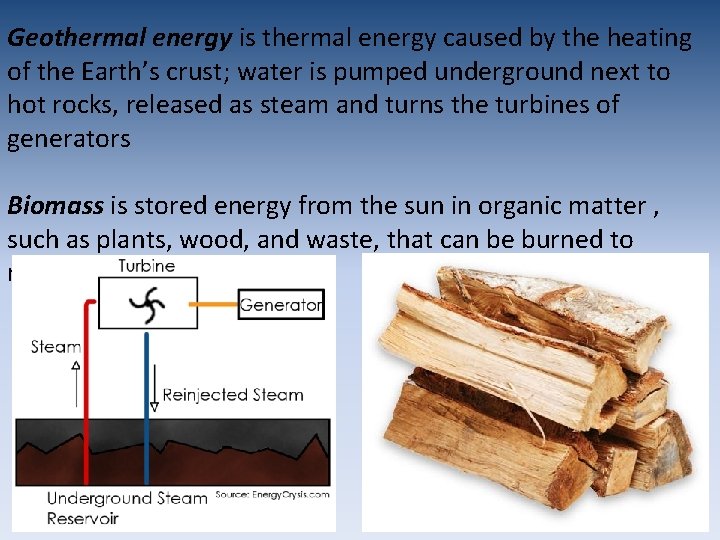
Geothermal energy is thermal energy caused by the heating of the Earth’s crust; water is pumped underground next to hot rocks, released as steam and turns the turbines of generators Biomass is stored energy from the sun in organic matter , such as plants, wood, and waste, that can be burned to release energy
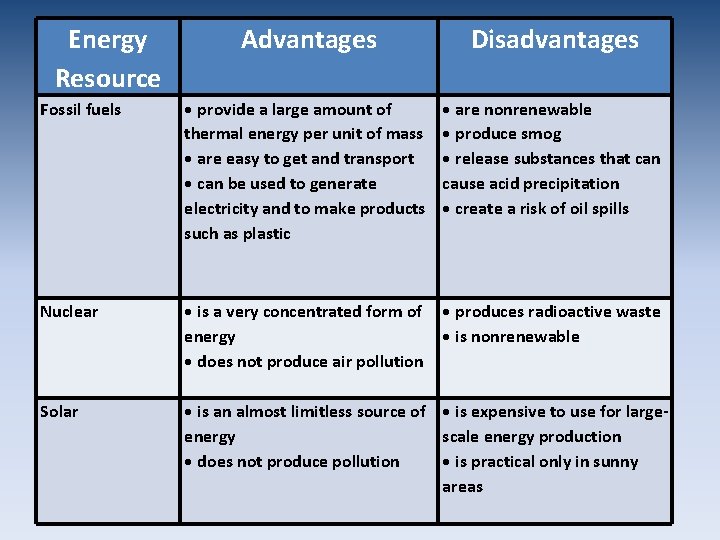
Energy Resource Advantages Disadvantages Fossil fuels • provide a large amount of thermal energy per unit of mass • are easy to get and transport • can be used to generate electricity and to make products such as plastic • are nonrenewable • produce smog • release substances that can cause acid precipitation • create a risk of oil spills Nuclear • is a very concentrated form of energy • does not produce air pollution • produces radioactive waste • is nonrenewable Solar • is an almost limitless source of • is expensive to use for largeenergy scale energy production • does not produce pollution • is practical only in sunny areas
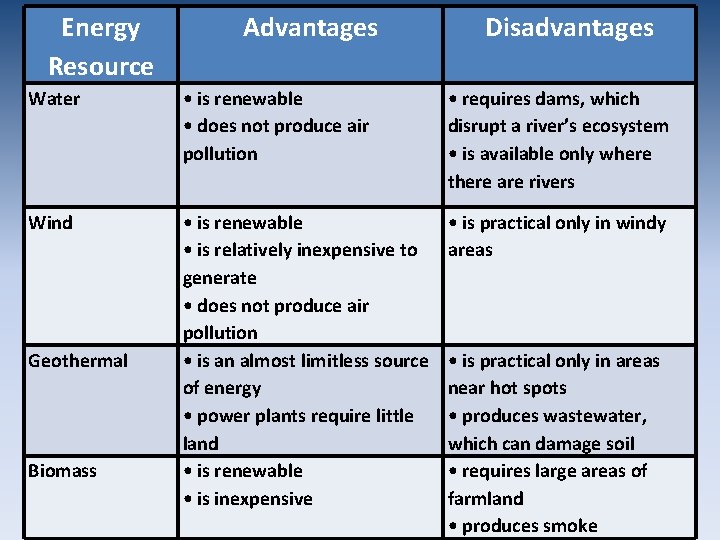
Energy Resource Advantages Disadvantages Water • is renewable • does not produce air pollution • requires dams, which disrupt a river’s ecosystem • is available only where there are rivers Wind • is renewable • is relatively inexpensive to generate • does not produce air pollution • is an almost limitless source of energy • power plants require little land • is renewable • is inexpensive • is practical only in windy areas Geothermal Biomass • is practical only in areas near hot spots • produces wastewater, which can damage soil • requires large areas of farmland • produces smoke
Chapter 10: Heat and Heat Technology Temperature
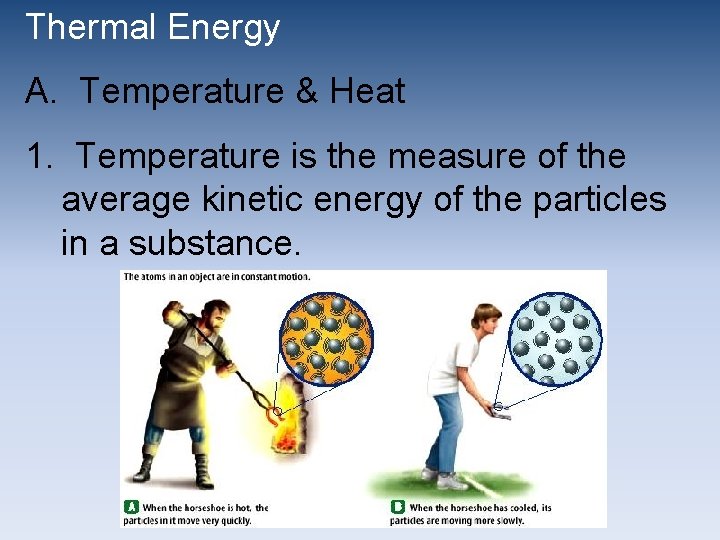
Thermal Energy A. Temperature & Heat 1. Temperature is the measure of the average kinetic energy of the particles in a substance.
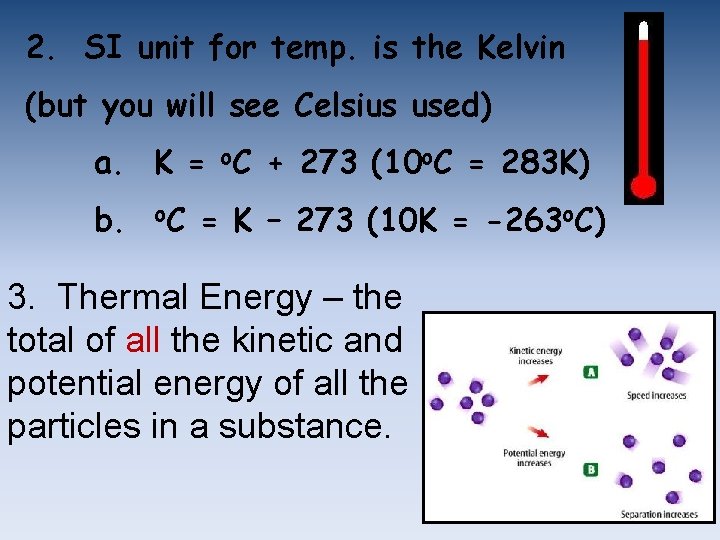
2. SI unit for temp. is the Kelvin (but you will see Celsius used) a. K = o. C + 273 (10 o. C = 283 K) b. o. C = K – 273 (10 K = -263 o. C) 3. Thermal Energy – the total of all the kinetic and potential energy of all the particles in a substance.
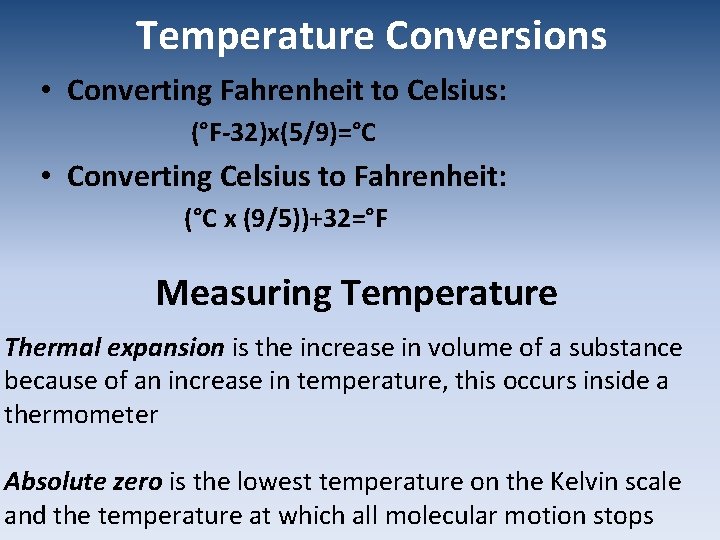
Temperature Conversions • Converting Fahrenheit to Celsius: (°F-32)x(5/9)=°C • Converting Celsius to Fahrenheit: (°C x (9/5))+32=°F Measuring Temperature Thermal expansion is the increase in volume of a substance because of an increase in temperature, this occurs inside a thermometer Absolute zero is the lowest temperature on the Kelvin scale and the temperature at which all molecular motion stops
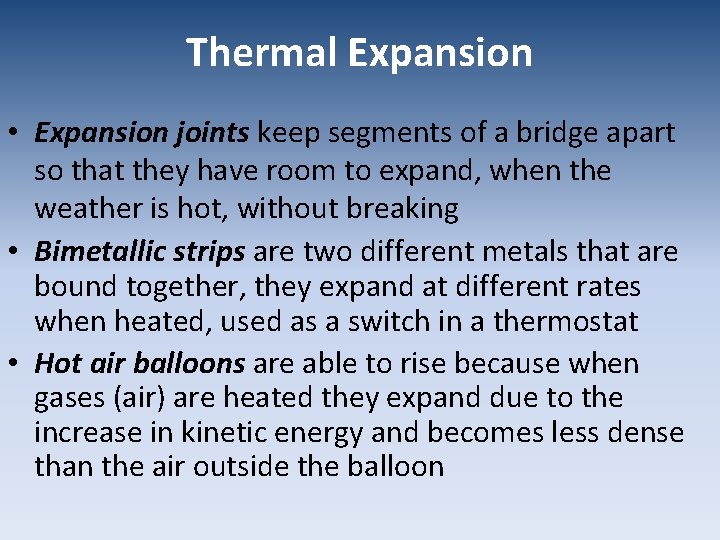
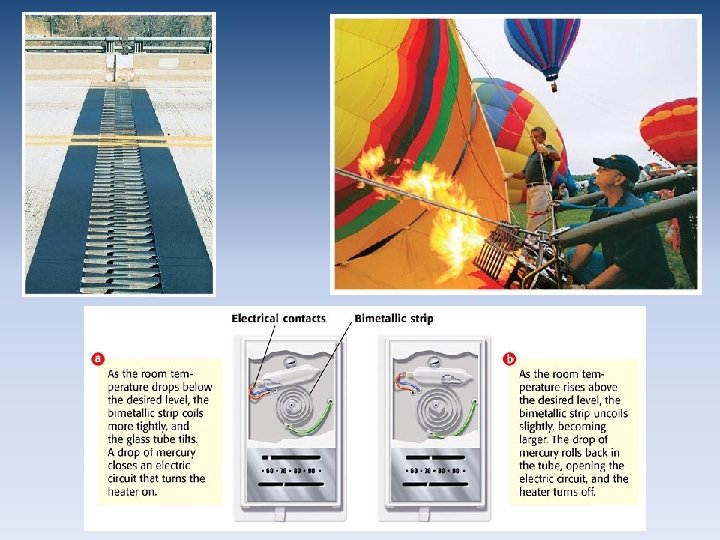
Thermal Expansion • Expansion joints keep segments of a bridge apart so that they have room to expand, when the weather is hot, without breaking • Bimetallic strips are two different metals that are bound together, they expand at different rates when heated, used as a switch in a thermostat • Hot air balloons are able to rise because when gases (air) are heated they expand due to the increase in kinetic energy and becomes less dense than the air outside the balloon
4. Thermal energy relationships a. As temperature increases, so does thermal energy (because the kinetic energy of the particles increased). b. Even if the temperature doesn’t change, thermal energy in a more massive substance is higher (because it is a total measure of energy).
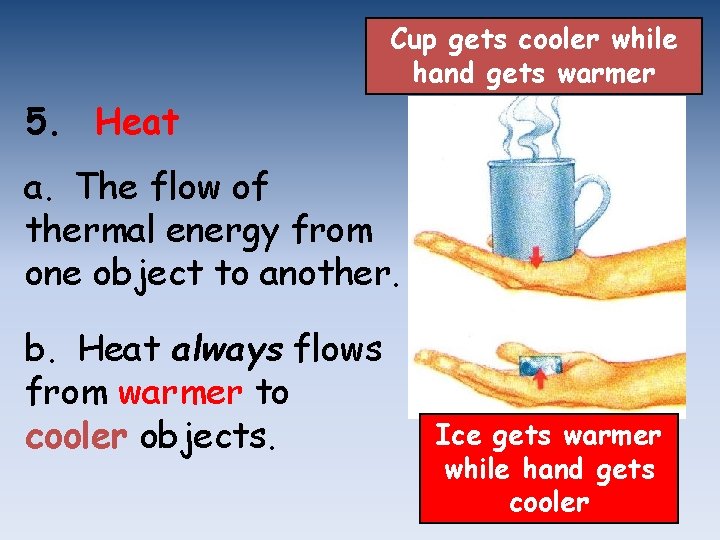
Cup gets cooler while hand gets warmer 5. Heat a. The flow of thermal energy from one object to another. b. Heat always flows from warmer to cooler objects. Ice gets warmer while hand gets cooler
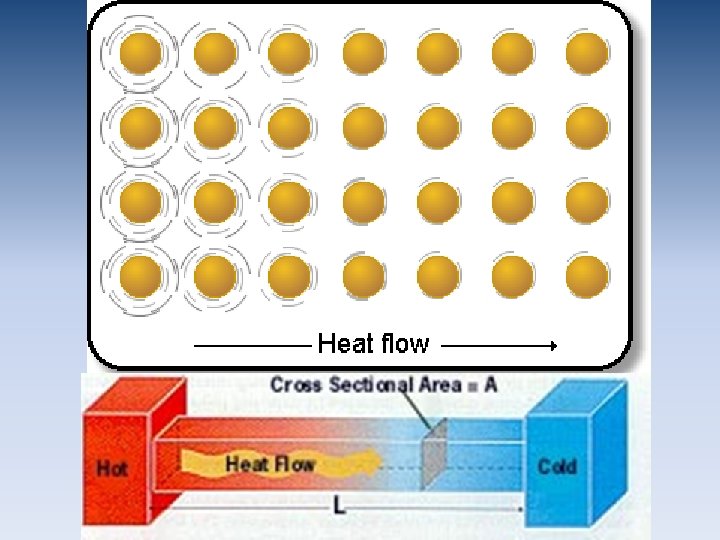
Heat Transfer • Heat flows from hot to cold. – If you hold something cold, heat flows from hand to object. – If you hold something hot, heat flows from object to hand • Thermal Conduction- transfer of thermal energy through matter by the direct contact of particles – Occurs because particles are in constant motion – KE transferred as particles collide
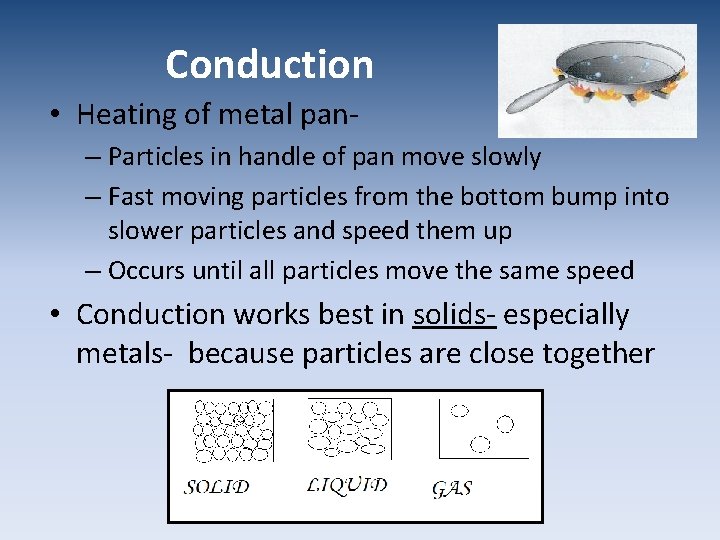
Conduction • Heating of metal pan– Particles in handle of pan move slowly – Fast moving particles from the bottom bump into slower particles and speed them up – Occurs until all particles move the same speed • Conduction works best in solids- especially metals- because particles are close together
Conductors and Insulators • Substances that conduct thermal energy very well are called thermal conductors. • For example, the metal in a doctor’s stethoscope is a conductor. Energy is transferred rapidly from your warm skin to the cool stethoscope. That’s why the stethoscope feels cold.
Conductors and Insulators • Substances that do not conduct thermal energy very well are called thermal insulators. • For example, a doctor’s wooden tongue depressor is an insulator. It is at the same temperature as the stethoscope. But the tongue depressor doesn’t feel cold. The reason is that thermal energy is transferred very slowly from your tongue to the wood
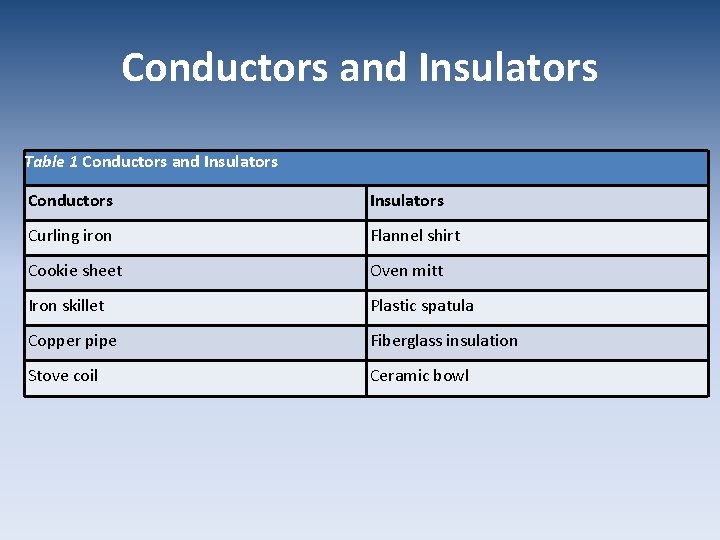
Conductors and Insulators Table 1 Conductors and Insulators Conductors Insulators Curling iron Flannel shirt Cookie sheet Oven mitt Iron skillet Plastic spatula Copper pipe Fiberglass insulation Stove coil Ceramic bowl
Controlling the Flow of Heat • To control the flow of heat: Use clothing, blankets, layers of fat, fur, etc. • Insulator- material that does not allow heat to flow through easily • Gases – like air- are good insulators because: – Gas particles are very far apart & can’t transmit energy through conduction. – If the gas is also held in place, particles can’t move around and warm up the rest of the gas
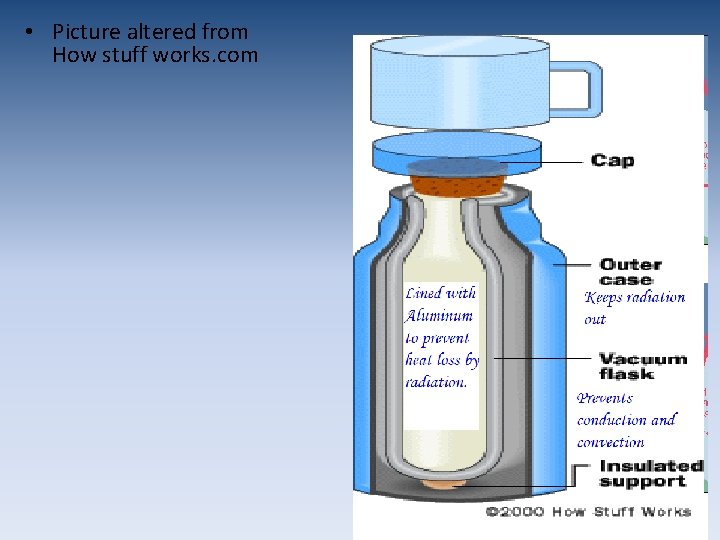
Insulation • Insulation is made of fluffy materials containing pockets of trapped air – prevents heat loss • Thermos- vacuum layer between 2 layers of glass – Vacuum contains few particles so conduction & convection don’t occur. • Thermos- coated in aluminum – Reflects electromagnetic waves that would either heat the substance or allow the substance to cool
• Picture altered from How stuff works. com
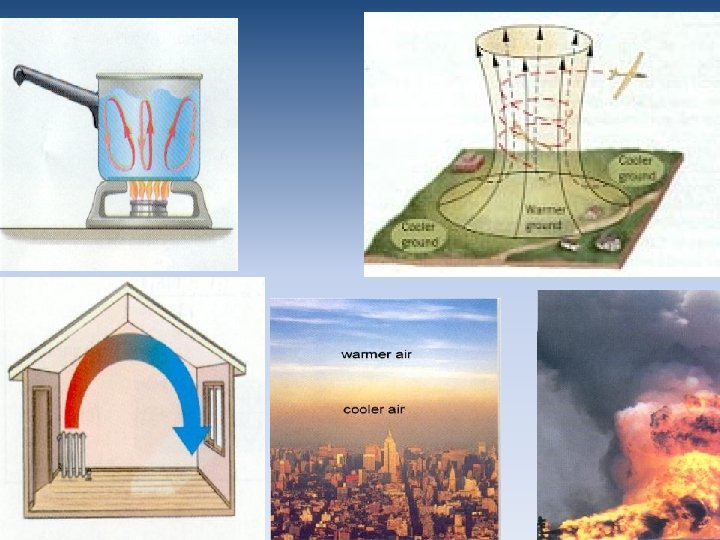
Conduction and Convection • Metals- good conductors-because electrons move easily & transfer KE to nearby particles • Fluid- any materials that flows • Convection- transfer of energy in a fluid by the movement of heated particles • Convection currents transfer heat from warmer to cooler parts of a fluid. • Convection vs. Conduction– Conduction involves collisions and transfers of energy. – Convection involves movement of the energetic particles from one location to another
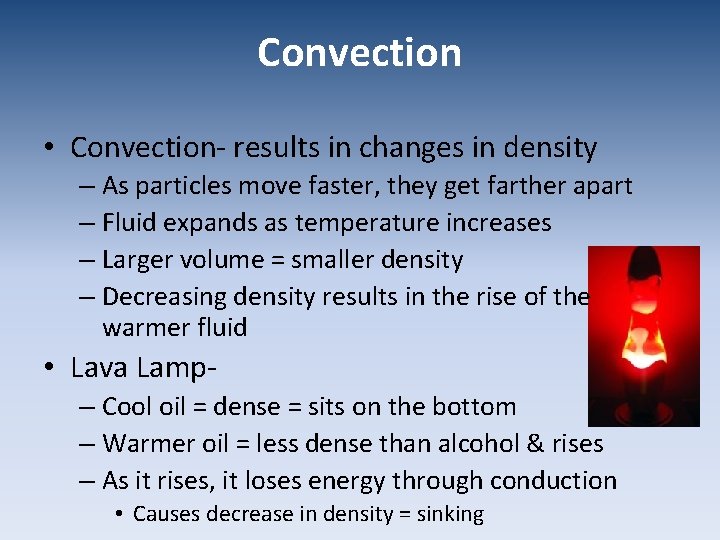
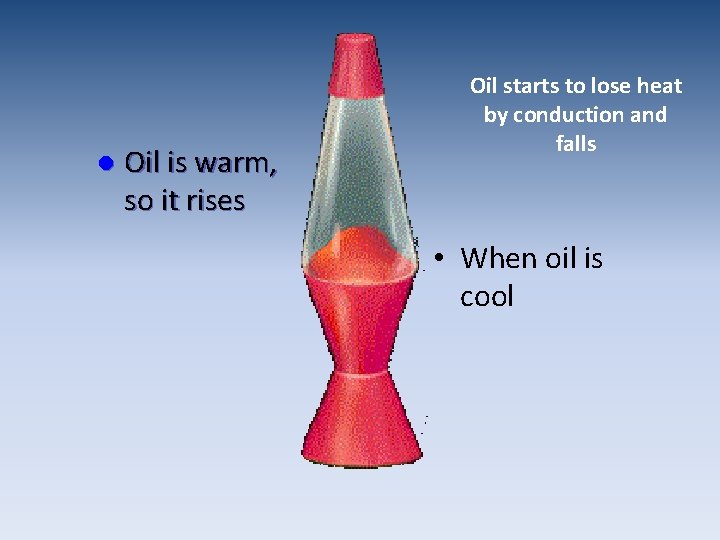
Convection • Convection- results in changes in density – As particles move faster, they get farther apart – Fluid expands as temperature increases – Larger volume = smaller density – Decreasing density results in the rise of the warmer fluid • Lava Lamp– Cool oil = dense = sits on the bottom – Warmer oil = less dense than alcohol & rises – As it rises, it loses energy through conduction • Causes decrease in density = sinking
l Oil is warm, so it rises Oil starts to lose heat by conduction and falls • When oil is cool
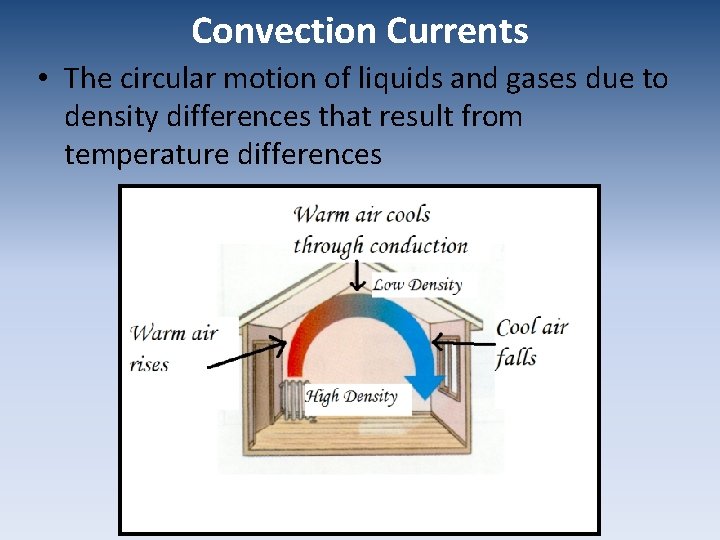
Convection Currents • The circular motion of liquids and gases due to density differences that result from temperature differences
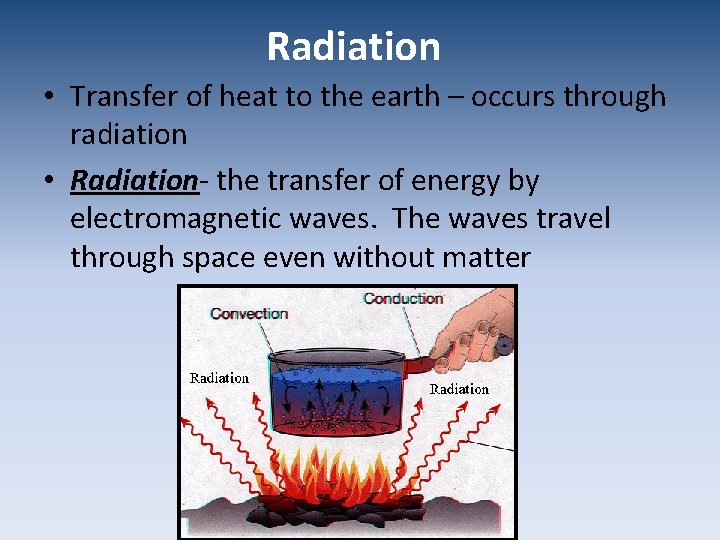
Radiation • Transfer of heat to the earth – occurs through radiation • Radiation- the transfer of energy by electromagnetic waves. The waves travel through space even without matter
Heat Transfer on Earth • At equator- earth experiences the most heat from the sun. – Result: evaporation of water and large accumulations of clouds. – As the water vapor rises, it cools and condenses, forming rain • After the rain = dry air – Dry air causes moisture to evaporate, drying out the ground – causes desert • Convection currents create deserts and rain forests over different regions of Earth
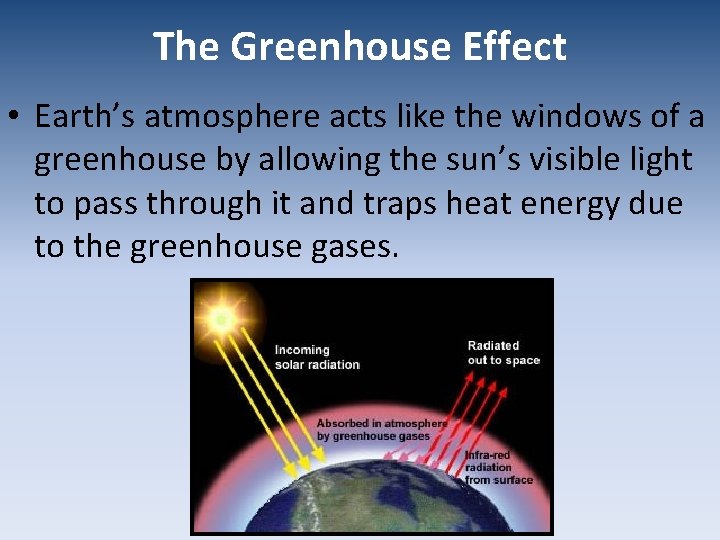
The Greenhouse Effect • Earth’s atmosphere acts like the windows of a greenhouse by allowing the sun’s visible light to pass through it and traps heat energy due to the greenhouse gases.
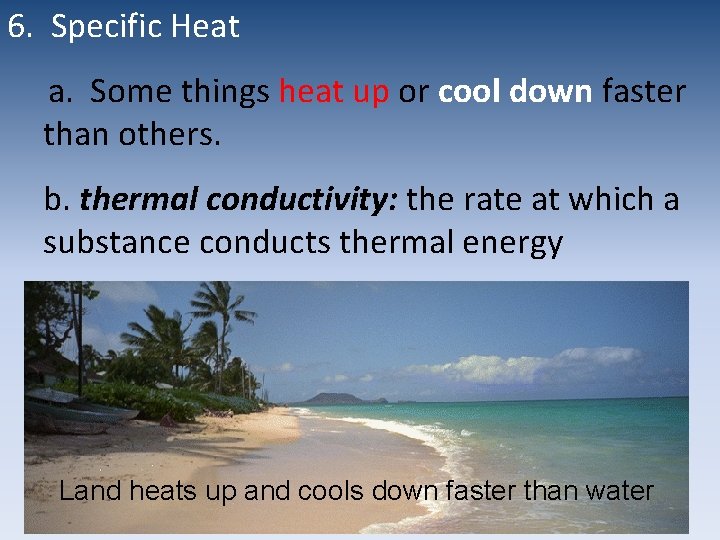
6. Specific Heat a. Some things heat up or cool down faster than others. b. thermal conductivity: the rate at which a substance conducts thermal energy Land heats up and cools down faster than water
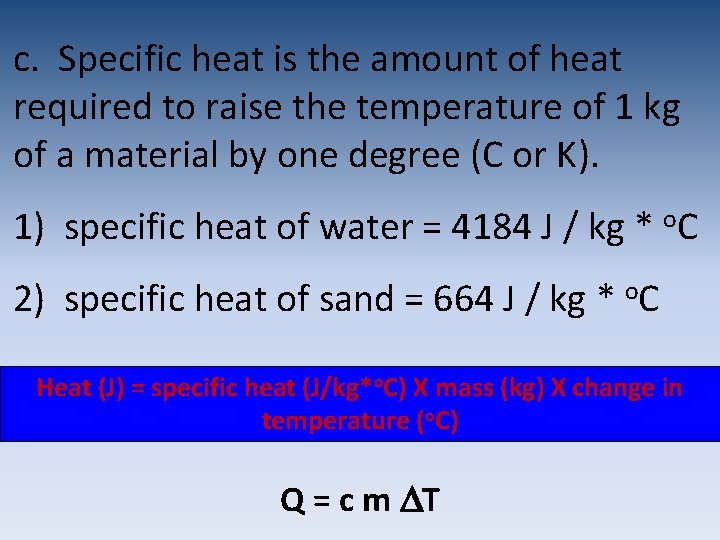
c. Specific heat is the amount of heat required to raise the temperature of 1 kg of a material by one degree (C or K). 1) specific heat of water = 4184 J / kg * o. C 2) specific heat of sand = 664 J / kg * o. C Heat (J) = specific heat (J/kg*o. C) X mass (kg) X change in temperature (o. C) Q = c m T
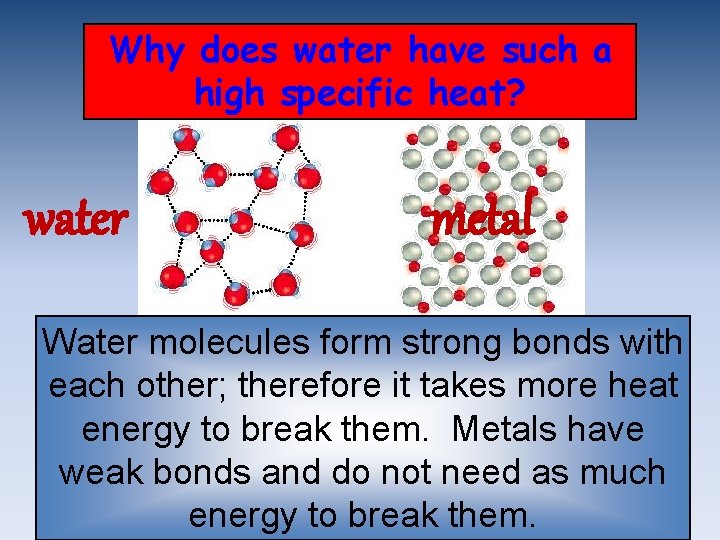
Why does water have such a high specific heat? water metal Water molecules form strong bonds with each other; therefore it takes more heat energy to break them. Metals have weak bonds and do not need as much energy to break them.
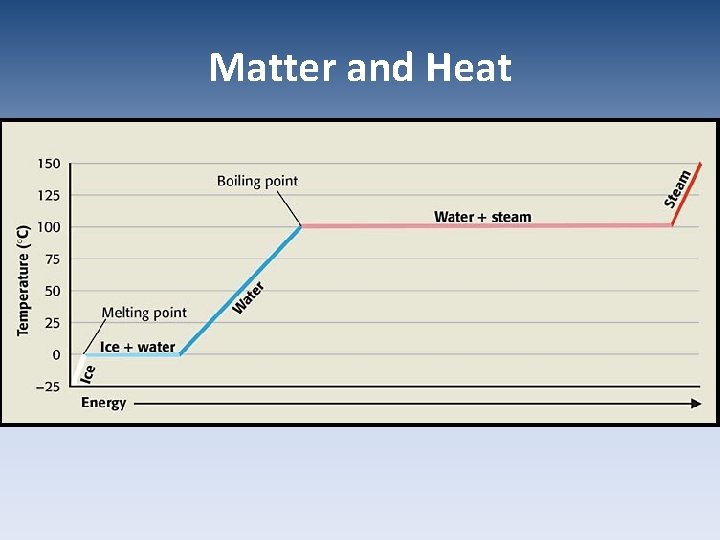
Matter and Heat • Matter consists of particles that can move around at different speeds • States of matter: the physical forms in which a substance can exist • Thermal energy is the total energy of all the particles that make up a substance
Matter and Heat • Change of state: is a change of a substance from one state of matter to another (also known as a phase change) – Physical changes (only affects physical properties that do not change the identity of the substance) – Examples: freezing (liquid to solid); melting (solid to liquid); boiling (liquid to gas); condensing (gas to liquid) – There is no change in temperature during a phase change
Matter and Heat
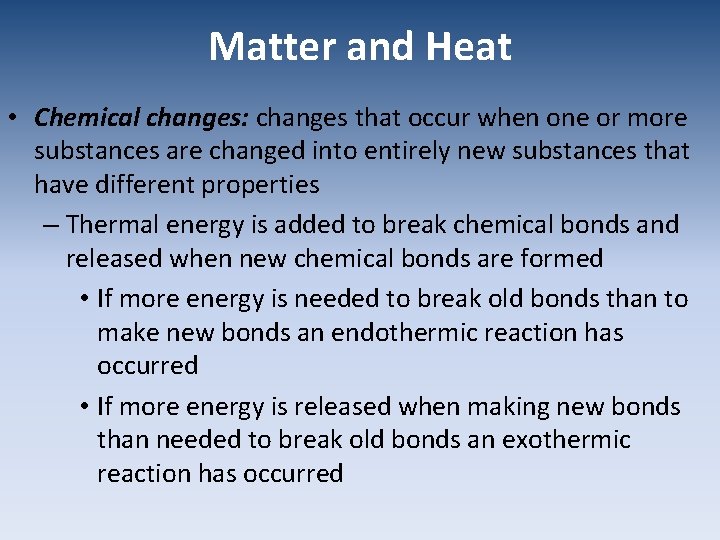
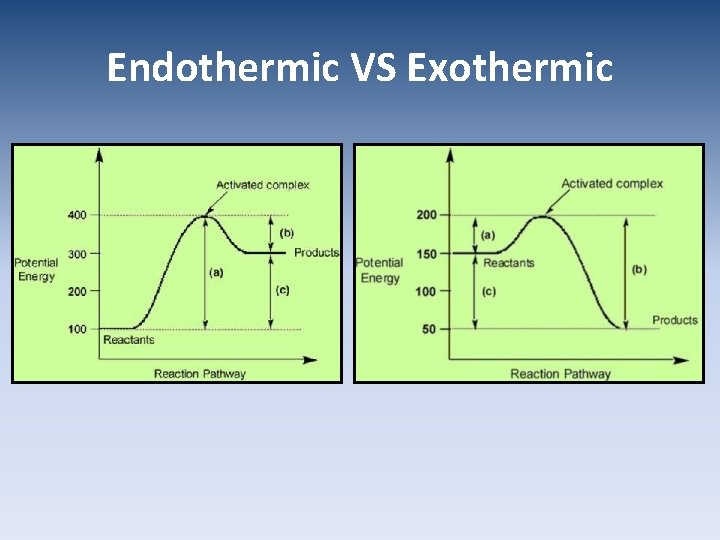
Matter and Heat • Chemical changes: changes that occur when one or more substances are changed into entirely new substances that have different properties – Thermal energy is added to break chemical bonds and released when new chemical bonds are formed • If more energy is needed to break old bonds than to make new bonds an endothermic reaction has occurred • If more energy is released when making new bonds than needed to break old bonds an exothermic reaction has occurred
Endothermic VS Exothermic
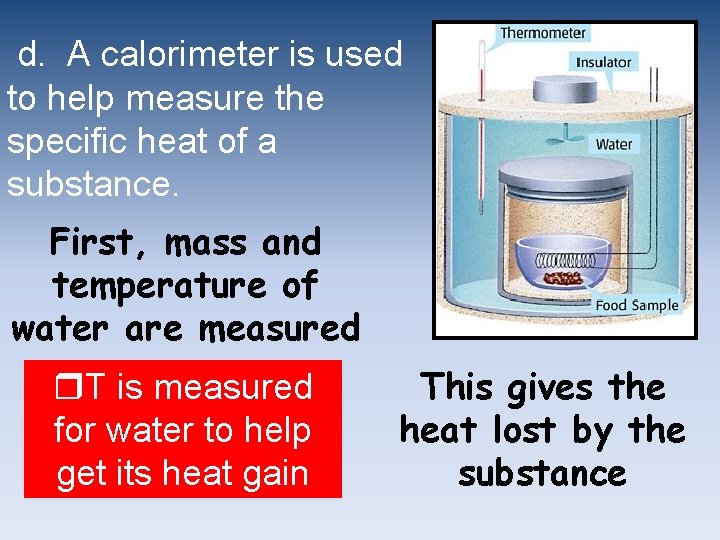
Food and Chemical Energy • Your body uses energy released from compounds, such as carbohydrates, when broken down in chemical reactions • The Calorie is the unit of energy often used in foods – Can be seen on food nutrition labels – 1 Calorie is = 4, 184 J – The calorie is also a measure of heat and is measured in a device known as a calorimeter
d. A calorimeter is used to help measure the specific heat of a substance. First, mass and temperature of water are measured T is measured for water to help get its heat gain This gives the heat lost by the substance
Heat Technology • Hot water heating—raises the temperature of water, pumps it through pipes that lead to radiators, radiators heat the cold air • Warm air heating—air is heated by burning fuel in a furnace, the warm air travels through ducts to different rooms, the air heats the room • Solar heating—uses sun’s energy to heat houses and buildings – Passive solar heating system (no moving parts) – Active solar heating system (moving parts)
Heat Technology • Heat engines -- machines that transform heat into mechanical energy, or work – Burn fuel through a process called combustion • External combustion engine (burns fuel outside the engine)---steam engine • Internal combustion engine (burns fuel inside the engine)---car engine • Cooling systems---transfer thermal energy out of a particular area so that it feels cooler (an air conditioner)
Heat Technology • Heating systems, car engines, and cooling systems all transfer thermal energy to the environment • Thermal pollution is a negative effect – A temperature increase in a body of water that is caused by human activity and that has a harmful effect on water quality and on the ability of that body of water to support life