
Chapter 9 Emergency Procedures and First Aid 2014
- Slides: 57
Chapter 9 Emergency Procedures and First Aid © 2014 Cengage©Learning. 2014 Cengage All Rights Learning. Reserved. All Rights May not Reserved. be scanned, May not copied be scanned, copied or duplicated, or or posted duplicated, to a publicly or posted accessible to a publicly website, accessible in wholewebsite, or in part. in whole or in part.
Recognizing an Emergency • Definition – Any instance in which individual suddenly becomes ill and requires immediate attention • Signs of emergencies – Use your senses; be sensitive for strange behavior • First aid – Designed to render immediate and temporary care to persons injured before arrival of health care practitioner © 2014 Cengage Learning. All Rights Reserved. May not be scanned, copied or duplicated, or posted to a publicly accessible website, in whole or in part.
Recognizing an Emergency • Recognizing a situation in which emergency measures should be taken is the first and most critical step in emergency response. © 2014 Cengage Learning. All Rights Reserved. May not be scanned, copied or duplicated, or posted to a publicly accessible website, in whole or in part.
Recognizing an Emergency • Emergency Situations – Choking and breathing crises – Chest pain – Bleeding – Shock – Stroke – Poisoning – Burns – Wounds – Sudden illnesses (fainting/falling) – Illnesses related to heat and cold – Fractures © 2014 Cengage Learning. All Rights Reserved. May not be scanned, copied or duplicated, or posted to a publicly accessible website, in whole or in part.
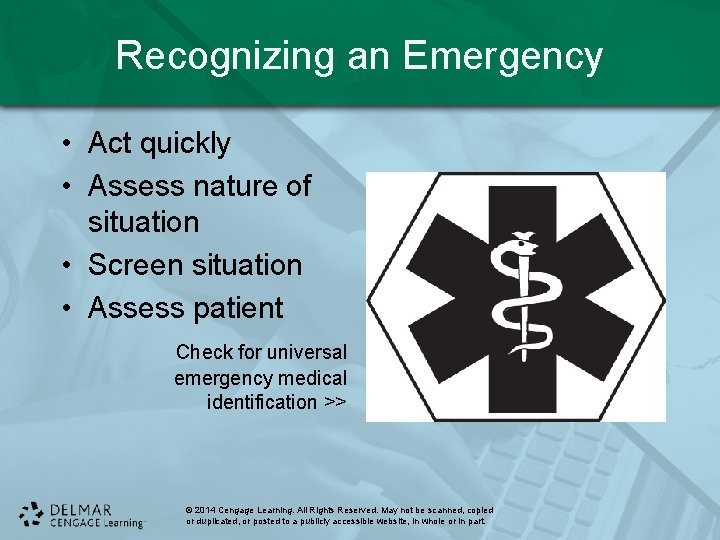
Recognizing an Emergency • Act quickly • Assess nature of situation • Screen situation • Assess patient Check for universal emergency medical identification >> © 2014 Cengage Learning. All Rights Reserved. May not be scanned, copied or duplicated, or posted to a publicly accessible website, in whole or in part.
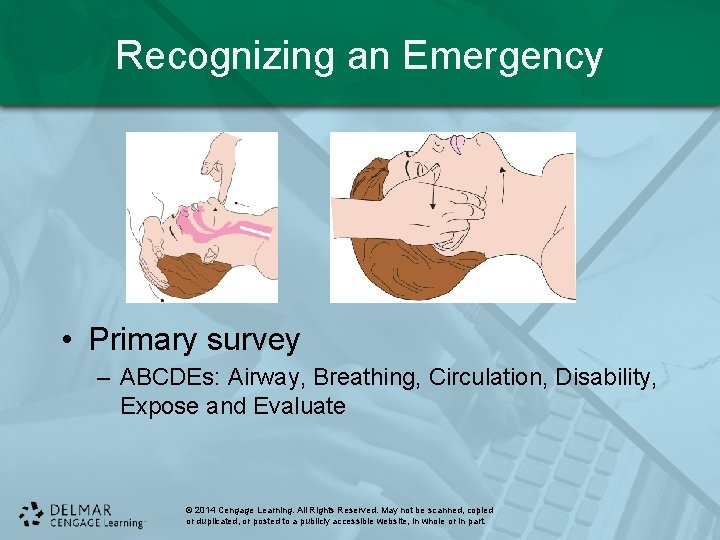
Recognizing an Emergency • Primary survey – ABCDEs: Airway, Breathing, Circulation, Disability, Expose and Evaluate © 2014 Cengage Learning. All Rights Reserved. May not be scanned, copied or duplicated, or posted to a publicly accessible website, in whole or in part.
Recognizing an Emergency • Using the 911 or EMS system – Emergency Medical Services (EMS) system: local network of police, fire, medical personnel trained to respond to emergency situations – Network activated by calling 911 © 2014 Cengage Learning. All Rights Reserved. May not be scanned, copied or duplicated, or posted to a publicly accessible website, in whole or in part.
Recognizing an Emergency • While waiting for EMS to arrive, check for following signs: – – – Degree of responsiveness Airway/breathing ability Heartbeat (rate and rhythm) Bleeding Signs of shock • Monitor vital signs • Keep patient warm © 2014 Cengage Learning. All Rights Reserved. May not be scanned, copied or duplicated, or posted to a publicly accessible website, in whole or in part.
Recognizing an Emergency • Good Samaritan laws – Provide some degree of legal protection to health care professional who offers first aid – Generally protect off-duty health care professionals – Primary principle of first aid is to prevent further injury – Conditions of law vary from state to state © 2014 Cengage Learning. All Rights Reserved. May not be scanned, copied or duplicated, or posted to a publicly accessible website, in whole or in part.
Recognizing an Emergency • Blood, body fluids, disease transmission – Always protect yourself and the patient – Establish and follow strict guidelines – Follow Standard Precautions © 2014 Cengage Learning. All Rights Reserved. May not be scanned, copied or duplicated, or posted to a publicly accessible website, in whole or in part.
Preparing for an Emergency • Develop in-office handbook of policies and procedures • Keep telephone numbers for local EMS and poison control center posted • All personnel trained in first aid and CPR © 2014 Cengage Learning. All Rights Reserved. May not be scanned, copied or duplicated, or posted to a publicly accessible website, in whole or in part.
Preparing for an Emergency • Proper documentation after any emergency situation • Keep office environment safe – Floors and corridors clean – Wipe up spills immediately to prevent falls – Medications out of sight © 2014 Cengage Learning. All Rights Reserved. May not be scanned, copied or duplicated, or posted to a publicly accessible website, in whole or in part.
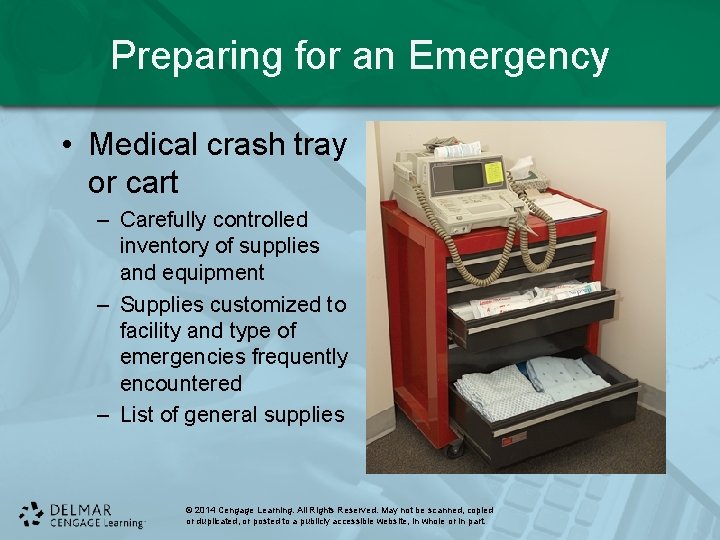
Preparing for an Emergency • Medical crash tray or cart – Carefully controlled inventory of supplies and equipment – Supplies customized to facility and type of emergencies frequently encountered – List of general supplies © 2014 Cengage Learning. All Rights Reserved. May not be scanned, copied or duplicated, or posted to a publicly accessible website, in whole or in part.
Common Emergencies • Shock – Condition in which circulatory system is not providing enough blood to all parts of body, causing body’s organs to fail to function properly – Always life-threatening – Activate EMS © 2014 Cengage Learning. All Rights Reserved. May not be scanned, copied or duplicated, or posted to a publicly accessible website, in whole or in part.
Common Emergencies • Shock – Learn to recognize signs and symptoms – Defined by categories or by underlying cause • • Cardiogenic Hypovolemic Neurogenic Anaphylactic Septic Respiratory Traumatic © 2014 Cengage Learning. All Rights Reserved. May not be scanned, copied or duplicated, or posted to a publicly accessible website, in whole or in part.
Common Emergencies • Treatment for shock – Shock is progressive; if not treated immediately, most types can be life threatening – Treat underlying causative factors – Activate EMS © 2014 Cengage Learning. All Rights Reserved. May not be scanned, copied or duplicated, or posted to a publicly accessible website, in whole or in part.
Common Emergencies • Wounds – Closed • • Have no break in skin Do not usually present emergency situation Bruise, contusion, hematoma common RICE and MICE procedures: Rest or Movement, Ice, Compression, Elevation © 2014 Cengage Learning. All Rights Reserved. May not be scanned, copied or duplicated, or posted to a publicly accessible website, in whole or in part.
Common Emergencies • Wounds – Open • Minor tears in skin or more serious breaks • All represent opportunity for infection • Tetanus injection may be indicated © 2014 Cengage Learning. All Rights Reserved. May not be scanned, copied or duplicated, or posted to a publicly accessible website, in whole or in part.
Common Emergencies • Wounds – Types of open wounds • • • Abrasions Avulsions Incisions Lacerations Punctures © 2014 Cengage Learning. All Rights Reserved. May not be scanned, copied or duplicated, or posted to a publicly accessible website, in whole or in part.
Common Emergencies • Use of tourniquets in emergency care – “Constriction band” now substituted for tourniquet and is widely used – Applied tightly enough to stem rapid loss of blood but loosely enough to allow small amount of blood to continue to flow – If bleeding controlled, direct pressure still best method to handle blood loss © 2014 Cengage Learning. All Rights Reserved. May not be scanned, copied or duplicated, or posted to a publicly accessible website, in whole or in part.
Common Emergencies • Dressings and bandages – Critical to dress and bandage open wound to curtail infection – Dressings • Sterile gauze pads placed directly on wound – Bandages • Nonsterile wraps placed over dressings © 2014 Cengage Learning. All Rights Reserved. May not be scanned, copied or duplicated, or posted to a publicly accessible website, in whole or in part.
Common Emergencies • Dressings and bandages – Bandage application can take many shapes and forms, depending on type of injury and injury site – Avoid too tight or too loose a wrap © 2014 Cengage Learning. All Rights Reserved. May not be scanned, copied or duplicated, or posted to a publicly accessible website, in whole or in part.
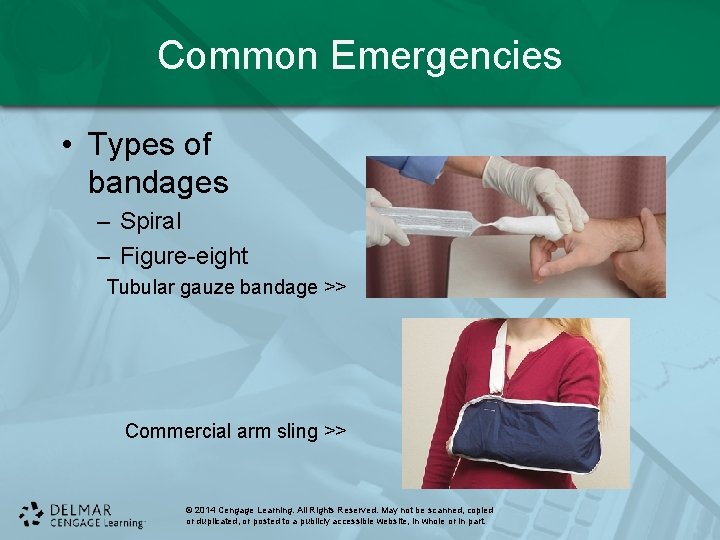
Common Emergencies • Types of bandages – Spiral – Figure-eight Tubular gauze bandage >> Commercial arm sling >> © 2014 Cengage Learning. All Rights Reserved. May not be scanned, copied or duplicated, or posted to a publicly accessible website, in whole or in part.
Common Emergencies • Burns – Caused by heat, chemicals, explosions, electricity, solar radiation – Critical burns can be life threatening and require immediate medical attention • • Breathing difficulty Cover more than one body part Head, neck, hands, feet, genitals Any burns to child or older adult (other than minor burns) © 2014 Cengage Learning. All Rights Reserved. May not be scanned, copied or duplicated, or posted to a publicly accessible website, in whole or in part.
Common Emergencies • Burns – Cool with normal saline or water – Cover with sterile dressing or sheet depending no severity and size – Protect patient from being chilled or overheated – DO NOT apply ice or ice water – DO NOT touch except with sterile dressing or sheet – DO NOT clean, break blisters or apply ointment – DO NOT remove clothing that may be stuck to burn © 2014 Cengage Learning. All Rights Reserved. May not be scanned, copied or duplicated, or posted to a publicly accessible website, in whole or in part.
Common Emergencies • Burns – Degrees of burns • First-degree – Superficial; top layer of skin • Second-degree – Skin red and blisters appear; very painful • Third-degree – Affect or destroy all layers of tissue; fat, muscles, bones, nerves – Can look charred or brown – Great pain or, if nerve endings destroyed, burn may be painless © 2014 Cengage Learning. All Rights Reserved. May not be scanned, copied or duplicated, or posted to a publicly accessible website, in whole or in part.
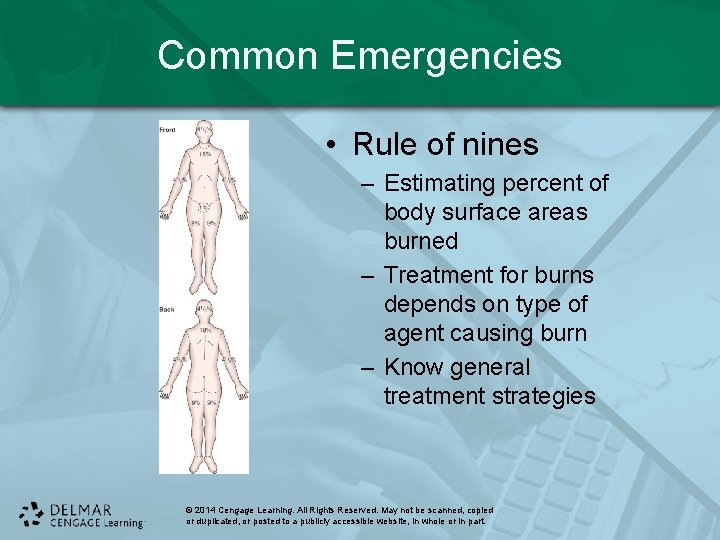
Common Emergencies • Rule of nines – Estimating percent of body surface areas burned – Treatment for burns depends on type of agent causing burn – Know general treatment strategies © 2014 Cengage Learning. All Rights Reserved. May not be scanned, copied or duplicated, or posted to a publicly accessible website, in whole or in part.
Common Emergencies • Musculoskeletal injuries – – Not life threatening Painful If not properly treated, can be disabling Spinal cord injuries can be quite serious and result in paralysis © 2014 Cengage Learning. All Rights Reserved. May not be scanned, copied or duplicated, or posted to a publicly accessible website, in whole or in part.
Common Emergencies • Musculoskeletal injuries – Sprain • Injury to joint (ankle, knee, wrist); tearing of ligaments • Rapid swelling, discoloration at site, limited function • Treat with RICE or MICE method – Strain • Overuse or stretching of muscle, tendons, group of muscles • Applications of ice and heat as well as rest • Slings, crutches, removable splints help protect injury © 2014 Cengage Learning. All Rights Reserved. May not be scanned, copied or duplicated, or posted to a publicly accessible website, in whole or in part.
Common Emergencies • Musculoskeletal injuries – Dislocations • Painful; separation of bone from its normal position • Treated urgently • Require x-rays or MRI © 2014 Cengage Learning. All Rights Reserved. May not be scanned, copied or duplicated, or posted to a publicly accessible website, in whole or in part.
Common Emergencies • Musculoskeletal injuries – Fractures: break in a bone • Open: open wound; characterized by protruding bone • Closed: skin not broken – Incomplete or greenstick – Simple – Compound – Impacted – Comminuted – Spiral – Depressed – Colles © 2014 Cengage Learning. All Rights Reserved. May not be scanned, copied or duplicated, or posted to a publicly accessible website, in whole or in part.
Common Emergencies • Assessing injuries to muscles, bones, joints – – – Note extent of bruising and swelling Pain is signal of injury Noticeable deformity to bone or joint Use of injured area limited Talk to patient © 2014 Cengage Learning. All Rights Reserved. May not be scanned, copied or duplicated, or posted to a publicly accessible website, in whole or in part.
Common Emergencies • Caring for muscle, bone, joint injuries – – – Rest Some motion Elevation of injured part Immobilization Application of ice to injury Call EMS © 2014 Cengage Learning. All Rights Reserved. May not be scanned, copied or duplicated, or posted to a publicly accessible website, in whole or in part.
Common Emergencies • Heat-related illnesses – Heat cramps (least serious) – Heat exhaustion (more serious) • Cold and clammy skin, profuse sweating, HA, weakness – Heat stroke (least common, most dangerous) • Red, dry, hot skin; weak pulse; shallow, fast breathing • Cold-related illnesses – Frostbite (affects extremities) • Freezing of exposed body parts; Skin becomes off-color, cold and waxy – Hypothermia (serious; can result in death) • Cool skin, confusion, shivering © 2014 Cengage Learning. All Rights Reserved. May not be scanned, copied or duplicated, or posted to a publicly accessible website, in whole or in part.
Common Emergencies • Poisoning – Can enter body in four ways: • Ingestion: medications, household chemicals • Inhalation: gasoline fumes • Absorption: poison ivy • Injection: drug abuse, insects, snakes © 2014 Cengage Learning. All Rights Reserved. May not be scanned, copied or duplicated, or posted to a publicly accessible website, in whole or in part.
Common Emergencies • Poisoning – Signs and symptoms: dyspnea, nausea and vomiting, confusion, convulsions – Call poison control center or local emergency number – In most poisoning cases, there are specific antidotes – No specific treatment; symptoms treated – Treatment varies according to source of poisoning – Important to identify type and amount of poison © 2014 Cengage Learning. All Rights Reserved. May not be scanned, copied or duplicated, or posted to a publicly accessible website, in whole or in part.
Common Emergencies • Poisoning – Insect stings • Localized swelling, tenderness, slight redness • Remove stinger by scraping with something rigid (credit card) • May cause allergic reaction or hypersensitivity • Epinephrine may be prescribed to patients with known allergic reactions (EPIPEN) © 2014 Cengage Learning. All Rights Reserved. May not be scanned, copied or duplicated, or posted to a publicly accessible website, in whole or in part.
Common Emergencies • Poisoning – Snake bite • Most snakes not poisonous • Poisonous snakes: rattlesnake, copperhead snake, cottonmouth water moccasin, coral snake • Signs and symptoms: rapid pulse, nausea and vomiting, severe pain, swelling, blood and fang marks at wound site, convulsions, thirst, diaphoresis © 2014 Cengage Learning. All Rights Reserved. May not be scanned, copied or duplicated, or posted to a publicly accessible website, in whole or in part.
Common Emergencies • Sudden illness – Fainting (syncope) • Loss of consciousness caused by insufficient supply of blood to brain • If patient feels faint, have individual lie down or sit with head level with knees • If patient faints, lower patient to flat surface, loosen tight clothing, check breathing, apply cool compresses to forehead • May indicate complex medical condition © 2014 Cengage Learning. All Rights Reserved. May not be scanned, copied or duplicated, or posted to a publicly accessible website, in whole or in part.
Common Emergencies • Sudden illness – Seizures (convulsions) • When normal brain functioning disrupted • Caused by fever, diabetes, infection, brain injury, epilepsy, other conditions and diseases • Patient should never be restrained • Treat patient with compassion • Protect patient from injury • Determine if EMS should be called © 2014 Cengage Learning. All Rights Reserved. May not be scanned, copied or duplicated, or posted to a publicly accessible website, in whole or in part.
Common Emergencies • Sudden illness – Diabetes • Inability of body to properly convert sugar from food into energy • Body does not produce insulin at all or does not produce enough • Type 1 (insulin-dependent) • Type 2 (noninsulin-dependent) • Diabetic coma and insulin shock or reaction may occur © 2014 Cengage Learning. All Rights Reserved. May not be scanned, copied or duplicated, or posted to a publicly accessible website, in whole or in part.
Common Emergencies • Sudden illness – Hemorrhage • External bleeding: capillary, venous, arterial bleeding • Epistaxis (nosebleeds) • Internal bleeding – Minor or serious depending on cause of injury – Important to recognize signs and symptoms – Stay with patient and have someone call EMS © 2014 Cengage Learning. All Rights Reserved. May not be scanned, copied or duplicated, or posted to a publicly accessible website, in whole or in part.
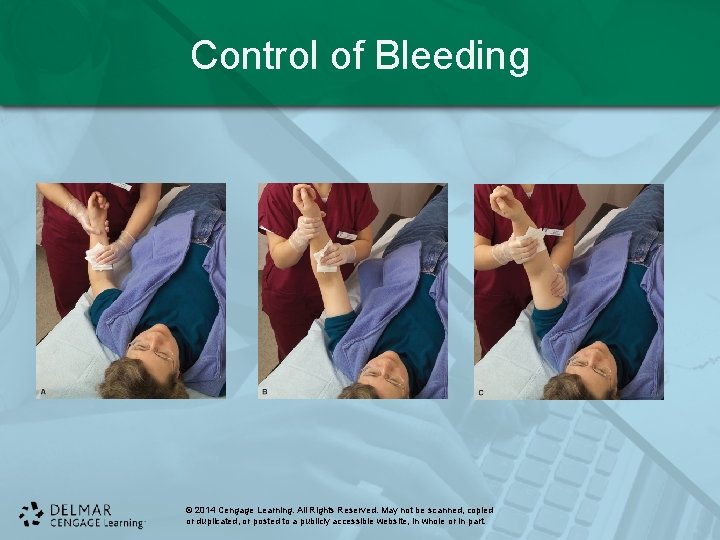
Control of Bleeding © 2014 Cengage Learning. All Rights Reserved. May not be scanned, copied or duplicated, or posted to a publicly accessible website, in whole or in part.
Common Emergencies • Cerebral vascular accident (CVA) – Common term is stroke – Result of ruptured blood vessel in brain – Can be caused by occlusion of blood vessel or by a clot © 2014 Cengage Learning. All Rights Reserved. May not be scanned, copied or duplicated, or posted to a publicly accessible website, in whole or in part.
Common Emergencies • Cerebral vascular accident (CVA) commonly known as stroke – – – – Numbness in face, arm, leg on one side of body Loss of vision Severe headache Mental confusion Slurred speech Nausea, vomiting Difficulty in breathing and swallowing Paralysis © 2014 Cengage Learning. All Rights Reserved. May not be scanned, copied or duplicated, or posted to a publicly accessible website, in whole or in part.
Common Emergencies • CVA: commonly known as stroke • Acronym for recognizing – – F: Facial droop A: Arm weakness S: Speech difficulties T: Time © 2014 Cengage Learning. All Rights Reserved. May not be scanned, copied or duplicated, or posted to a publicly accessible website, in whole or in part.
Common Emergencies • Cerebral vascular accident (CVA) – Treatment of CVA • • • Activate EMS; keep patient comfortable Maintain open airway Do not give anything by mouth Monitor vital signs Immediate emergency care critical © 2014 Cengage Learning. All Rights Reserved. May not be scanned, copied or duplicated, or posted to a publicly accessible website, in whole or in part.
Common Emergencies • Heart attack – Also known as myocardial infarction (MI) – Usually caused by blockage of coronary arteries – Symptoms: tightness of chest, pain radiating down one or both arms, pain radiating into left shoulder and jaw – Signs: rapid and weak pulse, excessive perspiration, agitation, nausea, cold and clammy skin – Symptoms in women may or may not be similar to men © 2014 Cengage Learning. All Rights Reserved. May not be scanned, copied or duplicated, or posted to a publicly accessible website, in whole or in part.
Common Emergencies • Heart attack – – Contact EMS immediately Keep patient comfortable Prepare to give oxygen and medications (aspirin) Cardioversion or defibrillation may be necessary with AED – Begin CPR if necessary © 2014 Cengage Learning. All Rights Reserved. May not be scanned, copied or duplicated, or posted to a publicly accessible website, in whole or in part.
Breathing Emergencies and Cardiac Arrest • When patient stops breathing, give artificial or rescue breathing immediately • Give chest compressions with rescue breathing (CPR) if patient has breathing emergency and cardiac arrest © 2014 Cengage Learning. All Rights Reserved. May not be scanned, copied or duplicated, or posted to a publicly accessible website, in whole or in part.
Breathing Emergencies and Cardiac Arrest • Rescue breathing – Previously called mouth-to-mouth resuscitation – Provide oxygen until emergency personnel arrive – Resuscitation mouthpieces recommended © 2014 Cengage Learning. All Rights Reserved. May not be scanned, copied or duplicated, or posted to a publicly accessible website, in whole or in part.
Breathing Emergencies and Cardiac Arrest • Cardiopulmonary resuscitation (CPR) – Combination of rescue breathing and chest compressions – Preliminary care until advanced medical help available – CPR plus shock with AED treatment for cardiac arrest • Started within 3 to 5 minutes of collapse can significantly boost chances of survival – Early recognition, calling EMS, immediate CPR can double or triple victim’s chances of surviving © 2014 Cengage Learning. All Rights Reserved. May not be scanned, copied or duplicated, or posted to a publicly accessible website, in whole or in part.
CPR • Please refer to the video “CPR” through the instructor companion site. © 2014 Cengage Learning. All Rights Reserved. May not be scanned, copied or duplicated, or posted to a publicly accessible website, in whole or in part.
Safety and Emergency Practices • Mass disasters – – – – – Floods Hurricanes Tornadoes Tsunamis Earthquakes Explosions Structural collapses Transportation accidents War or terrorism © 2014 Cengage Learning. All Rights Reserved. May not be scanned, copied or duplicated, or posted to a publicly accessible website, in whole or in part.
Safety and Emergency Practices • • Assisting at local shelters Using first aid and CPR skills Helping at clinic or hospital Giving injections for mass immunizations • Supporting providers • Working with American Red Cross • Giving emotional support © 2014 Cengage Learning. All Rights Reserved. May not be scanned, copied or duplicated, or posted to a publicly accessible website, in whole or in part.
Safety and Emergency Practices • Please refer to the video “Fire Safety” through the instructor companion site. © 2014 Cengage Learning. All Rights Reserved. May not be scanned, copied or duplicated, or posted to a publicly accessible website, in whole or in part.
Safety and Emergency Practices • Be prepared to respond to emergency in medical office or home environment • Medical Reserve Corps (MRC) volunteer units assigned to specific areas © 2014 Cengage Learning. All Rights Reserved. May not be scanned, copied or duplicated, or posted to a publicly accessible website, in whole or in part.