
Chapter 9 Efficiency of Algorithms 9 3 Efficiency
- Slides: 12
Chapter 9 Efficiency of Algorithms
9. 3 Efficiency of Algorithms
Efficiency of Algorithms • Two aspects of algorithm efficiency are important: – 1. the amount of time required for execution – 2. amount of memory space needed when it runs. • Algorithms are usually analyzed in terms of their best case, worst case, and average. • How can the time efficiency of an algorithm be calculated? – Have to factor in the input size to the algorithm – Nature of the input data
Efficiency of Algorithms • Because the time efficiency can be influenced by many physical parameters of a computing device, i. e. processor speed, memory size, multi-core, etc. , a method of analysis must be used that is not a factor of the processing platform. • Evaluation of algorithms can be based on the number of elementary operations required by the algorithm. – Elementary operations are addition, subtraction, multiplication, division and comparison. – All elementary ops are viewed as taking 1 time unit on any system.
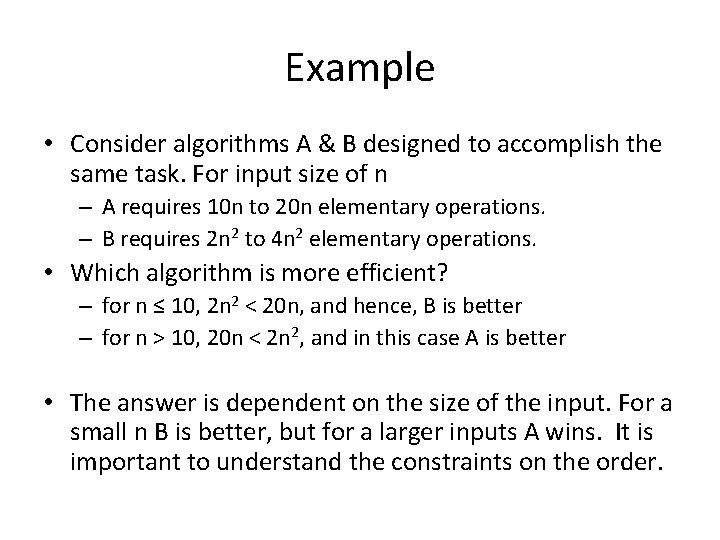
Example • Consider algorithms A & B designed to accomplish the same task. For input size of n – A requires 10 n to 20 n elementary operations. – B requires 2 n 2 to 4 n 2 elementary operations. • Which algorithm is more efficient? – for n ≤ 10, 2 n 2 < 20 n, and hence, B is better – for n > 10, 20 n < 2 n 2, and in this case A is better • The answer is dependent on the size of the input. For a small n B is better, but for a larger inputs A wins. It is important to understand the constraints on the order.
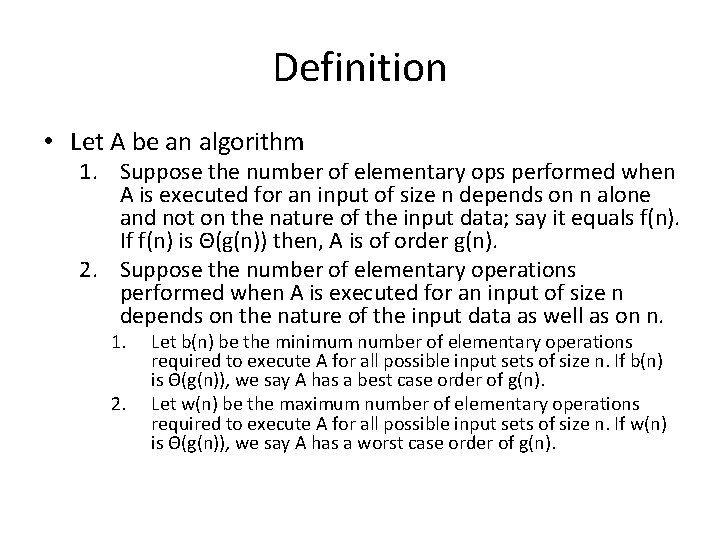
Definition • Let A be an algorithm 1. Suppose the number of elementary ops performed when A is executed for an input of size n depends on n alone and not on the nature of the input data; say it equals f(n). If f(n) is Θ(g(n)) then, A is of order g(n). 2. Suppose the number of elementary operations performed when A is executed for an input of size n depends on the nature of the input data as well as on n. 1. 2. Let b(n) be the minimum number of elementary operations required to execute A for all possible input sets of size n. If b(n) is Θ(g(n)), we say A has a best case order of g(n). Let w(n) be the maximum number of elementary operations required to execute A for all possible input sets of size n. If w(n) is Θ(g(n)), we say A has a worst case order of g(n).
Time Comparisons of Algorithm Orders
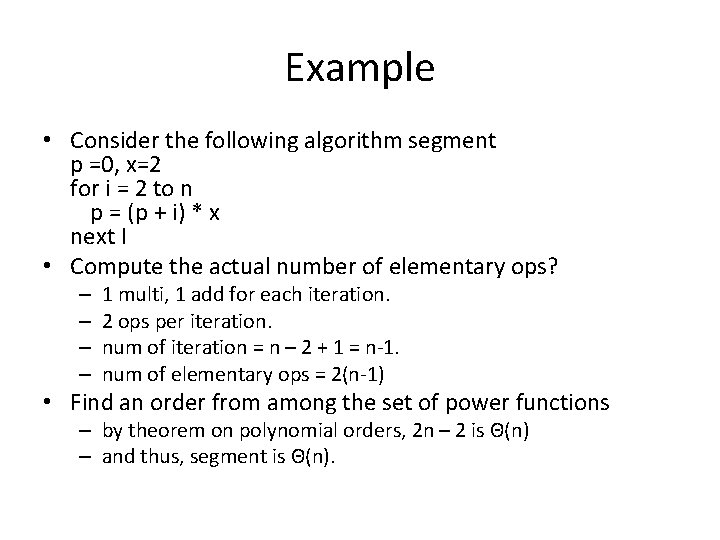
Example • Consider the following algorithm segment p =0, x=2 for i = 2 to n p = (p + i) * x next I • Compute the actual number of elementary ops? – – 1 multi, 1 add for each iteration. 2 ops per iteration. num of iteration = n – 2 + 1 = n-1. num of elementary ops = 2(n-1) • Find an order from among the set of power functions – by theorem on polynomial orders, 2 n – 2 is Θ(n) – and thus, segment is Θ(n).
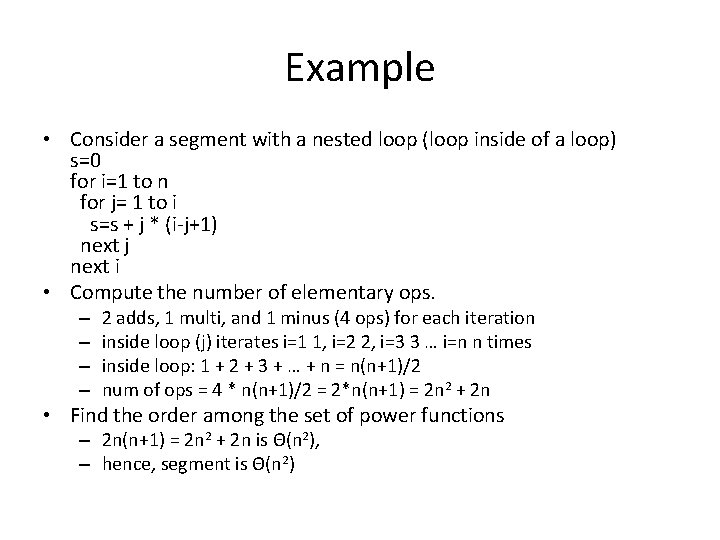
Example • Consider a segment with a nested loop (loop inside of a loop) s=0 for i=1 to n for j= 1 to i s=s + j * (i-j+1) next j next i • Compute the number of elementary ops. – – 2 adds, 1 multi, and 1 minus (4 ops) for each iteration inside loop (j) iterates i=1 1, i=2 2, i=3 3 … i=n n times inside loop: 1 + 2 + 3 + … + n = n(n+1)/2 num of ops = 4 * n(n+1)/2 = 2*n(n+1) = 2 n 2 + 2 n • Find the order among the set of power functions – 2 n(n+1) = 2 n 2 + 2 n is Θ(n 2), – hence, segment is Θ(n 2)
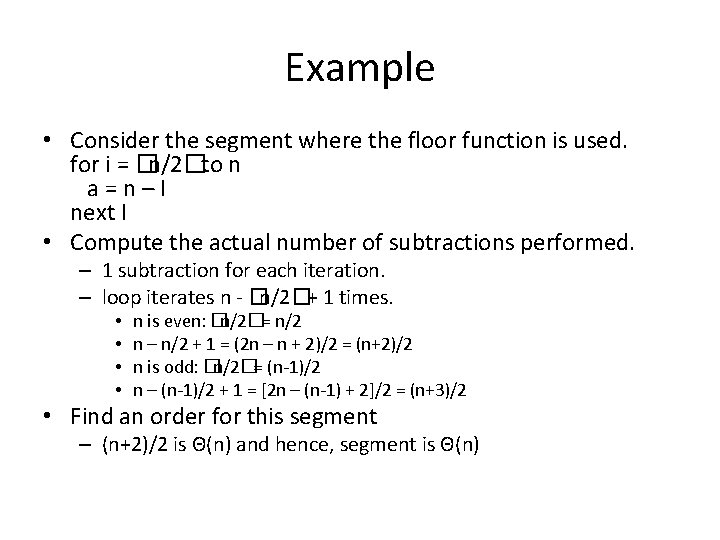
Example • Consider the segment where the floor function is used. for i = �n/2�to n a=n–I next I • Compute the actual number of subtractions performed. – 1 subtraction for each iteration. – loop iterates n - �n/2�+ 1 times. • • n is even: �n/2�= n/2 n – n/2 + 1 = (2 n – n + 2)/2 = (n+2)/2 n is odd: �n/2�= (n-1)/2 n – (n-1)/2 + 1 = [2 n – (n-1) + 2]/2 = (n+3)/2 • Find an order for this segment – (n+2)/2 is Θ(n) and hence, segment is Θ(n)
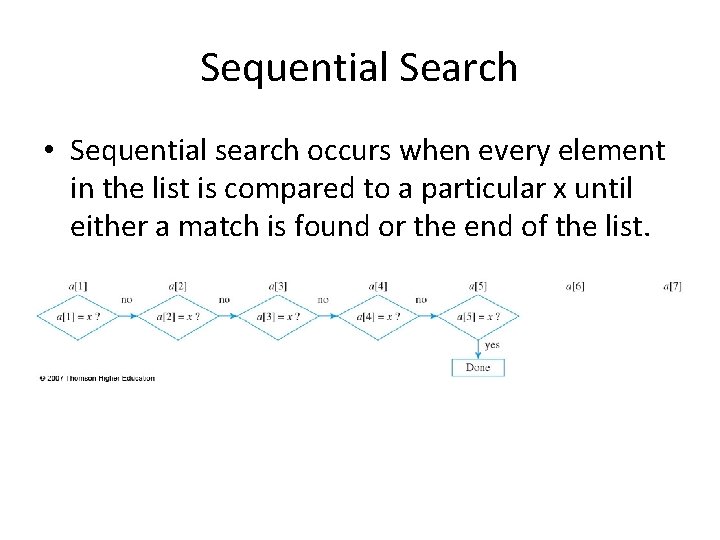
Sequential Search • Sequential search occurs when every element in the list is compared to a particular x until either a match is found or the end of the list.
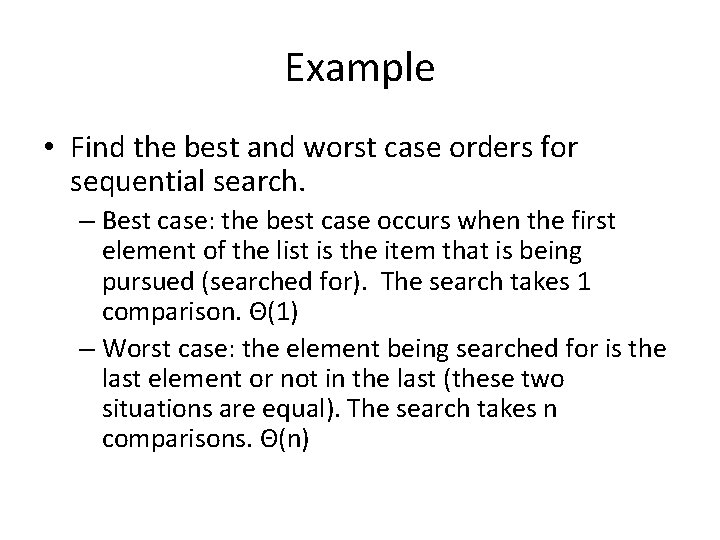
Example • Find the best and worst case orders for sequential search. – Best case: the best case occurs when the first element of the list is the item that is being pursued (searched for). The search takes 1 comparison. Θ(1) – Worst case: the element being searched for is the last element or not in the last (these two situations are equal). The search takes n comparisons. Θ(n)