
Chapter 9 DNA The Genetic Material Why Its
- Slides: 32
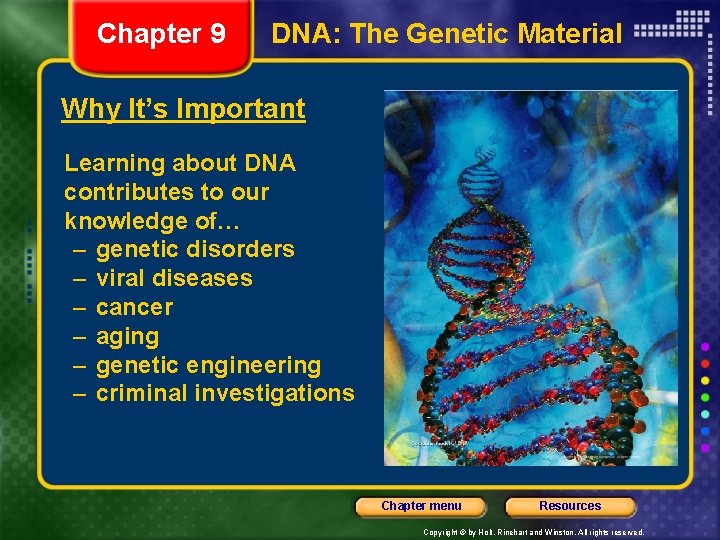
Chapter 9 DNA: The Genetic Material Why It’s Important Learning about DNA contributes to our knowledge of… – genetic disorders – viral diseases – cancer – aging – genetic engineering – criminal investigations Chapter menu Resources Copyright © by Holt, Rinehart and Winston. All rights reserved.
Chapter 9 Section 1 Identifying the Genetic Material Objectives • Relate Griffith’s conclusions to the observations he made during the transformation experiments. • Summarize the steps involved in Avery’s transformation experiments, and state the results. • Evaluate the results of the Hershey and Chase experiment. Chapter menu Resources Copyright © by Holt, Rinehart and Winston. All rights reserved.
New Vocabulary • • • Vaccine Virulent Restriction enzyme Transformation Bacteriophage Chapter menu Resources Copyright © by Holt, Rinehart and Winston. All rights reserved.
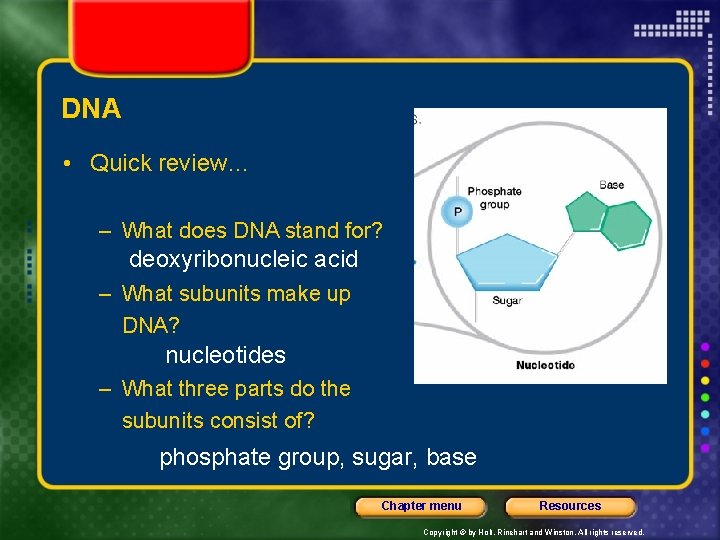
DNA • Quick review… – What does DNA stand for? deoxyribonucleic acid – What subunits make up DNA? nucleotides – What three parts do the subunits consist of? phosphate group, sugar, base Chapter menu Resources Copyright © by Holt, Rinehart and Winston. All rights reserved.
Friedrich Miescher • DNA was first identified as far back as ____ 1868 by Miescher a Swiss scientist named Friedrich ______ nuclei • He extracted DNA from the _____ of pus cells found on surgical bandages nuclein • At first DNA was called _____ because it was a substance found in the nucleus Chapter menu Resources Copyright © by Holt, Rinehart and Winston. All rights reserved.
• Miescher was also able to separate the substance into two basic parts… – The phosphate groups, also called phosphoric acids _____, were slightly acidic, so DNA belongs to a class of substances called ______ nucleic _____ acids • Throughout the next century, scientists made many function exciting discoveries about the ______ and structure _______ of DNA Chapter menu Resources Copyright © by Holt, Rinehart and Winston. All rights reserved.
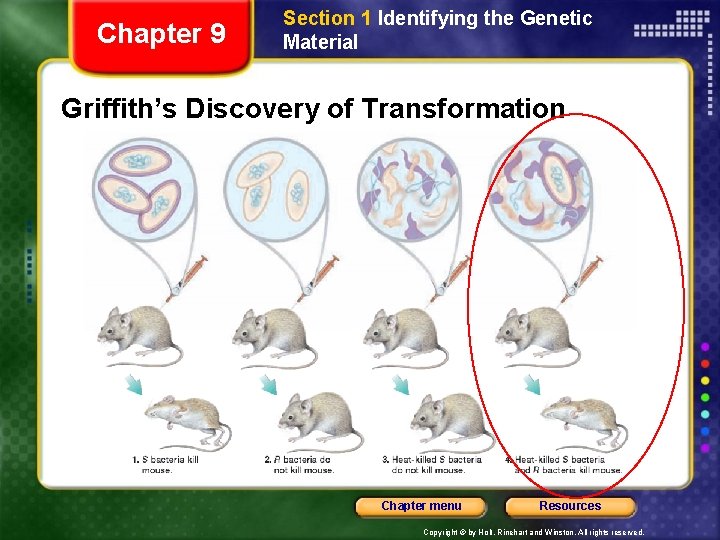
Chapter 9 Section 1 Identifying the Genetic Material Transformation Griffith’s Experiments Griffith • In 1928, Frederick _______, a bacteriologist, carried out an experiment that led to an accidental ________ discovery about DNA • He was actually trying to prepare a vaccine against the bacteria, Streptococcus pneumoniae, which pneumonia causes _________. Chapter menu Resources Copyright © by Holt, Rinehart and Winston. All rights reserved.
• A vaccine is a substance that is prepared from killed or ________ disease-causing agents weakened • When administered, it is easier for your body’s fight immune system to ______ off the disease and future prevent ________ infections • For example… – people who get a flu vaccine every year, will easily strain fight off that _____ of the virus and avoid symptoms having any _______ Chapter menu Resources Copyright © by Holt, Rinehart and Winston. All rights reserved.
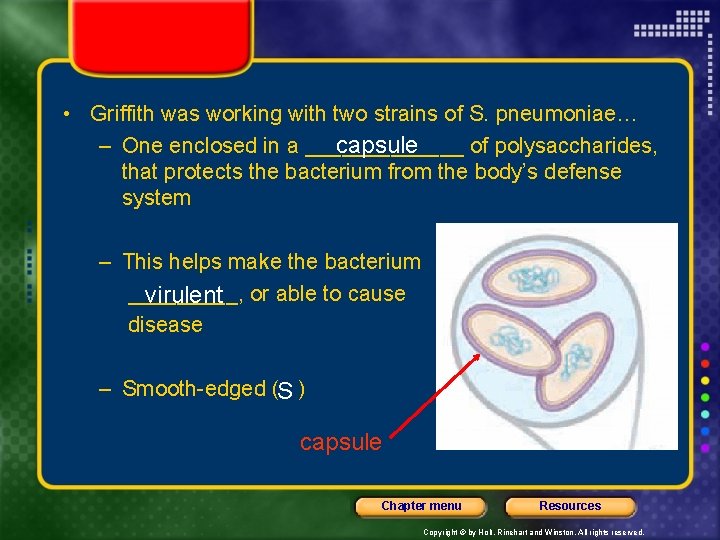
• Griffith was working with two strains of S. pneumoniae… – One enclosed in a _______ of polysaccharides, capsule that protects the bacterium from the body’s defense system – This helps make the bacterium _____, virulent or able to cause disease – Smooth-edged (S ) capsule Chapter menu Resources Copyright © by Holt, Rinehart and Winston. All rights reserved.
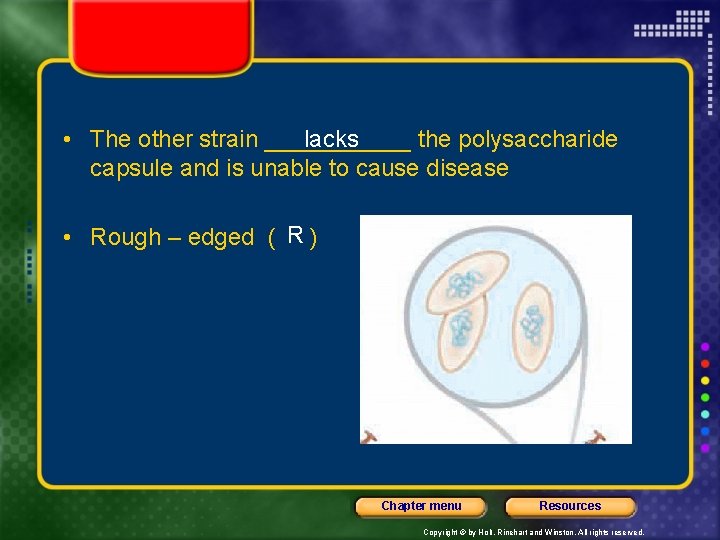
lacks • The other strain ______ the polysaccharide capsule and is unable to cause disease • Rough – edged ( R ) Chapter menu Resources Copyright © by Holt, Rinehart and Winston. All rights reserved.
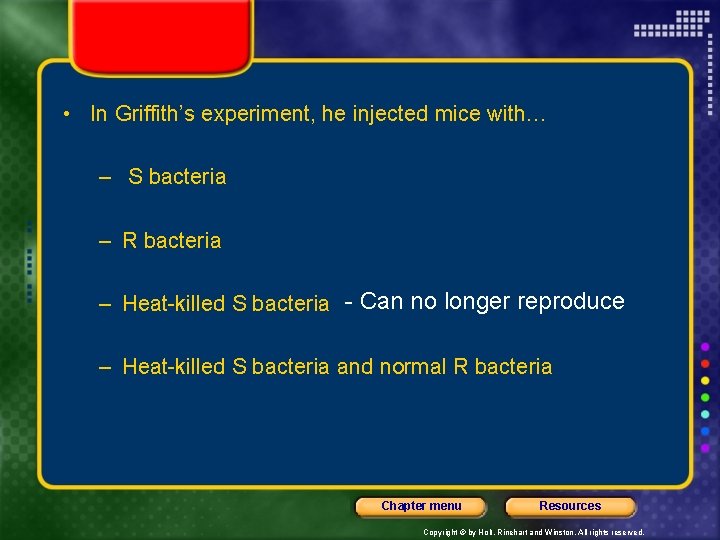
• In Griffith’s experiment, he injected mice with… – S bacteria – R bacteria – Heat-killed S bacteria - Can no longer reproduce – Heat-killed S bacteria and normal R bacteria Chapter menu Resources Copyright © by Holt, Rinehart and Winston. All rights reserved.
• Note about “heat-killing”… – During Griffith’s time, it was not understood that DNA can tolerate temperatures around 90°C proteins without being altered, but ______ are altered at around 60°C – So “heat-killing” damages a cells proteins and enzymes intact ______, but leaves DNA _____ Chapter menu Resources Copyright © by Holt, Rinehart and Winston. All rights reserved.
Chapter 9 Section 1 Identifying the Genetic Material Griffith’s Discovery of Transformation Chapter menu Resources Copyright © by Holt, Rinehart and Winston. All rights reserved.
• Somehow, the harmless R bacteria had changed and become _______ virulent • Griffith had discovered what is now called transformation __________ – Occurs when a cell picks up new DNA from it’s _______, changing its combination of environment genes, called a _________ genotype Chapter menu Resources Copyright © by Holt, Rinehart and Winston. All rights reserved.
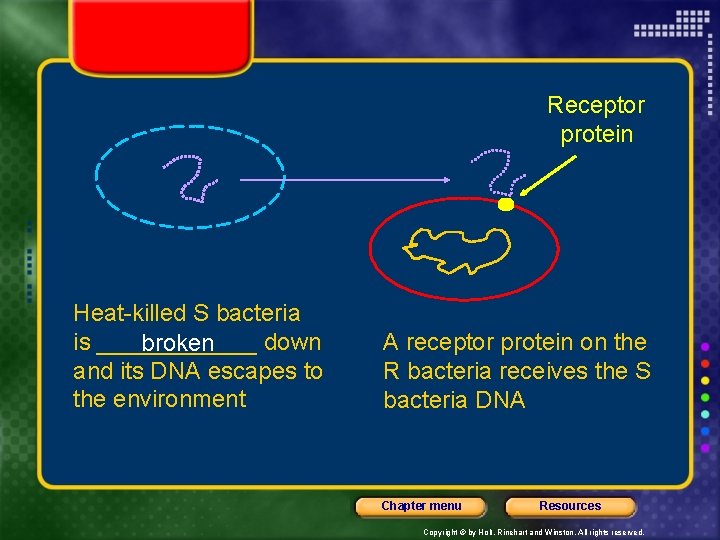
Receptor protein Heat-killed S bacteria is ______ down broken and its DNA escapes to the environment A receptor protein on the R bacteria receives the S bacteria DNA Chapter menu Resources Copyright © by Holt, Rinehart and Winston. All rights reserved.
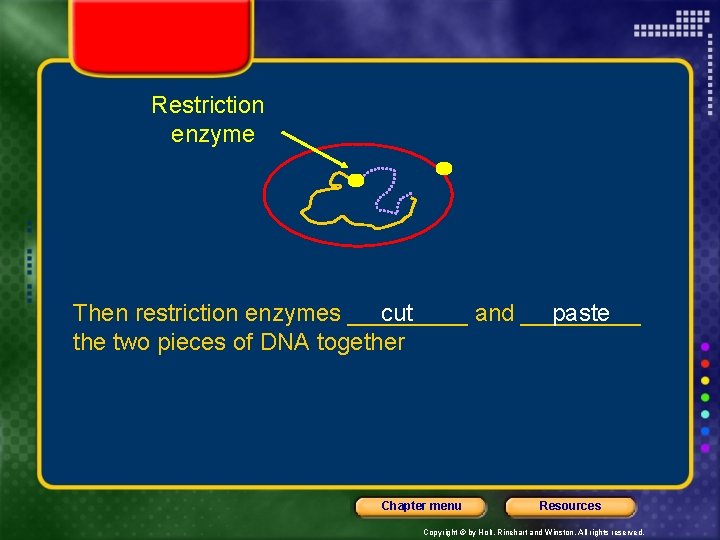
Restriction enzyme Then restriction enzymes _____ cut and _____ paste the two pieces of DNA together Chapter menu Resources Copyright © by Holt, Rinehart and Winston. All rights reserved.
• But during Griffith’s time, scientists really didn’t understand transformation • During the 1940 s and 1950 s, scientists were still debating over what cell part contained genetic information – Many scientists actually thought that ______ proteins our genetic information, and not DNA. contained Chapter menu Resources Copyright © by Holt, Rinehart and Winston. All rights reserved.
Oswald Avery • In 1944, a scientist named Oswald _____ conducted a transformation experiment under two different conditions… – Condition 1: Added an enzyme that destroyed proteins ______ – Condition 2: Added an enzyme that destroyed ______ DNA • Result? – Transformation was only stopped by the enzymes that DNA destroyed _____. . . so it must contain the genetic material! Chapter menu Resources Copyright © by Holt, Rinehart and Winston. All rights reserved.
• Despite Avery’s results, scientists remained _______ skeptical • Since proteins are so important to many cell structures metabolism _______ and ________, most scientists still thought that proteins contained the genetic material Chapter menu Resources Copyright © by Holt, Rinehart and Winston. All rights reserved.
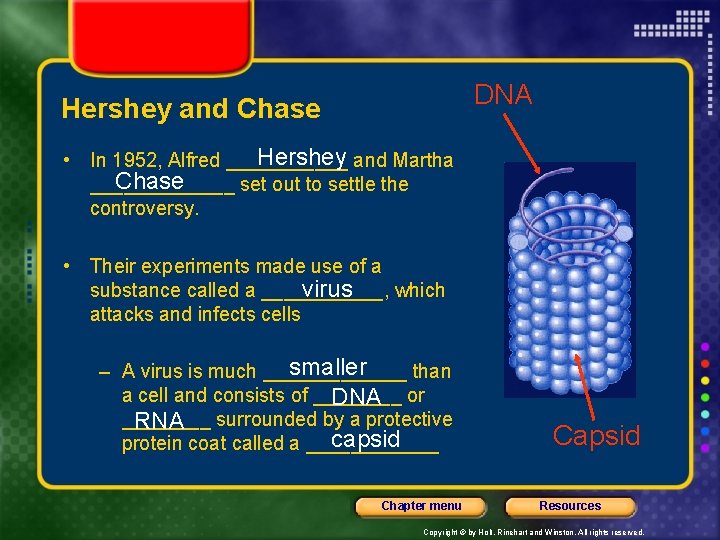
DNA Hershey and Chase Hershey and Martha • In 1952, Alfred ______ Chase _______ set out to settle the controversy. • Their experiments made use of a substance called a ______, which virus attacks and infects cells smaller – A virus is much _______ than a cell and consists of ____ DNA or ____ RNA surrounded by a protective capsid protein coat called a ______ Chapter menu Capsid Resources Copyright © by Holt, Rinehart and Winston. All rights reserved.
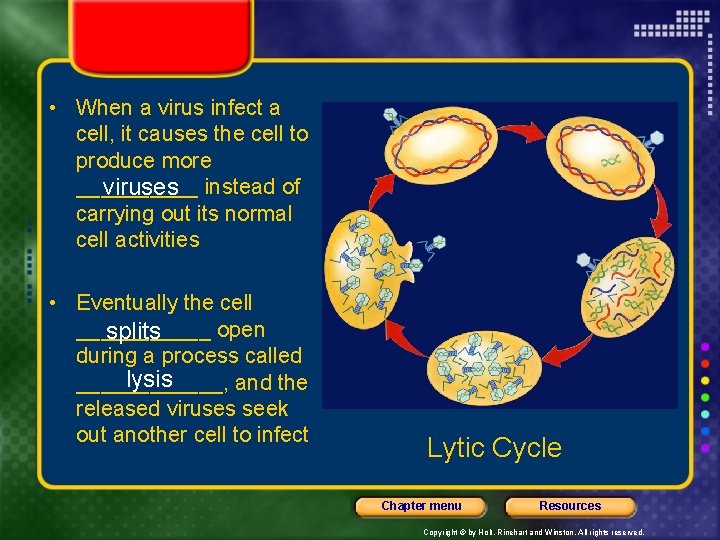
• When a virus infect a cell, it causes the cell to produce more _____ viruses instead of carrying out its normal cell activities • Eventually the cell ______ open splits during a process called lysis ______, and the released viruses seek out another cell to infect Lytic Cycle Chapter menu Resources Copyright © by Holt, Rinehart and Winston. All rights reserved.
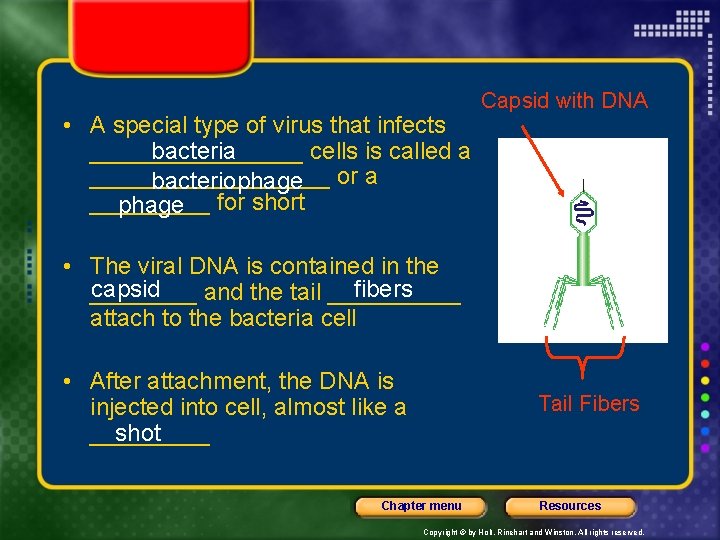
• A special type of virus that infects ________ cells is called a bacteria _________ bacteriophage or a _____ phage for short Capsid with DNA • The viral DNA is contained in the capsid fibers ____ and the tail _____ attach to the bacteria cell • After attachment, the DNA is injected into cell, almost like a _____ shot Tail Fibers Chapter menu Resources Copyright © by Holt, Rinehart and Winston. All rights reserved.
• The bacteriophage made the perfect test subject, because it was a simple substance that contained proteins both ____ and ______ DNA – Scientists knew that DNA contained a ______ phosphate group – They also knew that proteins often contain the sulfur element _____ Chapter menu Resources Copyright © by Holt, Rinehart and Winston. All rights reserved.
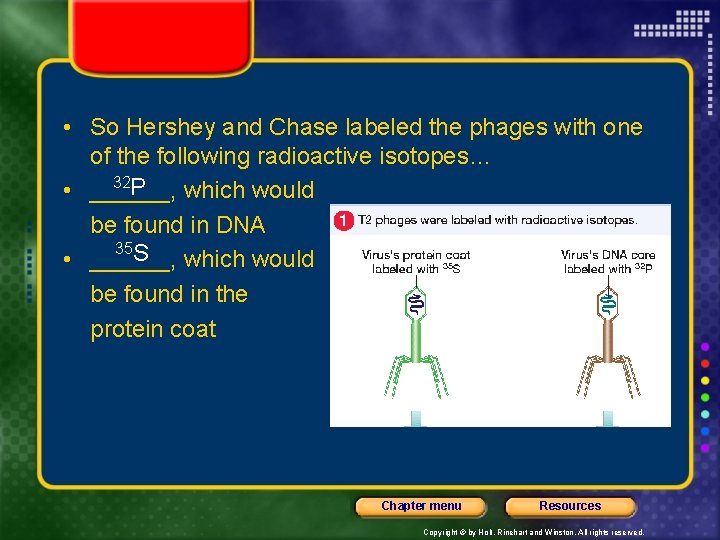
• So Hershey and Chase labeled the phages with one of the following radioactive isotopes… 32 P • ______, which would be found in DNA 35 S • ______, which would be found in the protein coat Chapter menu Resources Copyright © by Holt, Rinehart and Winston. All rights reserved.
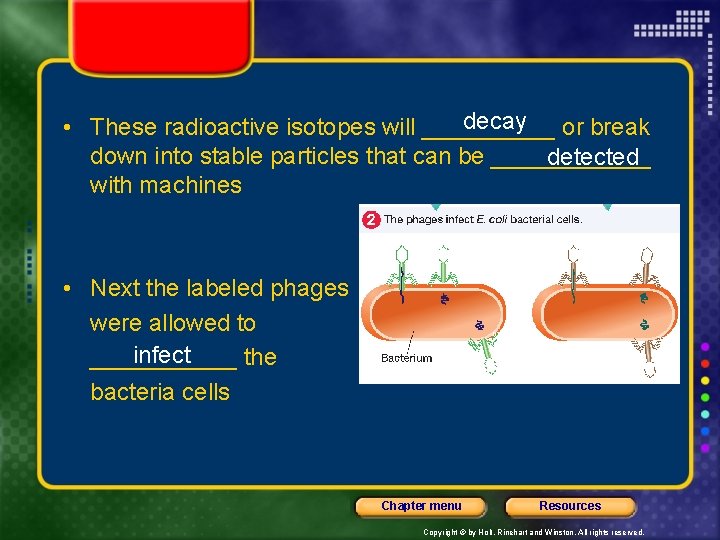
decay or break • These radioactive isotopes will _____ down into stable particles that can be ______ detected with machines • Next the labeled phages were allowed to infect ______ the bacteria cells Chapter menu Resources Copyright © by Holt, Rinehart and Winston. All rights reserved.
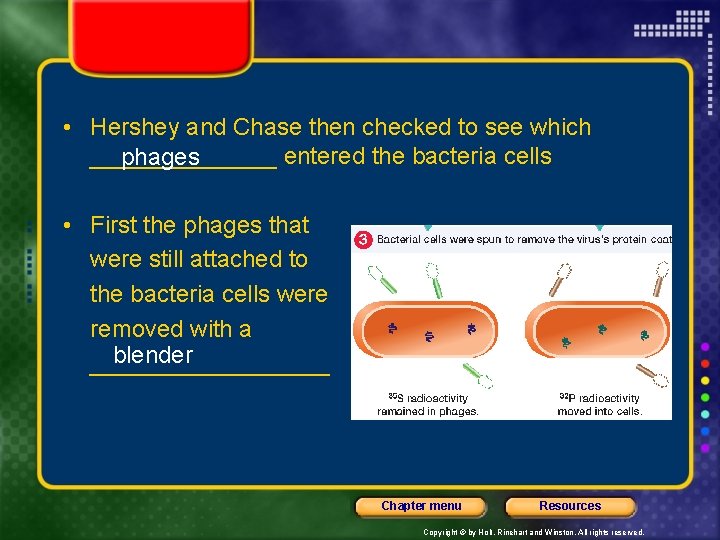
• Hershey and Chase then checked to see which _______ entered the bacteria cells phages • First the phages that were still attached to the bacteria cells were removed with a blender _________ Chapter menu Resources Copyright © by Holt, Rinehart and Winston. All rights reserved.
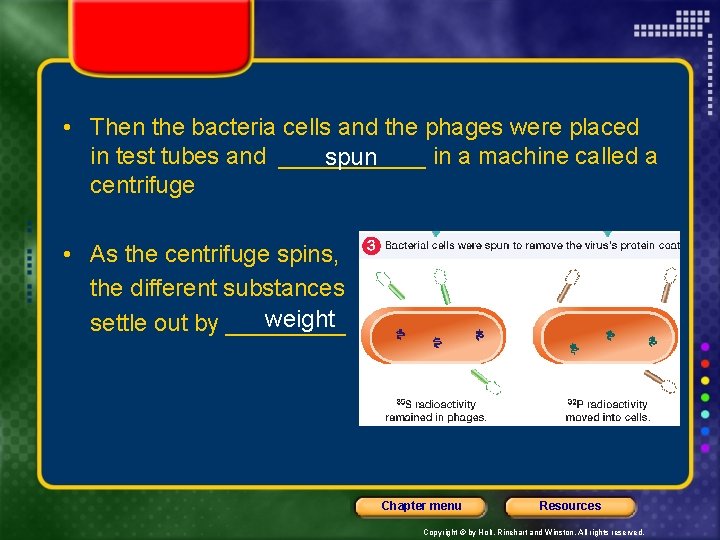
• Then the bacteria cells and the phages were placed in test tubes and ______ in a machine called a spun centrifuge • As the centrifuge spins, the different substances weight settle out by _____ Chapter menu Resources Copyright © by Holt, Rinehart and Winston. All rights reserved.
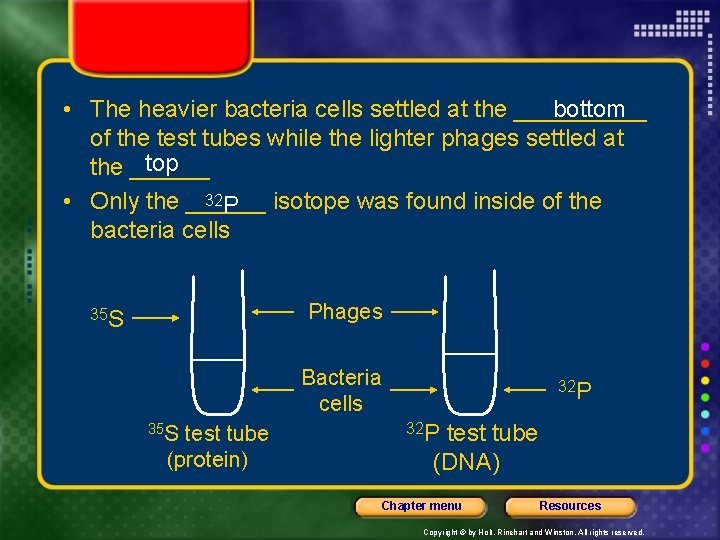
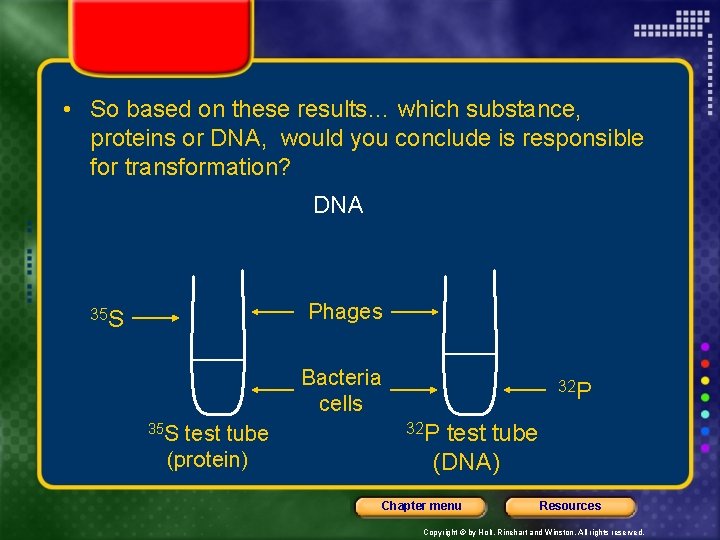
bottom • The heavier bacteria cells settled at the _____ of the test tubes while the lighter phages settled at top the ______ 32 P • Only the ______ isotope was found inside of the bacteria cells Phages 35 S Bacteria cells 35 S test tube (protein) 32 P test tube (DNA) Chapter menu Resources Copyright © by Holt, Rinehart and Winston. All rights reserved.
• So based on these results… which substance, proteins or DNA, would you conclude is responsible for transformation? DNA Phages 35 S Bacteria cells 35 S test tube (protein) 32 P test tube (DNA) Chapter menu Resources Copyright © by Holt, Rinehart and Winston. All rights reserved.
Objective 1 • Relate Griffith’s conclusions to the observations he made during the transformation experiments. R bacteria became virulent a “substance” transformed the bacteria Chapter menu Resources Copyright © by Holt, Rinehart and Winston. All rights reserved.
Objective 2 • Summarize the steps involved in Avery’s transformation experiments, and state the results. Two enzymes were added to transformation Experiments one destroyed proteins one destroyed DNA Only the DNA destroying enzyme prevented transformation Chapter menu Resources Copyright © by Holt, Rinehart and Winston. All rights reserved.
Objective 3 • Evaluate the results of the Hershey and Chase experiment. Only the 32 P radioactive isotope was Found in the bacteria cells, so DNA causes transformation Chapter menu Resources Copyright © by Holt, Rinehart and Winston. All rights reserved.