
Chapter 9 DISTRIBUTED FORCES MOMENTS OF INERTIA y

Chapter 9 DISTRIBUTED FORCES: MOMENTS OF INERTIA y The rectangular moments of inertia Ix and Iy of an area are defined as y x dx x Ix = ò y 2 d. A Iy = ò x 2 d. A These computations are reduced to single integrations by choosing d. A to be a thin strip parallel to one of the coordinate axes. The result is d. Ix = 1 3 y 3 dx d. Iy = x 2 ydx Sharif University-Aerospace Dep. Fall 2004
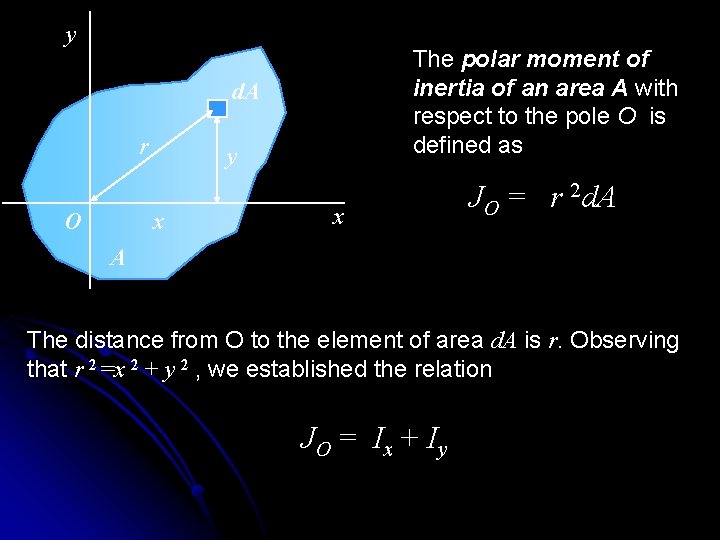
y The polar moment of inertia of an area A with respect to the pole O is defined as d. A r O y x x JO = ò r 2 d. A A The distance from O to the element of area d. A is r. Observing that r 2 =x 2 + y 2 , we established the relation J O = Ix + Iy

y The radius of gyration of an area A with respect to the x axis is defined as the distance kx, where 2 Ix = kx A. With similar definitions for the radii of gyration of A with respect to the y axis and with respect to O, we have A kx O x kx = Ix A ky = Iy A k. O = JO A
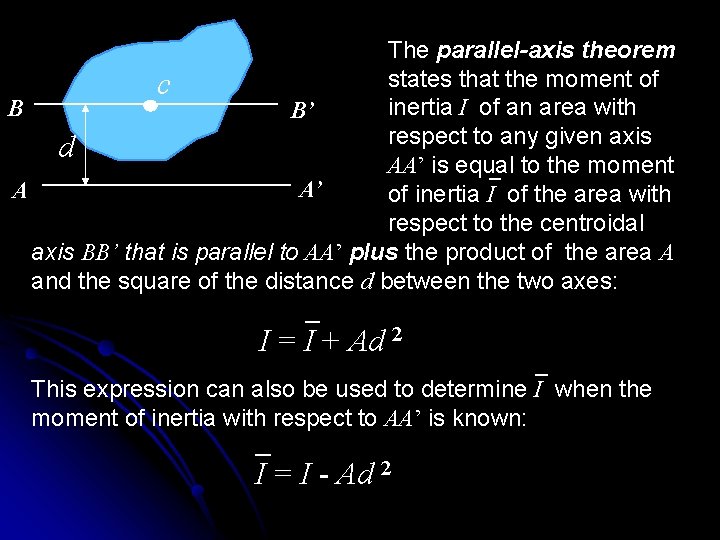
The parallel-axis theorem states that the moment of c inertia I of an area with B B’ respect to any given axis d AA’ is equal to the moment A’ A of inertia I of the area with respect to the centroidal axis BB’ that is parallel to AA’ plus the product of the area A and the square of the distance d between the two axes: I = I + Ad 2 This expression can also be used to determine I when the moment of inertia with respect to AA’ is known: I = I - Ad 2
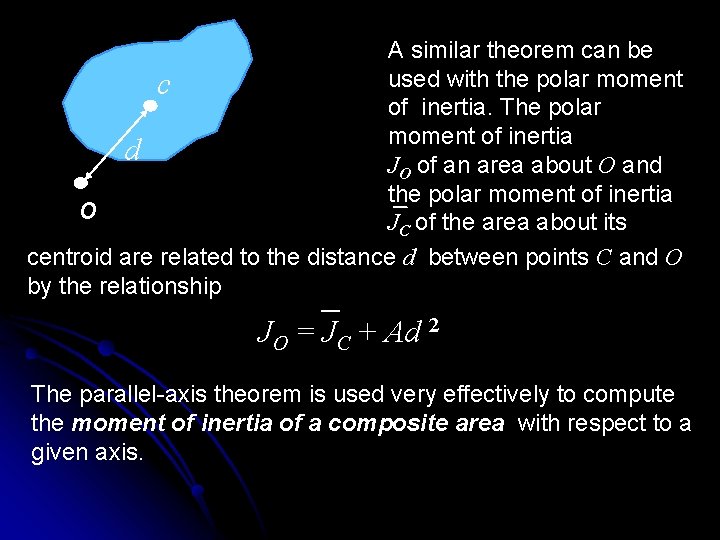
A similar theorem can be used with the polar moment c of inertia. The polar moment of inertia d JO of an area about O and the polar moment of inertia o JC of the area about its centroid are related to the distance d between points C and O by the relationship JO = JC + Ad 2 The parallel-axis theorem is used very effectively to compute the moment of inertia of a composite area with respect to a given axis.
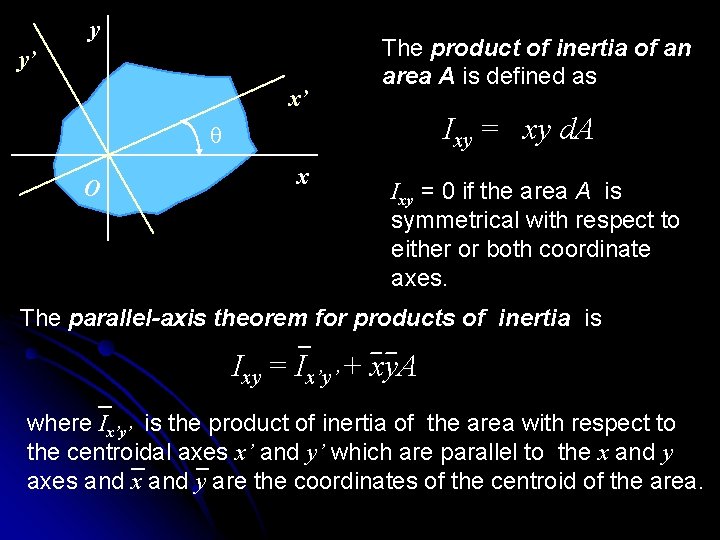
y y’ x’ The product of inertia of an area A is defined as Ixy = ò xy d. A q O x Ixy = 0 if the area A is symmetrical with respect to either or both coordinate axes. The parallel-axis theorem for products of inertia is Ixy = Ix’y’ + xy. A where Ix’y’ is the product of inertia of the area with respect to the centroidal axes x’ and y’ which are parallel to the x and y axes and x and y are the coordinates of the centroid of the area.
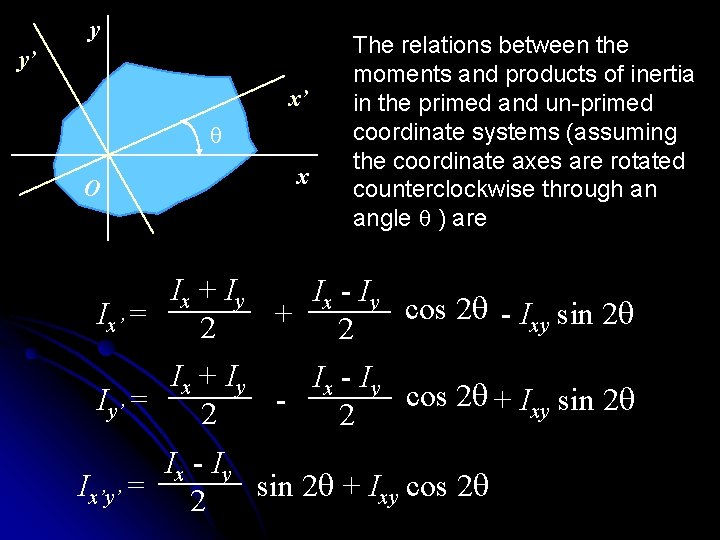
y y’ x’ q O x The relations between the moments and products of inertia in the primed and un-primed coordinate systems (assuming the coordinate axes are rotated counterclockwise through an angle q ) are Ix + Iy Ix - Iy cos 2 q - Ixy sin 2 q Ix’ = + 2 2 Ix + Iy Ix - Iy cos 2 q + Ixy sin 2 q Iy’ = 2 2 Ix - Iy Ix’y’ = 2 sin 2 q + Ixy cos 2 q
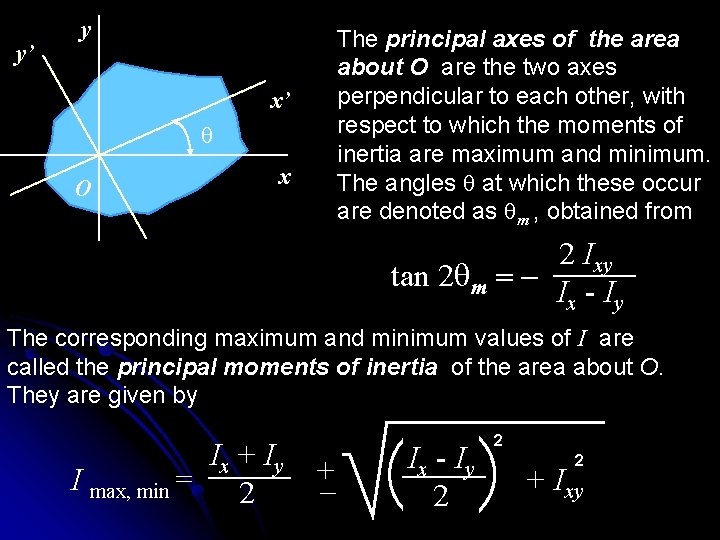
y’ y The principal axes of the area about O are the two axes perpendicular to each other, with respect to which the moments of inertia are maximum and minimum. The angles q at which these occur are denoted as qm , obtained from x’ q O x 2 Ixy tan 2 qm = Ix - Iy The corresponding maximum and minimum values of I are called the principal moments of inertia of the area about O. They are given by Ix + Iy I max, min = 2 +_ Ix - Iy 2 2 2 + Ixy
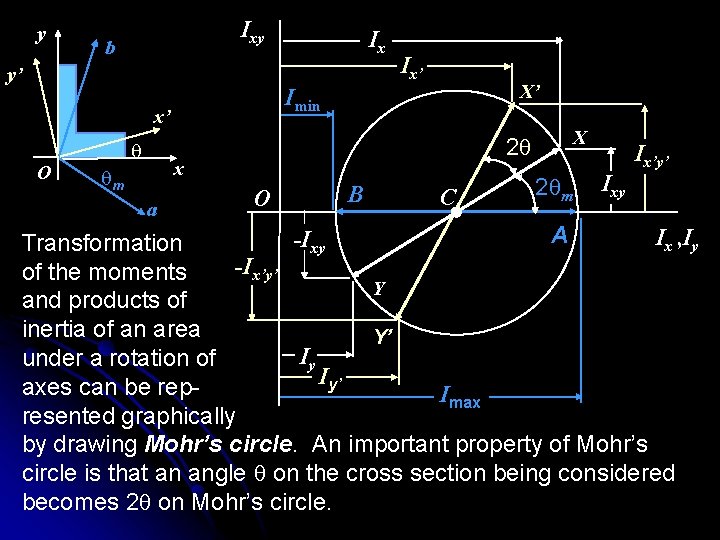
y Ixy b y’ O Ix’ X’ Imin x’ q Ix 2 q x qm a O B C X 2 qm Ixy Ix’y’ A Ix , Iy -Ixy Transformation -Ix’y’ of the moments Y and products of inertia of an area Y’ Iy under a rotation of Iy’ axes can be rep. Imax resented graphically by drawing Mohr’s circle. An important property of Mohr’s circle is that an angle q on the cross section being considered becomes 2 q on Mohr’s circle.
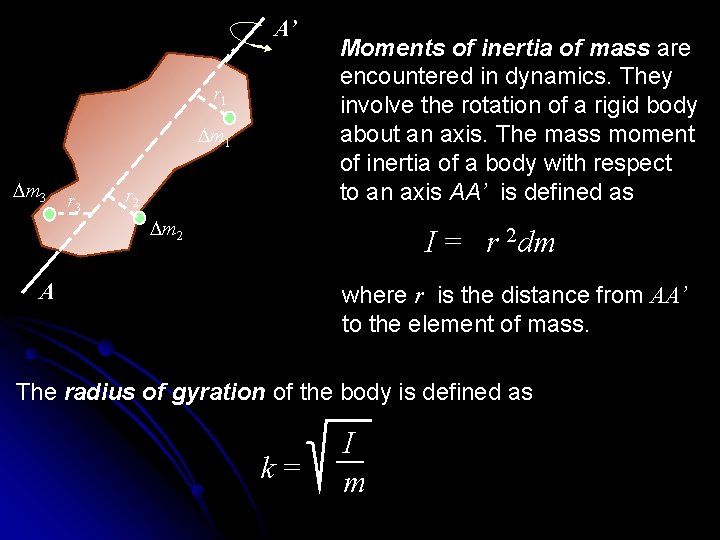
A’ r 1 Dm 3 r 2 Moments of inertia of mass are encountered in dynamics. They involve the rotation of a rigid body about an axis. The mass moment of inertia of a body with respect to an axis AA’ is defined as Dm 2 I = ò r 2 dm A where r is the distance from AA’ to the element of mass. The radius of gyration of the body is defined as k= I m
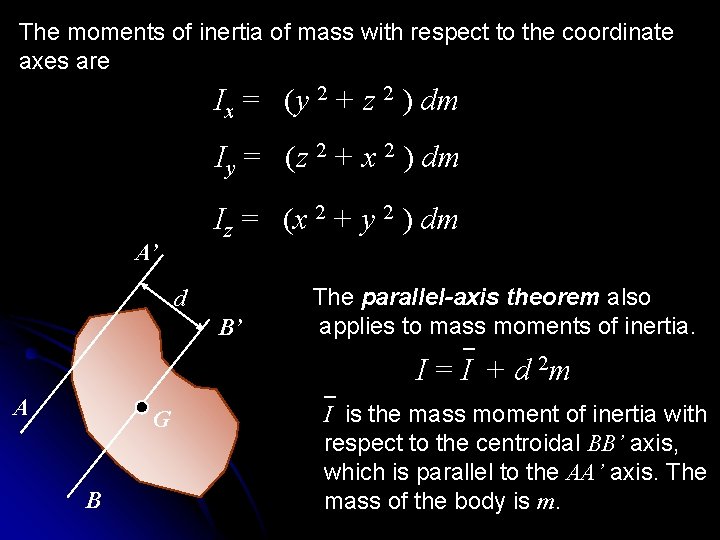
The moments of inertia of mass with respect to the coordinate axes are Ix = ò (y 2 + z 2 ) dm Iy = ò (z 2 + x 2 ) dm Iz = ò(x 2 + y 2 ) dm A’ d B’ The parallel-axis theorem also applies to mass moments of inertia. I = I + d 2 m A G B I is the mass moment of inertia with respect to the centroidal BB’ axis, which is parallel to the AA’ axis. The mass of the body is m.
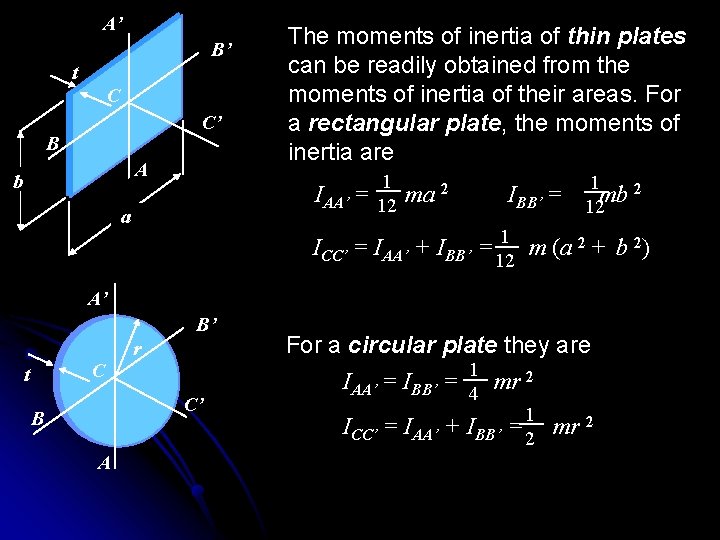
A’ B’ t C C’ B A b The moments of inertia of thin plates can be readily obtained from the moments of inertia of their areas. For a rectangular plate, the moments of inertia are IAA’ = a 1 12 1 ma 2 IBB’ = 12 mb 2 ICC’ = IAA’ + IBB’ = 1 m (a 2 + b 2) 12 A’ B’ C t r 1 C’ B A For a circular plate they are IAA’ = IBB’ = 4 mr 2 1 ICC’ = IAA’ + IBB’ = 2 mr 2

L y p dm l q O z r x The moment of inertia of a body with respect to an arbitrary axis OL can be determined. The components of the unit vector l along line OL are lx , ly , and lz. The products of inertia are Ixy = ò xy dm Iyz = ò yz dm Izx = ò zx dm The moment of inertia of the body with respect to OL is IOL = Ix l 2 x + Iy l y 2 + Iz l 2 z - 2 Ixy l x l y - 2 Iyz l y l z - 2 Izx l z l x
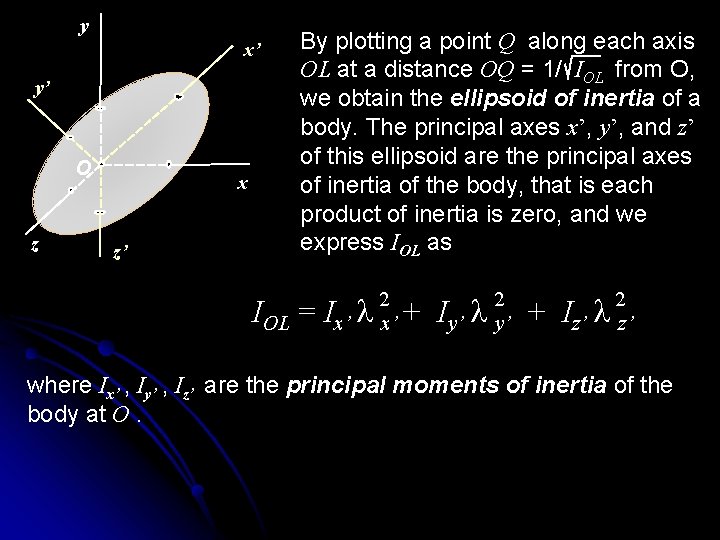
y x’ y’ O z x z’ By plotting a point Q along each axis OL at a distance OQ = 1/ IOL from O, we obtain the ellipsoid of inertia of a body. The principal axes x’, y’, and z’ of this ellipsoid are the principal axes of inertia of the body, that is each product of inertia is zero, and we express IOL as IOL = 2 Ix’ l x’ + Iy’ l 2 y’ + 2 Iz’ l z’ where Ix’ , Iy’ , Iz’ are the principal moments of inertia of the body at O.
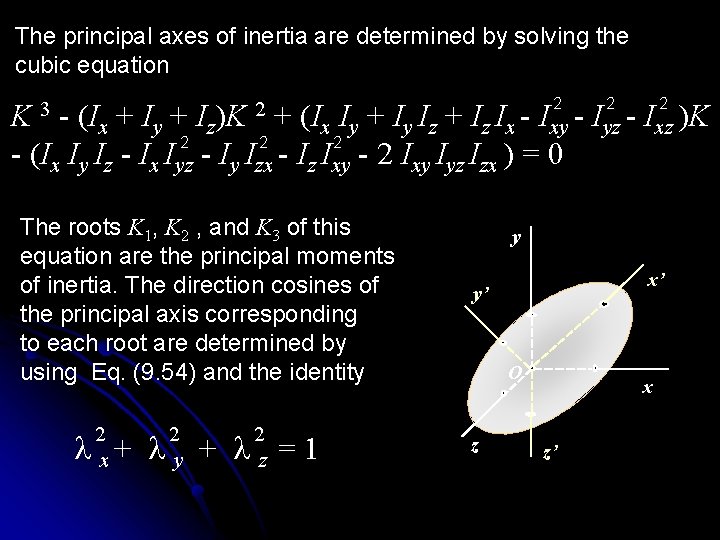
The principal axes of inertia are determined by solving the cubic equation 2 2 2 K - (Ix + Iy + Iz)K + (Ix Iy + Iy Iz + Iz Ix - Ixy - Iyz - Ixz )K 2 2 2 - (Ix Iy Iz - Ix Iyz - Iy Izx - Iz Ixy - 2 Ixy Iyz Izx ) = 0 3 2 The roots K 1, K 2 , and K 3 of this equation are the principal moments of inertia. The direction cosines of the principal axis corresponding to each root are determined by using Eq. (9. 54) and the identity 2 l x+ 2 ly + 2 lz =1 y x’ y’ O z x z’
- Slides: 15