
Chapter 9 Developmental Theory Life Course and Latent



- Slides: 39
Chapter 9 Developmental Theory: Life Course and Latent Trait
Developmental Theories • Seek to identify, describe, and understand the development factors the explain the onset and continuation of a criminal career § Intertwining of personal factors, socialization factors, cognitive factors, and situational factors § Two distinct groups: life course theories and latent trait
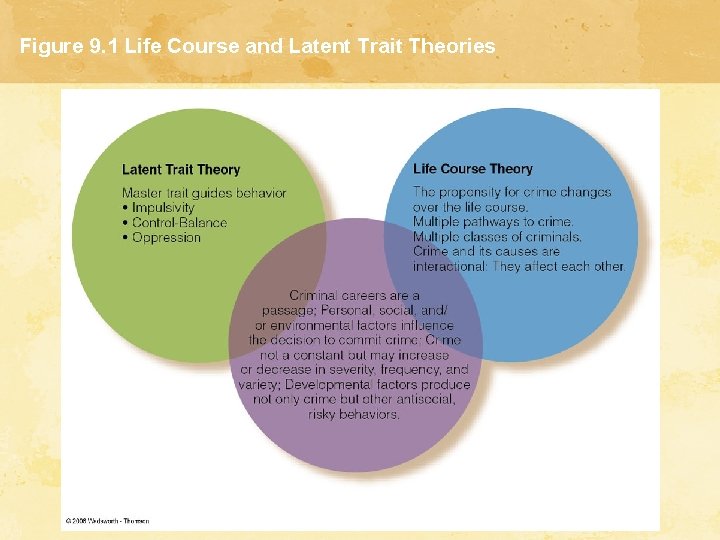
The Life Course View • Some people are incapable of maturing in a reasonable and timely fashion because of family, environmental and personal problems § The propensity to commit crime is neither stable nor constant § Life course theories at multidimensional, suggesting criminality has multiple roots
Figure 9. 1 Life Course and Latent Trait Theories
The Life Course View • The Glueck Research § Popularized the research on the life cycle of delinquent careers § “The deeper the roots of childhood maladjustment, the smaller the change of adult adjustment” § Family relations are paramount in terms of quality of discipline and emotional ties with parents § Children with low IQ’s, a background of mental disease, and a powerful physique were most likely to be delinquent
The Life Course View • Life Course Concepts § Rolf Loeber and Marc Le. Blanc devoted time to the evolution of the criminal career § Attention should be given to how a criminal career unfolds § People may show a propensity of offend early in their lives
The Life Course View • Problem Behavior Syndrome § Criminal behavior is one of many antisocial behaviors that cluster together and typically involve family dysfunction, sexual and physical abuse, substance abuse, smoking, and precocious sexuality. § All varieties of criminal behavior may be part of a generalized PBS • Unemployment • Educational underachievement • School misconduct • Residing in high crime and disorganized areas • Exposure to racism and poverty • Personal problems such as suicide attempts, sensation seeking, early parenthood, accident-proneness, medical problems, mental disease, anxiety, and eating disorders
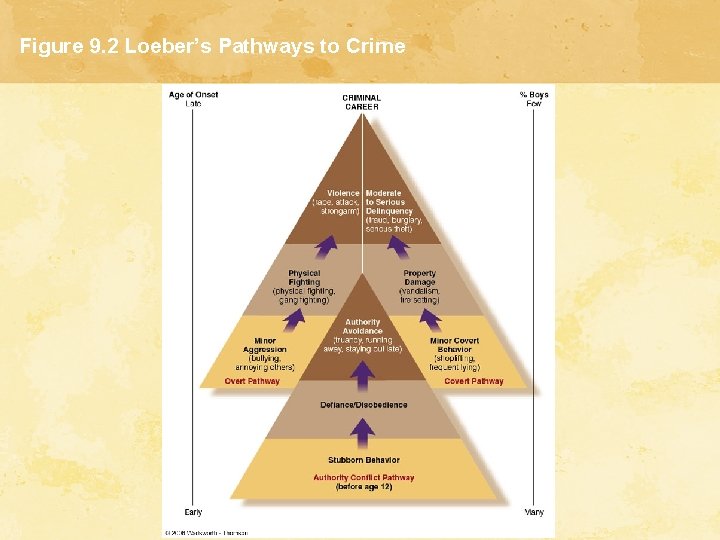
The Life Course View • Pathways to Crime § Loeber and associates identified three distinct pathways to a criminal career • Authority conflict: begins at an early age with stubborn behavior • Covert pathway: begins with minor underhanded behavior and leads to property damage • Overt pathway: escalates into aggressive acts and then to violence
Figure 9. 2 Loeber’s Pathways to Crime
The Life Course View • Age of Onset/Continuity of Crime § Life course theory suggests criminal careers are planted early in life § May begin with truancy, cruelty to animals, lying, and theft § Some offenders peak at an early age, whereas others persist into adulthood § Continuity and desistance: Poor parental discipline and monitoring may be key to early criminality § Rejection by peers and academic failure sustains antisocial behavior
The Life Course View • Gender Similarities and Differences § Like boys, early onset girls continue to experience difficulties such as drug/alcohol use, poor school adjustment, mental health problems, and a variety of relationship dysfunctions § Early onset path for males results in problems at work and substance abuse § Early onset pathways for females are more likely to lead to depression and a tendency to commit suicide
The Life Course View • Adolescent Limiteds and Life Course Persisters § Terrie Moffet suggests most offenders are adolescent limited in that antisocial behavior peaks and then diminishes § A small group of offenders are persisters who begin offending at an early age and continue into adulthood § Early starters experience: 1) poor parenting, 2) deviant behaviors and then 3) involvement with delinquent groups
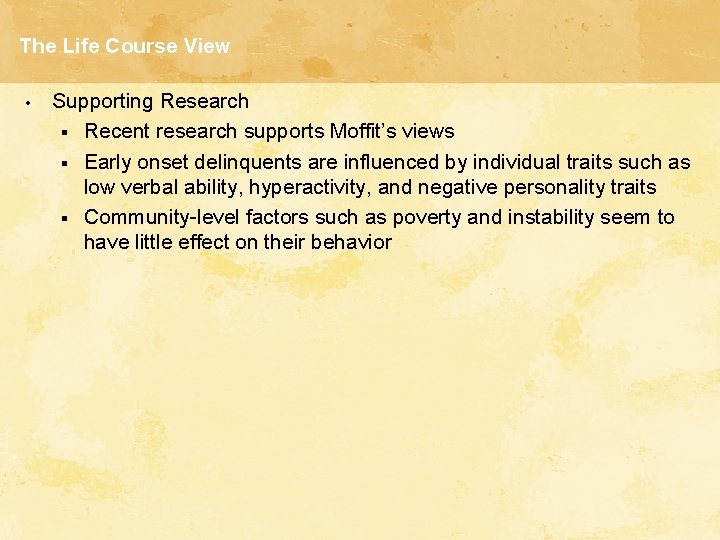
The Life Course View • Supporting Research § Recent research supports Moffit’s views § Early onset delinquents are influenced by individual traits such as low verbal ability, hyperactivity, and negative personality traits § Community-level factors such as poverty and instability seem to have little effect on their behavior
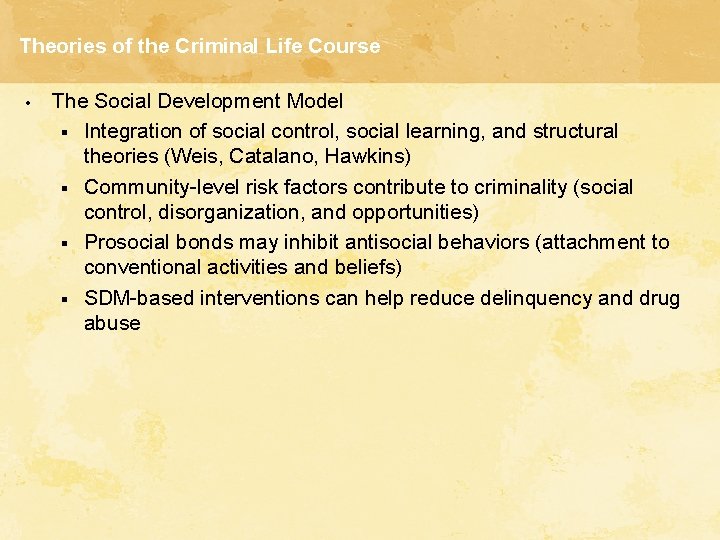
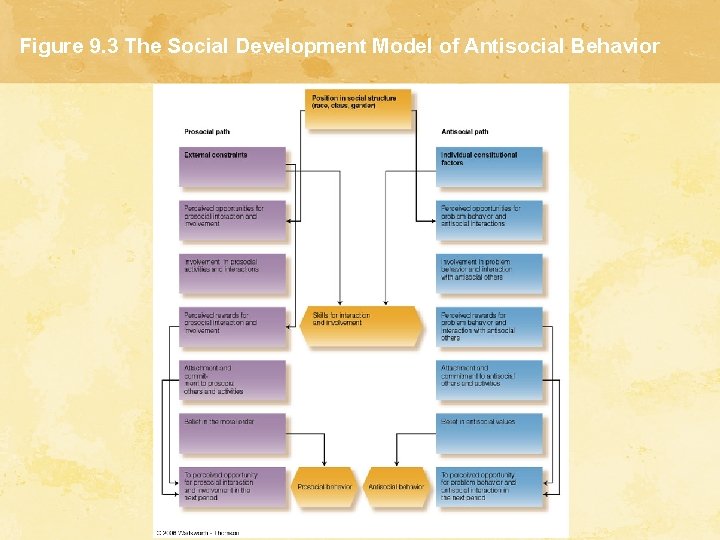
Theories of the Criminal Life Course • The Social Development Model § Integration of social control, social learning, and structural theories (Weis, Catalano, Hawkins) § Community-level risk factors contribute to criminality (social control, disorganization, and opportunities) § Prosocial bonds may inhibit antisocial behaviors (attachment to conventional activities and beliefs) § SDM-based interventions can help reduce delinquency and drug abuse
Figure 9. 3 The Social Development Model of Antisocial Behavior
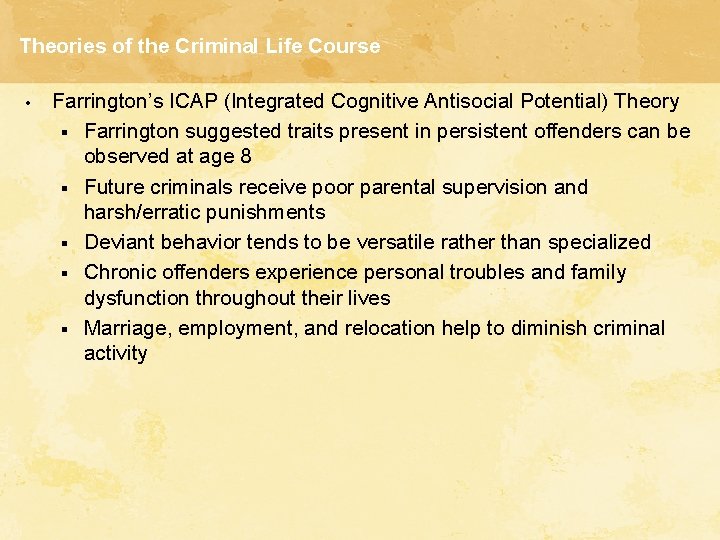
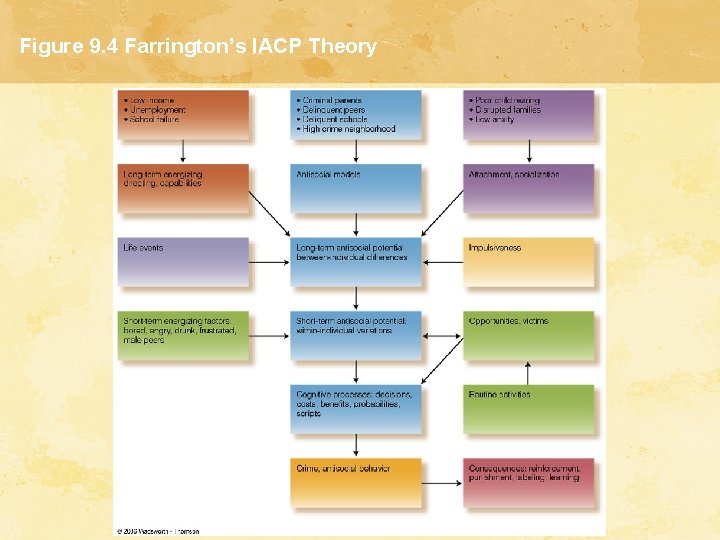
Theories of the Criminal Life Course • Farrington’s ICAP (Integrated Cognitive Antisocial Potential) Theory § Farrington suggested traits present in persistent offenders can be observed at age 8 § Future criminals receive poor parental supervision and harsh/erratic punishments § Deviant behavior tends to be versatile rather than specialized § Chronic offenders experience personal troubles and family dysfunction throughout their lives § Marriage, employment, and relocation help to diminish criminal activity
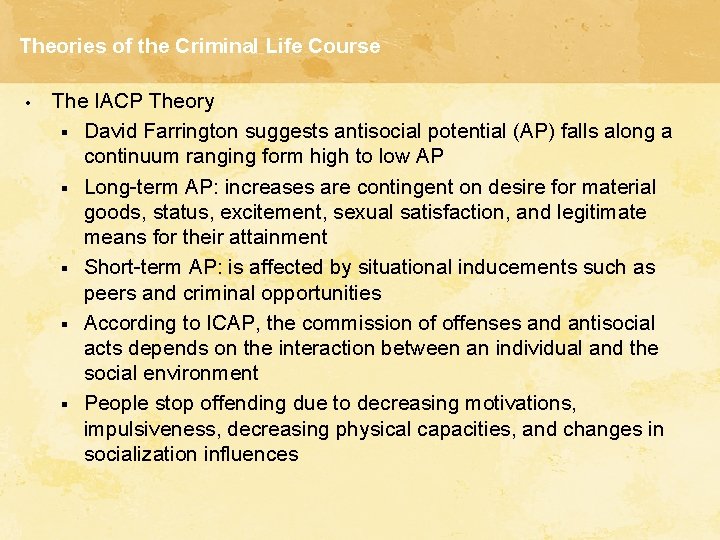
Theories of the Criminal Life Course • The IACP Theory § David Farrington suggests antisocial potential (AP) falls along a continuum ranging form high to low AP § Long-term AP: increases are contingent on desire for material goods, status, excitement, sexual satisfaction, and legitimate means for their attainment § Short-term AP: is affected by situational inducements such as peers and criminal opportunities § According to ICAP, the commission of offenses and antisocial acts depends on the interaction between an individual and the social environment § People stop offending due to decreasing motivations, impulsiveness, decreasing physical capacities, and changes in socialization influences
Figure 9. 4 Farrington’s IACP Theory
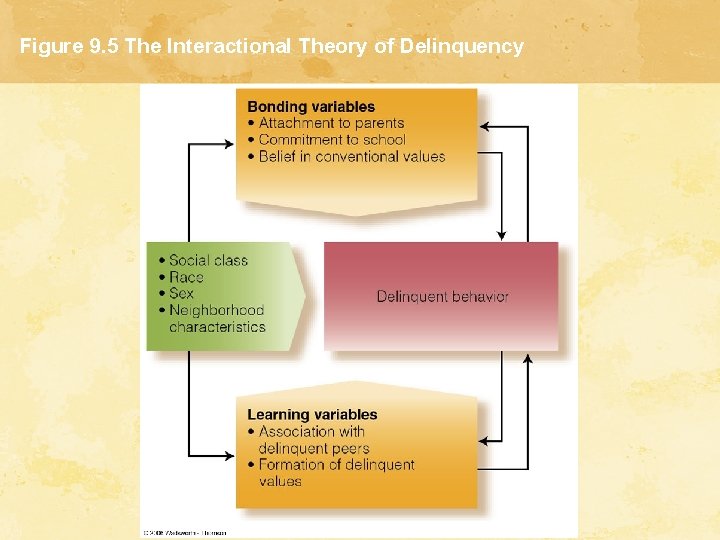
Theories of the Criminal Life Course • Interactional Theory § Terence Thornberry proposed an age-graded view of crime § The onset of crime can be traced to a deterioration of the social bond during adolescence § Delinquent youths form belief systems consistent with their deviant lifestyles § The causal process is dynamic and develops over a person’s life
Figure 9. 5 The Interactional Theory of Delinquency
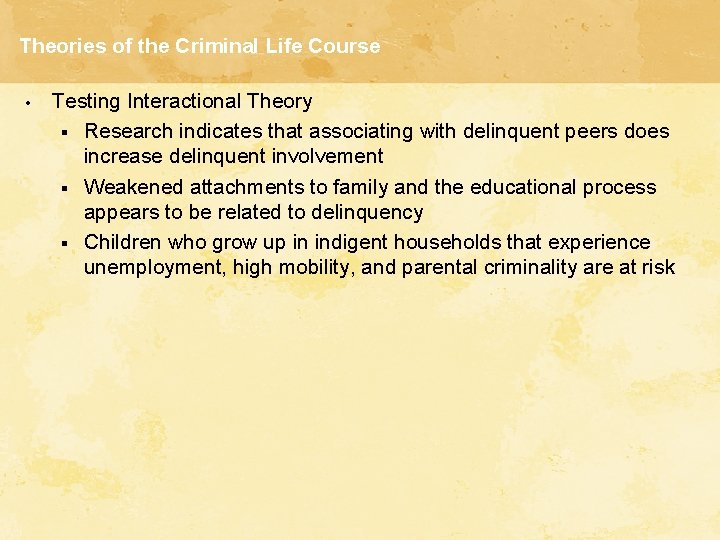
Theories of the Criminal Life Course • Testing Interactional Theory § Research indicates that associating with delinquent peers does increase delinquent involvement § Weakened attachments to family and the educational process appears to be related to delinquency § Children who grow up in indigent households that experience unemployment, high mobility, and parental criminality are at risk
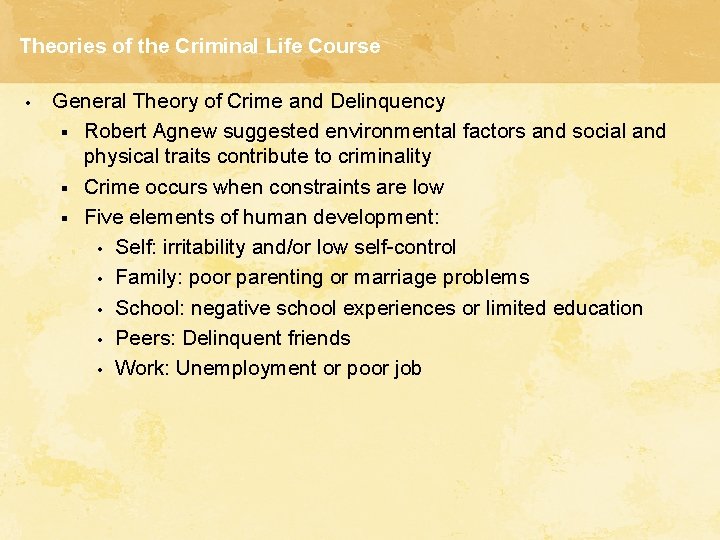
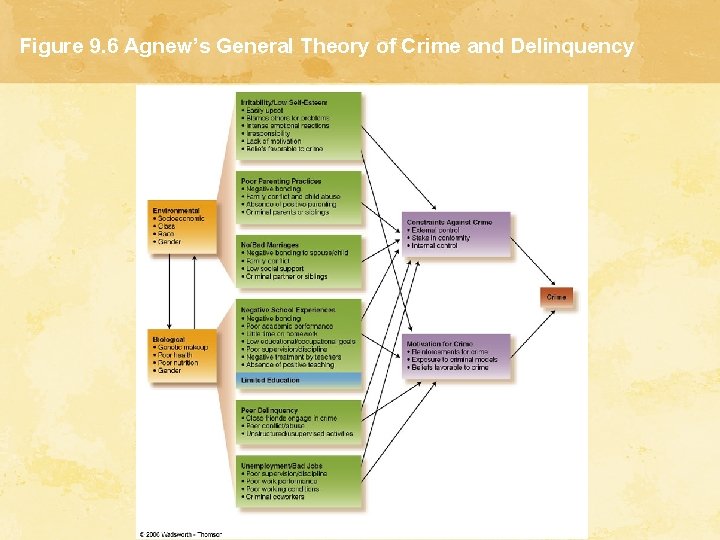
Theories of the Criminal Life Course • General Theory of Crime and Delinquency § Robert Agnew suggested environmental factors and social and physical traits contribute to criminality § Crime occurs when constraints are low § Five elements of human development: • Self: irritability and/or low self-control • Family: poor parenting or marriage problems • School: negative school experiences or limited education • Peers: Delinquent friends • Work: Unemployment or poor job
Figure 9. 6 Agnew’s General Theory of Crime and Delinquency
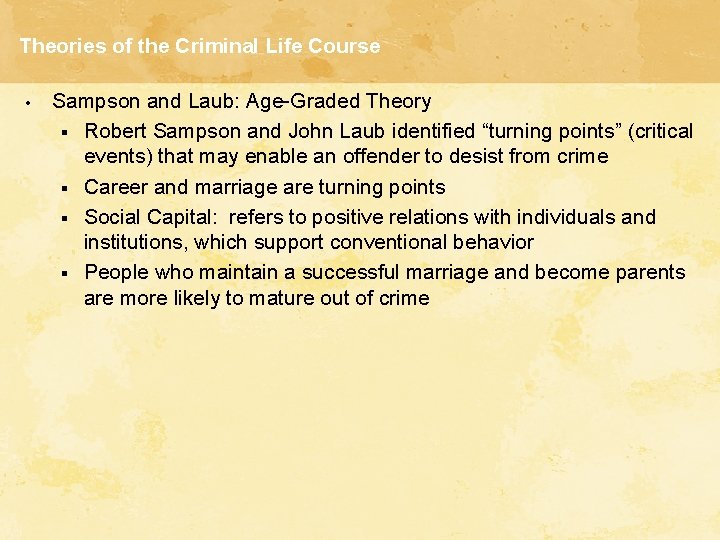
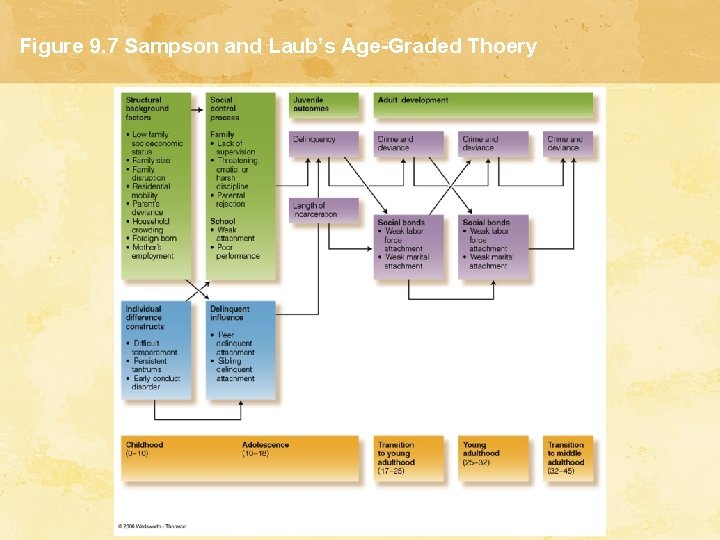
Theories of the Criminal Life Course • Sampson and Laub: Age-Graded Theory § Robert Sampson and John Laub identified “turning points” (critical events) that may enable an offender to desist from crime § Career and marriage are turning points § Social Capital: refers to positive relations with individuals and institutions, which support conventional behavior § People who maintain a successful marriage and become parents are more likely to mature out of crime
Figure 9. 7 Sampson and Laub’s Age-Graded Thoery
Theories of the Criminal Life Course • Testing Age-Graded Theory § Indicators tend to support age-graded theory (i. e. employment) § Research suggests the greater the social capital, the more likely one will be insulated from crime § The Marriage Factor: People who marry and become parents are most likely mature out of crime § Laub and Sampson are following up on the original research cohort of the Glueck’s
Latent Trait View • Assumes some people have a personal attribute that controls their propensity to commit crime § The trait is either present at birth or established early in life § Propensity and opportunity to commit crime fluctuate over time
Latent Trait View • Crime and Human Nature § Wilson and Herrnstein’s human nature theory suggests genetics, intelligence, and body build contribute to criminality § Biological and psychological traits influence crime choice and noncrime choices § Their work suggests the existence of an elusive trait that predisposes people to commit crime
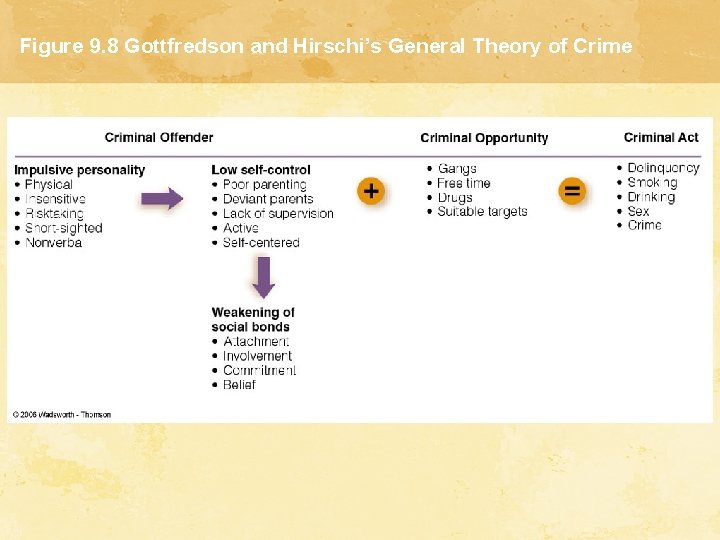
Latent Trait Theories • General Theory of Crime (GTC) § Michael Gottfredson and Travis Hirschi modified social control theory and integrated concepts of biosocial, psychological, routine activities, and rational choice theories § GTC considers the offender and the criminal act as separate concepts § People commit crime when it promises rewards and they are predisposed to commit crime § Tendencies to commit crime is contingent on a person’s level of self-control § Root of poor self-control is traced to inadequate child-rearing practices § Gottfredson and Hirschi maintain the GTC explains all varieties of criminal behavior § Empirical evidence tends to support the GTC
Figure 9. 8 Gottfredson and Hirschi’s General Theory of Crime
Latent Trait Theories • Analyzing the General Theory of Crime § Some critics charge GTC is: § Tautological: Crime and impulsive behavior § Different Classes of Criminals: Research indicates offenders occupy more than one class and more than one factor may contribute to their criminality § Ecological/Individual Differences: Fails to address individual and ecological patterns in crime rates § Racial and Gender Differences: Little evidence that males are more impulsive than females and overlooks racism and poverty issues § Moral Beliefs: GTC ignores the moral concept of right and wrong § Peer Influence: Negative influences of peers increases the likelihood of criminality rather than reducing it § People Change: Propensity to commit crime does change and it is not static as suggested by GTC § Modest Relationship: Self control is modestly related to antisocial behavior § Cross Cultural Differences: GTC may be weak in cross-national studies § Misreads Human Nature: GTC assumes people are selfish, self-serving, and hedonistic § Personality Disorder: GTC ignores personality disorders
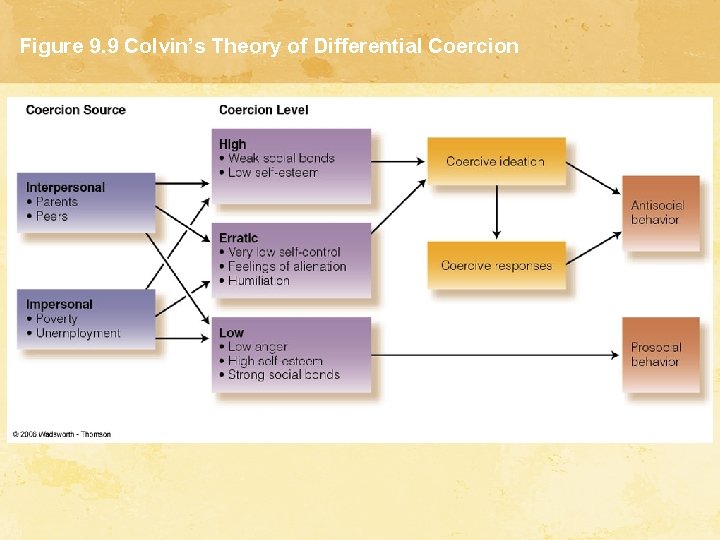
Latent Trait Theories • Differential Coercion Theory § Mark Colvin suggests coercion as a master trait for criminality § Interpersonal Coercion: involves the use or threat of force and intimidation from parents, peers, and others § Impersonal Coercion: involves pressures such as economic and social pressures (poverty-competition) § Maintaining self control is contingent on the function, type and consistency of coercion § To reduce crime society must enhance legitimate social support and reduce the forces of coercion
Figure 9. 9 Colvin’s Theory of Differential Coercion
Latent Trait Theories • Coercion and Criminal Careers § Chronic offenders grow up in homes with erratic and inconsistent control § Coercive Ideation: the world is conceived as full of coercive forces that need equal or greater coercive responses to overcome § Differential Social Support: Social support may negate or counterbalance crime-producing coercion • Expressive social support (affirmation of self-worth) • Instrumental social support (financial assistance)
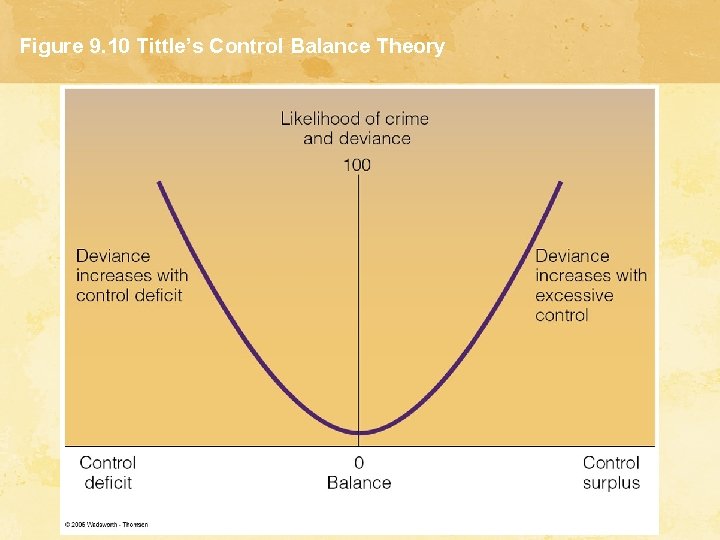
Latent Trait Theories • Control Balance Theory § Charles Tittle suggest control has two elements that when out of balance produce deviant and criminal behaviors • The amount of control one is subject to by others • The amount of control one can exercise over others § Three types of behavior restores balance for those who sense a deficit: • Predation: direct forms of physical violence • Defiance: challenges to control mechanisms • Submission: passive obedience § Those with an excess of control engage in: • Exploitation: using others to commit crime • Plunder: using power without regard for others • Decadence: spur of the moment irrational acts
Figure 9. 10 Tittle’s Control Balance Theory
Latent Trait Theories • Evaluating Developmental Theories § Life course theorists emphasize the influence of changing interpersonal and structural factors § Latent trait theorists place more emphasis on behavior being linked to personal change than to changes in the surrounding world
CNN Clip - Drug Cartel Leader On Trial
Public Policy Implications of Developmental Theory § § § Multi-systematic treatment efforts Programs targeting those at high risk to improve their developmental skills SMART (skills, mastery, and resistance training)