
Chapter 9 Crimes Against the Person Objectives Differentiate
Chapter 9 Crimes Against the Person
Objectives: • Differentiate between first degree murder, felony murder, and second degree murder. • Differentiate between Voluntary and Involuntary manslaughter. • Cite examples of negligent homicide and noncriminal homicide. • Analyze various scenarios to determine which type of homicide has occurred. • Define what constitutes malice and its place in determining which homicide has occurred.
I. Homicide • Killing of one human being by another. • Most serious of all crimes. • Can be either criminal or noncriminal
A. Criminal Homicide • Committed with intent or a plan • Murder is the most serious form of criminal homicide. ▫ Killing done in malice
1) First degree murder • Act of killing that is premeditated (thought about beforehand), deliberate and done w/malice
2) Felony murder • Killing that takes place during the commission of a felony (ex. Arson, rape, robbery or burglary) • Not necessary to prove intent, it can be accidental
3) Second-degree murder • Killing that is done with malice but without premeditation or deliberation. • Spontaneous killing • Unplanned
4) Voluntary manslaughter • Occurs after the victim has done something to the killer that would cause a reasonable person to lose self-control (ex. Crime of passion) • Killing occurs just after the provocation (aggravation).
5) Involuntary manslaughter • Killing in which there is no intent to kill at all. • Unintentional killing, usually resulting from recklessness (ex. Playing with a loaded gun)
6) Negligent homicide • Causes death through criminal negligence (failure to exercise a reasonable amount of care in a situation). • Ex. Vehicular manslaughter
B. Noncriminal homicide • Killing that is justifiable or excusable. ▫ Ex. Killing of enemy solider, killing of condemned criminal by executioner, killing by a police officer of a person committing a serious crime or who poses a threat of death, killing in self-defense or defense of another person
Objectives: • Define the term : Suicide • Describe the legal consequences for those who assist someone else in committing suicide.
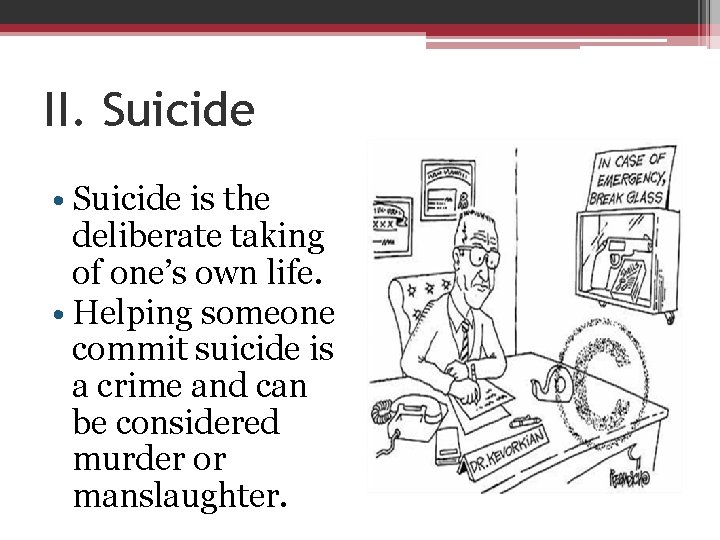
II. Suicide • Suicide is the deliberate taking of one’s own life. • Helping someone commit suicide is a crime and can be considered murder or manslaughter.
Objectives: • Explain how the charges relating to kidnapping change if the abductor brings a person across state lines. • Describe the significance of actual injury in the crimes of assault and battery. • Illustrate how differing degrees of seriousness are reflected in legal classifications of types of assault and battery.
III. Kidnapping • Originally referred to as the stealing of children for use as servants or workers. • Kidnapping is the taking away of a person against their will. • If taken across state lines, the crime becomes a federal crime.
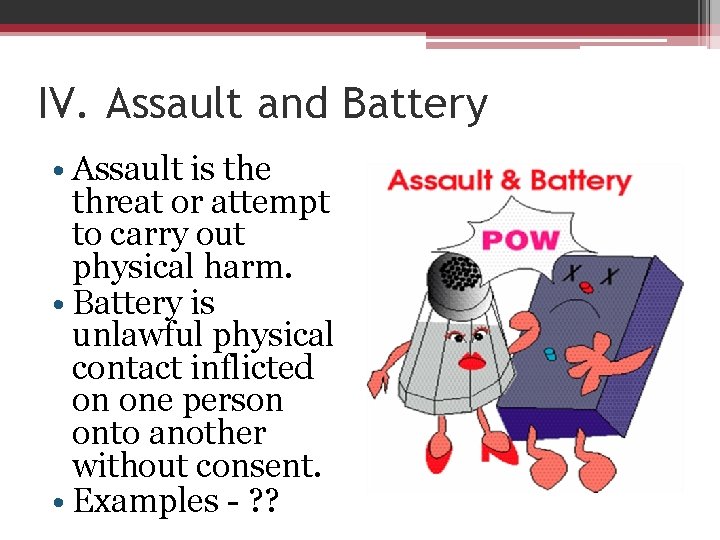
IV. Assault and Battery • Assault is the threat or attempt to carry out physical harm. • Battery is unlawful physical contact inflicted on one person onto another without consent. • Examples - ? ?
V. Rape • Sexual intercourse without consent. • Aggravated rape is when the perpetrator uses a weapon or some other form of force to compel the victim.
A. Statutory Rape • Intercourse with someone under the legal age of consent. • Legal age of consent varies by state. • Based on the notion that a minor is incapable of giving consent. • NJ = 16 years old
B. Felony Rape (Class A) • Sexual intercourse with another person by forcible compulsion w/out consent • Sexual intercourse with another person who is incapable of consent because he: ▫ Physically helpless ▫ Less than twelve (12) years old. • **Class B felony unless the victim is under twelve (12) years old or receives a serious physical injury in which case it is a Class A felony.
- Slides: 19