
Chapter 9 Covalent Bonding Orbitals Copyright 2017 Cengage
Chapter 9 Covalent Bonding: Orbitals Copyright © 2017 Cengage Learning. All Rights Reserved.
Chapter 9 Table of Contents § § § (9. 1) (9. 2) (9. 3) (9. 4) (9. 5) § (9. 6) Hybridization and the localized electron model The molecular orbital model Bonding in homonuclear diatomic molecules Bonding in heteronuclear diatomic molecules Combining the localized electron and molecular orbital models Photoelectron spectroscopy Copyright © 2017 Cengage Learning. All Rights Reserved.
Section 9. 1 Hybridization and the Localized Electron Model Hybridization § The mixing of native orbitals to form special orbitals for bonding § sp 3 orbitals - Formed from one 2 s and three 2 p orbitals § Atoms that undergo this process are said to be sp 3 hybridized Copyright © 2017 Cengage Learning. All Rights Reserved.
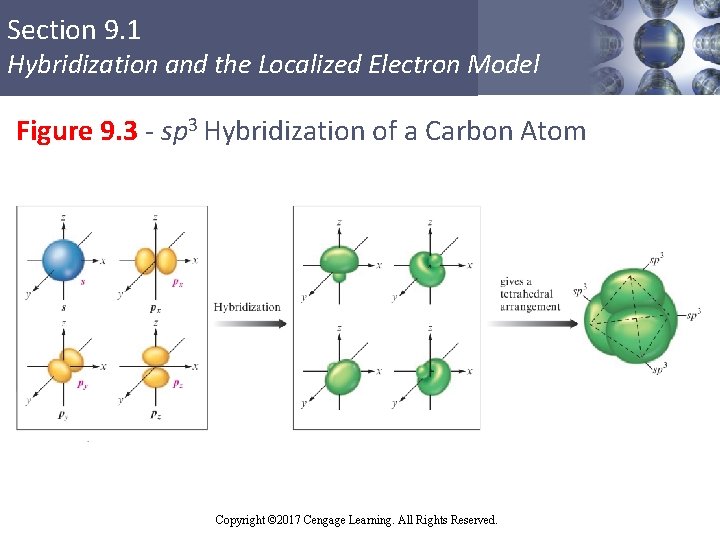
Section 9. 1 Hybridization and the Localized Electron Model Figure 9. 3 - sp 3 Hybridization of a Carbon Atom Copyright © 2017 Cengage Learning. All Rights Reserved.
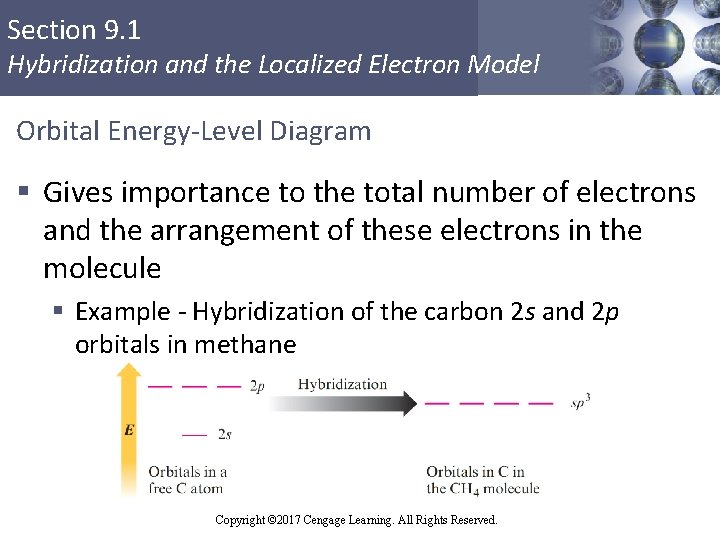
Section 9. 1 Hybridization and the Localized Electron Model Orbital Energy-Level Diagram § Gives importance to the total number of electrons and the arrangement of these electrons in the molecule § Example - Hybridization of the carbon 2 s and 2 p orbitals in methane Copyright © 2017 Cengage Learning. All Rights Reserved.
Section 9. 1 Hybridization and the Localized Electron Model Key Principle in sp 3 Hybridization § Whenever an atom requires a set of equivalent tetrahedral atomic orbitals, this model assumes that the atom adopts a set of sp 3 orbitals § The atom undergoes sp 3 hybridization Copyright © 2017 Cengage Learning. All Rights Reserved. 6
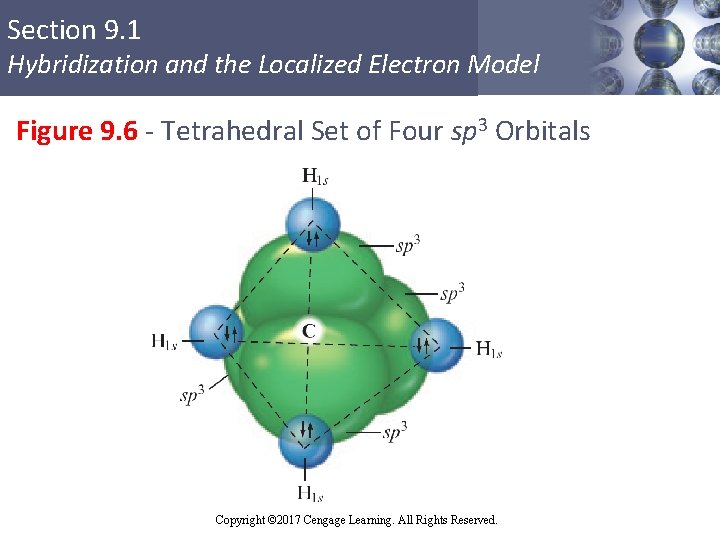
Section 9. 1 Hybridization and the Localized Electron Model Figure 9. 6 - Tetrahedral Set of Four sp 3 Orbitals Copyright © 2017 Cengage Learning. All Rights Reserved. 7
Section 9. 1 Hybridization and the Localized Electron Model Critical Thinking § What if the sp 3 hybrid orbitals were higher in energy than the p orbitals in the free atom? § How would this affect our model of bonding? Copyright © 2017 Cengage Learning. All Rights Reserved. 8
Section 9. 1 Hybridization and the Localized Electron Model Example 9. 1 - The Localized Electron Model I § Describe the bonding in the ammonia molecule using the localized electron model Copyright © 2017 Cengage Learning. All Rights Reserved.
Section 9. 1 Hybridization and the Localized Electron Model Example 9. 1 - Solution § A complete description of the bonding involves three steps § Writing the Lewis structure § Determining the arrangement of electron pairs using the VSEPR model § Determining the hybrid atomic orbitals needed to describe the bonding in the molecule Copyright © 2017 Cengage Learning. All Rights Reserved.
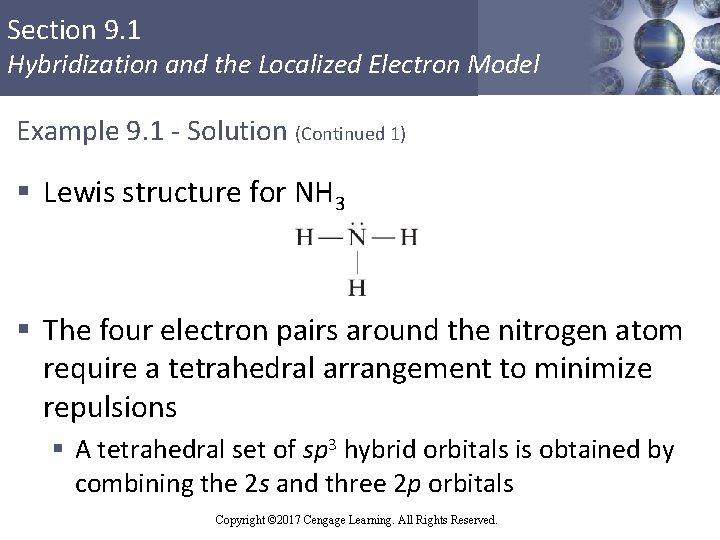
Section 9. 1 Hybridization and the Localized Electron Model Example 9. 1 - Solution (Continued 1) § Lewis structure for NH 3 § The four electron pairs around the nitrogen atom require a tetrahedral arrangement to minimize repulsions § A tetrahedral set of sp 3 hybrid orbitals is obtained by combining the 2 s and three 2 p orbitals Copyright © 2017 Cengage Learning. All Rights Reserved.
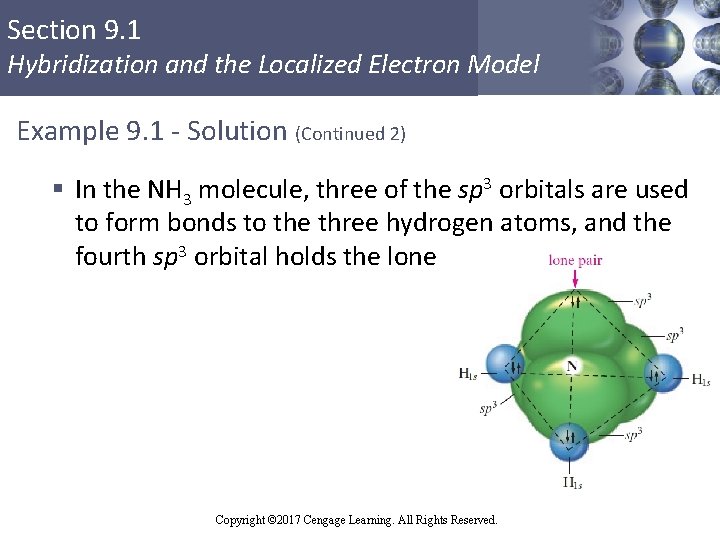
Section 9. 1 Hybridization and the Localized Electron Model Example 9. 1 - Solution (Continued 2) § In the NH 3 molecule, three of the sp 3 orbitals are used to form bonds to the three hydrogen atoms, and the fourth sp 3 orbital holds the lone pair Copyright © 2017 Cengage Learning. All Rights Reserved.
Section 9. 1 Hybridization and the Localized Electron Model sp 2 Hybridization § Combination of one 2 s and two 2 p orbitals § Gives a trigonal planar arrangement of atomic orbitals § Bond angles - 120 degrees § One 2 p orbital is not used § Oriented perpendicular to the plane of the sp 2 orbitals Copyright © 2017 Cengage Learning. All Rights Reserved. 13
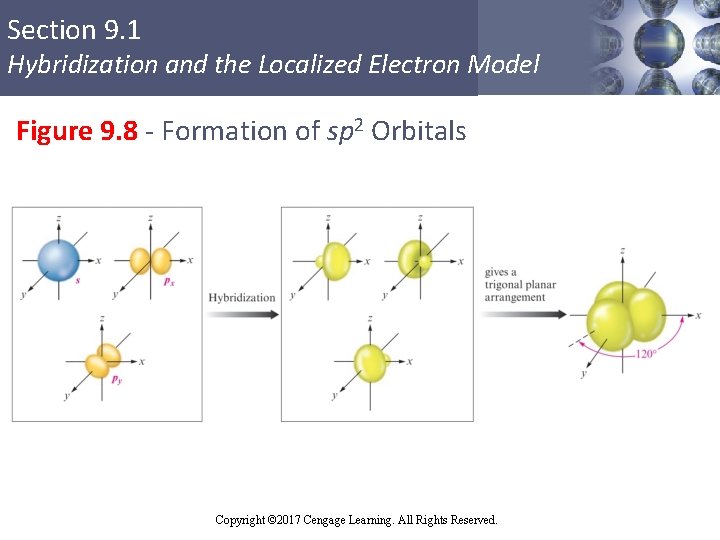
Section 9. 1 Hybridization and the Localized Electron Model Figure 9. 8 - Formation of sp 2 Orbitals Copyright © 2017 Cengage Learning. All Rights Reserved.
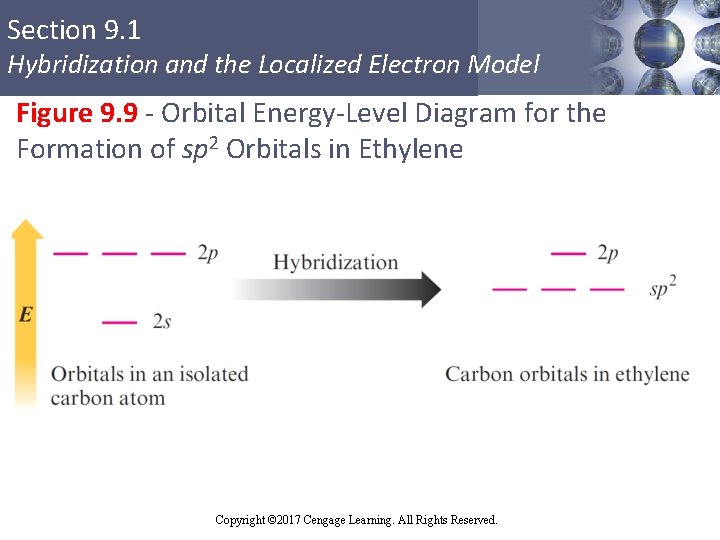
Section 9. 1 Hybridization and the Localized Electron Model Figure 9. 9 - Orbital Energy-Level Diagram for the Formation of sp 2 Orbitals in Ethylene Copyright © 2017 Cengage Learning. All Rights Reserved.
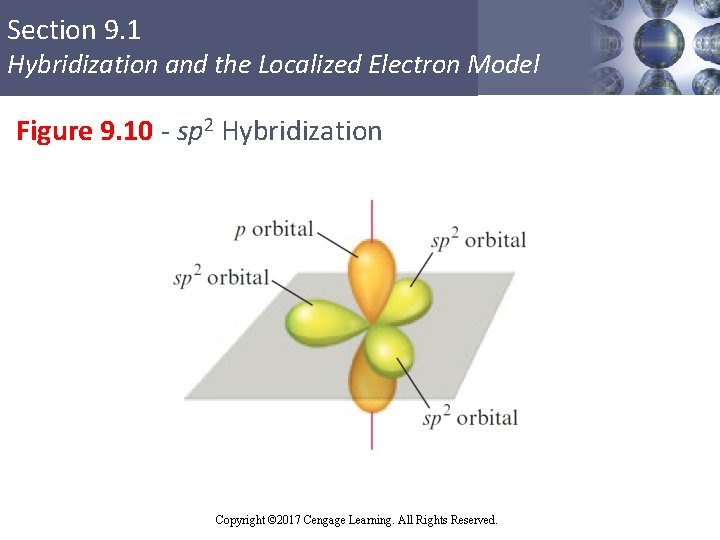
Section 9. 1 Hybridization and the Localized Electron Model Figure 9. 10 - sp 2 Hybridization Copyright © 2017 Cengage Learning. All Rights Reserved.
Section 9. 1 Hybridization and the Localized Electron Model Types of sp 2 Hybridized Bonds § Sigma ( ) bond: Formed by electron sharing in an area centered on a line running between the atoms § Pi ( ) bond: Parallel p orbitals share an electron pair occupying the space above and below the bond § A double bond always consists of one bond and one bond Copyright © 2017 Cengage Learning. All Rights Reserved. 17
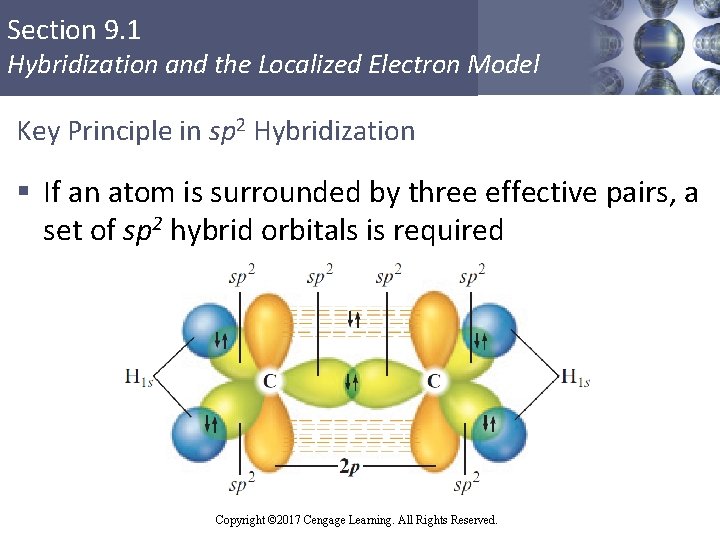
Section 9. 1 Hybridization and the Localized Electron Model Key Principle in sp 2 Hybridization § If an atom is surrounded by three effective pairs, a set of sp 2 hybrid orbitals is required Copyright © 2017 Cengage Learning. All Rights Reserved.
Section 9. 1 Hybridization and the Localized Electron Model sp Hybridization § Involves one s and one p orbital § Two effective pairs around an atom will always requires sp hybridization § Example - Carbon atoms in carbon dioxide § Two 2 p orbitals are unaffected § Used in formation of π bonds with oxygen atoms Copyright © 2017 Cengage Learning. All Rights Reserved. 19
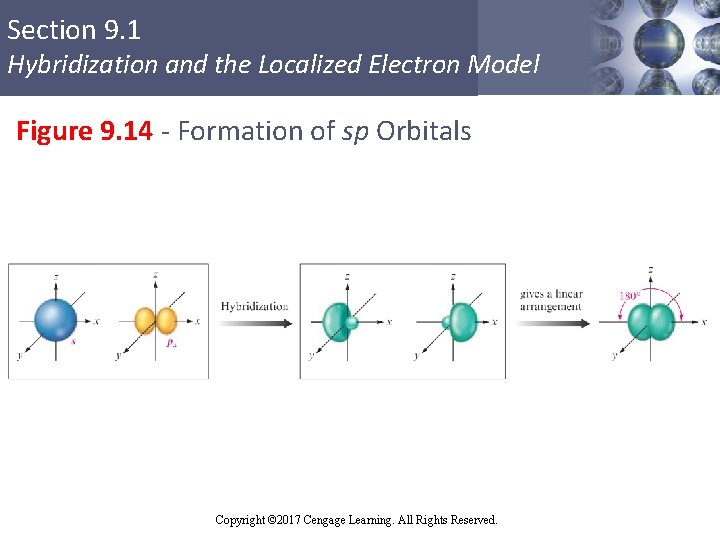
Section 9. 1 Hybridization and the Localized Electron Model Figure 9. 14 - Formation of sp Orbitals Copyright © 2017 Cengage Learning. All Rights Reserved. 20
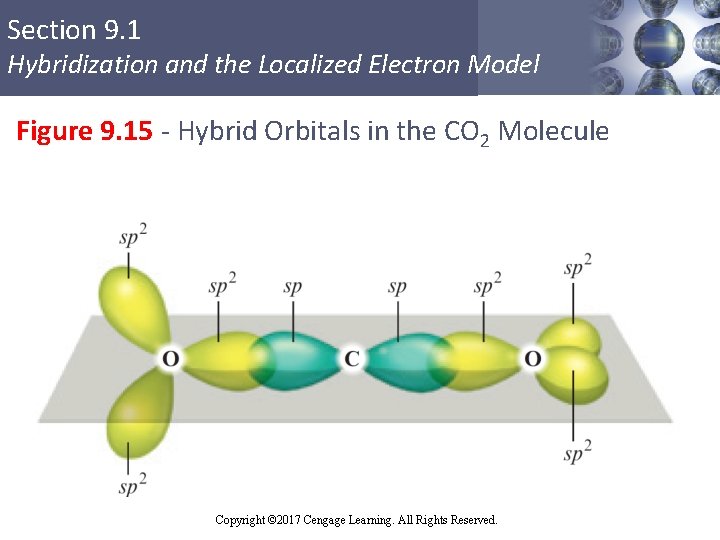
Section 9. 1 Hybridization and the Localized Electron Model Figure 9. 15 - Hybrid Orbitals in the CO 2 Molecule Copyright © 2017 Cengage Learning. All Rights Reserved.
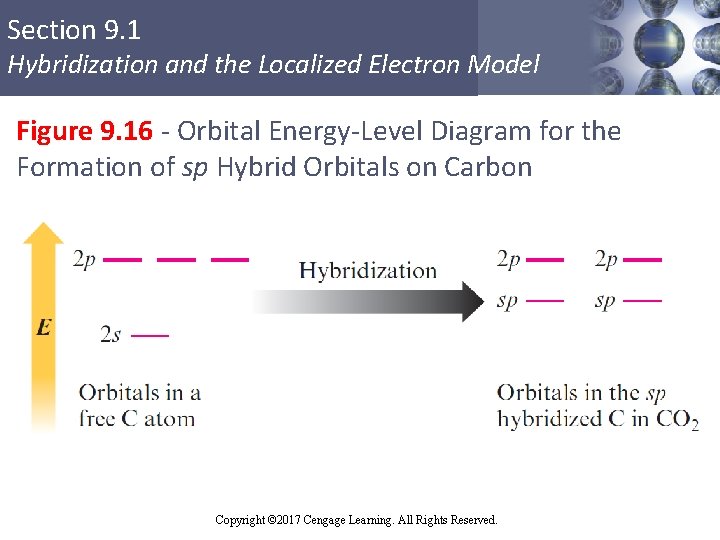
Section 9. 1 Hybridization and the Localized Electron Model Figure 9. 16 - Orbital Energy-Level Diagram for the Formation of sp Hybrid Orbitals on Carbon Copyright © 2017 Cengage Learning. All Rights Reserved. 22
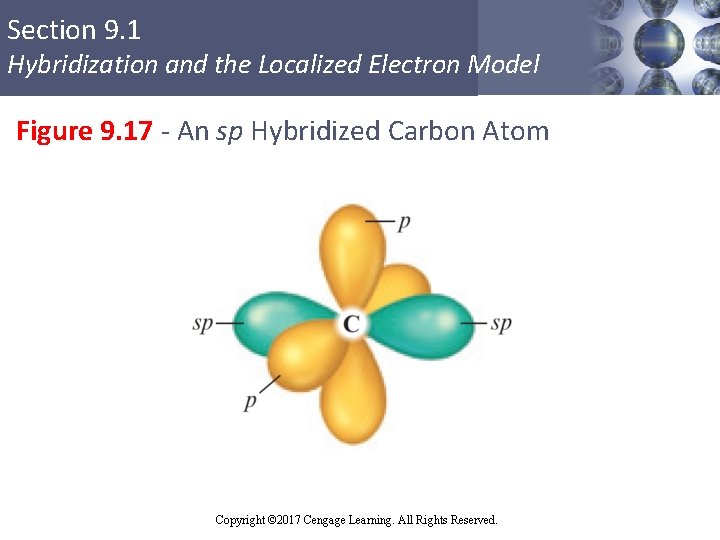
Section 9. 1 Hybridization and the Localized Electron Model Figure 9. 17 - An sp Hybridized Carbon Atom Copyright © 2017 Cengage Learning. All Rights Reserved.
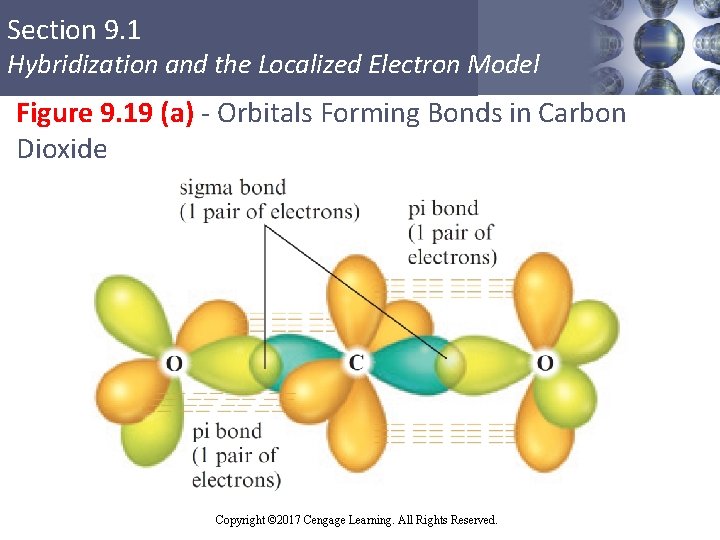
Section 9. 1 Hybridization and the Localized Electron Model Figure 9. 19 (a) - Orbitals Forming Bonds in Carbon Dioxide Copyright © 2017 Cengage Learning. All Rights Reserved. Copyright © Cengage Learning. All rights reserved 24
Section 9. 1 Hybridization and the Localized Electron Model Example 9. 2 - The Localized Electron Model II § Describe the bonding in the N 2 molecule Copyright © 2017 Cengage Learning. All Rights Reserved.
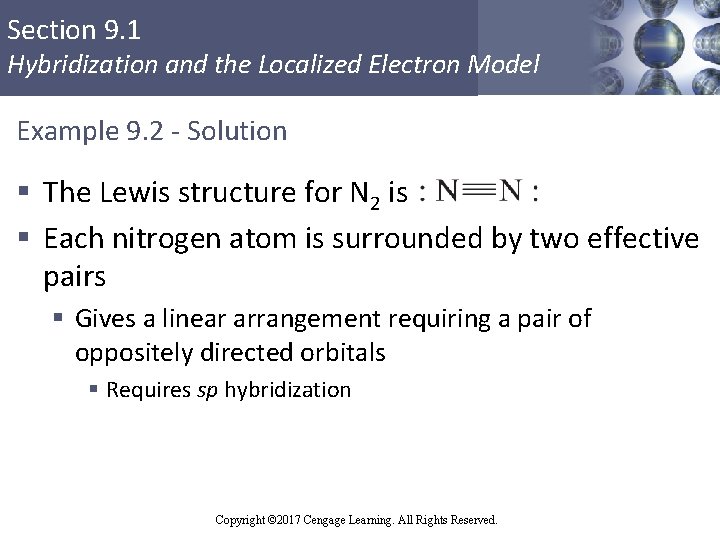
Section 9. 1 Hybridization and the Localized Electron Model Example 9. 2 - Solution § The Lewis structure for N 2 is § Each nitrogen atom is surrounded by two effective pairs § Gives a linear arrangement requiring a pair of oppositely directed orbitals § Requires sp hybridization Copyright © 2017 Cengage Learning. All Rights Reserved.
Section 9. 1 Hybridization and the Localized Electron Model Example 9. 2 - Solution (Continued 1) § Each nitrogen atom has two sp hybrid orbitals and two unchanged p orbitals § sp orbitals form the bond between the nitrogen atoms and hold lone pairs § p orbitals form the two bonds § Each pair of overlapping parallel p orbitals holds one electron pair § Accounts for electron arrangement given in the Lewis structure Copyright © 2017 Cengage Learning. All Rights Reserved.
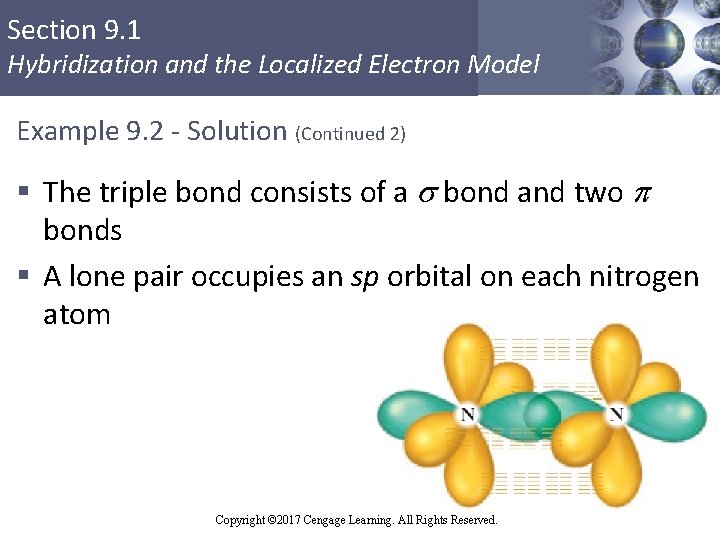
Section 9. 1 Hybridization and the Localized Electron Model Example 9. 2 - Solution (Continued 2) § The triple bond consists of a bond and two bonds § A lone pair occupies an sp orbital on each nitrogen atom Copyright © 2017 Cengage Learning. All Rights Reserved.
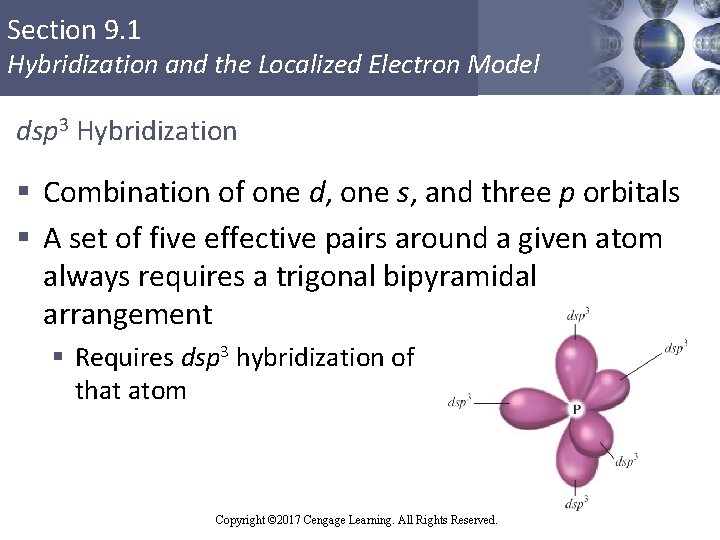
Section 9. 1 Hybridization and the Localized Electron Model dsp 3 Hybridization § Combination of one d, one s, and three p orbitals § A set of five effective pairs around a given atom always requires a trigonal bipyramidal arrangement § Requires dsp 3 hybridization of that atom Copyright © Cengage Learning. All rights reserved Copyright © 2017 Cengage Learning. All Rights Reserved. 29
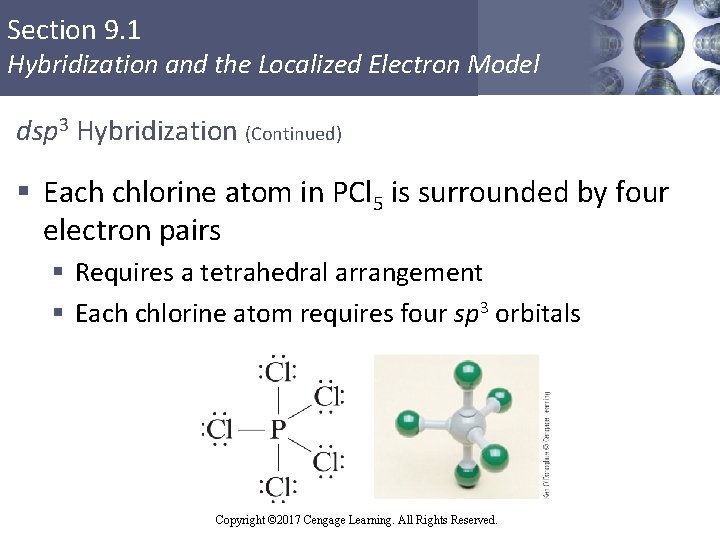
Section 9. 1 Hybridization and the Localized Electron Model dsp 3 Hybridization (Continued) § Each chlorine atom in PCl 5 is surrounded by four electron pairs § Requires a tetrahedral arrangement § Each chlorine atom requires four sp 3 orbitals Copyright © Cengage Learning. All rights reserved Copyright © 2017 Cengage Learning. All Rights Reserved. 30
Section 9. 1 Hybridization and the Localized Electron Model Example 9. 3 - The Localized Electron Model III § Describe the bonding in the triiodide ion (I 3–) Copyright © 2017 Cengage Learning. All Rights Reserved.
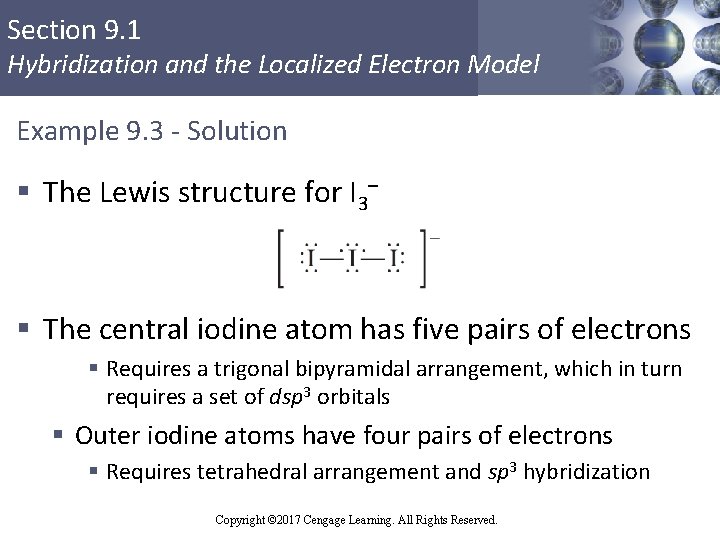
Section 9. 1 Hybridization and the Localized Electron Model Example 9. 3 - Solution § The Lewis structure for I 3– § The central iodine atom has five pairs of electrons § Requires a trigonal bipyramidal arrangement, which in turn requires a set of dsp 3 orbitals § Outer iodine atoms have four pairs of electrons § Requires tetrahedral arrangement and sp 3 hybridization Copyright © 2017 Cengage Learning. All Rights Reserved.
Section 9. 1 Hybridization and the Localized Electron Model Example 9. 3 - Solution (Continued) § The central iodine atom is dsp 3 hybridized § Three hybrid orbitals hold lone pairs § Two hybrid orbitals overlap with sp 3 orbitals of the other two iodine atoms to form bonds Copyright © 2017 Cengage Learning. All Rights Reserved.
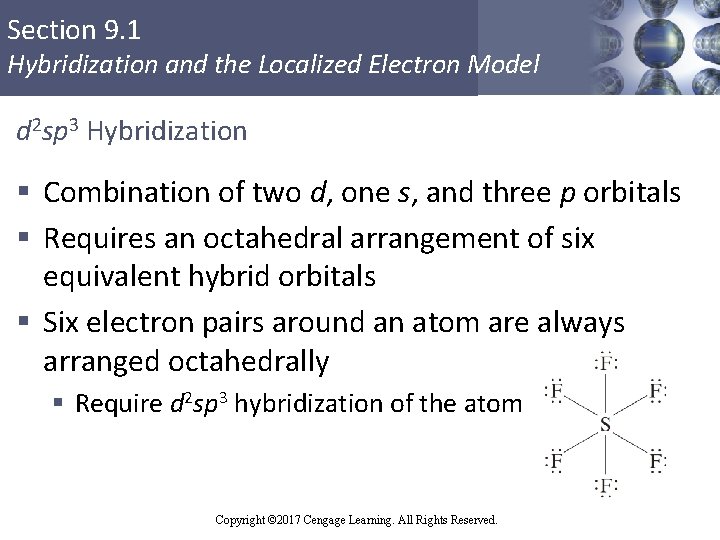
Section 9. 1 Hybridization and the Localized Electron Model d 2 sp 3 Hybridization § Combination of two d, one s, and three p orbitals § Requires an octahedral arrangement of six equivalent hybrid orbitals § Six electron pairs around an atom are always arranged octahedrally § Require d 2 sp 3 hybridization of the atom Copyright © Cengage Learning. All rights reserved Copyright © 2017 Cengage Learning. All Rights Reserved. 34
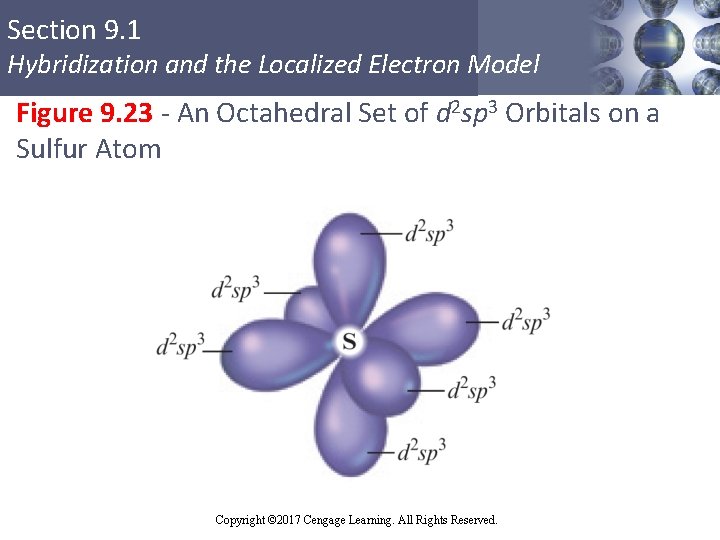
Section 9. 1 Hybridization and the Localized Electron Model Figure 9. 23 - An Octahedral Set of d 2 sp 3 Orbitals on a Sulfur Atom Copyright © 2017 Cengage Learning. All Rights Reserved.
Section 9. 1 Hybridization and the Localized Electron Model Interactive Example 9. 4 - The Localized Electron Model IV § How is the xenon atom in Xe. F 4 hybridized? Copyright © 2017 Cengage Learning. All Rights Reserved.
Section 9. 1 Hybridization and the Localized Electron Model Interactive Example 9. 4 - Solution § Xe. F 4 has six pairs of electrons around xenon that are arranged octahedrally to minimize repulsions § An octahedral set of six atomic orbitals is required to hold these electrons, and the xenon atom is d 2 sp 3 hybridized Copyright © 2017 Cengage Learning. All Rights Reserved.
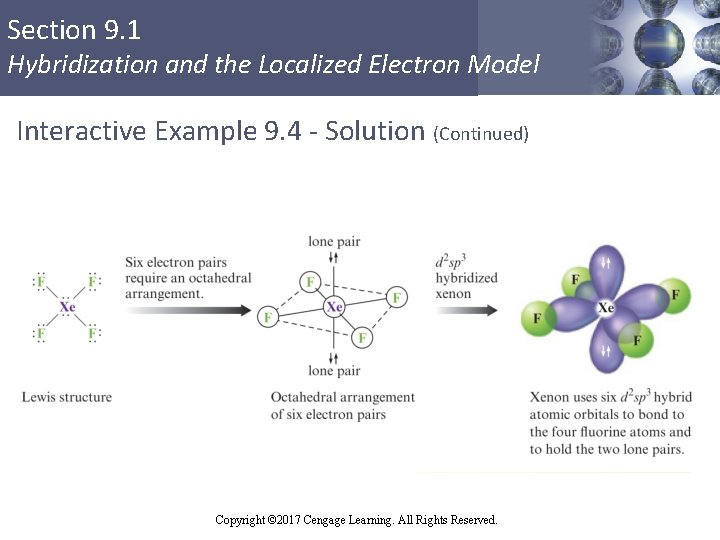
Section 9. 1 Hybridization and the Localized Electron Model Interactive Example 9. 4 - Solution (Continued) Copyright © 2017 Cengage Learning. All Rights Reserved.
Section 9. 1 Hybridization and the Localized Electron Model Problem Solving Strategy - Using the Localized Electron Model § Draw the Lewis structure(s) § Determine the arrangement of electron pairs using the VSEPR model § Specify the hybrid orbitals required to accommodate the electron pairs Copyright © 2017 Cengage Learning. All Rights Reserved.
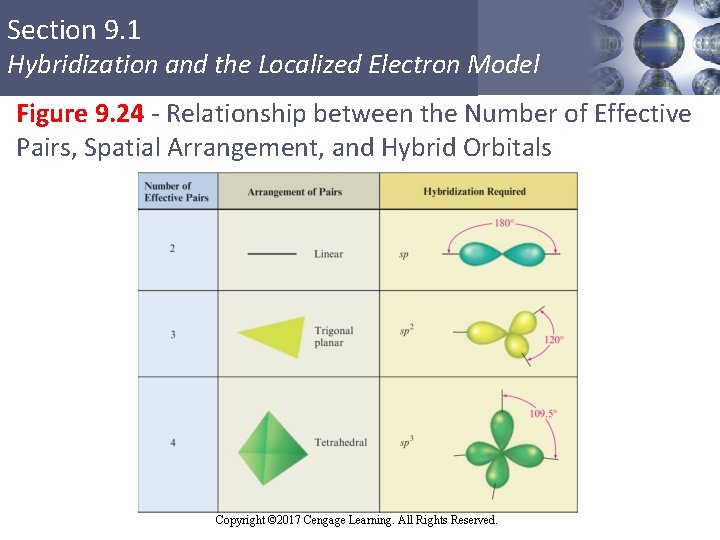
Section 9. 1 Hybridization and the Localized Electron Model Figure 9. 24 - Relationship between the Number of Effective Pairs, Spatial Arrangement, and Hybrid Orbitals Copyright © 2017 Cengage Learning. All Rights Reserved.
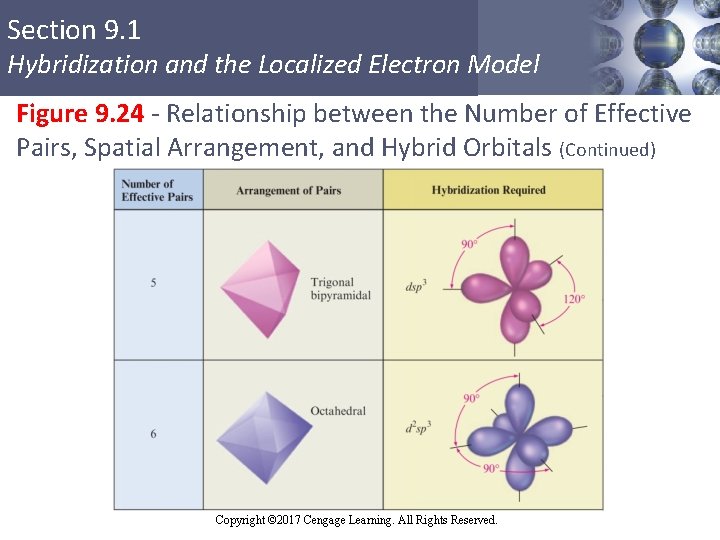
Section 9. 1 Hybridization and the Localized Electron Model Figure 9. 24 - Relationship between the Number of Effective Pairs, Spatial Arrangement, and Hybrid Orbitals (Continued) Copyright © 2017 Cengage Learning. All Rights Reserved.
Section 9. 1 Hybridization and the Localized Electron Model Interactive Example 9. 5 - The Localized Electron Model V § For each of the following molecules or ions, predict the hybridization of each atom, and describe the molecular structure a. CO b. BF 4– c. Xe. F 2 Copyright © 2017 Cengage Learning. All Rights Reserved.
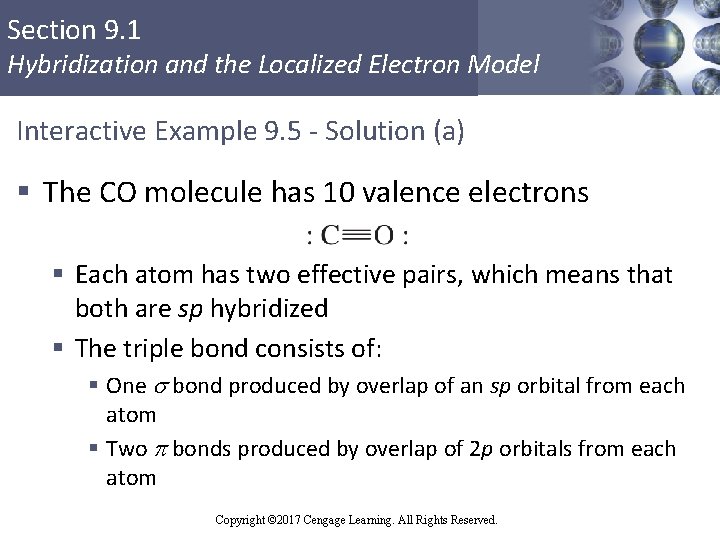
Section 9. 1 Hybridization and the Localized Electron Model Interactive Example 9. 5 - Solution (a) § The CO molecule has 10 valence electrons § Each atom has two effective pairs, which means that both are sp hybridized § The triple bond consists of: § One bond produced by overlap of an sp orbital from each atom § Two bonds produced by overlap of 2 p orbitals from each atom Copyright © 2017 Cengage Learning. All Rights Reserved.
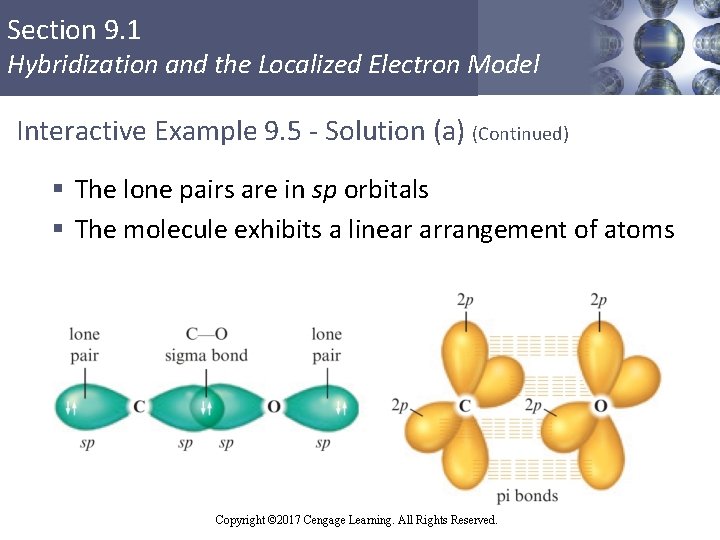
Section 9. 1 Hybridization and the Localized Electron Model Interactive Example 9. 5 - Solution (a) (Continued) § The lone pairs are in sp orbitals § The molecule exhibits a linear arrangement of atoms Copyright © 2017 Cengage Learning. All Rights Reserved.
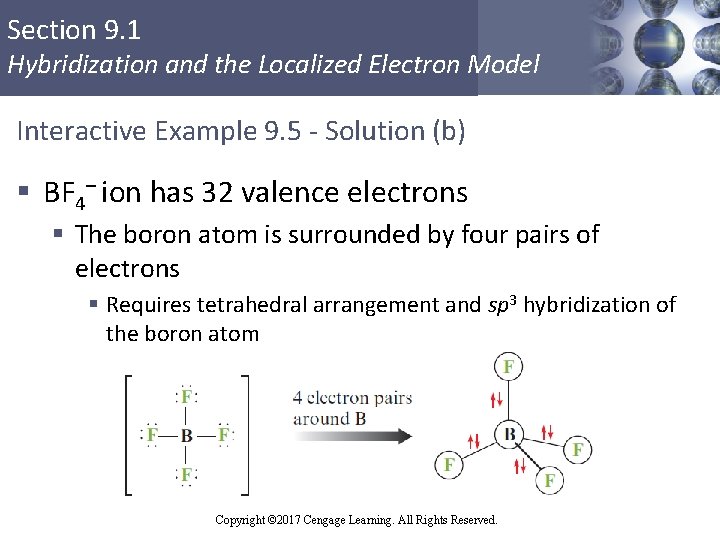
Section 9. 1 Hybridization and the Localized Electron Model Interactive Example 9. 5 - Solution (b) § BF 4– ion has 32 valence electrons § The boron atom is surrounded by four pairs of electrons § Requires tetrahedral arrangement and sp 3 hybridization of the boron atom Copyright © 2017 Cengage Learning. All Rights Reserved.
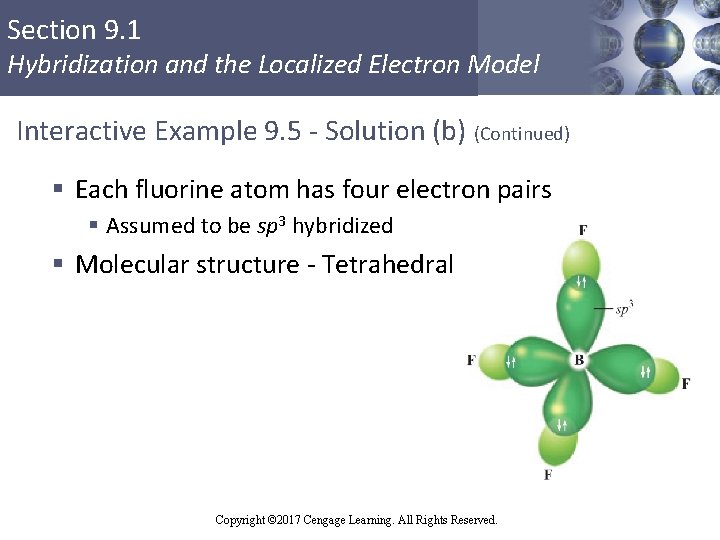
Section 9. 1 Hybridization and the Localized Electron Model Interactive Example 9. 5 - Solution (b) (Continued) § Each fluorine atom has four electron pairs § Assumed to be sp 3 hybridized § Molecular structure - Tetrahedral Copyright © 2017 Cengage Learning. All Rights Reserved.
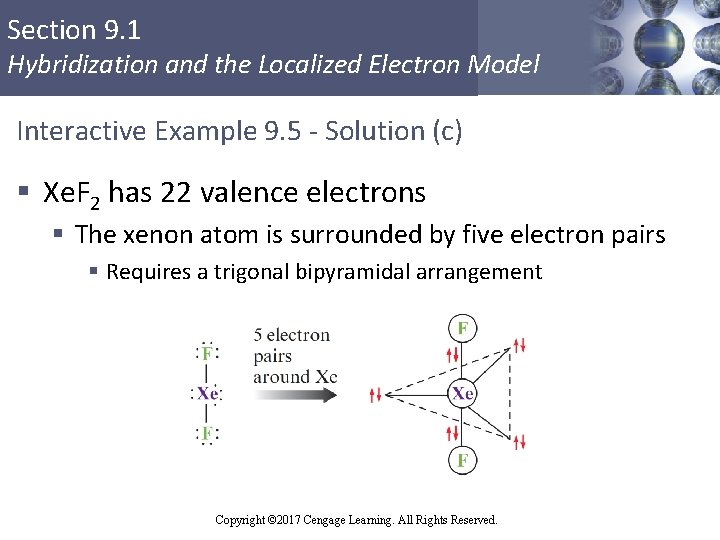
Section 9. 1 Hybridization and the Localized Electron Model Interactive Example 9. 5 - Solution (c) § Xe. F 2 has 22 valence electrons § The xenon atom is surrounded by five electron pairs § Requires a trigonal bipyramidal arrangement Copyright © 2017 Cengage Learning. All Rights Reserved.
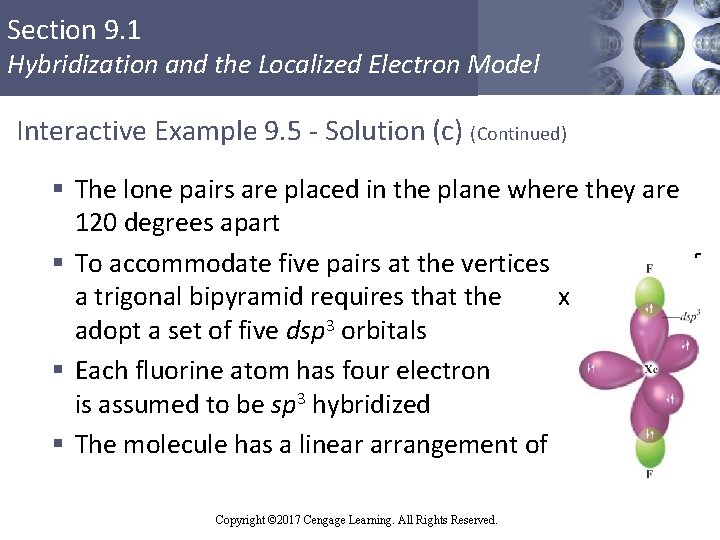
Section 9. 1 Hybridization and the Localized Electron Model Interactive Example 9. 5 - Solution (c) (Continued) § The lone pairs are placed in the plane where they are 120 degrees apart § To accommodate five pairs at the vertices of a trigonal bipyramid requires that the xenon atom adopt a set of five dsp 3 orbitals § Each fluorine atom has four electron pairs and is assumed to be sp 3 hybridized § The molecule has a linear arrangement of atoms Copyright © 2017 Cengage Learning. All Rights Reserved.
Section 9. 2 The Molecular Orbital Model Limitations of the Localized Electron Model § Incorrectly assumes that electrons are localized § Concept of resonance must be added § Does not deal effectively with molecules containing unpaired electrons § Does not provide direct information about bond energies Copyright © Cengage Learning. All rights reserved Copyright © 2017 Cengage Learning. All Rights Reserved. 49

Section 9. 2 The Molecular Orbital Model Molecular Orbitals (MOs) § Have the same characteristics as atomic orbitals § Can hold two electrons with opposite spins § The square of the molecular orbital wave function indicates electron probability Copyright © 2017 Cengage Learning. All Rights Reserved.
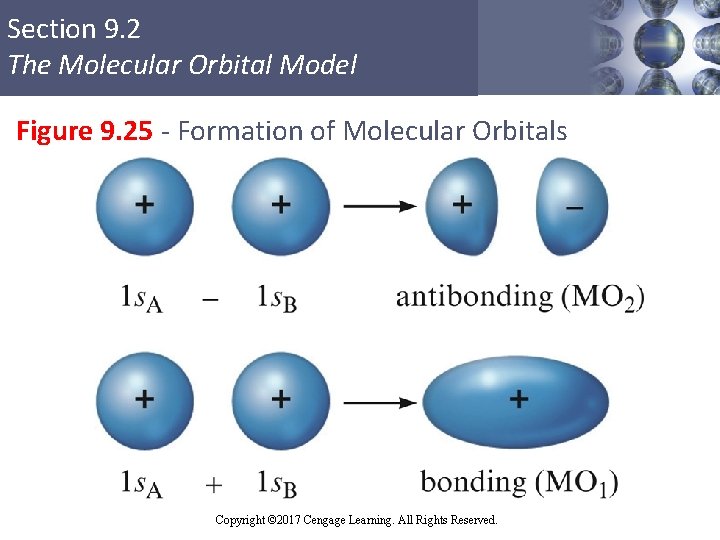
Section 9. 2 The Molecular Orbital Model Figure 9. 25 - Formation of Molecular Orbitals Copyright © Cengage Learning. All rights reserved Copyright © 2017 Cengage Learning. All Rights Reserved. 51
Section 9. 2 The Molecular Orbital Model Properties of Molecular Orbitals § The electron probability of both molecular orbitals is centered along the line passing through the two nuclei § MO 1 and MO 2 are referred to as sigma (σ) molecular orbitals § In the molecule, only the molecular orbitals are available for occupation by electrons Copyright © Cengage Learning. All rights reserved Copyright © 2017 Cengage Learning. All Rights Reserved. 52
Section 9. 2 The Molecular Orbital Model Properties of Molecular Orbitals (Continued 1) § Bonding and antibonding § Bonding molecular orbital: Lower in energy than the atomic orbitals from which it is composed § Electrons in this orbital will favor bonding § Antibonding molecular orbital: Higher in energy than the atomic orbitals from which it is composed § Electrons in this orbital will favor the separated atoms Copyright © Cengage Learning. All rights reserved Copyright © 2017 Cengage Learning. All Rights Reserved. 53
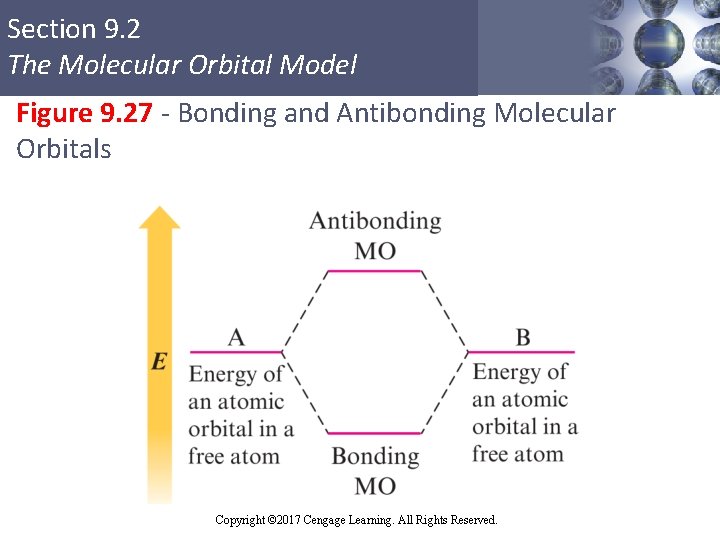
Section 9. 2 The Molecular Orbital Model Figure 9. 27 - Bonding and Antibonding Molecular Orbitals Copyright © 2017 Cengage Learning. All Rights Reserved.
Section 9. 2 The Molecular Orbital Model Properties of Molecular Orbitals (Continued 2) § The MO model is physically reasonable § There is high probability of finding electrons between nuclei in bonding MOs § Electrons are outside the space between the nuclei in antibonding MOs § Labels on molecular orbitals indicate their shape, the parent atomic orbitals, and whether they are bonding or antibonding § Antibonding character is indicated by an asterisk Copyright © 2017 Cengage Learning. All Rights Reserved.
Section 9. 2 The Molecular Orbital Model Properties of Molecular Orbitals (Continued 3) § Molecular electronic configuration can be written in the same way as atomic configurations § Each molecular orbital can hold two electrons § The spins should be opposite § Molecular orbitals are conserved § The number of MOs will be equal to the number of atomic orbitals used to construct them Copyright © 2017 Cengage Learning. All Rights Reserved.
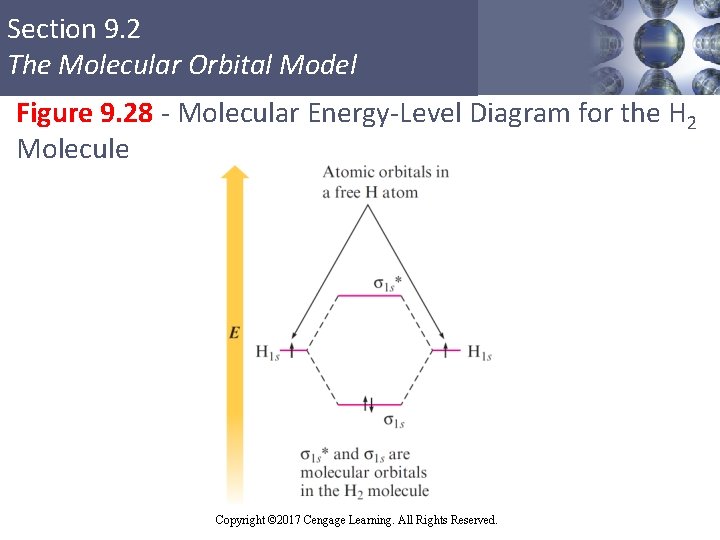
Section 9. 2 The Molecular Orbital Model Figure 9. 28 - Molecular Energy-Level Diagram for the H 2 Molecule Copyright © 2017 Cengage Learning. All Rights Reserved.
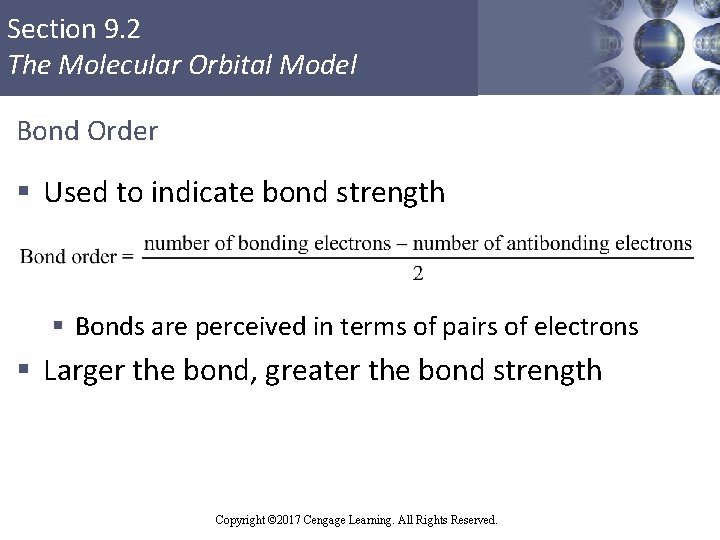
Section 9. 2 The Molecular Orbital Model Bond Order § Used to indicate bond strength § Bonds are perceived in terms of pairs of electrons § Larger the bond, greater the bond strength Copyright © Cengage Learning. All rights reserved Copyright © 2017 Cengage Learning. All Rights Reserved. 58
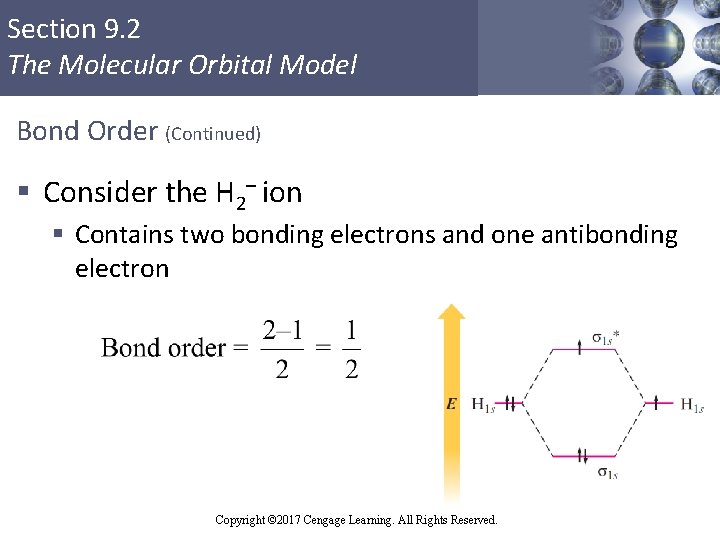
Section 9. 2 The Molecular Orbital Model Bond Order (Continued) § Consider the H 2– ion § Contains two bonding electrons and one antibonding electron Copyright © Cengage Learning. All rights reserved Copyright © 2017 Cengage Learning. All Rights Reserved. 59
Section 9. 3 Bonding in Homonuclear Diatomic Molecules § Composed of two identical atoms § Only the valence orbitals of the atoms contribute significantly to the molecular orbitals of a particular molecule Copyright © Cengage Learning. All rights reserved Copyright © 2017 Cengage Learning. All Rights Reserved. 60
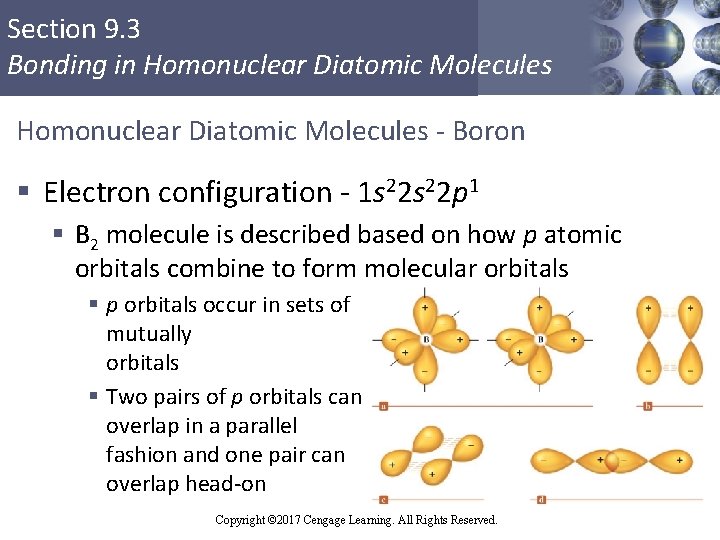
Section 9. 3 Bonding in Homonuclear Diatomic Molecules - Boron § Electron configuration - 1 s 22 p 1 § B 2 molecule is described based on how p atomic orbitals combine to form molecular orbitals § p orbitals occur in sets of mutually orbitals § Two pairs of p orbitals can overlap in a parallel fashion and one pair can overlap head-on Copyright © Cengage Learning. All rights reserved perpendicular Copyright © 2017 Cengage Learning. All Rights Reserved. 61 three
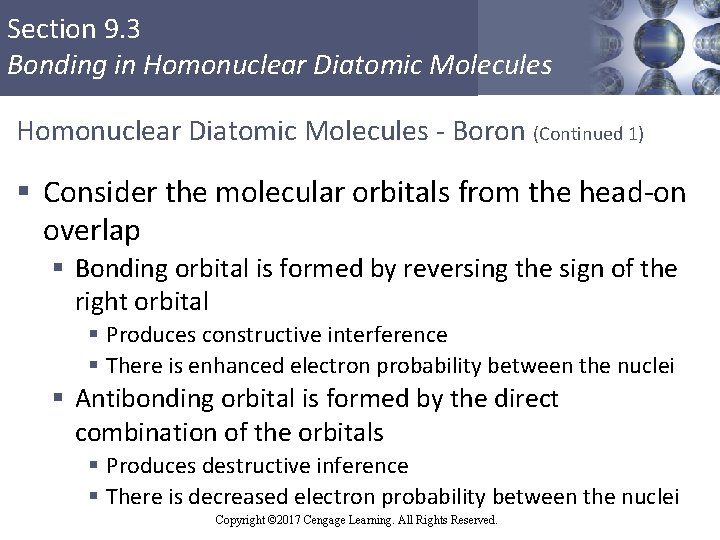
Section 9. 3 Bonding in Homonuclear Diatomic Molecules - Boron (Continued 1) § Consider the molecular orbitals from the head-on overlap § Bonding orbital is formed by reversing the sign of the right orbital § Produces constructive interference § There is enhanced electron probability between the nuclei § Antibonding orbital is formed by the direct combination of the orbitals § Produces destructive inference § There is decreased electron probability between the nuclei Copyright © Cengage Learning. All rights reserved Copyright © 2017 Cengage Learning. All Rights Reserved. 62
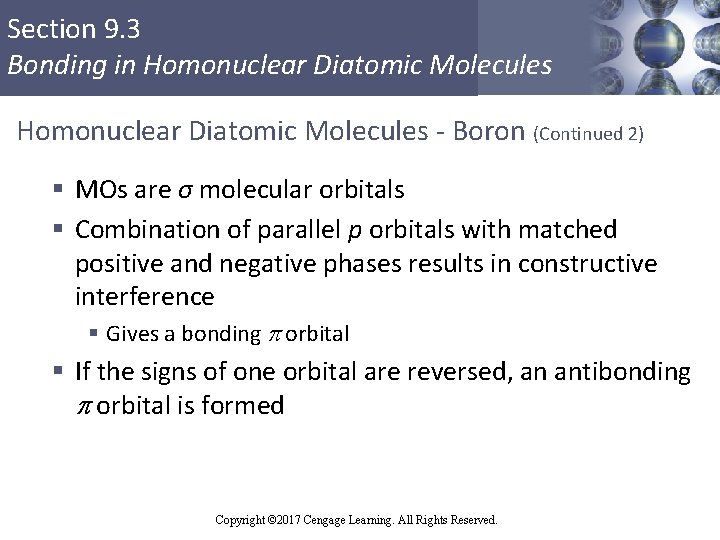
Section 9. 3 Bonding in Homonuclear Diatomic Molecules - Boron (Continued 2) § MOs are σ molecular orbitals § Combination of parallel p orbitals with matched positive and negative phases results in constructive interference § Gives a bonding orbital § If the signs of one orbital are reversed, an antibonding orbital is formed Copyright © Cengage Learning. All rights reserved Copyright © 2017 Cengage Learning. All Rights Reserved. 63
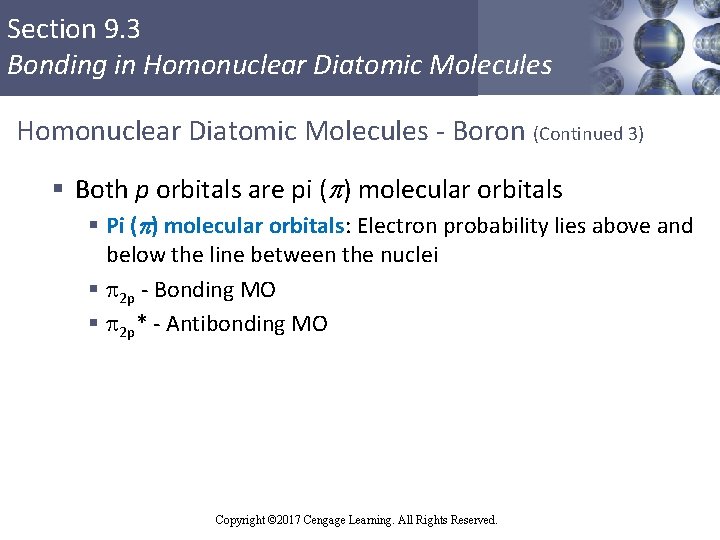
Section 9. 3 Bonding in Homonuclear Diatomic Molecules - Boron (Continued 3) § Both p orbitals are pi ( ) molecular orbitals § Pi ( ) molecular orbitals: Electron probability lies above and below the line between the nuclei § 2 p - Bonding MO § 2 p* - Antibonding MO Copyright © Cengage Learning. All rights reserved Copyright © 2017 Cengage Learning. All Rights Reserved. 64
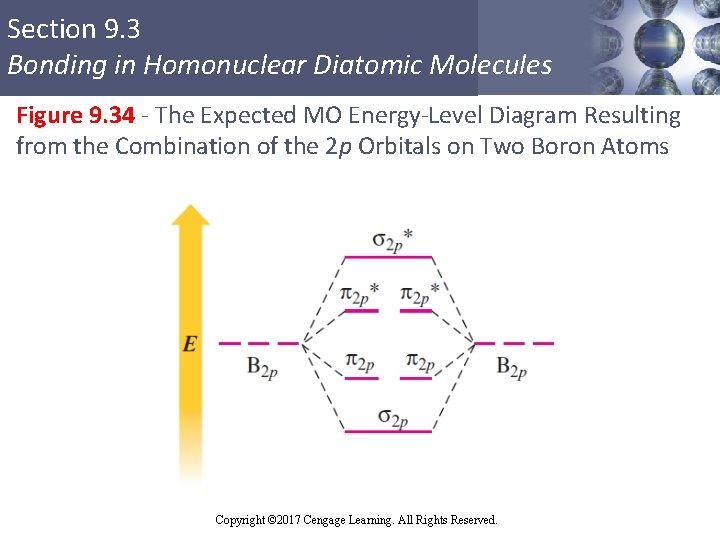
Section 9. 3 Bonding in Homonuclear Diatomic Molecules Figure 9. 34 - The Expected MO Energy-Level Diagram Resulting from the Combination of the 2 p Orbitals on Two Boron Atoms Copyright © 2017 Cengage Learning. All Rights Reserved.
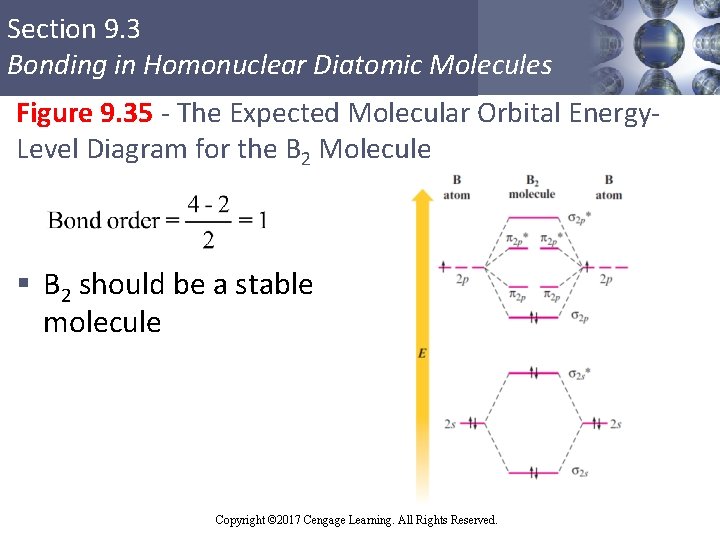
Section 9. 3 Bonding in Homonuclear Diatomic Molecules Figure 9. 35 - The Expected Molecular Orbital Energy. Level Diagram for the B 2 Molecule § B 2 should be a stable molecule Copyright © 2017 Cengage Learning. All Rights Reserved.
Section 9. 3 Bonding in Homonuclear Diatomic Molecules Types of Magnetism in the Presence of a Magnetic Field § Paramagnetism: Substance is attracted into the inducing magnetic field § Associated with unpaired electrons § Diamagnetism: Substance is repelled from the inducing magnetic field § Associated with paired electrons § Substance that has both paired and unpaired electrons will exhibit a net paramagnetism Copyright © Cengage Learning. All rights reserved Copyright © 2017 Cengage Learning. All Rights Reserved. 67
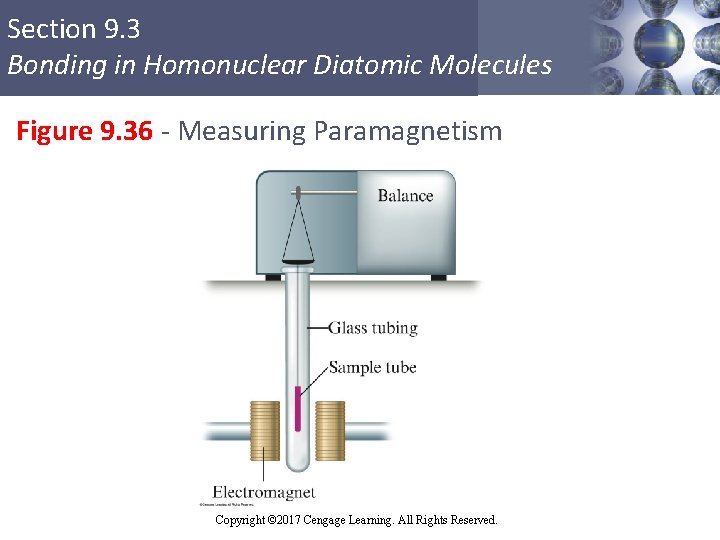
Section 9. 3 Bonding in Homonuclear Diatomic Molecules Figure 9. 36 - Measuring Paramagnetism Copyright © Cengage Learning. All rights reserved Copyright © 2017 Cengage Learning. All Rights Reserved. 68
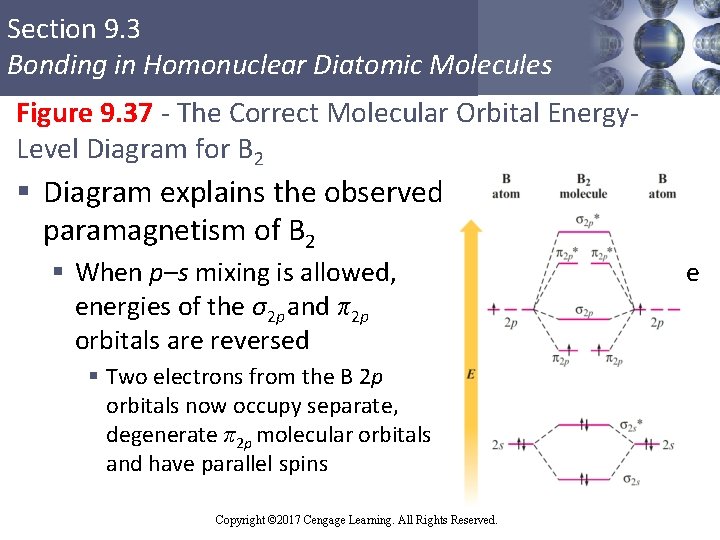
Section 9. 3 Bonding in Homonuclear Diatomic Molecules Figure 9. 37 - The Correct Molecular Orbital Energy. Level Diagram for B 2 § Diagram explains the observed paramagnetism of B 2 § When p–s mixing is allowed, energies of the σ2 p and π2 p orbitals are reversed § Two electrons from the B 2 p orbitals now occupy separate, degenerate π2 p molecular orbitals and have parallel spins Copyright © 2017 Cengage Learning. All Rights Reserved. the
Section 9. 3 Bonding in Homonuclear Diatomic Molecules Critical Thinking § What if 2 p orbitals were lower in energy than 2 p orbitals? § What would you expect the B 2 molecular orbital energy-level diagram to look like (without considering p–s mixing)? § Compare the expected diagram to figures 9. 34 and 9. 35, and state the differences from each Copyright © 2017 Cengage Learning. All Rights Reserved.
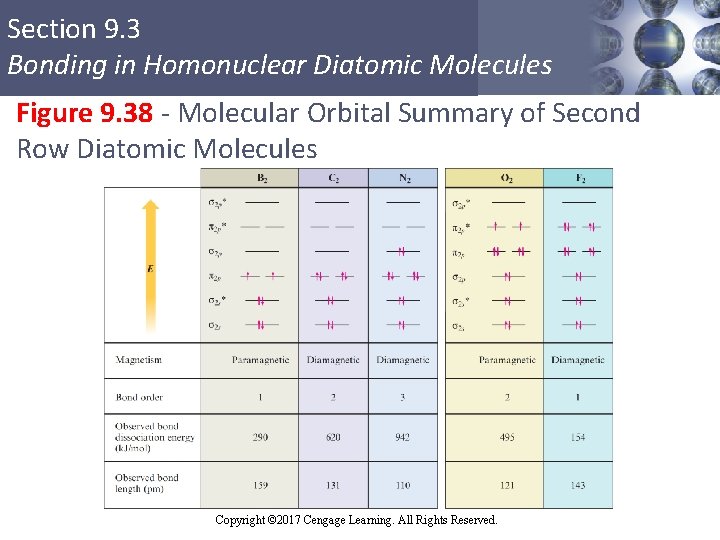
Section 9. 3 Bonding in Homonuclear Diatomic Molecules Figure 9. 38 - Molecular Orbital Summary of Second Row Diatomic Molecules Copyright © Cengage Learning. All rights reserved Copyright © 2017 Cengage Learning. All Rights Reserved. 71
Section 9. 3 Bonding in Homonuclear Diatomic Molecules Key Points regarding Period 2 Diatomics § There are definite correlations between bond order, bond energy, and bond length § Bond order cannot be associated with a particular bond energy § The large bond energy associated with the N 2 molecule will have a triple bond § The O 2 molecule is paramagnetic Copyright © 2017 Cengage Learning. All Rights Reserved.
Section 9. 3 Bonding in Homonuclear Diatomic Molecules Interactive Example 9. 7 - The Molecular Orbital Model II § Use the molecular orbital model to predict the bond order and magnetism of each of the following molecules a. Ne 2 b. P 2 Copyright © 2017 Cengage Learning. All Rights Reserved.
Section 9. 3 Bonding in Homonuclear Diatomic Molecules Interactive Example 9. 7 - Solution (a) § The valence orbitals for Ne are 2 s and 2 p § The Ne 2 molecule has 16 valence electrons (8 from each atom) Copyright © 2017 Cengage Learning. All Rights Reserved.
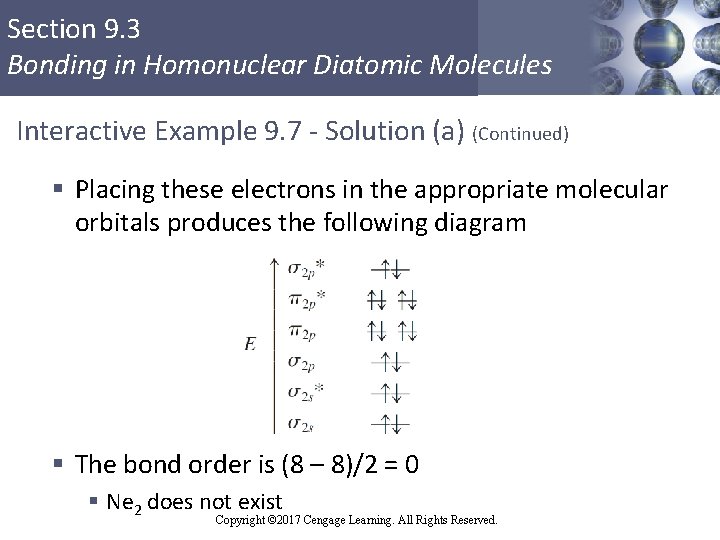
Section 9. 3 Bonding in Homonuclear Diatomic Molecules Interactive Example 9. 7 - Solution (a) (Continued) § Placing these electrons in the appropriate molecular orbitals produces the following diagram § The bond order is (8 – 8)/2 = 0 § Ne 2 does not exist Copyright © 2017 Cengage Learning. All Rights Reserved.
Section 9. 3 Bonding in Homonuclear Diatomic Molecules Interactive Example 9. 7 - Solution (b) § P 2 contains phosphorus atoms from the third row of the periodic table § Assume that the diatomic molecules of the Period 3 elements can be treated in a way similar to that which has been used so far § Draw the MO diagram for P 2 analogous to that for N 2 § The only change will be that the molecular orbitals will be formed from 3 s and 3 p atomic orbitals Copyright © 2017 Cengage Learning. All Rights Reserved.
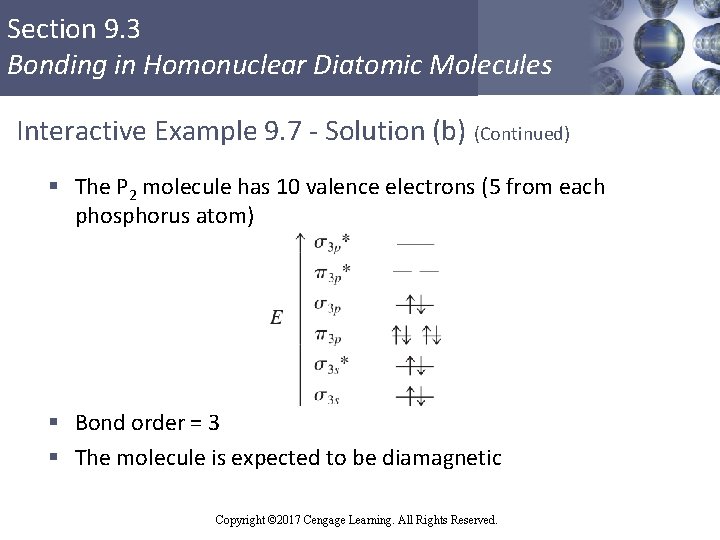
Section 9. 3 Bonding in Homonuclear Diatomic Molecules Interactive Example 9. 7 - Solution (b) (Continued) § The P 2 molecule has 10 valence electrons (5 from each phosphorus atom) § Bond order = 3 § The molecule is expected to be diamagnetic Copyright © 2017 Cengage Learning. All Rights Reserved.

Section 9. 4 Bonding in Heteronuclear Diatomic Molecules § Heteronuclear: Different atoms § A special case involves molecules containing atoms adjacent to each other in the periodic table § MO diagram can be used for homonuclear molecules as atoms involved in such molecules are similar Copyright © Cengage Learning. All rights reserved Copyright © 2017 Cengage Learning. All Rights Reserved. 78
Section 9. 4 Bonding in Heteronuclear Diatomic Molecules Interactive Example 9. 8 - The Molecular Orbital Model III § Use the molecular orbital model to predict the magnetism and bond order of the NO+ and CN– ions Copyright © 2017 Cengage Learning. All Rights Reserved.
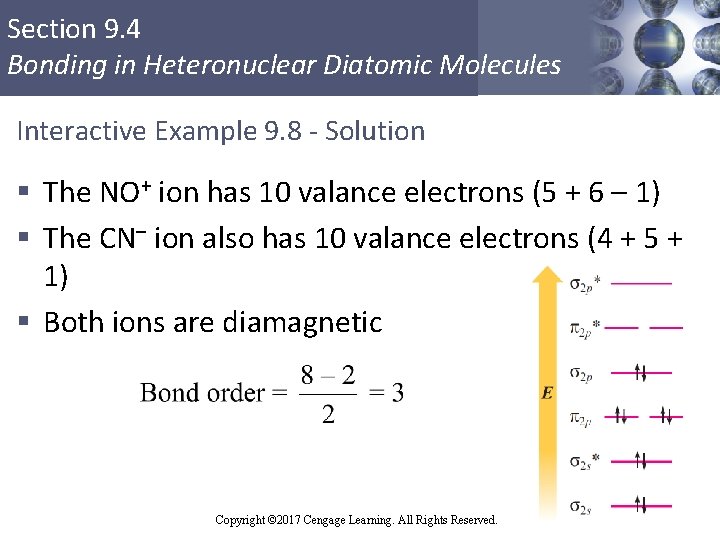
Section 9. 4 Bonding in Heteronuclear Diatomic Molecules Interactive Example 9. 8 - Solution § The NO+ ion has 10 valance electrons (5 + 6 – 1) § The CN– ion also has 10 valance electrons (4 + 5 + 1) § Both ions are diamagnetic Copyright © 2017 Cengage Learning. All Rights Reserved.
Section 9. 4 Bonding in Heteronuclear Diatomic Molecules Energy-Level Diagrams for Diatomic Molecules § When the two atoms of a diatomic molecule are very different, the energy-level diagram for homonuclear molecules cannot be used § Consider the hydrogen fluoride (HF) molecule § Electron configuration of hydrogen - 1 s 1 § Electron configuration of fluorine - 1 s 22 p 5 § Assume that fluorine uses only one of its 2 p orbitals to bond to hydrogen Copyright © 2017 Cengage Learning. All Rights Reserved.
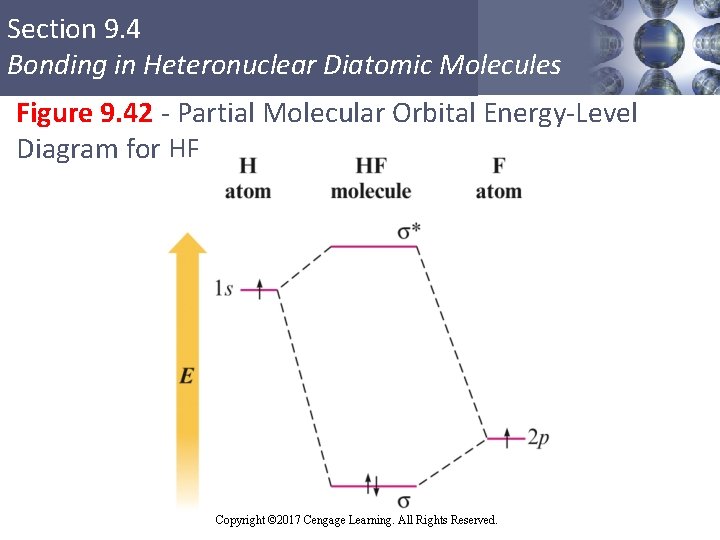
Section 9. 4 Bonding in Heteronuclear Diatomic Molecules Figure 9. 42 - Partial Molecular Orbital Energy-Level Diagram for HF Copyright © 2017 Cengage Learning. All Rights Reserved.
Section 9. 4 Bonding in Heteronuclear Diatomic Molecules Energy-Level Diagrams for Diatomic Molecules (Continued) § The HF molecule should be stable as both electrons are lowered in energy relative to their energy in the free hydrogen and fluorine atoms § Electrons prefer to be closer to the fluorine atom § The electron pair is not shared equally § Fluorine has a slight excess of negative charge, and hydrogen is partially positive Copyright © 2017 Cengage Learning. All Rights Reserved.
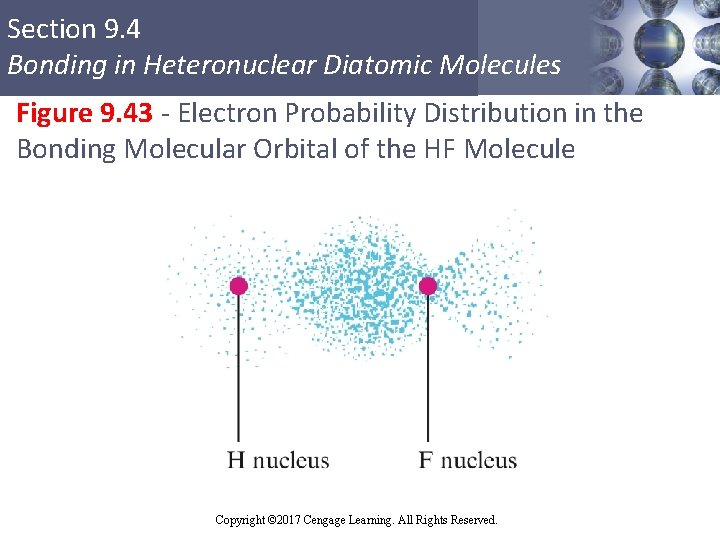
Section 9. 4 Bonding in Heteronuclear Diatomic Molecules Figure 9. 43 - Electron Probability Distribution in the Bonding Molecular Orbital of the HF Molecule Copyright © Cengage Learning. All rights reserved Copyright © 2017 Cengage Learning. All Rights Reserved. 84
Section 9. 5 Combining the Localized Electron and Molecular Orbital Models Combining the Localized Electron and MO Models § The σ bonds in a molecule can be described as being localized § The π bonds must be treated as being delocalized § For molecules that require resonance: § The localized electron model can be used to describe the σ bonding § The MO model can be used to describe the π bonding Copyright © 2017 Cengage Learning. All Rights Reserved.
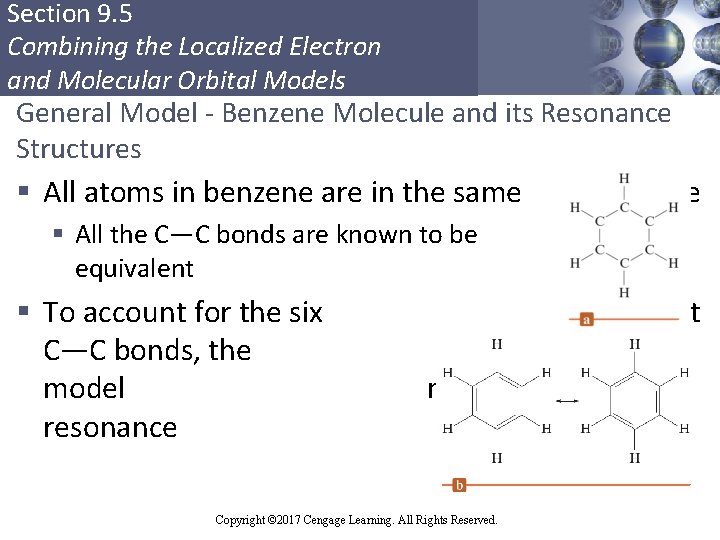
Section 9. 5 Combining the Localized Electron and Molecular Orbital Models General Model - Benzene Molecule and its Resonance Structures § All atoms in benzene are in the same plane § All the C—C bonds are known to be equivalent § To account for the six C—C bonds, the model resonance equivalent localized electron must invoke Copyright © 2017 Cengage Learning. All Rights Reserved.
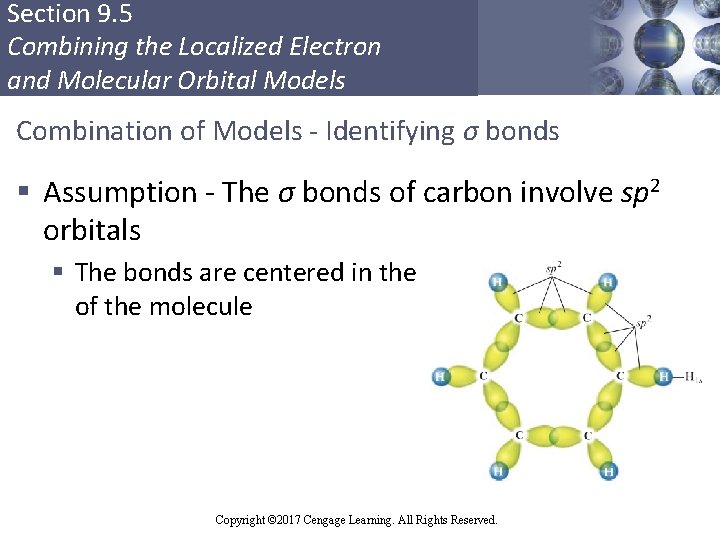
Section 9. 5 Combining the Localized Electron and Molecular Orbital Models Combination of Models - Identifying σ bonds § Assumption - The σ bonds of carbon involve sp 2 orbitals § The bonds are centered in the of the molecule Copyright © 2017 Cengage Learning. All Rights Reserved. plane
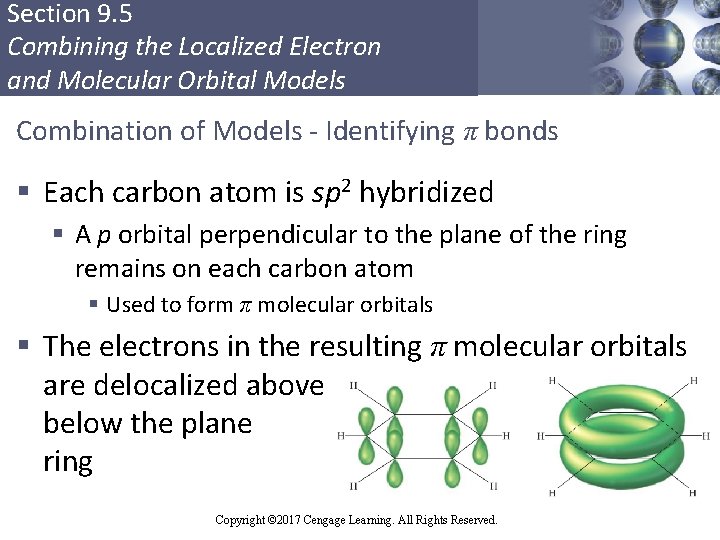
Section 9. 5 Combining the Localized Electron and Molecular Orbital Models Combination of Models - Identifying π bonds § Each carbon atom is sp 2 hybridized § A p orbital perpendicular to the plane of the ring remains on each carbon atom § Used to form π molecular orbitals § The electrons in the resulting π molecular orbitals are delocalized above and below the plane of the ring Copyright © 2017 Cengage Learning. All Rights Reserved.
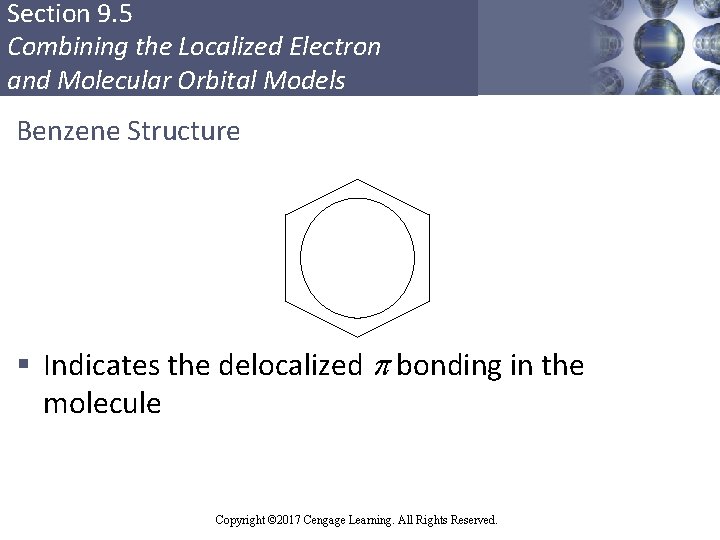
Section 9. 5 Combining the Localized Electron and Molecular Orbital Models Benzene Structure § Indicates the delocalized bonding in the molecule Copyright © 2017 Cengage Learning. All Rights Reserved.
Section 9. 6 Photoelectron Spectroscopy (PES) Electron Spectroscopy § Uses § Determines the relative energies of electrons in individual atoms and molecules § Characterizes and tests molecular bonding theories § Helps in the study of the electron energy levels of atoms § Involves bombarding the sample with high-energy photons § Kinetic energies of the ejected electrons are measured Copyright © 2017 Cengage Learning. All Rights Reserved.
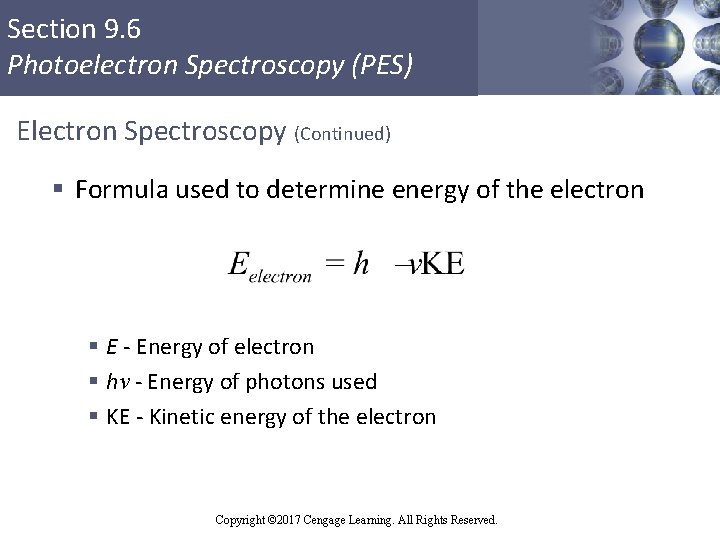
Section 9. 6 Photoelectron Spectroscopy (PES) Electron Spectroscopy (Continued) § Formula used to determine energy of the electron § E - Energy of electron § hν - Energy of photons used § KE - Kinetic energy of the electron Copyright © 2017 Cengage Learning. All Rights Reserved.
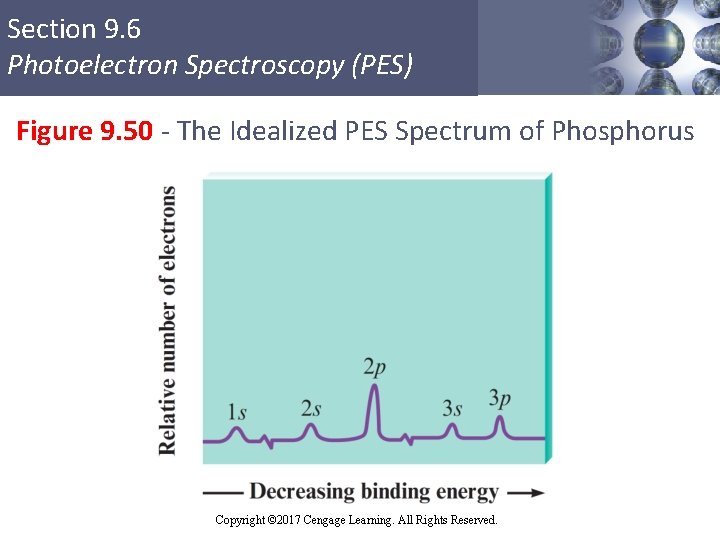
Section 9. 6 Photoelectron Spectroscopy (PES) Figure 9. 50 - The Idealized PES Spectrum of Phosphorus Copyright © 2017 Cengage Learning. All Rights Reserved.
- Slides: 92