
Chapter 9 Covalent Bonding Chemistry 1 Updated 2122022
Chapter 9: Covalent Bonding Chemistry 1 Updated: 2/12/2022 1
Covalent Bonding Atoms form bonds to achieve stability ¡ Covalent Bond – sharing of valence electrons to form bond. ¡ Molecule – formed when atoms bond covalently ¡ Don’t forget the octet rule 2
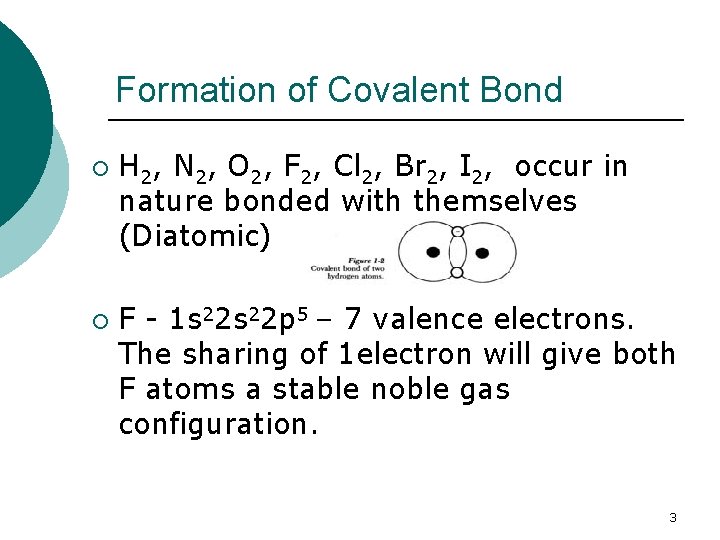
Formation of Covalent Bond ¡ ¡ H 2, N 2, O 2, F 2, Cl 2, Br 2, I 2, occur in nature bonded with themselves (Diatomic) F - 1 s 22 p 5 – 7 valence electrons. The sharing of 1 electron will give both F atoms a stable noble gas configuration. 3
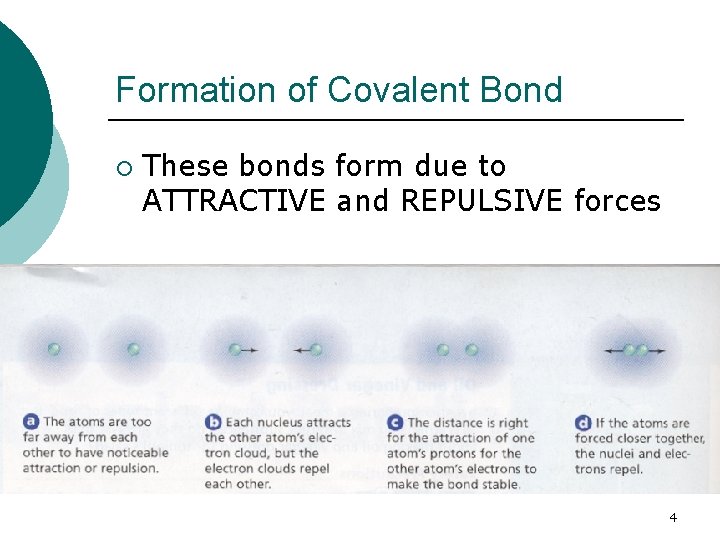
Formation of Covalent Bond ¡ These bonds form due to ATTRACTIVE and REPULSIVE forces 4
Single Covalent Bonds When a single pair of e- is shared ¡ Lewis Structure – use e- dot diagram to show e- are arranged in molecules H: H or H—H ¡ O O H H or H H 5
Multiple Bonds ¡ Double: 2 pairs e- shared l ¡ Ex. - O 2 Triple: 3 pairs e- shared. l Ex. - N 2 6
Covalent Bonds sigma (s) bonds –formed when valence atomic orbitals overlap or merges with another atom’s orbitals ¡ pi (p) bonds – formed when parallel orbitals overlap to share e. First covalent bond is always sigma (s), then pi (p) bonds follow. ¡ Single bond = 1 sigma bonds Double bond = 1 sigma and 1 pi bonds Triple bond = 1 sigma and 2 pi bonds 7
Strength of Covalent Bonds ¡ ¡ ¡ The strength of a covalent bond is dependent on the bond length Bond length – distance between two nuclei at the position of maximum attraction. Bond length is determined by l l the size of the atoms – increased size of atoms = increased bond length the number of electrons shared – increased number of shared electrons = decreased bond length 8
Strength of Covalent Bonds The shorter the bond length, the stronger the bond. ¡ Bond Dissociation Energy – energy required to break a specific covalent bond. ¡ l Breaking bonds always requires the addition of energy, so bond dissociation energy is always positive (+) 9
Endothermic vs. Exothermic Endothermic reactions occur when the energy needed to break existing bonds is greater than the energy released to form new bonds ¡ Exothermic reactions occur when more energy is released forming new bonds than is required to break existing bonds. ¡ 10
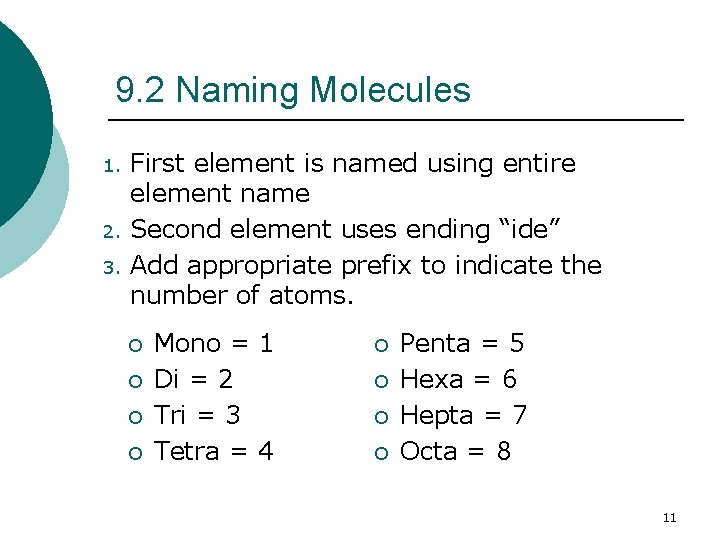
9. 2 Naming Molecules 1. 2. 3. First element is named using entire element name Second element uses ending “ide” Add appropriate prefix to indicate the number of atoms. ¡ ¡ Mono = 1 Di = 2 Tri = 3 Tetra = 4 ¡ ¡ Penta = 5 Hexa = 6 Hepta = 7 Octa = 8 11
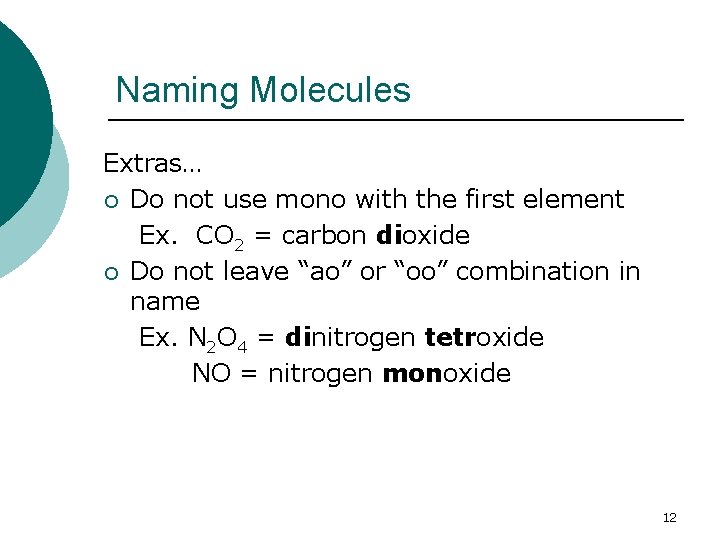
Naming Molecules Extras… ¡ Do not use mono with the first element Ex. CO 2 = carbon dioxide ¡ Do not leave “ao” or “oo” combination in name Ex. N 2 O 4 = dinitrogen tetroxide NO = nitrogen monoxide 12
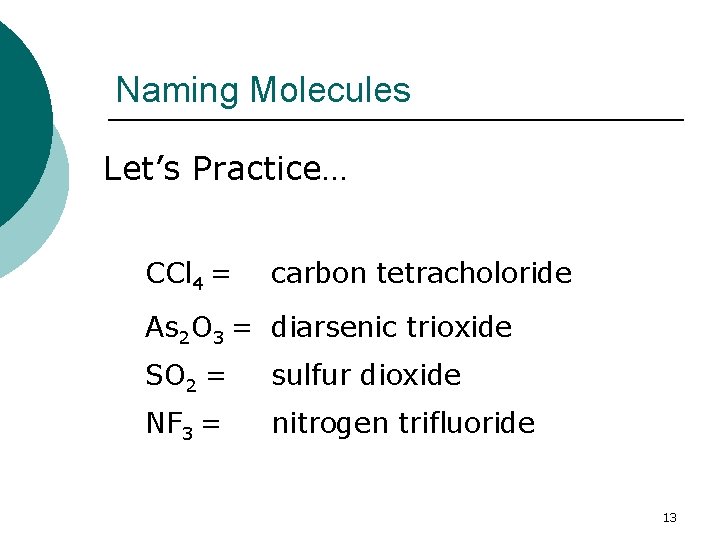
Naming Molecules Let’s Practice… CCl 4 = carbon tetracholoride As 2 O 3 = diarsenic trioxide SO 2 = sulfur dioxide NF 3 = nitrogen trifluoride 13
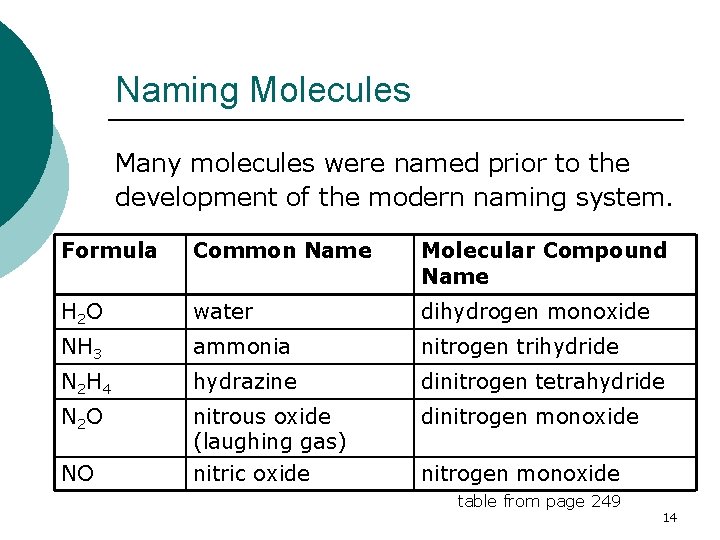
Naming Molecules Many molecules were named prior to the development of the modern naming system. Formula Common Name Molecular Compound Name H 2 O water dihydrogen monoxide NH 3 ammonia nitrogen trihydride N 2 H 4 hydrazine dinitrogen tetrahydride N 2 O nitrous oxide (laughing gas) dinitrogen monoxide NO nitric oxide nitrogen monoxide table from page 249 14

Naming Acids HCl hydrogen chloride hydrochloric acid H 2 SO 4 hydrogen sulfate sulfuric acid HNO 2 hydrogen nitrite nitrous acid 15
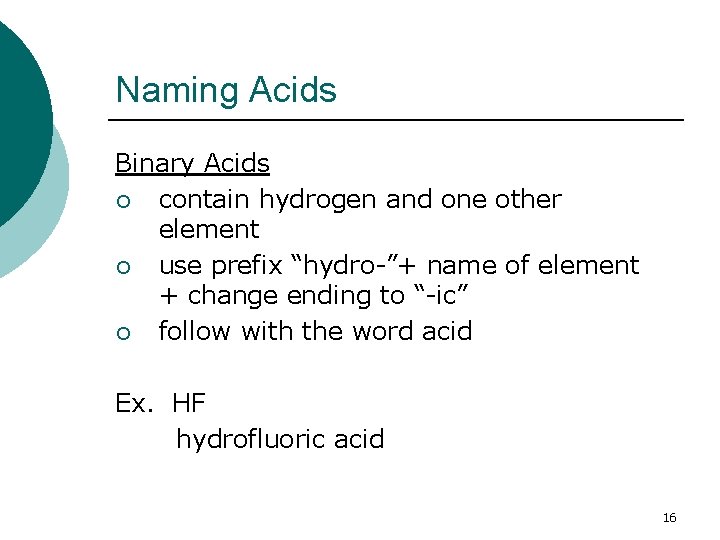
Naming Acids Binary Acids ¡ contain hydrogen and one other element ¡ use prefix “hydro-”+ name of element + change ending to “-ic” ¡ follow with the word acid Ex. HF hydrofluoric acid 16
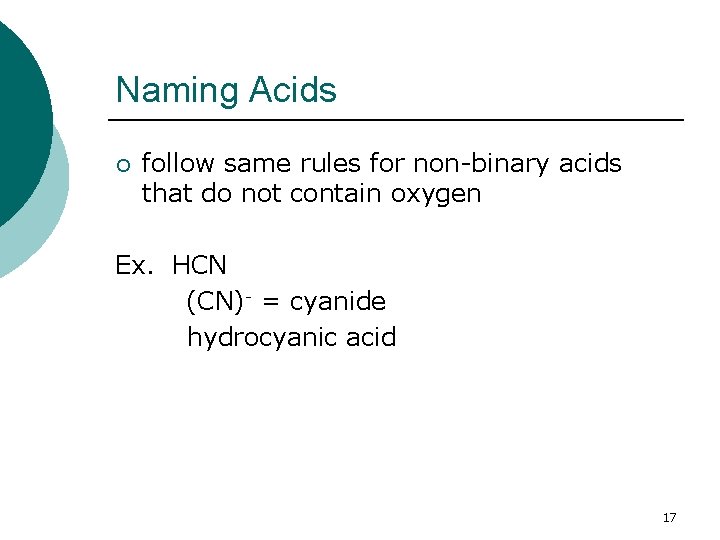
Naming Acids ¡ follow same rules for non-binary acids that do not contain oxygen Ex. HCN (CN)- = cyanide hydrocyanic acid 17
Naming Acids Oxyacids ¡ contain hydrogen and an oxyanion (anions that contain oxygen – like NO 3 -) ¡ to name… l l l root of the oxyanion + “-ic” if the anion ends in “-ate” root of the oxyanion + “-ous” if the anion ends in “-ite” follow with the word acid Ex. HNO 3 (NO 3)- = nitrate nitric acid 18
Naming Acids Let’s Practice… HI = hydroiodic acid HCl. O 3 = chloric acid HCl. O 2 = chlorous acid H 2 S = hydrosulfuric acid 19
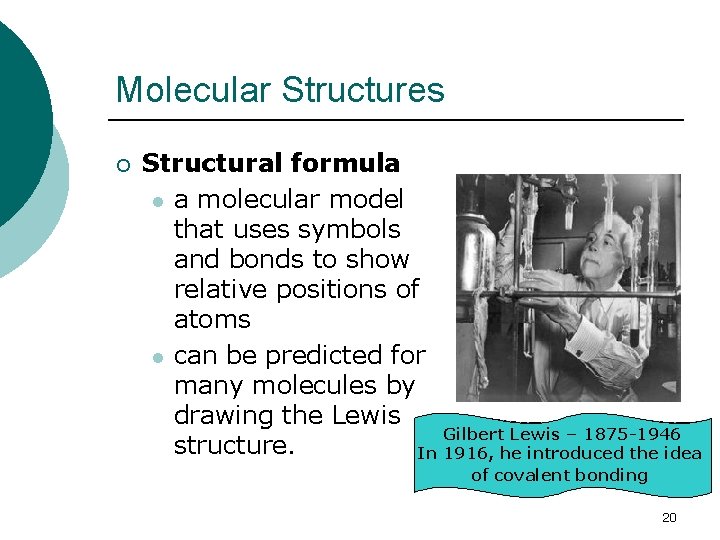
Molecular Structures ¡ Structural formula l a molecular model that uses symbols and bonds to show relative positions of atoms l can be predicted for many molecules by drawing the Lewis Gilbert Lewis – 1875 -1946 What is my name? structure. In 1916, he introduced the idea I developed the Lewis structure of covalent bonding 20
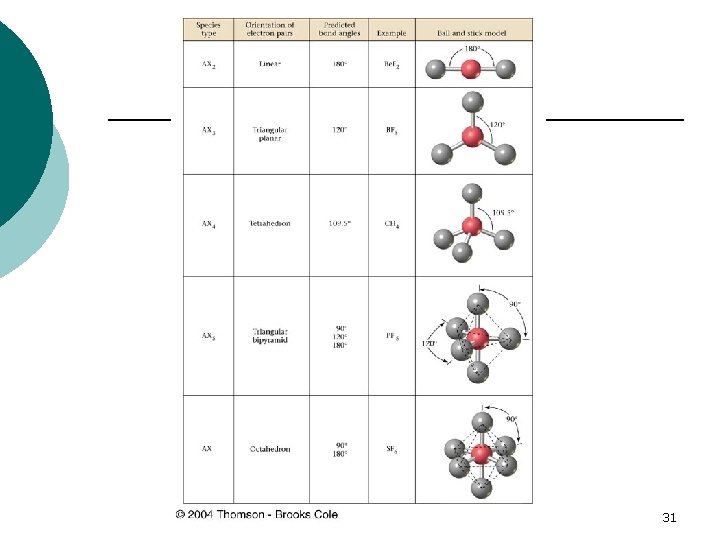
MOLECULAR SHAPES ¡ The molecular geometry of covalent molecules is based on the Valence Shell Electron Pair Repulsion Theory: VSEPR 29
VSEPR Electron pairs arrange themselves to be as far apart as possible: this results in specific molecular shapes and BOND ANGLES ¡ LONE PAIRS (Unshared) of electrons occupy slightly larger amounts of space than shared pairs ¡ 30
31
POLARITY ¡ WHEN ONE END OF A MOLECULE HAS A CONCENTRATION OF NEGATIVE CHARGE AND THE OTHER END HAS A POSITIVE CHARGE THE MOLECULE IS POLAR. 32
POLARITY : When is it Polar? ¡ When there is an unequal sharing of electron pairs due to a large DIFFERENCE IN ELECTRONEGATIVITY BETWEEN TWO ATOMS IN THE BOND. 33
POLARITY : When is it Polar? ¡ WHEN THE MOLECULE IS NOT SYMMETRICAL: The molecule is not the same all the way around. 34
POLARITY : When is it Polar? ¡ When there are unbonded or lone pairs of electrons on one of the atoms in the bond. 35
POLARITY : When is it Polar? ¡ Electronegativity difference(Unequal sharing of electron pairs) ¡ Non-symmetrical molecule ¡ Unbonded pairs of electrons 36
IONIC OR COVALENT WHEN IS A BOND IONIC OR COVALENT? ¡ FIND THE DIFFERENCE IN ELECTRONEGATIVITY BETWEEN ATOMS ¡ COMPARE THIS VALUE TO THE BOND POLARITY CHART 41
PROPERTIES OF COVALENT COMPOUNDS THE ATTRACTIVE FORCES BETWEEN INDIVIDUAL COVALENT MOLECULES ARE GENERALLY WEAK THIS RESULTS IN PROPERTIES THAT DIFFER FROM IONIC COMPOUNDS 45
PROPERTIES OF COVALENT COMPOUNDS GENERALLY, COVALENT COMPOUNDS HAVE: ¡ LOW MELTING, BOILING POINTS Many are gases or liquids at room temp ¡ SOLIDS ARE USUALLY SOFT Paraffin (wax), butter, 46
- Slides: 31