
Chapter 9 CoreTraining Concepts Objectives After this presentation
Chapter 9 Core-Training Concepts
Objectives • After this presentation, the participant will be able to: – Understand the importance of the core musculature. – Differentiate between the stabilization system and the movement system. – Rationalize the importance of core training. – Design a core-training program for clients in any level of training. – Perform, describe, and instruct various core-training exercises.
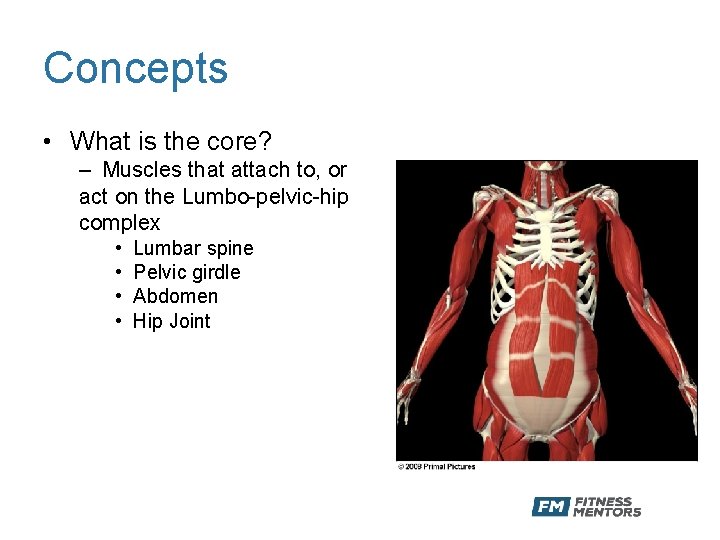
Concepts • What is the core? – Muscles that attach to, or act on the Lumbo-pelvic-hip complex • • Lumbar spine Pelvic girdle Abdomen Hip Joint
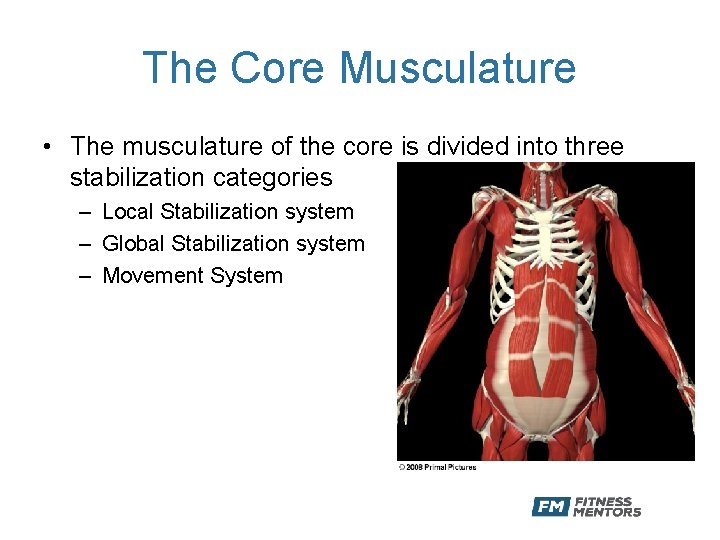
The Core Musculature • The musculature of the core is divided into three stabilization categories – Local Stabilization system – Global Stabilization system – Movement System
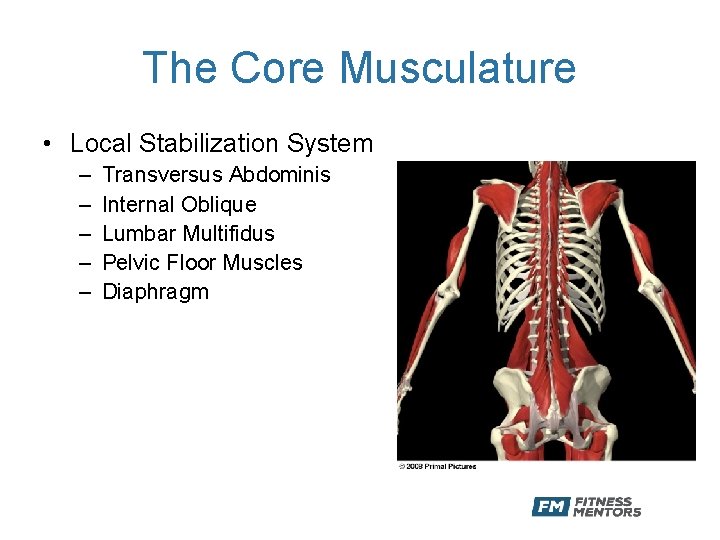
The Core Musculature • Local Stabilization System – – – Transversus Abdominis Internal Oblique Lumbar Multifidus Pelvic Floor Muscles Diaphragm
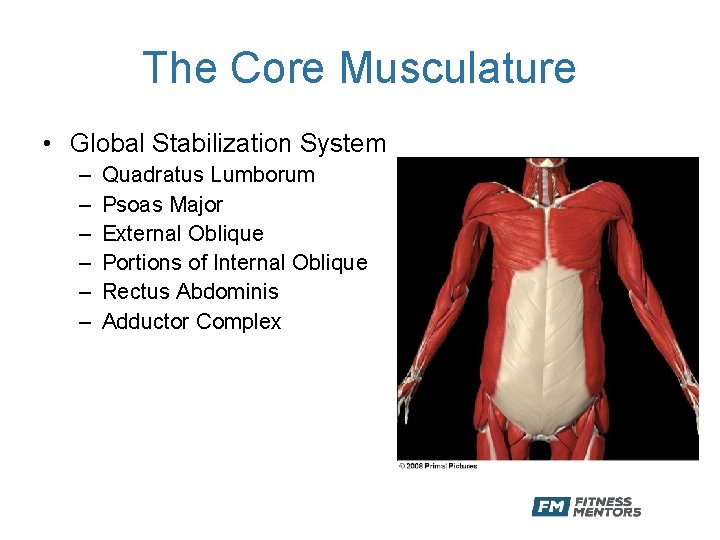
The Core Musculature • Global Stabilization System – – – Quadratus Lumborum Psoas Major External Oblique Portions of Internal Oblique Rectus Abdominis Adductor Complex
The Core Musculature • The Movement System – Latissimus Dorsi – Hip Flexors – Hamstring complex – Quadriceps
The Stabilization System • Many people have a strong movement system, but weak stabilizing muscles. – Increasing forces throughout the lumbo-pelvichip complex • May result in low-back pain and injury – Strengthen the stabilizers (stabilization system) before the musculature that moves the spine (movement system)
Scientific Rationale • Decreased activation of the stabilizing mechanism in individuals with chronic low back pain. – Performing traditional abdominal exercises without proper internal pelvic stabilization increases pressure on the disks and compressive forces in the lumbar spine. – Performing traditional low-back hyperextension exercises without proper internal pelvic stabilization increases pressure on the disks to dangerous levels.
Solutions for Stabilization • Drawing-in Maneuver – Pull in the region just below the navel toward the spine – Activates local stabilization system • Bracing – Co-contraction of the rectus abdominis, external obliques, and quadratus lumborum. – Focuses on global trunk stability, not segmental vertebral stability
Solutions for Stabilization • Maintaining the cervical spine in a neutral position during core training will improve posture, muscle balance, and stabilization.
Requirements for Core Training • The core stabilization system is primarily slow twitch, type I muscle fibers, which respond best to time under tension. – Muscles need sustained contractions (20 -30 seconds) to enhance static and dynamic stabilization of the lumbo-pelvic-hip complex.
Designing an Integrated Program • Exercise Selection – Progressive • • Easy to hard Simple to complex Known to unknown Stable to unstable – Systematic • Stabilization • Strength • Power
Program Design Variables • Planes of motion – Sagittal – Frontal – Transverse • Type of resistance – – – Stability ball Cable Tubing Medicine ball Power ball Dumbbells
The Levels of Core Training • Three levels of core training within the OPTTM model – Stabilization – Strength – Power
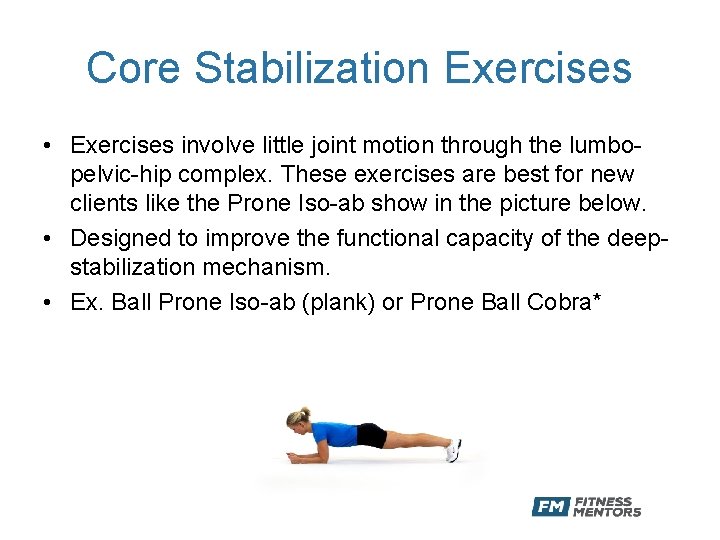
Core Stabilization Exercises • Exercises involve little joint motion through the lumbopelvic-hip complex. These exercises are best for new clients like the Prone Iso-ab show in the picture below. • Designed to improve the functional capacity of the deepstabilization mechanism. • Ex. Ball Prone Iso-ab (plank) or Prone Ball Cobra*
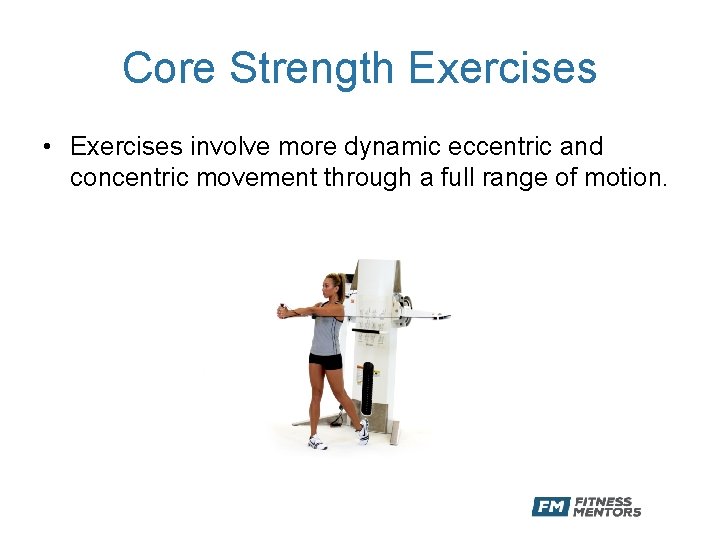
Core Strength Exercises • Exercises involve more dynamic eccentric and concentric movement through a full range of motion.
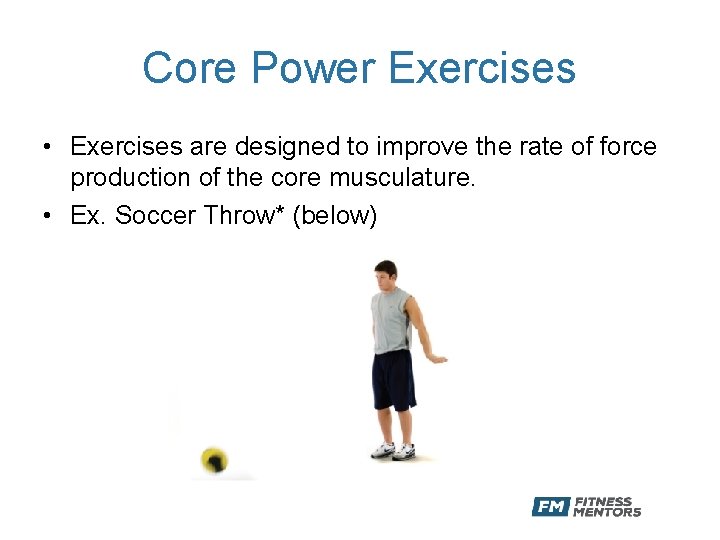
Core Power Exercises • Exercises are designed to improve the rate of force production of the core musculature. • Ex. Soccer Throw* (below)
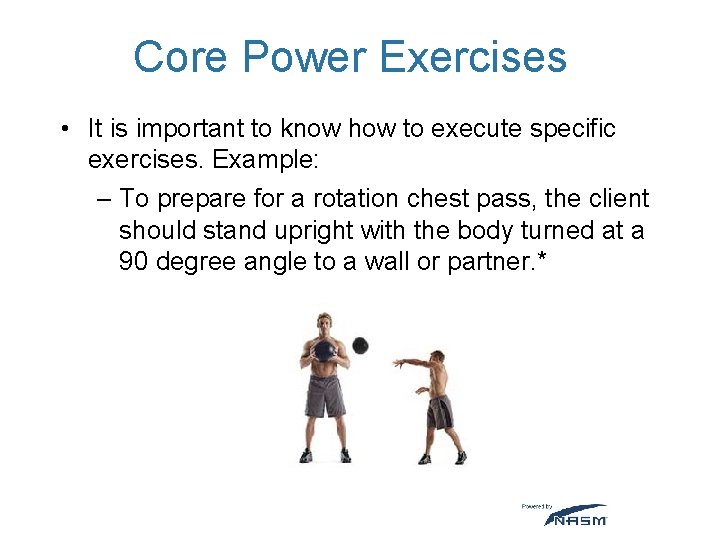
Core Power Exercises • It is important to know how to execute specific exercises. Example: – To prepare for a rotation chest pass, the client should stand upright with the body turned at a 90 degree angle to a wall or partner. *
Implementing a Core Program • Stabilization Level (Phase 1) – Select Core Stabilization Exercises • Strength Level (Phases 2– 4) – Select Core Strength Exercises • Power Level (Phase 5) – Select Core Power Exercises
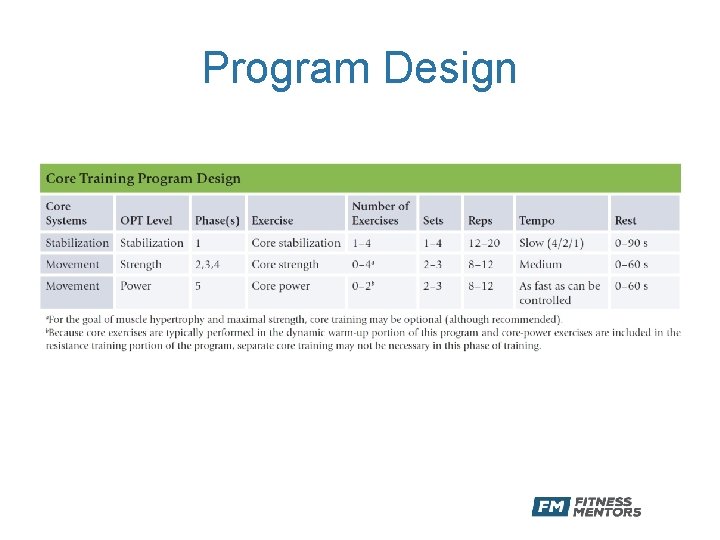
Program Design
Summary • The core musculature helps protect the spine from harmful forces that occur during functional activities. • Core-training programs must be systematic, progressive, activity- or goal-specific, integrated, and proprioceptively challenging. • A proper core-training program follows the same systematic progression as the OPT™ Model: stabilization, strength, and power.
- Slides: 22