
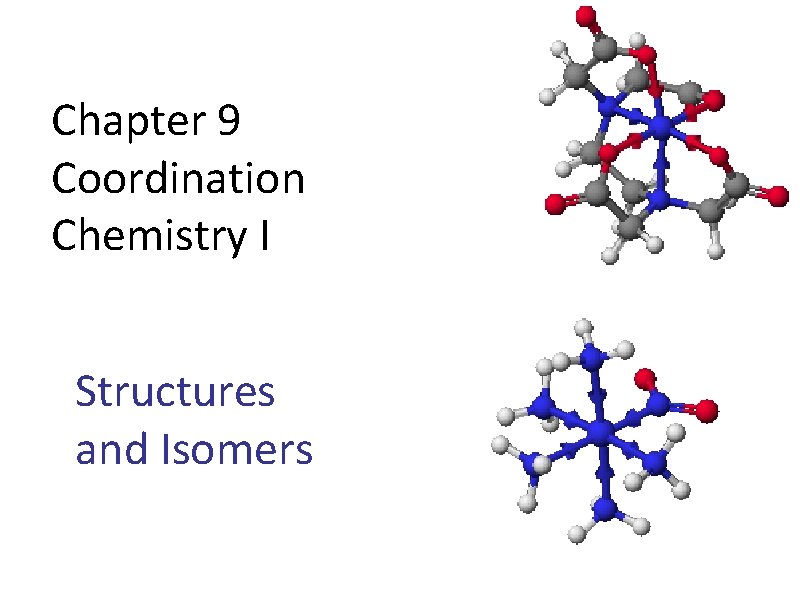
Chapter 9 Coordination Chemistry I Structures and Isomers

![Li 2[Co. F 6] VCl 3(NMe 3)2 (NH 4)3[Fe(CN)5 CO] K 3[Ni(CN)5] [Ru(bpy)3]Cl 2](https://slidetodoc.com/presentation_image_h/3460d304b34640378a8ad7acd448b792/image-10.jpg "Li 2[Co. F 6] VCl 3(NMe 3)2 (NH 4)3[Fe(CN)5 CO] K 3[Ni(CN)5] [Ru(bpy)3]Cl 2")
![Some examples. . . • • • Pt(NH 3)42+ [Co(NH 3)4(H 2 O)2]Cl 2](https://slidetodoc.com/presentation_image_h/3460d304b34640378a8ad7acd448b792/image-11.jpg "Some examples. . . • • • Pt(NH 3)42+ [Co(NH 3)4(H 2 O)2]Cl 2")

















- Slides: 60
Chapter 9 Coordination Chemistry I Structures and Isomers
2
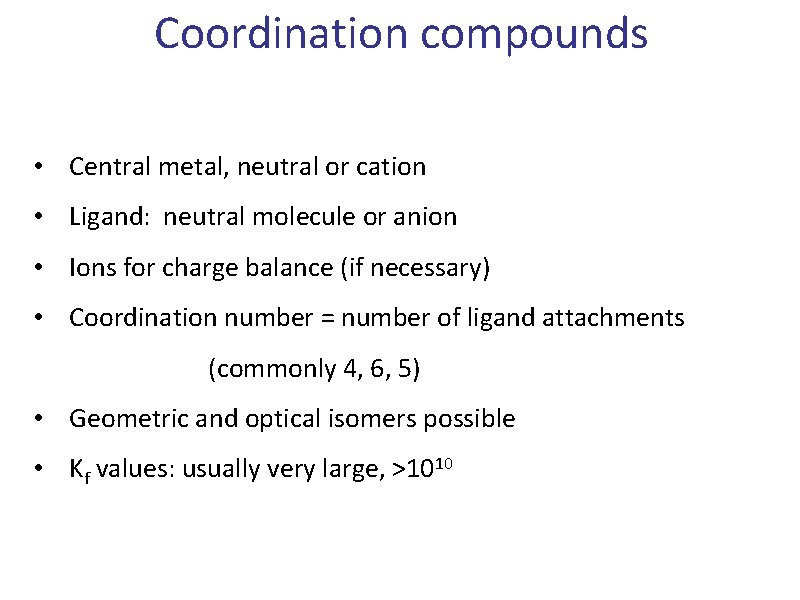
Coordination compounds • Central metal, neutral or cation • Ligand: neutral molecule or anion • Ions for charge balance (if necessary) • Coordination number = number of ligand attachments (commonly 4, 6, 5) • Geometric and optical isomers possible • Kf values: usually very large, >1010
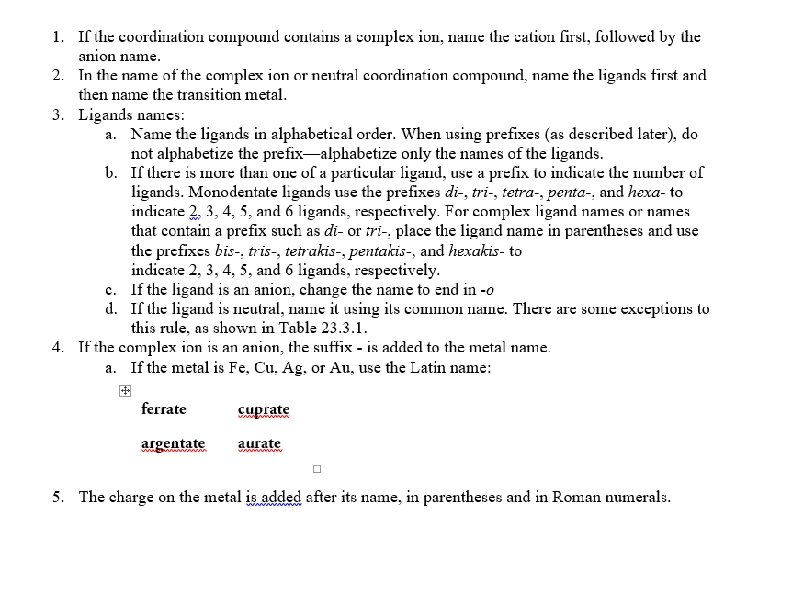
Naming Coordination Compounds • Cation + anion • Ligands + metal in coordination compound • Charge indicated by Roman numerals in parentheses • If complex ion carries a negative charge, add -ate to the name of the metal • Ligands are named in alphabetical order • Prefixes indicate the number of ligands
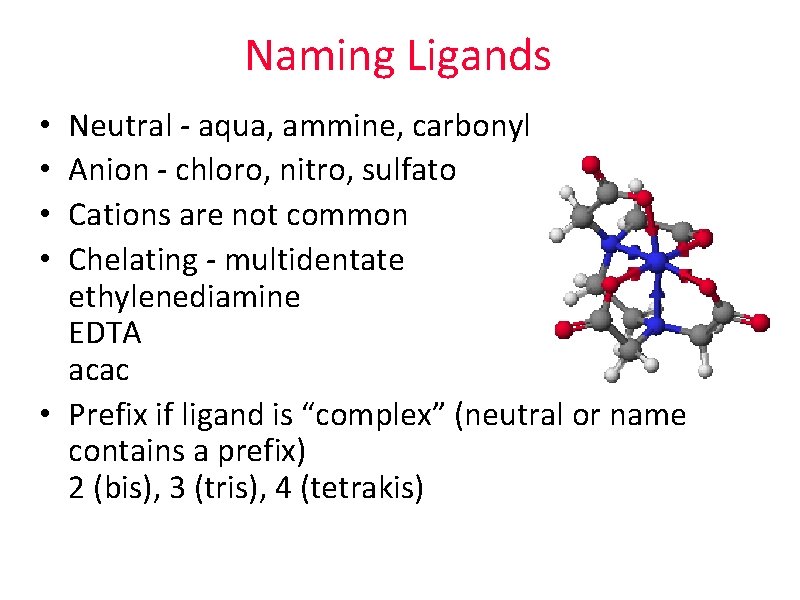
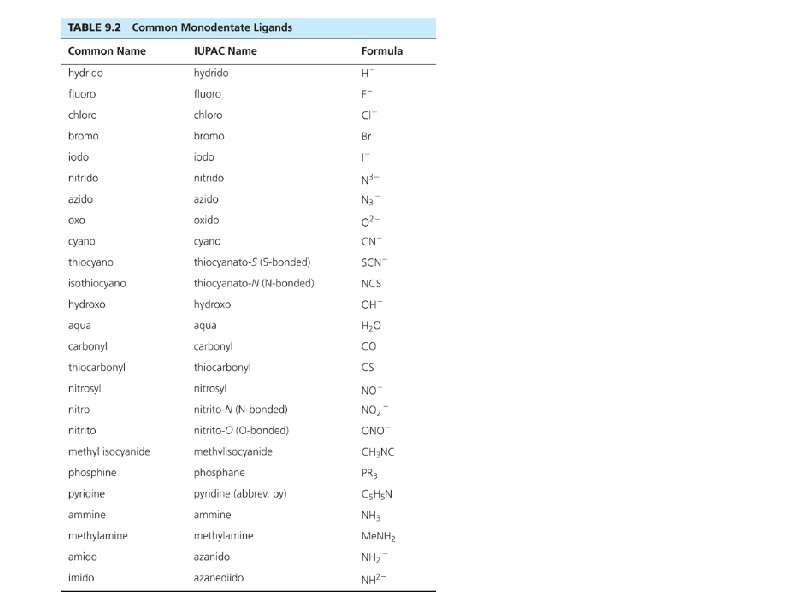
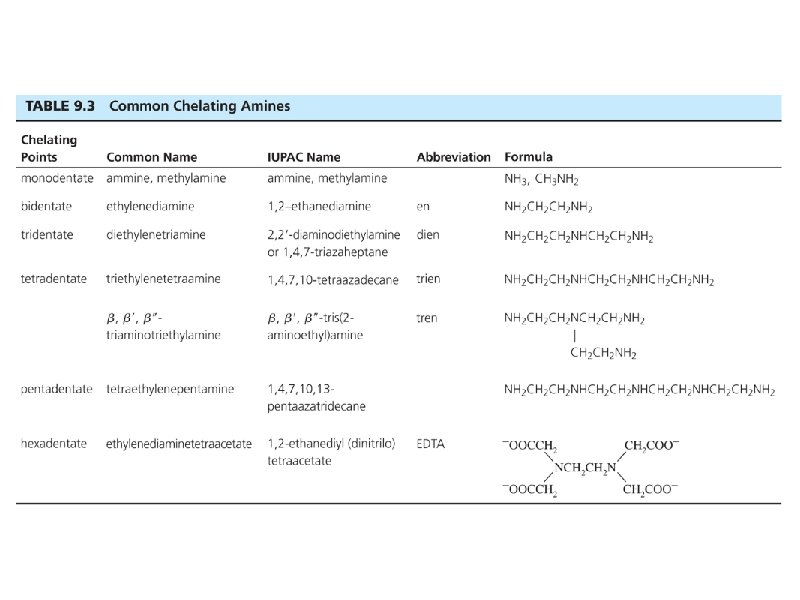
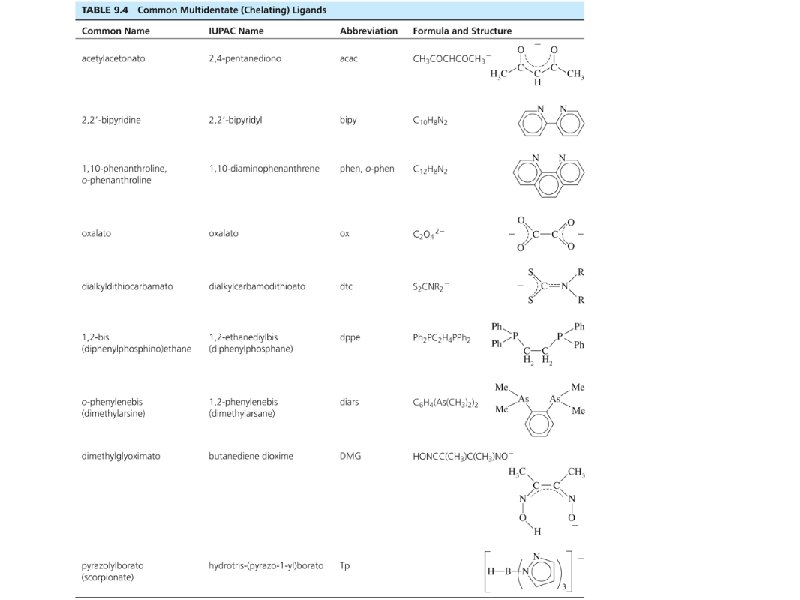
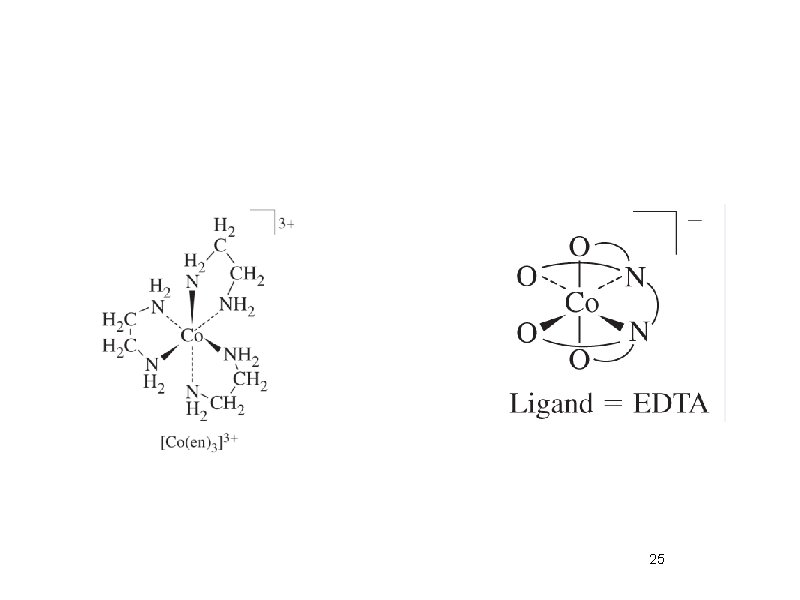
Naming Ligands Neutral - aqua, ammine, carbonyl Anion - chloro, nitro, sulfato Cations are not common Chelating - multidentate ethylenediamine EDTA acac • Prefix if ligand is “complex” (neutral or name contains a prefix) 2 (bis), 3 (tris), 4 (tetrakis) • •
Li 2[Co. F 6] VCl 3(NMe 3)2 (NH 4)3[Fe(CN)5 CO] K 3[Ni(CN)5] [Ru(bpy)3]Cl 2 10
Some examples. . . • • • Pt(NH 3)42+ [Co(NH 3)4(H 2 O)2]Cl 2 Ligands shown in Tables in Chapter 9 Bridging ligands - μ Naming rules in Chapter 9 Exercises 9 -1 and 9 -2
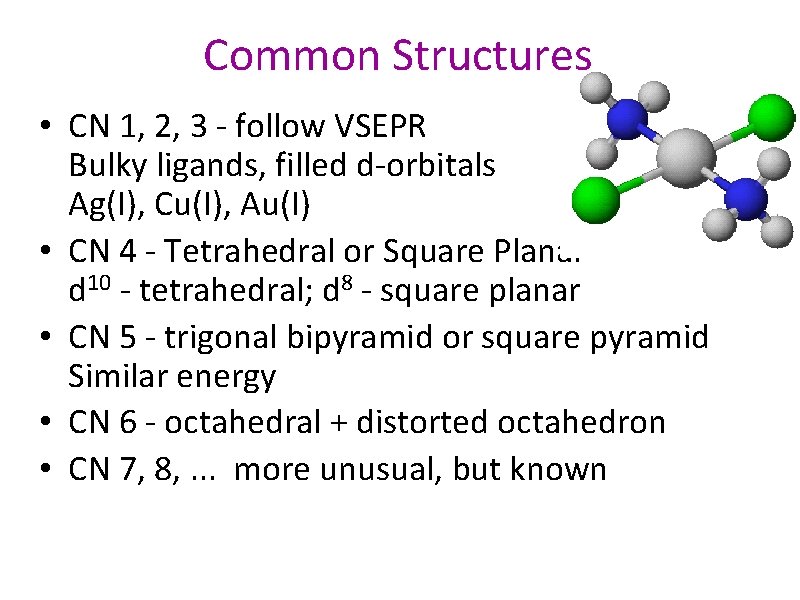
Common Structures • CN 1, 2, 3 - follow VSEPR Bulky ligands, filled d-orbitals Ag(I), Cu(I), Au(I) • CN 4 - Tetrahedral or Square Planar d 10 - tetrahedral; d 8 - square planar • CN 5 - trigonal bipyramid or square pyramid Similar energy • CN 6 - octahedral + distorted octahedron • CN 7, 8, . . . more unusual, but known
13
Coordination Compound Isomers • Stereoisomers geometric and optical isomers • Structural hydrate, solvent, ionization, linkage isomers
Geometric Isomers • • CN 4 and 6 most common cis, trans fac, mer Isomer designations for compounds containing chelating ligands can get complicated (see textbook), we will not use
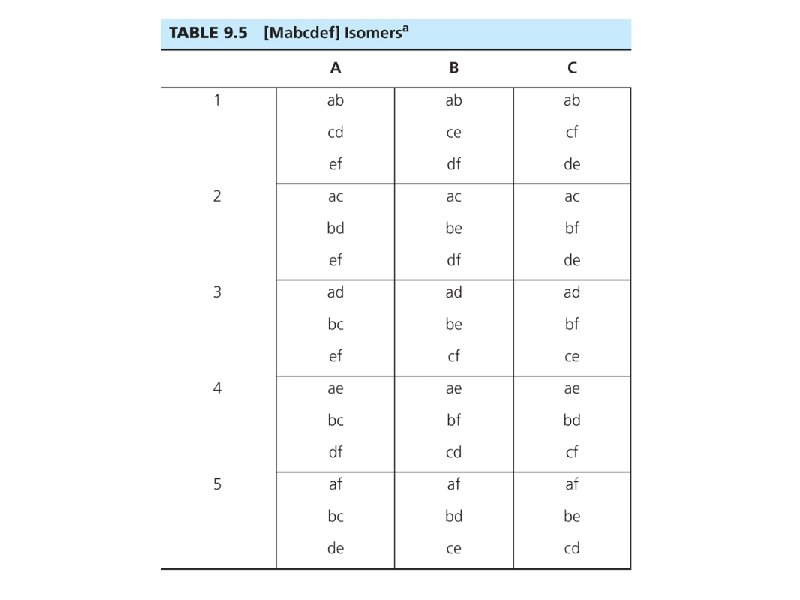
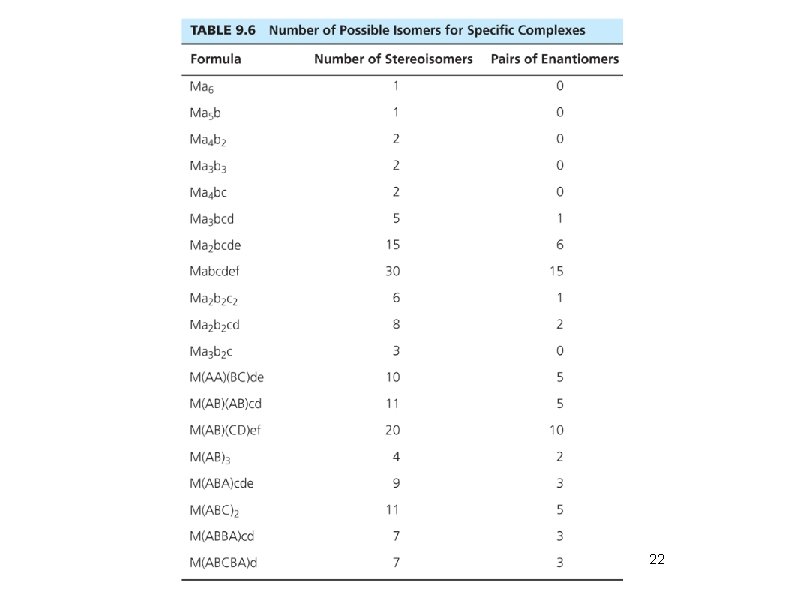
Geometric + Optical Isomers • Octahedral geometry (consider monodentate ligands only): trans-pair method • Mabcdef: Identify all trans pairs, then identify optically active isomers (ab)(cd)(ef), (ab)(ce)(df), (ab)(cf)(de), . . . • Try Ma 2 b 2 cd • Diastereomer + mirror image = pair of enantiomers • Bidentate ligands? Use capital letters or “manual” method to identify geometric isomers • M(AA)(BB)c 2 • How many isomers? How many chiral isomers?
17
18
19
20
22
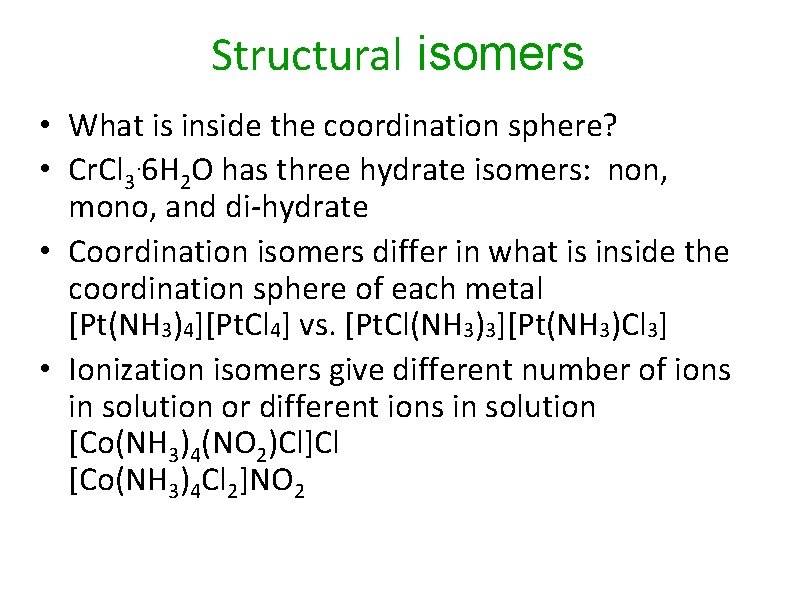
Structural isomers • What is inside the coordination sphere? • Cr. Cl 3. 6 H 2 O has three hydrate isomers: non, mono, and di-hydrate • Coordination isomers differ in what is inside the coordination sphere of each metal [Pt(NH 3)4][Pt. Cl 4] vs. [Pt. Cl(NH 3)3][Pt(NH 3)Cl 3] • Ionization isomers give different number of ions in solution or different ions in solution [Co(NH 3)4(NO 2)Cl]Cl [Co(NH 3)4 Cl 2]NO 2
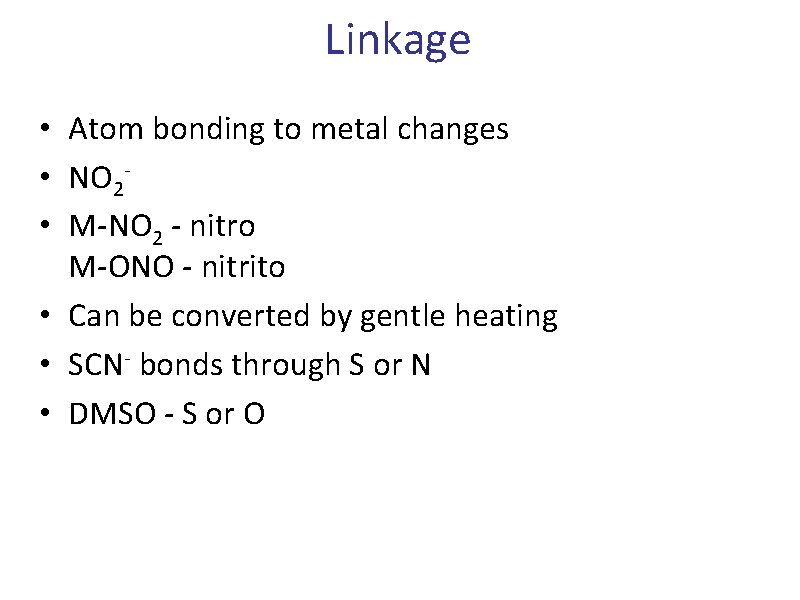
Linkage • Atom bonding to metal changes • NO 2 • M-NO 2 - nitro M-ONO - nitrito • Can be converted by gentle heating • SCN- bonds through S or N • DMSO - S or O
25
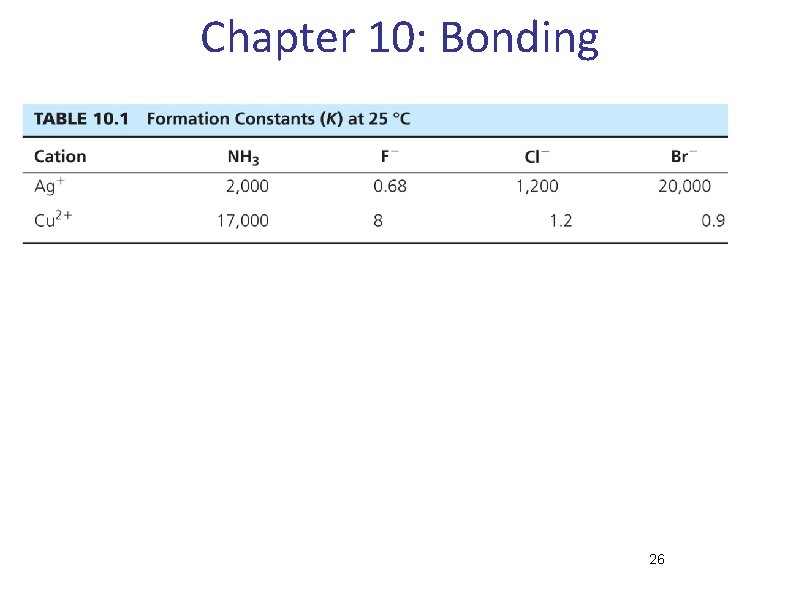
Chapter 10: Bonding 26
27
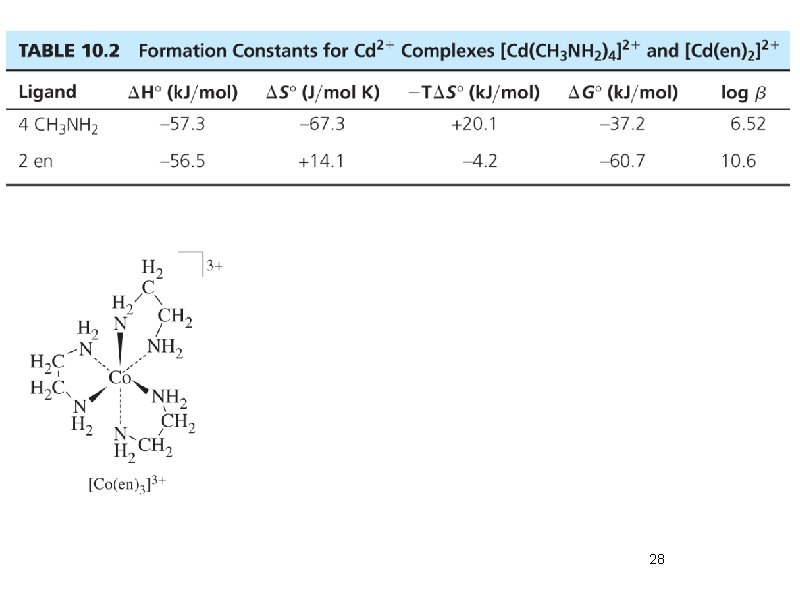
28
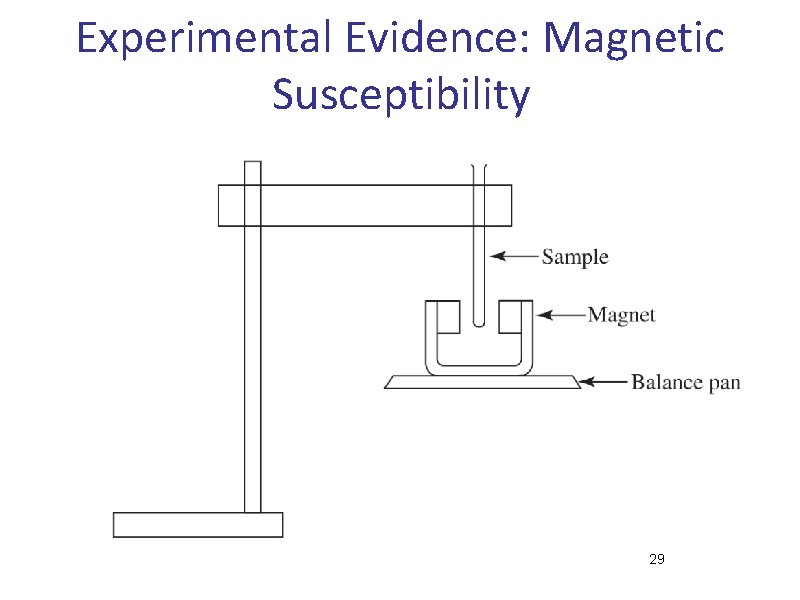
Experimental Evidence: Magnetic Susceptibility 29
30
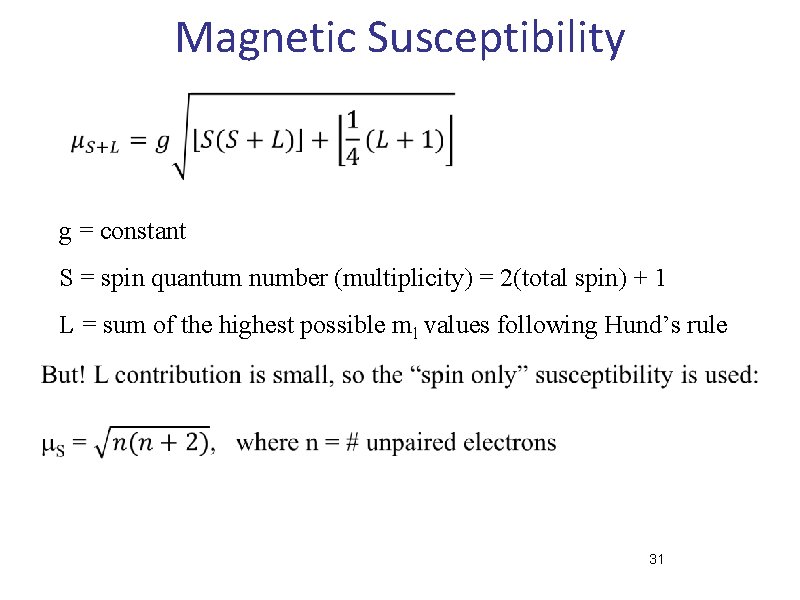
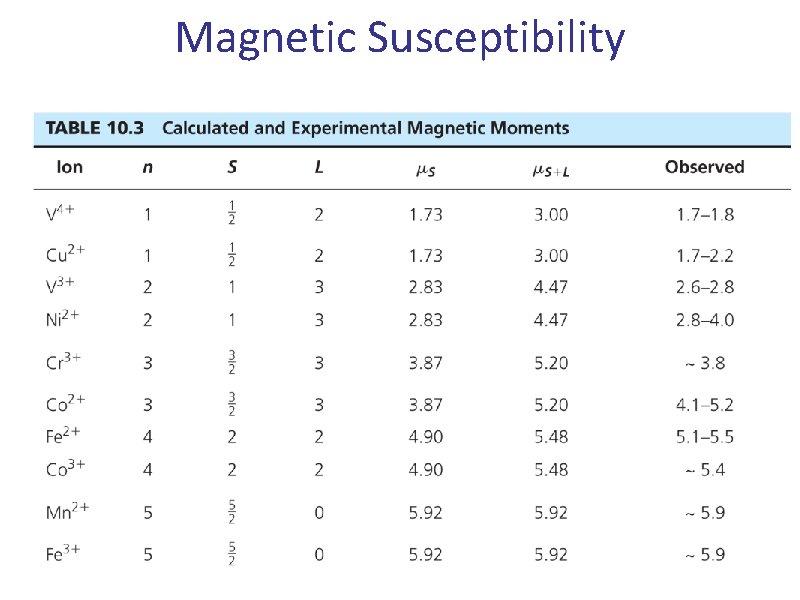
Magnetic Susceptibility g = constant S = spin quantum number (multiplicity) = 2(total spin) + 1 L = sum of the highest possible ml values following Hund’s rule 31
Magnetic Susceptibility 32
Do some examples: 33
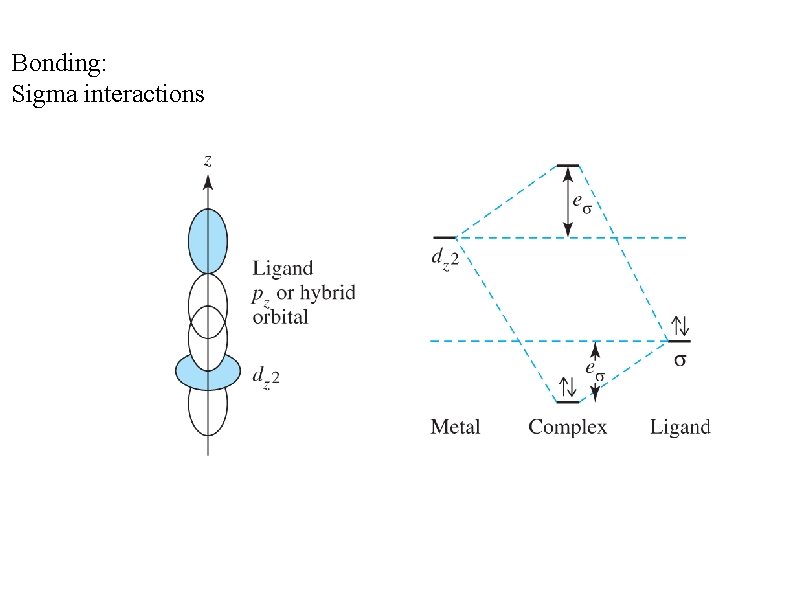
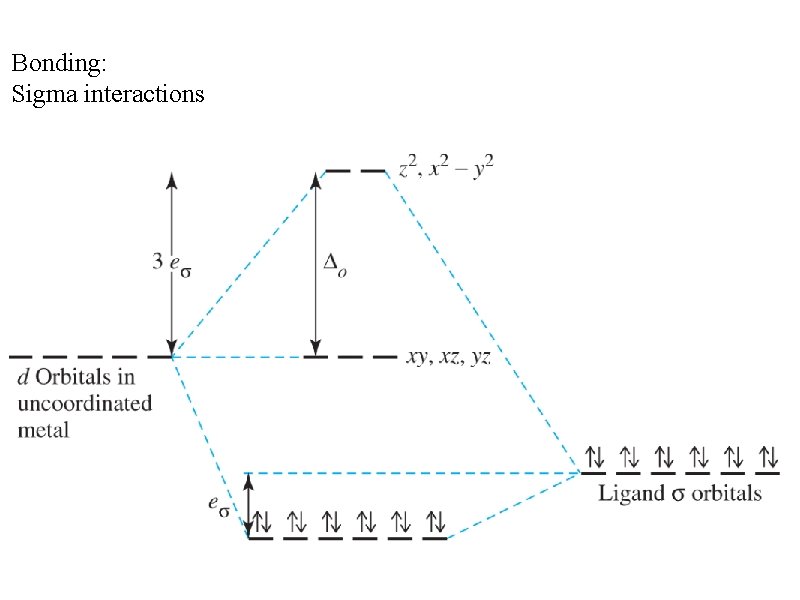
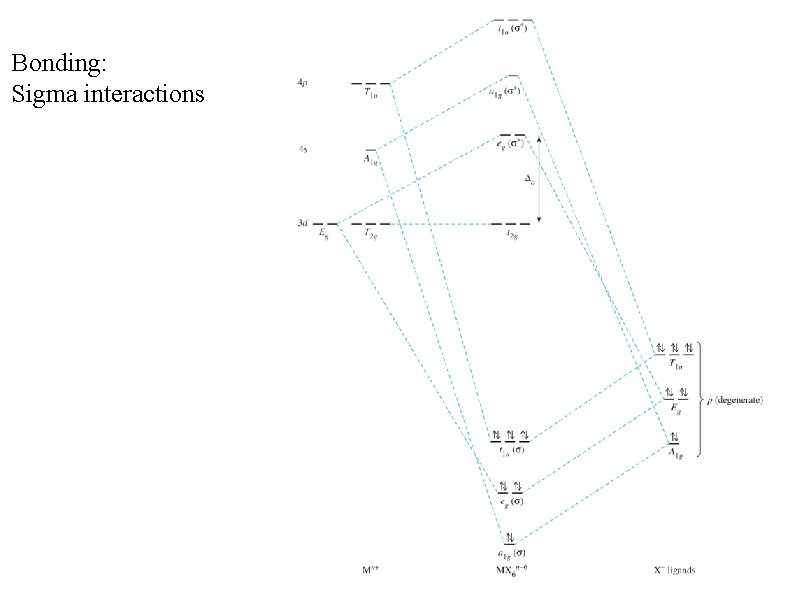
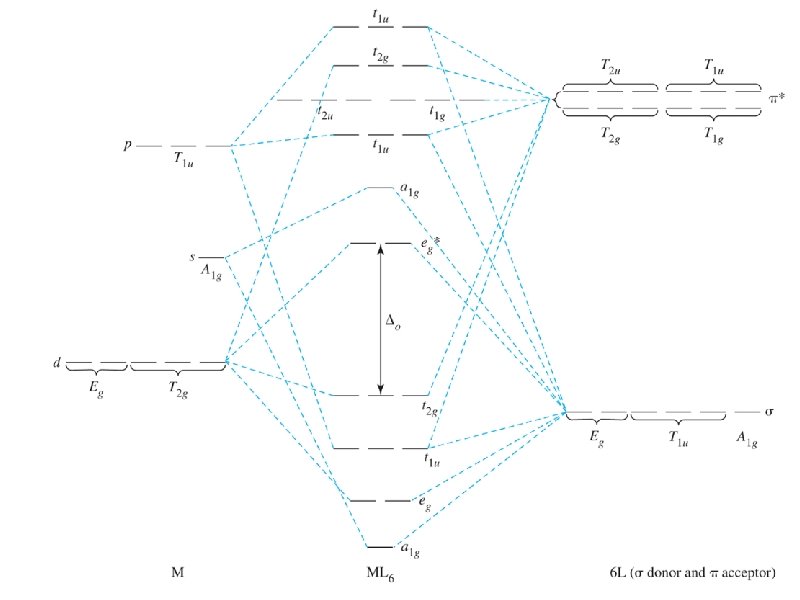
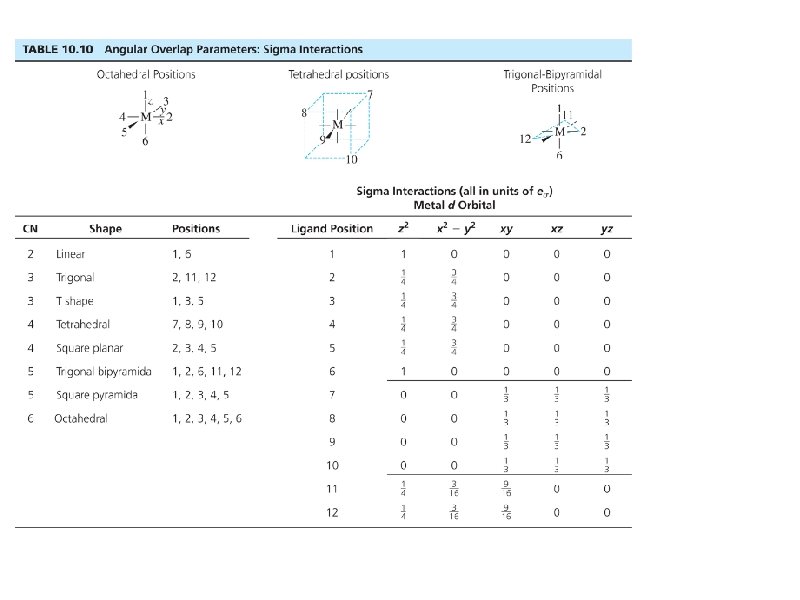
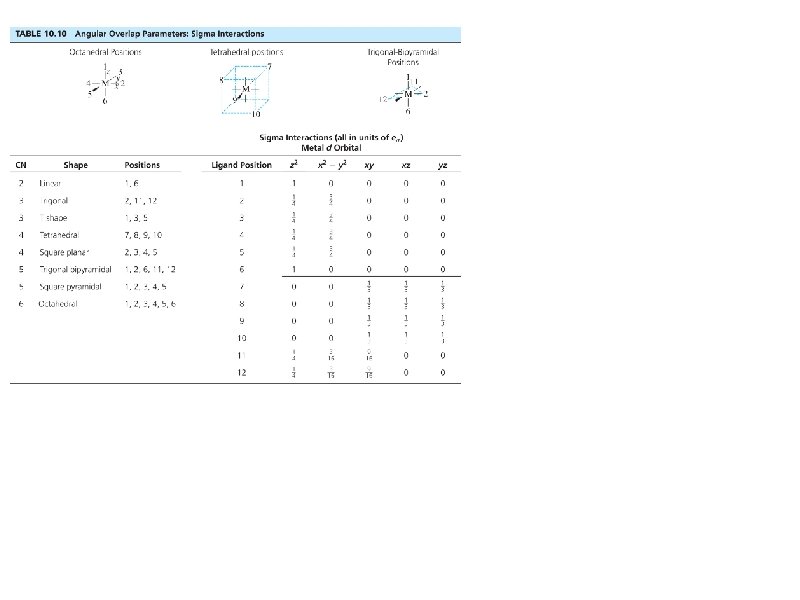
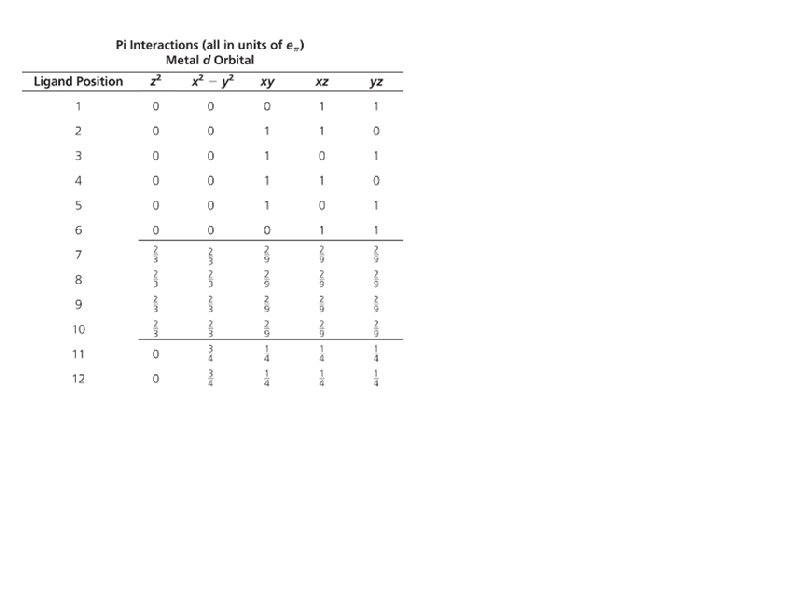
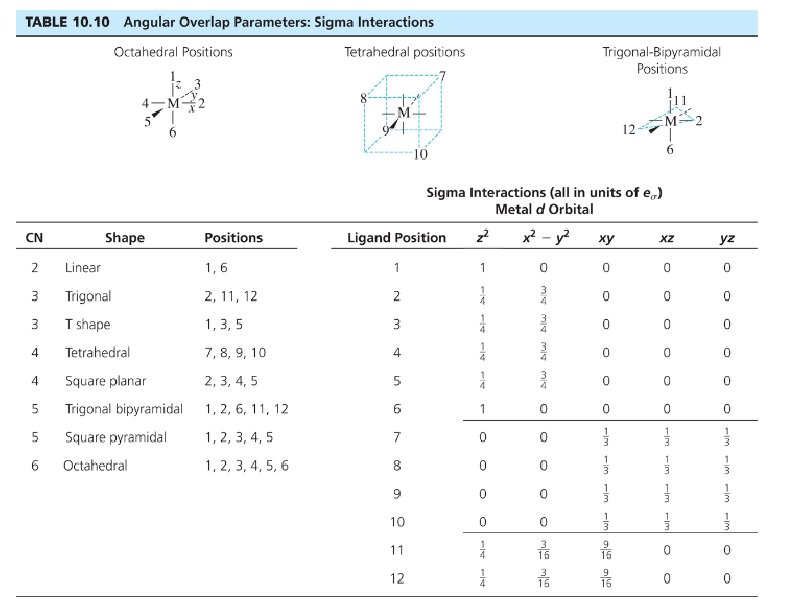
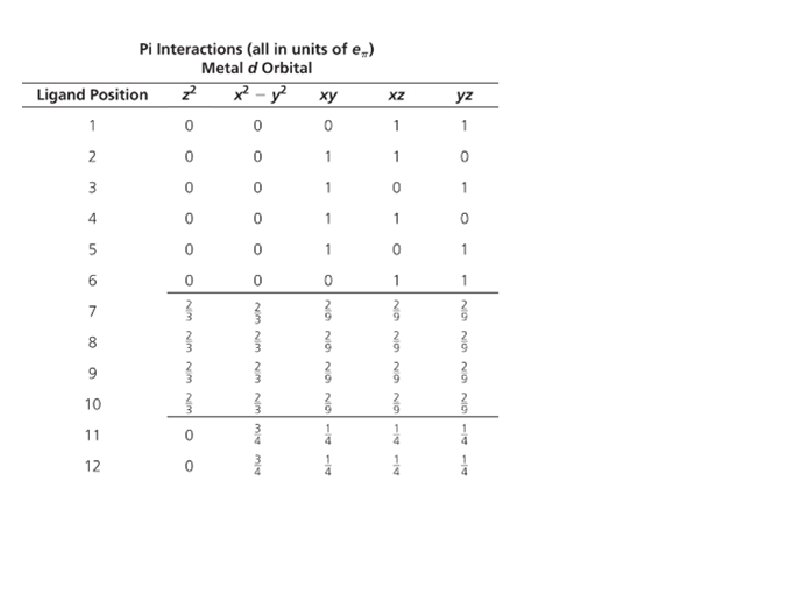
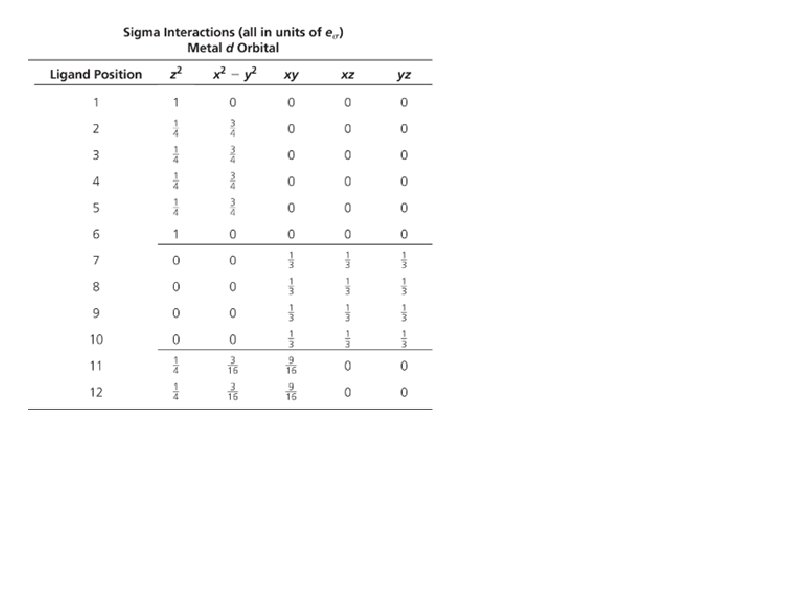
Bonding: Sigma interactions
35
Bonding: Sigma interactions
Bonding: Sigma interactions
38
High Spin/Low Spin States
40
41
42
43
44
Spectroscopy
48
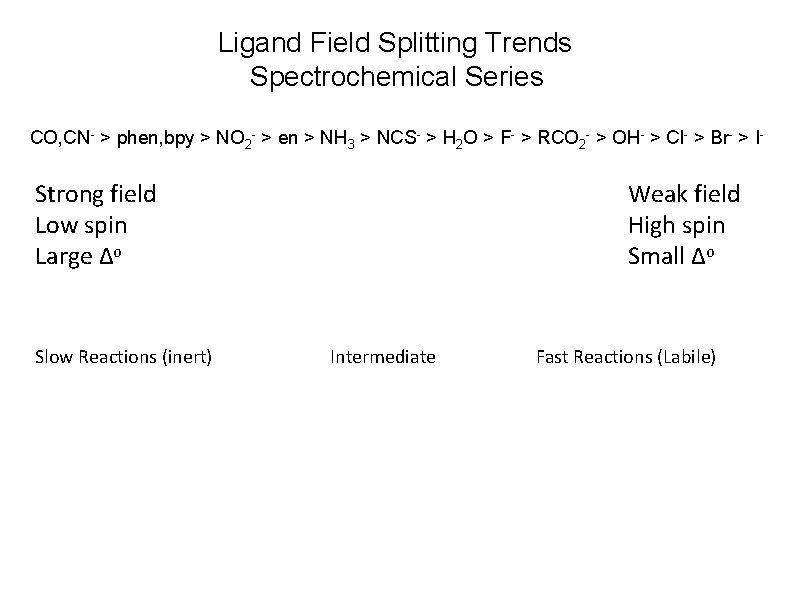
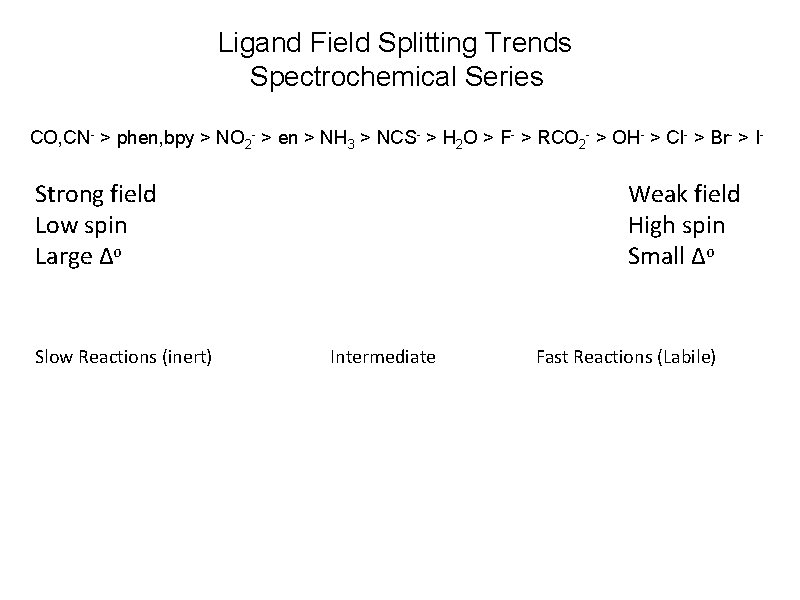
Ligand Field Splitting Trends Spectrochemical Series CO, CN- > phen, bpy > NO 2 - > en > NH 3 > NCS- > H 2 O > F- > RCO 2 - > OH- > Cl- > Br- > I- Strong field Low spin Large Δo Slow Reactions (inert) Weak field High spin Small Δo Intermediate Fast Reactions (Labile)
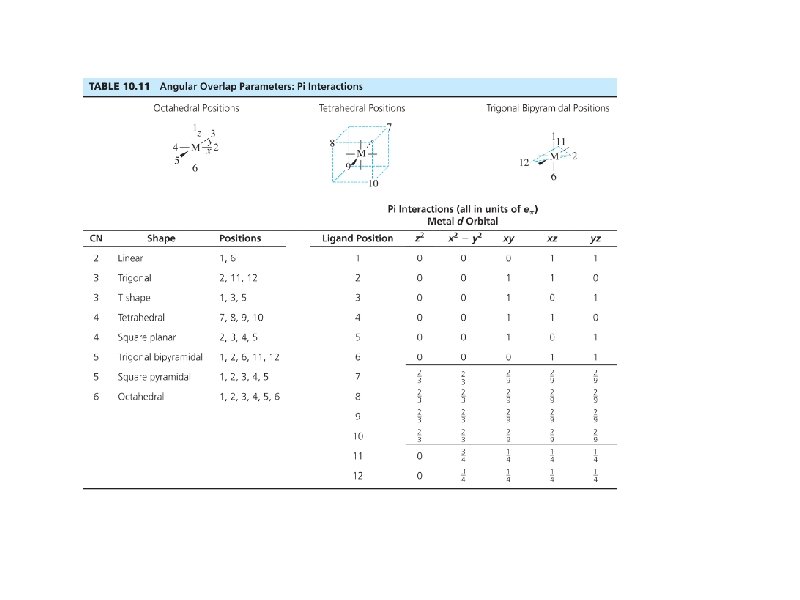
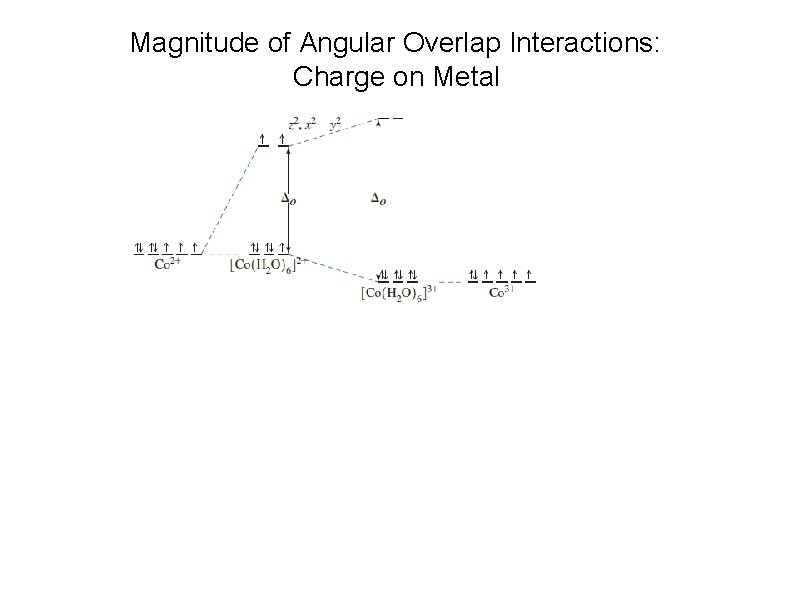
Magnitude of Angular Overlap Interactions: Charge on Metal
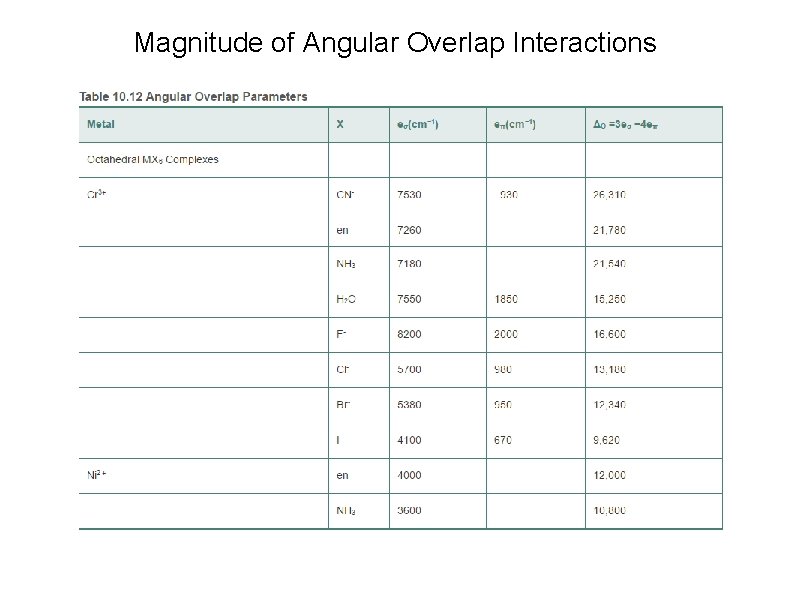
Magnitude of Angular Overlap Interactions
Ligand Field Splitting Trends Spectrochemical Series CO, CN- > phen, bpy > NO 2 - > en > NH 3 > NCS- > H 2 O > F- > RCO 2 - > OH- > Cl- > Br- > I- Strong field Low spin Large Δo Slow Reactions (inert) Weak field High spin Small Δo Intermediate Fast Reactions (Labile)
58
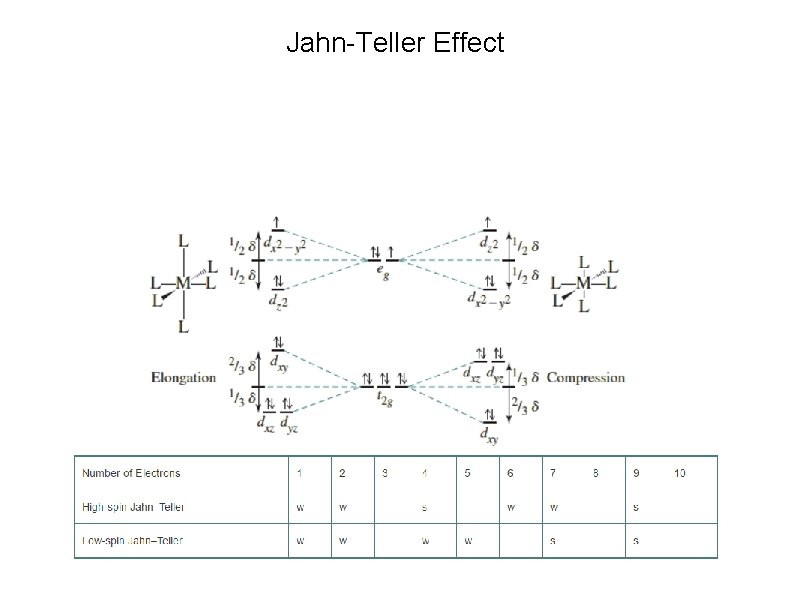
Jahn-Teller Effect
Jahn-Teller Effect