
Chapter 9 Compounds and Their Bonds Polyatomic Ions
Chapter 9 Compounds and Their Bonds Polyatomic Ions Covalent Compounds Bond Polarity 1

Thursday Feb. 16, 2012 Objective: IWBAT review how to write the formula for ionic compounds • • • Agenda: Catalyst More practice about ionic bonds Practice Problems on page 217 Section 8. 2 Assessment Page. 220 (Q 12 -18) • Practice Problems page 224 ( Q. 19 -23) • Practice Problems ( 24 -28) Catalyst Explain the polyatomic ions. Name the followings: -2 (SO 4) -2 (CO 3) Homework: page Lecture. PLUS Timberlake 2, 3, 4 of H. W 2
SIT ACCORDING TO YOUR NUMBER. If you have any suggestion or argument, come to the office hour to discuss it. THANK YOU Lecture. PLUS Timberlake 3
Monday 10/7/13 Objectives: IWBAT describe and illustrate Covalent Bonds • • • Agenda: Catalyst Binder check Design a model of Na. Cl Covalent Bond Worksheet Practice Problem Page 244 Home work: Chemical bonds project due Tuesday/Wednesday 10/15 Catalyst • Explain a chemical bonds • Describe an ionic bond • Write the correct formula for the followings: • A. potassium and iodide • B. aluminum and bromide • C. Sodium and Nitride 4
Announcement • Don’t put your home work assignments in paper out trays ( the colorful ones). • Put your assignments in Paper in trays on the wall. • Thank you! • Think about a topic for Science fair • Chemical bonds project is due Tuesday 10/15 5

Covalent Bonds l Formed between two nonmetals in 4 A, 5 A, 6 A, and 7 A l Nonmetals have high electronegativity values l Electrons are shared single bond shares one pair electrons double bond shares two pairs electrons triple bond shares three pairs electrons Lecture. PLUS Timberlake 6
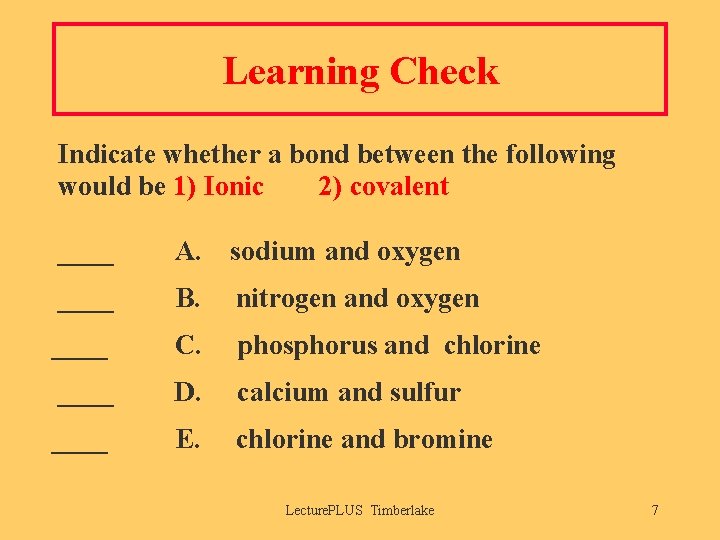
Learning Check Indicate whether a bond between the following would be 1) Ionic 2) covalent ____ A. sodium and oxygen ____ B. nitrogen and oxygen ____ C. phosphorus and chlorine ____ D. calcium and sulfur ____ E. chlorine and bromine Lecture. PLUS Timberlake 7
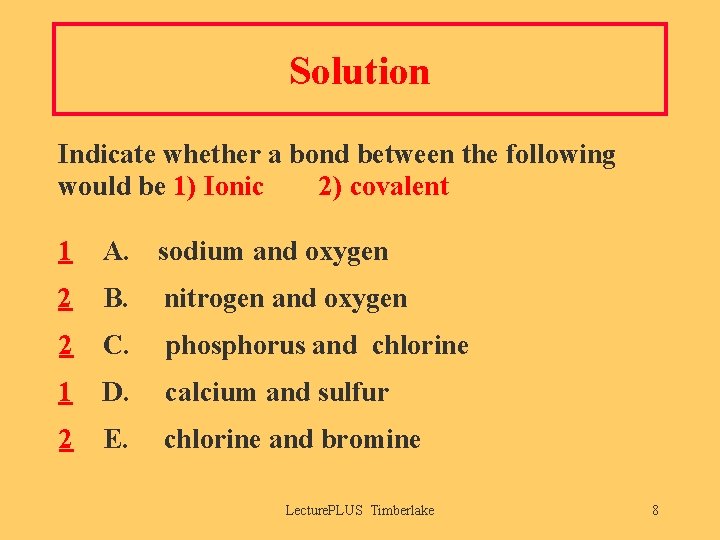
Solution Indicate whether a bond between the following would be 1) Ionic 2) covalent 1 A. sodium and oxygen 2 B. nitrogen and oxygen 2 C. phosphorus and chlorine 1 D. calcium and sulfur 2 E. chlorine and bromine Lecture. PLUS Timberlake 8
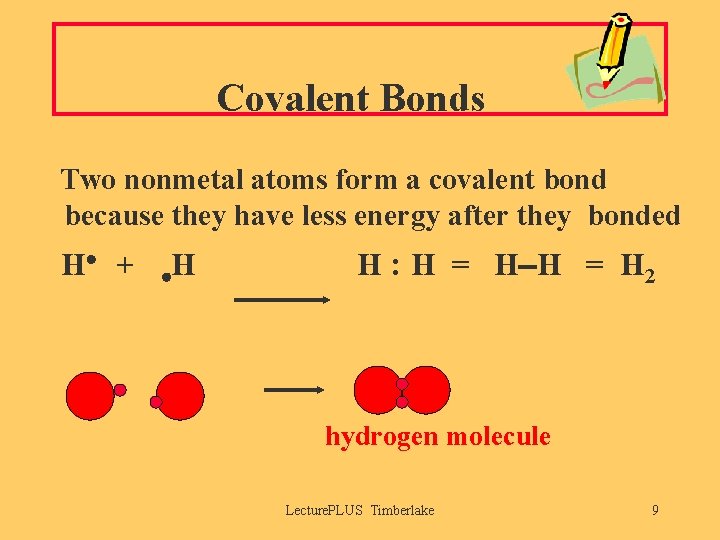
Covalent Bonds Two nonmetal atoms form a covalent bond because they have less energy after they bonded H + H H : H = H 2 hydrogen molecule Lecture. PLUS Timberlake 9

Diatomic Molecules Gases that exist as diatomic molecules are H 2, F 2, N 2, O 2, Cl 2, Br 2, I 2 octets N + N N: : : N triple bond Lecture. PLUS Timberlake 10
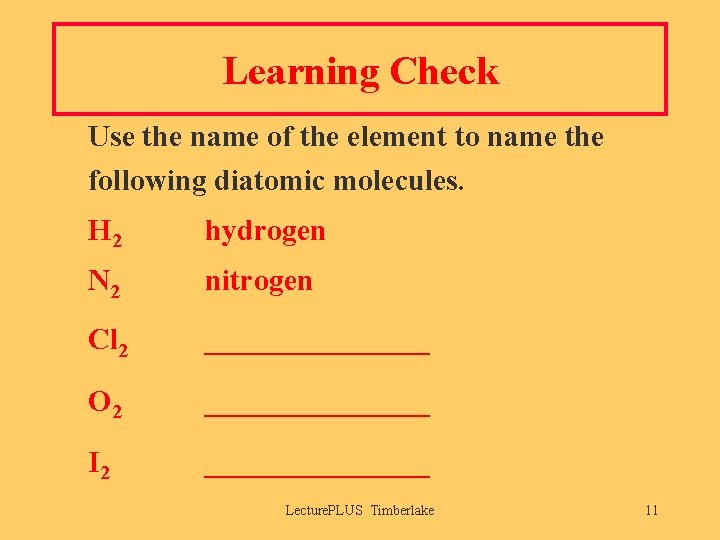
Learning Check Use the name of the element to name the following diatomic molecules. H 2 hydrogen N 2 nitrogen Cl 2 ________ O 2 ________ I 2 ________ Lecture. PLUS Timberlake 11
Solution Use the name of the element to name the following diatomic molecules. H 2 hydrogen N 2 nitrogen Cl 2 chlorine O 2 oxygen I 2 iodine Lecture. PLUS Timberlake 12

Covalent Bonds in NH 3 Bonding pairs H H : N : H Lone pair of electrons Lecture. PLUS Timberlake 13
Bond Polarity: Nonpolar covalent bond l Electrons are shared between atoms with the same electronegativity values. l Difference = 0 l Examples: N 2 Br 2 Lecture. PLUS Timberlake 14
Bond Polarity: Polar covalent bond l Electrons are shared between different nonmetal atoms Examples: O-Cl O-S N-Cl Lecture. PLUS Timberlake 15
Tuesday Feb. 12, 2013 Objectives: IWBAT explain naming covalent bond • • Agenda: Catalyst Naming covalent compounds Polar and non polar C. V. Practice problems page 249 Section 9. 2 Assessment page 251 Binder check Work on the project Catalyst • Explain electronegativty • Draw Lewis Diagram for the followings • NH 3 • CH 4 Homework: Lewis structure for at least 5 covalent compounds/chart of prefixes Lecture. PLUS Timberlake 16 Test on Chemical Bonds
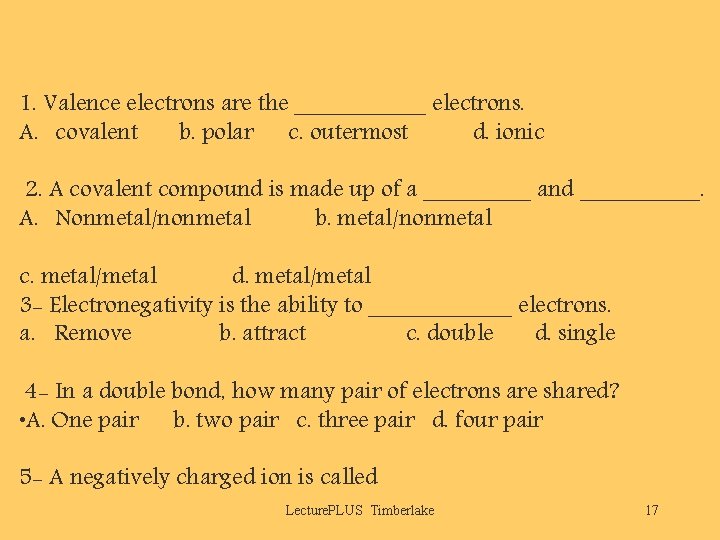
1. Valence electrons are the ______ electrons. A. covalent b. polar c. outermost d. ionic 2. A covalent compound is made up of a _____ and _____. A. Nonmetal/nonmetal b. metal/nonmetal c. metal/metal d. metal/metal 3 - Electronegativity is the ability to ______ electrons. a. Remove b. attract c. double d. single 4 - In a double bond, how many pair of electrons are shared? • A. One pair b. two pair c. three pair d. four pair 5 - A negatively charged ion is called Lecture. PLUS Timberlake 17
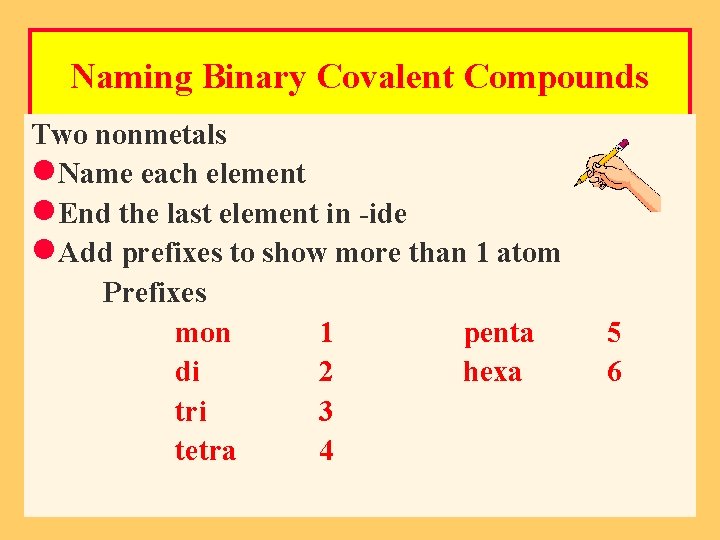
Naming Binary Covalent Compounds Two nonmetals l. Name each element l. End the last element in -ide l. Add prefixes to show more than 1 atom Prefixes mon 1 penta di 2 hexa tri 3 tetra 4 Lecture. PLUS Timberlake 5 6 18
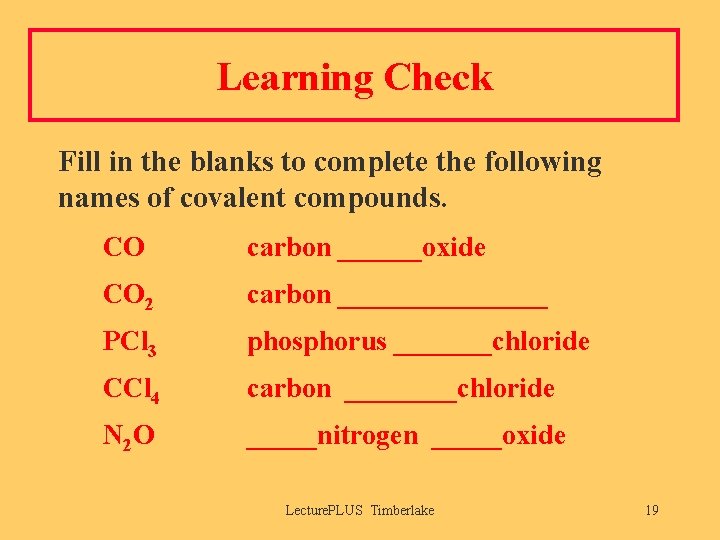
Learning Check Fill in the blanks to complete the following names of covalent compounds. CO carbon ______oxide CO 2 carbon ________ PCl 3 phosphorus _______chloride CCl 4 carbon ____chloride N 2 O _____nitrogen _____oxide Lecture. PLUS Timberlake 19
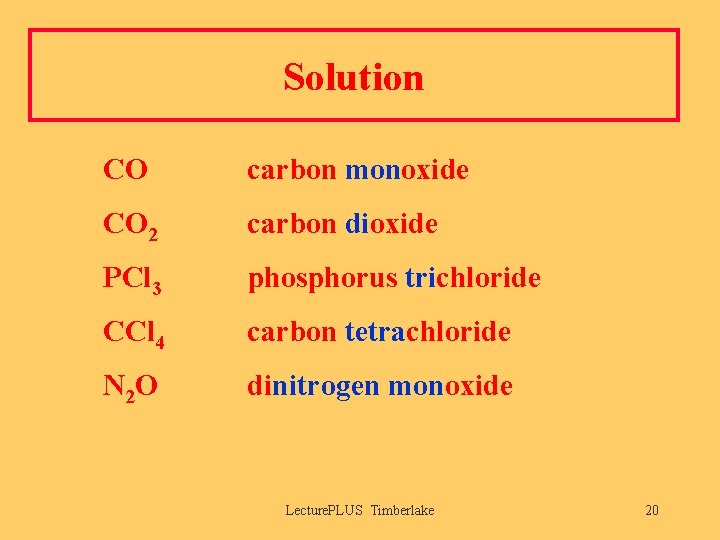
Solution CO carbon monoxide CO 2 carbon dioxide PCl 3 phosphorus trichloride CCl 4 carbon tetrachloride N 2 O dinitrogen monoxide Lecture. PLUS Timberlake 20
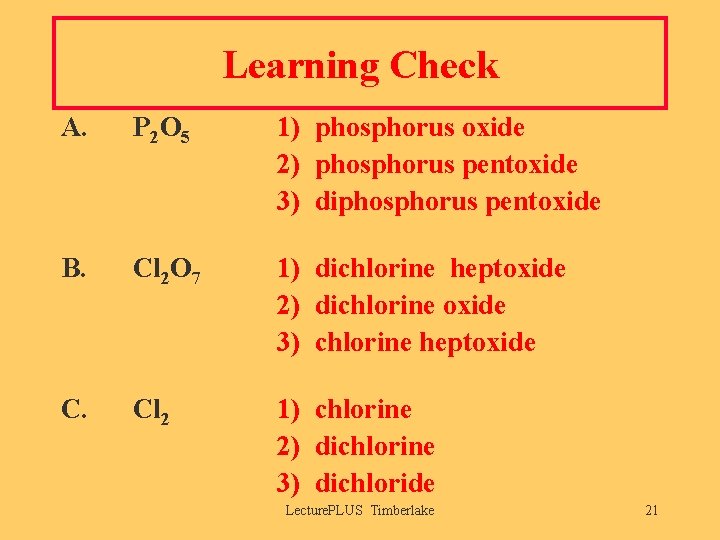
Learning Check A. P 2 O 5 1) phosphorus oxide 2) phosphorus pentoxide 3) diphosphorus pentoxide B. Cl 2 O 7 1) dichlorine heptoxide 2) dichlorine oxide 3) chlorine heptoxide C. Cl 2 1) chlorine 2) dichlorine 3) dichloride Lecture. PLUS Timberlake 21
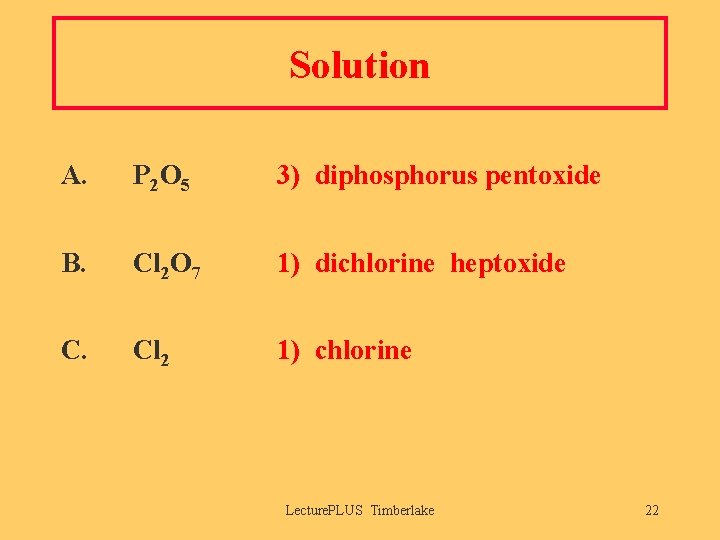
Solution A. P 2 O 5 3) diphosphorus pentoxide B. Cl 2 O 7 1) dichlorine heptoxide C. Cl 2 1) chlorine Lecture. PLUS Timberlake 22
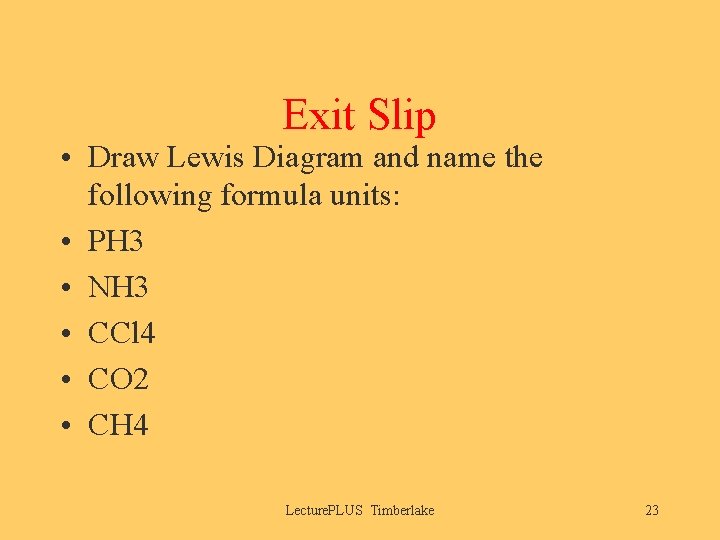
Exit Slip • Draw Lewis Diagram and name the following formula units: • PH 3 • NH 3 • CCl 4 • CO 2 • CH 4 Lecture. PLUS Timberlake 23
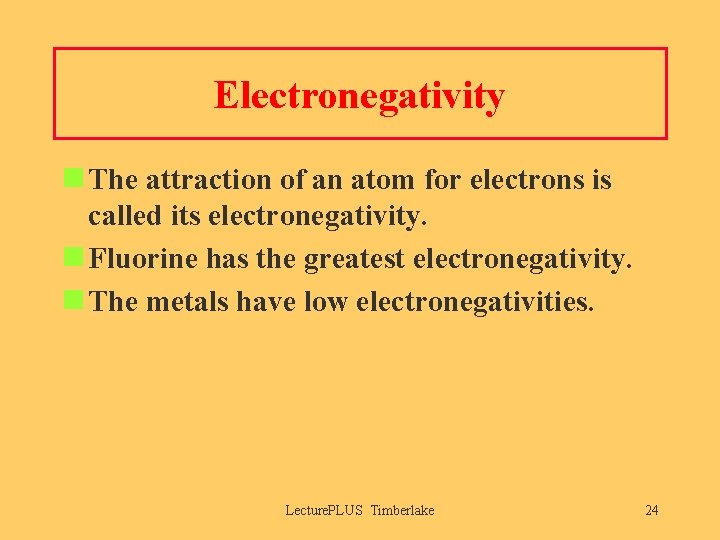
Electronegativity n The attraction of an atom for electrons is called its electronegativity. n Fluorine has the greatest electronegativity. n The metals have low electronegativities. Lecture. PLUS Timberlake 24
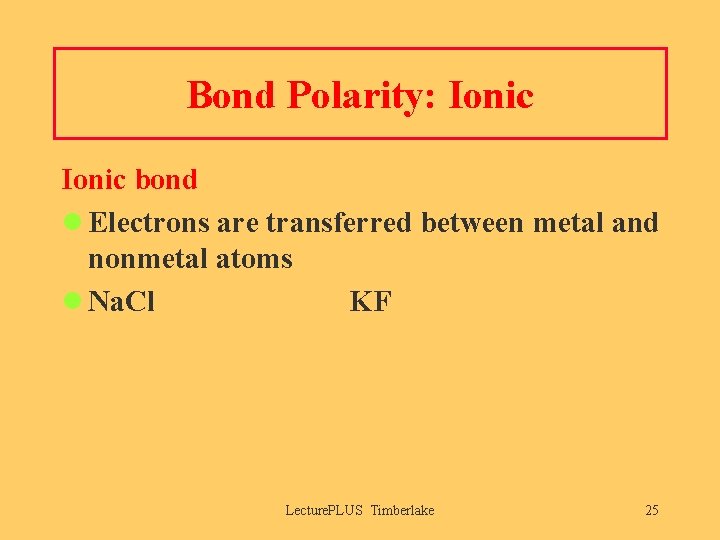
Bond Polarity: Ionic bond l Electrons are transferred between metal and nonmetal atoms l Na. Cl KF Lecture. PLUS Timberlake 25
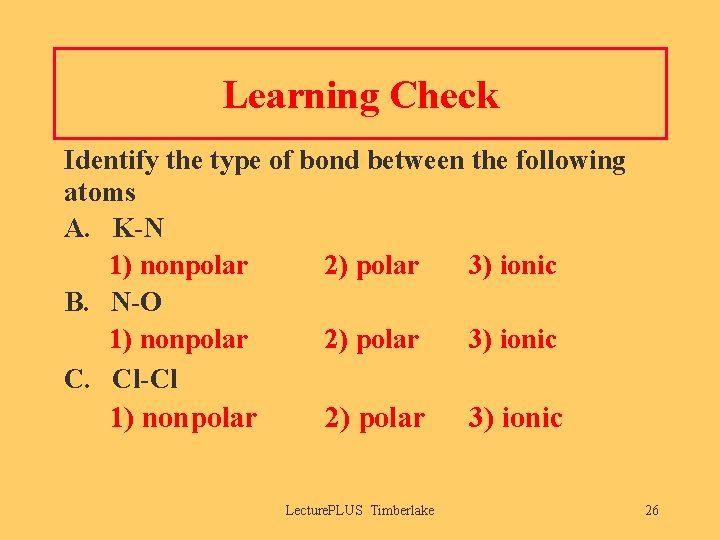
Learning Check Identify the type of bond between the following atoms A. K-N 1) nonpolar 2) polar 3) ionic B. N-O 1) nonpolar 2) polar 3) ionic C. Cl-Cl 1) nonpolar 2) polar Lecture. PLUS Timberlake 3) ionic 26
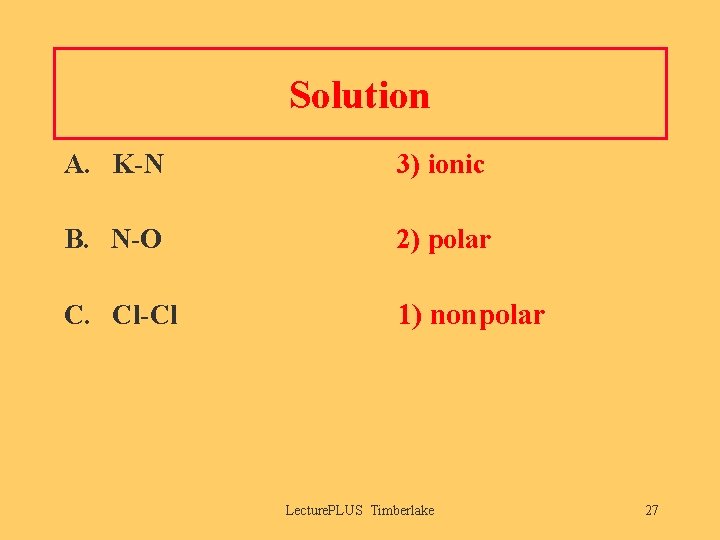
Solution A. K-N 3) ionic B. N-O 2) polar C. Cl-Cl 1) nonpolar Lecture. PLUS Timberlake 27
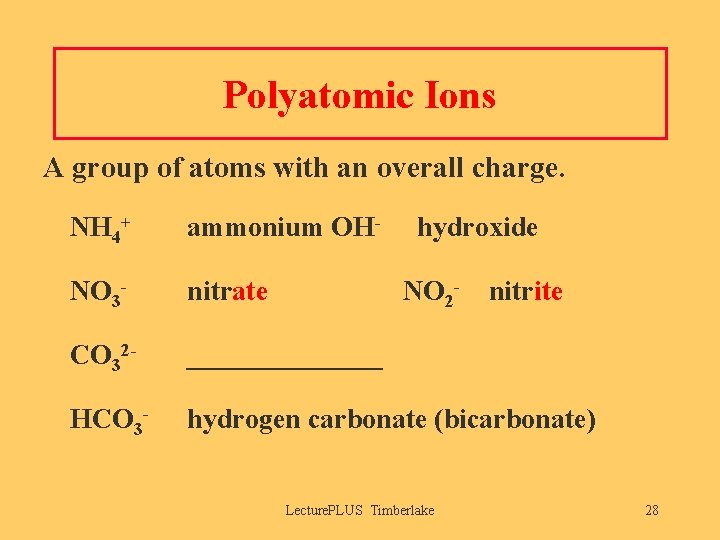
Polyatomic Ions A group of atoms with an overall charge. NH 4+ ammonium OH- hydroxide NO 3 - nitrate CO 32 - _______ HCO 3 - hydrogen carbonate (bicarbonate) NO 2 - Lecture. PLUS Timberlake nitrite 28

More Polyatomic Ions Sulfur SO 42 - sulfate SO 32 - sulfite HSO 4 - hydrogen sulfate HSO 3 - hydrogen sulfite Phosphate PO 43 - phosphate PO 33 - ______ HPO 42 - ________________ H 2 PO 4 - dihydrogen phosphate Lecture. PLUS Timberlake 29
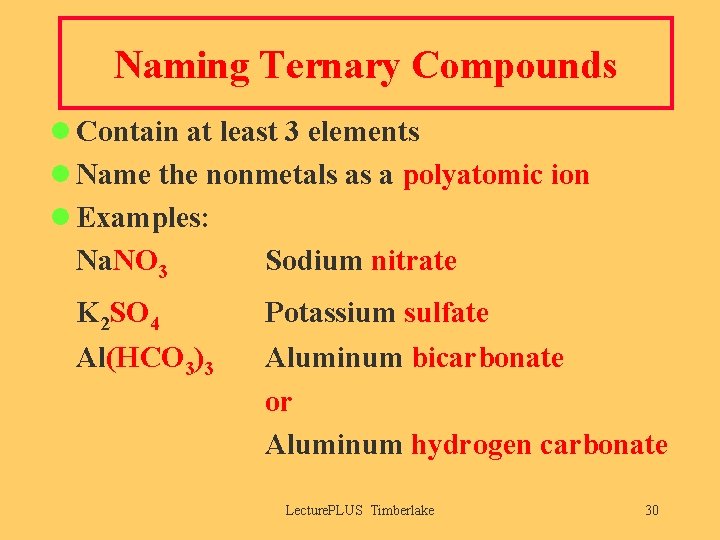
Naming Ternary Compounds l Contain at least 3 elements l Name the nonmetals as a polyatomic ion l Examples: Na. NO 3 Sodium nitrate K 2 SO 4 Potassium sulfate Al(HCO 3)3 Aluminum bicarbonate or Aluminum hydrogen carbonate Lecture. PLUS Timberlake 30
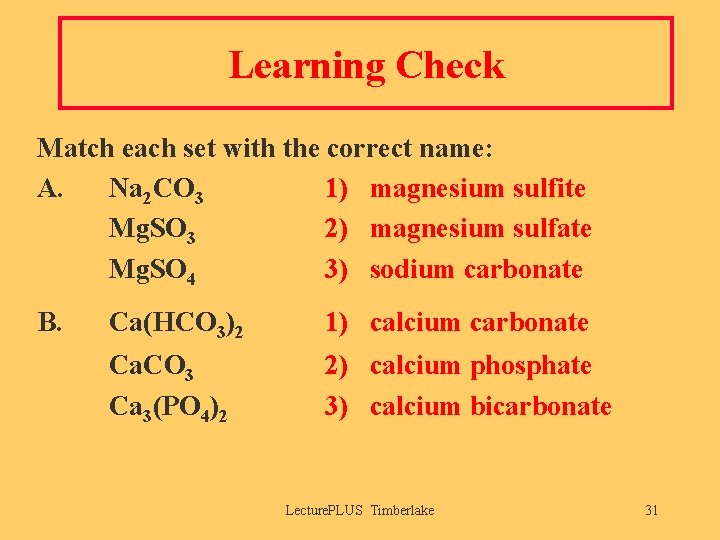
Learning Check Match each set with the correct name: A. Na 2 CO 3 1) magnesium sulfite Mg. SO 3 2) magnesium sulfate Mg. SO 4 3) sodium carbonate B. Ca(HCO 3)2 1) calcium carbonate Ca. CO 3 Ca 3(PO 4)2 2) calcium phosphate 3) calcium bicarbonate Lecture. PLUS Timberlake 31
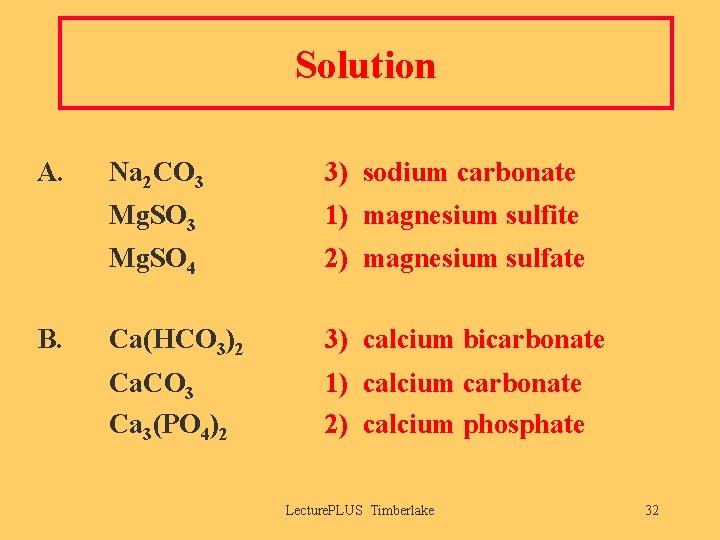
Solution A. B. Na 2 CO 3 3) sodium carbonate Mg. SO 3 1) magnesium sulfite Mg. SO 4 2) magnesium sulfate Ca(HCO 3)2 3) calcium bicarbonate Ca. CO 3 Ca 3(PO 4)2 1) calcium carbonate 2) calcium phosphate Lecture. PLUS Timberlake 32
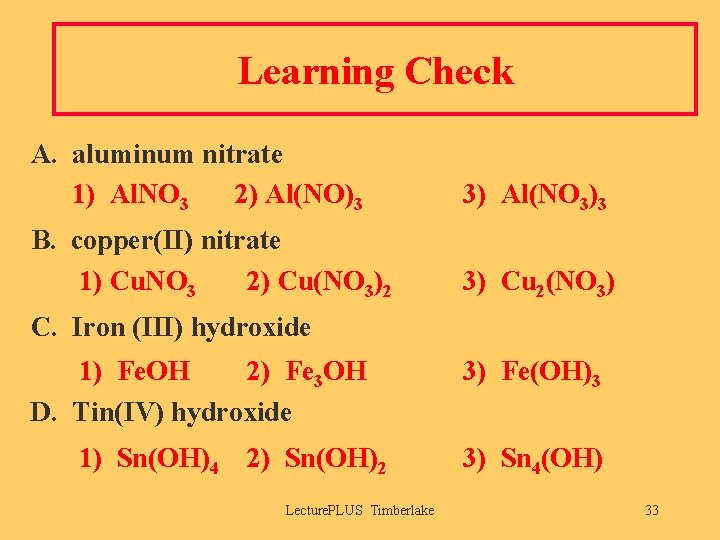
Learning Check A. aluminum nitrate 1) Al. NO 3 2) Al(NO)3 3) Al(NO 3)3 B. copper(II) nitrate 1) Cu. NO 3 2) Cu(NO 3)2 3) Cu 2(NO 3) C. Iron (III) hydroxide 1) Fe. OH 2) Fe 3 OH D. Tin(IV) hydroxide 1) Sn(OH)4 2) Sn(OH)2 Lecture. PLUS Timberlake 3) Fe(OH)3 3) Sn 4(OH) 33
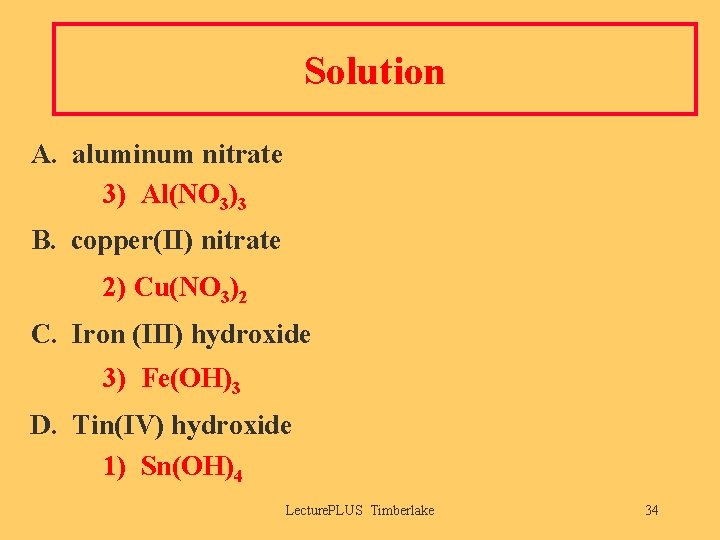
Solution A. aluminum nitrate 3) Al(NO 3)3 B. copper(II) nitrate 2) Cu(NO 3)2 C. Iron (III) hydroxide 3) Fe(OH)3 D. Tin(IV) hydroxide 1) Sn(OH)4 Lecture. PLUS Timberlake 34
- Slides: 34