
chapter 9 Communications and Customers Functions of Communication
- Slides: 18
chapter 9 Communications and Customers
Functions of Communication • The communication process has two distinct functions: 1. Conveying information 2. Achieving mutual understanding • Effective communication is a true two-way process.
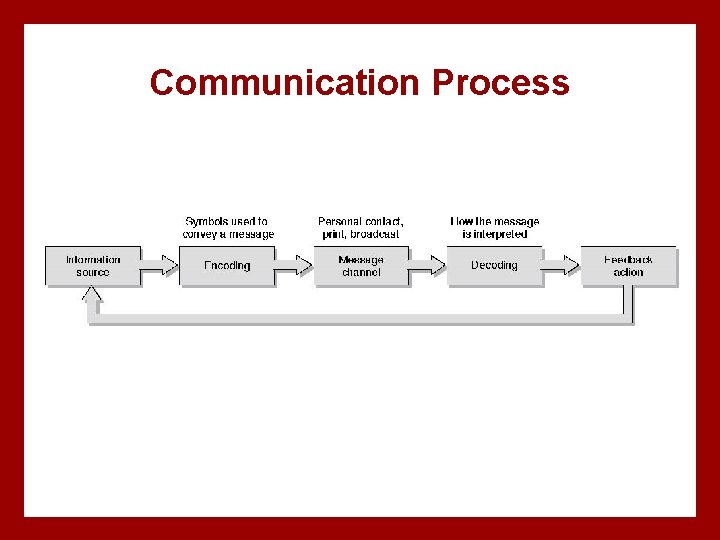
Communication Process
Communication Process: Key Terms • • Encoding Communication channels Decoding Feedback
Communication Breakdowns • Communication noise includes the internal and external factors that interfere with an effective communication process. • External noise could include a loud or distracting work environment. (continued)
Communication Breakdowns (continued) • Internal noise refers to the factors that often result in a misinterpretation of a message— for example, nonwork stress or other distractions. • External–internal noise is when misinterpretation comes from the social context. (continued)
Communication Breakdowns (continued) • Sociocultural noise occurs because of cultural misinterpretations. • Language choices can result in breakdowns because of vague language, multiple meanings, or the use of jargon.
Strategic Approach to Communication • Carefully consider whom your audience is. • Understand the needs and information capacity of the audience. • Encode information clearly and unambiguously. • Choose communication channels that fit the message. (continued)
Strategic Approach to Communication (continued) • Check to be sure the message has been adequately received. • Develop a system for multiple levels of feedback. • Change the message according to the feedback.
Types of Communication • • Downward communication Upward communication Horizontal communication Informal communication
Internal Communication • Provides synthesizing and organizing information • Expresses values • Aids in coordination and control
Keys to Crisis Communication • Quickly get on top of what happened. • Have good management procedures throughout the organization (this will aid in an effective response). • Have a designated organizational go-to person for stakeholders and the media. • Be truthful, honest, and upfront, but do not jump to conclusions or offer unsupported opinions. • Speak with one voice.
External Communication • External communication is targeted to external constituencies. • External communication includes two main areas: – Marketing communications – Positioning and repositioning strategies
Positioning is the place that leisure services and programs hold in the minds of stakeholders relative to their perceptions of other services provided by competitors.
Positioning Strategies • Attributes focus on what customers value about a service. • Price focuses on cost relative to that of competitors or as a signal of quality. • Comparison to competitors focuses on what you do that your competitors do not. (continued)
Positioning Strategies (continued) • Product class differentiates your service from a range of other options. • User focuses on the interests or needs of a particular user group. • Use-related focuses on how a product or service is consumed.
Three Axioms of Positioning • Positioning is about affecting perceptions. • An agency’s position in a person’s mind is held in relation to its competitors. • Consistency in messaging is key.
Repositioning • Repositioning is changing the way stakeholders perceive an organization in relation to competitors. • The axioms of positioning apply to repositioning as well. • Changing existing perceptions can be a much more difficult and resource-intensive process than positioning.