
Chapter 9 Colour The Human Perceptual System Using
- Slides: 27
Chapter 9: Colour • The Human Perceptual System • Using Colour in Interaction Design • Colour Concerns for Interaction Design • Technical Issues Concerning Colour Sources Addison Wesley and Plimmer 2009
The Human Perceptual System • Colour Perception • Colour Deficiencies • Individual and Cultural Issues Sources Addison Wesley and Plimmer 2009
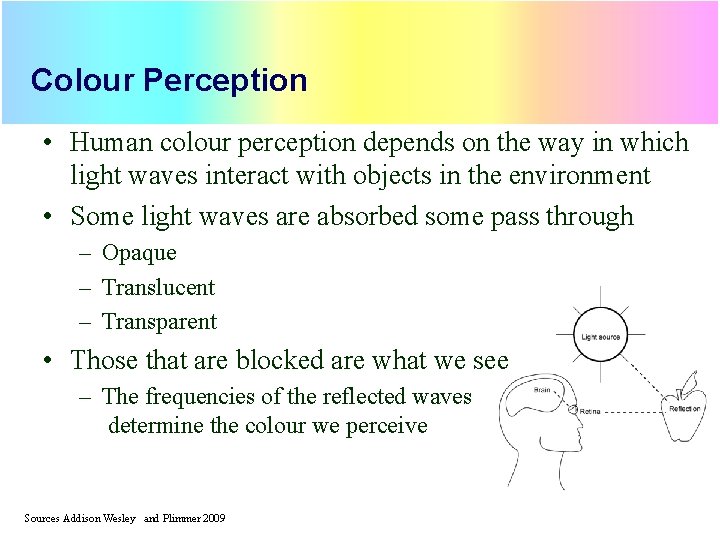
Colour Perception • Human colour perception depends on the way in which light waves interact with objects in the environment • Some light waves are absorbed some pass through – Opaque – Translucent – Transparent • Those that are blocked are what we see – The frequencies of the reflected waves determine the colour we perceive Sources Addison Wesley and Plimmer 2009
Colour Perception The perceived colour of an object can change drastically under different lighting situations • The colour of an object depends on the light source and the nature of the light it emits (Metamerism) – Red/blue light bulb party • However computer screens usually emit enough light for colour not be effected. – Too much external light is of course a problem outside Sources Addison Wesley and Plimmer 2009
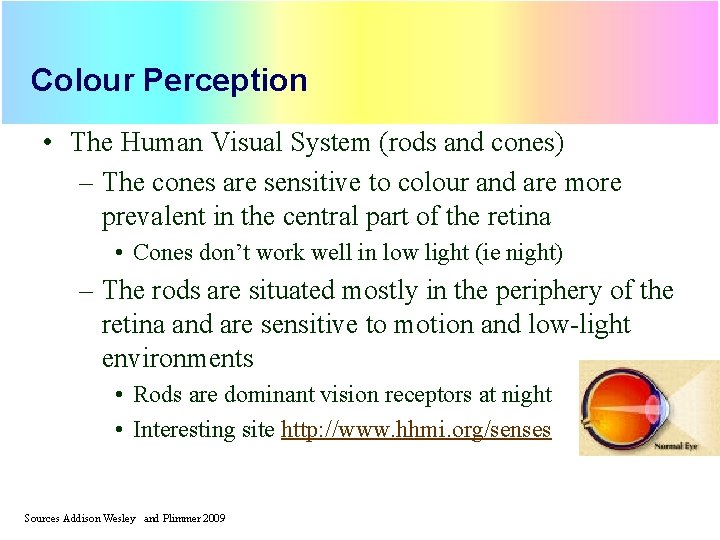
Colour Perception • The Human Visual System (rods and cones) – The cones are sensitive to colour and are more prevalent in the central part of the retina • Cones don’t work well in low light (ie night) – The rods are situated mostly in the periphery of the retina and are sensitive to motion and low-light environments • Rods are dominant vision receptors at night • Interesting site http: //www. hhmi. org/senses Sources Addison Wesley and Plimmer 2009
Colour Perception - Visual Limitations Avoid using blue for text and small screen elements Our ability to distinguish colour is directly related to the size of an object colour perception is weak in our peripheral vision Do not rely on colour to delineate shape Sources Addison Wesley and Plimmer 2009
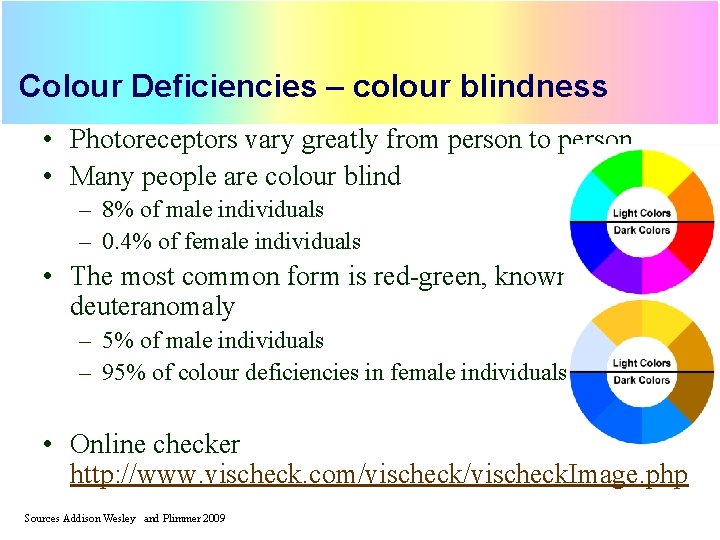
Colour Deficiencies – colour blindness • Photoreceptors vary greatly from person to person • Many people are colour blind – 8% of male individuals – 0. 4% of female individuals • The most common form is red-green, known as deuteranomaly – 5% of male individuals – 95% of colour deficiencies in female individuals • Online checker http: //www. vischeck. com/vischeck. Image. php Sources Addison Wesley and Plimmer 2009
Colour Deficiencies • Factors affecting colour perception: – – – – Culture Age Fatigue Emotions Ambient light Light sources Blood oxygen levels Sources Addison Wesley and Plimmer 2009
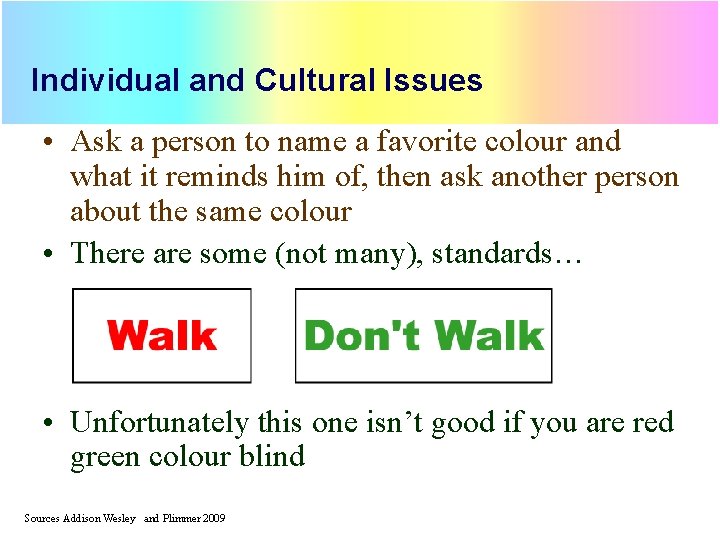
Individual and Cultural Issues • Ask a person to name a favorite colour and what it reminds him of, then ask another person about the same colour • There are some (not many), standards… • Unfortunately this one isn’t good if you are red green colour blind Sources Addison Wesley and Plimmer 2009
Individual and Cultural Issues • Globalization—Localization – Emotions: Associations with yellow range from grace and nobility in Japan, to cowardice and caution in the United States, to happiness and prosperity in Egypt (Russo & Boor, 1993) – Age: People of different generations have observable and often contrasting preferences in colour – Gender: In most cultures gender can greatly influence colour decisions – Fashion: colours fashions come and go (even on computer interfaces – Physical Appearance: Mail box colours Sources Addison Wesley and Plimmer 2009
Using colour in Interaction Design • • • Clarification, Relation, and Differentiation Searching Comprehension, Retention, and Recall Tasks and Performance Redundant Coding Sources Addison Wesley and Plimmer 2009
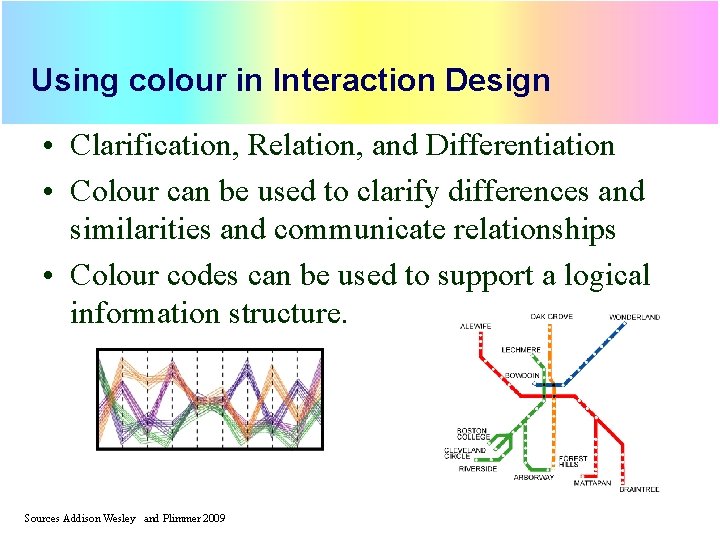
Using colour in Interaction Design • Clarification, Relation, and Differentiation • Colour can be used to clarify differences and similarities and communicate relationships • Colour codes can be used to support a logical information structure. Sources Addison Wesley and Plimmer 2009
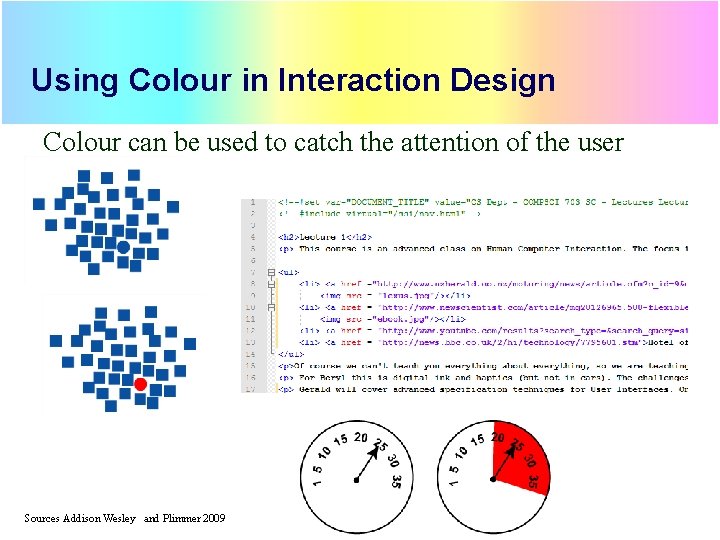
Using Colour in Interaction Design Colour can be used to catch the attention of the user Sources Addison Wesley and Plimmer 2009
Using Colour in Interaction Design • Tasks and Performance • Colour improves performance in the following tasks: (Hoadley) – Recall task – Search-and-locate task – Retention task – Decision judgment task Sources Addison Wesley and Plimmer 2009
Using Colour in Interaction Design • Redundant Coding A clear structure and presentation must already be present before colour is introduced • Studies have shown that people are better at search tasks when the targets of the search are coded using more than one parameter, for instance, colour and shape (Thorell & Smith, 1990) Sources Addison Wesley and Plimmer 2009
Colour Concerns for Interaction Design • • • Indistinguishable Differences Optimal colours Number of colours Incompatible Differences colour Backgrounds Sources Addison Wesley and Plimmer 2009
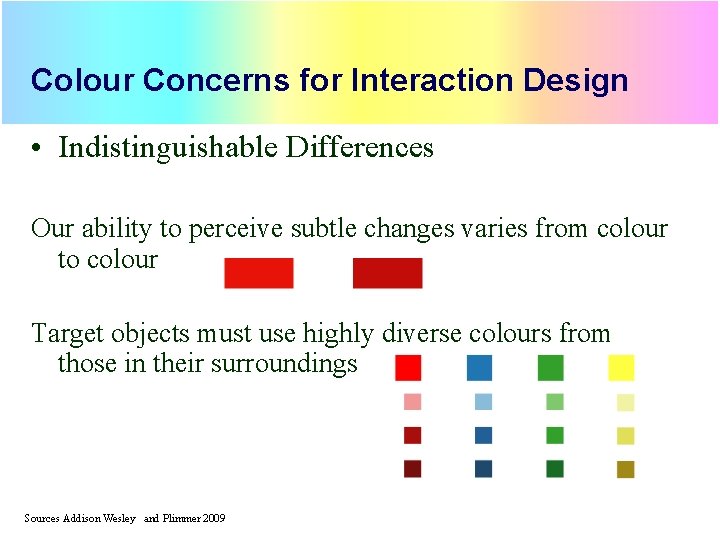
Colour Concerns for Interaction Design • Indistinguishable Differences Our ability to perceive subtle changes varies from colour to colour Target objects must use highly diverse colours from those in their surroundings Sources Addison Wesley and Plimmer 2009
Colour Concerns for Interaction Design • Number of colours – To remember a colour and then recognize it later, we should use only a few distinct colours – To be able to tell the difference between two adjacent colour-coded objects, we can use more colours Interface colours should never distract the user or compete with content Sources Addison Wesley and Plimmer 2009
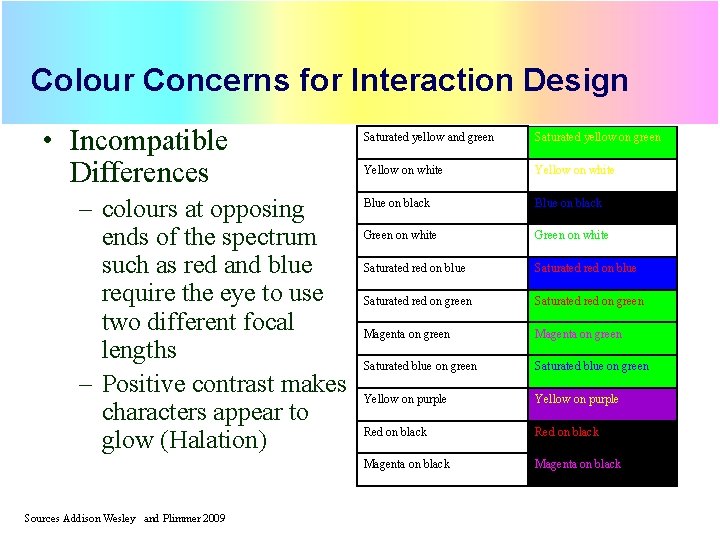
Colour Concerns for Interaction Design • Incompatible Differences – colours at opposing ends of the spectrum such as red and blue require the eye to use two different focal lengths – Positive contrast makes characters appear to glow (Halation) Sources Addison Wesley and Plimmer 2009 Saturated yellow and green Saturated yellow on green Yellow on white Blue on black Green on white Saturated red on blue Saturated red on green Magenta on green Saturated blue on green Yellow on purple Red on black Magenta on black
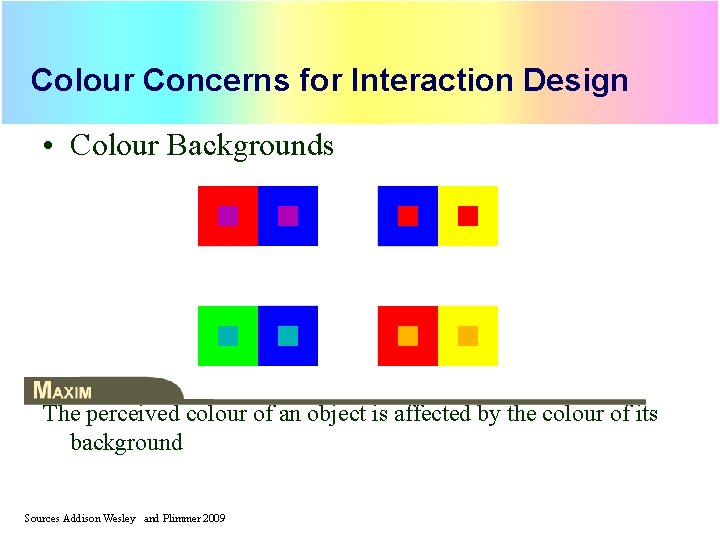
Colour Concerns for Interaction Design • Colour Backgrounds The perceived colour of an object is affected by the colour of its background Sources Addison Wesley and Plimmer 2009
Technical Issues Concerning Colour • • Self study from the text book colour Displays Computing Environment Colour Systems Colour Contrast Colour Space Web-Based colour The Colour Picker Sources Addison Wesley and Plimmer 2009
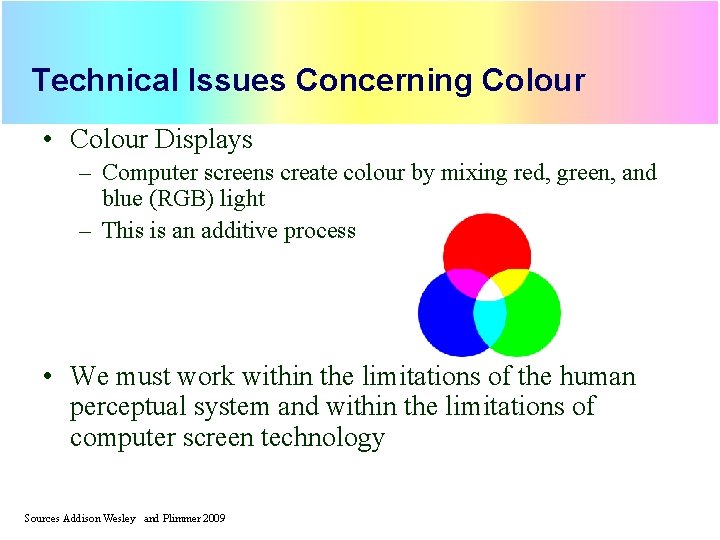
Technical Issues Concerning Colour • Colour Displays – Computer screens create colour by mixing red, green, and blue (RGB) light – This is an additive process • We must work within the limitations of the human perceptual system and within the limitations of computer screen technology Sources Addison Wesley and Plimmer 2009
Technical Issues Concerning Colour • The use of colour in interaction design involves the following four components: – Human perception – Display technology – User tasks – Computing environment Sources Addison Wesley and Plimmer 2009
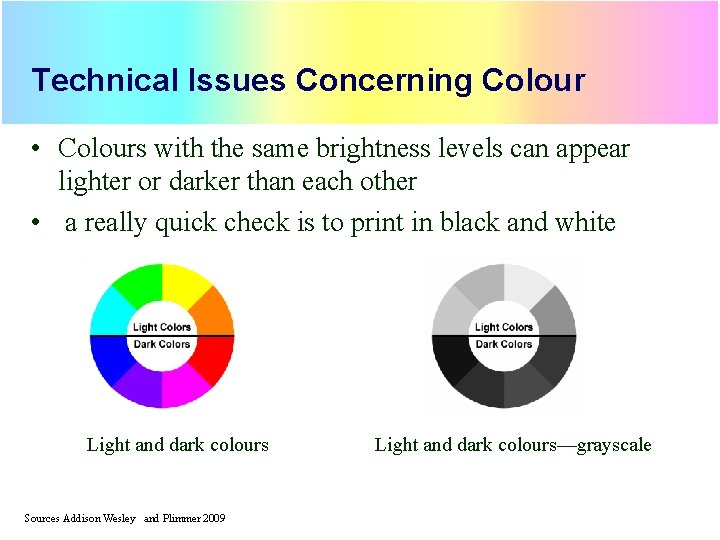
Technical Issues Concerning Colour • Colours with the same brightness levels can appear lighter or darker than each other • a really quick check is to print in black and white Light and dark colours Sources Addison Wesley and Plimmer 2009 Light and dark colours—grayscale
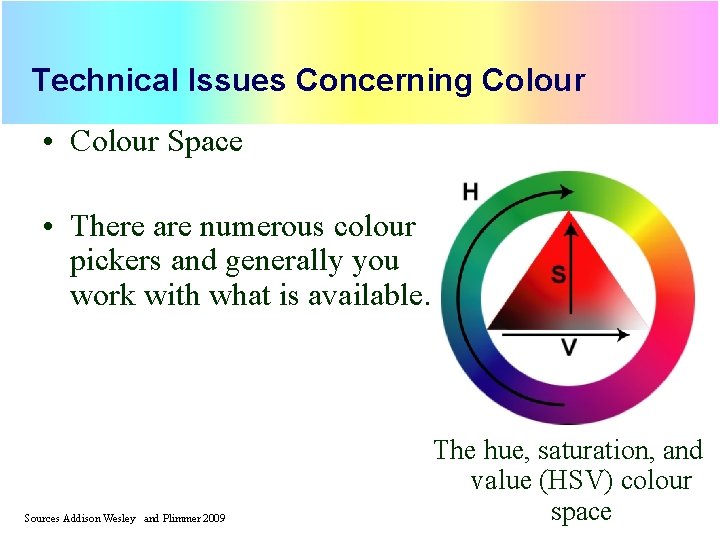
Technical Issues Concerning Colour • Colour Space • There are numerous colour pickers and generally you work with what is available. Sources Addison Wesley and Plimmer 2009 The hue, saturation, and value (HSV) colour space
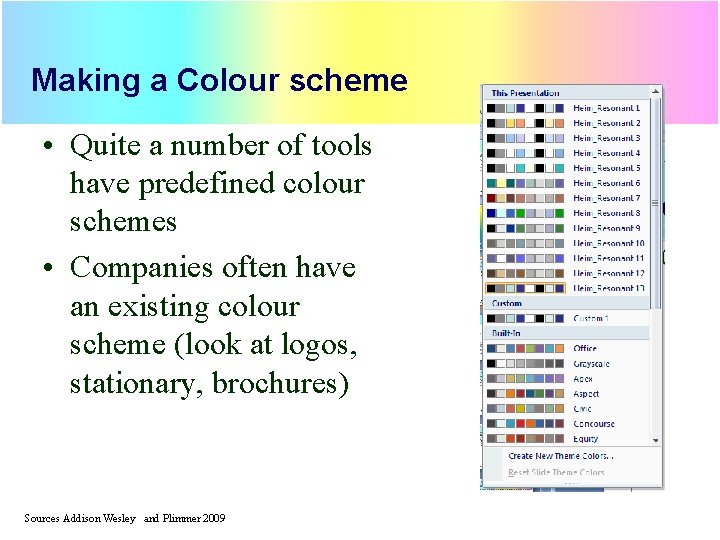
Making a Colour scheme • Quite a number of tools have predefined colour schemes • Companies often have an existing colour scheme (look at logos, stationary, brochures) Sources Addison Wesley and Plimmer 2009
Finally • Colour is part of the aesthetics of a interface • and • Aesthetics are very important!!! – ‘nice’ interfaces work better. Sources Addison Wesley and Plimmer 2009