
Chapter 9 Colonialism and the exotic Romanticism is
- Slides: 29
Chapter 9 Colonialism and the exotic -Romanticism is composed of different competing voices, arguing over particular social and political agenda -Much literature of the Romantic period provides escape from day to day reality, with exotic historical and geographical narratives and images. -Romantic writers adopted images from medieval and gothic culture, from ancient Greece, Renaissance Italy, the Orient (Muslim World) 1
Chapter 9 Colonialism and the exotic Romantics are fascinated with the Orient While studying Coleridge, Shelley, Byron and Thomas De Quincy, we realize that conflicting claims of oriental escapism and contemporary social and political concerns can be reconciled. 2
Coleridge and the orient • Coleridge involved in the political turmoil of the revolutionary decade, confesses to having had personal experiments with opium. • He admired Hindu Mysticism and other Christian political radicalism– Contradictory statements: (p: 223/4/6 RW) 3
Coleridge and the orient • 1 - Coleridge identified with a cultural stereotype which associated the Orient with narcotic reverie and mystical contemplation. Oriental subjects have no power over their will and live in the exotic closer to mythology than history. The Orient is the Other of the West. • 2 - In contrast, the Westerner lives a progressive and purposeful historical present motivated by moral choice and action. 4
Kubla Khan • It is the greatest orientalist poem in English language. • It’s an opium-induced reverie compiled after having read Purchas his pilgrimage • A fragment of the poem was published for its psychological curiosity more than for its poetic merit, as it represents the pleasures , the pains and inspirations of opium-induced reverie 5
• The oriental paradise described in Kubla Khan becomes an oriental hell in which the poet discovers his impotence to restore terrible wrongs inflicted upon him • Instead of opening the gates to paradise and turning the poet into Vishnu floating on a Lotos leaf, the oriental reverie becomes a terrifying experience where the western identity and willpower were overwhelmed by uncanny and alien forces. 6
• The Romantic attitude towards the orient is not a reaction towards the pleasures and pain of opium, but have cultural, political and economic reasons and consequences linked to European imperial expansions in the East. • According to Jones (1772), European western culture was marked by reason, whereas Oriental eastern culture held imagination in a superior degree. • Kubla Khan represents the orient as a place of magical beauty and power but also of tyranny, eroticism and danger 7
• The more Khan seeks to control his territory for his pleasure, the more the force of nature spoils his design. • The end is the downfall of his dynasty. Kubla Khan to be compared by Shelley’s Ozymandias. Both empires end in ruins. • The work of artists is more eternal than tyrants rules. 8
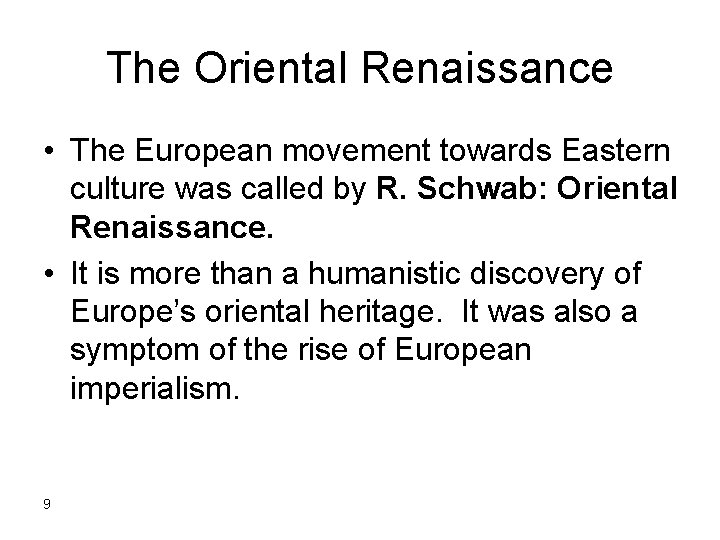
The Oriental Renaissance • The European movement towards Eastern culture was called by R. Schwab: Oriental Renaissance. • It is more than a humanistic discovery of Europe’s oriental heritage. It was also a symptom of the rise of European imperialism. 9
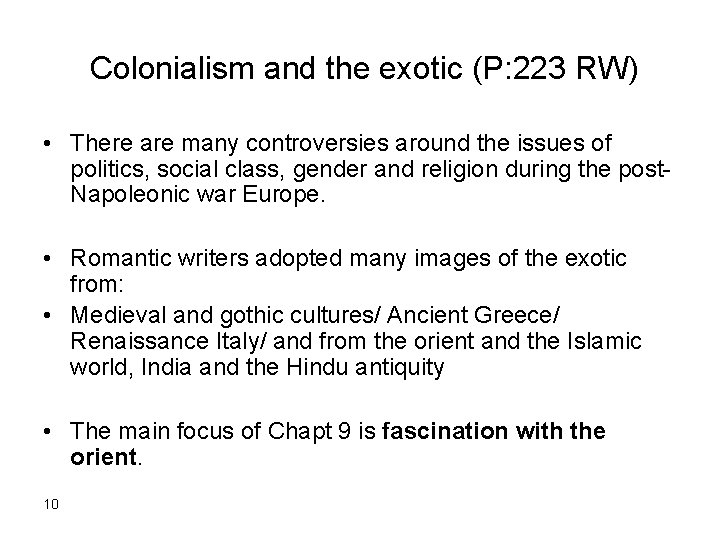
Colonialism and the exotic (P: 223 RW) • There are many controversies around the issues of politics, social class, gender and religion during the post. Napoleonic war Europe. • Romantic writers adopted many images of the exotic from: • Medieval and gothic cultures/ Ancient Greece/ Renaissance Italy/ and from the orient and the Islamic world, India and the Hindu antiquity • The main focus of Chapt 9 is fascination with the orient. 10
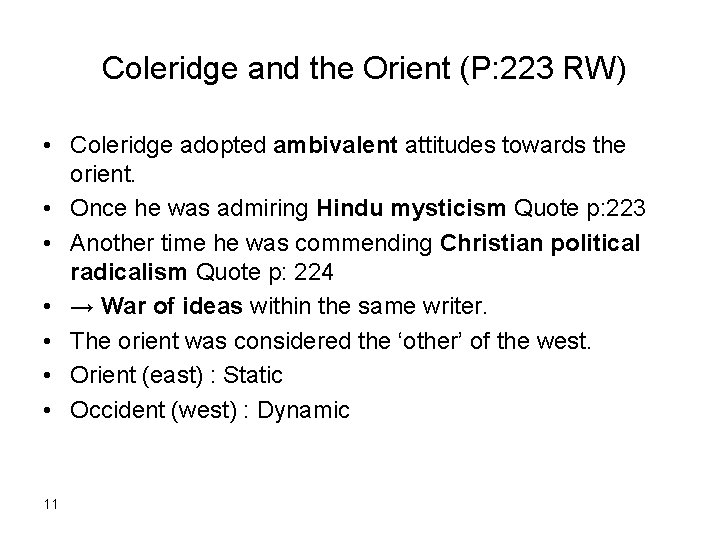
Coleridge and the Orient (P: 223 RW) • Coleridge adopted ambivalent attitudes towards the orient. • Once he was admiring Hindu mysticism Quote p: 223 • Another time he was commending Christian political radicalism Quote p: 224 • → War of ideas within the same writer. • The orient was considered the ‘other’ of the west. • Orient (east) : Static • Occident (west) : Dynamic 11
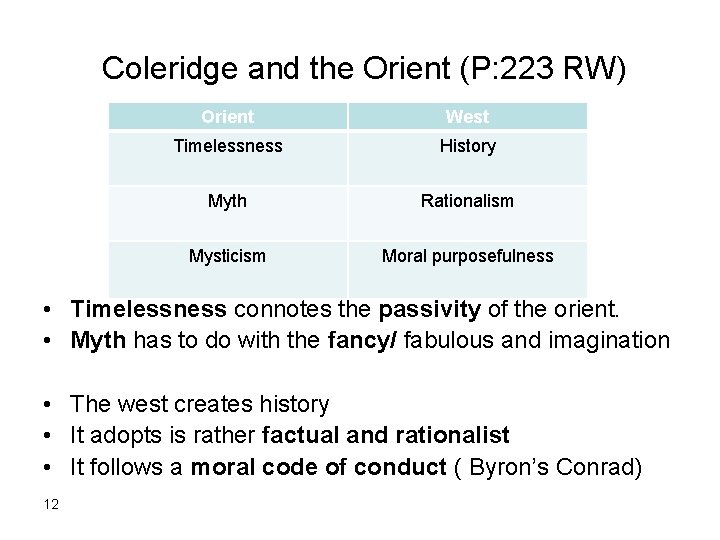
Coleridge and the Orient (P: 223 RW) Orient West Timelessness History Myth Rationalism Mysticism Moral purposefulness • Timelessness connotes the passivity of the orient. • Myth has to do with the fancy/ fabulous and imagination • The west creates history • It adopts is rather factual and rationalist • It follows a moral code of conduct ( Byron’s Conrad) 12
Kubla Khan (P: 225 RW) • Coleridge represents the pleasure and pain of opium reverie. • The oriental paradise described in Kubla Khan has become an oriental hell, in which the poet could not cope with the terrible wrongs inflicted upon him (Quote p: 226 and compare it with the quote on p: 223) • An ambivalent representation of the orient, where the poet is at times like the Hindu Deity (Vishnu) floating on a Lotos leaf and at other times, he is in a terrifying experience that threatens to efface his western identity and supplants it with an uncanny mystic croyance. 13
Kubla Khan (P: 225 RW) • Fear and Fascination with the orient is the core of our theme. • Not only opium is responsible for this romantic attitude towards the orient, • There are the cultural, political and economic issues of imperialist expansion in the East. This however has been overlooked by critics like Schwab. . • In Kubla Khan, there are two settings: • Asia – Kubla’s tartary • Africa – Maid’s Abyssinia 14
Kubla Khan (P: 225 RW) • Abrupt move from one scene to another, in different continents! • This shows the attitude of the orientalists: All that is not European, like Chinese, Indian, Arab, Persian, African. . All fall under a confused imaginary geography. • Sir William Jones: western culture was marked by reason, whereas oriental culture epitomizes imagination in a superior degree. 15
Kubla Khan as an orientalist poem(P: 228 RW) • In Kubla Khan, the orient is a symbol of both magical beauty and power; and of tyranny, eroticism and danger. • This is an ambivalent contemporary stereotype about the orient, not just Coleridge’s fantasy. • Absolute power corrupts and causes damnation, examples are : • Kubla Khan’s power threatened by the eruption of the fountain and breaking his dominion into ‘fragments’. • The Caliph Vatnek. Protagonist of Beckford’s novel, sought divine power from an Indian wizard and was eternally damned in the subterranean hell of iblis. • Ozymandias and his transient power. 16
Kubla Khan as an orientalist poem(P: 228 RW) • Comparison between Ozymandias and Kubla Khan in terms of short-lived power. • Khan interprets the fountain negatively, whereas the poet (artist) discovers harmony in nature. • In the same manner, the sculptor’s art is eternal. He mocked the Pharaoh’s claim of omnipotence. 17
The Oriental Renaissance (P: 230 RW) • The term was dubbed by the French critic Raymond Schwab. A cultural rebirth of the orient, like the Italian Renaissance. • Schwab asserts that orientalist scholars such as (Duperron, Jones and Schlegel) were tired of neoclassicism. Their classical and religious heritage is not unique, they themselves descended from ancient oriental ancestry → plunged towards the study of literature, language and religion of Persia, India, Egypt and Arabia. 18
The Oriental Renaissance (P: 230 RW) • The oriental scholars found, during their exploration of the east, that there is an older and wider world than the classical or renaissance scholars imagined. • The encounter between European and non-European cultures is at the heart of Romanticism. 19
Shelley’s Alastor (P: 231 RW) • In Coleridge’s Kubla Khan and in Shelley’s Alastor, the relationship between the east and west is gendered. • A European man being seduced by an oriental woman who leaves him broken-hearted. • Shelley had an ambivalent attitude towards the visionary imagination, figured as a beautiful Eastern woman. • The desire in the poet, stimulated by the woman, helps him to transcend a cold, unfeeling world, where there is no space for his idealism, but pledging his life in a vain pursuit of the lost woman leads to further alienation and in Alastor, the poet dies on the stony mountains. 20
Orientalism and imperialism(P: 231 RW) • In his book Orientalism, E. Said asserts that the question of imperialism is at the heart of the romantic fascination with the orient. • ¼ of the world population was governed by Britain in all its colonies → large eastward drive of British expansion during the Napoleonic wars. • Said criticizes Schwab for overlooking the issue of imperialism in his oriental discourse. • He believes that oriental renaissance is not just a western intellectual curiosity, but a cultural consequence of 21 European imperialism.
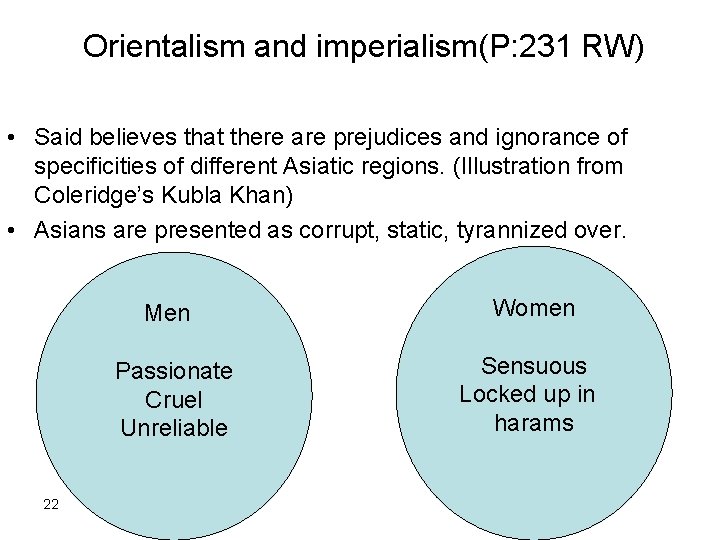
Orientalism and imperialism(P: 231 RW) • Said believes that there are prejudices and ignorance of specificities of different Asiatic regions. (Illustration from Coleridge’s Kubla Khan) • Asians are presented as corrupt, static, tyrannized over. 22 Men Women Passionate Cruel Unreliable Sensuous Locked up in harams
Orientalism and imperialism(P: 231 RW) • Only colonialism is to free and polish them. • Said: This legitimized the colonial enterprise, they are there to improve the eastern’s lot, while their main motive is to extract as much ‘loot’ as possible. (comment) • The same issue is described in terms of gender. • The Indian critic Gayatri Spivak illustrates the rescue by Europeans of Asiatic women from their traditional bondage as: • “White men saving brown women from brown men” • (comment with regard to Byron’s ‘The Corsair’) 23
Byron’s The Corsair (P: 234 RW) • Lord Byron scorned British imperialism • “The Corsair” was published in 1814, and was a bestseller. • "The Corsair" is the tale of a pirate captain willing to risk the love of his life to save a slave in a Turkish harem. 24
Byron’s The Corsair (P: 234 RW) • It is a narrative poem written in three cantos. • In the first canto, Conrad decided to attack the sultan Seyd to steal his riches. After the evening's feast he will lead the attack, which means that he is to say goodbye to his wife again, though he has only been home for an hour. She beseeches him to stay by tempting him with the joys of domestic life, but her inducements do not prevail and, though he misses his wife when he leaves her, Conrad sets sail for the pasha’s island. 25
Byron’s The Corsair (P: 234 RW) • The second canto has Conrad arriving in disguise at the Sultan’s palace. He distracts the sultan while his crew surrounds the palace; when all are in place the surprise attack begins. At first, the pirates appear to be winning the battle. • When Conrad hears cries from the harem, he commands his men to help him rescue the women inside, which ultimately allows enough time for Seyd’s men to regroup and gain the upper hand. Conrad is captured and the majority of his crew is killed. Gulnare, the Pasha’s favorite sex-slave, comes to Conrad in his prison cell and tells him she will try to save his life in return for having saved hers. In the process, she falls in love with him. 26
Byron’s The Corsair (P: 234 RW) • In the final canto, Gulnare attempts to talk Seyd into freeing Conrad for a day in order to gain his treasure through ransom, after which they can recapture him. This plan makes Seyd suspicious of her motives and he threatens to kill her as well as the captive. • She sneaks a knife to Conrad’s cell so that he can use it to kill Seyd before they make their escape. Conrad refuses on the grounds that he will only kill in a fair fight, although he had no reservations about disguising himself to trick the sultan during the original attack. Gulnare then kills the Pasha herself and rescues the Corsair, bringing him back to his island. Upon their return, Conrad discovers Medora has died from the grief of her mistaken belief that her husband is dead. Instead of taking Gulnare for his wife, however, he leaves the island, dead 27 in spirit, not in body.
Byron’s The Corsair (P: 234 RW) • The official ideology of European imperialists is betrayed here when: • ‘ A brown woman saves a white man from brown man!!’ • Gender issues are also on the agenda in The Corsair. There is a reverse of gender roles. (discuss) • The Corsair is a tale of chivalry defeated and of love betrayed. Discuss. • Is the Corsair an orientalist representation of imperial anxiety or of western triumph? Illustrate. 28
Byron’s The Corsair (P: 234 RW) 29