
Chapter 9 Circulatory Adaptations to Exercise EXERCISE PHYSIOLOGY
- Slides: 51
Chapter 9: Circulatory Adaptations to Exercise EXERCISE PHYSIOLOGY Theory and Application to Fitness and Performance, 6 th edition Scott K. Powers & Edward T. Howley © 2007 Mc. Graw-Hill Higher Education. All rights reserved.
Introduction One major challenge to homeostasis posed by exercise is the increased muscular demand for oxygen l During heavy exercise, oxygen demands may by 15 to 25 times l Two major adjustments of blood flow are; l ¡ ¡ l cardiac output Redistribution of blood flow A thorough understanding of the cardiovascular system is essential to exercise physiology © 2007 Mc. Graw-Hill Higher Education. All rights reserved.
Objectives Give an overview of the design and function of the circulatory system l Describe cardiac cycle & associated electrical activity recorded via electrocardiogram l Discuss the pattern of redistribution of blood flow during exercise l Outline the circulatory responses to various types of exercise l © 2007 Mc. Graw-Hill Higher Education. All rights reserved.
Objectives l Identify the factors that regulate local blood flow during exercise l List & discuss those factors responsible for regulation of stroke volume during exercise l Discuss the regulation of cardiac output during exercise © 2007 Mc. Graw-Hill Higher Education. All rights reserved.
The Cardiovascular System Purposes 1. 2. 3. © 2007 Mc. Graw-Hill Higher Education. All rights reserved.
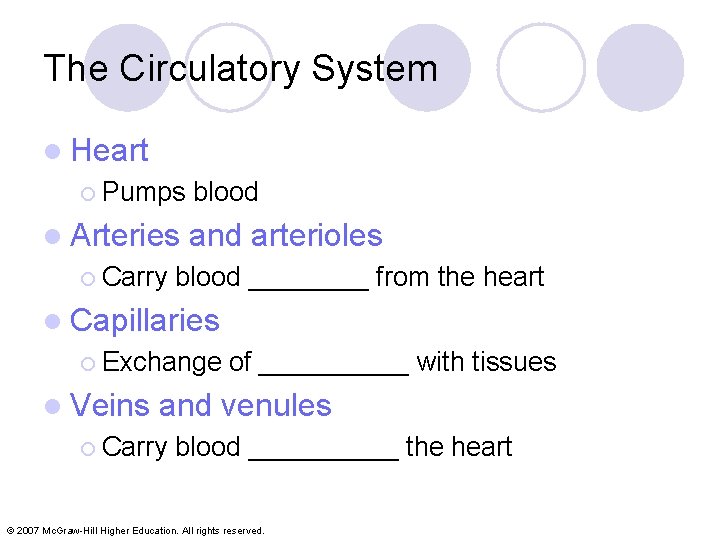
The Circulatory System l Heart ¡ Pumps l Arteries ¡ Carry blood and arterioles blood ____ from the heart l Capillaries ¡ Exchange l Veins of _____ with tissues and venules ¡ Carry blood _____ the heart © 2007 Mc. Graw-Hill Higher Education. All rights reserved.
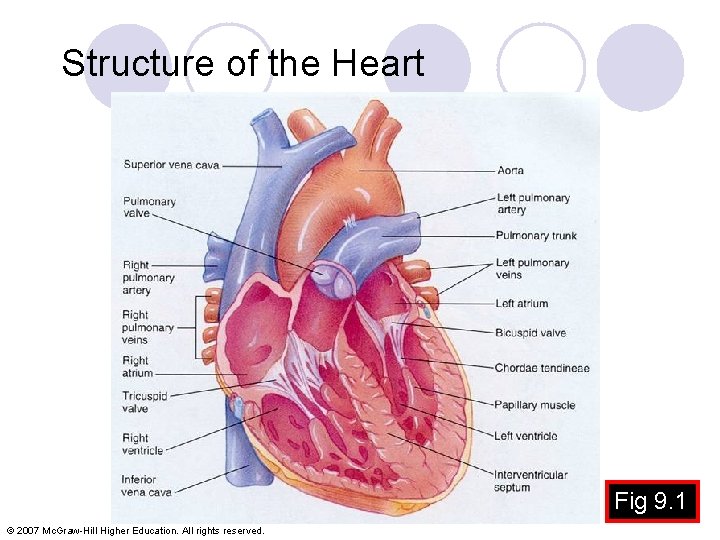
Structure of the Heart Fig 9. 1 © 2007 Mc. Graw-Hill Higher Education. All rights reserved.
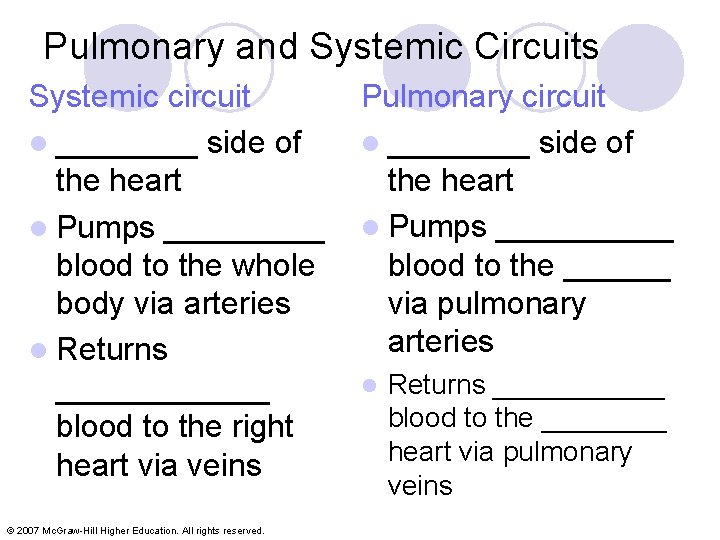
Pulmonary and Systemic Circuits Systemic circuit l ____ side of the heart l Pumps _____ blood to the whole body via arteries l Returns ______ blood to the right heart via veins © 2007 Mc. Graw-Hill Higher Education. All rights reserved. Pulmonary circuit l ____ side of the heart l Pumps _____ blood to the ______ via pulmonary arteries l Returns ______ blood to the ____ heart via pulmonary veins
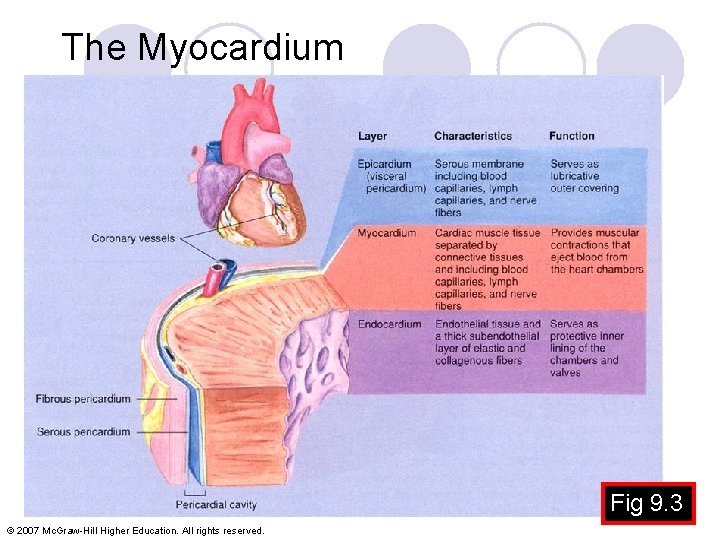
The Myocardium Fig 9. 3 © 2007 Mc. Graw-Hill Higher Education. All rights reserved.
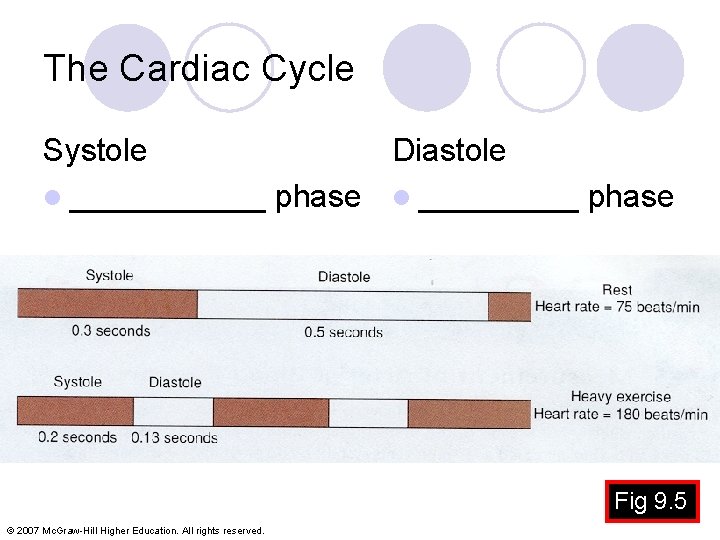
The Cardiac Cycle Diastole Systole l ______ phase l _____ phase Fig 9. 5 © 2007 Mc. Graw-Hill Higher Education. All rights reserved.
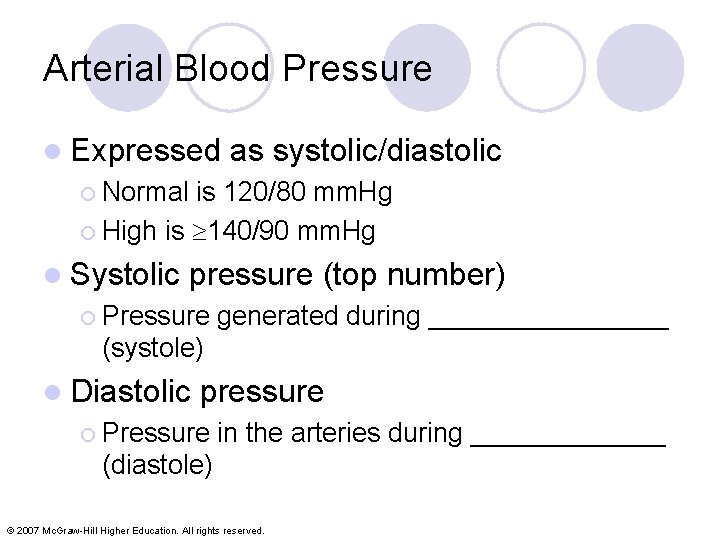
Arterial Blood Pressure l Expressed as systolic/diastolic ¡ Normal is 120/80 mm. Hg ¡ High is 140/90 mm. Hg l Systolic pressure (top number) ¡ Pressure generated during ________ (systole) l Diastolic pressure ¡ Pressure in the arteries during _______ (diastole) © 2007 Mc. Graw-Hill Higher Education. All rights reserved.
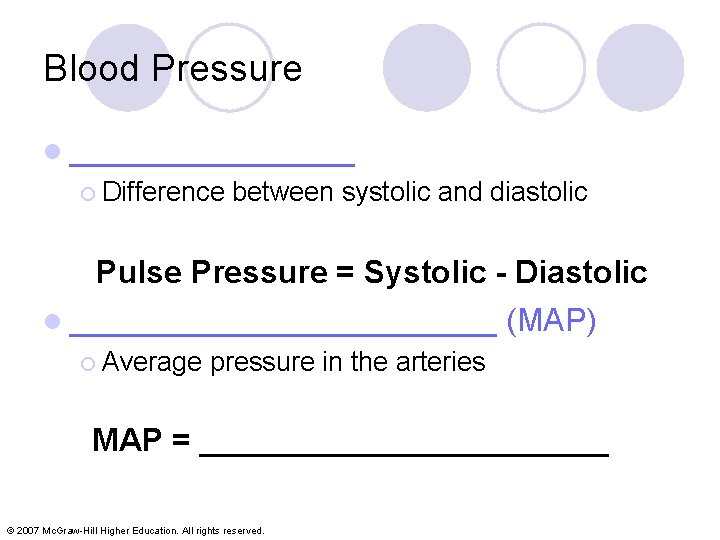
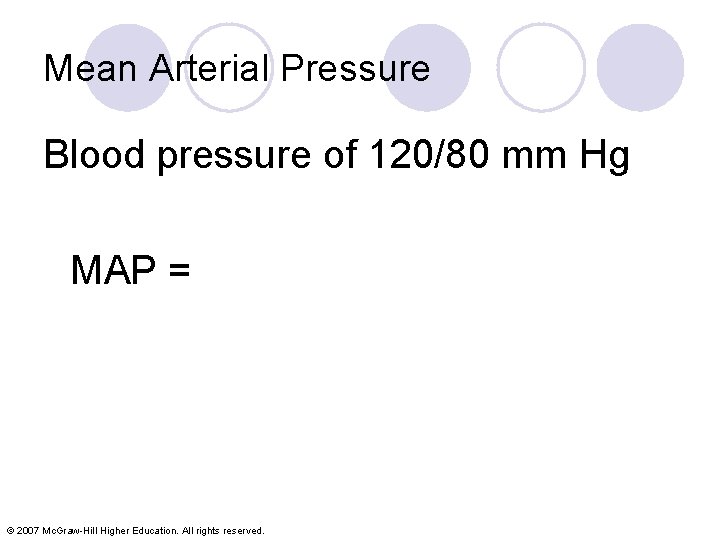
Blood Pressure l ________ ¡ Difference between systolic and diastolic Pulse Pressure = Systolic - Diastolic l ____________ (MAP) ¡ Average pressure in the arteries MAP = ____________ © 2007 Mc. Graw-Hill Higher Education. All rights reserved.
Mean Arterial Pressure Blood pressure of 120/80 mm Hg MAP = © 2007 Mc. Graw-Hill Higher Education. All rights reserved.
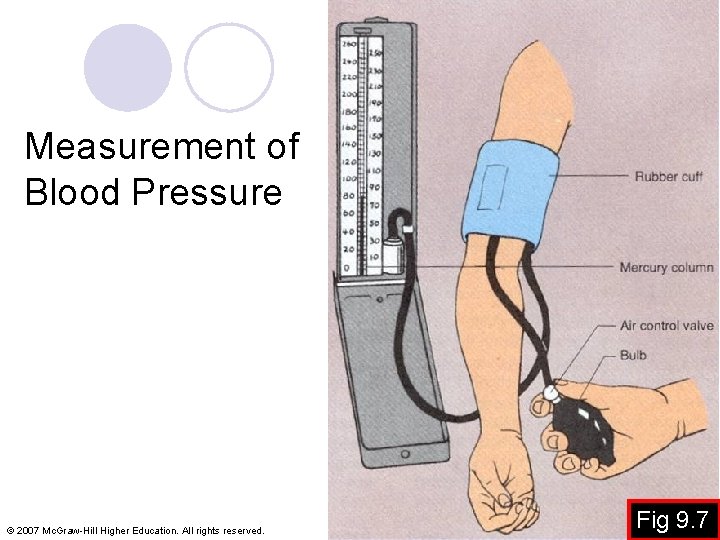
Measurement of Blood Pressure © 2007 Mc. Graw-Hill Higher Education. All rights reserved. Fig 9. 7
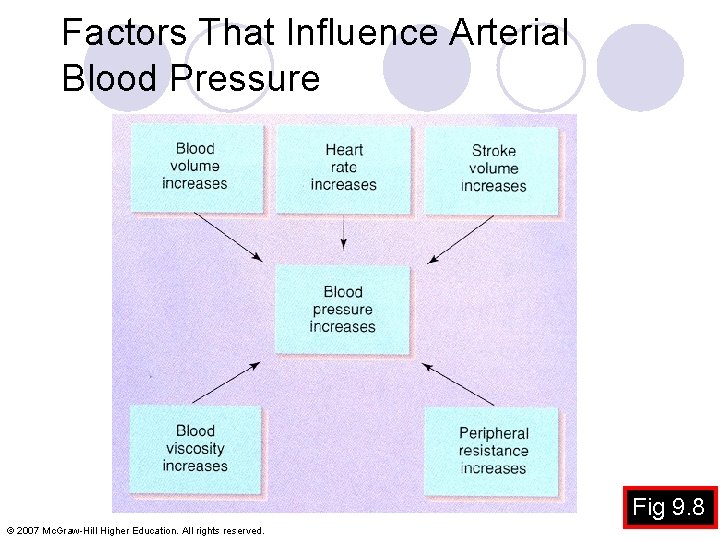
Factors That Influence Arterial Blood Pressure Fig 9. 8 © 2007 Mc. Graw-Hill Higher Education. All rights reserved.
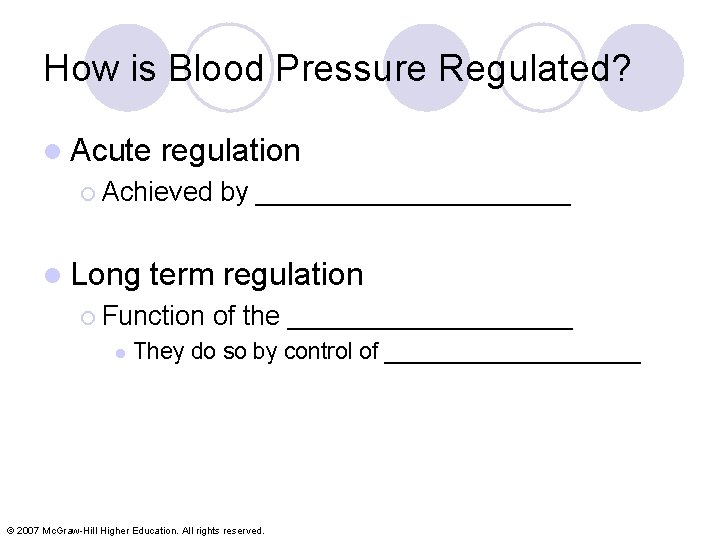
How is Blood Pressure Regulated? l Acute regulation ¡ Achieved l Long term regulation ¡ Function l by ___________ of the __________ They do so by control of __________ © 2007 Mc. Graw-Hill Higher Education. All rights reserved.
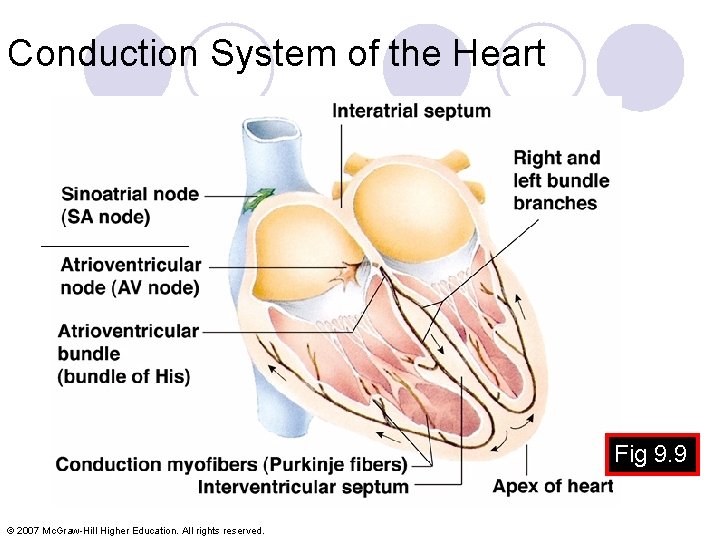
Electrical Activity of the Heart l Contraction of the heart depends on electrical stimulation of the myocardium l Impulse is initiated in the _____ and spreads throughout entire heart l May be recorded on an _________ (ECG) © 2007 Mc. Graw-Hill Higher Education. All rights reserved.
Conduction System of the Heart __________ Fig 9. 9 © 2007 Mc. Graw-Hill Higher Education. All rights reserved.
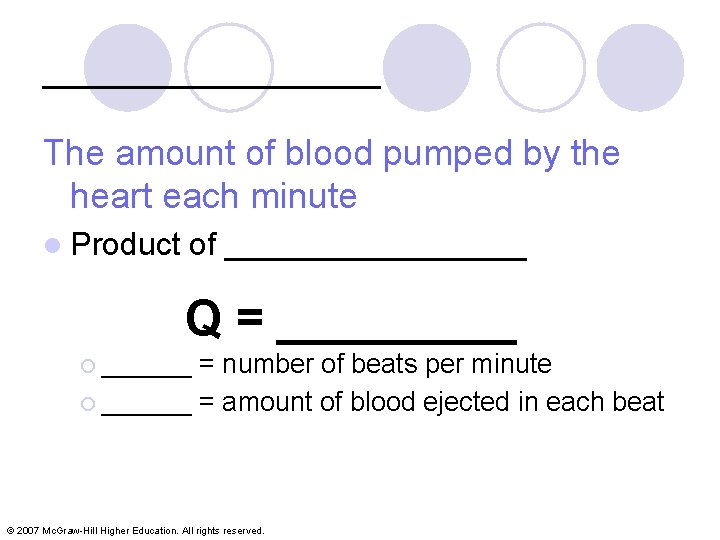
________ The amount of blood pumped by the heart each minute l Product of _________ Q = _____ ¡ ______ = number of beats per minute ¡ ______ = amount of blood ejected in each beat © 2007 Mc. Graw-Hill Higher Education. All rights reserved.
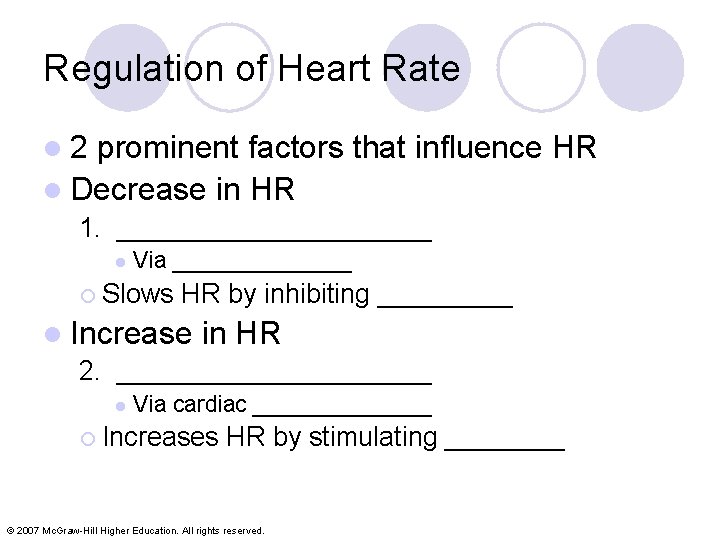
Regulation of Heart Rate l 2 prominent factors that influence HR l Decrease in HR 1. ___________ l Via _______ ¡ Slows HR by inhibiting _____ l Increase in HR 2. ___________ l Via cardiac _______ ¡ Increases HR by stimulating ____ © 2007 Mc. Graw-Hill Higher Education. All rights reserved.
Regulation of Stroke Volume SV at rest or during exercise is regulated by 3 variables 1. _________ (EDV) l ¡ Volume of blood in the ventricles at the end of diastole (“preload”) 2. _________ ¡ Pressure the heart must pump against to eject blood (“afterload”) 3. _____ of the ventricular contraction ¡ “Contractility” © 2007 Mc. Graw-Hill Higher Education. All rights reserved.
End-Diastolic Volume l _________ ¡ Greater preload results in stretch of ventricles and in a more forceful contraction l Affected by venous return: l What factors regulate venous return? 1. 2. 3. © 2007 Mc. Graw-Hill Higher Education. All rights reserved.
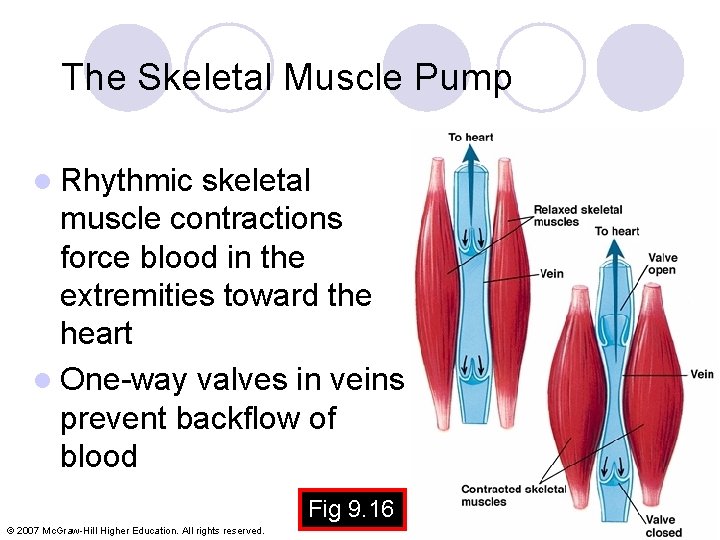
The Skeletal Muscle Pump l Rhythmic skeletal muscle contractions force blood in the extremities toward the heart l One-way valves in veins prevent backflow of blood Fig 9. 16 © 2007 Mc. Graw-Hill Higher Education. All rights reserved.
Average Aortic Pressure l Aortic pressure is ______ related to stroke volume l High afterload results in a ______ stroke volume ¡ Requires greater force generation by the myocardium to eject blood into the aorta l Reducing aortic pressure results in _______ stroke volume © 2007 Mc. Graw-Hill Higher Education. All rights reserved.
Ventricular Contractility l Increased contractility results in ____ stroke volume ¡ Circulating epinephrine and norepinephrine ¡ Direct sympathetic stimulation of heart © 2007 Mc. Graw-Hill Higher Education. All rights reserved.
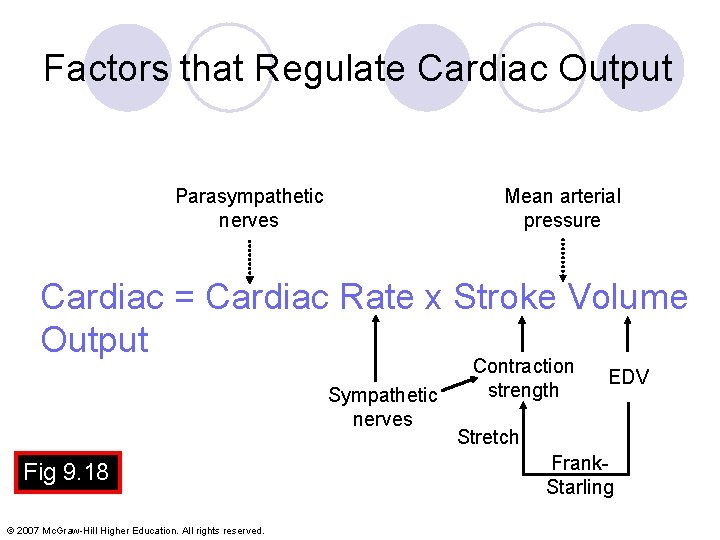
Factors that Regulate Cardiac Output Parasympathetic nerves Mean arterial pressure Cardiac = Cardiac Rate x Stroke Volume Output Sympathetic nerves Fig 9. 18 © 2007 Mc. Graw-Hill Higher Education. All rights reserved. Contraction strength EDV Stretch Frank. Starling
Hemodynamics The study of the physical principles of blood flow © 2007 Mc. Graw-Hill Higher Education. All rights reserved.
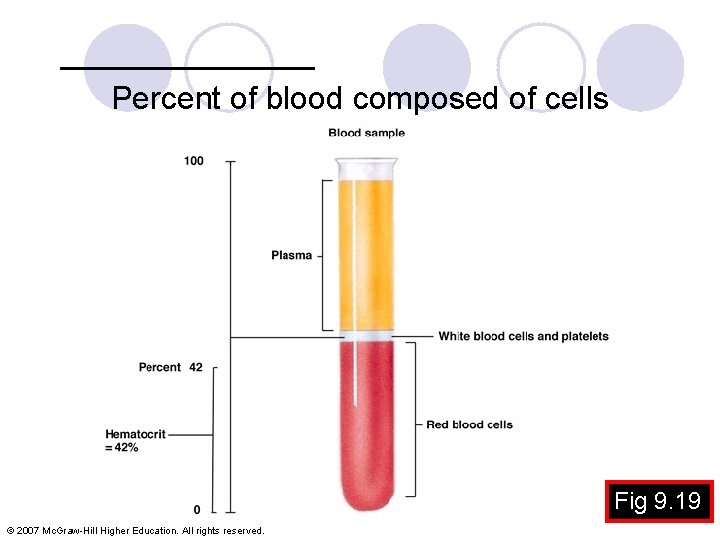
Physical Characteristics of Blood l ______ ¡ Liquid portion of blood ¡ Contains ions, proteins, hormones l Cells ¡ ______ l Contain hemoglobin to carry oxygen ¡ ___________ l Important in blood clotting © 2007 Mc. Graw-Hill Higher Education. All rights reserved.
______ Percent of blood composed of cells Fig 9. 19 © 2007 Mc. Graw-Hill Higher Education. All rights reserved.
Hemodynamics Based on interrelationships between: ¡ ___________ ¡ ______ l Since large increases in P are hazardous to health – decreasing resistance is the primary factor used to achieve increases in BF during exercise with a small rise in P © 2007 Mc. Graw-Hill Higher Education. All rights reserved.
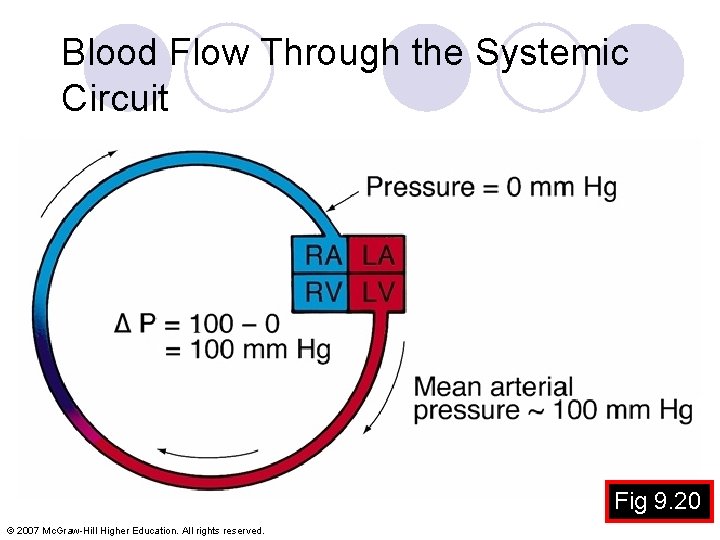
Hemodynamics: Pressure l Blood flows from ___ pressure ¡ Proportional to the difference between MAP and right atrial pressure ( P) l BF depends on P at 2 ends of vascular system l P at 2 ends of a vessel are equal = _____ © 2007 Mc. Graw-Hill Higher Education. All rights reserved.
Blood Flow Through the Systemic Circuit Fig 9. 20 © 2007 Mc. Graw-Hill Higher Education. All rights reserved.
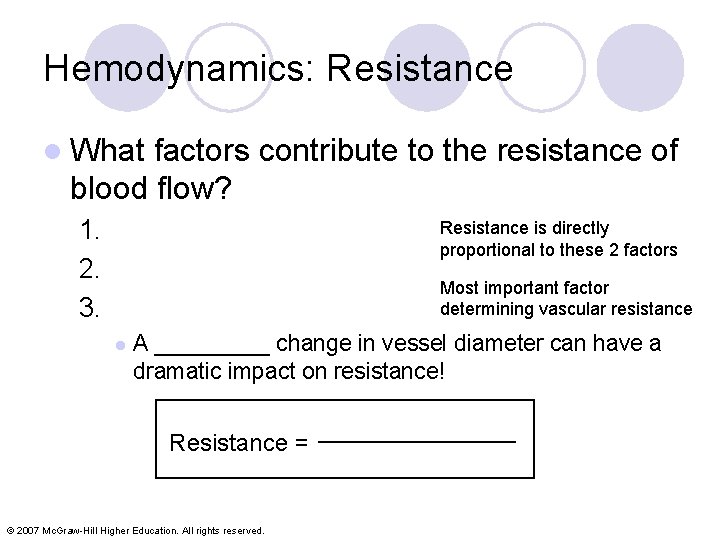
Hemodynamics: Resistance l What factors contribute to the resistance of blood flow? 1. 2. 3. Resistance is directly proportional to these 2 factors Most important factor determining vascular resistance l A _____ change in vessel diameter can have a dramatic impact on resistance! Resistance = © 2007 Mc. Graw-Hill Higher Education. All rights reserved.
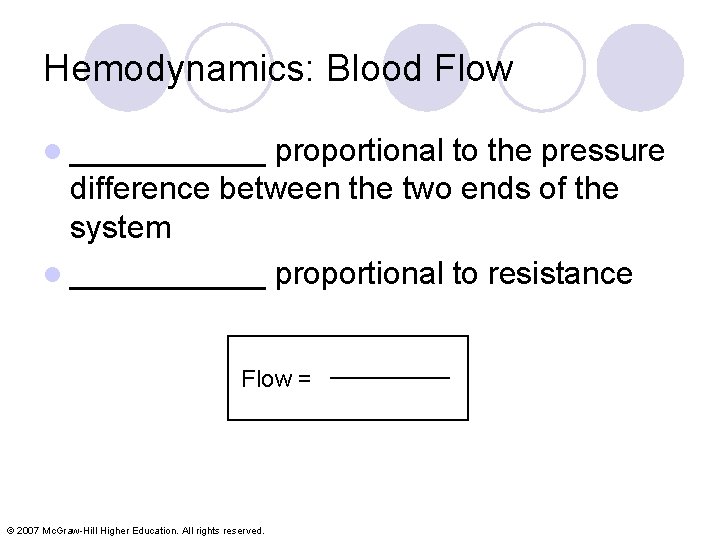
Hemodynamics: Blood Flow l ______ proportional to the pressure difference between the two ends of the system l ______ proportional to resistance Flow = © 2007 Mc. Graw-Hill Higher Education. All rights reserved.
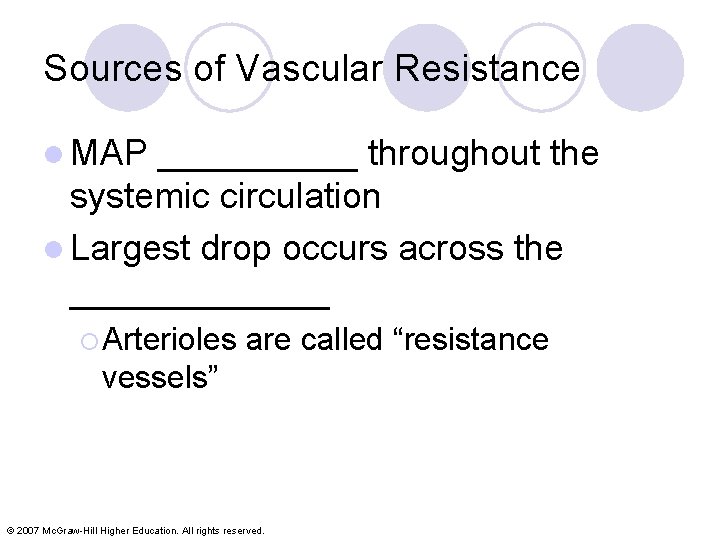
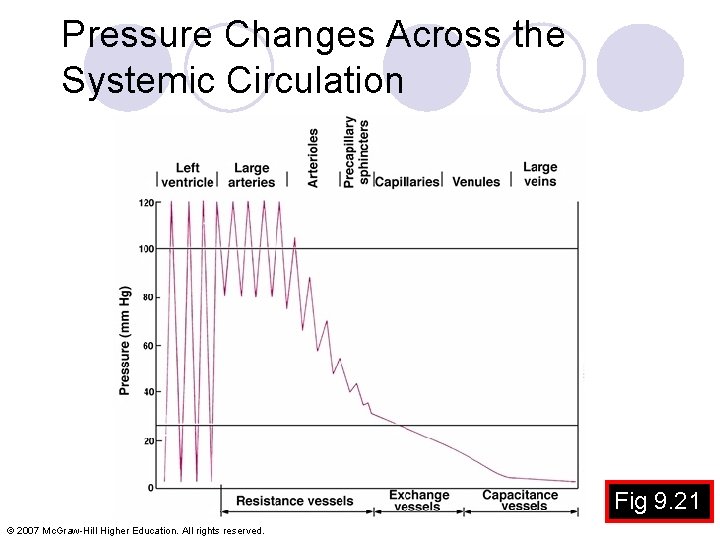
Sources of Vascular Resistance l MAP _____ throughout the systemic circulation l Largest drop occurs across the _______ ¡ Arterioles are called “resistance vessels” © 2007 Mc. Graw-Hill Higher Education. All rights reserved.
Pressure Changes Across the Systemic Circulation Fig 9. 21 © 2007 Mc. Graw-Hill Higher Education. All rights reserved.
Oxygen Delivery During Exercise l Oxygen demand by muscles during exercise is many times greater than at rest l Increased O 2 delivery accomplished via 2 mechanisms: 1. 2. © 2007 Mc. Graw-Hill Higher Education. All rights reserved.
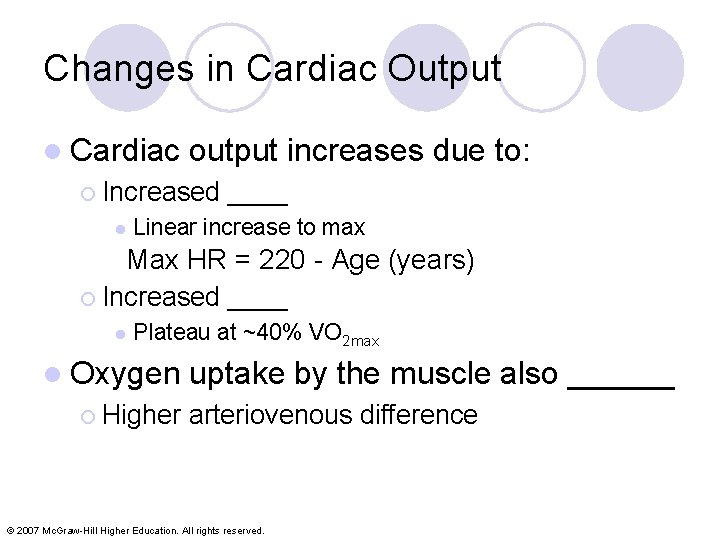
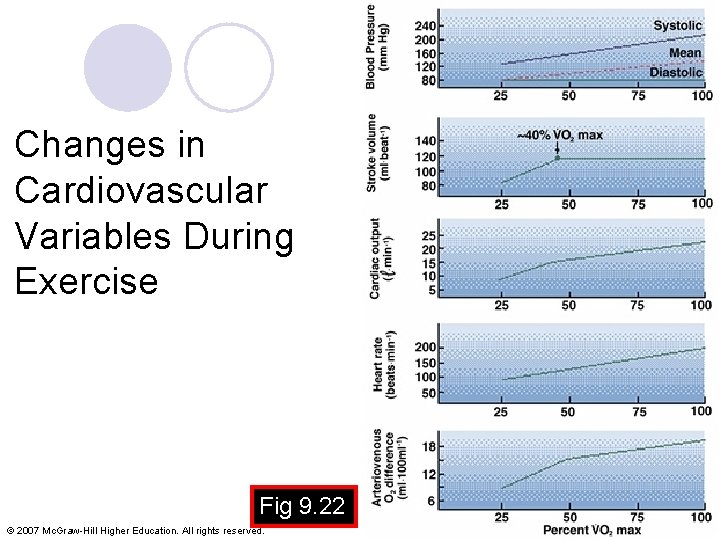
Changes in Cardiac Output l Cardiac output increases due to: ¡ Increased l ____ Linear increase to max Max HR = 220 - Age (years) ¡ Increased ____ l Plateau at ~40% VO 2 max l Oxygen ¡ Higher uptake by the muscle also ______ arteriovenous difference © 2007 Mc. Graw-Hill Higher Education. All rights reserved.
Changes in Cardiovascular Variables During Exercise Fig 9. 22 © 2007 Mc. Graw-Hill Higher Education. All rights reserved.
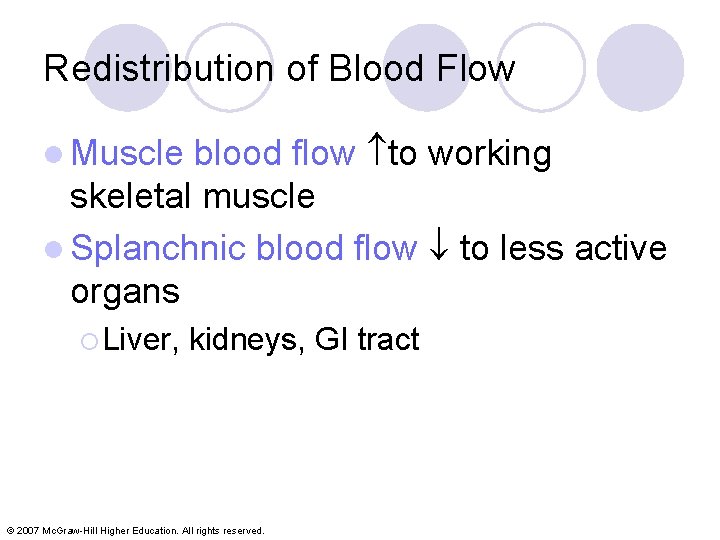
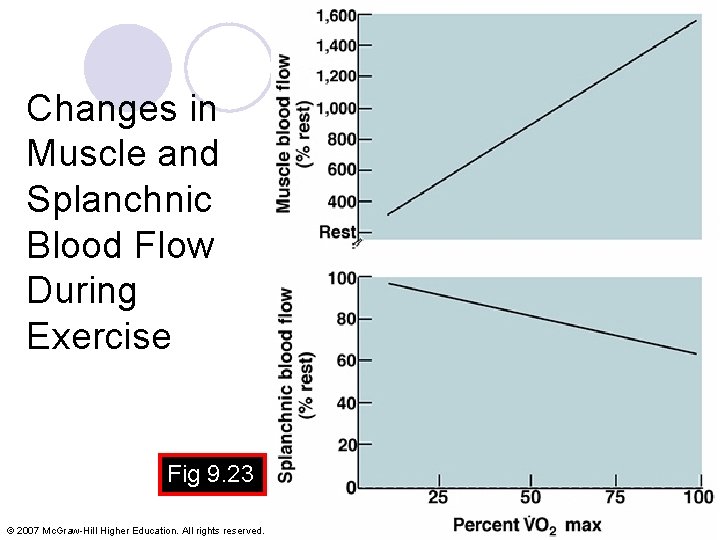
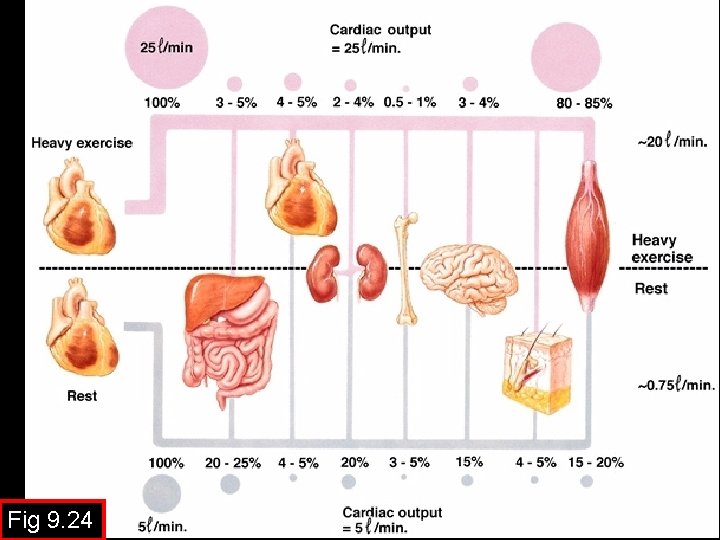
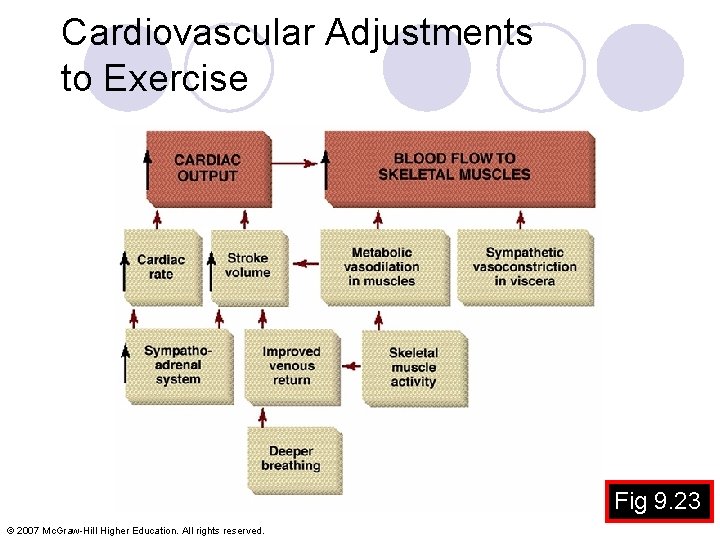
Redistribution of Blood Flow blood flow to working skeletal muscle l Splanchnic blood flow to less active organs l Muscle ¡ Liver, kidneys, GI tract © 2007 Mc. Graw-Hill Higher Education. All rights reserved.
Changes in Muscle and Splanchnic Blood Flow During Exercise Fig 9. 23 © 2007 Mc. Graw-Hill Higher Education. All rights reserved.
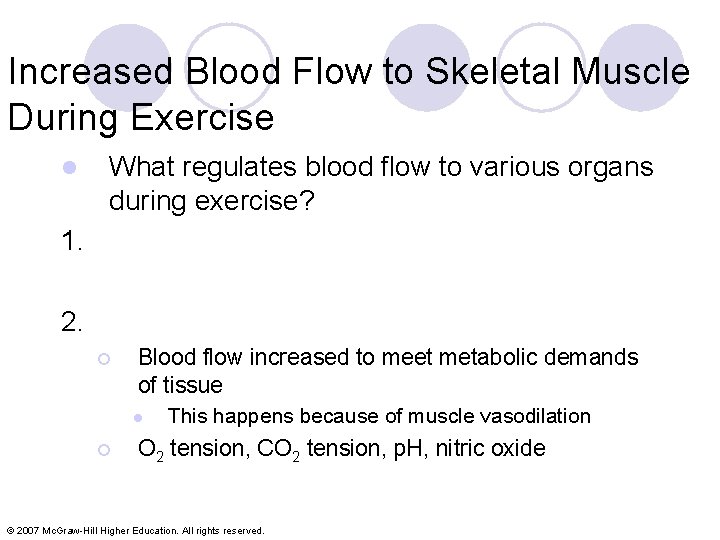
Increased Blood Flow to Skeletal Muscle During Exercise l What regulates blood flow to various organs during exercise? 1. 2. ¡ Blood flow increased to meet metabolic demands of tissue l ¡ This happens because of muscle vasodilation O 2 tension, CO 2 tension, p. H, nitric oxide © 2007 Mc. Graw-Hill Higher Education. All rights reserved.
Redistribution of Blood Flow During Exercise Fig 9. 24 © 2007 Mc. Graw-Hill Higher Education. All rights reserved.
Circulatory Responses to Exercise l Heart rate and blood pressure l Depend on: ¡ Type, intensity, and duration of exercise ¡ Environmental condition ¡ Emotional influence © 2007 Mc. Graw-Hill Higher Education. All rights reserved.
Transition From Rest Exercise and Exercise Recovery l Rapid increase in HR, SV, cardiac output l Plateau in submaximal (below lactate threshold) exercise l Recovery depends on: ¡ Duration and intensity of exercise ¡ Training state of subject © 2007 Mc. Graw-Hill Higher Education. All rights reserved.
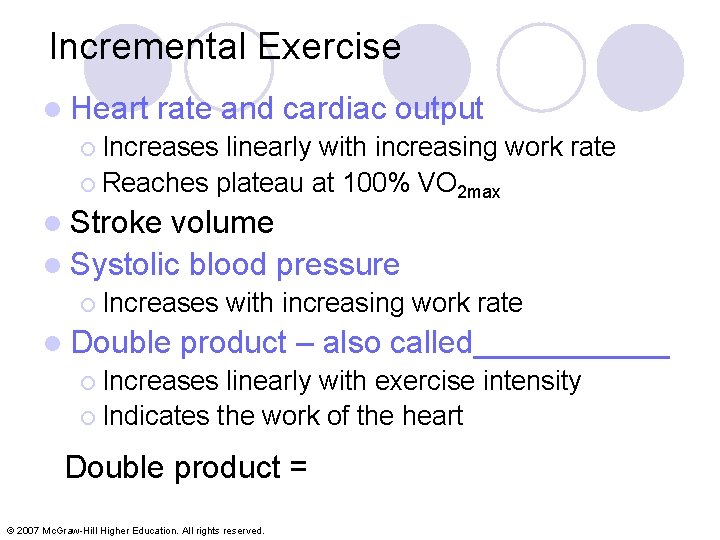
Incremental Exercise l Heart rate and cardiac output ¡ Increases linearly with increasing work rate ¡ Reaches plateau at 100% VO 2 max l Stroke volume l Systolic blood pressure ¡ Increases with increasing work rate l Double product – also called______ ¡ Increases linearly with exercise intensity ¡ Indicates the work of the heart Double product = © 2007 Mc. Graw-Hill Higher Education. All rights reserved.
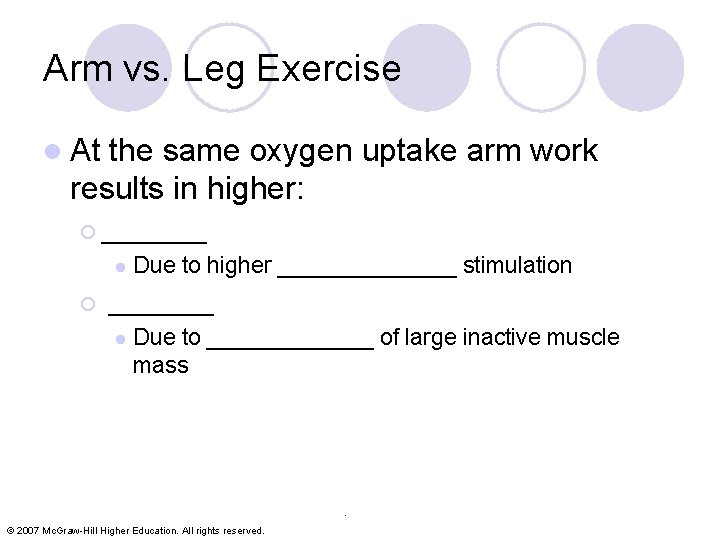
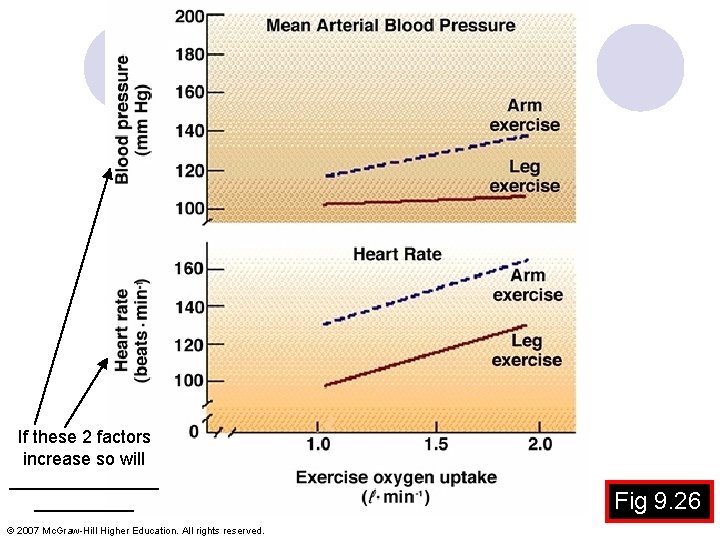
Arm vs. Leg Exercise l At the same oxygen uptake arm work results in higher: ¡ _______ l ¡ Due to higher _______ stimulation _______ l Due to _______ of large inactive muscle mass . © 2007 Mc. Graw-Hill Higher Education. All rights reserved.
Heart Rate and Blood Pressure During Arm and Leg Exercise If these 2 factors increase so will ________ © 2007 Mc. Graw-Hill Higher Education. All rights reserved. Fig 9. 26
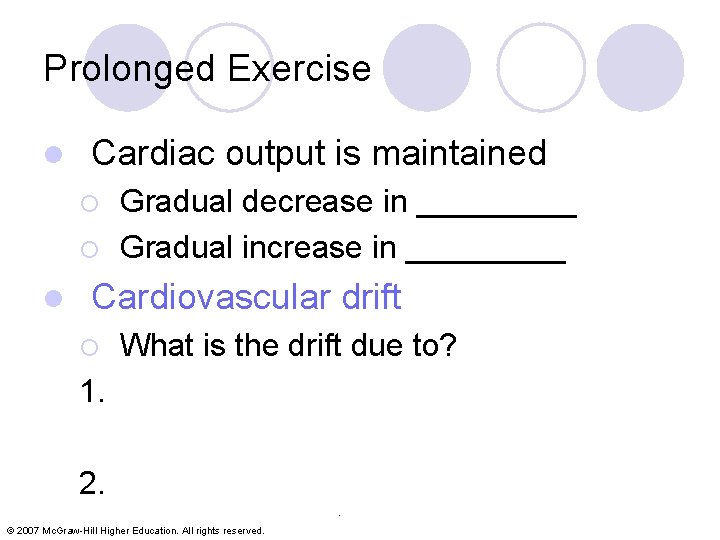
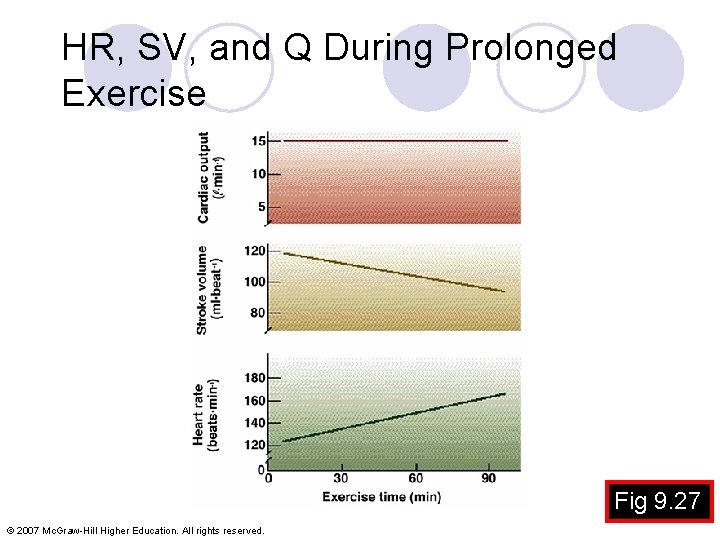
Prolonged Exercise l Cardiac output is maintained ¡ ¡ l Gradual decrease in _____ Gradual increase in _____ Cardiovascular drift ¡ What is the drift due to? 1. 2. . © 2007 Mc. Graw-Hill Higher Education. All rights reserved.
HR, SV, and Q During Prolonged Exercise Fig 9. 27 © 2007 Mc. Graw-Hill Higher Education. All rights reserved.
Cardiovascular Adjustments to Exercise Fig 9. 23 © 2007 Mc. Graw-Hill Higher Education. All rights reserved.