
Chapter 9 Chemical reactions Topics well be looking
Chapter 9 Chemical reactions
Topics we’ll be looking at in this chapter • • • Types of chemical reactions Redox and non-redox reactions Terminology associated with redox processes Collision theory and chemical reactions Exothermic and endothermic reactions Factors that influence chemical reaction rates Chemical equilibrium Equilibrium constants Altering equilibrium conditions: Le Chatelier
Types of chemical reactions • A chemical reaction is a process in which at least one new substance is produced as a result of a chemical change. • Chemical reactions usually take the form of one the following basic types: – – – Combination reactions Decomposition reactions Single-replacement reactions Double-replacement reactions Combustion reactions
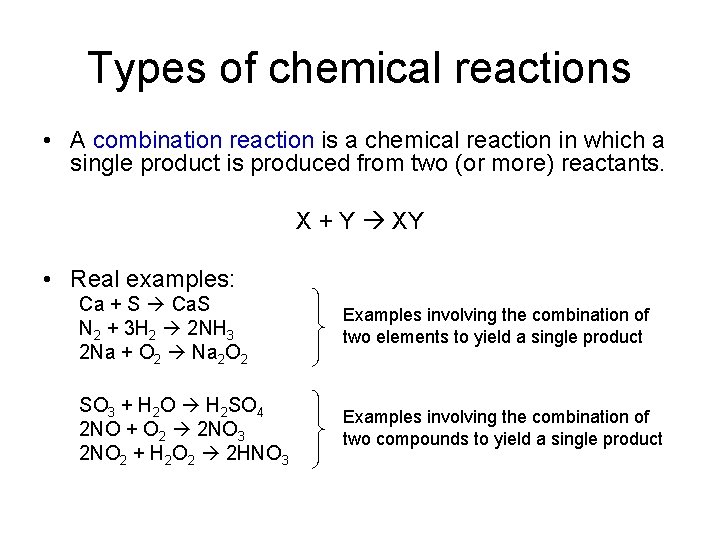
Types of chemical reactions • A combination reaction is a chemical reaction in which a single product is produced from two (or more) reactants. X + Y XY • Real examples: Ca + S Ca. S N 2 + 3 H 2 2 NH 3 2 Na + O 2 Na 2 O 2 Examples involving the combination of two elements to yield a single product SO 3 + H 2 O H 2 SO 4 2 NO + O 2 2 NO 3 2 NO 2 + H 2 O 2 2 HNO 3 Examples involving the combination of two compounds to yield a single product
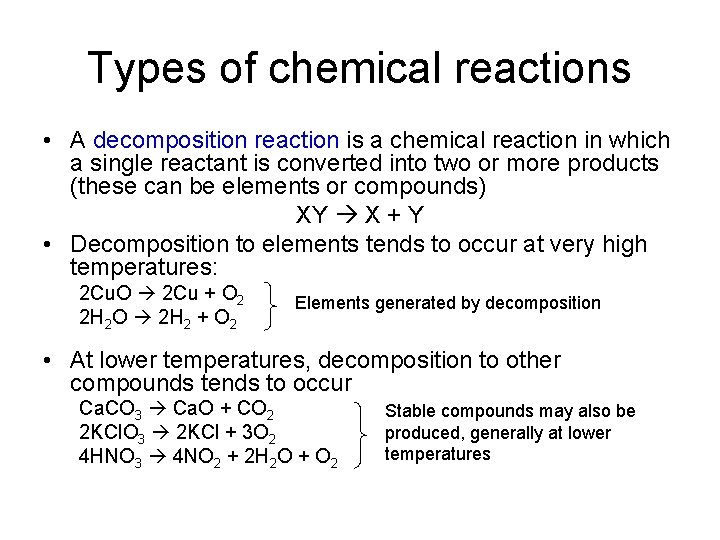
Types of chemical reactions • A decomposition reaction is a chemical reaction in which a single reactant is converted into two or more products (these can be elements or compounds) XY X + Y • Decomposition to elements tends to occur at very high temperatures: 2 Cu. O 2 Cu + O 2 2 H 2 O 2 H 2 + O 2 Elements generated by decomposition • At lower temperatures, decomposition to other compounds tends to occur Ca. CO 3 Ca. O + CO 2 2 KCl. O 3 2 KCl + 3 O 2 4 HNO 3 4 NO 2 + 2 H 2 O + O 2 Stable compounds may also be produced, generally at lower temperatures
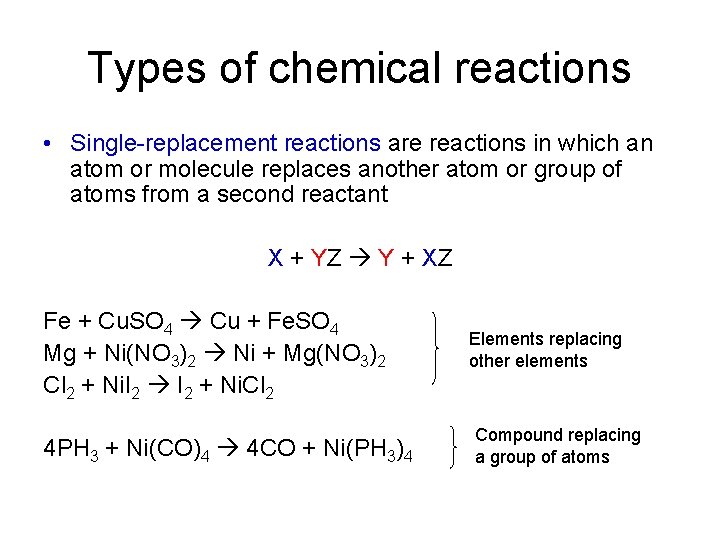
Types of chemical reactions • Single-replacement reactions are reactions in which an atom or molecule replaces another atom or group of atoms from a second reactant X + YZ Y + XZ Fe + Cu. SO 4 Cu + Fe. SO 4 Mg + Ni(NO 3)2 Ni + Mg(NO 3)2 Cl 2 + Ni. I 2 + Ni. Cl 2 4 PH 3 + Ni(CO)4 4 CO + Ni(PH 3)4 Elements replacing other elements Compound replacing a group of atoms
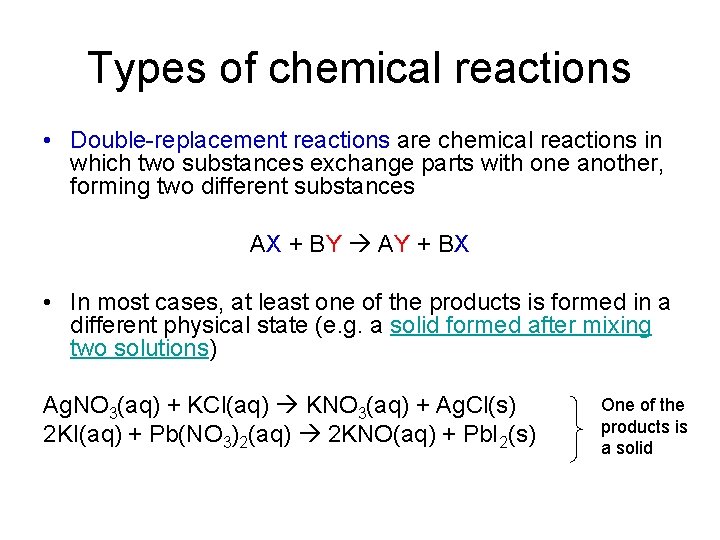
Types of chemical reactions • Double-replacement reactions are chemical reactions in which two substances exchange parts with one another, forming two different substances AX + BY AY + BX • In most cases, at least one of the products is formed in a different physical state (e. g. a solid formed after mixing two solutions) Ag. NO 3(aq) + KCl(aq) KNO 3(aq) + Ag. Cl(s) 2 KI(aq) + Pb(NO 3)2(aq) 2 KNO(aq) + Pb. I 2(s) One of the products is a solid
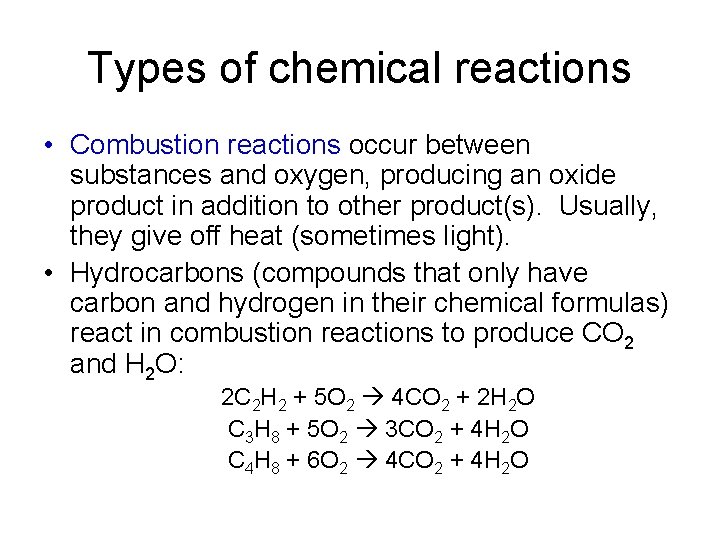
Types of chemical reactions • Combustion reactions occur between substances and oxygen, producing an oxide product in addition to other product(s). Usually, they give off heat (sometimes light). • Hydrocarbons (compounds that only have carbon and hydrogen in their chemical formulas) react in combustion reactions to produce CO 2 and H 2 O: 2 C 2 H 2 + 5 O 2 4 CO 2 + 2 H 2 O C 3 H 8 + 5 O 2 3 CO 2 + 4 H 2 O C 4 H 8 + 6 O 2 4 CO 2 + 4 H 2 O
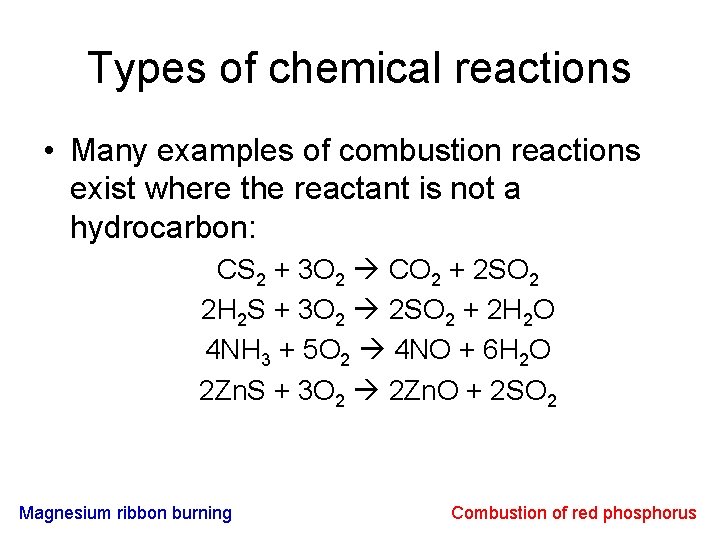
Types of chemical reactions • Many examples of combustion reactions exist where the reactant is not a hydrocarbon: CS 2 + 3 O 2 CO 2 + 2 SO 2 2 H 2 S + 3 O 2 2 SO 2 + 2 H 2 O 4 NH 3 + 5 O 2 4 NO + 6 H 2 O 2 Zn. S + 3 O 2 2 Zn. O + 2 SO 2 Magnesium ribbon burning Combustion of red phosphorus

Indicators of chemical reactions • Sometimes, it is difficult to determine whether a chemical reaction has happened or not. There are several indicators for this: – – Production of a solid, liquid, or gas Generation/consumption of heat Color change Production of light
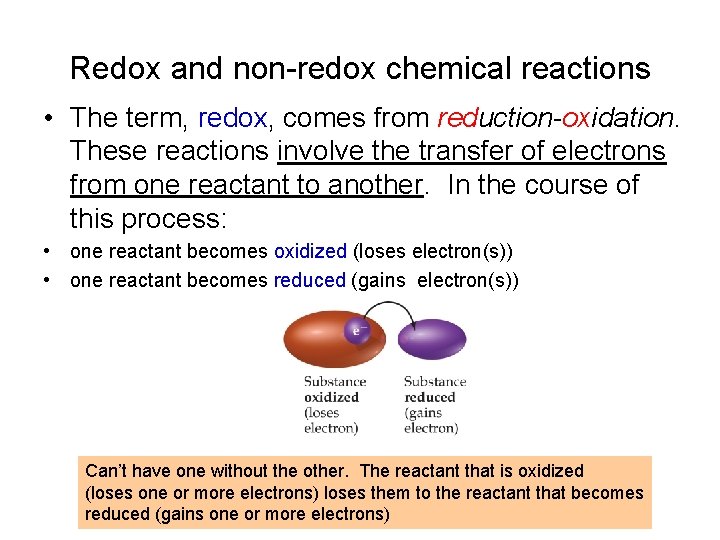
Redox and non-redox chemical reactions • The term, redox, comes from reduction-oxidation. These reactions involve the transfer of electrons from one reactant to another. In the course of this process: • one reactant becomes oxidized (loses electron(s)) • one reactant becomes reduced (gains electron(s)) Can’t have one without the other. The reactant that is oxidized (loses one or more electrons) loses them to the reactant that becomes reduced (gains one or more electrons)
Redox and non-redox chemical reactions • Redox reactions involve the transfer of electrons between reactants. Non-redox reactions do not involve electron-transfer. • We can keep track of where electrons are moving using a bookkeeping system called oxidation numbers • Oxidation numbers represent the charges that atoms appear to have when the electrons in each bond it is participating in are assigned to the more electronegative of the two atoms involved in the bond
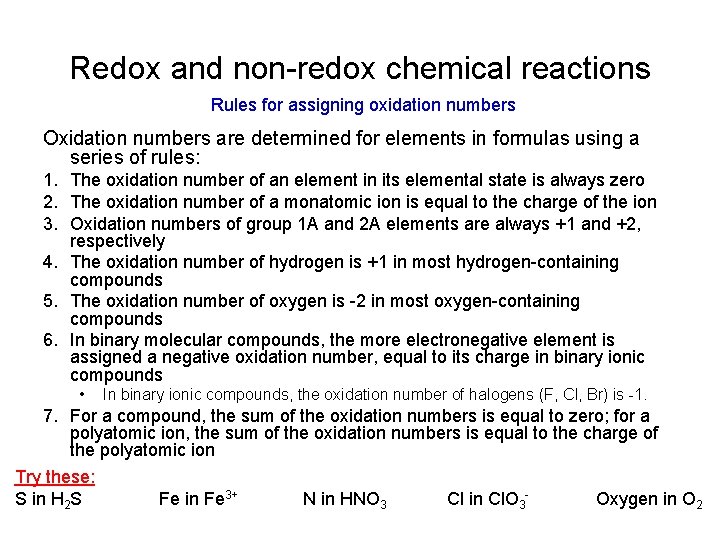
Redox and non-redox chemical reactions Rules for assigning oxidation numbers Oxidation numbers are determined for elements in formulas using a series of rules: 1. The oxidation number of an element in its elemental state is always zero 2. The oxidation number of a monatomic ion is equal to the charge of the ion 3. Oxidation numbers of group 1 A and 2 A elements are always +1 and +2, respectively 4. The oxidation number of hydrogen is +1 in most hydrogen-containing compounds 5. The oxidation number of oxygen is -2 in most oxygen-containing compounds 6. In binary molecular compounds, the more electronegative element is assigned a negative oxidation number, equal to its charge in binary ionic compounds • In binary ionic compounds, the oxidation number of halogens (F, Cl, Br) is -1. 7. For a compound, the sum of the oxidation numbers is equal to zero; for a polyatomic ion, the sum of the oxidation numbers is equal to the charge of the polyatomic ion Try these: S in H 2 S Fe in Fe 3+ N in HNO 3 Cl in Cl. O 3 Oxygen in O 2
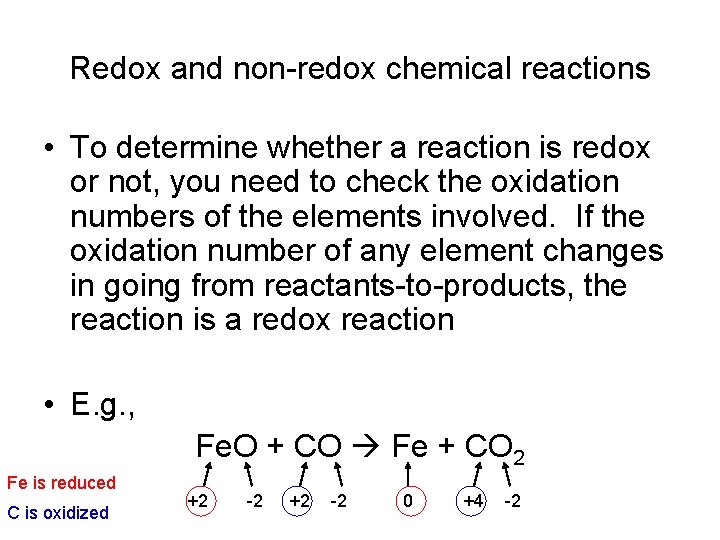
Redox and non-redox chemical reactions • To determine whether a reaction is redox or not, you need to check the oxidation numbers of the elements involved. If the oxidation number of any element changes in going from reactants-to-products, the reaction is a redox reaction • E. g. , Fe. O + CO Fe + CO 2 Fe is reduced C is oxidized +2 -2 0 +4 -2
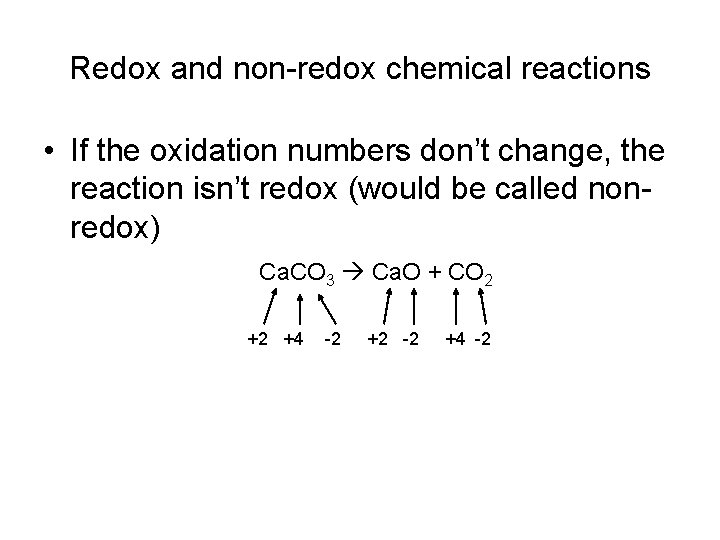
Redox and non-redox chemical reactions • If the oxidation numbers don’t change, the reaction isn’t redox (would be called nonredox) Ca. CO 3 Ca. O + CO 2 +2 +4 -2 +2 -2 +4 -2
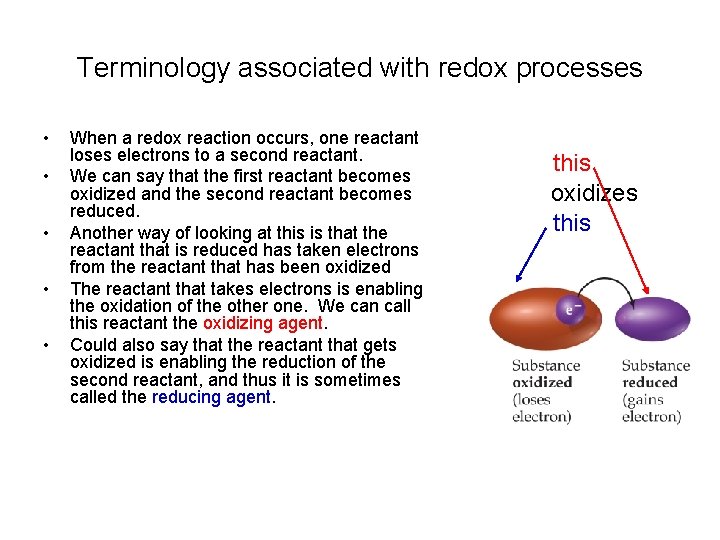
Terminology associated with redox processes • • • When a redox reaction occurs, one reactant loses electrons to a second reactant. We can say that the first reactant becomes oxidized and the second reactant becomes reduced. Another way of looking at this is that the reactant that is reduced has taken electrons from the reactant that has been oxidized The reactant that takes electrons is enabling the oxidation of the other one. We can call this reactant the oxidizing agent. Could also say that the reactant that gets oxidized is enabling the reduction of the second reactant, and thus it is sometimes called the reducing agent. this oxidizes this
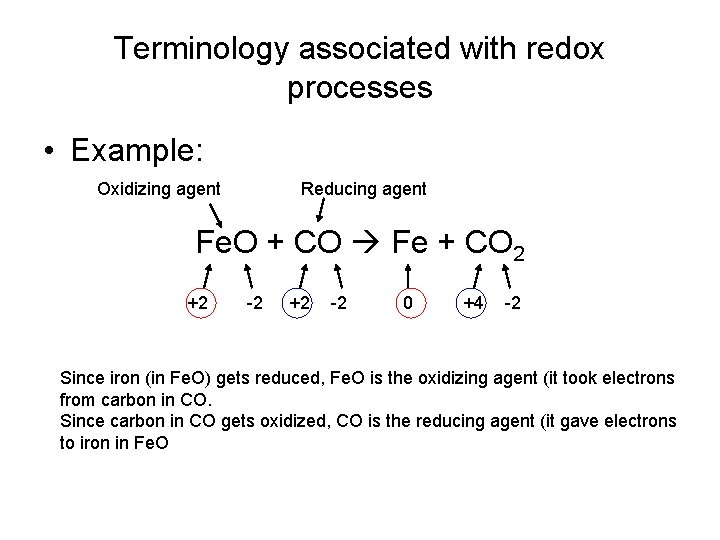
Terminology associated with redox processes • Example: Oxidizing agent Reducing agent Fe. O + CO Fe + CO 2 +2 -2 0 +4 -2 Since iron (in Fe. O) gets reduced, Fe. O is the oxidizing agent (it took electrons from carbon in CO. Since carbon in CO gets oxidized, CO is the reducing agent (it gave electrons to iron in Fe. O
Collision theory and chemical reactions • What causes chemical reactions to take place? There are three requirements that must be met for a chemical reaction to occur: – Molecular collisions: reactant particles must interact with one another before a reaction can occur – Activation energy: molecules must collide with a certain, minimum energy, in order for the reaction to take place – Collision orientation: in many cases, collisions need to involve specific regions (groups of atoms) for a successful reaction to result
Collision theory and chemical reactions Molecular collisions • Collisions must occur in order for two or more chemical species to react with each other (reactants can’t react if they are separated from each other). • The collisions involve a transfer of energy, and this energy can be used to break bonds during reactions. The greater the frequency of collisions the faster the rate. and The more molecules present, the greater the probability of collision and the faster the rate (concentration)
Collision theory and chemical reactions Activation energy • Activation energy: the energy barrier (kinetic) that must be overcome during the chemical transformation of reactants to products. • Activation energy varies from reaction to reaction. • Slow reactions typically have high activation energies (only a small proportion of the molecules in the reaction container have adequate kinetic energy to react). Higher activation energy barriers yield slower chemical reactions
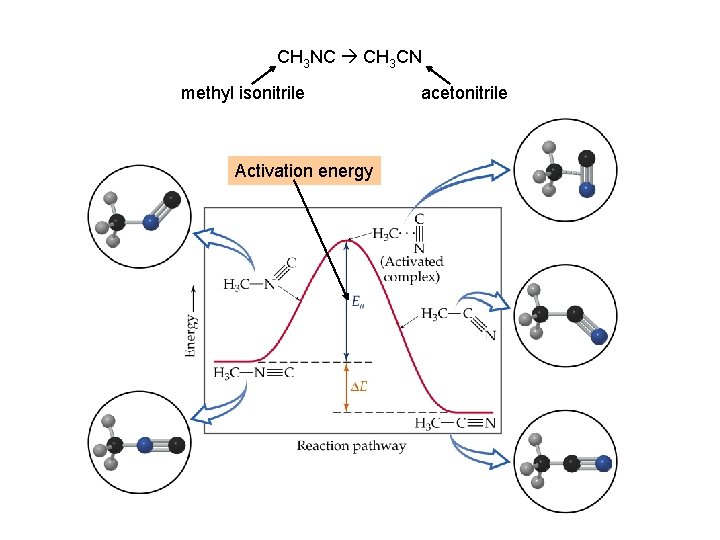
CH 3 NC CH 3 CN methyl isonitrile Activation energy acetonitrile
Collision theory and chemical reactions Collision orientation • Bonds are broken and new bonds are formed when reactions occur. New bonds are formed between atoms, and the bonds result from sharing of electrons between those atoms. • The atoms that are involved in these new bonds formed must participate in the collision/contact. Reactions that have strict orientation requirements tend to be slow
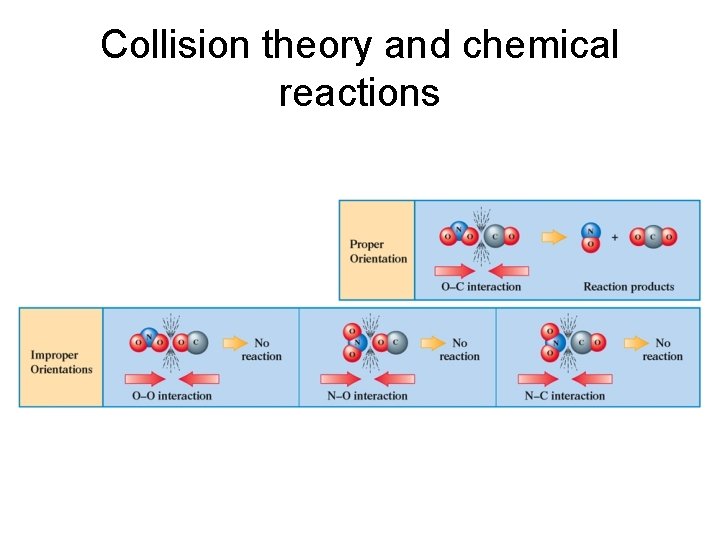
Collision theory and chemical reactions
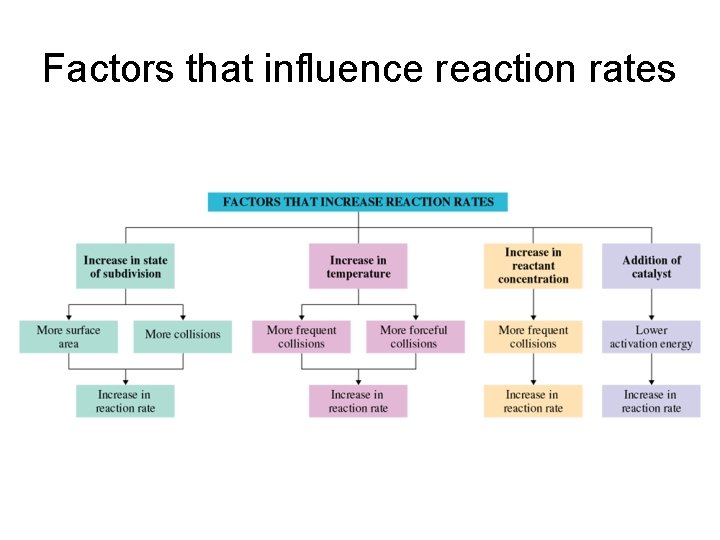
Factors that influence reaction rates
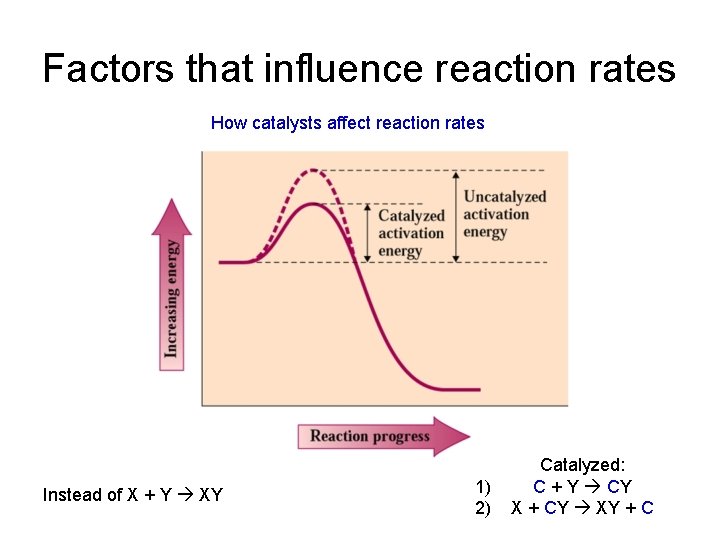
Factors that influence reaction rates How catalysts affect reaction rates Instead of X + Y XY 1) 2) Catalyzed: C + Y CY X + CY XY + C
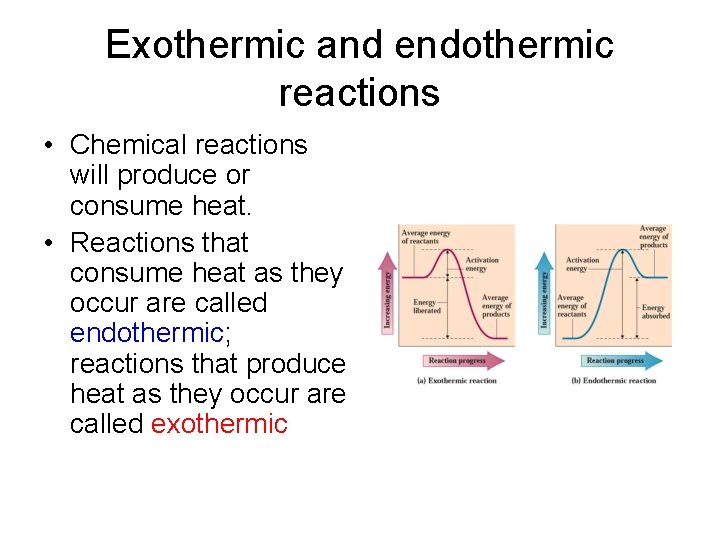
Exothermic and endothermic reactions • Chemical reactions will produce or consume heat. • Reactions that consume heat as they occur are called endothermic; reactions that produce heat as they occur are called exothermic
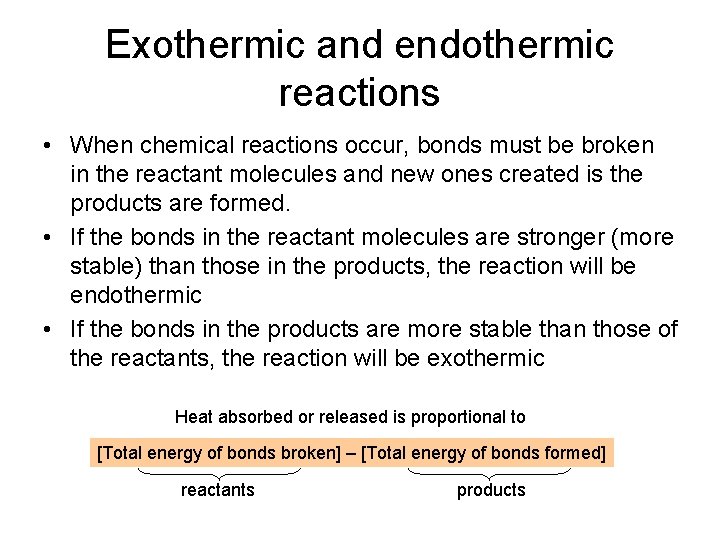
Exothermic and endothermic reactions • When chemical reactions occur, bonds must be broken in the reactant molecules and new ones created is the products are formed. • If the bonds in the reactant molecules are stronger (more stable) than those in the products, the reaction will be endothermic • If the bonds in the products are more stable than those of the reactants, the reaction will be exothermic Heat absorbed or released is proportional to [Total energy of bonds broken] – [Total energy of bonds formed] reactants products
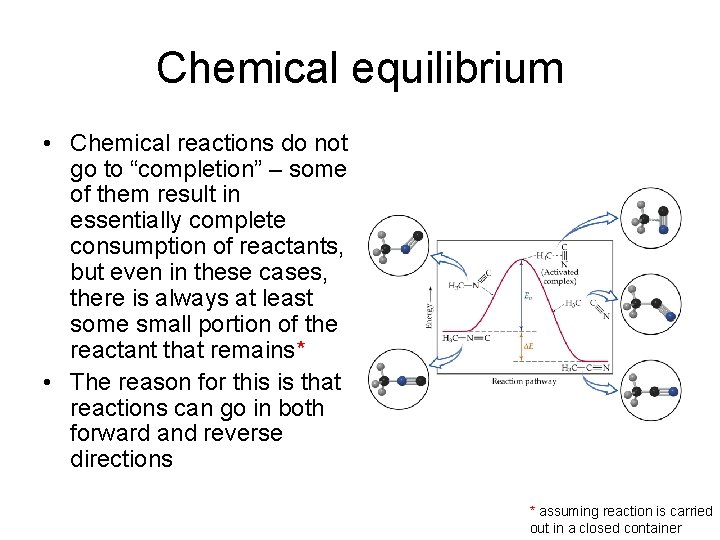
Chemical equilibrium • Chemical reactions do not go to “completion” – some of them result in essentially complete consumption of reactants, but even in these cases, there is always at least some small portion of the reactant that remains* • The reason for this is that reactions can go in both forward and reverse directions * assuming reaction is carried out in a closed container
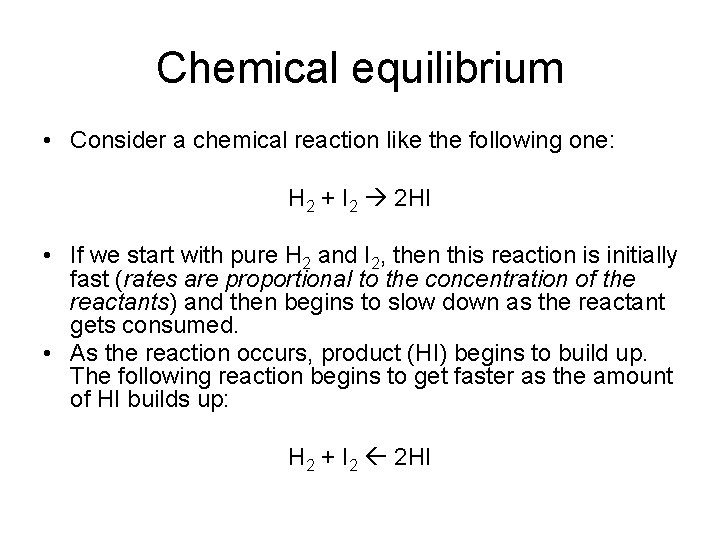
Chemical equilibrium • Consider a chemical reaction like the following one: H 2 + I 2 2 HI • If we start with pure H 2 and I 2, then this reaction is initially fast (rates are proportional to the concentration of the reactants) and then begins to slow down as the reactant gets consumed. • As the reaction occurs, product (HI) begins to build up. The following reaction begins to get faster as the amount of HI builds up: H 2 + I 2 2 HI
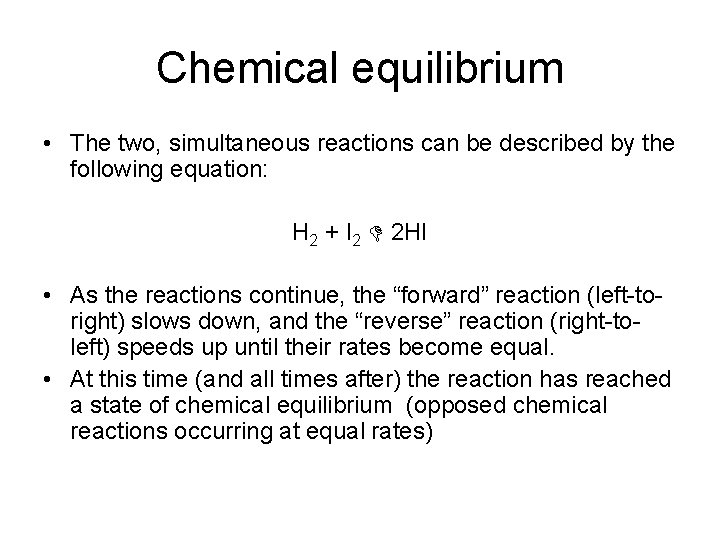
Chemical equilibrium • The two, simultaneous reactions can be described by the following equation: H 2 + I 2 D 2 HI • As the reactions continue, the “forward” reaction (left-toright) slows down, and the “reverse” reaction (right-toleft) speeds up until their rates become equal. • At this time (and all times after) the reaction has reached a state of chemical equilibrium (opposed chemical reactions occurring at equal rates)
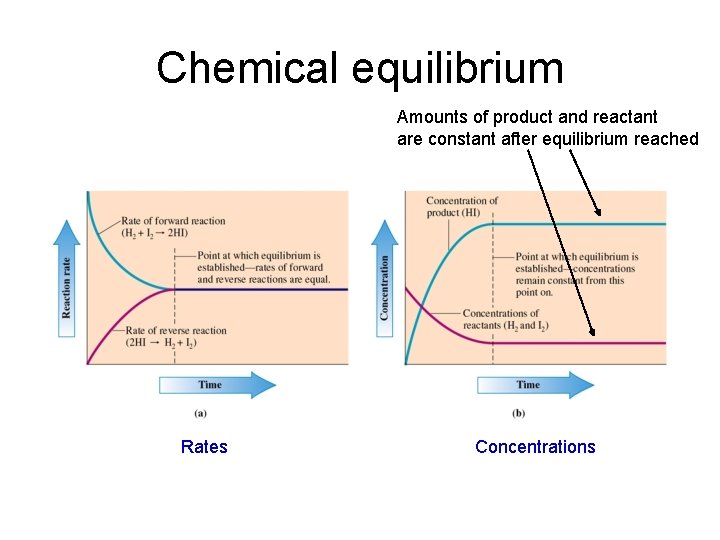
Chemical equilibrium Amounts of product and reactant are constant after equilibrium reached Rates Concentrations
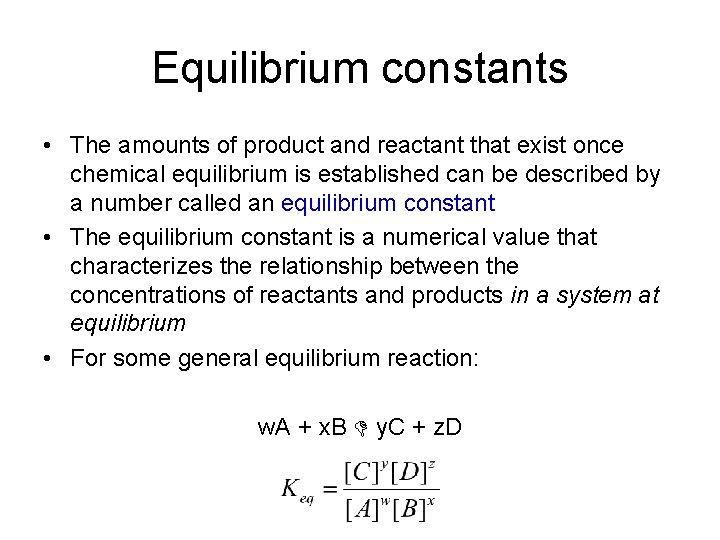
Equilibrium constants • The amounts of product and reactant that exist once chemical equilibrium is established can be described by a number called an equilibrium constant • The equilibrium constant is a numerical value that characterizes the relationship between the concentrations of reactants and products in a system at equilibrium • For some general equilibrium reaction: w. A + x. B D y. C + z. D
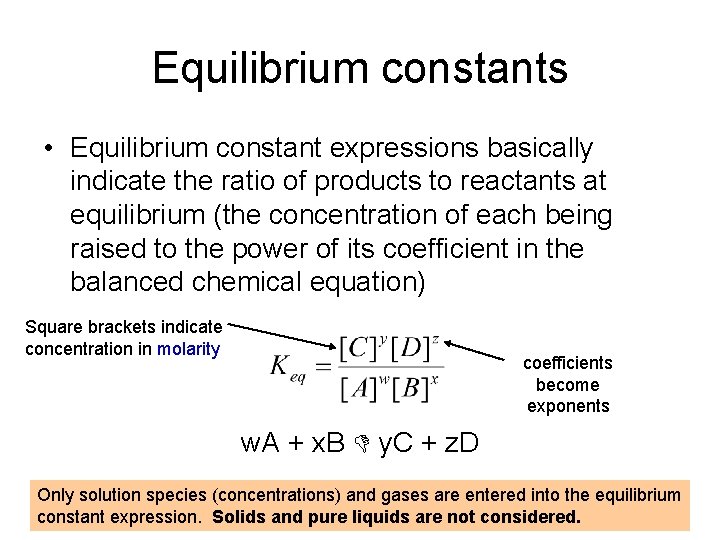
Equilibrium constants • Equilibrium constant expressions basically indicate the ratio of products to reactants at equilibrium (the concentration of each being raised to the power of its coefficient in the balanced chemical equation) Square brackets indicate concentration in molarity coefficients become exponents w. A + x. B D y. C + z. D Only solution species (concentrations) and gases are entered into the equilibrium constant expression. Solids and pure liquids are not considered.
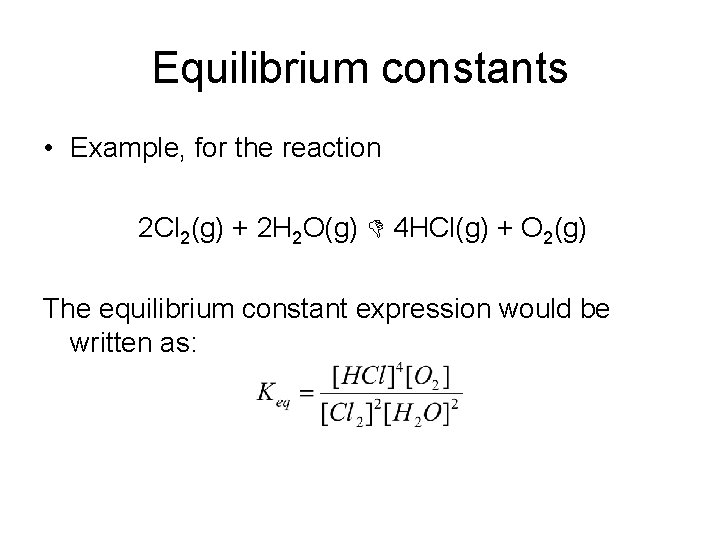
Equilibrium constants • Example, for the reaction 2 Cl 2(g) + 2 H 2 O(g) D 4 HCl(g) + O 2(g) The equilibrium constant expression would be written as:
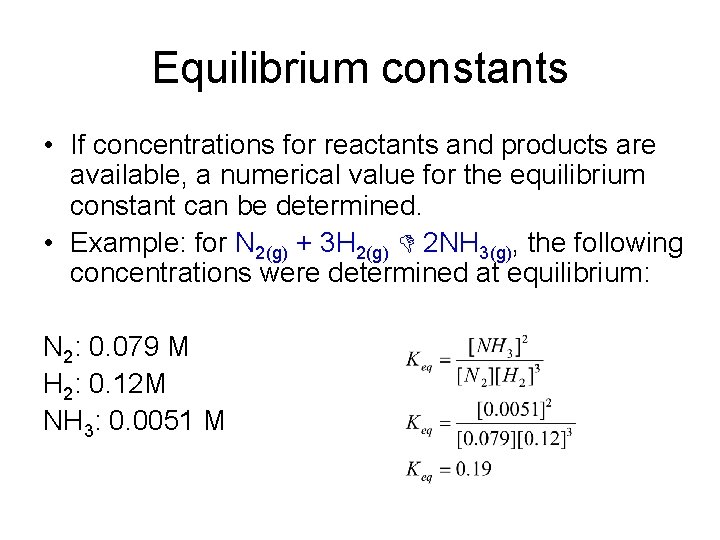
Equilibrium constants • If concentrations for reactants and products are available, a numerical value for the equilibrium constant can be determined. • Example: for N 2(g) + 3 H 2(g) D 2 NH 3(g), the following concentrations were determined at equilibrium: N 2: 0. 079 M H 2: 0. 12 M NH 3: 0. 0051 M
Equilibrium constants • Another example: write an expression for Keq for the following reaction, and calculate Keq if the following concentrations are present at equilbrium: Ag. Cl(s) D Ag+(aq) + Cl-(aq) At equilibrium Ag+(aq) = 1. 3 x 10 -5 M Cl-(aq) = 1. 3 x 10 -5 M
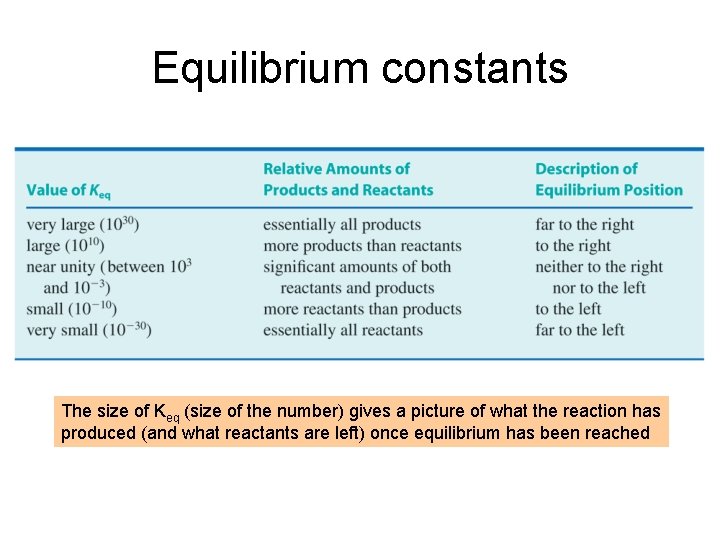
Equilibrium constants The size of Keq (size of the number) gives a picture of what the reaction has produced (and what reactants are left) once equilibrium has been reached
Altering equilibrium conditions: Le Chatelier’s principle • Chemical equilibrium is a balancing act that exists under a certain set of conditions. If the conditions are changed, equilibrium can be upset • When this occurs, the chemical reaction responds in a way that takes it back to equilibrium (though the final “picture” will probably look a little different than what it looked like before equilibrium was upset)
Altering equilibrium conditions: Le Chatelier’s principle • Consider the following reaction: N 2(g) + 3 H 2(g) D 2 NH 3(g) • If this reaction has reached equilibrium, what happens if we add some more H 2(g)? N 2(g) + 3 H 2(g) 2 NH 3(g) The concentrations of the reactants for this reaction have been increased. N 2(g) + 3 H 2(g) 2 NH 3(g)
Altering equilibrium conditions: Le Chatelier’s principle • The reaction will respond in a way that will take it back to equilibrium. It does this by minimizing the stress that has been applied to the system N 2(g) + 3 H 2(g) D 2 NH 3(g) Stress here is too much H 2. Reaction will “shift-to-the-right” to consume the extra H 2
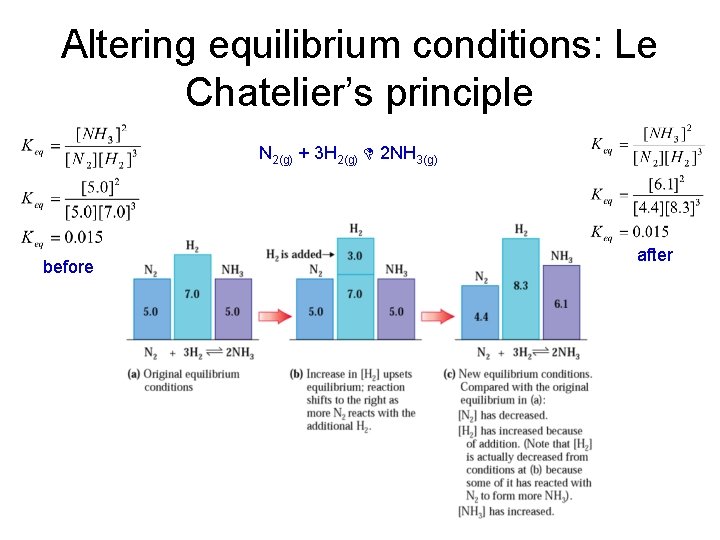
Altering equilibrium conditions: Le Chatelier’s principle N 2(g) + 3 H 2(g) D 2 NH 3(g) before after
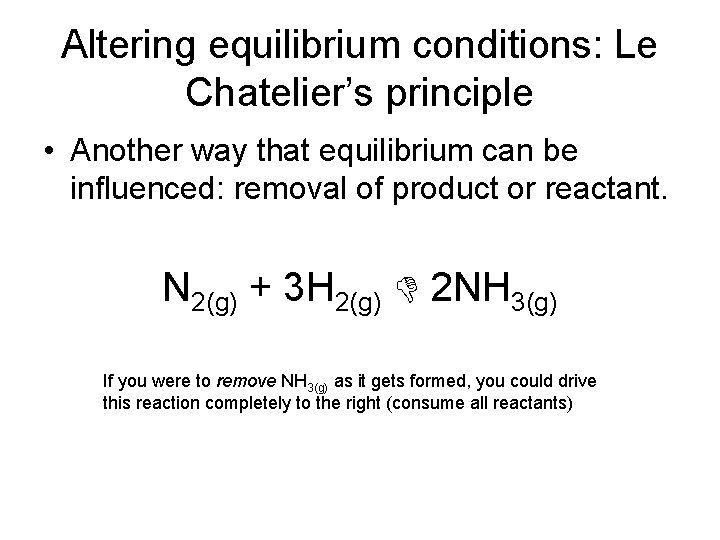
Altering equilibrium conditions: Le Chatelier’s principle • Another way that equilibrium can be influenced: removal of product or reactant. N 2(g) + 3 H 2(g) D 2 NH 3(g) If you were to remove NH 3(g) as it gets formed, you could drive this reaction completely to the right (consume all reactants)
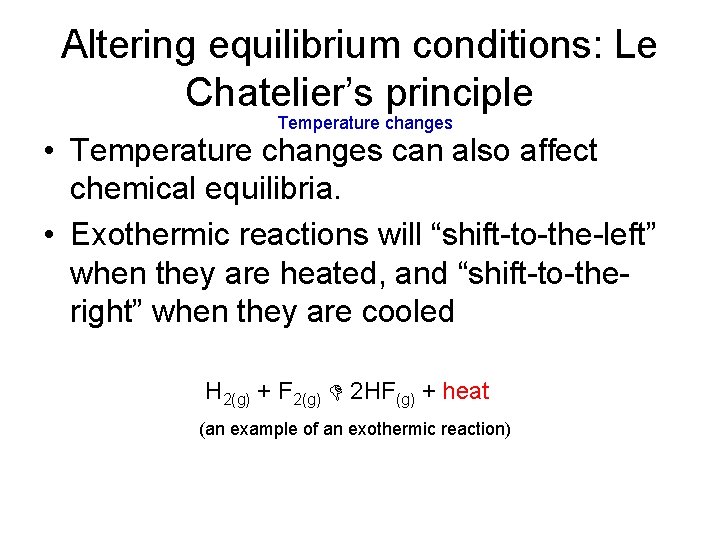
Altering equilibrium conditions: Le Chatelier’s principle Temperature changes • Temperature changes can also affect chemical equilibria. • Exothermic reactions will “shift-to-the-left” when they are heated, and “shift-to-theright” when they are cooled H 2(g) + F 2(g) D 2 HF(g) + heat (an example of an exothermic reaction)
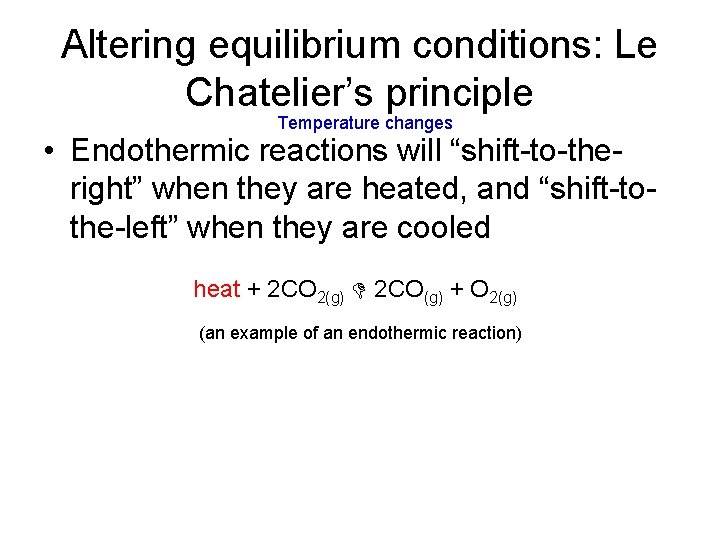
Altering equilibrium conditions: Le Chatelier’s principle Temperature changes • Endothermic reactions will “shift-to-theright” when they are heated, and “shift-tothe-left” when they are cooled heat + 2 CO 2(g) D 2 CO(g) + O 2(g) (an example of an endothermic reaction)
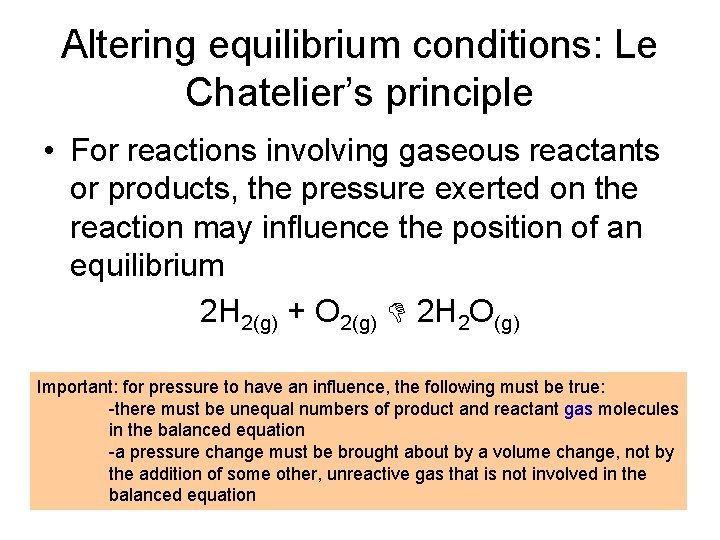
Altering equilibrium conditions: Le Chatelier’s principle • For reactions involving gaseous reactants or products, the pressure exerted on the reaction may influence the position of an equilibrium 2 H 2(g) + O 2(g) D 2 H 2 O(g) Important: for pressure to have an influence, the following must be true: -there must be unequal numbers of product and reactant gas molecules in the balanced equation -a pressure change must be brought about by a volume change, not by the addition of some other, unreactive gas that is not involved in the balanced equation
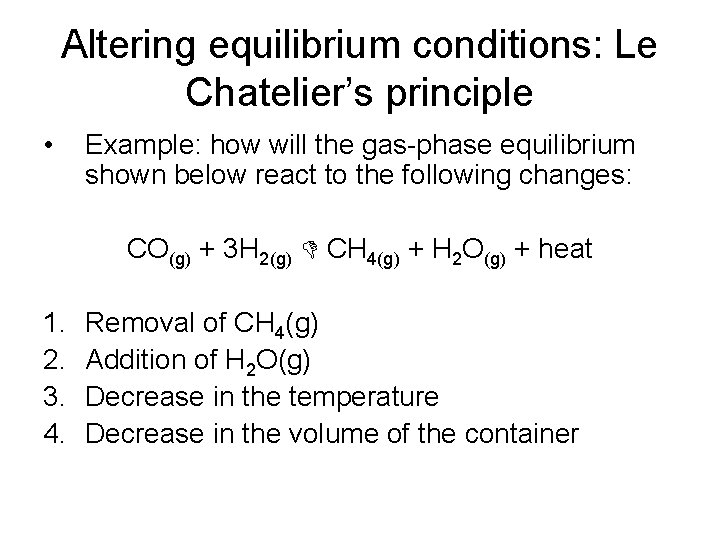
Altering equilibrium conditions: Le Chatelier’s principle • Example: how will the gas-phase equilibrium shown below react to the following changes: CO(g) + 3 H 2(g) D CH 4(g) + H 2 O(g) + heat 1. 2. 3. 4. Removal of CH 4(g) Addition of H 2 O(g) Decrease in the temperature Decrease in the volume of the container
- Slides: 46