
Chapter 9 CHEMICAL REACTIONS Honors Chemistry Section 9
- Slides: 25
Chapter 9 CHEMICAL REACTIONS Honors Chemistry
Section 9. 1 Reactions and Equations Chemical Reactions • The process by which one or more substances are rearranged to form different substances is called a chemical reaction. • All chemical reactions are the result of chemical changes.
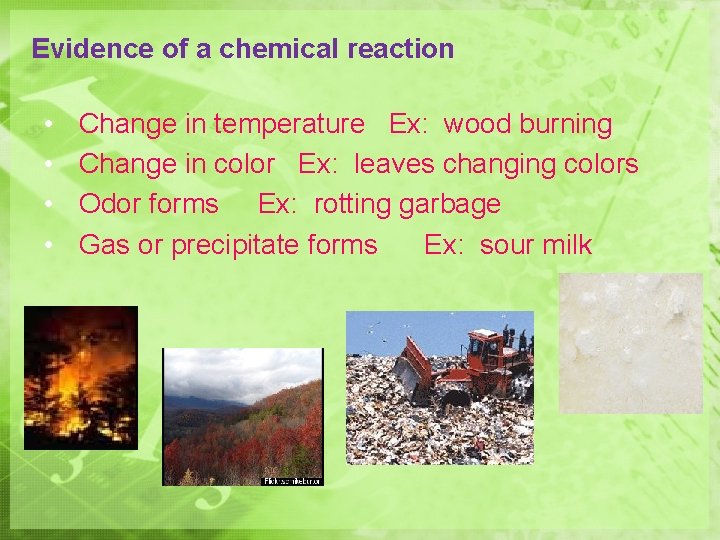
Evidence of a chemical reaction • • Change in temperature Ex: wood burning Change in color Ex: leaves changing colors Odor forms Ex: rotting garbage Gas or precipitate forms Ex: sour milk
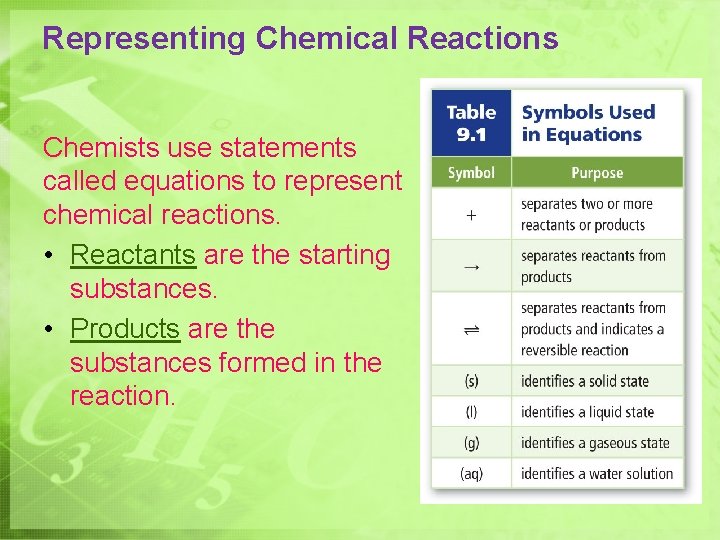
Representing Chemical Reactions Chemists use statements called equations to represent chemical reactions. • Reactants are the starting substances. • Products are the substances formed in the reaction.
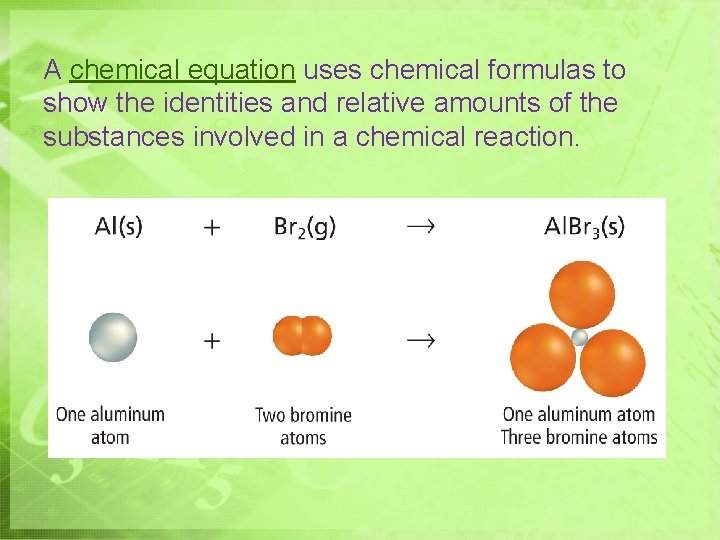
A chemical equation uses chemical formulas to show the identities and relative amounts of the substances involved in a chemical reaction.
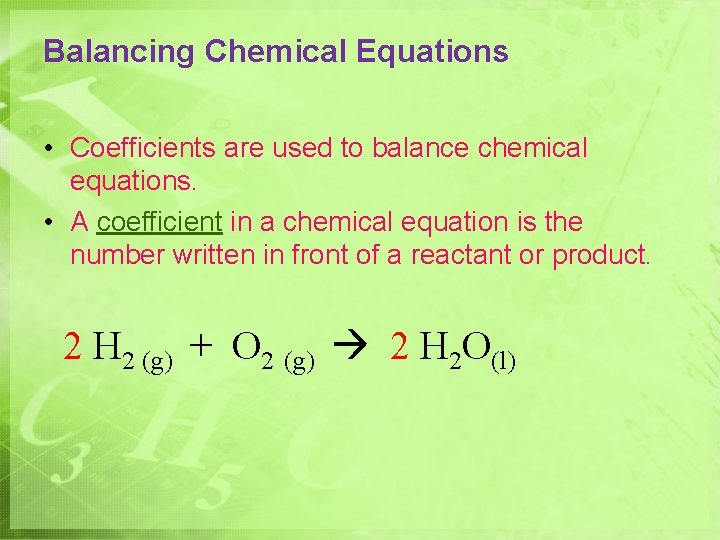
Balancing Chemical Equations • Coefficients are used to balance chemical equations. • A coefficient in a chemical equation is the number written in front of a reactant or product. 2 H 2 (g) + O 2 (g) 2 H 2 O(l)
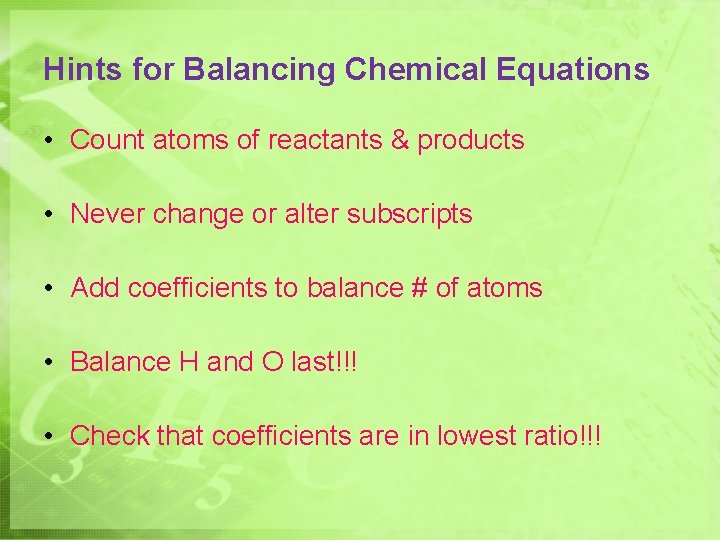
Hints for Balancing Chemical Equations • Count atoms of reactants & products • Never change or alter subscripts • Add coefficients to balance # of atoms • Balance H and O last!!! • Check that coefficients are in lowest ratio!!!
Why Balance Chemical Equations? ? ? • The most fundamental law in chemistry is the law of conservation of mass. • Balanced equations show this law!!!
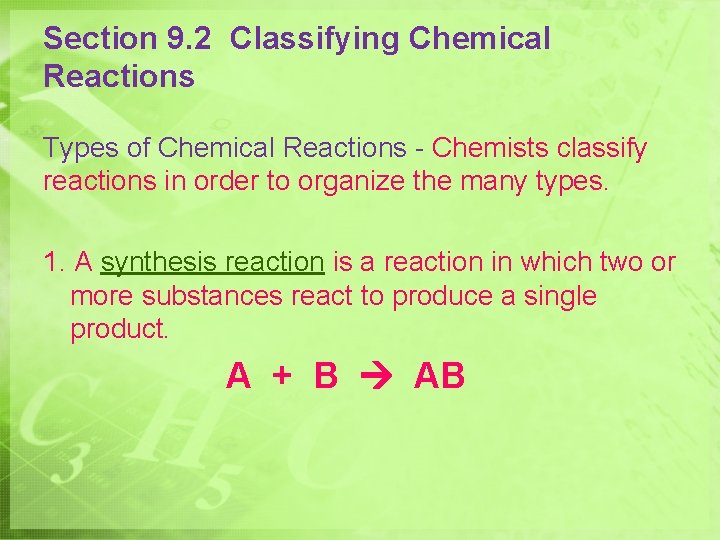
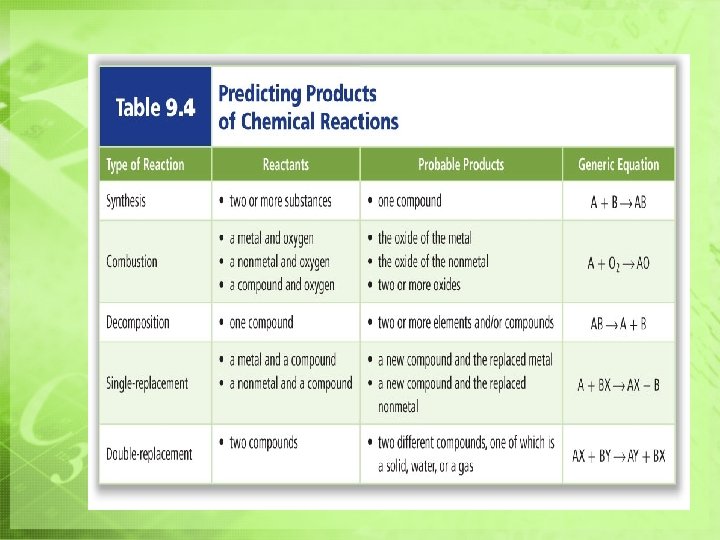
Section 9. 2 Classifying Chemical Reactions Types of Chemical Reactions - Chemists classify reactions in order to organize the many types. 1. A synthesis reaction is a reaction in which two or more substances react to produce a single product. A + B AB
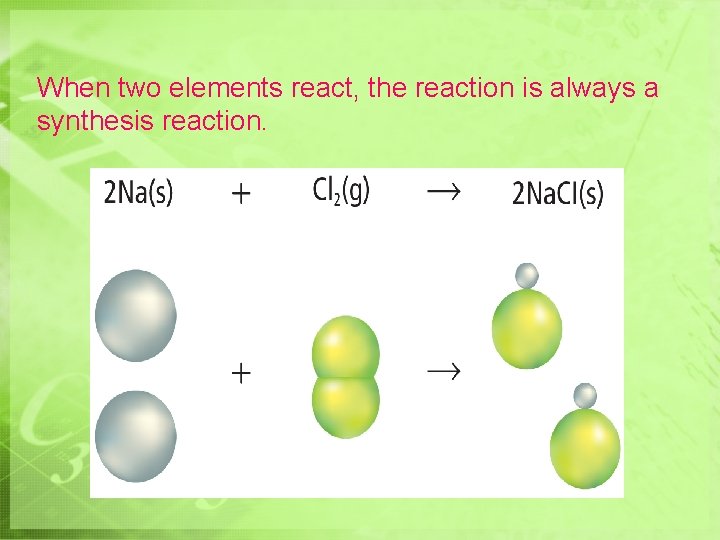
When two elements react, the reaction is always a synthesis reaction.
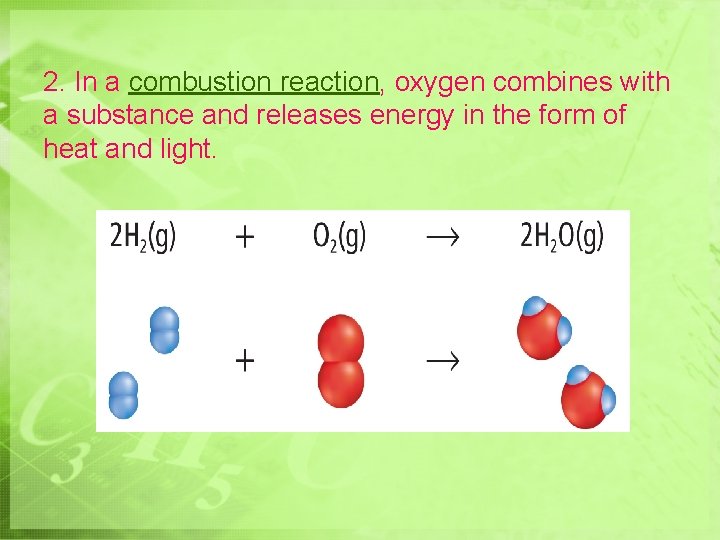
2. In a combustion reaction, oxygen combines with a substance and releases energy in the form of heat and light.
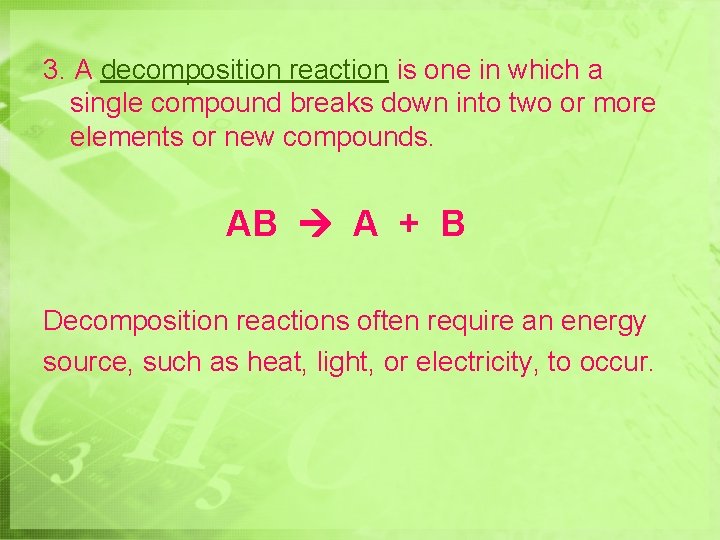
3. A decomposition reaction is one in which a single compound breaks down into two or more elements or new compounds. AB A + B Decomposition reactions often require an energy source, such as heat, light, or electricity, to occur.
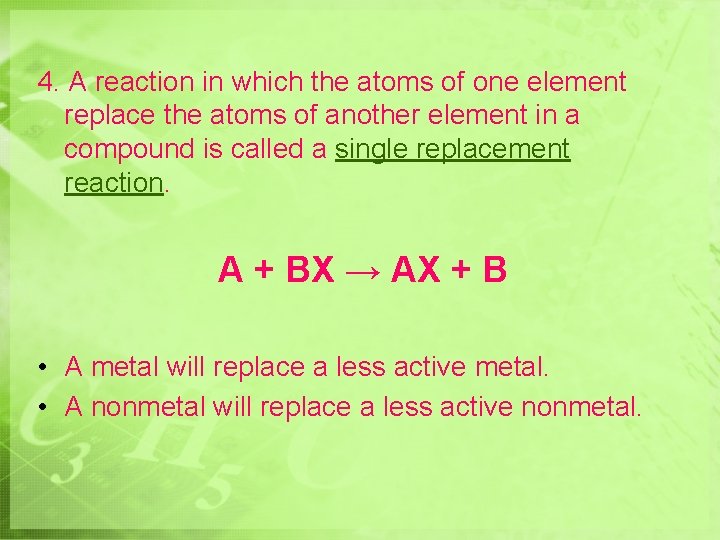
4. A reaction in which the atoms of one element replace the atoms of another element in a compound is called a single replacement reaction. A + BX → AX + B • A metal will replace a less active metal. • A nonmetal will replace a less active nonmetal.
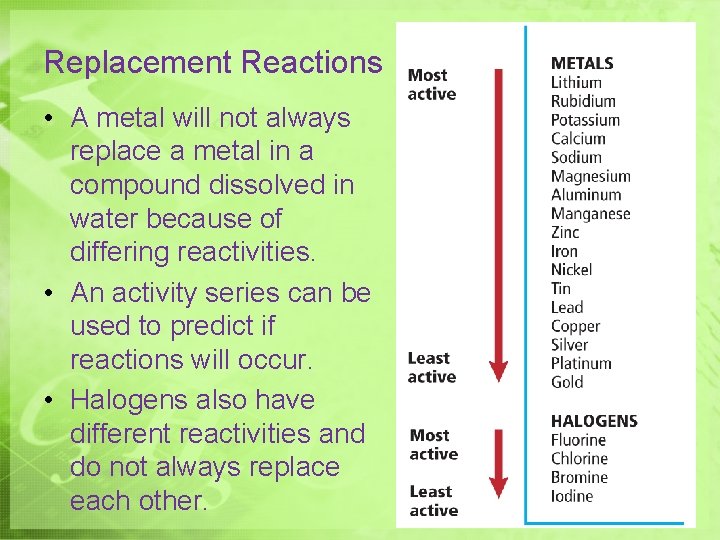
Replacement Reactions • A metal will not always replace a metal in a compound dissolved in water because of differing reactivities. • An activity series can be used to predict if reactions will occur. • Halogens also have different reactivities and do not always replace each other.
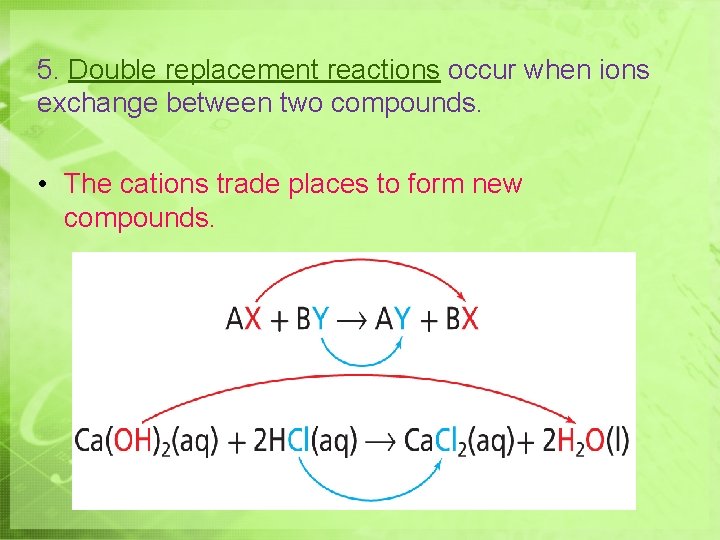
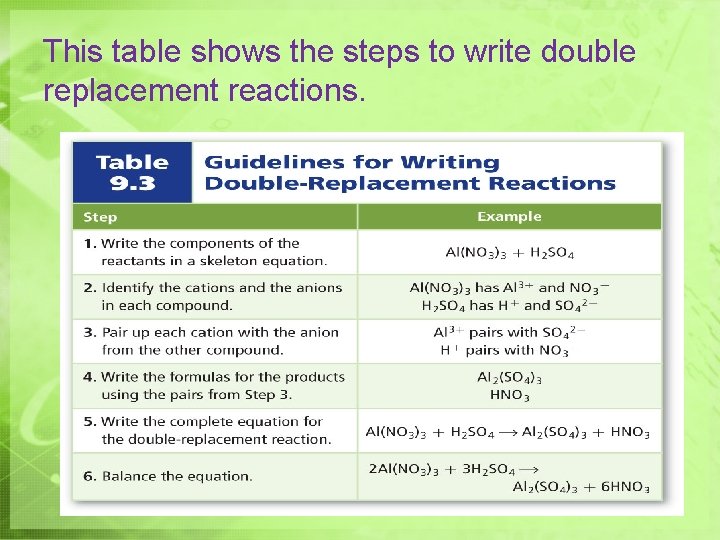
5. Double replacement reactions occur when ions exchange between two compounds. • The cations trade places to form new compounds.
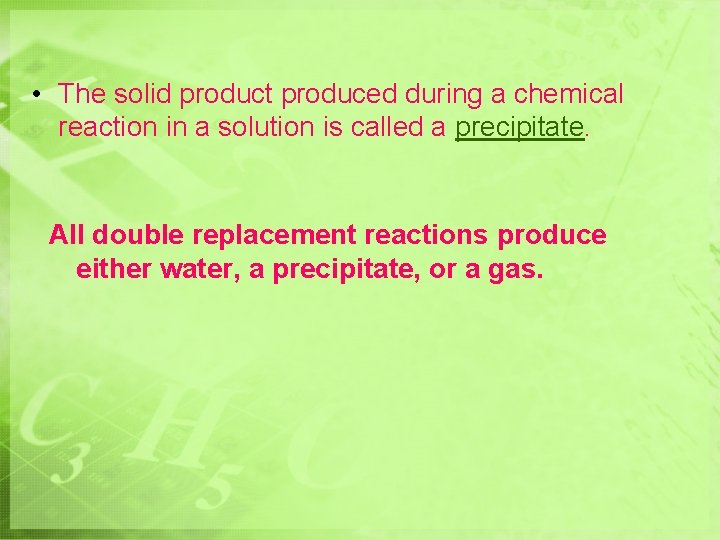
• The solid product produced during a chemical reaction in a solution is called a precipitate. All double replacement reactions produce either water, a precipitate, or a gas.
This table shows the steps to write double replacement reactions.
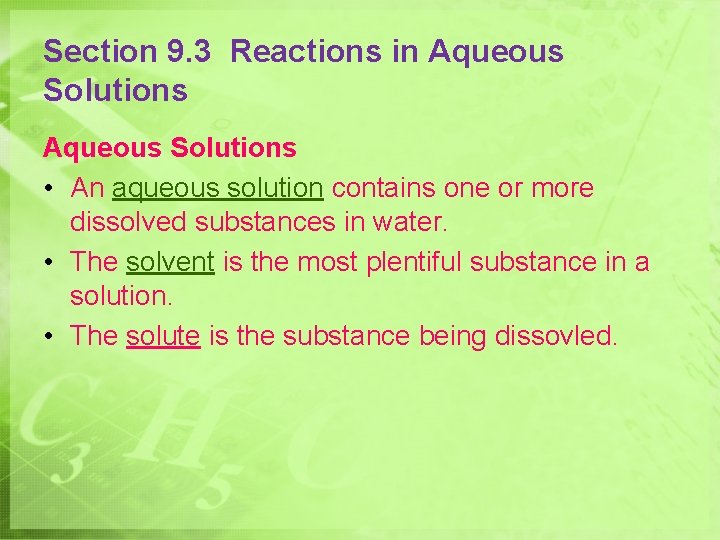
Section 9. 3 Reactions in Aqueous Solutions • An aqueous solution contains one or more dissolved substances in water. • The solvent is the most plentiful substance in a solution. • The solute is the substance being dissovled.
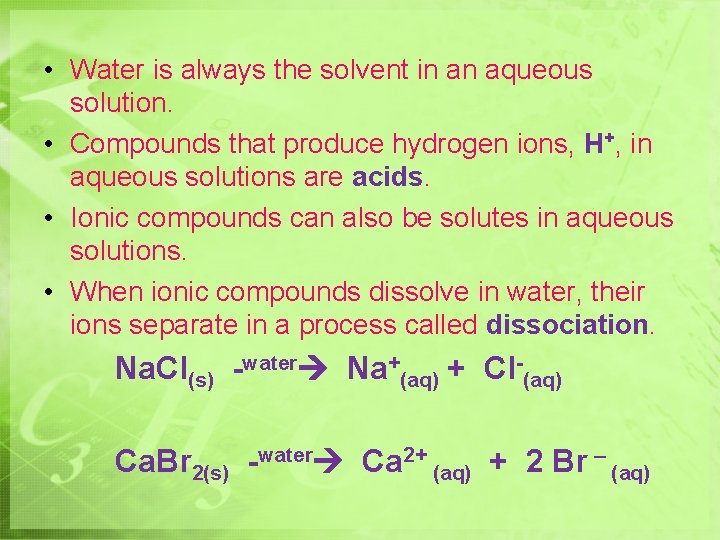
• Water is always the solvent in an aqueous solution. • Compounds that produce hydrogen ions, H+, in aqueous solutions are acids. • Ionic compounds can also be solutes in aqueous solutions. • When ionic compounds dissolve in water, their ions separate in a process called dissociation. Na. Cl(s) -water Na+(aq) + Cl-(aq) Ca. Br 2(s) -water Ca 2+ (aq) + 2 Br – (aq)
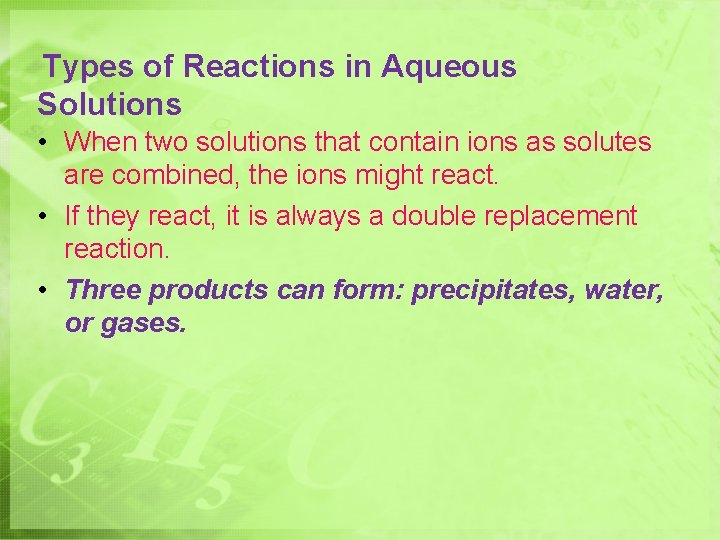
Types of Reactions in Aqueous Solutions • When two solutions that contain ions as solutes are combined, the ions might react. • If they react, it is always a double replacement reaction. • Three products can form: precipitates, water, or gases.
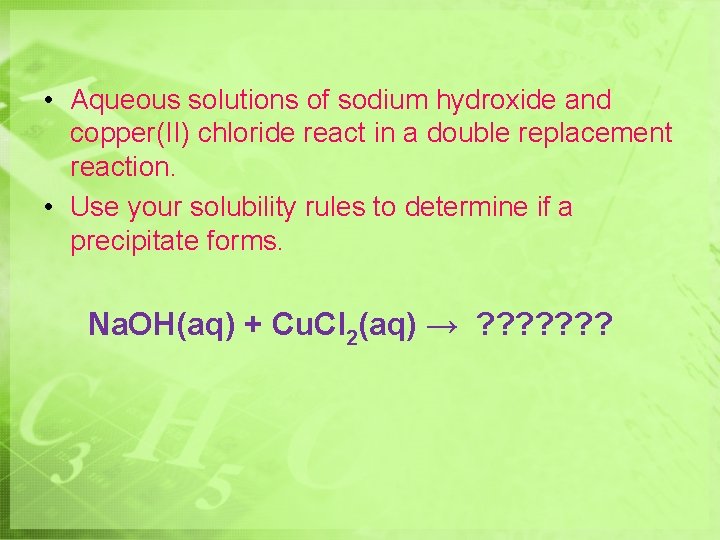
• Aqueous solutions of sodium hydroxide and copper(II) chloride react in a double replacement reaction. • Use your solubility rules to determine if a precipitate forms. Na. OH(aq) + Cu. Cl 2(aq) → ? ? ? ?
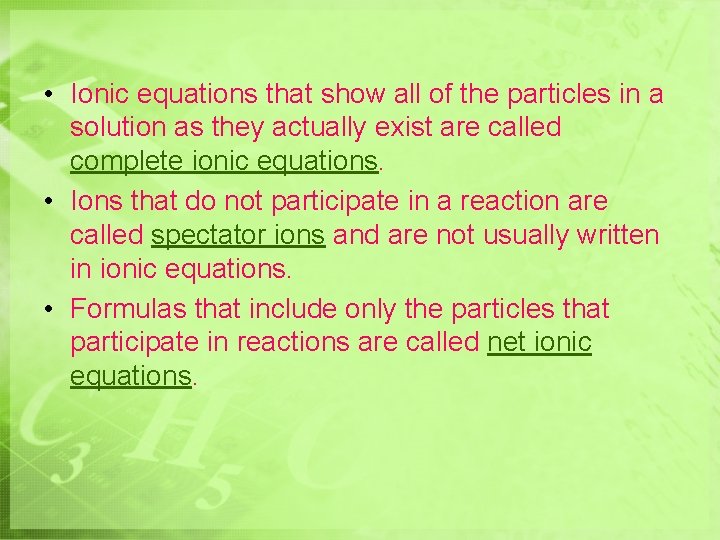
• Ionic equations that show all of the particles in a solution as they actually exist are called complete ionic equations. • Ions that do not participate in a reaction are called spectator ions and are not usually written in ionic equations. • Formulas that include only the particles that participate in reactions are called net ionic equations.
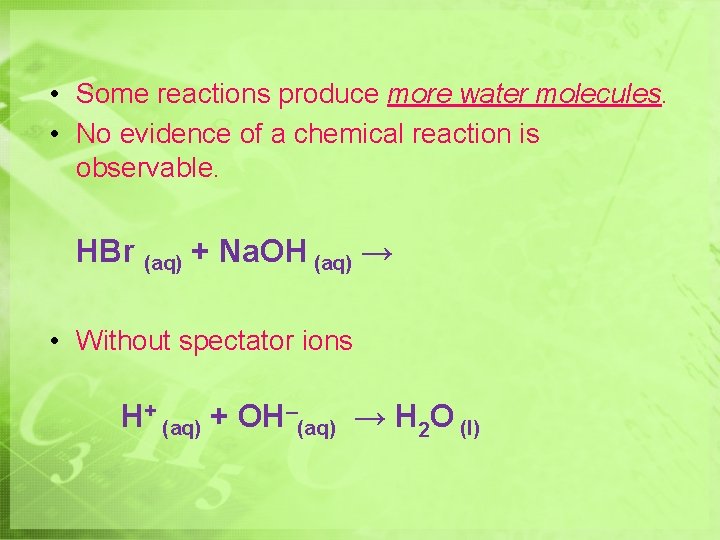
• Some reactions produce more water molecules. • No evidence of a chemical reaction is observable. HBr (aq) + Na. OH (aq) → • Without spectator ions H+ (aq) + OH–(aq) → H 2 O (l)
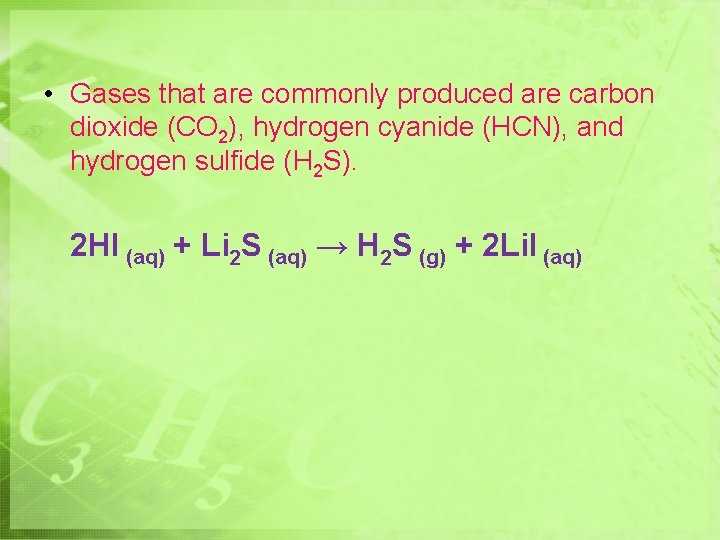
• Gases that are commonly produced are carbon dioxide (CO 2), hydrogen cyanide (HCN), and hydrogen sulfide (H 2 S). 2 HI (aq) + Li 2 S (aq) → H 2 S (g) + 2 Li. I (aq)