
CHAPTER 9 CHEMICAL NAMES AND FORMULAS Jennie L

- Slides: 26
CHAPTER 9 –CHEMICAL NAMES AND FORMULAS Jennie L. Borders
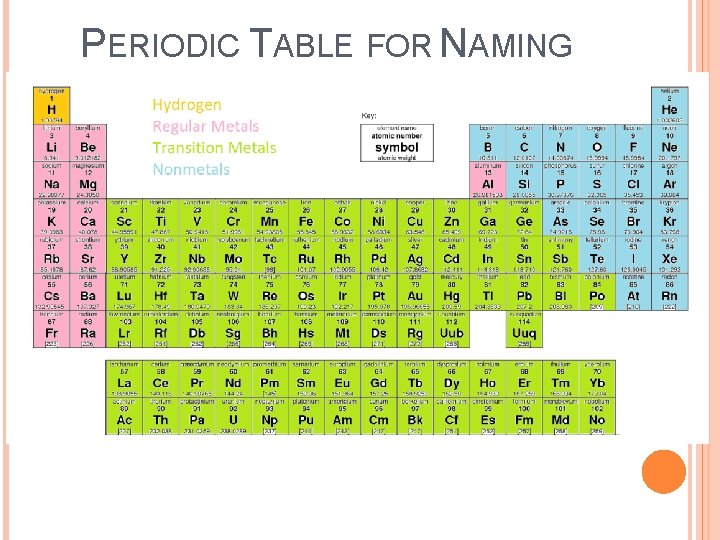
PERIODIC TABLE FOR NAMING
SECTION 9. 1 REGULAR METALS REVIEW The regular metals include Group 1 (except H) and 2 and aluminum. When naming a compound that starts with a regular metal, name the first element and add – ide to the second element (except for polyatomic ions). When writing the formula, remember to balance charges.
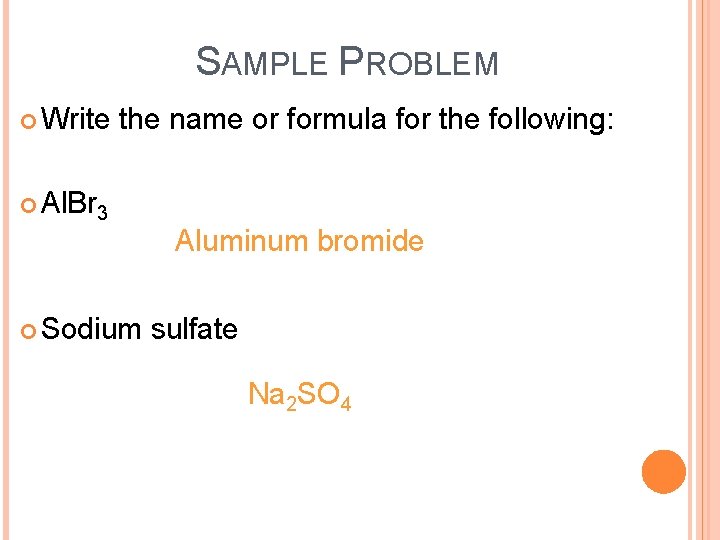
SAMPLE PROBLEM Write the name or formula for the following: Al. Br 3 Sodium Aluminum bromide sulfate Na 2 SO 4
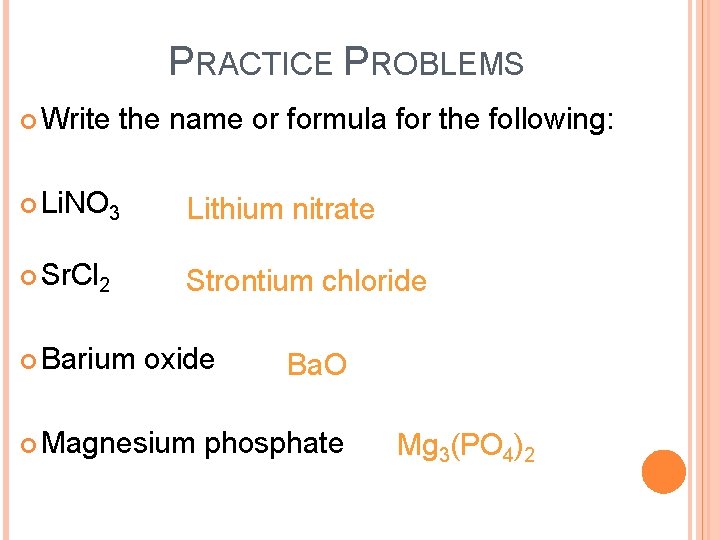
PRACTICE PROBLEMS Write the name or formula for the following: Li. NO 3 Lithium nitrate Sr. Cl 2 Strontium chloride Barium oxide Magnesium Ba. O phosphate Mg 3(PO 4)2
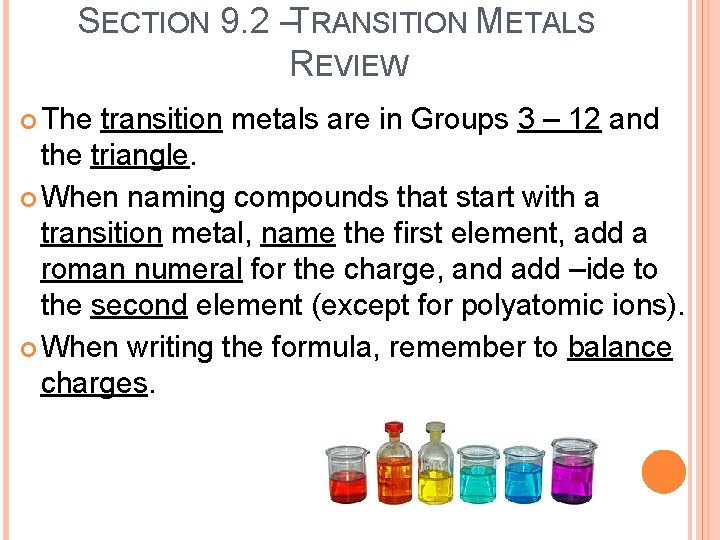
SECTION 9. 2 –TRANSITION METALS REVIEW The transition metals are in Groups 3 – 12 and the triangle. When naming compounds that start with a transition metal, name the first element, add a roman numeral for the charge, and add –ide to the second element (except for polyatomic ions). When writing the formula, remember to balance charges.
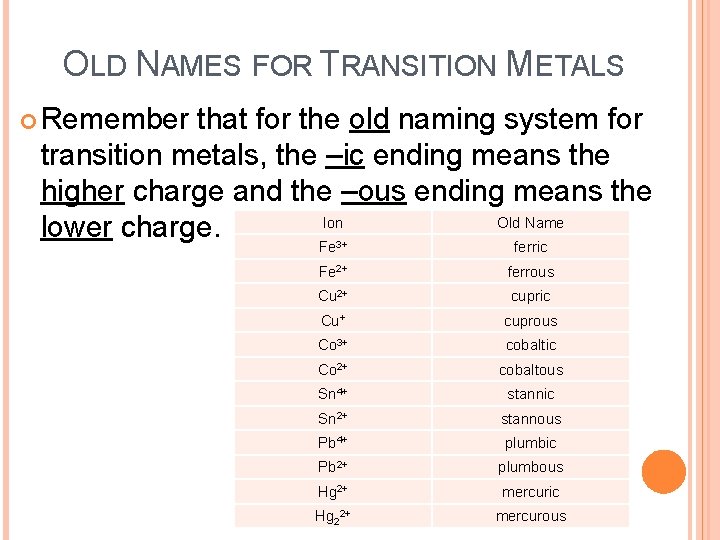
OLD NAMES FOR TRANSITION METALS Remember that for the old naming system for transition metals, the –ic ending means the higher charge and the –ous ending means the Ion Old Name lower charge. Fe 3+ ferric Fe 2+ ferrous Cu 2+ cupric Cu+ cuprous Co 3+ cobaltic Co 2+ cobaltous Sn 4+ stannic Sn 2+ stannous Pb 4+ plumbic Pb 2+ plumbous Hg 2+ mercuric Hg 22+ mercurous
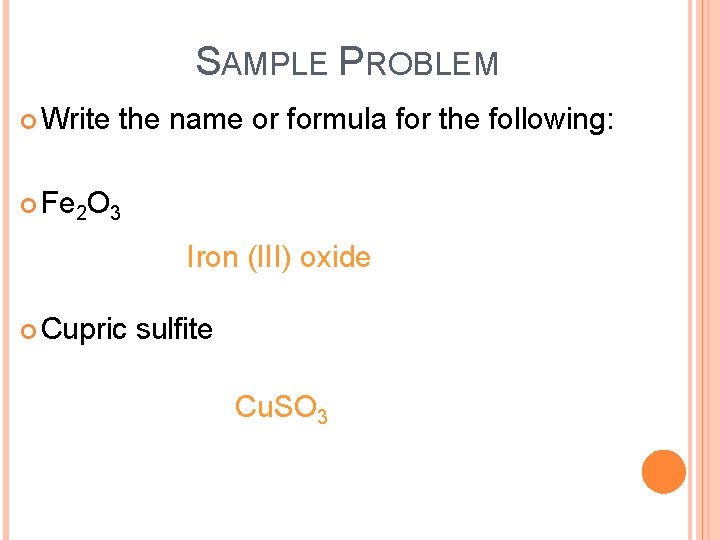
SAMPLE PROBLEM Write the name or formula for the following: Fe 2 O 3 Iron (III) oxide Cupric sulfite Cu. SO 3
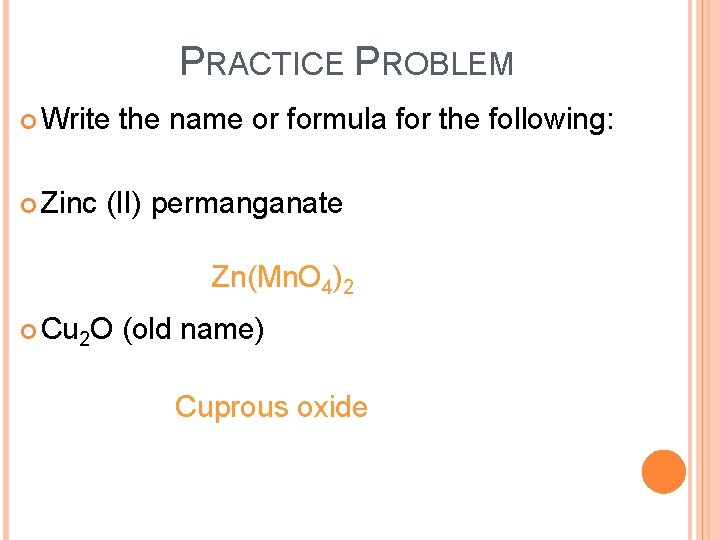
PRACTICE PROBLEM Write Zinc the name or formula for the following: (II) permanganate Zn(Mn. O 4)2 Cu 2 O (old name) Cuprous oxide
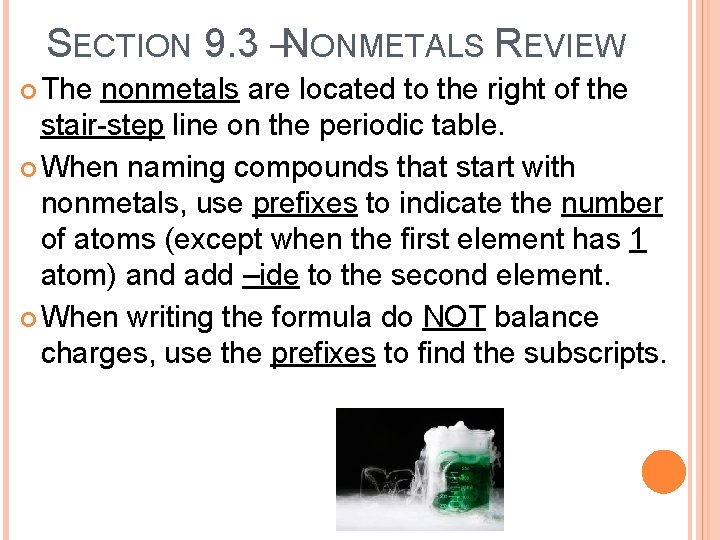
SECTION 9. 3 –NONMETALS REVIEW The nonmetals are located to the right of the stair-step line on the periodic table. When naming compounds that start with nonmetals, use prefixes to indicate the number of atoms (except when the first element has 1 atom) and add –ide to the second element. When writing the formula do NOT balance charges, use the prefixes to find the subscripts.
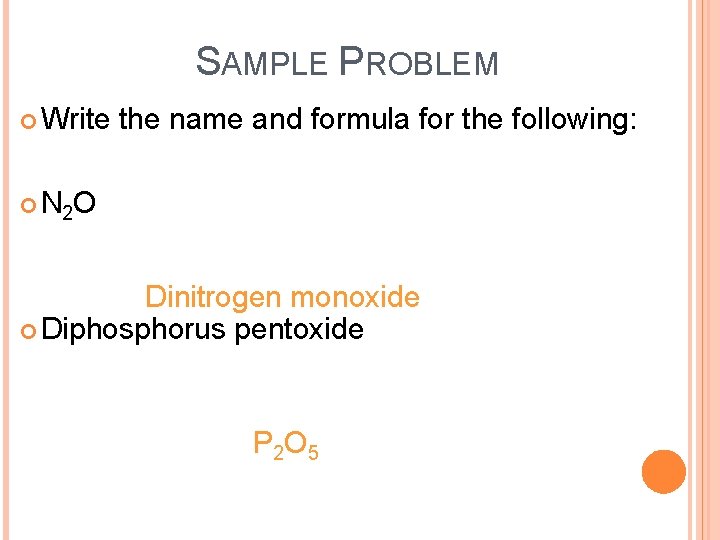
SAMPLE PROBLEM Write the name and formula for the following: N 2 O Dinitrogen monoxide Diphosphorus pentoxide P 2 O 5
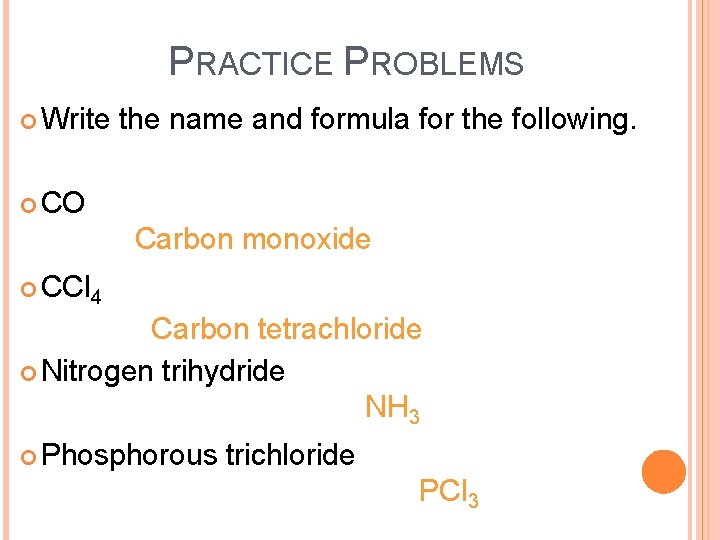
PRACTICE PROBLEMS Write the name and formula for the following. CO Carbon monoxide CCl 4 Carbon tetrachloride Nitrogen trihydride NH 3 Phosphorous trichloride PCl 3
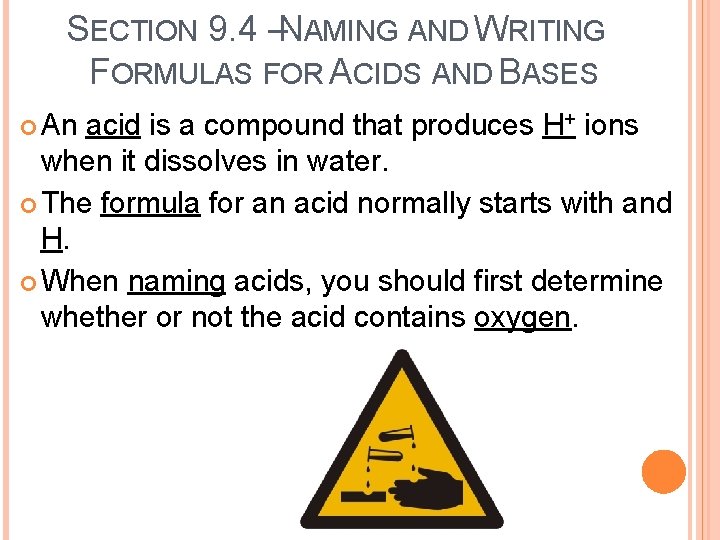
SECTION 9. 4 –NAMING AND WRITING FORMULAS FOR ACIDS AND BASES An acid is a compound that produces H+ ions when it dissolves in water. The formula for an acid normally starts with and H. When naming acids, you should first determine whether or not the acid contains oxygen.
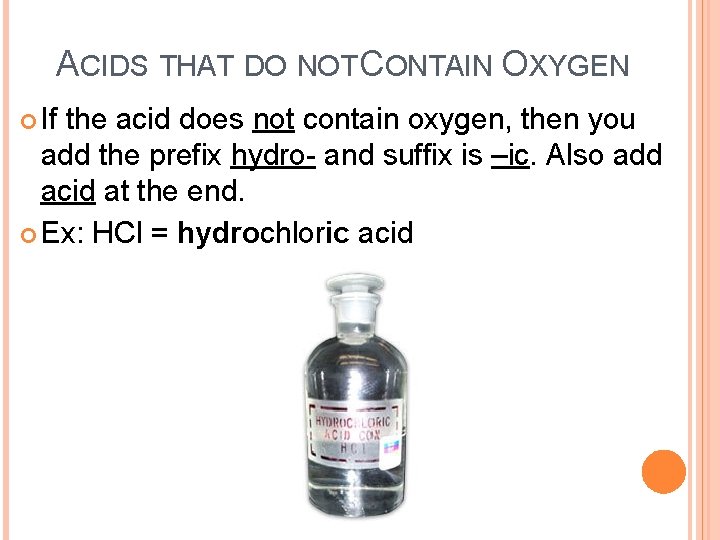
ACIDS THAT DO NOT CONTAIN OXYGEN If the acid does not contain oxygen, then you add the prefix hydro- and suffix is –ic. Also add acid at the end. Ex: HCl = hydrochloric acid
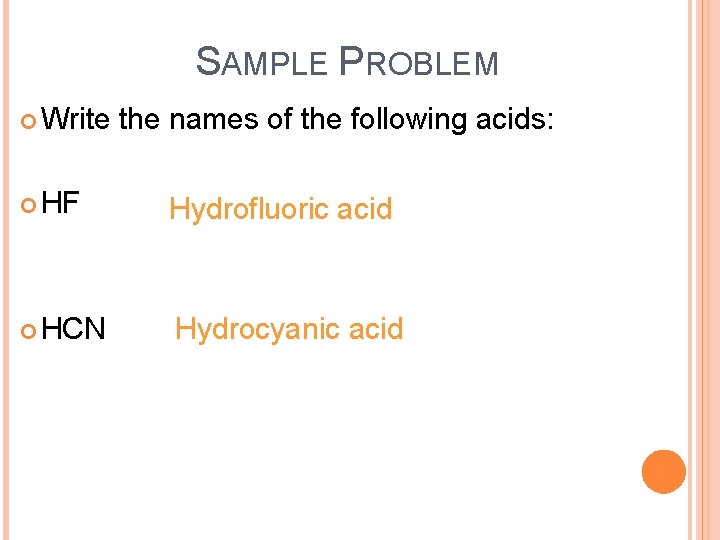
SAMPLE PROBLEM Write the names of the following acids: HF Hydrofluoric acid HCN Hydrocyanic acid
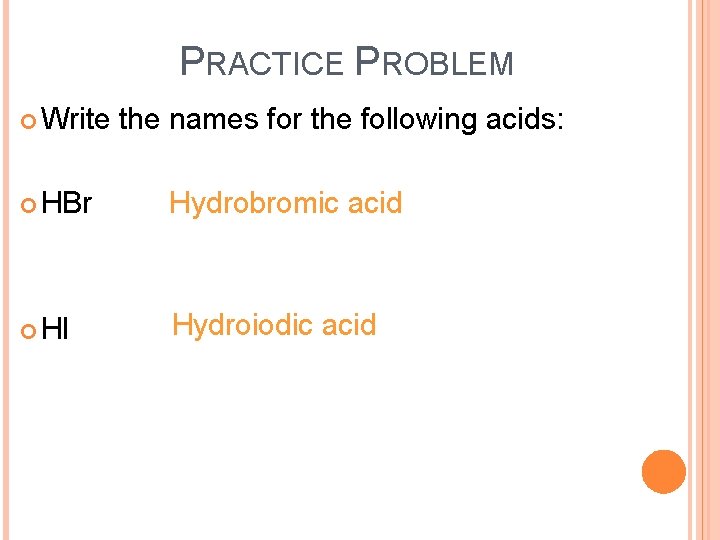
PRACTICE PROBLEM Write the names for the following acids: HBr Hydrobromic acid HI Hydroiodic acid
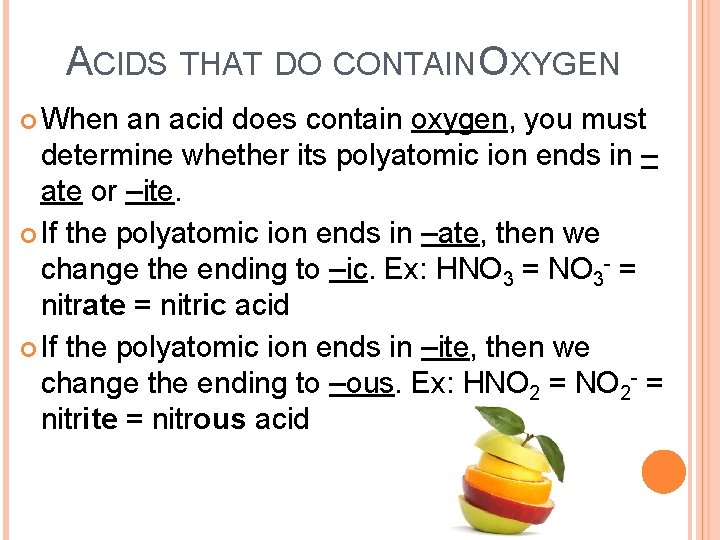
ACIDS THAT DO CONTAIN OXYGEN When an acid does contain oxygen, you must determine whether its polyatomic ion ends in – ate or –ite. If the polyatomic ion ends in –ate, then we change the ending to –ic. Ex: HNO 3 = NO 3 - = nitrate = nitric acid If the polyatomic ion ends in –ite, then we change the ending to –ous. Ex: HNO 2 = NO 2 - = nitrite = nitrous acid
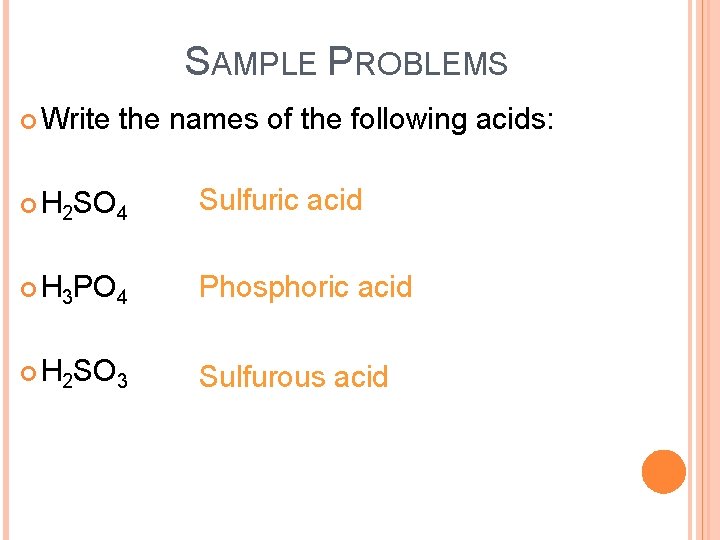
SAMPLE PROBLEMS Write the names of the following acids: H 2 SO 4 Sulfuric acid H 3 PO 4 Phosphoric acid H 2 SO 3 Sulfurous acid
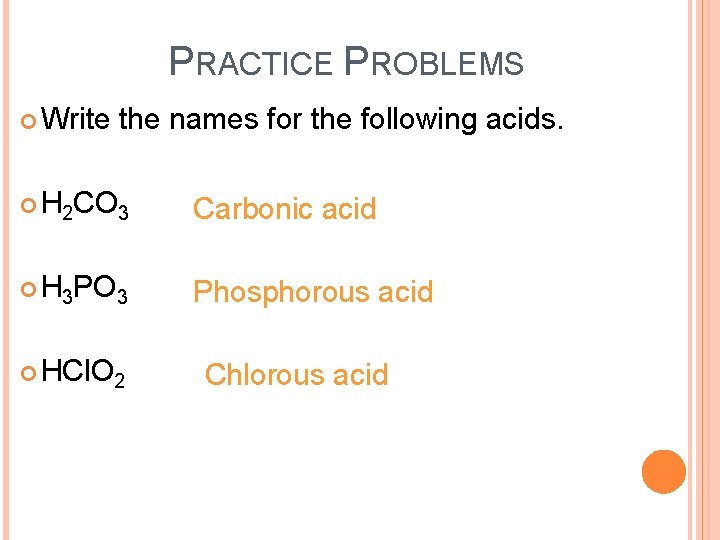
PRACTICE PROBLEMS Write the names for the following acids. H 2 CO 3 Carbonic acid H 3 PO 3 Phosphorous acid HCl. O 2 Chlorous acid
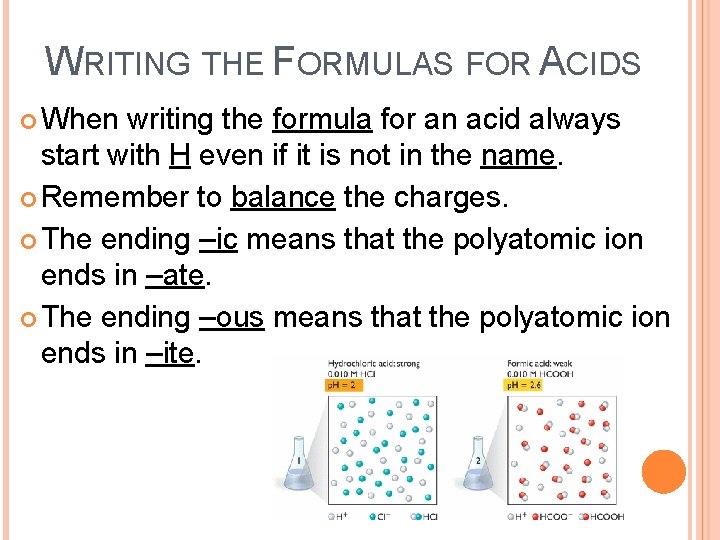
WRITING THE FORMULAS FOR ACIDS When writing the formula for an acid always start with H even if it is not in the name. Remember to balance the charges. The ending –ic means that the polyatomic ion ends in –ate. The ending –ous means that the polyatomic ion ends in –ite.
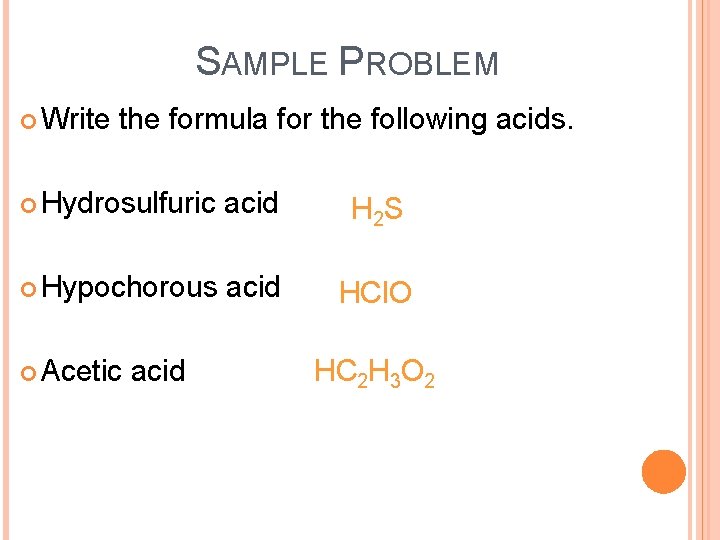
SAMPLE PROBLEM Write the formula for the following acids. Hydrosulfuric acid H 2 S Hypochorous acid HCl. O Acetic acid HC 2 H 3 O 2
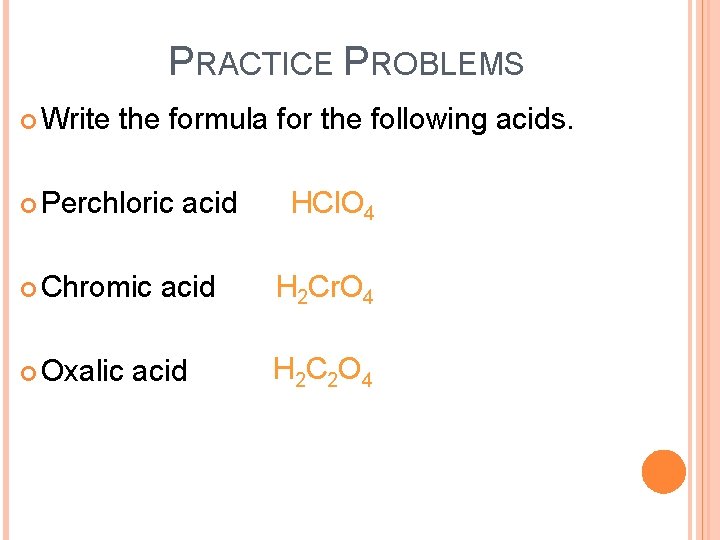
PRACTICE PROBLEMS Write the formula for the following acids. Perchloric Chromic Oxalic acid HCl. O 4 H 2 Cr. O 4 H 2 C 2 O 4
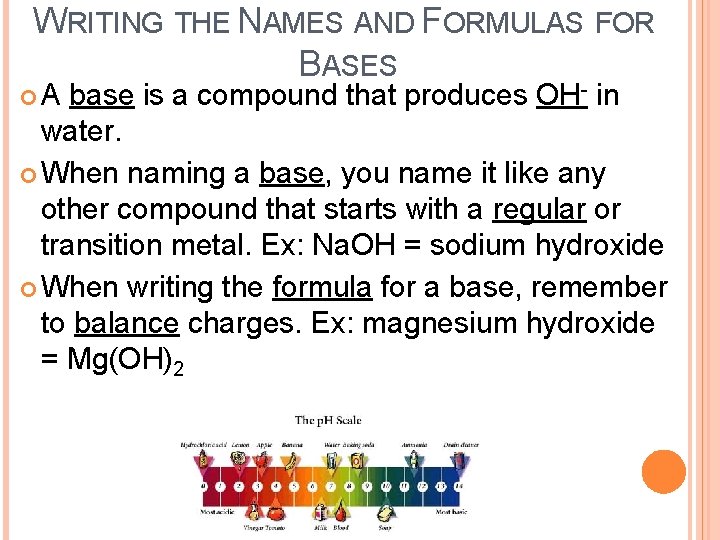
WRITING THE NAMES AND FORMULAS FOR BASES A base is a compound that produces OH- in water. When naming a base, you name it like any other compound that starts with a regular or transition metal. Ex: Na. OH = sodium hydroxide When writing the formula for a base, remember to balance charges. Ex: magnesium hydroxide = Mg(OH)2
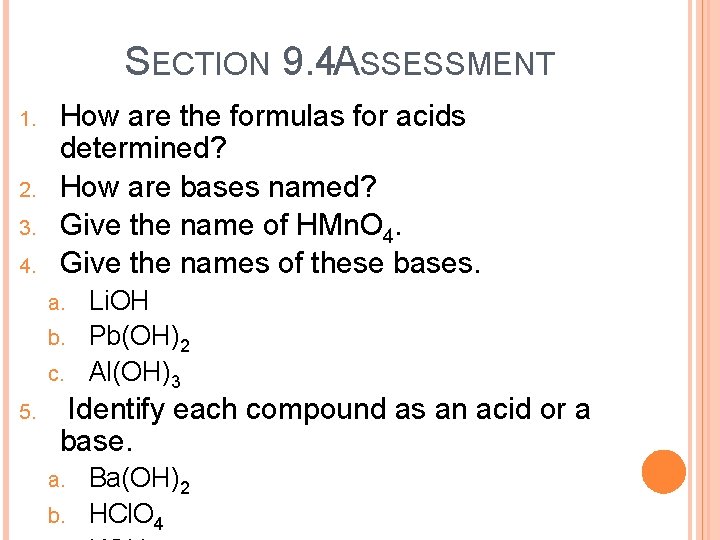
SECTION 9. 4 ASSESSMENT 1. 2. 3. 4. How are the formulas for acids determined? How are bases named? Give the name of HMn. O 4. Give the names of these bases. Li. OH b. Pb(OH)2 c. Al(OH)3 a. 5. Identify each compound as an acid or a base. Ba(OH)2 b. HCl. O 4 a.
SECTION 9. 4 ASSESSMENT 6. Write the formula for the following compounds. a. carbonic acid b. sulfurous acid c. iron (III) hydroxide
THE END