
Chapter 9 Chemical Bonding I Joanna Sabey Chemistry
Chapter 9: Chemical Bonding I Joanna Sabey Chemistry 1411 1
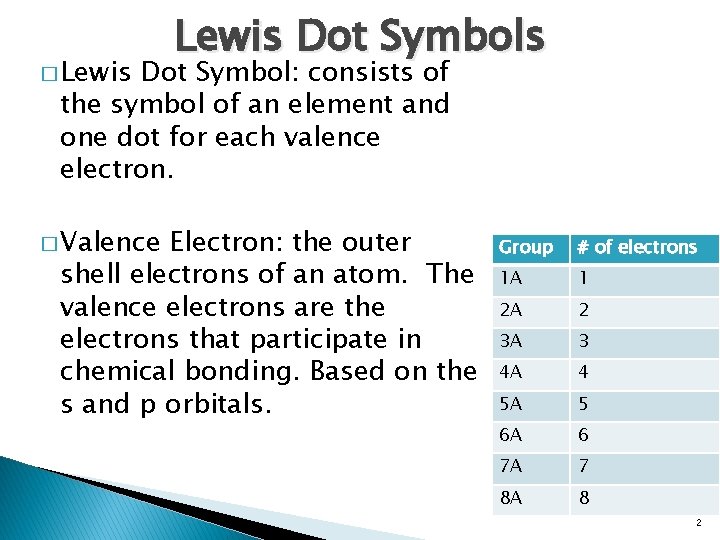
� Lewis Dot Symbols Dot Symbol: consists of the symbol of an element and one dot for each valence electron. � Valence Electron: the outer shell electrons of an atom. The valence electrons are the electrons that participate in chemical bonding. Based on the s and p orbitals. Group # of electrons 1 A 1 2 A 2 3 A 3 4 A 4 5 A 5 6 A 6 7 A 7 8 A 8 2
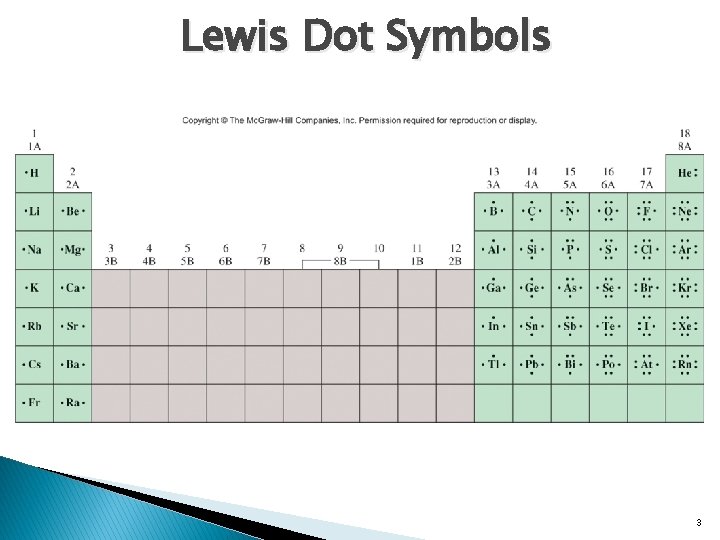
Lewis Dot Symbols 3

The Ionic Bond � Ionic Bond: The electrostatic force that holds together an ionic compound, metal and nonmetal bond. + Li � Li+ + e- Li e- + Li+ F - F F F - � Use Lewis dot symbols to show the formation of aluminum oxide (Al 2 O 3). 4
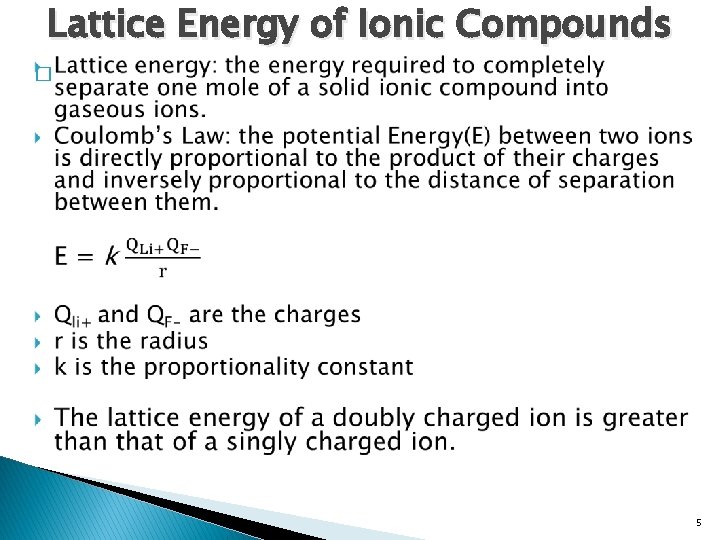
Lattice Energy of Ionic Compounds � 5
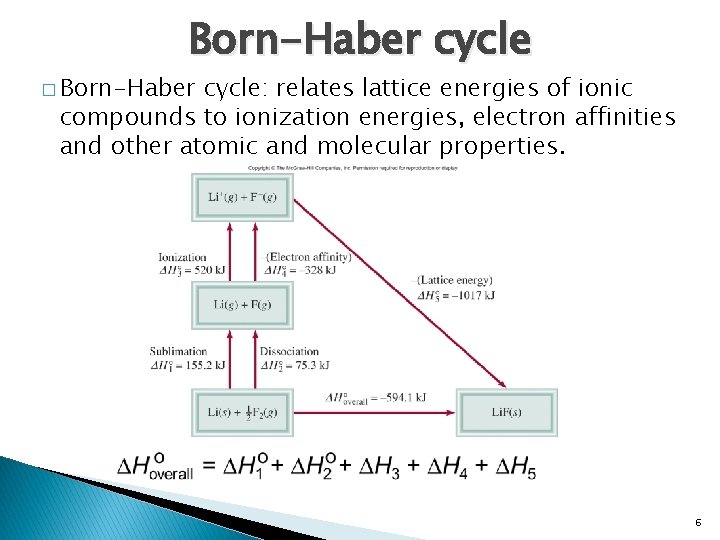
Born-Haber cycle � Born-Haber cycle: relates lattice energies of ionic compounds to ionization energies, electron affinities and other atomic and molecular properties. 6
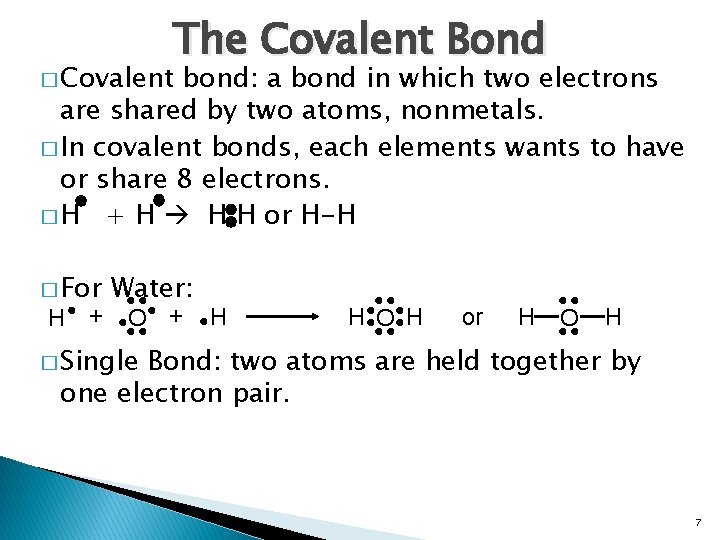
The Covalent Bond � Covalent bond: a bond in which two electrons are shared by two atoms, nonmetals. � In covalent bonds, each elements wants to have or share 8 electrons. � H + H H H or H-H � For H + Water: O + H H O H or H O H � Single Bond: two atoms are held together by one electron pair. 7
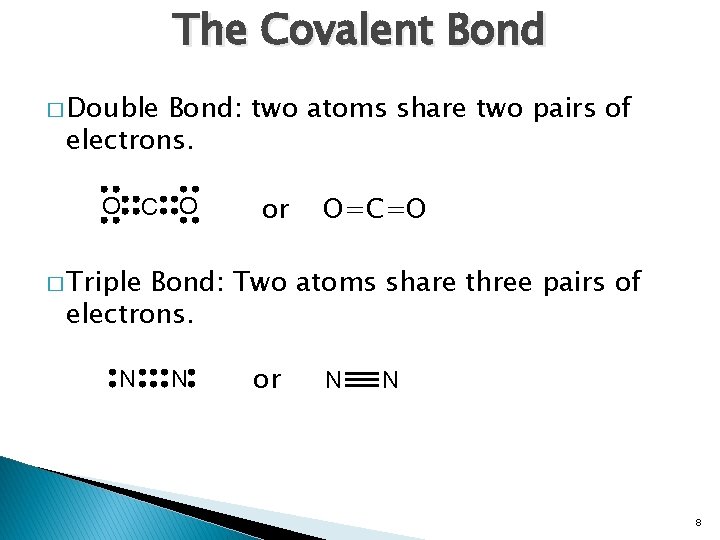
The Covalent Bond � Double Bond: two atoms share two pairs of electrons. O C O or O=C=O � Triple Bond: Two atoms share three pairs of electrons. N N or N N 8
Electronegativity � Electronegativity: The ability of an atom to attract toward itself the electrons in a chemical bond. � Polar Covalent Bond: The electrons spend more time in the vicinity of one atom than the other. � To determine the type of bond, must find the difference in the electronegativity values 9
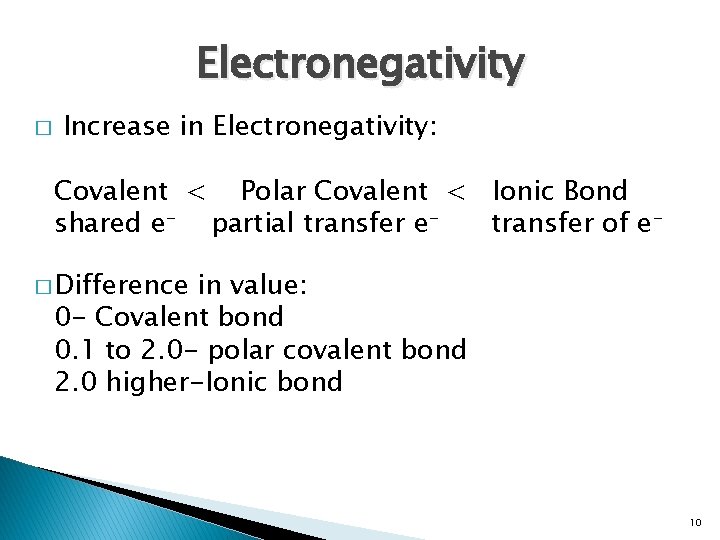
Electronegativity � Increase in Electronegativity: Covalent < Polar Covalent < Ionic Bond shared e- partial transfer etransfer of e- � Difference in value: 0 - Covalent bond 0. 1 to 2. 0 - polar covalent bond 2. 0 higher-Ionic bond 10
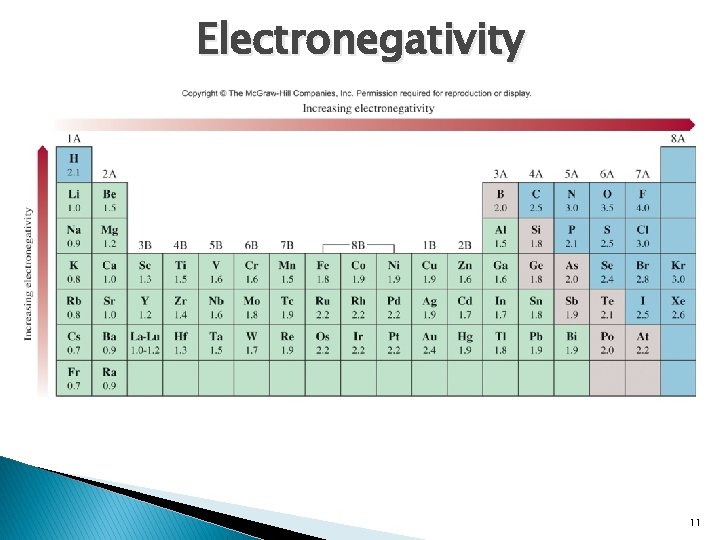
Electronegativity 11
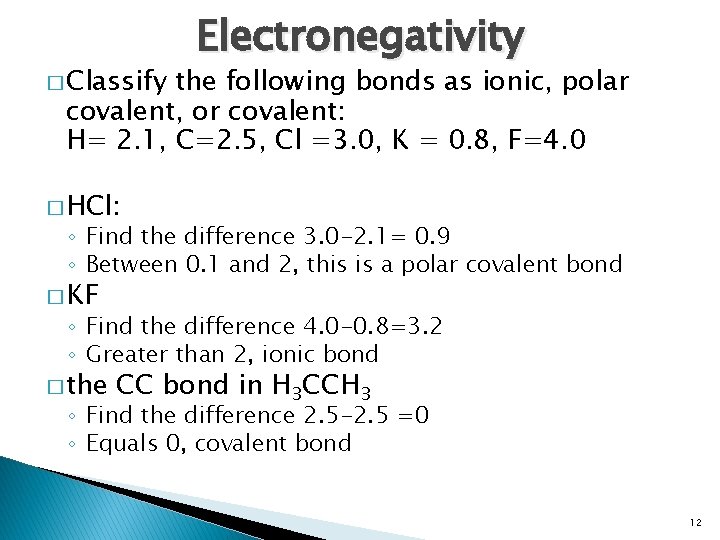
� Classify Electronegativity the following bonds as ionic, polar covalent, or covalent: H= 2. 1, C=2. 5, Cl =3. 0, K = 0. 8, F=4. 0 � HCl: ◦ Find the difference 3. 0 -2. 1= 0. 9 ◦ Between 0. 1 and 2, this is a polar covalent bond � KF ◦ Find the difference 4. 0 -0. 8=3. 2 ◦ Greater than 2, ionic bond � the CC bond in H 3 CCH 3 ◦ Find the difference 2. 5 -2. 5 =0 ◦ Equals 0, covalent bond 12
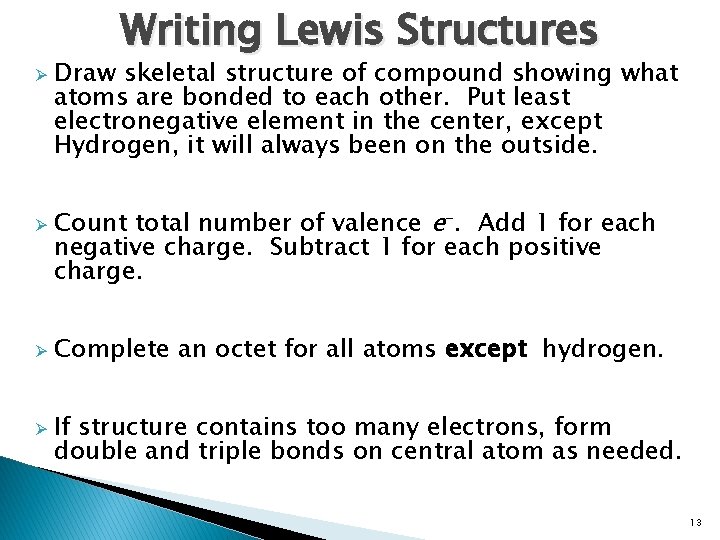
Writing Lewis Structures Ø Ø Draw skeletal structure of compound showing what atoms are bonded to each other. Put least electronegative element in the center, except Hydrogen, it will always been on the outside. Count total number of valence e-. Add 1 for each negative charge. Subtract 1 for each positive charge. Complete an octet for all atoms except hydrogen. If structure contains too many electrons, form double and triple bonds on central atom as needed. 13
Lewis Structures � Write the Lewis Structure for the following compounds: � Nitrogen � Nitric trifluoride (NF 3) Acid (HNO 3) � Carbonate ion(CO 32 -) 14
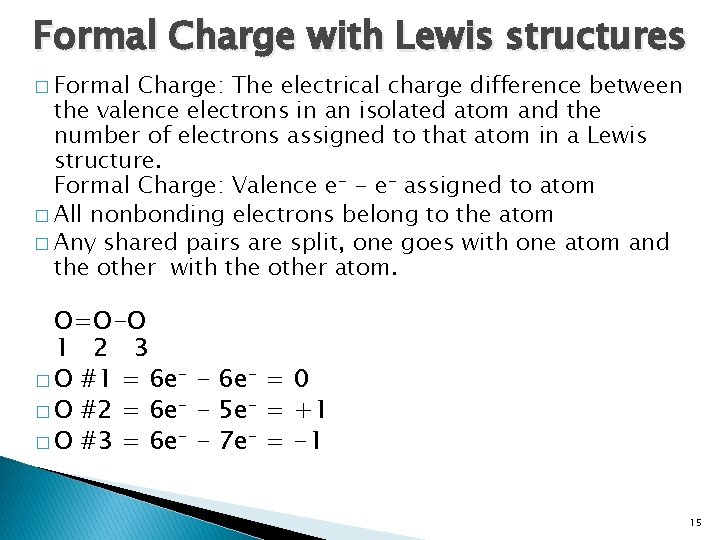
Formal Charge with Lewis structures � Formal Charge: The electrical charge difference between the valence electrons in an isolated atom and the number of electrons assigned to that atom in a Lewis structure. Formal Charge: Valence e- - e- assigned to atom � All nonbonding electrons belong to the atom � Any shared pairs are split, one goes with one atom and the other with the other atom. O=O-O 1 2 3 � O #1 = 6 e- - 6 e- = 0 � O #2 = 6 e- - 5 e- = +1 � O #3 = 6 e- - 7 e- = -1 15
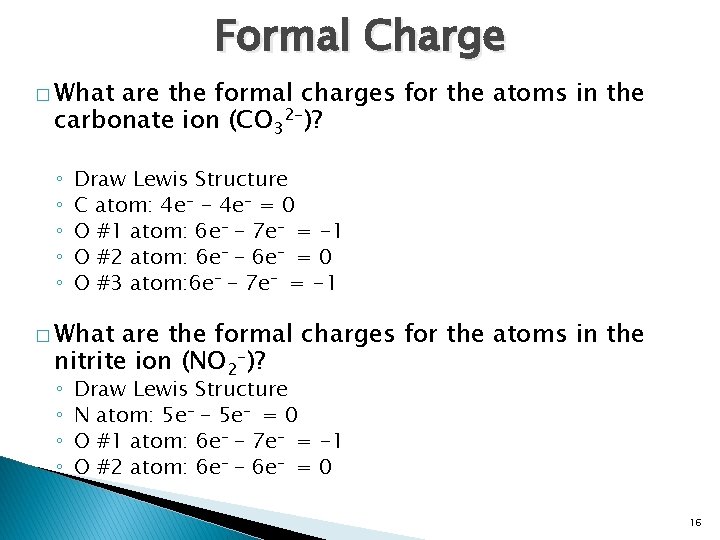
Formal Charge � What are the formal charges for the atoms in the carbonate ion (CO 32 -)? ◦ ◦ ◦ Draw Lewis Structure C atom: 4 e- - 4 e- = 0 O #1 atom: 6 e- - 7 e- = -1 O #2 atom: 6 e- - 6 e- = 0 O #3 atom: 6 e- - 7 e- = -1 � What are the formal charges for the atoms in the nitrite ion (NO 2 -)? ◦ ◦ Draw Lewis Structure N atom: 5 e- - 5 e- = 0 O #1 atom: 6 e- - 7 e- = -1 O #2 atom: 6 e- - 6 e- = 0 16
� If Formal Charges a compound has more than one acceptable Lewis Structure, use the one that has the least or no formal charge on the atoms. � Formaldehyde ( CH 2 O) 17
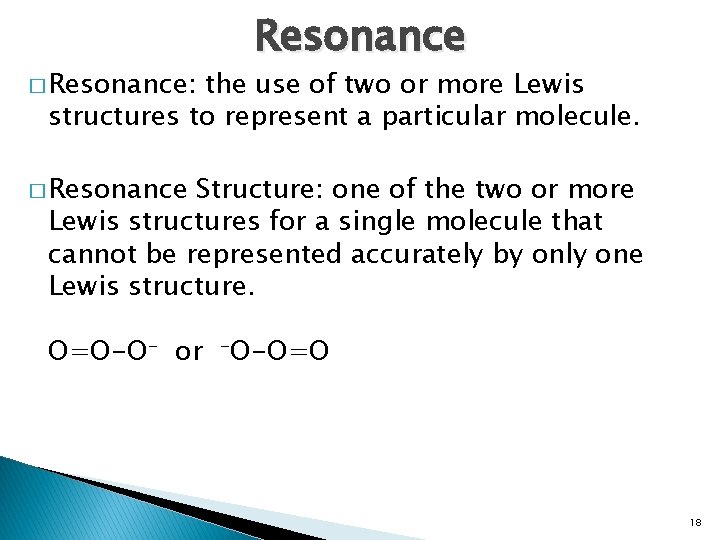
� Resonance: Resonance the use of two or more Lewis structures to represent a particular molecule. � Resonance Structure: one of the two or more Lewis structures for a single molecule that cannot be represented accurately by only one Lewis structure. O=O-O- or -O-O=O 18
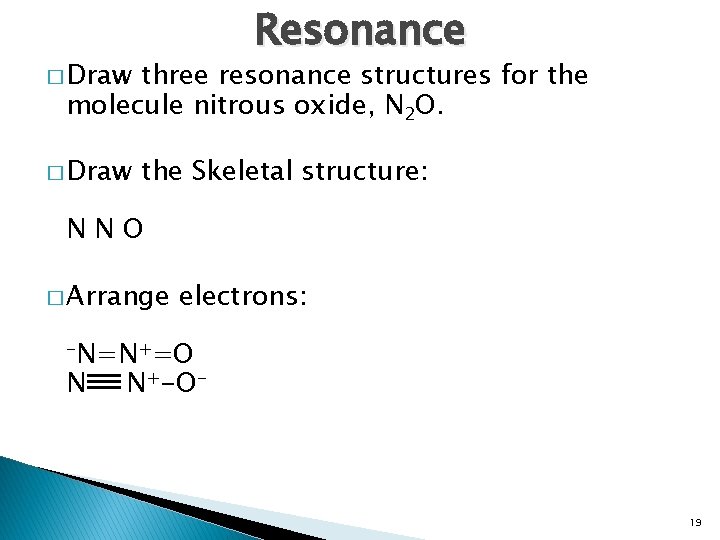
Resonance � Draw three resonance structures for the molecule nitrous oxide, N 2 O. � Draw the Skeletal structure: NNO � Arrange electrons: -N=N+=O N N+-O- 19
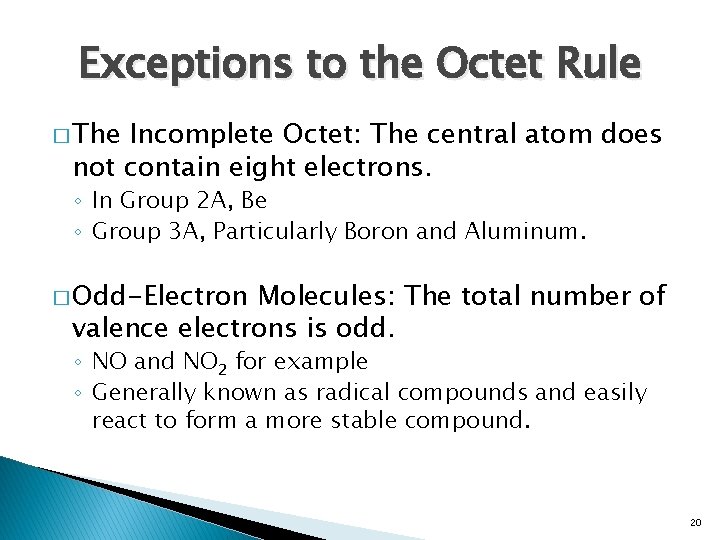
Exceptions to the Octet Rule � The Incomplete Octet: The central atom does not contain eight electrons. ◦ In Group 2 A, Be ◦ Group 3 A, Particularly Boron and Aluminum. � Odd-Electron Molecules: The total number of valence electrons is odd. ◦ NO and NO 2 for example ◦ Generally known as radical compounds and easily react to form a more stable compound. 20
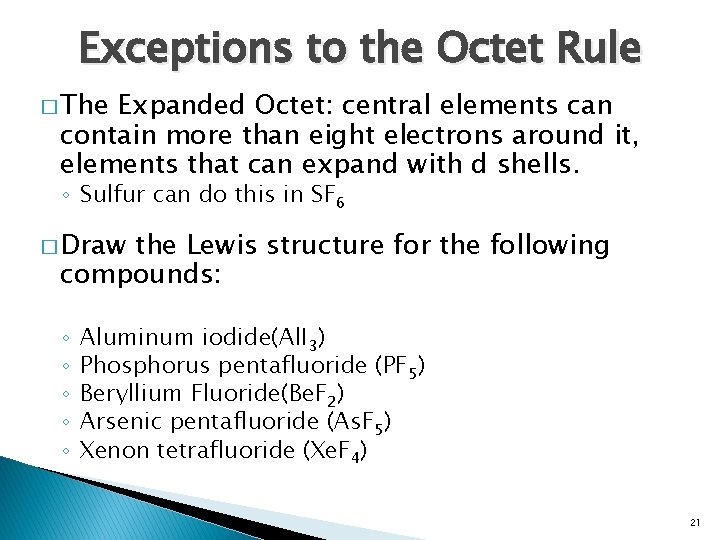
Exceptions to the Octet Rule � The Expanded Octet: central elements can contain more than eight electrons around it, elements that can expand with d shells. ◦ Sulfur can do this in SF 6 � Draw the Lewis structure for the following compounds: ◦ ◦ ◦ Aluminum iodide(Al. I 3) Phosphorus pentafluoride (PF 5) Beryllium Fluoride(Be. F 2) Arsenic pentafluoride (As. F 5) Xenon tetrafluoride (Xe. F 4) 21
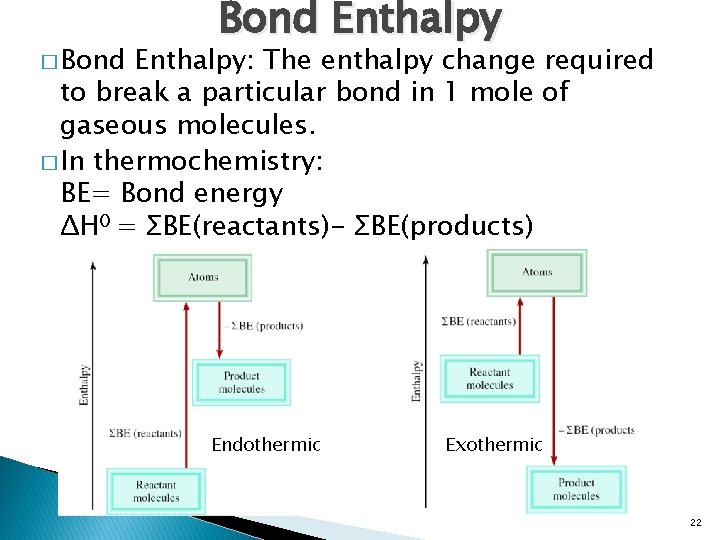
� Bond Enthalpy: The enthalpy change required to break a particular bond in 1 mole of gaseous molecules. � In thermochemistry: BE= Bond energy ΔH 0 = ΣBE(reactants)- ΣBE(products) Endothermic Exothermic 22
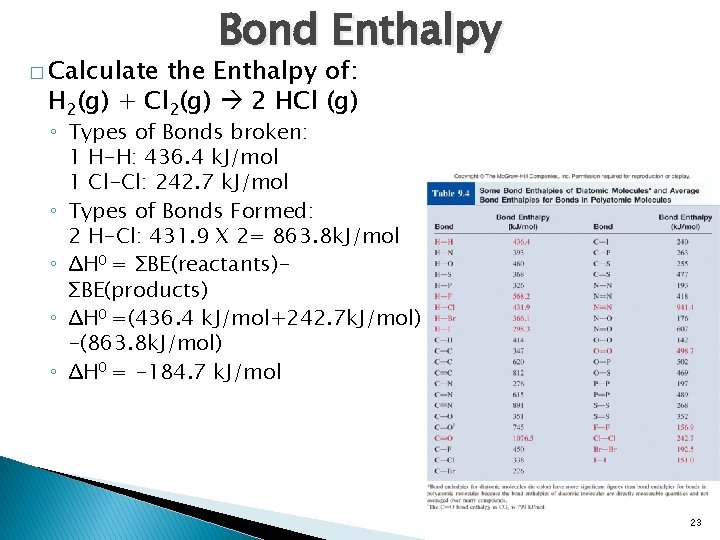
� Calculate Bond Enthalpy the Enthalpy of: H 2(g) + Cl 2(g) 2 HCl (g) ◦ Types of Bonds broken: 1 H-H: 436. 4 k. J/mol 1 Cl-Cl: 242. 7 k. J/mol ◦ Types of Bonds Formed: 2 H-Cl: 431. 9 X 2= 863. 8 k. J/mol ◦ ΔH 0 = ΣBE(reactants)ΣBE(products) ◦ ΔH 0 =(436. 4 k. J/mol+242. 7 k. J/mol) -(863. 8 k. J/mol) ◦ ΔH 0 = -184. 7 k. J/mol 23
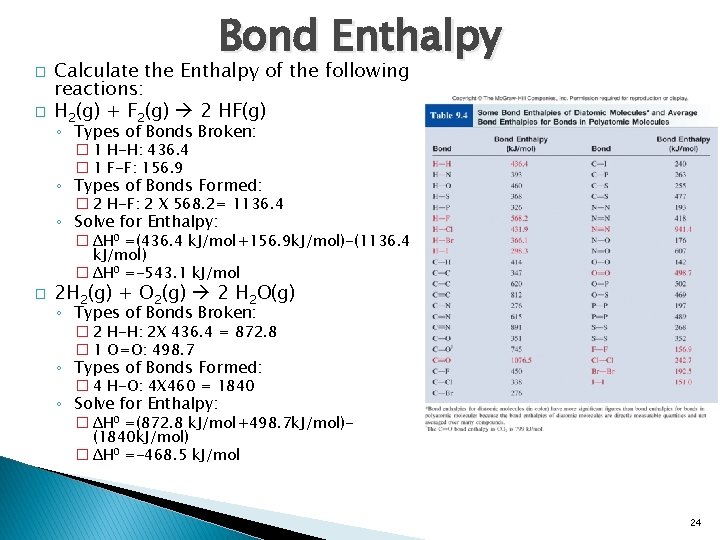
� � Bond Enthalpy Calculate the Enthalpy of the following reactions: H 2(g) + F 2(g) 2 HF(g) ◦ Types of Bonds Broken: � 1 H-H: 436. 4 � 1 F-F: 156. 9 ◦ Types of Bonds Formed: � 2 H-F: 2 X 568. 2= 1136. 4 ◦ Solve for Enthalpy: � ΔH 0 =(436. 4 k. J/mol+156. 9 k. J/mol)-(1136. 4 k. J/mol) � ΔH 0 =-543. 1 k. J/mol � 2 H 2(g) + O 2(g) 2 H 2 O(g) ◦ Types of Bonds Broken: � 2 H-H: 2 X 436. 4 = 872. 8 � 1 O=O: 498. 7 ◦ Types of Bonds Formed: � 4 H-O: 4 X 460 = 1840 ◦ Solve for Enthalpy: � ΔH 0 =(872. 8 k. J/mol+498. 7 k. J/mol)(1840 k. J/mol) � ΔH 0 =-468. 5 k. J/mol 24
- Slides: 24