
Chapter 9 Chemical Bonding I Basic Concepts 9
Chapter 9 Chemical Bonding I: Basic Concepts � 9. 1 Lewis dot symbols � 9. 2 the ionic bond � 9. 4 the covalent bond � 9. 5 Electroegativity � 9. 6 Writing Lewis structures � 9. 7 formal charge and Lewis structures � 9. 8 the concept of resonance � 9. 9 the exception of octate rules Dr. Laila Al-harbi
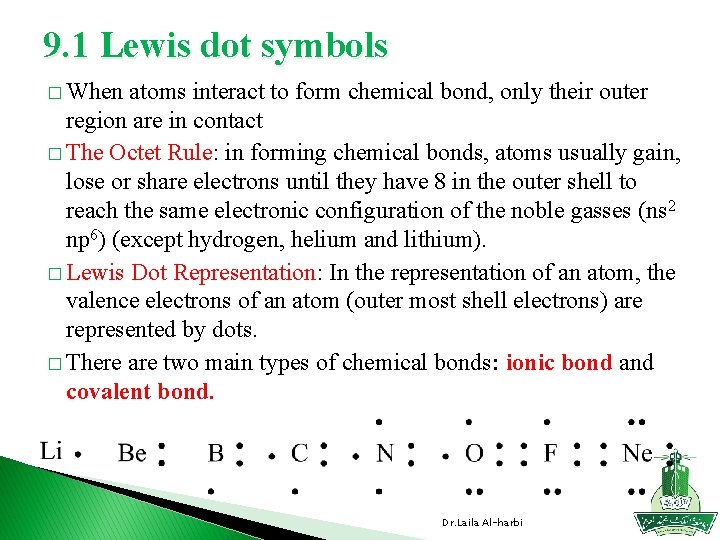
9. 1 Lewis dot symbols � When atoms interact to form chemical bond, only their outer region are in contact � The Octet Rule: in forming chemical bonds, atoms usually gain, lose or share electrons until they have 8 in the outer shell to reach the same electronic configuration of the noble gasses (ns 2 np 6) (except hydrogen, helium and lithium). � Lewis Dot Representation: In the representation of an atom, the valence electrons of an atom (outer most shell electrons) are represented by dots. � There are two main types of chemical bonds: ionic bond and covalent bond. Dr. Laila Al-harbi
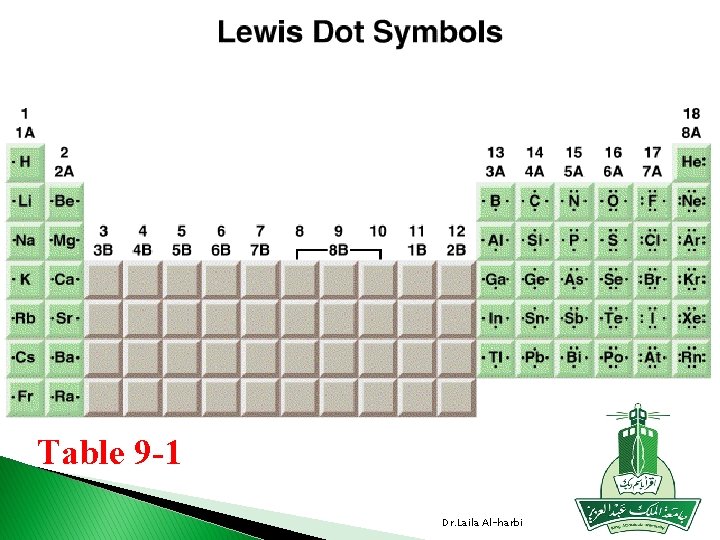
Table 9 -1 Dr. Laila Al-harbi
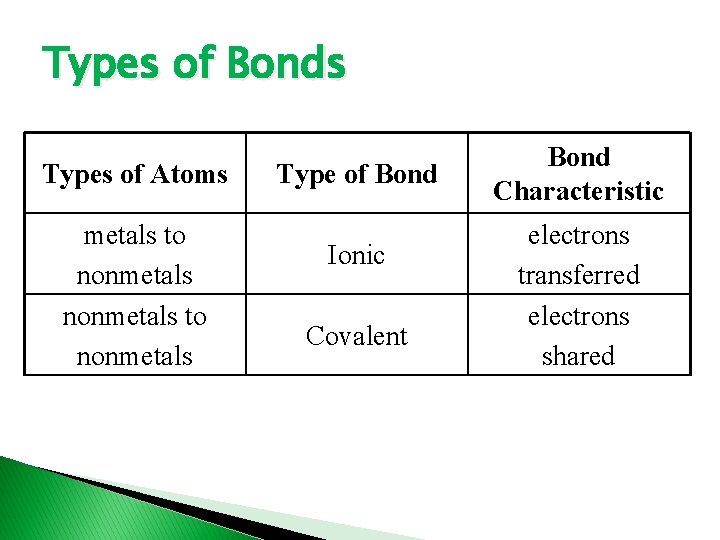
Types of Bonds Types of Atoms metals to nonmetals Type of Bond Ionic Covalent Bond Characteristic electrons transferred electrons shared
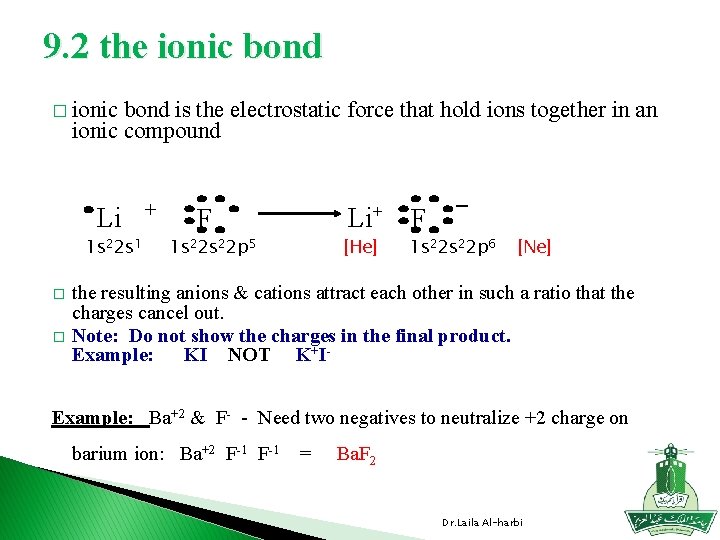
9. 2 the ionic bond � ionic bond is the electrostatic force that hold ions together in an ionic compound Li 1 s 22 s 1 � � + Li+ F 1 s 22 p 5 [He] F - 1 s 22 p 6 [Ne] the resulting anions & cations attract each other in such a ratio that the charges cancel out. Note: Do not show the charges in the final product. Example: KI NOT K+I- Example: Ba+2 & F- - Need two negatives to neutralize +2 charge on barium ion: Ba+2 F-1 = Ba. F 2 Dr. Laila Al-harbi
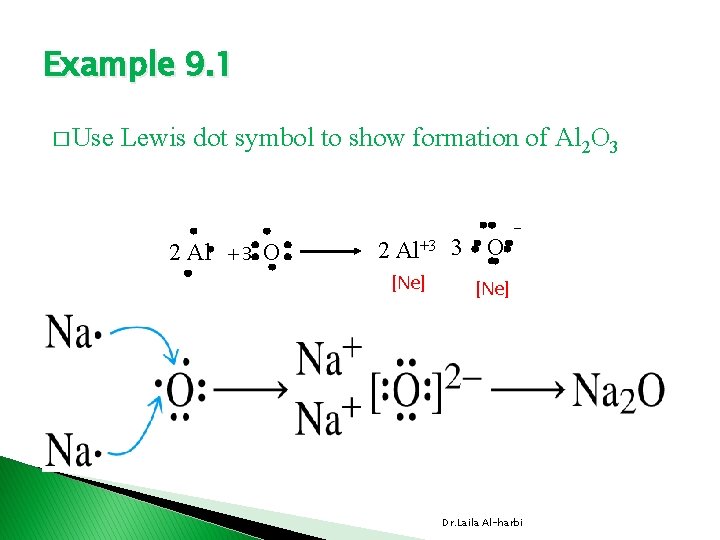
Example 9. 1 � Use Lewis dot symbol to show formation of Al 2 O 3 2 Al +3 O 2 Al+3 3 [Ne] O - [Ne] Dr. Laila Al-harbi
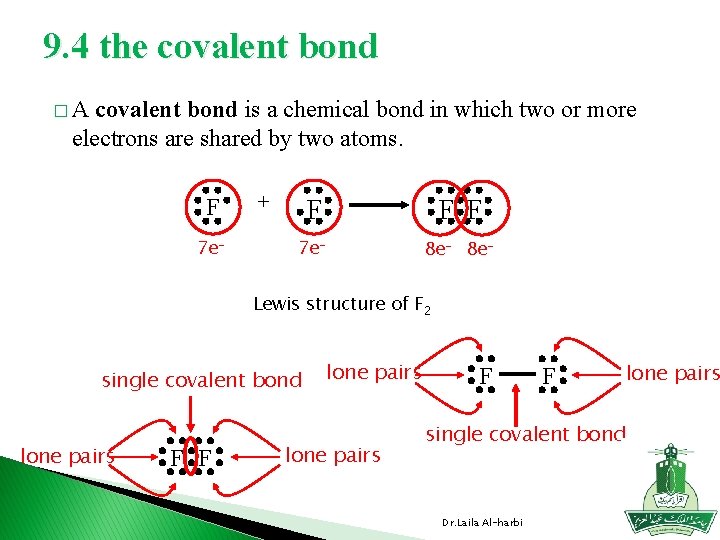
9. 4 the covalent bond �A covalent bond is a chemical bond in which two or more electrons are shared by two atoms. F 7 e- + F F F 7 e- 8 e- Lewis structure of F 2 single covalent bond lone pairs F F lone pairs single covalent bond Dr. Laila Al-harbi
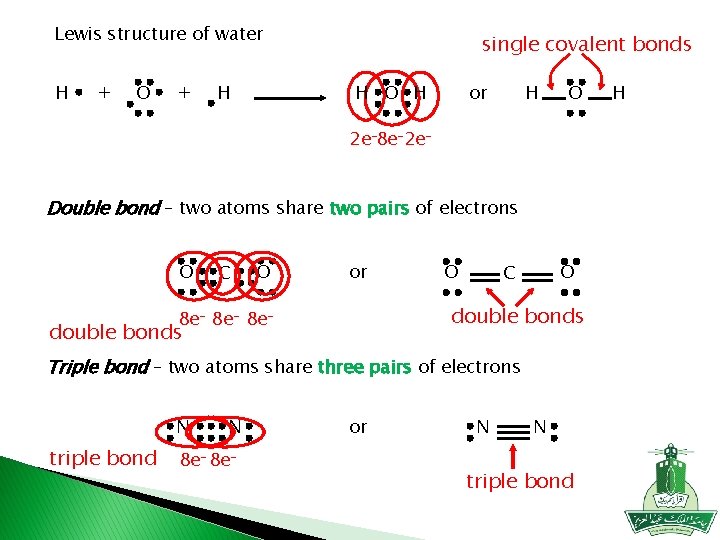
Lewis structure of water H + O + H single covalent bonds H O H H or O 2 e-8 e-2 e- Double bond – two atoms share two pairs of electrons O C O or O O C double bonds 8 e- 8 e- double bonds Triple bond – two atoms share three pairs of electrons N triple bond N 8 e- or N N triple bond H
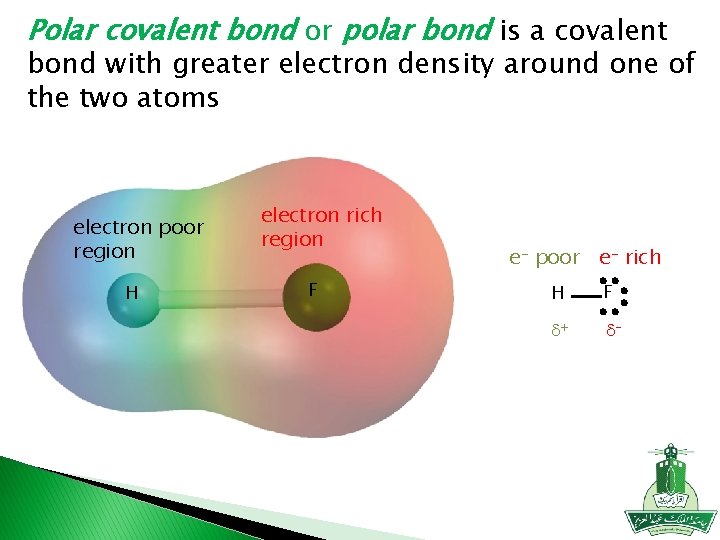
Polar covalent bond or polar bond is a covalent bond with greater electron density around one of the two atoms electron poor region H electron rich region F e- poor e- rich H F d+ d-
Comparing of the properties of covalent and ionic � Covalent compounds are usually gases, liquid and low melting solid � Ionic compounds are solids at room temperature and high melting point. � Many ionic compounds are soluble in water , and the resulting aqueous solutions conduct electricity, because the compounds are strong electrolytes. Dr. Laila Al-Harbi
Electronegativity � � Electronegativity is the ability of an atom to attract toward itself the electrons in a chemical bond. High electronegativity →pick up electron easily � Electronegativity increase from left to right in period. Electronegativity increase from bottom to up in group. Transition metals don’t follow these trend. � Nonmetals have high electronegativity, metals have low electronegativity. � high difference in electronegativity (2 or more ), element tend to form ionic bond. (Na. Cl) small difference in electronegativity, element tend to form polar covelent bond. (HCl) Same electronegative of the same elements from pure covelent bond (H 2) � � Dr. Laila Al-Harbi
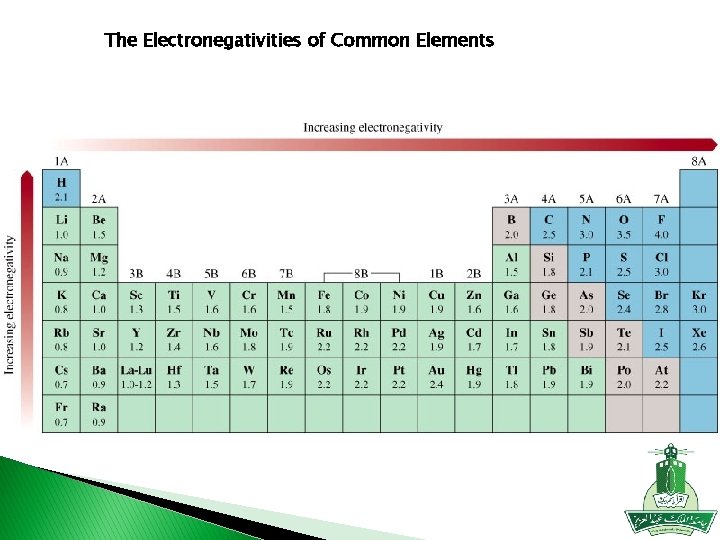
The Electronegativities of Common Elements
ØElectron Affinity (EA) and electronegativity are related but in different concept Ø(EA) refers to isolated atoms attraction for additional electron (experimental) ØEA →measurable, Cl is highest ØElectronegativity signifies the ability of an atom in a chemical bond( with another atom) to attract the shared electrons (estimated ) ØElectronegativity - relative, F is highest Dr. Laila Al-harbi
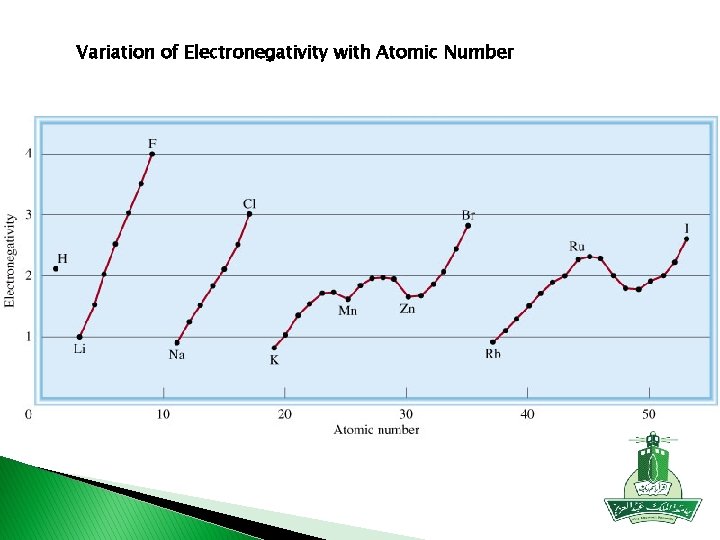
Variation of Electronegativity with Atomic Number
Example 9. 2 the following bonds as ionic, polar covalent, or covalent � Classify � A) � HCl =3 -2. 1=0. 9 Polar covalent b) KF =4 -0. 8=3. 2 Ionic � c) � A) � Cs. Cl =3 -1=2 Ionic b) H 2 S =2. 5 -2. 1=0. 4 Polar covalent � c) N-N =3 -3=0 covalent C-C =2. 5 -2. 5=0 covalent Dr. Laila Al-harbi
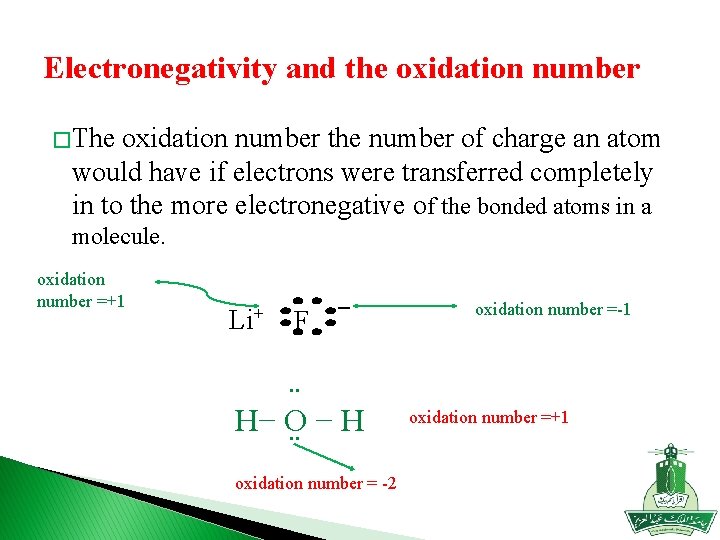
Electronegativity and the oxidation number � The oxidation number the number of charge an atom would have if electrons were transferred completely in to the more electronegative of the bonded atoms in a molecule. oxidation number =+1 Li+ F - ¨ H− O − H ¨ oxidation number = -2 oxidation number =-1 oxidation number =+1
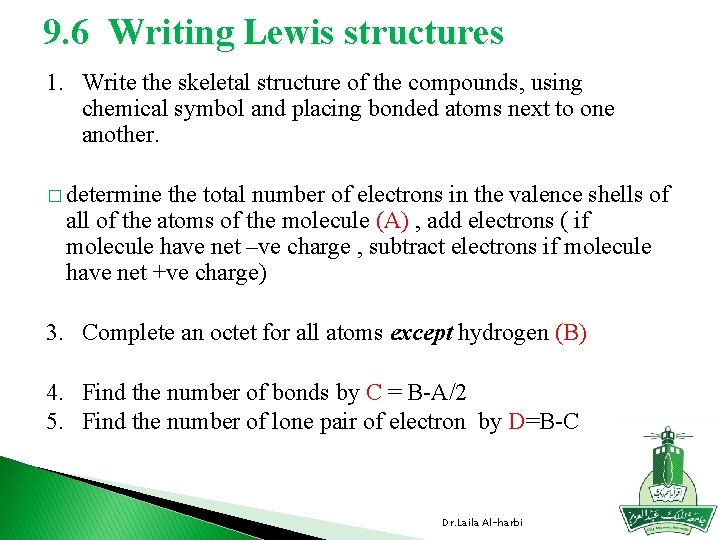
9. 6 Writing Lewis structures 1. Write the skeletal structure of the compounds, using chemical symbol and placing bonded atoms next to one another. � determine the total number of electrons in the valence shells of all of the atoms of the molecule (A) , add electrons ( if molecule have net –ve charge , subtract electrons if molecule have net +ve charge) 3. Complete an octet for all atoms except hydrogen (B) 4. Find the number of bonds by C = B-A/2 5. Find the number of lone pair of electron by D=B-C Dr. Laila Al-harbi
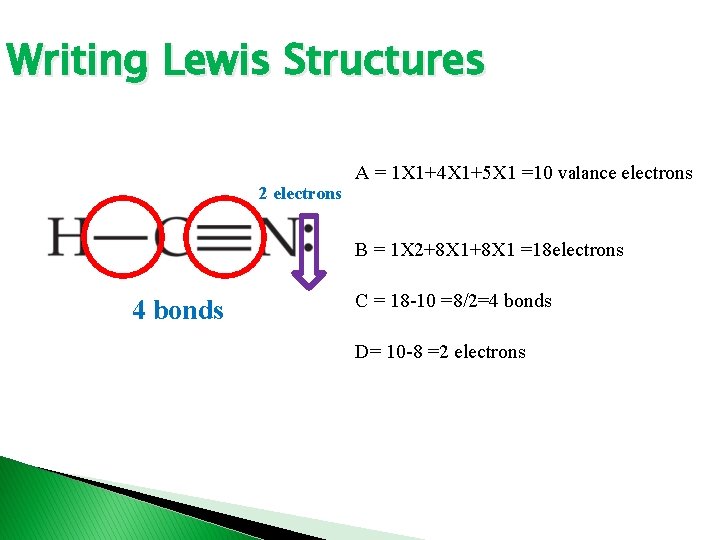
Writing Lewis Structures 2 electrons A = 1 X 1+4 X 1+5 X 1 =10 valance electrons B = 1 X 2+8 X 1 =18 electrons 4 bonds C = 18 -10 =8/2=4 bonds D= 10 -8 =2 electrons
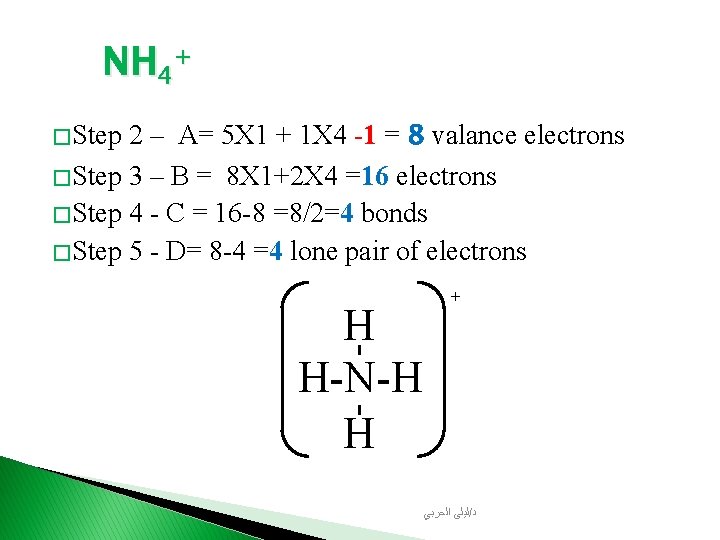
NH 4+ 2 – A= 5 X 1 + 1 X 4 -1 = 8 valance electrons � Step 3 – B = 8 X 1+2 X 4 =16 electrons � Step 4 - C = 16 -8 =8/2=4 bonds � Step 5 - D= 8 -4 =4 lone pair of electrons � Step - H H-N-H H + - ﻟﻴﻠﻰ ﺍﻟﺤﺮﺑﻲ / ﺩ

Example 9. 3 Write the Lewis structure of nitrogen trifluoride (NF 3). Step 1 – N is less electronegative than F, put N in center Step 2 – A= 5 X 1 + 7 X 3 = 26 valance electrons Step 3 – B = 8 X 1+8 X 3 =32 electrons Step 4 - C = 32 -26 =6/2=3 bonds Step 5 - D= 26 -6 =20 lone pair of electrons : : : : F-N-F: : F: Dr. Laila Al-harbi
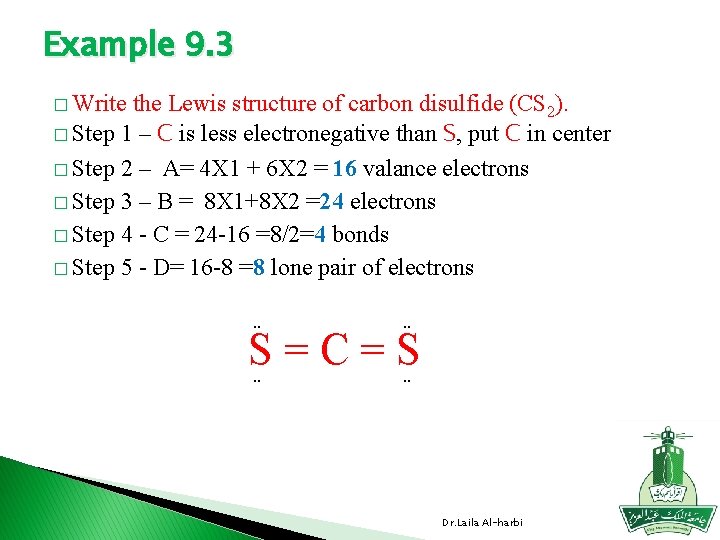
Example 9. 3 � Write the Lewis structure of carbon disulfide (CS 2). � Step 1 – C is less electronegative than S, put C in center � Step 2 – A= 4 X 1 + 6 X 2 = 16 valance electrons � Step 3 – B = 8 X 1+8 X 2 =24 electrons � Step 4 - C = 24 -16 =8/2=4 bonds � Step 5 - D= 16 -8 =8 lone pair of electrons ¨ ¨ S=C=S Dr. Laila Al-harbi
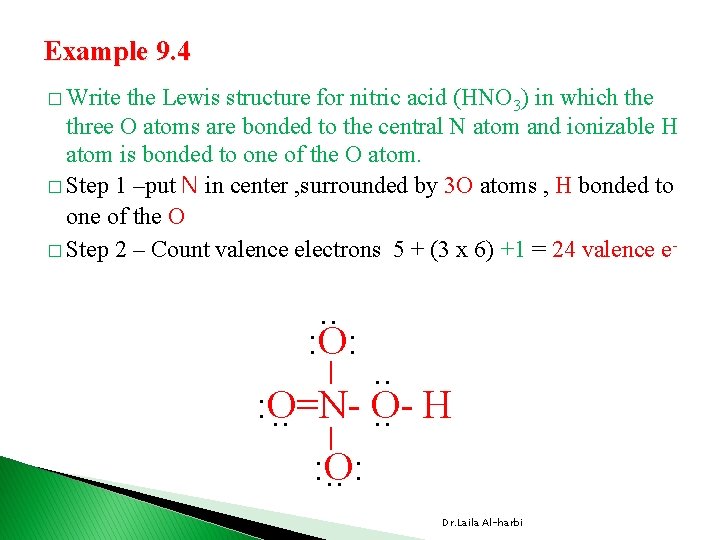
Example 9. 4 � Write the Lewis structure for nitric acid (HNO 3) in which the three O atoms are bonded to the central N atom and ionizable H atom is bonded to one of the O atom. � Step 1 –put N in center , surrounded by 3 O atoms , H bonded to one of the O � Step 2 – Count valence electrons 5 + (3 x 6) +1 = 24 valence e- . . : O: _ . . : O=NO. . H : O: . . _ Dr. Laila Al-harbi
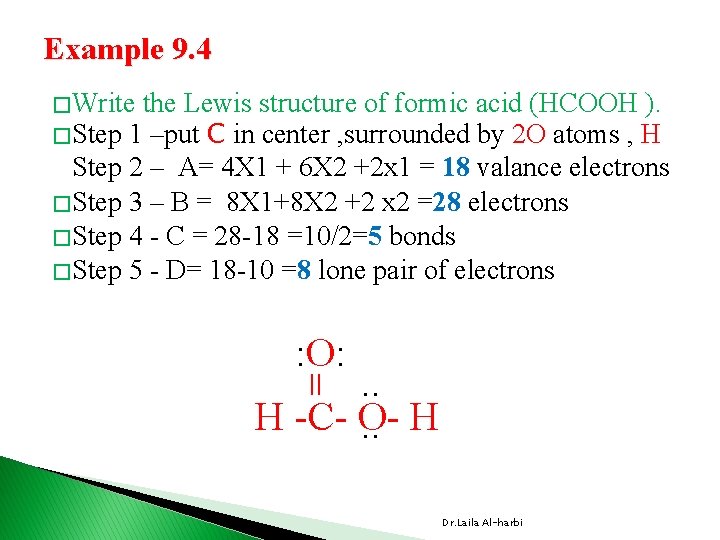
Example 9. 4 � Write the Lewis structure of formic acid (HCOOH ). � Step 1 –put C in center , surrounded by 2 O atoms , H Step 2 – A= 4 X 1 + 6 X 2 +2 x 1 = 18 valance electrons � Step 3 – B = 8 X 1+8 X 2 +2 x 2 =28 electrons � Step 4 - C = 28 -18 =10/2=5 bonds � Step 5 - D= 18 -10 =8 lone pair of electrons : O: = . . H -C- O. . H Dr. Laila Al-harbi
![Example 9. 5 � Write the Lewis structure of carbon dioxide [CO 3]-2 �](http://slidetodoc.com/presentation_image_h/7f9b647673a2098b11d4bd2d84621043/image-24.jpg "Example 9. 5 � Write the Lewis structure of carbon dioxide [CO 3]-2 �")
Example 9. 5 � Write the Lewis structure of carbon dioxide [CO 3]-2 � Step 1 – C is less electronegative than O, put C in center � Step 2 – A= 4 X 1 + 6 X 3 +2 = 24 valance electrons � Step 3 – B = 8 X 1+8 X 3 = 32 electrons � Step 4 - C = 32 -24 =8/2=4 bonds � Step 5 - D= 24 -8 =16 lone pair of electrons � - -2 : : = : : : O-C-O: : O: Dr. Laila Al-harbi
![Example 9. 5 � Write the Lewis structure of carbon dioxide [NO 2]-1 �](http://slidetodoc.com/presentation_image_h/7f9b647673a2098b11d4bd2d84621043/image-25.jpg "Example 9. 5 � Write the Lewis structure of carbon dioxide [NO 2]-1 �")
Example 9. 5 � Write the Lewis structure of carbon dioxide [NO 2]-1 � Step 1 – N is less electronegative than O, put N in center � Step 2 – A= 5 X 1 + 6 X 2 +1 = 18 valance electrons � Step 3 – B = 8 X 1+8 X 2 = 24 electrons � Step 4 - C = 24 -18 =6/2=3 bonds � Step 5 - D= 18 -6 =12 lone pair of electrons : : : : [: O - N = O: ]Dr. Laila Al-harbi
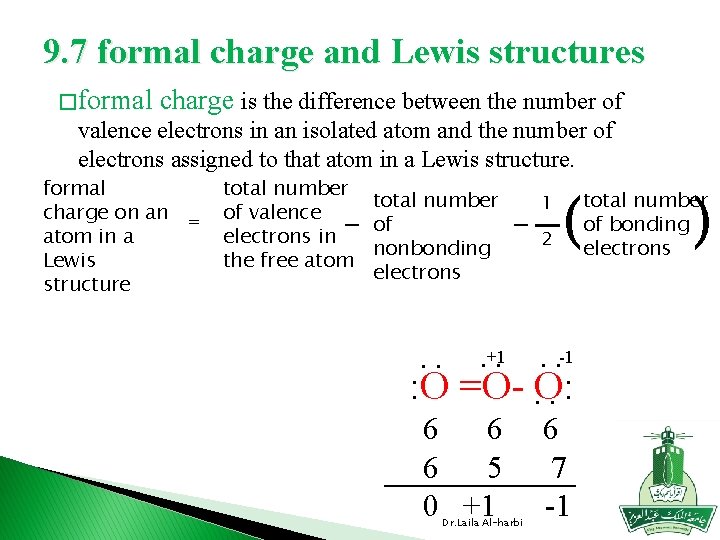
9. 7 formal charge and Lewis structures � formal charge is the difference between the number of valence electrons in an isolated atom and the number of electrons assigned to that atom in a Lewis structure. formal charge on an = atom in a Lewis structure total number of valence of electrons in nonbonding the free atom electrons - - 1 2 ( 6 6 6 5 0 +1 6 7 -1 : : : -1 : +1 : O =O- O: Dr. Laila Al-harbi ) total number of bonding electrons
� For molecules , the sum of the charges should be zero � For ion , the sum of the charges should be -ve for anions � For ion , the sum of the charges should be +ve for cations � formal charge and Lewis structures 1. For neutral molecules, a Lewis structure in which there are no formal charges is preferable to one in which formal charges are present. 2. Lewis structures with large formal charges are less plausible than those with small formal charges. 3. Among Lewis structures having similar distributions of formal charges, the most plausible structure is the one in which negative formal charges are placed on the more electronegative atoms Dr. Laila Al-harbi
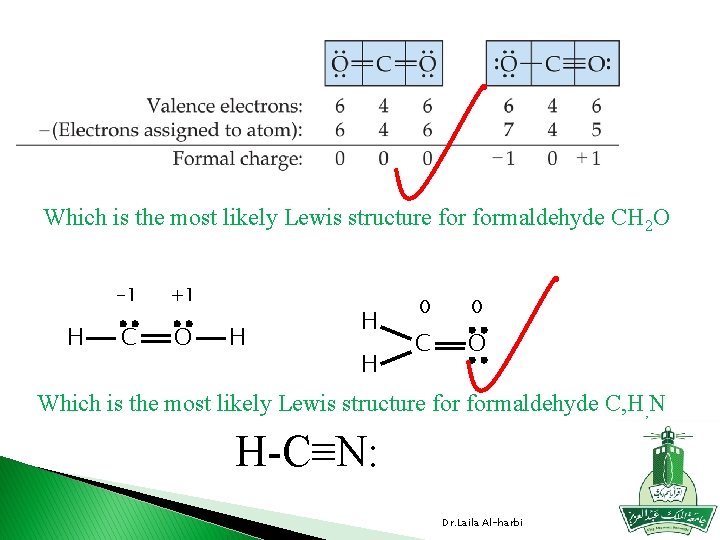
Which is the most likely Lewis structure formaldehyde CH 2 O H -1 +1 C O H H H 0 0 C O Which is the most likely Lewis structure formaldehyde C, H, N H-C≡N: Dr. Laila Al-harbi
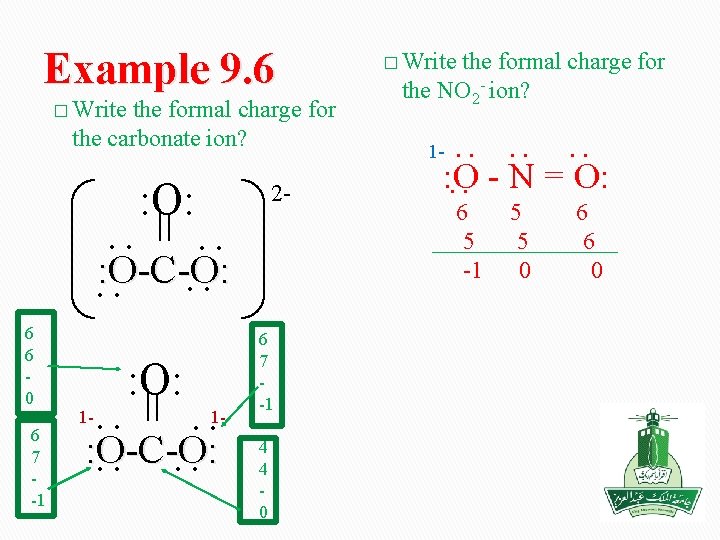
Example 9. 6 � Write the formal charge for the carbonate ion? : = 1 - 6 7 -1 : : O-C-O: 4 4 0 : : O: : : 6 7 -1 : 6 6 0 1 - : : O-C-O: the formal charge for the NO 2 - ion? : : : O: 2 - � Write 6 5 -1 5 5 0 6 6 0 : O - N = O:
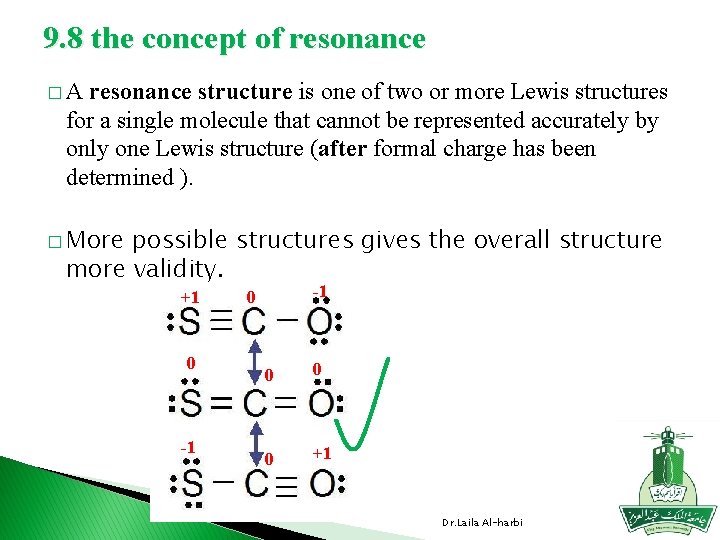
9. 8 the concept of resonance �A resonance structure is one of two or more Lewis structures for a single molecule that cannot be represented accurately by only one Lewis structure (after formal charge has been determined ). � More possible structures gives the overall structure more validity. +1 0 -1 -1 0 0 +1 Dr. Laila Al-harbi
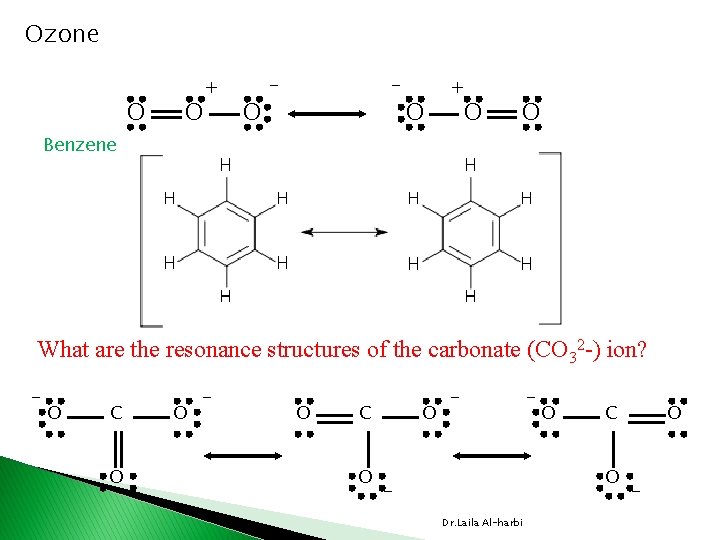
Ozone O O + O - - O + O O Benzene What are the resonance structures of the carbonate (CO 32 -) ion? - O C O O - - O C O Dr. Laila Al-harbi O -
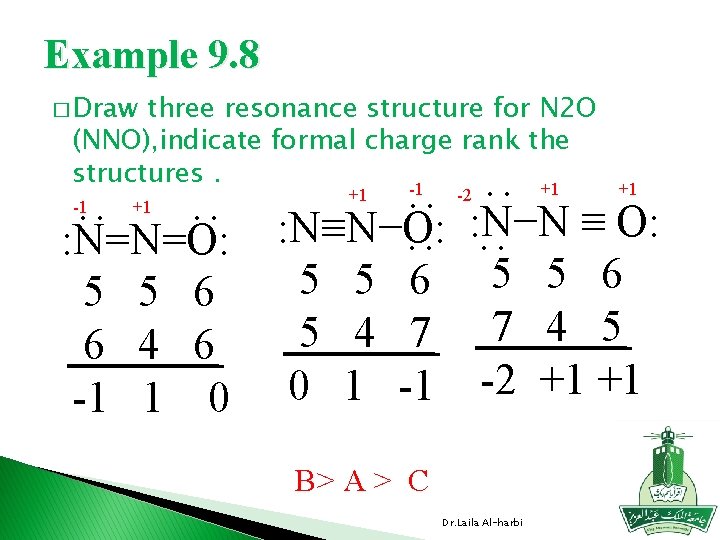
Example 9. 8 � Draw three resonance structure for N 2 O (NNO), indicate formal charge rank the structures. -1 +1 : : : N=N=O: 5 5 6 6 4 6 -1 1 0 -2 +1 : N≡N−O: : N−N ≡ O: 5 5 6 5 4 7 7 4 5 0 1 -1 -2 +1 +1 : : +1 : : -1 +1 B> A > C Dr. Laila Al-harbi
9. 9 the exception of octate rules � There are three types of ions or molecules that do not follow the octet rule: ◦ Ions or molecules with an odd number of electrons ◦ Ions or molecules with less than an octet ( the incomplete Octet) ◦ Ions or molecules with more than eight valence electrons (an expanded octet) Dr. Laila Al-harbi
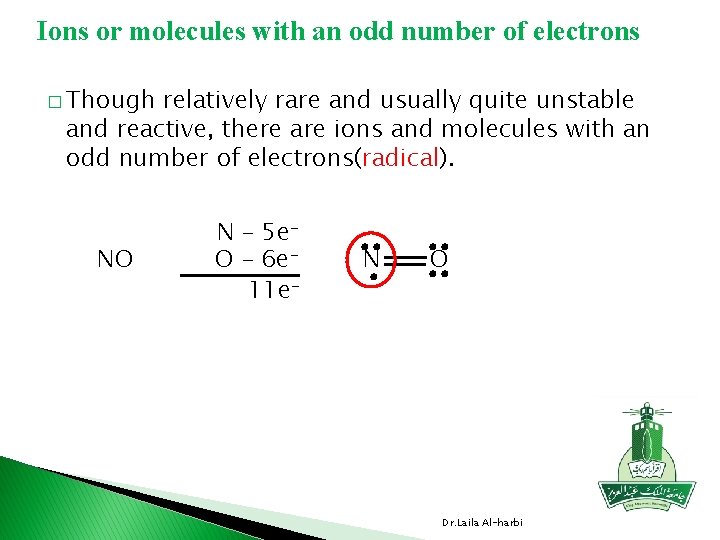
Ions or molecules with an odd number of electrons � Though relatively rare and usually quite unstable and reactive, there are ions and molecules with an odd number of electrons(radical). NO N – 5 e. O – 6 e 11 e- N O Dr. Laila Al-harbi
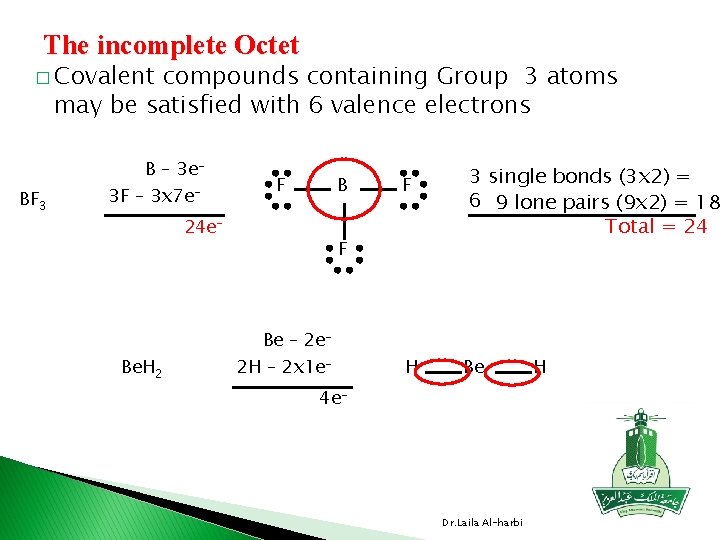
The incomplete Octet � Covalent compounds containing Group 3 atoms may be satisfied with 6 valence electrons BF 3 B – 3 e 3 F – 3 x 7 e- F B 24 e- Be. H 2 F F Be – 2 e 2 H – 2 x 1 e- H 3 single bonds (3 x 2) = 6 9 lone pairs (9 x 2) = 18 Total = 24 Be 4 e- Dr. Laila Al-harbi H
An expanded octet � Usually occurs in element in 3 rd period and beyond ◦ More than 4 bonds ◦ Elements ≥ row 3 can use s, p & d orbitals and have > 8 VE � P: 8 OR 10 � S: 8, 10, OR 12 � Xe: 8, 10, OR 12 � Examples SF 6 PF 5 Xe. F 4 Dr. Laila Al-harbi

� Write Be. F 2 : : F I Al Lewis structure Be I I Dr. Laila Al-harbi : : Al. I 3 Lewis structure � Write F: : Example 9 -9
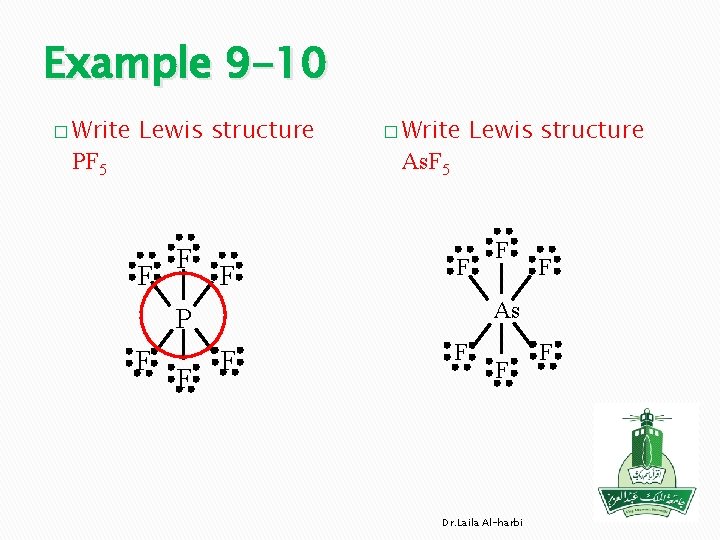
Example 9 -10 � Write PF 5 Lewis structure F F F � Write As. F 5 F F As P F Lewis structure F F F Dr. Laila Al-harbi F
![Example 9 -11 � Write Lewis structure [SO 4] -2 : O: : O-S-O:](http://slidetodoc.com/presentation_image_h/7f9b647673a2098b11d4bd2d84621043/image-39.jpg "Example 9 -11 � Write Lewis structure [SO 4] -2 : O: : O-S-O:")
Example 9 -11 � Write Lewis structure [SO 4] -2 : O: : O-S-O: : O: - H 2 SO 4 Lewis structure : O: : : = = : : - � Write H-O-S-O-H : O: Dr. Laila Al-harbi
- Slides: 39