
Chapter 9 Cellular Respiration Feel the Burn Section
Chapter 9 Cellular Respiration

• Feel the Burn Section 9 -1 Interest Grabber • Do you like to run, bike, or swim? These all are good ways to exercise. When you exercise, your body uses oxygen to get energy from glucose, a six-carbon sugar. 1. How does your body feel at the start of exercise, such as a long, slow run? How do you feel 1 minute into the run; 10 minutes into the run? 2. What do you think is happening in your cells to cause the changes in how you feel? 3. Think about running as fast as you can for 100 meters. Could you keep up this pace for a much longer distance? Explain your answer. Go to Section:
I. Chemical Pathways ***Food serves as a source of raw materials for molecular synthesis and energy
A. Chemical Energy and Food – • 1 g glucose when burned in the presence of O 2 releases 3811 calories of heat energy. – A ________is the amount of energy needed to raise the temperature of 1 g water 1 degree C. The calorie used on food labels is a kilocalorie, or 1000 calories calorie
– Cells don’t “burn” glucose. Instead, they gradually release the energy from glucose and other food compounds. – Begins w/ _____________-a pathway that releases a small amount of energy. If O 2 is present, it turns to 2 other pathways that release a lot of energy ---and if O 2 is not present, glycolysis is followed by another pathway. glycolysis
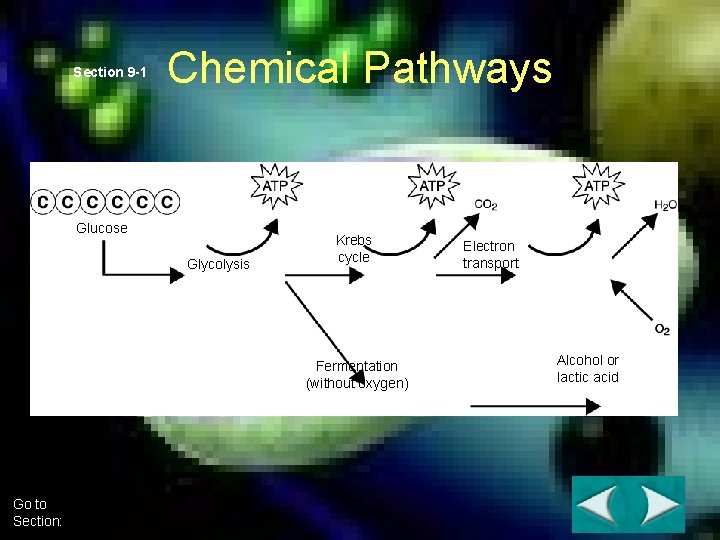
Section 9 -1 Chemical Pathways Glucose Glycolysis Krebs cycle Fermentation (without oxygen) Go to Section: Electron transport Alcohol or lactic acid
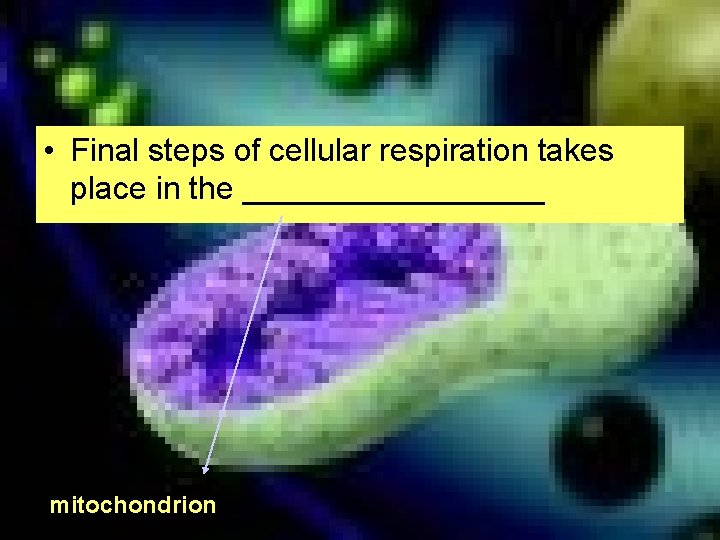
• Final steps of cellular respiration takes place in the _________ mitochondrion
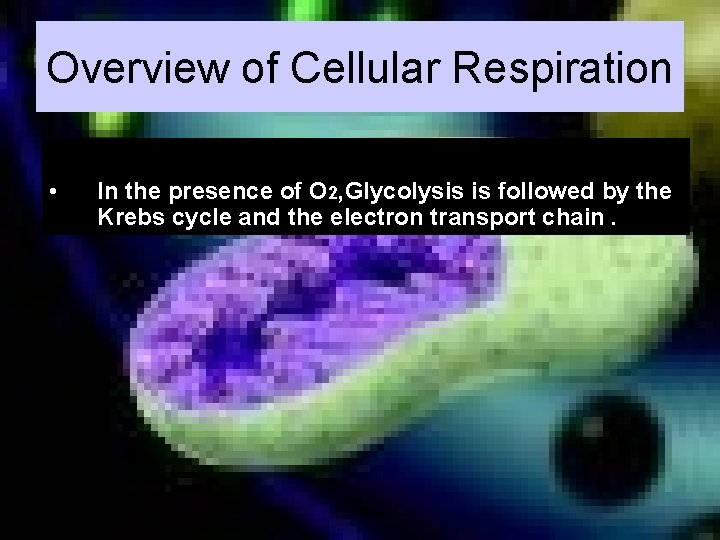
Overview of Cellular Respiration • In the presence of O 2, Glycolysis is followed by the Krebs cycle and the electron transport chain.
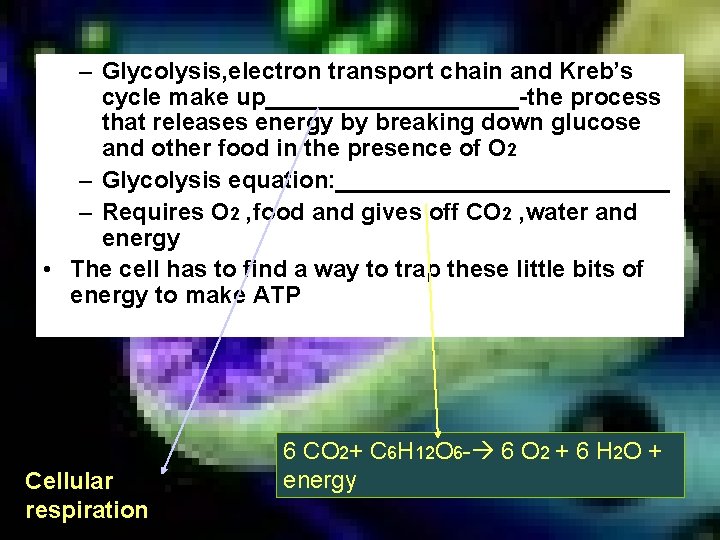
– Glycolysis, electron transport chain and Kreb’s cycle make up__________-the process that releases energy by breaking down glucose and other food in the presence of O 2 – Glycolysis equation: _____________ – Requires O 2 , food and gives off CO 2 , water and energy • The cell has to find a way to trap these little bits of energy to make ATP Cellular respiration 6 CO 2+ C 6 H 12 O 6 - 6 O 2 + 6 H 2 O + energy
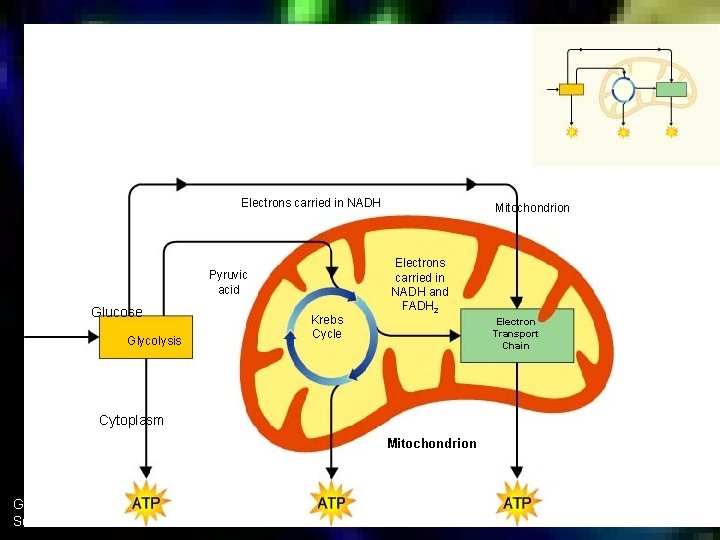
Section 9 -1 Electrons carried in NADH Pyruvic acid Glucose Glycolysis Krebs Cycle Mitochondrion Electrons carried in NADH and FADH 2 Electron Transport Chain Cytoplasm Mitochondrion Go to Section:
• Glycolysis= process in which one molecule of glucose is broken in ½ , producing 2 molecules of _________, a 3 -C compound Pyruvic acid
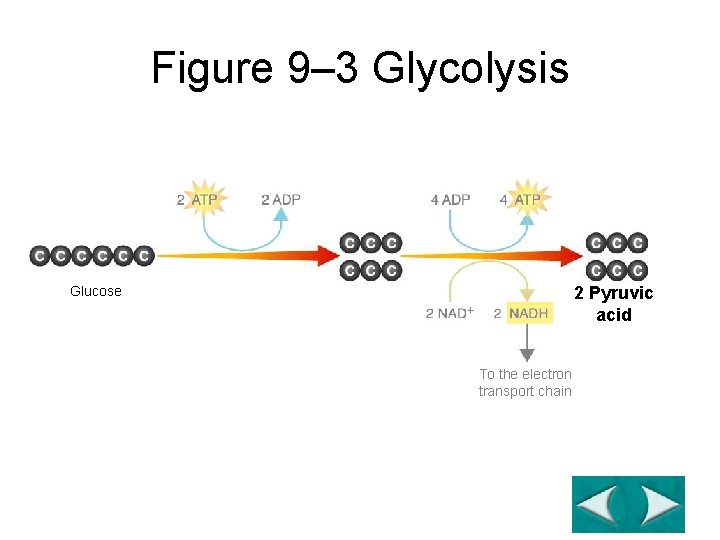
Section 9 -1 Figure 9– 3 Glycolysis Glucose 2 Pyruvic acid To the electron transport chain Go to Section:
Glycolysis Process • • 1) ATP Production 2 molecules of _____ used @ beginning/4 molecules ATP are produced @ end-net gain of 2 molecules ATP

2 - NADH Production – • • 4 high energy molecules are removed and passed onto electron carrier _______-nictotinamide adenine dinucleotide-these accept a pair of high energy electrons making ________ and it passes electrons onto next molecule. Energy is passed from glucose to other pathways. Process is fast so ATP is produced –a lot in a short amount of time. Does not require O 2 A problem: when a lot of ATP is made from glycolysis-NAD+ fills w/electrons and w/o NAD+, glycolysis stops Nad+ nadh
D. Fermentation • • Follows glycolysis if O 2 is not present ________releases energy from food molecules by making ATP in the Absence of O 2. Cells convert NADH to NAD+ by passing electrons to _______acid. This coverts NADH back to carrier NAD+, allowing glycolysis to continue Called_____because it does not require O 2 Fermentation Pyruvic acid anaerobic
Types of Fermentation • • • 1) Alcoholic Fermentation – Used by__________ – Ethyl alcohol and CO 2 are made as waste Pyruvic acid + NADH-- alcohol + CO 2 + NAD+ Causes bread dough to rise due to _____ Yeasts and other microorganisms CO 2
2) Lactic Acid Fermentation • • • Fermentation that uses pyruvic acid produced to convert to lactic acid Regenerates NAD+ so glycolysis can continue Pyruvic acid + NADH-- lactic acid + NAD+ Produced in muscles during rapid exercise when the body cannot supply enough ___ to the tissues. (for ATP production) Causes a painful burning sensation Unicellular organisms also produce lactic acid as a waste during fermentation…. . eg. prokaryotes in yogurt production, buttermilk, sauerkraut… O 2
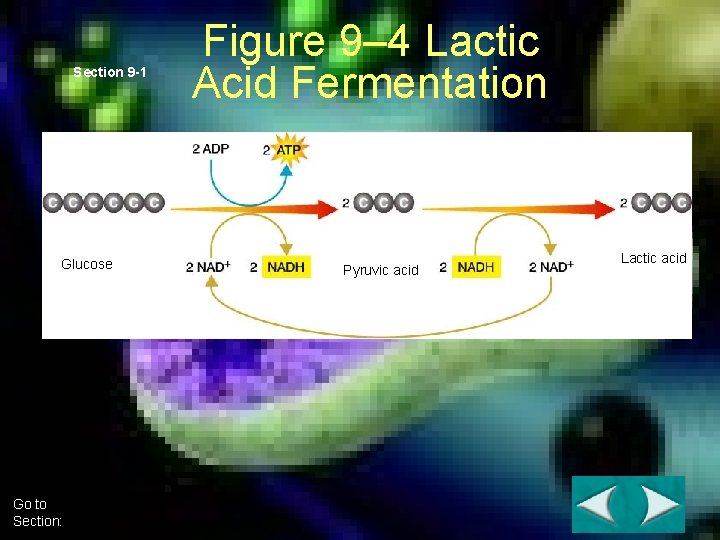
Section 9 -1 Glucose Go to Section: Figure 9– 4 Lactic Acid Fermentation Pyruvic acid Lactic acid
Section 9 -2 Interest Grabber • Rolling and Folding • Some of the steps in cellular respiration take place in the membrane inside the cell structure called the mitochondrion, which has a folded inner membrane. What purpose do these folds serve? • To find out the answer to this question, Go to perform this activity. Section:
Interest Grabber continued Section 9 -2 • 1. Obtain two sheets of paper and a metric ruler. What is the surface area of the paper? • 2. Roll one sheet of paper into a tube lengthwise. What is the surface area of the rolled paper? • 3. Fold the second sheet of paper into a fan. Then, roll the first sheet of paper around the folded paper so it is inside the rolled paper. What has happened to the surface area of the inside of the rolled paper? • 4. What would be the value of increasing the surface area of the membrane inside a mitochondrion? Go to Section:
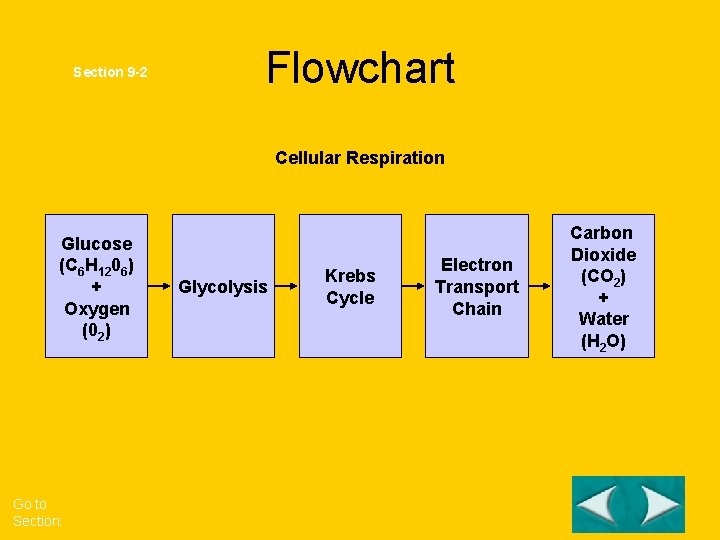
Section 9 -2 Flowchart Cellular Respiration Glucose (C 6 H 1206) + Oxygen (02) Go to Section: Glycolysis Krebs Cycle Electron Transport Chain Carbon Dioxide (CO 2) + Water (H 2 O)
A. The Kreb’s Cycle – – CO 2 During the Kreb’s Cycle, pyruvic acid is broken down into ______ in a series of energyextracting steps Because ________is the 1 st compound formed, it is also called __________. Citric acid cycle
• • 1) Begins when pyruvic acid produced by glycolysis enters the _________. – 1 C-atom pyruvic acid becomes part of CO 2 and gets released into the air. 2) Citric acid is broken down into a 4 -C molecule, more CO 2 is released, and _________are transferred to energy carriers electrons mitochondrion
• For each turn of the cycle, a molecule similar to ADP is converted into a molecule similar to ATP. • Electron carrier NAD+ changes to ______ • Electron carrier FAD(flavine adenine dinucleotide) changes to _________ NADH FADH 2
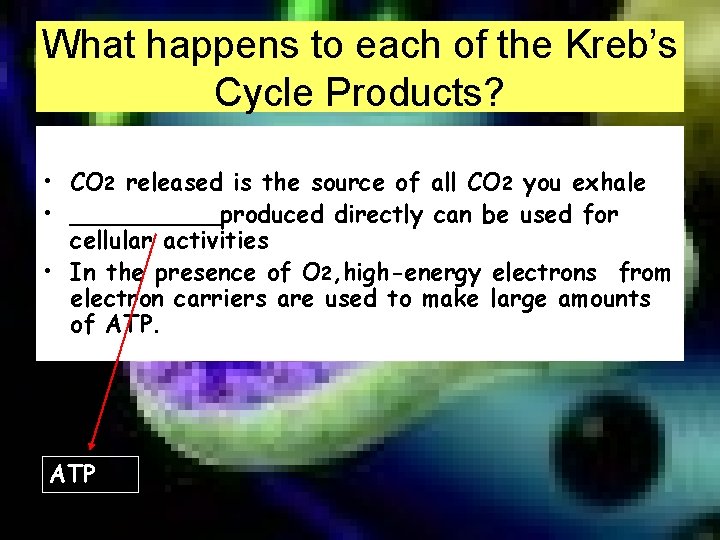
What happens to each of the Kreb’s Cycle Products? • CO 2 released is the source of all CO 2 you exhale • _____produced directly can be used for cellular activities • In the presence of O 2, high-energy electrons from electron carriers are used to make large amounts of ATP
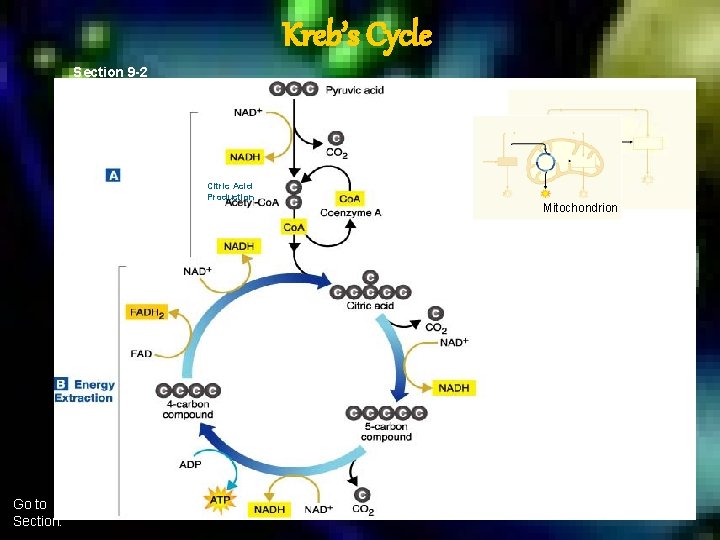
Kreb’s Cycle Section 9 -2 Citric Acid Production Go to Section: Mitochondrion
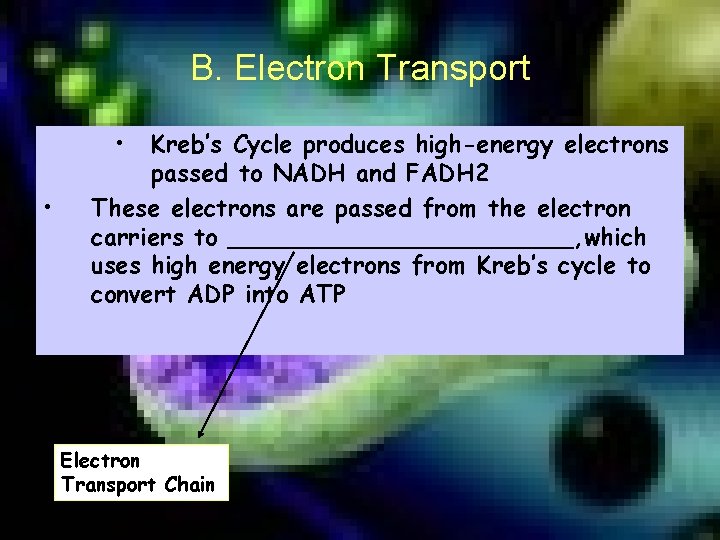
B. Electron Transport • • Kreb’s Cycle produces high-energy electrons passed to NADH and FADH 2 These electrons are passed from the electron carriers to ____________, which uses high energy electrons from Kreb’s cycle to convert ADP into ATP Electron Transport Chain
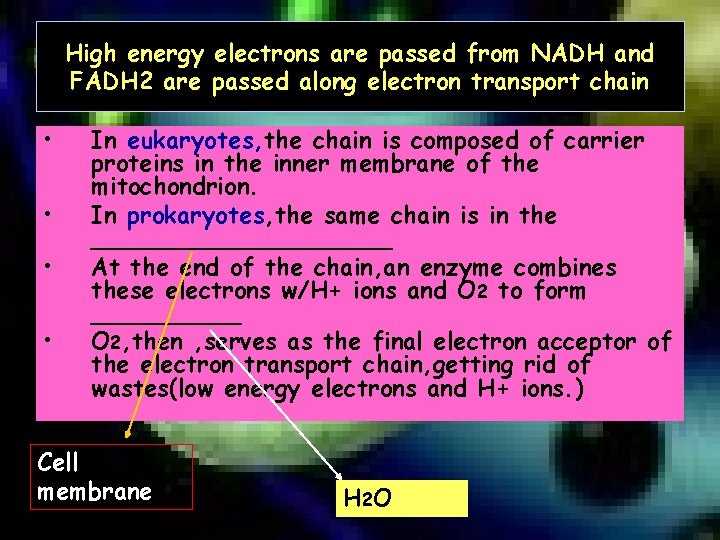
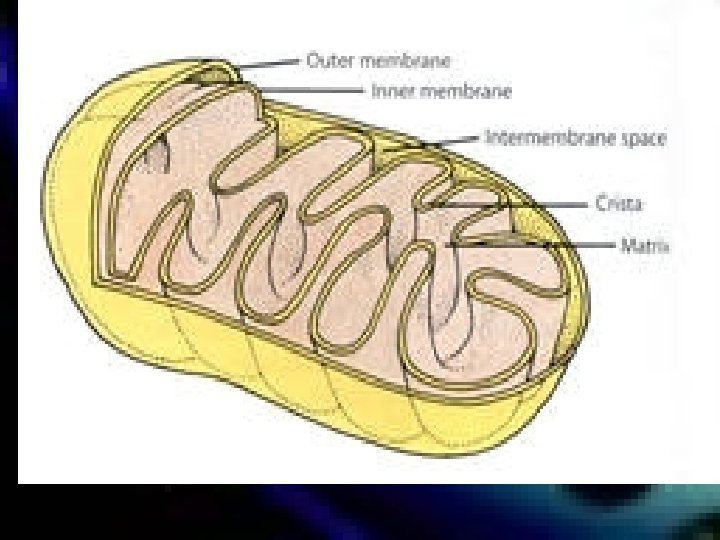
High energy electrons are passed from NADH and FADH 2 are passed along electron transport chain • • In eukaryotes, the chain is composed of carrier proteins in the inner membrane of the mitochondrion. In prokaryotes, the same chain is in the __________ At the end of the chain, an enzyme combines these electrons w/H+ ions and O 2 to form _____ O 2, then , serves as the final electron acceptor of the electron transport chain, getting rid of wastes(low energy electrons and H+ ions. ) Cell membrane H 2 O
• • 2) Every time 2 high energy electrons transport down the transport chain, their energy is used to transport H+ across the membrane…. . H+ ions build up in the intermembrane space making it positive…. and the other side is negative. 3) How does the cell use the charge difference? . . The inner membranes of mitochondria contain protein spheres called ATP synthase…. As H+ ions escape into the proteins, the enzyme rotates, adding phosphate to low energy ADP to make _____. ATP
On the average, each pair of high energy electrons moves down the chain, providing enough energy to make 3 ATP from 3 ADP.
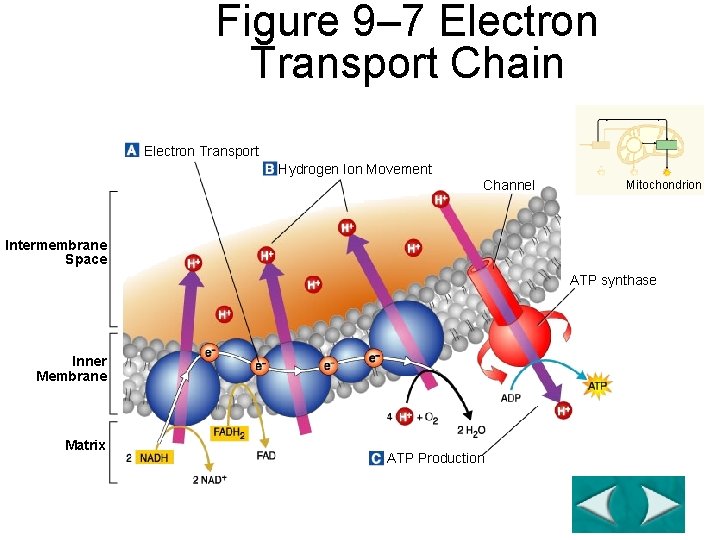
Section 9 -2 Figure 9– 7 Electron Transport Chain Electron Transport Hydrogen Ion Movement Channel Mitochondrion Intermembrane Space ATP synthase Inner Membrane Matrix Go to Section: ATP Production
The totals – – – Glycolysis makes 2 ATP for each glucose molecule w/o O 2, that’s all the energy extracted w/ O 2, the Kreb’s Cycle and the transport chain make 34 more ATP(36 molecules total, counting glycolsis)----18 x as much These 36 molecules of ATP are 38% the total energy in glucose…actually efficient The other 62 % is released as ________---one reason why you feel warmer after exercise heat
D. Energy and Exercise • • Glycolysis covers a few seconds of a runners run • Next –lactic acid fermentation produces ATP w/o O 2 present • At end of race, runner breathes extra to use O 2 to help rid body of lactic acid • For long term energy(eg. Cross-country running), cellular respiration releases a continual supply of ATP • Muscles store _______ that help out w/ about 20 min. of activity After that, stored fats are broken down glycogen
E. Comparing Photosynthesis & Cellular Respiration – – – _________deposits energy by making glucose __________withdraws energy by breaking down glucose Photosynthesis removes CO 2 from atmosphere and cellular respiration puts it back. Photosynthesis releases ____ into atmosphere and Cellular Respiration uses it to release energy from food. Cellular Respiration happens in eukaryotes and some prokaryotes and____________only happens in plants , algae and some bacteria. O 2 photosynthesis Cellular respiration
- Slides: 36