
Chapter 9 Cellular Respiration Copyright 2005 Pearson Education
- Slides: 46
Chapter 9 Cellular Respiration Copyright © 2005 Pearson Education, Inc. publishing as Benjamin Cummings
• Living cells require transfusions of energy: – From outside sources – To perform their many tasks Copyright © 2005 Pearson Education, Inc. publishing as Benjamin Cummings
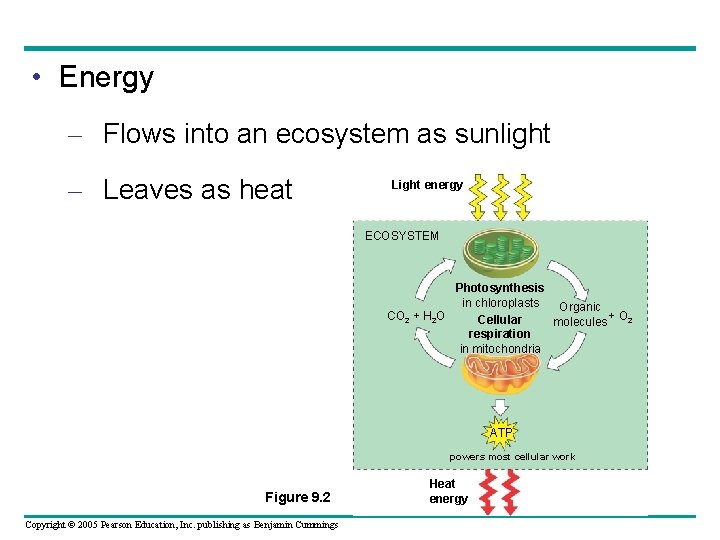
• Energy – Flows into an ecosystem as sunlight – Leaves as heat Light energy ECOSYSTEM Photosynthesis in chloroplasts Organic CO 2 + H 2 O + O 2 Cellular molecules respiration in mitochondria ATP powers most cellular work Figure 9. 2 Copyright © 2005 Pearson Education, Inc. publishing as Benjamin Cummings Heat energy
Catabolic Pathways and Production of ATP • Catabolic pathways – Yield energy by: • Oxidizing organic fuels • The breakdown of organic molecules is: – Exergonic • One catabolic process is called fermentation: – It is a partial degradation of sugars – It occurs without oxygen Copyright © 2005 Pearson Education, Inc. publishing as Benjamin Cummings
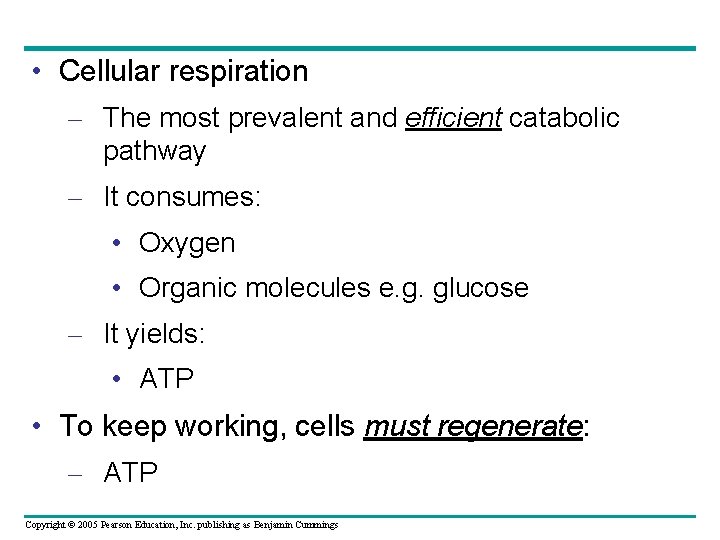
• Cellular respiration – The most prevalent and efficient catabolic pathway – It consumes: • Oxygen • Organic molecules e. g. glucose – It yields: • ATP • To keep working, cells must regenerate: – ATP Copyright © 2005 Pearson Education, Inc. publishing as Benjamin Cummings
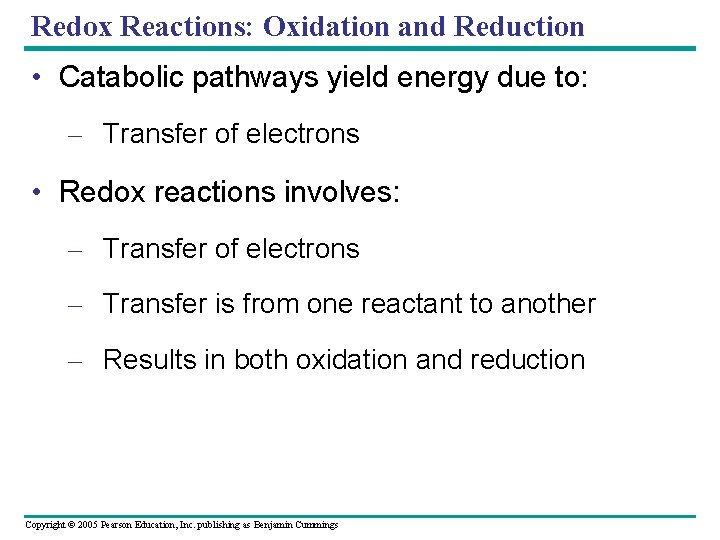
Redox Reactions: Oxidation and Reduction • Catabolic pathways yield energy due to: – Transfer of electrons • Redox reactions involves: – Transfer of electrons – Transfer is from one reactant to another – Results in both oxidation and reduction Copyright © 2005 Pearson Education, Inc. publishing as Benjamin Cummings
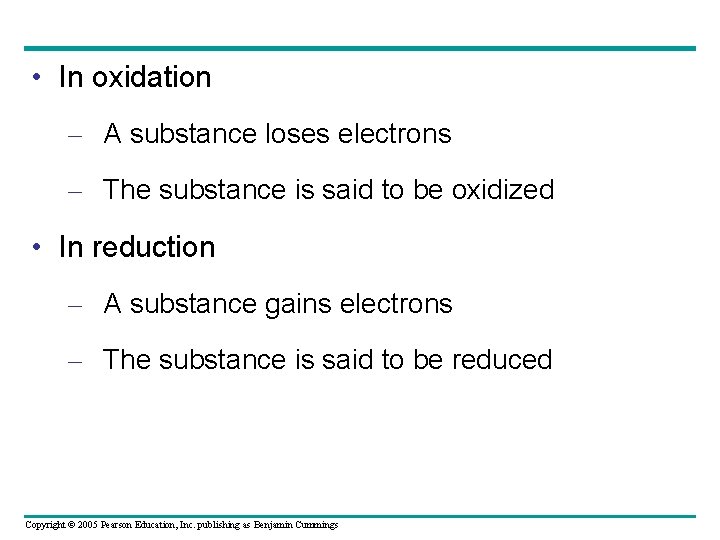
• In oxidation – A substance loses electrons – The substance is said to be oxidized • In reduction – A substance gains electrons – The substance is said to be reduced Copyright © 2005 Pearson Education, Inc. publishing as Benjamin Cummings
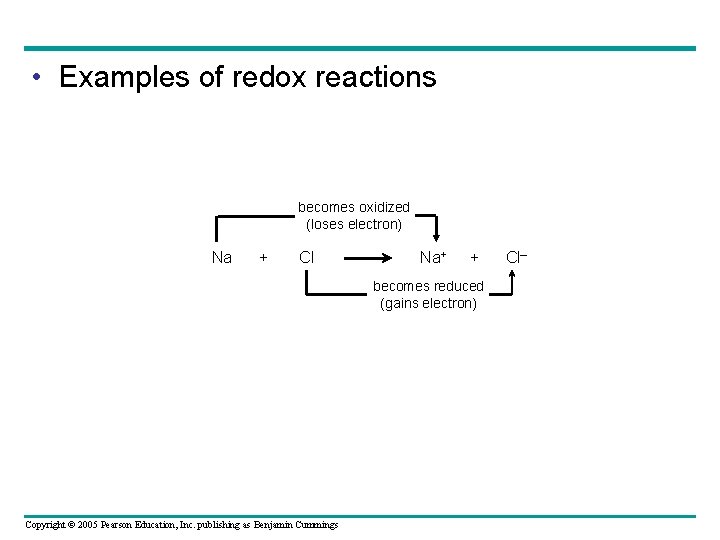
• Examples of redox reactions becomes oxidized (loses electron) Na + Cl Na + + becomes reduced (gains electron) Copyright © 2005 Pearson Education, Inc. publishing as Benjamin Cummings Cl–
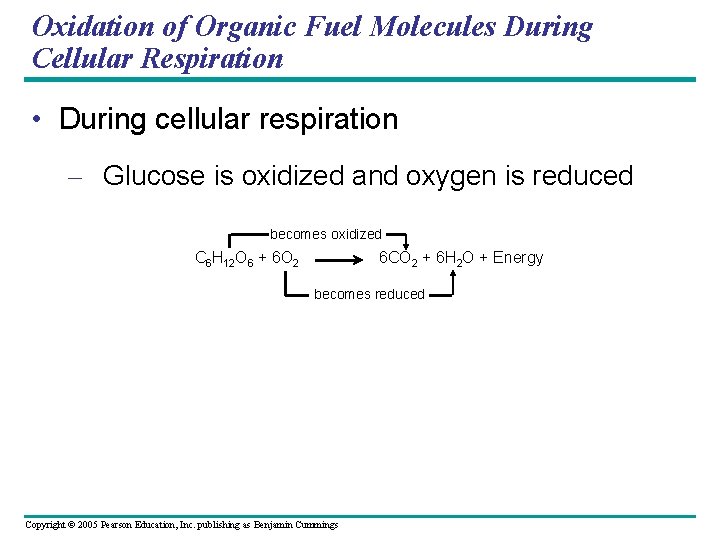
Oxidation of Organic Fuel Molecules During Cellular Respiration • During cellular respiration – Glucose is oxidized and oxygen is reduced becomes oxidized C 6 H 12 O 6 + 6 O 2 6 CO 2 + 6 H 2 O + Energy becomes reduced Copyright © 2005 Pearson Education, Inc. publishing as Benjamin Cummings
Stepwise Energy Harvest via NAD+ and the Electron Transport Chain • Cellular respiration – Oxidation of glucose in a series of steps – Electrons from organic compounds are first: • Transferred to NAD+, • NAD+ (nicotineamide dinucleotide): – is a coenzyme Copyright © 2005 Pearson Education, Inc. publishing as Benjamin Cummings
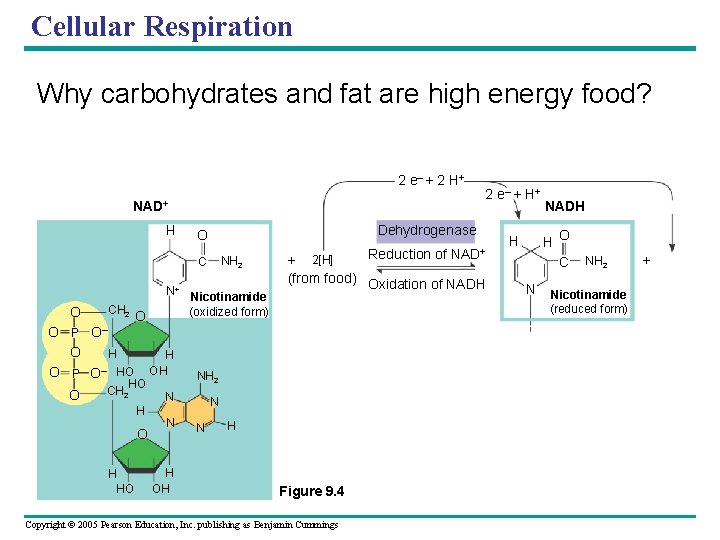
Cellular Respiration Why carbohydrates and fat are high energy food? 2 e– + 2 H + NAD+ Dehydrogenase O NH 2 H C N+ CH 2 O O– O P O H O P O– HO O O HO CH 2 H O H HO H OH Nicotinamide (oxidized form) N H OH NAD+ Reduction of + 2[H] (from food) Oxidation of NADH NH 2 N N N 2 e– + H Figure 9. 4 Copyright © 2005 Pearson Education, Inc. publishing as Benjamin Cummings NADH H O C H N NH 2 Nicotinamide (reduced form) +
• NADH: – Is the reduced form of NAD+ – It passes the electrons to: • The electron transport chain Copyright © 2005 Pearson Education, Inc. publishing as Benjamin Cummings
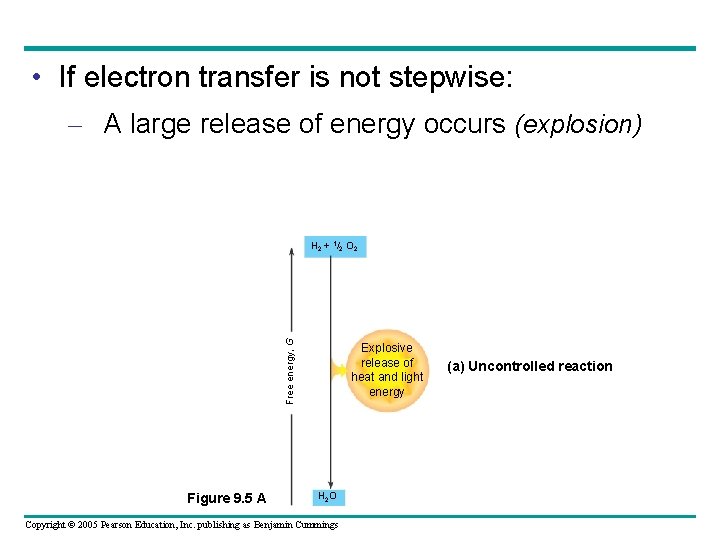
• If electron transfer is not stepwise: – A large release of energy occurs (explosion) Free energy, G H 2 + 1/2 O 2 Figure 9. 5 A Explosive release of heat and light energy H 2 O Copyright © 2005 Pearson Education, Inc. publishing as Benjamin Cummings (a) Uncontrolled reaction
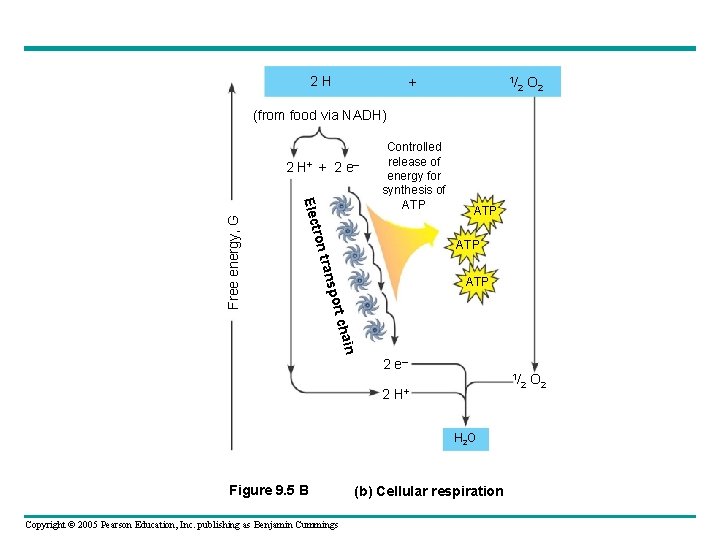
• The electron transport chain: – Passes electrons in a series of steps – Passage is not in one explosive reaction – Energy from the electron transfer is used to: • Generate ATP Copyright © 2005 Pearson Education, Inc. publishing as Benjamin Cummings
2 H + 1/ 2 O 2 1/ O 2 (from food via NADH) tron Elec ATP trans ATP port Free energy, G 2 H+ + 2 e – Controlled release of energy for synthesis of ATP n chai 2 e– 2 H+ H 2 O Figure 9. 5 B Copyright © 2005 Pearson Education, Inc. publishing as Benjamin Cummings (b) Cellular respiration 2
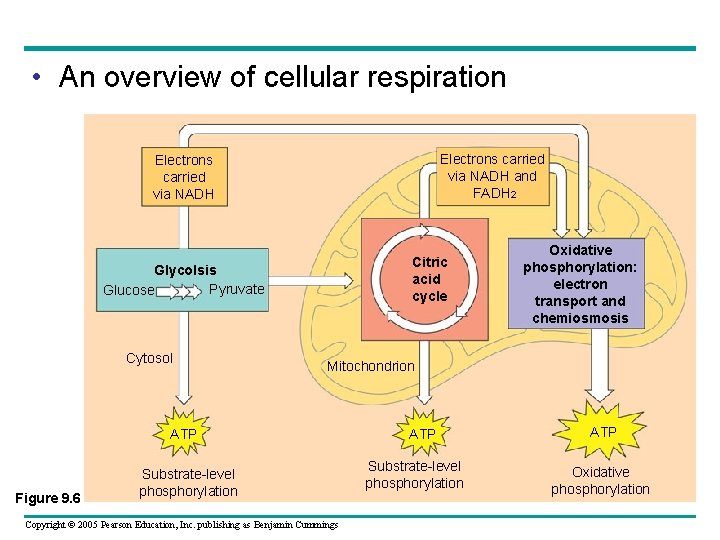
The Stages of Cellular Respiration: A Preview • Cellular respiration is: – A cumulative function of three metabolic stages: • Glycolysis • The citric acid cycle • Oxidative phosphorylation Copyright © 2005 Pearson Education, Inc. publishing as Benjamin Cummings
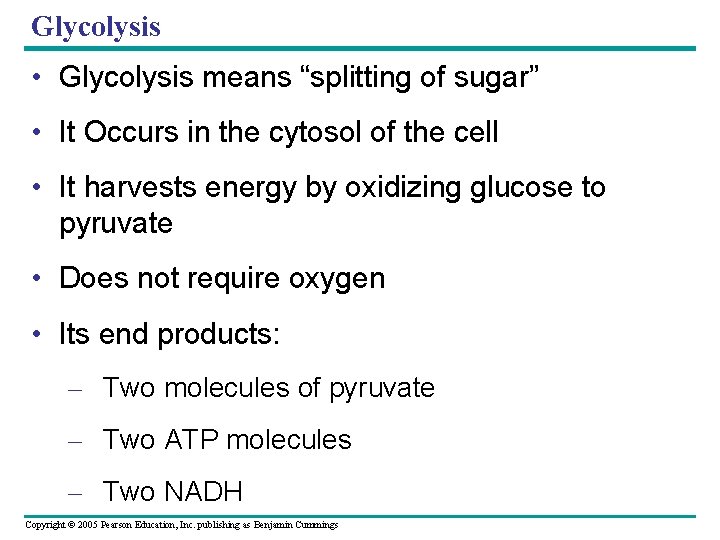
Glycolysis • Glycolysis means “splitting of sugar” • It Occurs in the cytosol of the cell • It harvests energy by oxidizing glucose to pyruvate • Does not require oxygen • Its end products: – Two molecules of pyruvate – Two ATP molecules – Two NADH Copyright © 2005 Pearson Education, Inc. publishing as Benjamin Cummings
• An overview of cellular respiration Electrons carried via NADH and FADH 2 Electrons carried via NADH Citric acid cycle Glycolsis Pyruvate Glucose Cytosol Mitochondrion ATP Figure 9. 6 Oxidative phosphorylation: electron transport and chemiosmosis Substrate-level phosphorylation Copyright © 2005 Pearson Education, Inc. publishing as Benjamin Cummings ATP Substrate-level phosphorylation ATP Oxidative phosphorylation
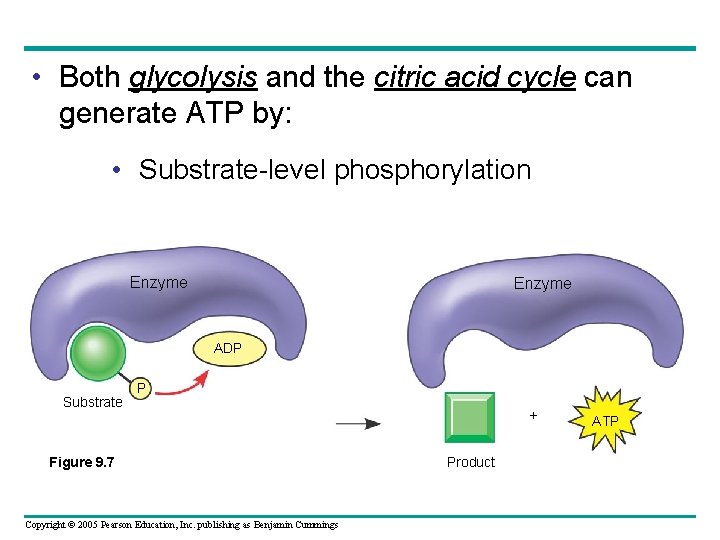
• Both glycolysis and the citric acid cycle can generate ATP by: • Substrate-level phosphorylation Enzyme ADP Substrate P Figure 9. 7 Copyright © 2005 Pearson Education, Inc. publishing as Benjamin Cummings + Product ATP
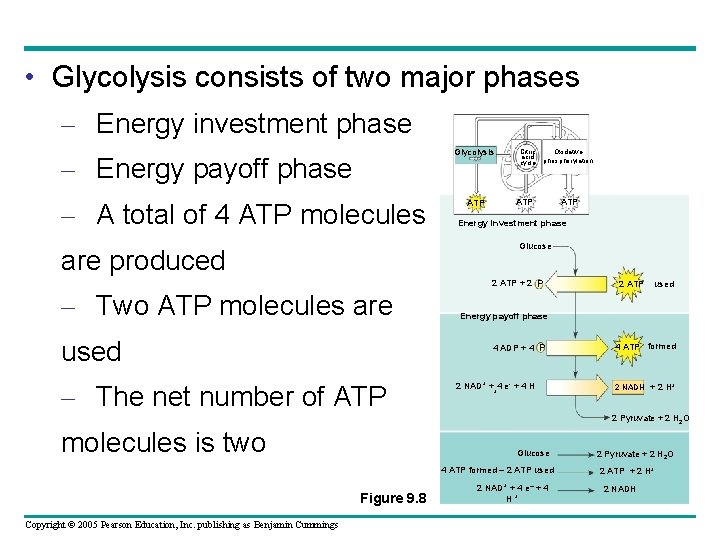
• Glycolysis consists of two major phases – Energy investment phase Glycolysis – Energy payoff phase – A total of 4 ATP molecules Citric acid cycle Oxidative phosphorylation ATP ATP Energy investment phase Glucose are produced 2 ATP + 2 P – Two ATP molecules are used Energy payoff phase 4 ADP + 4 P – The net number of ATP 2 NAD+ + 4 e- + 4 H + 4 ATP formed 2 NADH + 2 H+ 2 Pyruvate + 2 H 2 O molecules is two Glucose 4 ATP formed – 2 ATP used Figure 9. 8 Copyright © 2005 Pearson Education, Inc. publishing as Benjamin Cummings 2 NAD+ + 4 e– + 4 H+ 2 Pyruvate + 2 H 2 O 2 ATP + 2 H+ 2 NADH
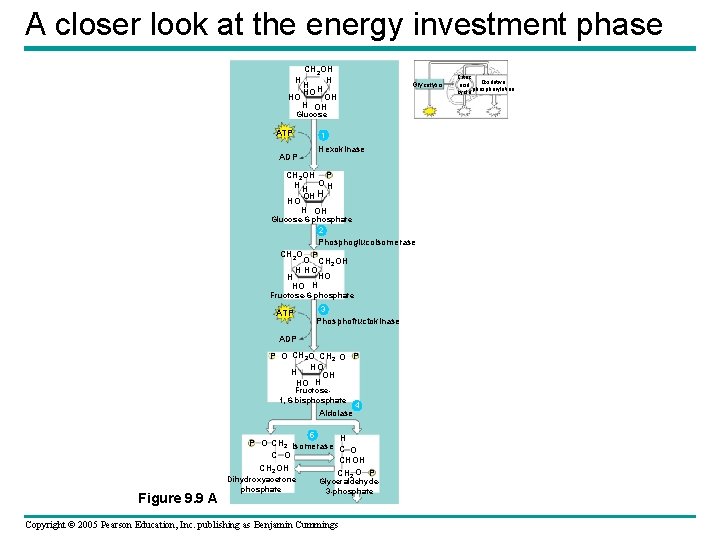
A closer look at the energy investment phase CH 2 OH HH H HO OH H OH Glycolysis Glucose ATP ADP 1 Hexokinase CH 2 OH P HH OH OH H HO H OH Glucose-6 -phosphate 2 Phosphoglucoisomerase CH 2 O P O CH 2 OH H HO HO H Fructose-6 -phosphate ATP 3 Phosphofructokinase ADP P O CH 2 O P HO H OH HO H Fructose 1, 6 -bisphosphate Aldolase 4 5 H P O CH 2 Isomerase C O CHOH CH 2 O P Figure 9. 9 A Dihydroxyacetone phosphate Glyceraldehyde 3 -phosphate Copyright © 2005 Pearson Education, Inc. publishing as Benjamin Cummings Citric Oxidative acid cycle phosphorylation
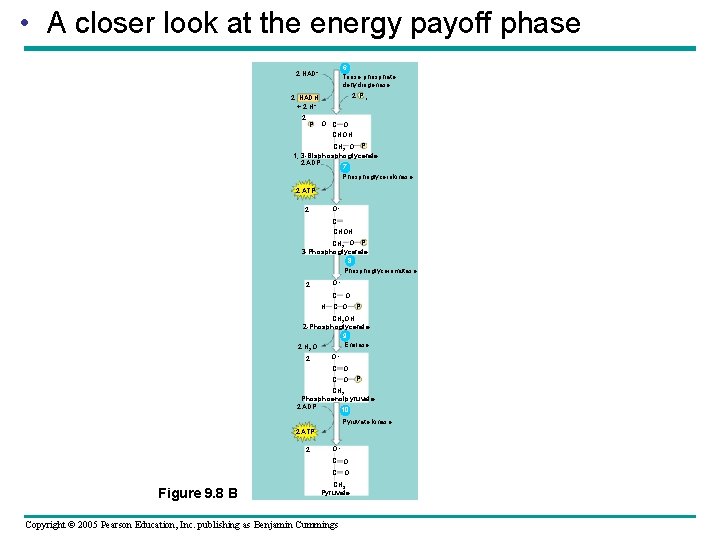
• A closer look at the energy payoff phase 6 Triose phosphate dehydrogenase 2 NAD+ 2 Pi 2 NADH + 2 H+ 2 P O CHOH CH 2 O P 1, 3 -Bisphoglycerate 2 ADP 7 Phosphoglycerokinase 2 ATP O– 2 C CHOH CH 2 O P 3 -Phosphoglycerate 8 Phosphoglyceromutase 2 O– C O H C O P CH 2 OH 2 -Phosphoglycerate 9 Enolase 2 H O 2 2 O– C O P CH 2 Phosphoenolpyruvate 2 ADP 10 Pyruvate kinase 2 ATP 2 O– C O Figure 9. 8 B CH 3 Pyruvate Copyright © 2005 Pearson Education, Inc. publishing as Benjamin Cummings
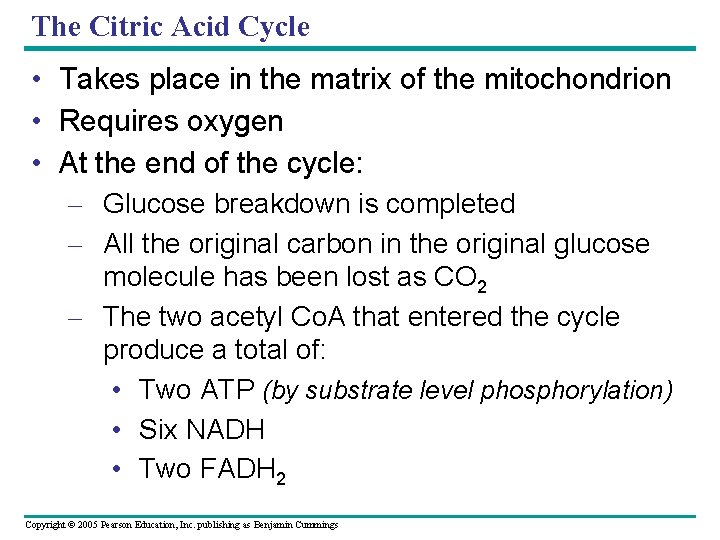
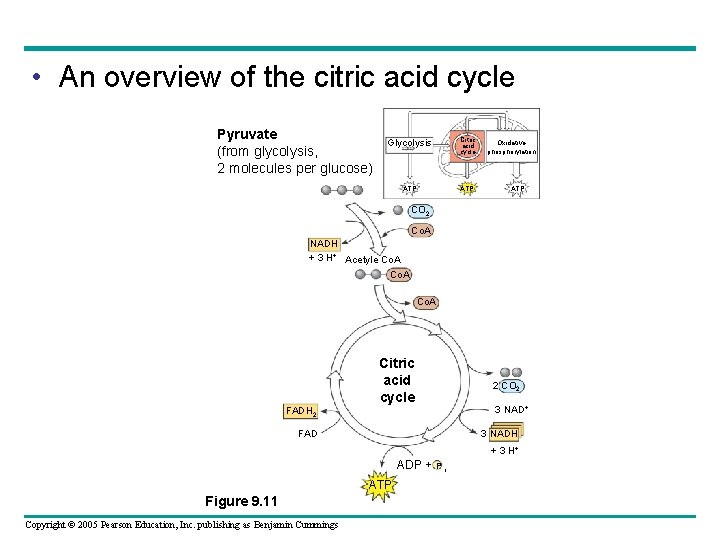
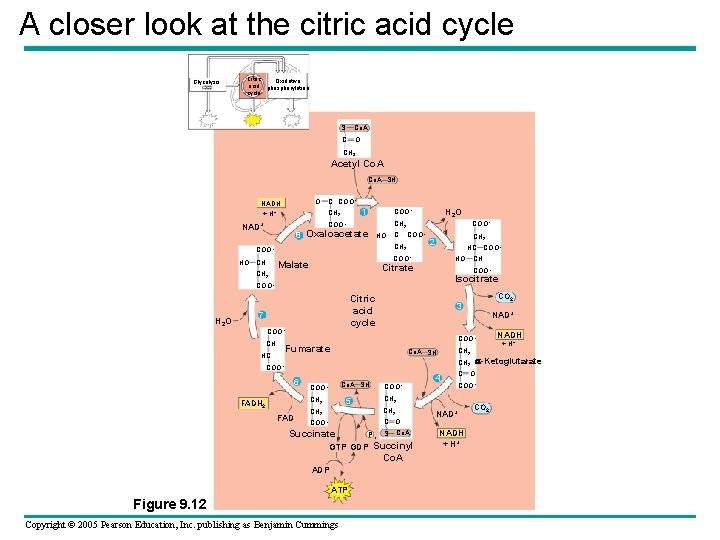
The Citric Acid Cycle • Takes place in the matrix of the mitochondrion • Requires oxygen • At the end of the cycle: – Glucose breakdown is completed – All the original carbon in the original glucose molecule has been lost as CO 2 – The two acetyl Co. A that entered the cycle produce a total of: • Two ATP (by substrate level phosphorylation) • Six NADH • Two FADH 2 Copyright © 2005 Pearson Education, Inc. publishing as Benjamin Cummings
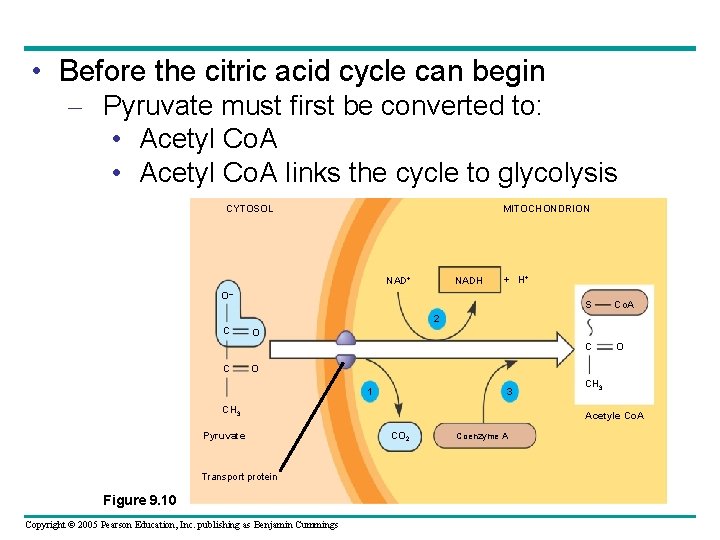
• Before the citric acid cycle can begin – Pyruvate must first be converted to: • Acetyl Co. A links the cycle to glycolysis CYTOSOL MITOCHONDRION NAD+ NADH + H+ O– S Co. A C O 2 C C O O 1 3 CH 3 Pyruvate Transport protein Figure 9. 10 Copyright © 2005 Pearson Education, Inc. publishing as Benjamin Cummings CH 3 Acetyle Co. A CO 2 Coenzyme A
• An overview of the citric acid cycle Pyruvate (from glycolysis, 2 molecules per glucose) Glycolysis Citric acid cycle ATP Oxidative phosphorylation ATP CO 2 Co. A NADH + 3 H+ Acetyle Co. A Citric acid cycle FADH 2 FAD 2 CO 2 3 NAD+ 3 NADH + 3 H+ ADP + P i ATP Figure 9. 11 Copyright © 2005 Pearson Education, Inc. publishing as Benjamin Cummings
A closer look at the citric acid cycle Glycolysis Citric Oxidative acid phosphorylation cycle S Co. A C O CH 3 Acetyl Co. A SH O NADH + H+ C COO– 1 CH 2 8 Oxaloacetate HO C CH 2 COO– HO CH COO– CH 2 COO– NAD+ H 2 O COO– CH 2 2 HC COO– Malate Figure HO Citrate 9. 12 Isocitrate COO– H 2 O Citric acid cycle 7 COO– CH CO 2 3 NAD+ COO– Fumarate HC CH COO– CH 2 Co. A SH 6 Co. A SH COO– FAD CH 2 C O COO– Succinate Pi S Co. A GTP GDP Succinyl Co. A ADP ATP Figure 9. 12 Copyright © 2005 Pearson Education, Inc. publishing as Benjamin Cummings 4 C O COO– CH 2 5 CH 2 FADH 2 COO– NAD+ NADH + H+ a-Ketoglutarate CH 2 COO– NADH CO 2
Oxidative Phosphorylation • Oxidative phosphorylation – Driven by the electron transport chain – Electrons (generated during glycolys & citric acid cycle) are escorted & donated by: • Na. DH • FADH 2 – Released energy during electron transfer is used thru chemiosmosis to generates ATP Copyright © 2005 Pearson Education, Inc. publishing as Benjamin Cummings
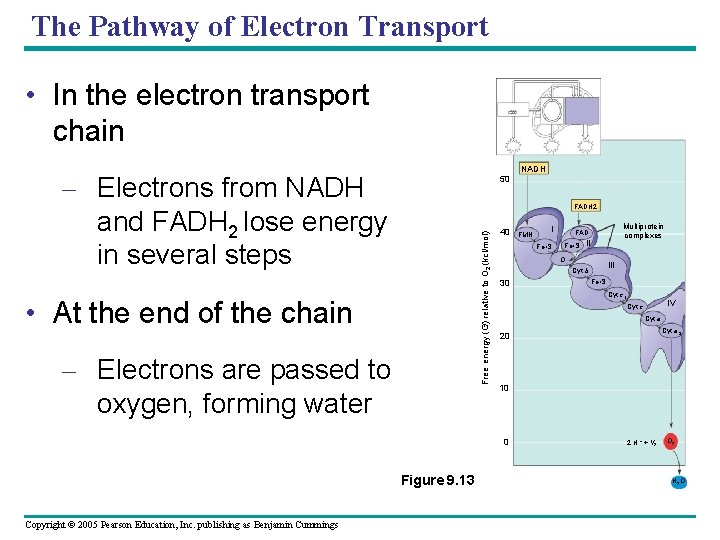
The Pathway of Electron Transport • In the electron transport chain NADH – Electrons from NADH and FADH 2 lose energy in several steps 50 Free energy (G) relative to O 2 (kcl/mol) FADH 2 • At the end of the chain – Electrons are passed to oxygen, forming water 40 Copyright © 2005 Pearson Education, Inc. publishing as Benjamin Cummings I FAD Fe • S II Multiprotein complexes O III Cyt b 30 Fe • S Cyt c 1 IV Cyt c Cyt a 3 20 10 0 Figure 9. 13 FMN 2 H + + 1 2 O 2 H 2 O
• Chemiosmosis – Is an energy-coupling mechanism – It uses energy in the form of a H+ gradient across a membrane to drive ATP synhesis Copyright © 2005 Pearson Education, Inc. publishing as Benjamin Cummings
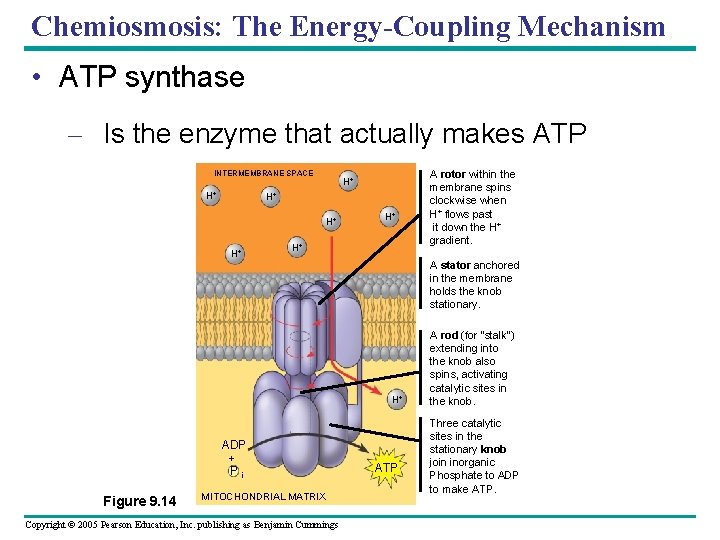
Chemiosmosis: The Energy-Coupling Mechanism • ATP synthase – Is the enzyme that actually makes ATP INTERMEMBRANE SPACE H+ H+ A stator anchored in the membrane holds the knob stationary. H+ ADP + Pi Figure 9. 14 MITOCHONDRIAL MATRIX Copyright © 2005 Pearson Education, Inc. publishing as Benjamin Cummings A rotor within the membrane spins clockwise when H+ flows past it down the H+ gradient. ATP A rod (for “stalk”) extending into the knob also spins, activating catalytic sites in the knob. Three catalytic sites in the stationary knob join inorganic Phosphate to ADP to make ATP.
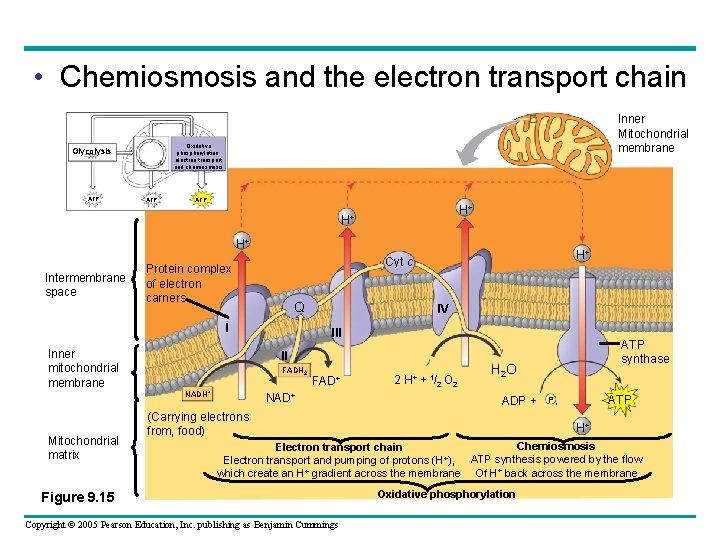
Chemiosmosis • At certain steps along the electron transport chain: – The electron transfer causes protein complexes to pump H+ – Hydrogrn ions (H+) are pumped from the mitochondrial matrix to the intermembrane space – This creates a H+ gradient (stored energy) that drives ATP synthase to make ATP from: • ADP, and • inorganic phosphate Copyright © 2005 Pearson Education, Inc. publishing as Benjamin Cummings
• Chemiosmosis and the electron transport chain Oxidative phosphorylation. electron transport and chemiosmosis Glycolysis ATP Inner Mitochondrial membrane ATP H+ H+ H+ Intermembrane space Protein complex of electron carners Q I Inner mitochondrial membrane IV III II FADH 2 NADH+ Mitochondrial matrix H+ Cyt c FAD+ NAD+ 2 H+ + 1/2 O 2 ATP synthase H 2 O ADP + (Carrying electrons from, food) ATP Pi H+ Chemiosmosis Electron transport chain + ATP synthesis powered by the flow Electron transport and pumping of protons (H ), + + which create an H gradient across the membrane Of H back across the membrane Figure 9. 15 Copyright © 2005 Pearson Education, Inc. publishing as Benjamin Cummings Oxidative phosphorylation
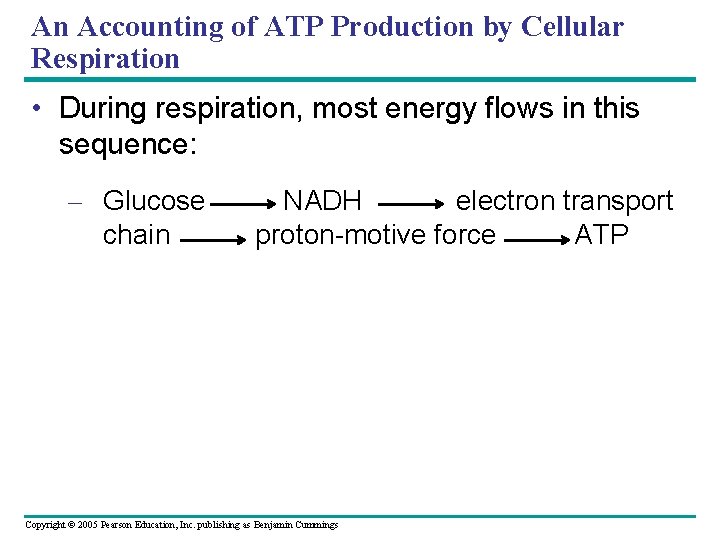
An Accounting of ATP Production by Cellular Respiration • During respiration, most energy flows in this sequence: – Glucose chain NADH electron transport proton-motive force ATP Copyright © 2005 Pearson Education, Inc. publishing as Benjamin Cummings
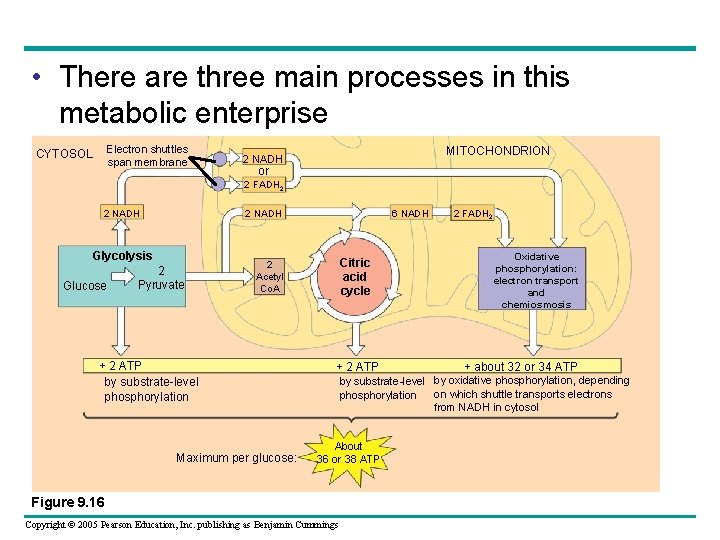
• There are three main processes in this metabolic enterprise Electron shuttles span membrane CYTOSOL MITOCHONDRION 2 NADH or 2 FADH 2 2 NADH Glycolysis Glucose 2 Pyruvate 6 NADH Citric acid cycle 2 Acetyl Co. A + 2 ATP by substrate-level phosphorylation Maximum per glucose: + 2 ATP 2 FADH 2 Oxidative phosphorylation: electron transport and chemiosmosis + about 32 or 34 ATP by substrate-level by oxidative phosphorylation, depending on which shuttle transports electrons phosphorylation from NADH in cytosol About 36 or 38 ATP Figure 9. 16 Copyright © 2005 Pearson Education, Inc. publishing as Benjamin Cummings
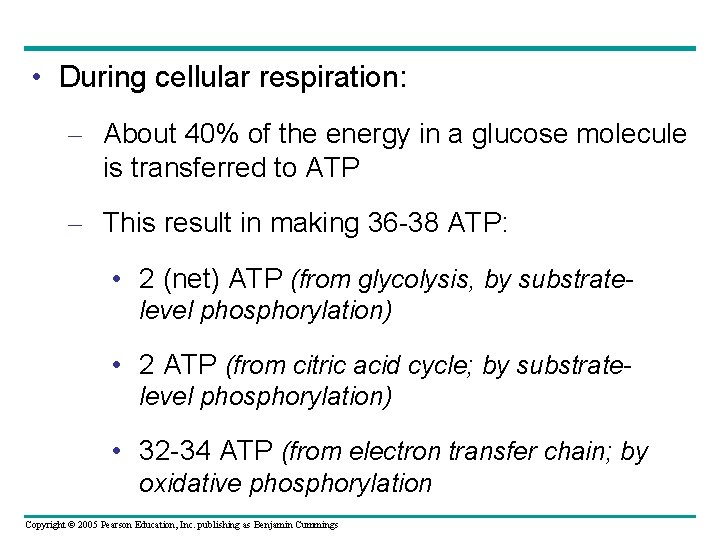
• During cellular respiration: – About 40% of the energy in a glucose molecule is transferred to ATP – This result in making 36 -38 ATP: • 2 (net) ATP (from glycolysis, by substratelevel phosphorylation) • 2 ATP (from citric acid cycle; by substratelevel phosphorylation) • 32 -34 ATP (from electron transfer chain; by oxidative phosphorylation Copyright © 2005 Pearson Education, Inc. publishing as Benjamin Cummings
Fermentation • Fermentation: – Enables some cells to produce ATP without the use of oxygen • Cellular respiration – Relies on oxygen to produce ATP • In the absence of oxygen: – Cells can still produce ATP through a process called fermentation Copyright © 2005 Pearson Education, Inc. publishing as Benjamin Cummings
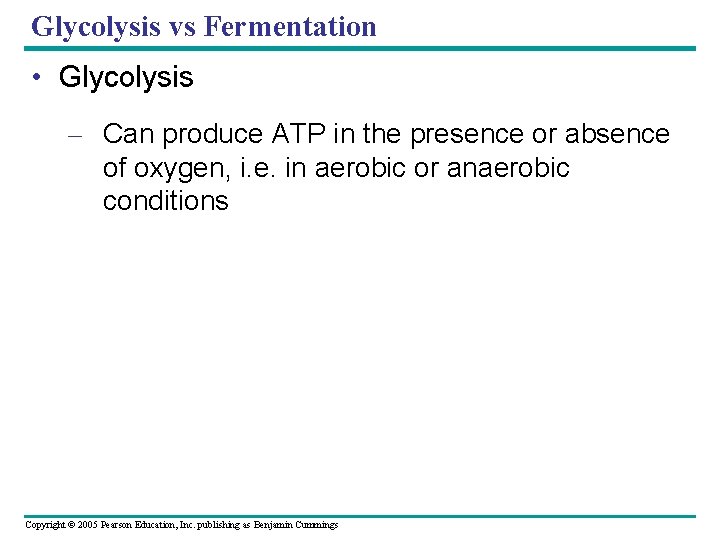
Glycolysis vs Fermentation • Glycolysis – Can produce ATP in the presence or absence of oxygen, i. e. in aerobic or anaerobic conditions Copyright © 2005 Pearson Education, Inc. publishing as Benjamin Cummings
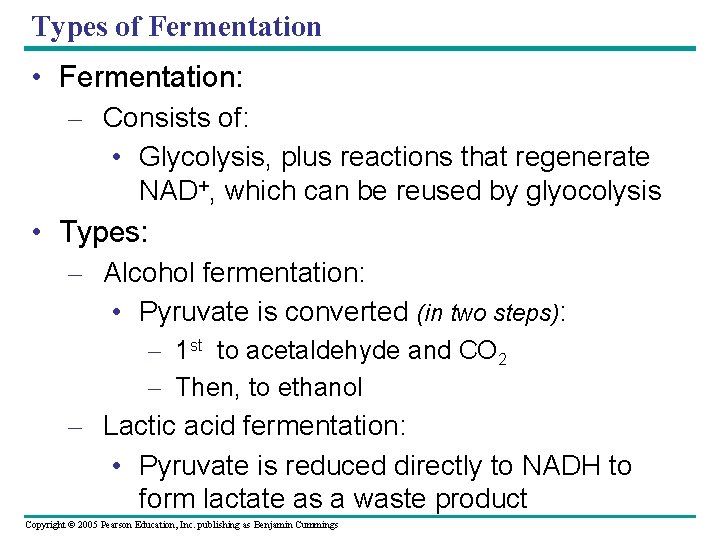
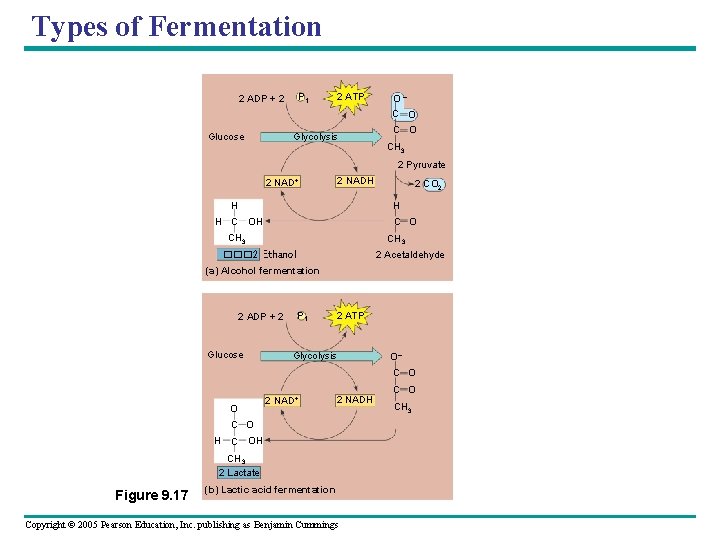
Types of Fermentation • Fermentation: – Consists of: • Glycolysis, plus reactions that regenerate NAD+, which can be reused by glyocolysis • Types: – Alcohol fermentation: • Pyruvate is converted (in two steps): – 1 st to acetaldehyde and CO 2 – Then, to ethanol – Lactic acid fermentation: • Pyruvate is reduced directly to NADH to form lactate as a waste product Copyright © 2005 Pearson Education, Inc. publishing as Benjamin Cummings
Types of Fermentation P 1 2 ADP + 2 2 ATP O– C O Glucose Glycolysis C O CH 3 2 Pyruvate 2 NAD+ 2 NADH H 2 CO 2 H H C O CH 3 2 Acetaldehyde ��� 2 Ethanol (a) Alcohol fermentation 2 ADP + 2 Glucose P 1 2 ATP Glycolysis O– C O O 2 NAD+ 2 NADH C OH CH 3 2 Lactate Figure 9. 17 (b) Lactic acid fermentation Copyright © 2005 Pearson Education, Inc. publishing as Benjamin Cummings C O CH 3
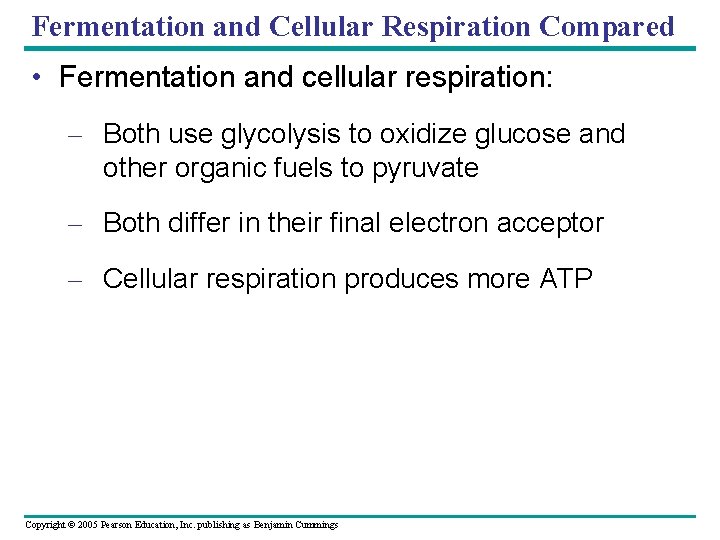
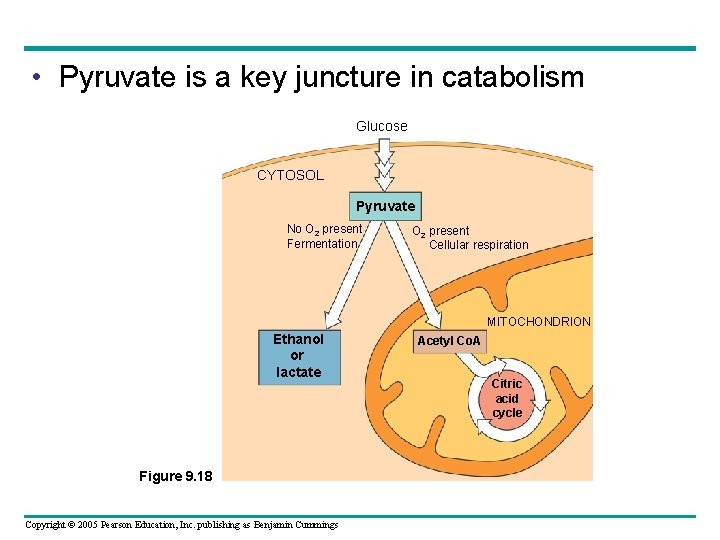
Fermentation and Cellular Respiration Compared • Fermentation and cellular respiration: – Both use glycolysis to oxidize glucose and other organic fuels to pyruvate – Both differ in their final electron acceptor – Cellular respiration produces more ATP Copyright © 2005 Pearson Education, Inc. publishing as Benjamin Cummings
• Pyruvate is a key juncture in catabolism Glucose CYTOSOL Pyruvate No O 2 present Fermentation O 2 present Cellular respiration MITOCHONDRION Ethanol or lactate Figure 9. 18 Copyright © 2005 Pearson Education, Inc. publishing as Benjamin Cummings Acetyl Co. A Citric acid cycle
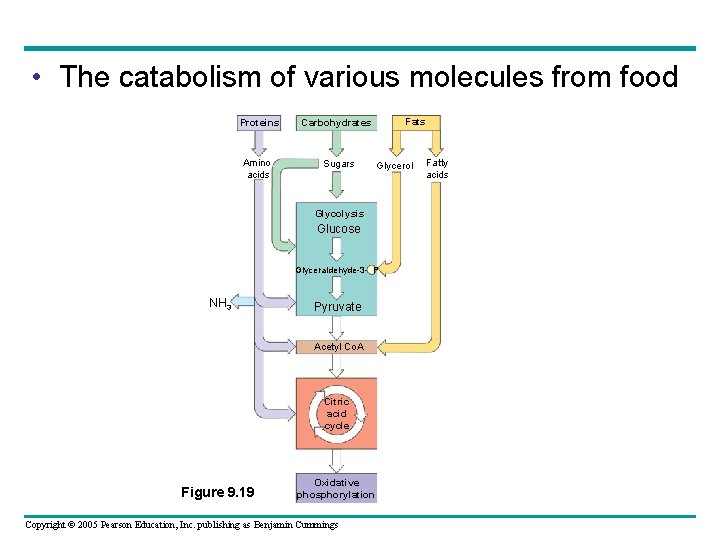
The Versatility of Catabolism • Glycolysis and the citric acid cycle connect to many other metabolic pathways • Catabolic pathways – Funnel electrons from many kinds of organic molecules into cellular respiration Copyright © 2005 Pearson Education, Inc. publishing as Benjamin Cummings
• The catabolism of various molecules from food Proteins Carbohydrates Amino acids Sugars Fats Glycerol Glycolysis Glucose Glyceraldehyde-3 - P NH 3 Pyruvate Acetyl Co. A Citric acid cycle Figure 9. 19 Oxidative phosphorylation Copyright © 2005 Pearson Education, Inc. publishing as Benjamin Cummings Fatty acids
Biosynthesis (Anabolic Pathways) • The body – Uses small molecules to build other substances • These small molecules may come: – Directly from food, – Through: • Glycolysis • The citric acid cycle Copyright © 2005 Pearson Education, Inc. publishing as Benjamin Cummings
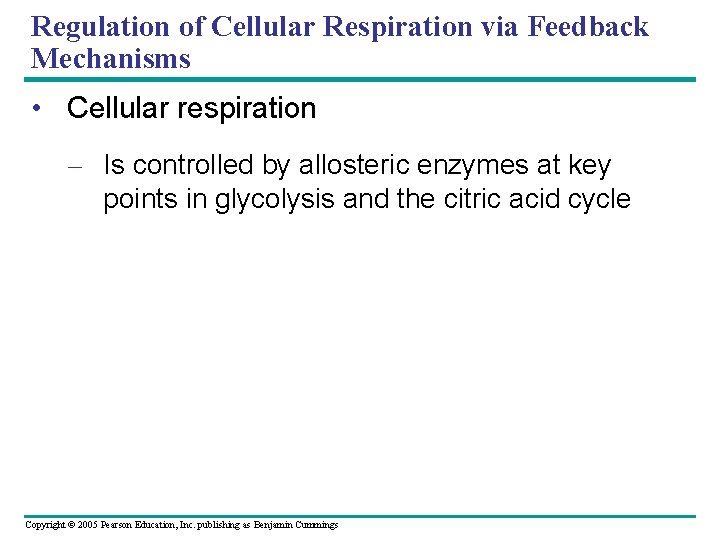
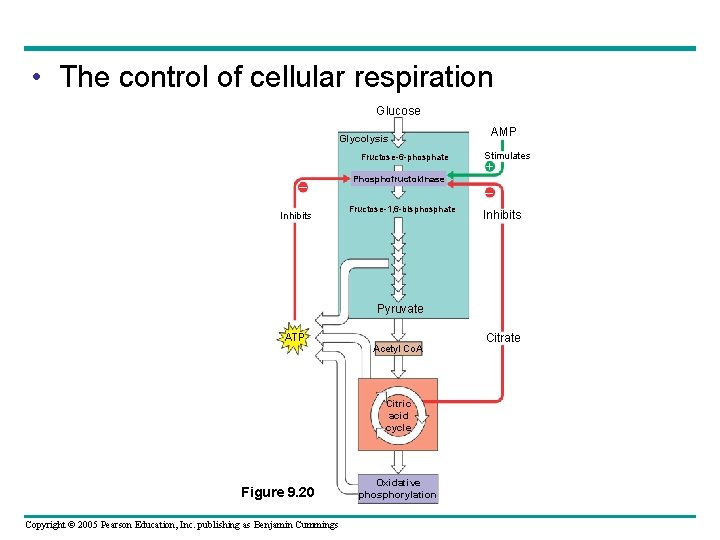
Regulation of Cellular Respiration via Feedback Mechanisms • Cellular respiration – Is controlled by allosteric enzymes at key points in glycolysis and the citric acid cycle Copyright © 2005 Pearson Education, Inc. publishing as Benjamin Cummings
• The control of cellular respiration Glucose Glycolysis Fructose-6 -phosphate – Inhibits Phosphofructokinase AMP Stimulates + – Fructose-1, 6 -bisphosphate Inhibits Pyruvate ATP Acetyl Co. A Citric acid cycle Figure 9. 20 Copyright © 2005 Pearson Education, Inc. publishing as Benjamin Cummings Oxidative phosphorylation Citrate