
Chapter 9 Cell Cycle Mitosis and Cancer 1
- Slides: 36
Chapter 9 Cell Cycle, Mitosis, and Cancer 1
9. 1 The Cell Cycle • The cell cycle is an orderly set of stages from the first division to the time the resulting daughter cells divide • Just prior to the next division: § The cell grows larger § The number of organelles doubles § The DNA is replicated • The two major stages of the cell cycle: § Interphase (includes several stages) § Mitotic Stage (includes mitosis and cytokinesis) 2
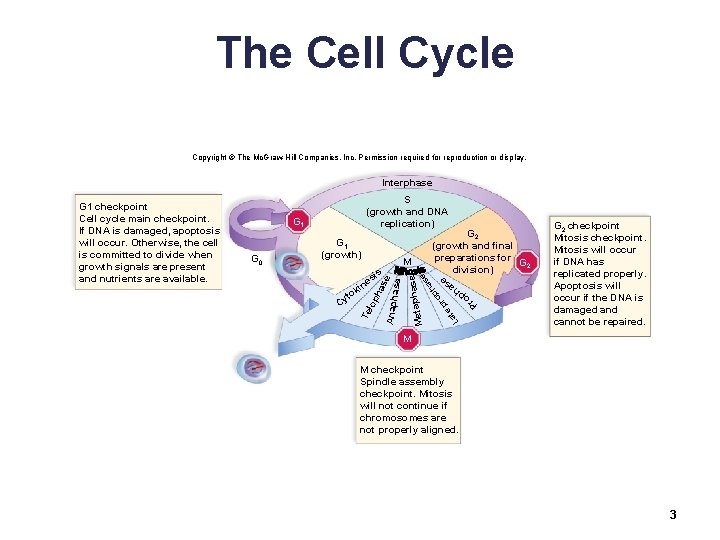
The Cell Cycle Copyright © The Mc. Graw-Hill Companies, Inc. Permission required for reproduction or display. Interphase S (growth and DNA replication) as La te h op pr ase e M Metaph ph as e Anapha se e in Tel o C ok yt s si Pr G 0 G 1 (growth) G 2 (growth and final preparations for G 2 division) e G 1 o p ha s G 1 checkpoint Cell cycle main checkpoint. If DNA is damaged, apoptosis will occur. Otherwise, the cell is committed to divide when growth signals are present and nutrients are available. G 2 checkpoint Mitosis checkpoint. Mitosis will occur if DNA has replicated properly. Apoptosis will occur if the DNA is damaged and cannot be repaired. M M checkpoint Spindle assembly checkpoint. Mitosis will not continue if chromosomes are not properly aligned. 3
The Cell Cycle • Interphase § Most of the cell cycle is spent in interphase § Cell performs its usual functions § Time spent in interphase varies by cell type § Nerve and muscle cells do not complete the cell cycle (remain in the G 0 stage) 4
The Cell Cycle • Interphase consists of: G 1, S, and G 2 phases § G 1 Phase: • • Recovery from previous division Cell doubles its organelles Cell grows in size Cell accumulates raw materials for DNA synthesis • • DNA replication Proteins associated with DNA are synthesized Chromosomes enter with 1 chromatid each Chromosomes leave with 2 identical chromatids (sister chromatids) each § S Phase: § G 2 Phase: • Between DNA replication and onset of mitosis • Cell synthesizes proteins necessary for division 5
The Cell Cycle • M (Mitotic) Stage § Includes: • Mitosis – Nuclear division – Daughter chromosomes are distributed by the mitotic spindle to two daughter nuclei • Cytokinesis – Division of the cytoplasm § Results in two genetically identical daughter cells 6
The Cell Cycle • The cell cycle is controlled by internal and external signals • A signal is a molecule that either stimulates or inhibits a metabolic event. § Internal signals • Cyclins = proteins that control cell cycle • Without cyclins, the cell cycle stops at G 1, M or G 2 (checkpoints) • Allows time for any damage to be repaired 7
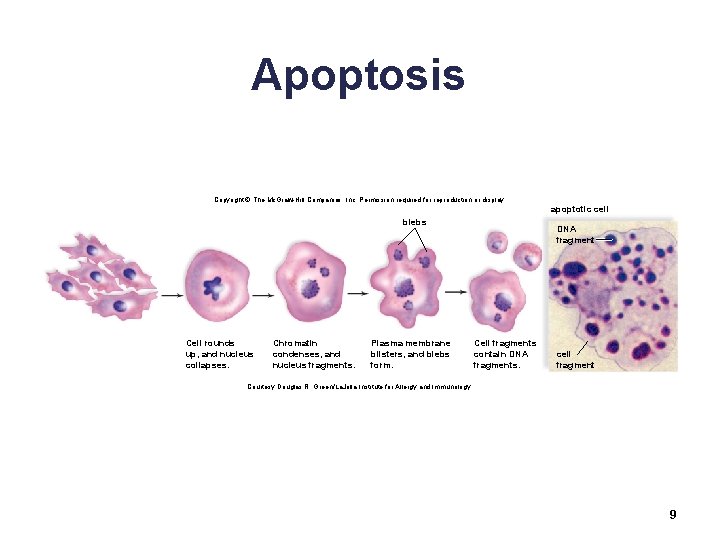
The Cell Cycle • Apoptosis is programmed cell death • It involves a sequence of cellular events: § fragmenting of the nucleus, § blistering of the plasma membrane § engulfing of cell fragments. • Apoptosis is caused by enzymes called caspases. • Mitosis and apoptosis are opposing forces § Mitosis increases cell number § Apoptosis decreases cell number 8
Apoptosis Copyright © The Mc. Graw-Hill Companies, Inc. Permission required for reproduction or display. apoptotic cell blebs Cell rounds up, and nucleus collapses. Chromatin condenses, and nucleus fragments. Plasma membrane blisters, and blebs form. DNA fragment Cell fragments contain DNA fragments. cell fragment Courtesy Douglas R. Green/La. Jolla Institute for Allergy and Immunology 9
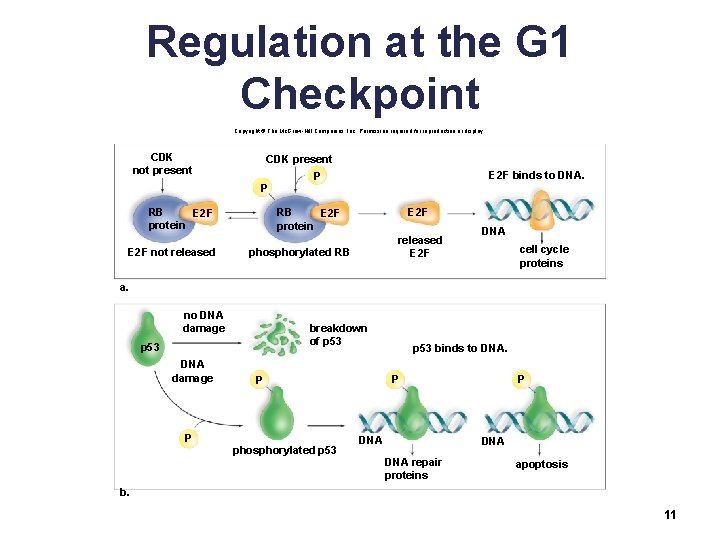
The Cell Cycle • Apoptosis § Cells harbor caspases that are kept in check by inhibitors • Can be unleashed by internal or external signals § Signal protein p 53 • Stops the cell cycle at G 1 when DNA is damaged • Initiates an attempt at DNA repair – If successful, the cycle continues to mitosis – If not, apoptosis is initiated 10
Regulation at the G 1 Checkpoint Copyright © The Mc. Graw-Hill Companies, Inc. Permission required for reproduction or display. CDK not present CDK present P RB E 2 F protein E 2 F not released E 2 F binds to DNA. P E 2 F RB E 2 F protein released E 2 F phosphorylated RB DNA cell cycle proteins a. no DNA damage breakdown of p 53 DNA damage P P phosphorylated p 53 binds to DNA DNA repair proteins apoptosis b. 11
9. 2 Mitosis and Cytokinesis • DNA is in very long threads § § Chromosomes Stretched out and intertwined between divisions DNA is associated with histones (proteins) DNA and histone proteins are collectively called chromatin • Before mitosis begins: § Chromatin condenses (coils) into distinctly visible chromosomes § Each species has a characteristic chromosome number 12
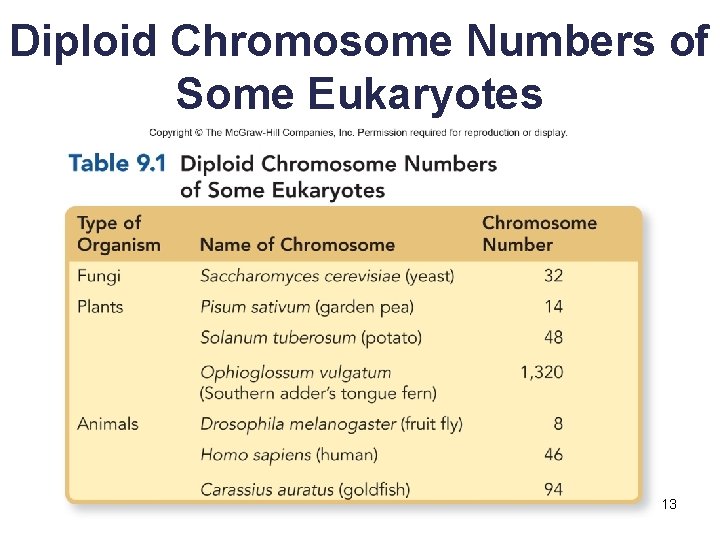
Diploid Chromosome Numbers of Some Eukaryotes 13
Mitosis and Cytokinesis • The diploid (2 n) number includes two sets of chromosomes of each type § Humans have 23 different types of chromosomes • Each type is represented twice in each body cell (diploid) • Only sperm and eggs have one of each type ·termed haploid (n) § The haploid (n) number for humans is 23 • Two representatives of each chromosome type • Makes a total of 2 n = 46 in each nucleus – One set of 23 from individual’s father (paternal) – Other set of 23 from individual’s mother (maternal) 14
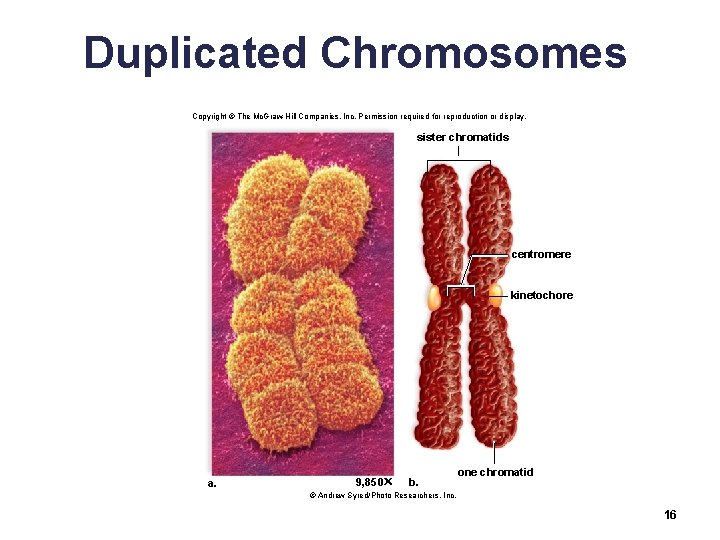
Mitosis and Cytokinesis • At the end of S phase: § Each chromosome internally duplicated § Consists of two identical DNA chains • Sister chromatids (two strands of genetically identical chromosomes) • Attached together at a single point (called centromere) • During mitosis: § Centromeres holding sister chromatids together separate § Sister chromatids separate § Each becomes a daughter chromosome § Sisters of each type are distributed to opposite daughter nuclei 15
Duplicated Chromosomes Copyright © The Mc. Graw-Hill Companies, Inc. Permission required for reproduction or display. sister chromatids centromere kinetochore a. 9, 850 b. one chromatid © Andrew Syred/Photo Researchers, Inc. 16
Mitosis and Cytokinesis • Just outside the nucleus is the centrosome § This is the microtubule organizing center in animal cells § Organizes the mitotic spindle • Contains many fibers • Each fiber is composed of a bundle of microtubules § In animals, the centrosome contains two barrelshaped centrioles • Oriented at right angles to each other within the centrosome • Each has 9 triplets of microtubules arranged in a cylinder • Centrosome was also replicated in S-phase, so there are two centrosomes before mitosis begins 17
Mitosis and Cytokinesis • Phases of Mitosis: § Prophase • Chromatin has condensed – Chromosomes are distinguishable with microscope – Each chromosome has two sister chromatids attached at the centromere • • • Nucleolus disappears Nuclear envelope disintegrates Spindle begins to assemble The two centrosomes move away from each other Microtubules form star-like arrays termed asters 18
Mitosis and Cytokinesis • Phases of Mitosis § Prometaphase • The centromere of each chromosome develops two kinetochores – Specialized protein complex – One attached to each sister chromatid » Physically connect sister chromatids with specialized microtubules (kinetochores) » These connect sister chromatids to opposite poles of the mother cell 19
Mitosis and Cytokinesis • Stages of Mitosis § Metaphase • Chromosomes are pulled around by kinetochore fibers • Forced to align across the equatorial plane of the cell – Metaphase plate - Represents plane through which mother cell will be divided § Anaphase • Centromere dissolves, releasing sister chromatids • Sister chromatids separate – Now called daughter chromosomes – Pulled to opposite poles along kinetochore fibers 20
Mitosis and Cytokinesis • Stages of Mitosis § Telophase • Spindle disappears • Now two clusters of daughter chromosomes – Still two of each type with all types represented – Clusters are incipient daughter nuclei • Nuclear envelopes form around the two incipient daughter nuclei – Each daughter nucleus receives one chromosome of each type 21
Mitosis and Cytokinesis • Cytokinesis = division of cytoplasm • Allocates the mother cell’s cytoplasm equally to daughter nucleus • Encloses each daughter cell in its own plasma membrane • Often begins in anaphase • Animal cytokinesis: § § A cleavage furrow appears between daughter nuclei Formed by a contractile ring of actin filaments Like pulling on a drawstring Eventually pinches the mother cell in two 22
Mitosis and Cytokinesis • Cytokinesis in plant cells begins with the formation of a cell plate § Rigid cell walls outside plasma membrane do not permit furrowing § The membranes of the cell plate become the plasma membrane between the daughter cells § The space between the daughter cells becomes filled with the middle lamella § Daughter cells later secrete primary cell walls on opposite sides of the middle lamella 23
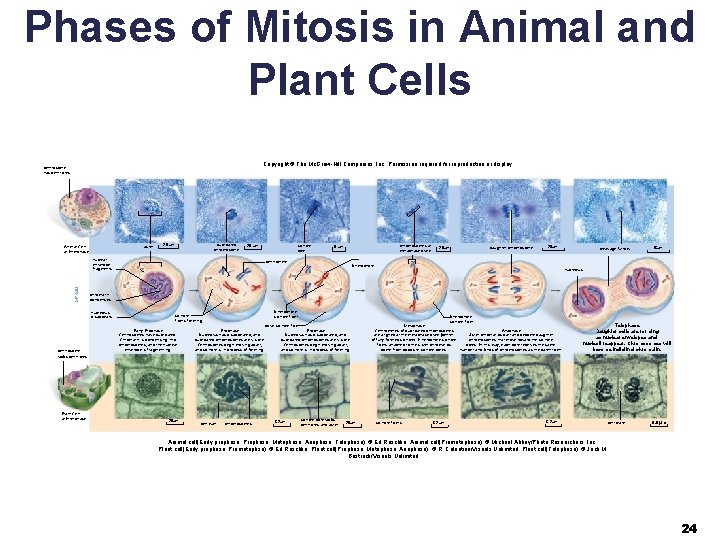
Phases of Mitosis in Animal and Plant Cells Copyright © The Mc. Graw-Hill Companies, Inc. Permission required for reproduction or display. centrosome has centrioles Animal Cell at Interphase aster duplicated chromosome 20 µm spindle pole MITOSIS nuclear envelope fragments centromere 20µm daughter chromosome 20µm cleavage furrow 16µm kinetochore nucleolus chromatin condenses nucleolus disappears centrosome chromosomes at metaphase plate 9 µm kinetochore spindle fibers forming Early Prophase Centrosomes have duplicated. Chromatin is condensing into chromosomes, and the nuclear envelope is fragmenting. polar spindle fiber Prophase Nucleolus has disappeared, and duplicated chromosomes are visible. Centrosomes begin moving apart, and spindle is in process of forming. kinetochore spindle fiber Metaphase Anaphase Centromeres of duplicated chromosomes Sister chromatids part and become daughter are aligned at the metaphase plate (center chromosomes that move toward the spindle of fully formed spindle). Kinetochore spindle poles. In this way, each pole receives the same fibers attached to the sister chromatids number and kinds of chromosomes as the parent cell. come from opposite spindle poles. Telophase Daughter cells are forming as nuclear envelopes and nucleoli reappear. Chromosomes will become indistinct chromatin. lacks centrioles Plant Cell at Interphase 25µm cell wall chromosomes 6. 2µm spindle pole lacks centrioles and aster 20µm spindle fibers 6. 2µm cell plate 6. 6µm Animal cell(Early prophase, Prophase, Metaphase, Anaphase, Telophase): © Ed Reschke; Animal cell(Prometaphase): © Michael Abbey/Photo Researchers, Inc. ; Plant cell(Early prophase, Prometaphse): © Ed Reschke; Plant cell(Prophase, Metaphase, Anaphase): © R. Calentine/Visuals Unlimited; Plant cell(Telophase): © Jack M. Bostrack/Visuals Unlimited; 24
Phases of Mitosis in Animal and Plant Cells • Functions of mitosis: § § Permits growth and repair. In flowering plants, meristematic tissue retains the ability to divide throughout the life of the plant In mammals, mitosis is necessary when: § • • • A fertilized egg becomes an embryo An embryo becomes a fetus A cut heals or a broken bone mends 25
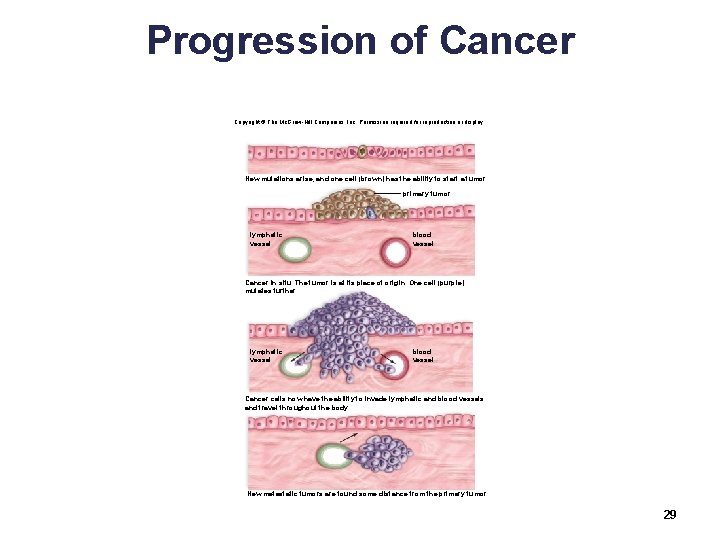
9. 3 The Cell Cycle and Cancer • Abnormal growth of cells is called a tumor § Benign tumors are not cancerous • Encapsulated • Do not invade neighboring tissue or spread § Malignant tumors are cancerous • • Not encapsulated Readily invade neighboring tissues May also detach and lodge in distant places (metastasis) Results from mutation of genes regulating the cell cycle • Development of cancer § Tends to be gradual § May take years before a cell is obviously cancerous 26
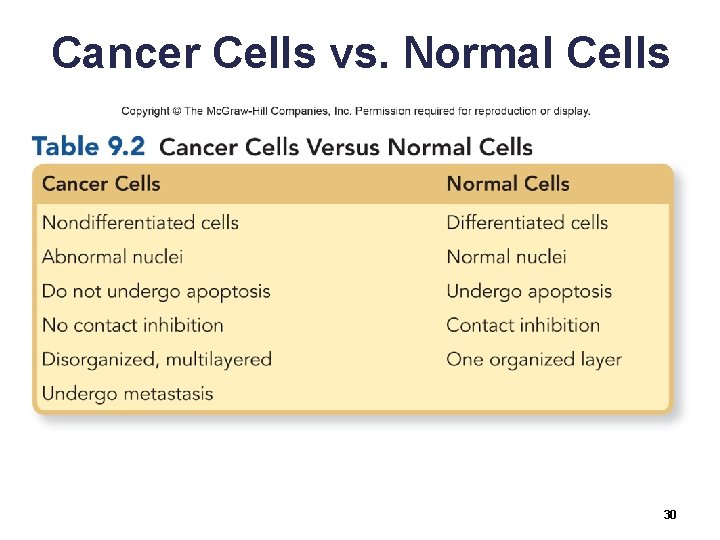
The Cell Cycle and Cancer • Characteristics of Cancer Cells § Lack differentiation • Are non-specialized • Are immortal (can enter cell cycle repeatedly) § Have abnormal nuclei • May be enlarged • May have abnormal number of chromosomes • Often have extra copies of genes § Do not undergo apoptosis • Normally, cells with damaged DNA undergo apoptosis • The immune system can also recognize abnormal cells and trigger apoptosis • Cancer cells are abnormal but fail to undergo apoptosis 27
The Cell Cycle and Cancer • Characteristics of Cancer Cells § Form tumors • Mitosis is normally controlled by contact with neighboring cells – contact inhibition • Cancer cells have lost contact inhibition § Undergo metastasis • Original tumor easily fragments • New tumors appear in other organs § Undergo angiogenesis • Formation of new blood vessels – Brings nutrients and oxygen to the tumor 28
Progression of Cancer Copyright © The Mc. Graw-Hill Companies, Inc. Permission required for reproduction or display. New mutations arise, and one cell (brown) has the ability to start a tumor. primary tumor lymphatic vessel blood vessel Cancer in situ. The tumor is at its place of origin. One cell (purple) mutates further. lymphatic vessel blood vessel Cancer cells now have the ability to invade lymphatic and blood vessels and travel throughout the body. New metastatic tumors are found some distance from the primary tumor. 29
Cancer Cells vs. Normal Cells 30
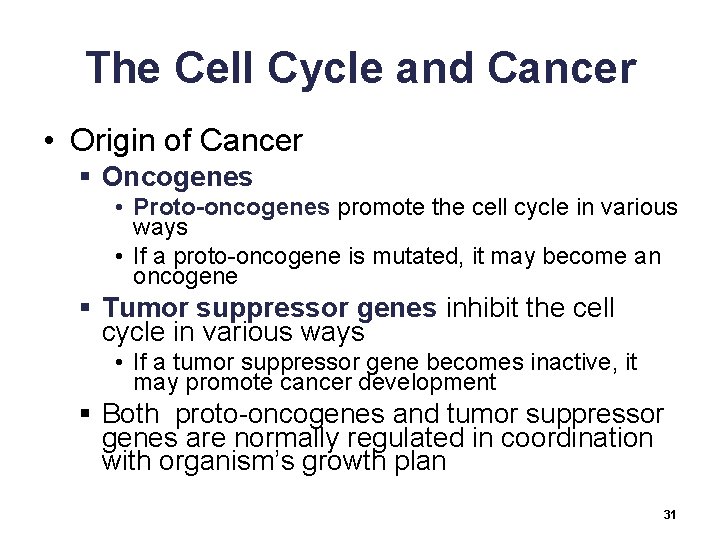
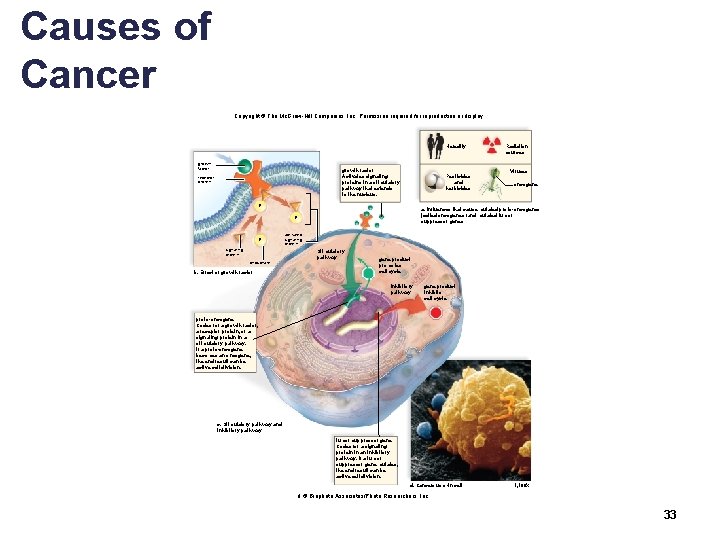
The Cell Cycle and Cancer • Origin of Cancer § Oncogenes • Proto-oncogenes promote the cell cycle in various ways • If a proto-oncogene is mutated, it may become an oncogene § Tumor suppressor genes inhibit the cell cycle in various ways • If a tumor suppressor gene becomes inactive, it may promote cancer development § Both proto-oncogenes and tumor suppressor genes are normally regulated in coordination with organism’s growth plan 31
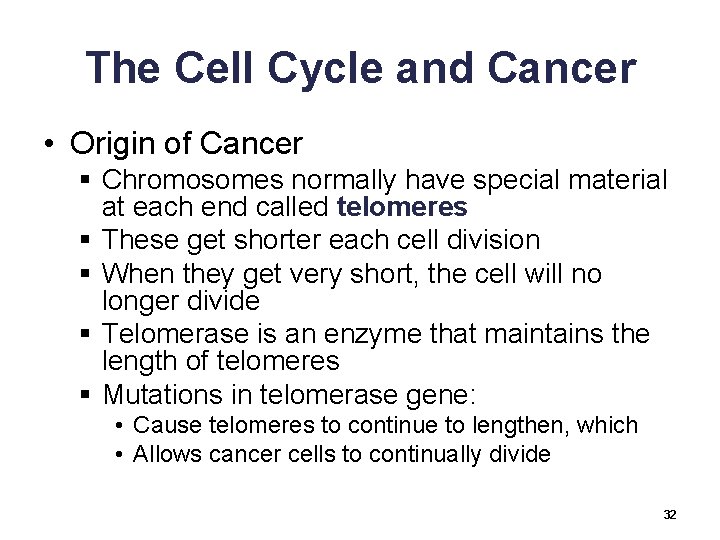
The Cell Cycle and Cancer • Origin of Cancer § Chromosomes normally have special material at each end called telomeres § These get shorter each cell division § When they get very short, the cell will no longer divide § Telomerase is an enzyme that maintains the length of telomeres § Mutations in telomerase gene: • Cause telomeres to continue to lengthen, which • Allows cancer cells to continually divide 32
Causes of Cancer Copyright © The Mc. Graw-Hill Companies, Inc. Permission required for reproduction or display. Heredity growth factor Activates signaling proteins in a stimulatory pathway that extends to the nucleus. receptor protein Pesticides and herbicides P signaling protein phosphate b. Effect of growth factor Viruses oncogene a. Influences that cause mutated proto-oncogenes (called oncogenes) and mutated tumor suppressor genes P P Radiation sources activated signaling protein Stimulatory pathway gene product promotes cell cycle Inhibitory pathway gene product inhibits cell cycle proto-oncogene Codes for a growth factor, a receptor protein, or a signaling protein in a stimulatory pathway. If a proto-oncogene becomes an oncogene, the end result can be active cell division. c. Stimulatory pathway and inhibitory pathway tumor suppressor gene Codes for a signaling protein in an inhibitory pathway. If a tumor suppressor gene mutates, the end result can be active cell division. d. Cancerous skin cell 1, 100 X d: © Biophoto Associates/Photo Researchers, Inc. 33
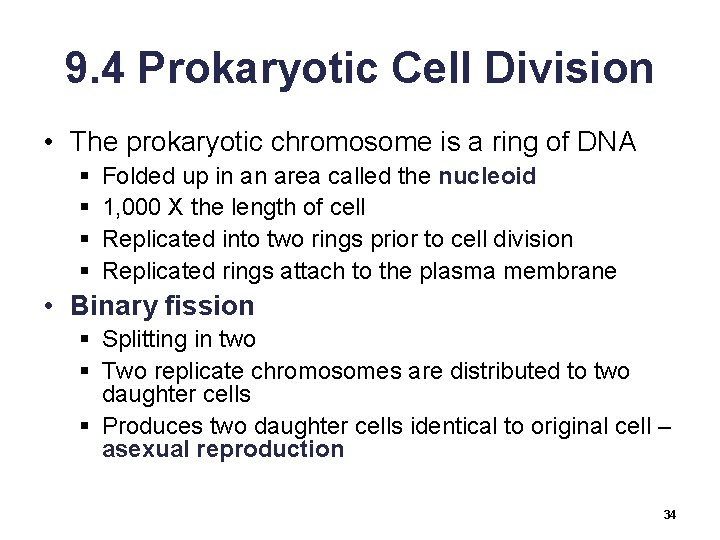
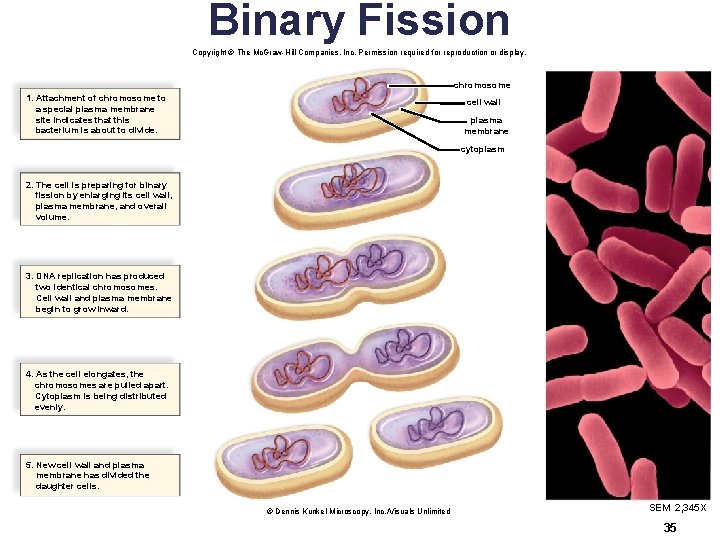
9. 4 Prokaryotic Cell Division • The prokaryotic chromosome is a ring of DNA § § Folded up in an area called the nucleoid 1, 000 X the length of cell Replicated into two rings prior to cell division Replicated rings attach to the plasma membrane • Binary fission § Splitting in two § Two replicate chromosomes are distributed to two daughter cells § Produces two daughter cells identical to original cell – asexual reproduction 34
Binary Fission Copyright © The Mc. Graw-Hill Companies, Inc. Permission required for reproduction or display. chromosome 1. Attachment of chromosome to a special plasma membrane site indicates that this bacterium is about to divide. cell wall plasma membrane cytoplasm 2. The cell is preparing for binary fission by enlarging its cell wall, plasma membrane, and overall volume. 3. DNA replication has produced two identical chromosomes. Cell wall and plasma membrane begin to grow inward. 4. As the cell elongates, the chromosomes are pulled apart. Cytoplasm is being distributed evenly. 5. New cell wall and plasma membrane has divided the daughter cells. © Dennis Kunkel Microscopy, Inc. /Visuals Unlimited SEM 2, 345 X 35
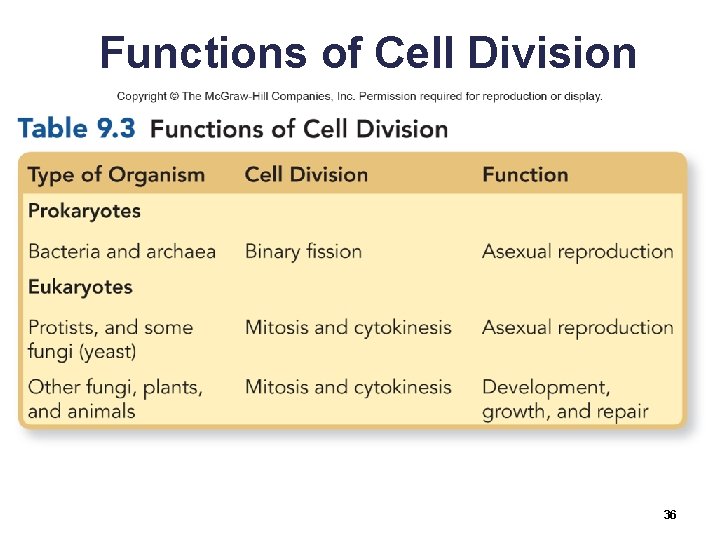
Functions of Cell Division 36