
Chapter 9 Causality Aim in Epidemiology At the

- Slides: 31
Chapter 9 Causality
Aim in Epidemiology �At the heart of epidemiology is the notion of causality �The idea is that when a causal association is established, a protection and control attitude can occur rather than a mere reaction to the public health crises
Cause �A cause is a specific event, condition, or characteristic that precedes the health outcome and is necessary for its occurrence �If an environmental exposure is required for the outcome to occur, the causative factor is “necessary” �If the health-related state or event always occurs because of the exposure, the causative factor is “sufficient”
Related Terms �Risk factor �At-risk behavior – Stop it �Predisposing factor
Epidemiology Triangle �The epidemiology triangle is a traditional model that characterizes infectious disease causation by showing the interaction and interdependence of agent, host, environment, and time
Epidemiology Triangle �The agent is a causative factor, such as a pathogen or chemical �The host is an organism and usually a human �Host factors are intrinsic factors that influence a person’s exposure, susceptibility, or response to a causative agent, such as age or race �Environmental factors are extrinsic factors that affect the agent and the opportunity for exposure �Climate and geology, biological factors, psychosocial factors
Epidemiology Triangle �The agent, host, and environment interact in complex ways to produce adverse health-related states or events in humans �Each component has time-related issues �The interrelatedness of the four epidemiological factors influences birth defects and other adverse reproductive health outcomes
Rothman’s Causal Pies (1976) �Rothman’s causal pies explains the multifactorial nature of causation for many noninfectious diseases �The factors that cause the adverse health outcome are pieces of a pie, with the entire pie making up the sufficient cause for a health problem or one causal mechanism �Component causes – contributing factors to the cause of a health-related state or event �Component causes include agent, host factors, and environmental factors
What Is Causal Inference? �A conclusion about the presence of a healthrelated state or event and reasons for its existence �Causal inferences provide a scientific basis for medical and public health action �Made with methods comprising lists of criteria or conditions applied to the results of scientific studies
What Is Statistical Inference? �Draws a conclusion about a population based on information from sampled data �Probability is used to indicate the level of reliability in the conclusion �The possibility that chance, bias, or confounding explain a statistical association should always be considered
Types of Causal Associations �Direct causal association �No intermediate factor and is more obvious �Eliminating the exposure will eliminate the adverse health outcome �Example? �Indirect causal association �Involves one or more intervening factors �Often much more complicated �Example?
Direct Causal Association �Example 1 – A trauma to the skin results in a bruise or infection �Example 2 – Salmonella results in enteritis (inflammation of the small intestine)
Indirect Causal Association �Example 1 – Poor diet and stress may cause high blood pressure, which in turn causes heart disease �Example 2 – Early pregnancy may cause molecular changes that stabilize p 53 (a tumor suppressor gene). With p 53 stabilized, it remains functionally active longer to repair cumulative DNA damage and to prevent cellular proliferation induced by carcinogens.
Factors of Causation �Predisposing factors �Enabling factors �Precipitating factors �Reinforcing factors
Predisposing Factors �Factors or conditions already present that produce a susceptibility or disposition in a host to a disease or condition without actually causing it �Example 1 – Age �Example 2 – Immune status �Example 3 – Li-Fraumeni syndrome predisposes the person to a greater susceptibility of sarcomas, brain cancer, breast cancer, and leukemia �Other examples – Peoples’ knowledge, attitudes, beliefs, preferences, skills, and self-efficacy beliefs
Reinforcing Factors �The factors that help aggravate and perpetuate behaviors, disease, conditions, disability, or death �Positive reinforcing factors �Social support, health education and economic assistance �Negative reinforcing factors �Negative peer influence or poor economic conditions
Enabling Factors �Antecedents to behaviors, disease, conditions, disability, or death that allow it to be realized �Services, living conditions, programs, societal supports, skills, and resources that facilitate a health outcome’s occurrence �Can also be a result of a lack of services or medical programs
Precipitating Factors �Factors essential to the development of diseases, conditions, injuries, disabilities, and death �An infectious agent �Lack of seat belt use in cars �Drinking and driving �Lack of helmet use on motorcycles
Three methods of hypothesis formulation in disease etiology (John Stuart Mill, 1856) �Method of difference �Method of agreement �Method of concomitant variation
Method of Difference �The frequency of disease occurrence is extremely different under different situations or conditions �If a risk factor can be identified in one condition and not in a second, it may be that factor, or the absence of it, that causes the disease
Method of Agreement �If risk factors are common to a variety of different circumstances and the risk factors have been positively associated with a disease, then the probability of that factor being the cause is extremely high
Method of Concomitant Variation �The frequency or strength of a risk factor varies with the frequency of the disease or condition �Increased numbers of children not immunized against measles causes the incidence rate for measles to go up
Statistical association does not mean causal association �For example, ice cream consumption and murder are strongly correlated �Does eating ice cream make people want to kill or does killing result in a desire for ice cream? �The explanation may be that hot temperatures are related to both ice cream consumption and murder, and that it is the heat, not the ice cream, causally associated with murder
Causal Criteria �Strength of association �Consistency of association �Temporality �Biological plausibility �Experimental evidence
The role of chance The “luck of the draw” �Most epidemiologic studies rely on sampled data �Characteristics of subjects in a sample may vary from sample to sample. As a result, an association between an exposure and outcome, or lack thereof, may be the result of chance. �Sample size is directly related to chance �To minimize chance, increase the sample size
Confidence Intervals �A range of reasonable values in which a population parameter lies, based on a random sample from the population �As sample size increases, the role of chance decreases, as reflected by the confidence interval �Can also be used to evaluate statistical significance
The Role of Bias �The deviation of the results from the truth can explain an observed association between exposure and outcome variables �Minimized by properly designing and conducting the research study
The Role of Confounding �Occurs when the relationship between an exposure and a disease outcome is influenced by a third factor, which is related to the exposure and, independent of this relationship, is also related to the health outcome �Only the randomized experimental study allows us to balance out confounding among groups
The Role of Confounding (cont’d) �Should always be considered as a possible explanation for an observed association, particularly descriptive epidemiologic studies and non-randomized analytic epidemiologic studies �May over- or underestimate a true association �Possible to control for at the design and analysis levels of a study
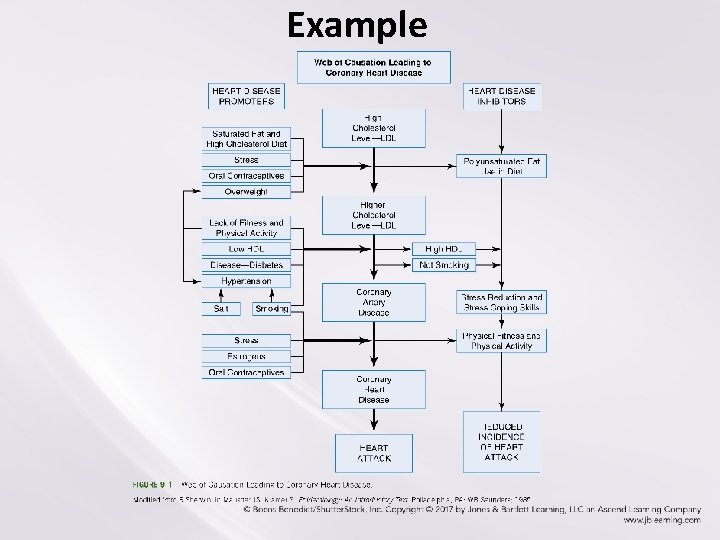
Web of Causation �Webs are graphic, pictorial, or paradigm representations of complex sets of events or conditions caused by an array of activities connected to a common core or common experience or event
Example