
Chapter 9 Camshafts Lifters Timing Belts and Chains
Chapter 9 Camshafts, Lifters, Timing Belts, and Chains
Objectives • Analyze theories of camshaft and related parts • Describe operation of hydraulic lifters and lash adjusters 2
Objectives • Install single and dual overhead camshafts with correct valve timing • Verify valve timing and be able to correctly position a camshaft in relation to TDC 3
Camshaft • Located in block or on cylinder head • Cam in block design is typically called a pushrod engine • Made from hardened cast iron or steel • Cam has one lobe for each valve • Some engines have multiple cams 4
Controlling Camshaft End Thrust • On some engines – Resistance from driving the oil pump causes cam to be forced backwards • Rearward movement of cam is called end thrust – Could affect ignition timing in a distributor type engine 5
Controlling Camshaft End Thrust • Thrust plates and machined areas on the back of the timing chain gear – Used to control end thrust 6
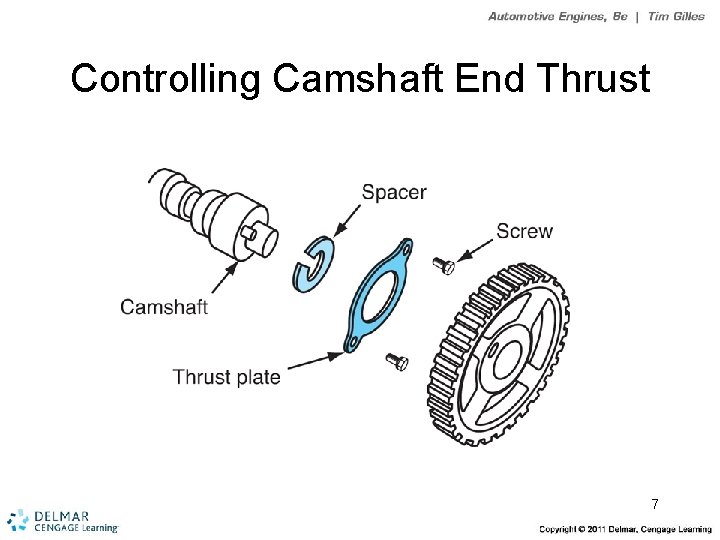
Controlling Camshaft End Thrust 7
Valve Lash (OHC) • OHC engines – Valve clearance adjusted hydraulically while others have provisions for adjustment 8
Valve Lash (OHC) • Some OHC engines have cam lobes that act directly on the valves • On these type engines, lash is adjusted by adding or removing shims 9
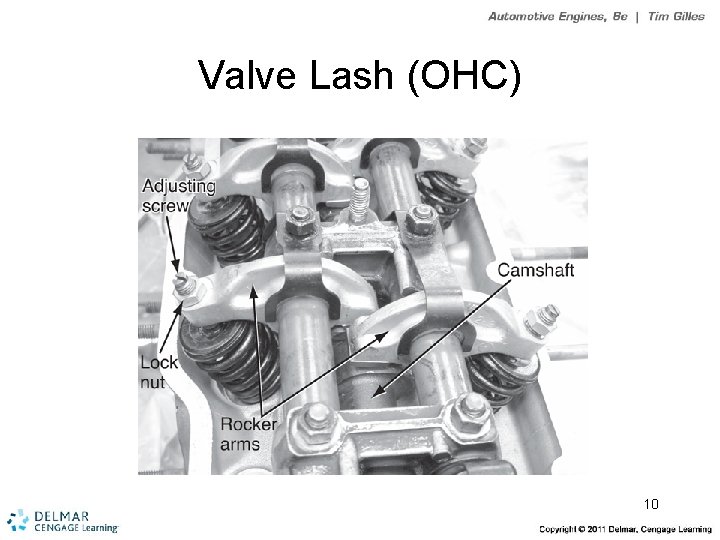
Valve Lash (OHC) 10
Valve Lifters • Mechanical or hydraulic – Mechanical are also referred to as solid lifters or tappets • Two types – Flat tappet – Roller 11
Hydraulic Lifter Operation • When clearance occurs in valvetrain – Spring between plunger and lifter body causes lifter to expand – Oil fills cavity created under plunger – Excessive oil in lifter leaks down between plunger and lifter body 12

Hydraulic Lifter Failure • Causes of hydraulic lifter failure – Dirt lodged in check valve – Too much wear between plunger and lifter body causing excessive leak down – Insufficient oil pressure – Varnish between plunger and body 13
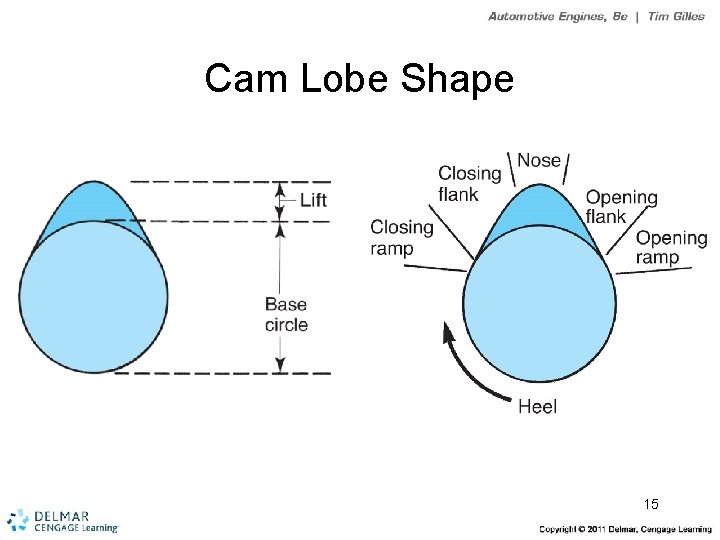
Cam Lobe Shape • • Base circle Opening and closing ramp Lift Duration 14
Cam Lobe Shape 15
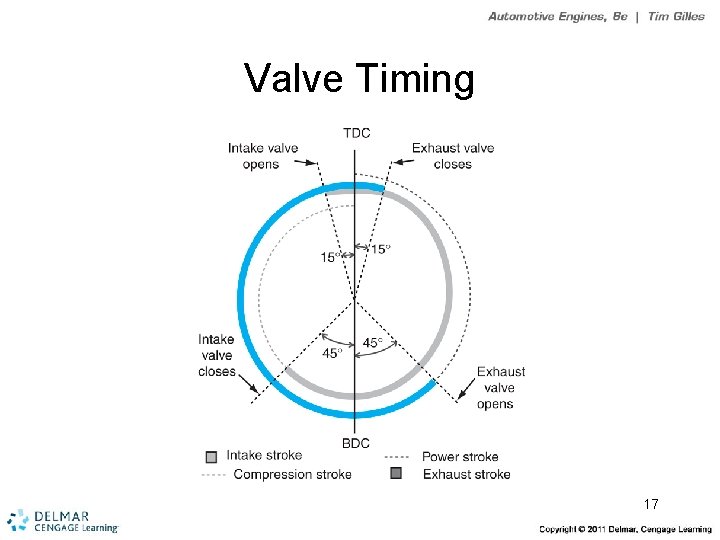
Valve Timing • Intake valve opens before TDC – Allows cylinder to fill with air-fuel mixture • Intake valve remains open after BDC • Exhaust valve opens considerably before end of power stroke • Exhaust valve remains open past TDC, partly into intake stroke 16
Valve Timing 17
Roller Cam and Lifters • Accept higher rate of movement without wear to lifter or cam lobe • Valvetrain friction cut in half • Increase in power and fuel economy • Roller lifters use brackets to keep them from spinning 18
Roller Cam and Lifters 19
Freewheeling and Interference Engines • Interference engines experience piston-tovalve contact if timing belt or chain breaks • Damage may occur to pushrods, pistons, and valves • Freewheeling engines will not damage valvetrain in the event of a timing beltchain failure 20
Timing Chains • Two types of chains: – Roller chain – Silent chain • Roller chains have single or double rows • Timing chains have drive side and a side where slack accumulates 21
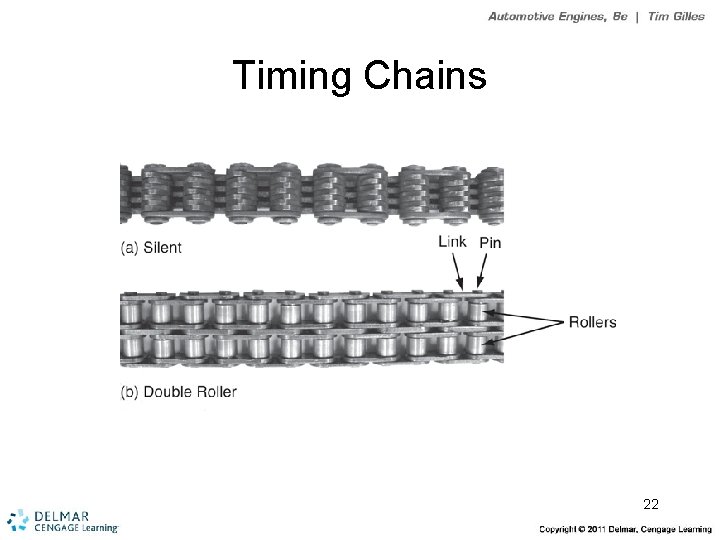
Timing Chains 22
Checking Timing Chain for Stretch • Observe dwell section of ignition waveform on a scope • While watching distributor rotor, turn vibration damper back and forth Movement should be less than 5º • Measure chain slack with timing cover removed 23
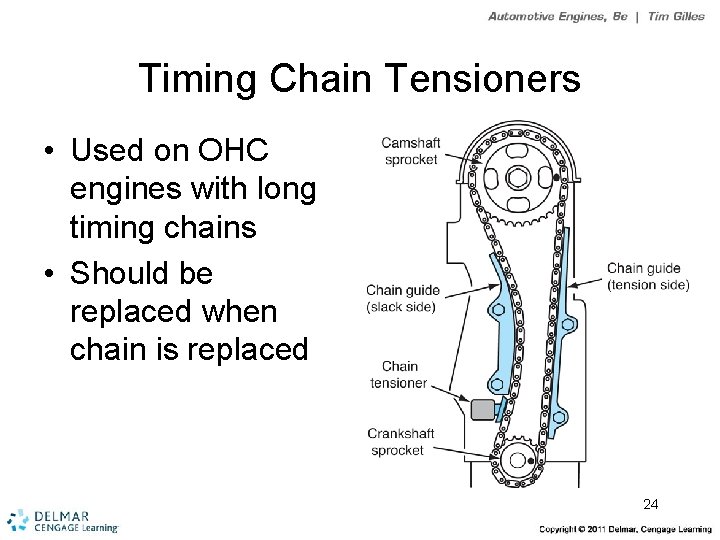
Timing Chain Tensioners • Used on OHC engines with long timing chains • Should be replaced when chain is replaced 24
Chain Drive Timing Marks • Some manufactures specify a certain number of chain links between marks • Some have colored links that must be aligned with marks on sprockets 25
Chain Drive Timing Marks • Some have a mark on cam sprocket that lines up with a mark on cylinder head • Some OHC engine have a drive chain and one or two auxiliary chains 26
Timing Belts • Drive camshaft on OHC engines • Compared to timing chains – Quieter – Require no lubrication – More efficient – Very strong and durable – Sometimes drives coolant pump and oil pump 27
Timing Belt Materials • Neoprene • High-temperature neoprene • Highly saturated nitrile 28
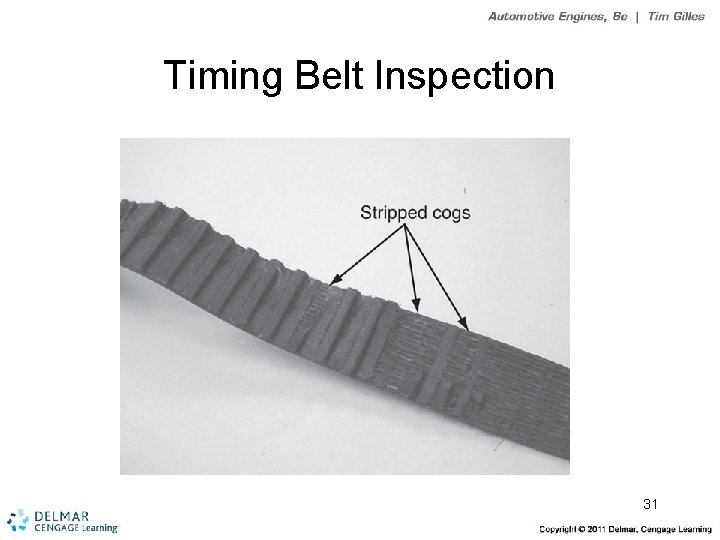
Timing Belt Inspection • Look for fraying, cracks at base of teeth or loose fibers • Rotate engine by hand to inspect entire belt 29
Timing Belt Inspection • Wear on one side of tooth indicates misalignment problem • Check for oil leaks which could damage belt 30
Timing Belt Inspection 31
Timing Belt Replacement • Replacements will be done on a preventative maintenance basis, or when they fail. • Use a non-petroleum based solvent to clean sprockets • Inspect sprockets for wear • Inspect or replace front camshaft oil seal • Cogs can strip off the belt, resulting in serious engine damage 32
Timing Belt Replacement • Adjust belt tension according to manufacturer specification • Place sticker on valve cover or door post listing mileage when belt was replaced 33
Automatic Belt Tensioners • Some are spring loaded and must be unloaded before belt can be installed • Some tensioners have a specific clearance measurement that is adjustable and measured with a feeler gauge 34
Automatic Belt Tensioners • Some require belt tension gauge to set proper timing tension 35
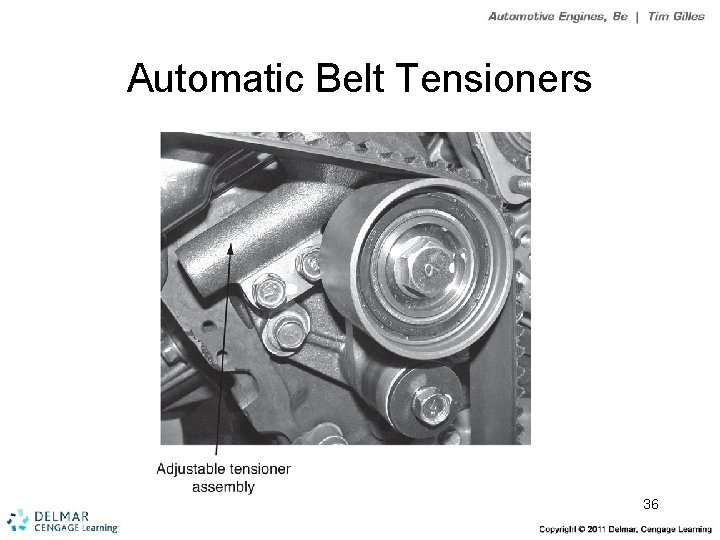
Automatic Belt Tensioners 36
- Slides: 36