
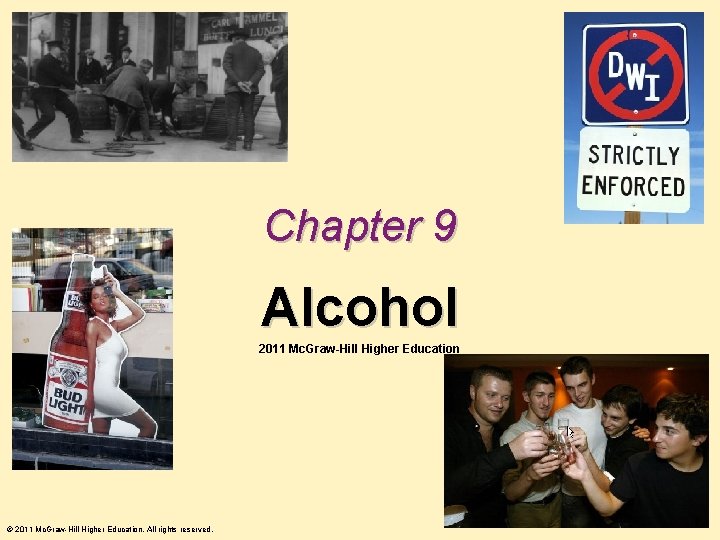
Chapter 9 Alcohol 2011 Mc GrawHill Higher Education
- Slides: 50
Chapter 9 Alcohol 2011 Mc. Graw-Hill Higher Education © 2011 Mc. Graw-Hill Higher Education. All rights reserved.
Fermentation Products § § Fermentation = the production of alcohol from sugars through the action of yeasts § Forms the basis of all alcoholic beverages Fruits + yeast = fermentation will begin § Fruits naturally contain sugar Cereal grains contain starch, which must be converted to sugar by malt before fermentation can begin Yeast has a limited tolerance for alcohol § When the concentration reaches a certain percentage (15% is possible, but standard for wine is about 12%) the yeast dies and fermentation ceases. © 2011 Mc. Graw-Hill Higher Education. All rights reserved.
Distilled Products § Distillation = evaporation and condensing of alcohol vapors to produce beverages with alcohol content higher than 15 percent § Heating a solution of alcohol & water, then collecting the § § alcohol vapor & condensing them into a liquid with a high alcohol content. Perhaps first used in Arabia around AD 800 Introduced into Europe in about the 10 th century In U. S. , began on a large scale at the end of the 18 th century Proof = alcohol content of a distilled beverage; twice the percentage of alcohol by weight § 90 -proof whiskey is 45 percent alcohol © 2011 Mc. Graw-Hill Higher Education. All rights reserved.
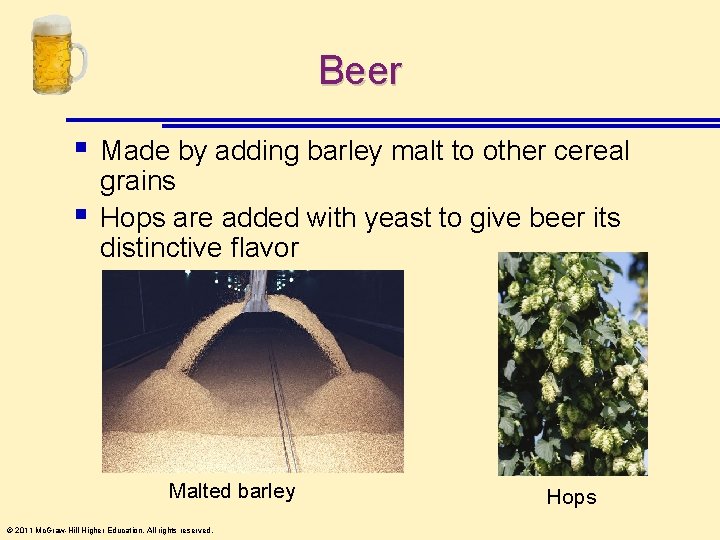
Beer § § Made by adding barley malt to other cereal grains Hops are added with yeast to give beer its distinctive flavor Malted barley © 2011 Mc. Graw-Hill Higher Education. All rights reserved. Hops
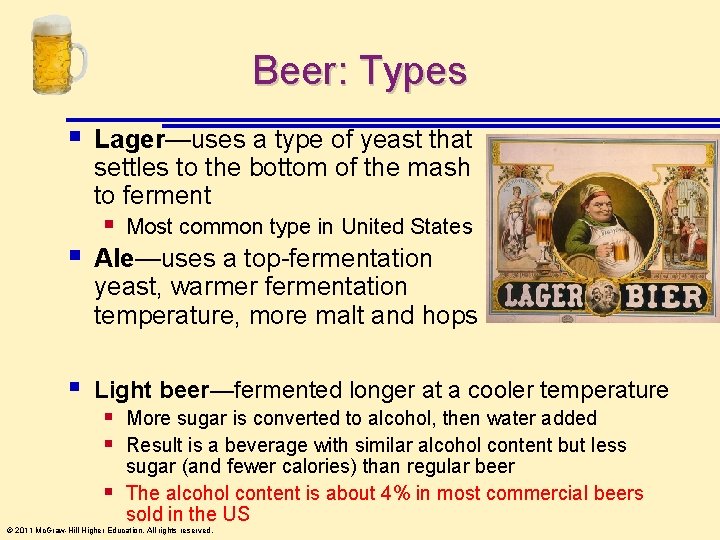
Beer: Types § Lager—uses a type of yeast that settles to the bottom of the mash to ferment § Most common type in United States § Ale—uses a top-fermentation yeast, warmer fermentation temperature, more malt and hops § Light beer—fermented longer at a cooler temperature § § § More sugar is converted to alcohol, then water added Result is a beverage with similar alcohol content but less sugar (and fewer calories) than regular beer The alcohol content is about 4% in most commercial beers sold in the US © 2011 Mc. Graw-Hill Higher Education. All rights reserved.
Alcohol-- History § § Alcoholic beverages have been consumed for thousands of years, at least as far back as 6400 BC (beer and berry wine) Grape wine has existed for over 2, 000 years Mead may date back to the Paleolithic Age, around 8000 BC Beer was consumed by Native Americans at the time of Columbus’s landing Alcohol is a CNS depressant with a long history. © 2011 Mc. Graw-Hill Higher Education. All rights reserved.
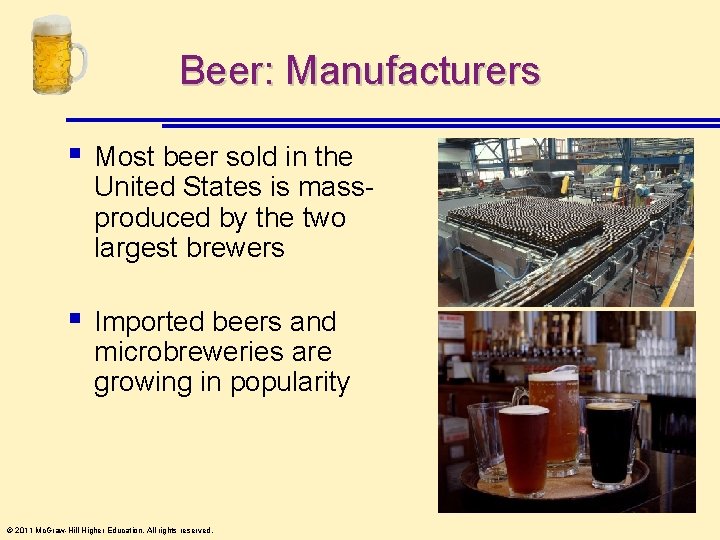
Beer: Manufacturers § Most beer sold in the United States is massproduced by the two largest brewers § Imported beers and microbreweries are growing in popularity © 2011 Mc. Graw-Hill Higher Education. All rights reserved.
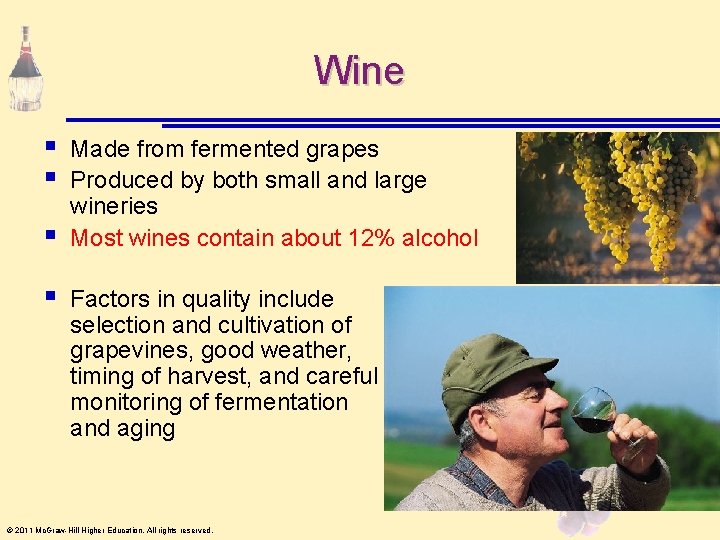
Wine § § Made from fermented grapes Produced by both small and large wineries Most wines contain about 12% alcohol Factors in quality include selection and cultivation of grapevines, good weather, timing of harvest, and careful monitoring of fermentation and aging © 2011 Mc. Graw-Hill Higher Education. All rights reserved.
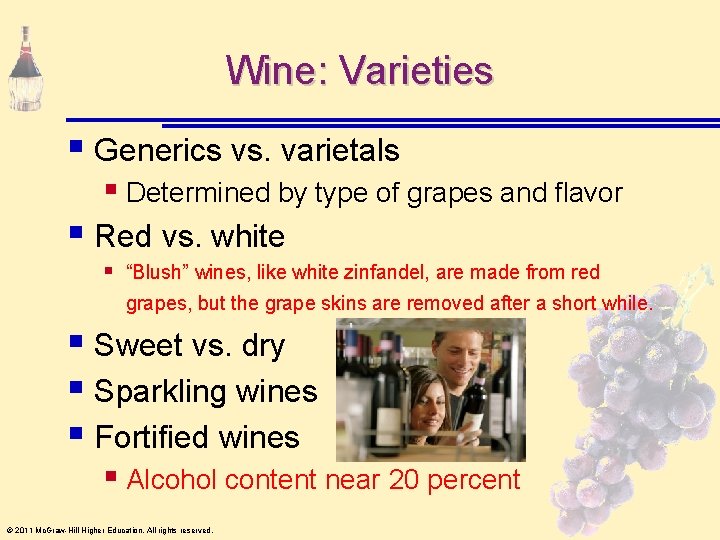
Wine: Varieties § Generics vs. varietals § Determined by type of grapes and flavor § Red vs. white § “Blush” wines, like white zinfandel, are made from red grapes, but the grape skins are removed after a short while. § Sweet vs. dry § Sparkling wines § Fortified wines § Alcohol content near 20 percent © 2011 Mc. Graw-Hill Higher Education. All rights reserved.
Distilled Spirits § Grain neutral spirits—clear, tasteless, nearly pure alcohol (190 proof) produced by distillation § May be sold as Everclear or used in research § Ethanol is used in commercial products as a § gasoline additive, cleaner, solvent Used to make various beverages § Gin: distillate filtered through juniper berries and then § diluted with water Vodka: mixture of grain neutral spirits and water – These grain neutral spirits produced by many large commericial distilleries are 95% pure alcohol. § Contains relatively few congeners © 2011 Mc. Graw-Hill Higher Education. All rights reserved.
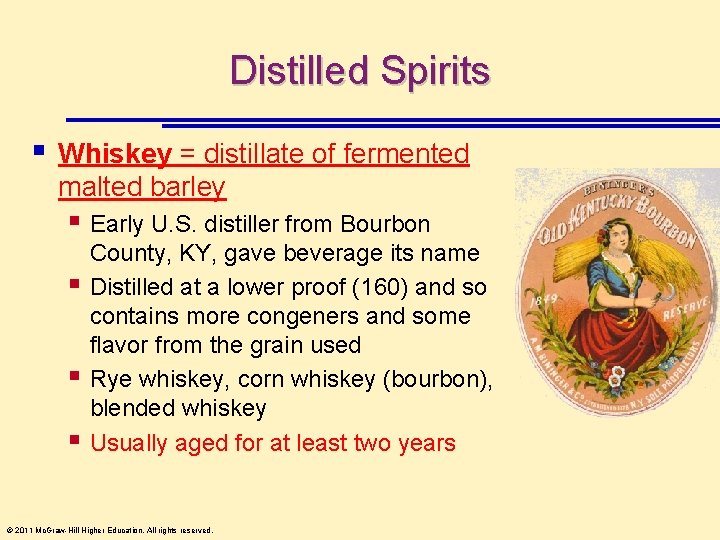
Distilled Spirits § Whiskey = distillate of fermented malted barley § Early U. S. distiller from Bourbon § § § County, KY, gave beverage its name Distilled at a lower proof (160) and so contains more congeners and some flavor from the grain used Rye whiskey, corn whiskey (bourbon), blended whiskey Usually aged for at least two years © 2011 Mc. Graw-Hill Higher Education. All rights reserved.
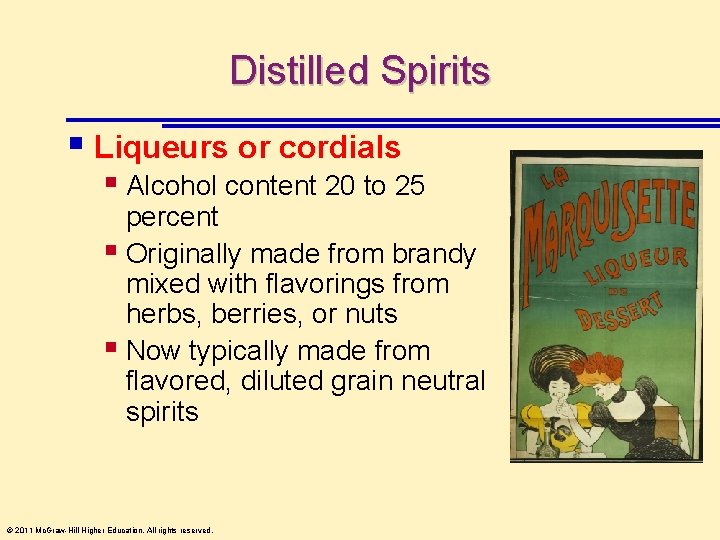
Distilled Spirits § Liqueurs or cordials § Alcohol content 20 to 25 percent § Originally made from brandy mixed with flavorings from herbs, berries, or nuts § Now typically made from flavored, diluted grain neutral spirits © 2011 Mc. Graw-Hill Higher Education. All rights reserved.
Alcohol Use: Early Views § Before American Revolution § People drank more alcohol than water § Drunkenness was viewed as misuse of positive product § After American Revolution § Alcohol itself viewed as the cause of serious problems, an active agent of evil § Alcohol was first psychoactive substance to become demonized in American culture © 2011 Mc. Graw-Hill Higher Education. All rights reserved.
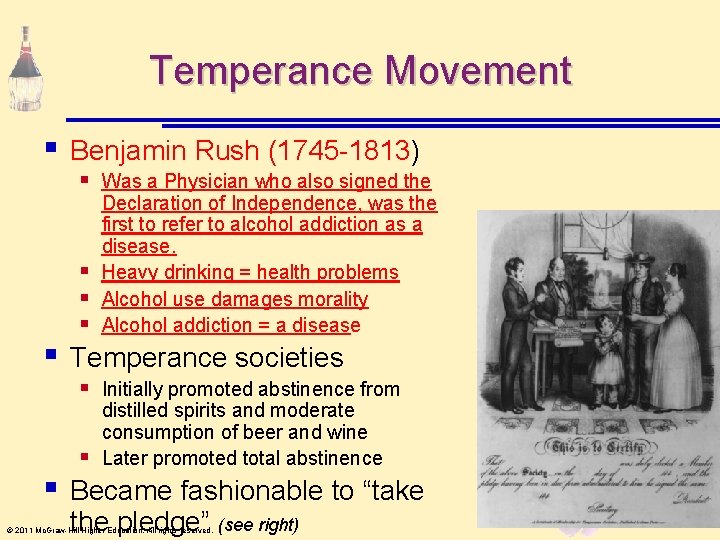
Temperance Movement § § § Benjamin Rush (1745 -1813) § § Was a Physician who also signed the Declaration of Independence, was the first to refer to alcohol addiction as a disease. Heavy drinking = health problems Alcohol use damages morality Alcohol addiction = a disease Temperance societies § § Initially promoted abstinence from distilled spirits and moderate consumption of beer and wine Later promoted total abstinence Became fashionable to “take the pledge” (see right) © 2011 Mc. Graw-Hill Higher Education. All rights reserved.
Prohibition § States began passing prohibition laws in 1851 § By 1917, 64 percent of Americans lived in “dry” territory § Laws reflected issues of class, ethnicity, religion, immigration, and politics § People still drank illegally in speakeasies and private clubs and legally through purchase of patent medicines © 2011 Mc. Graw-Hill Higher Education. All rights reserved.
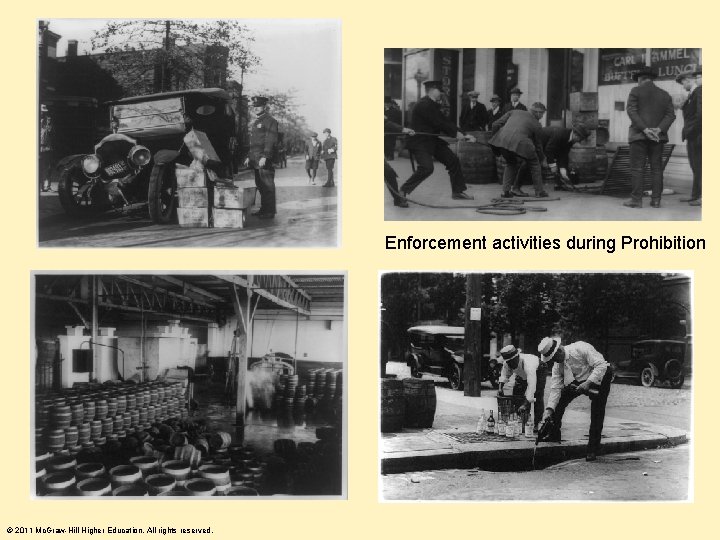
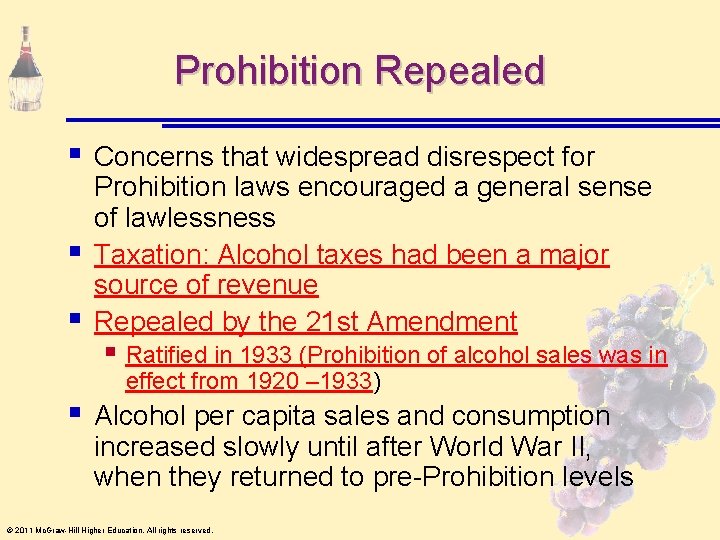
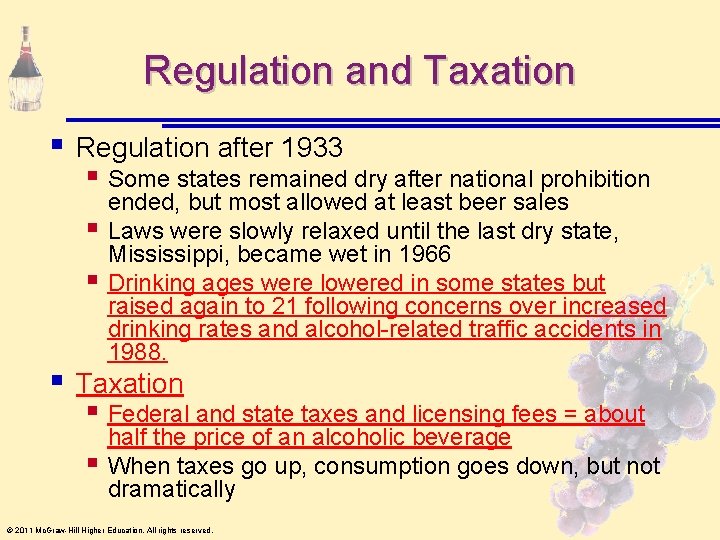
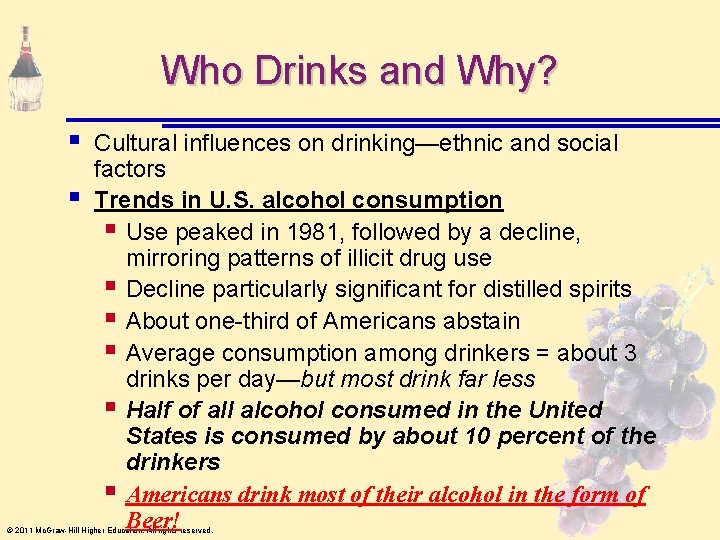
Prohibition § Federal prohibition § 18 th Amendment to the U. S. Constitution, banning § § the sale of alcohol, was ratified in January 1919 National prohibition went into effect in January 1920 People continued to buy and sell alcohol illegally, and enforcement was challenging and expensive Organized crime became more organized and profitable Alcohol dependence and alcohol-related deaths declined © 2011 Mc. Graw-Hill Higher Education. All rights reserved.
Enforcement activities during Prohibition © 2011 Mc. Graw-Hill Higher Education. All rights reserved.
Prohibition Repealed § § Concerns that widespread disrespect for Prohibition laws encouraged a general sense of lawlessness Taxation: Alcohol taxes had been a major source of revenue Repealed by the 21 st Amendment § Ratified in 1933 (Prohibition of alcohol sales was in effect from 1920 – 1933) Alcohol per capita sales and consumption increased slowly until after World War II, when they returned to pre-Prohibition levels © 2011 Mc. Graw-Hill Higher Education. All rights reserved.
Regulation and Taxation § Regulation after 1933 § Some states remained dry after national prohibition § § § ended, but most allowed at least beer sales Laws were slowly relaxed until the last dry state, Mississippi, became wet in 1966 Drinking ages were lowered in some states but raised again to 21 following concerns over increased drinking rates and alcohol-related traffic accidents in 1988. Taxation § Federal and state taxes and licensing fees = about § half the price of an alcoholic beverage When taxes go up, consumption goes down, but not dramatically © 2011 Mc. Graw-Hill Higher Education. All rights reserved.
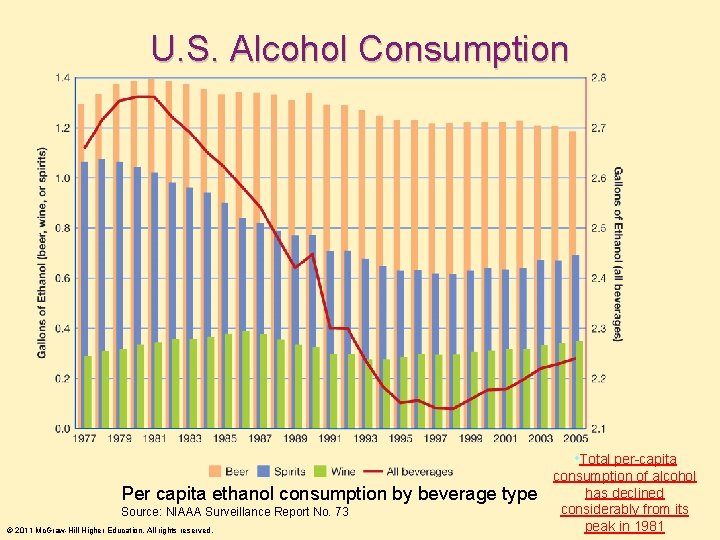
Who Drinks and Why? § § Cultural influences on drinking—ethnic and social factors Trends in U. S. alcohol consumption § Use peaked in 1981, followed by a decline, mirroring patterns of illicit drug use § Decline particularly significant for distilled spirits § About one-third of Americans abstain § Average consumption among drinkers = about 3 drinks per day—but most drink far less § Half of all alcohol consumed in the United States is consumed by about 10 percent of the drinkers § Americans drink most of their alcohol in the form of Beer! © 2011 Mc. Graw-Hill Higher Education. All rights reserved.
U. S. Alcohol Consumption • Total per-capita Per capita ethanol consumption by beverage type Source: NIAAA Surveillance Report No. 73 © 2011 Mc. Graw-Hill Higher Education. All rights reserved. consumption of alcohol has declined considerably from its peak in 1981
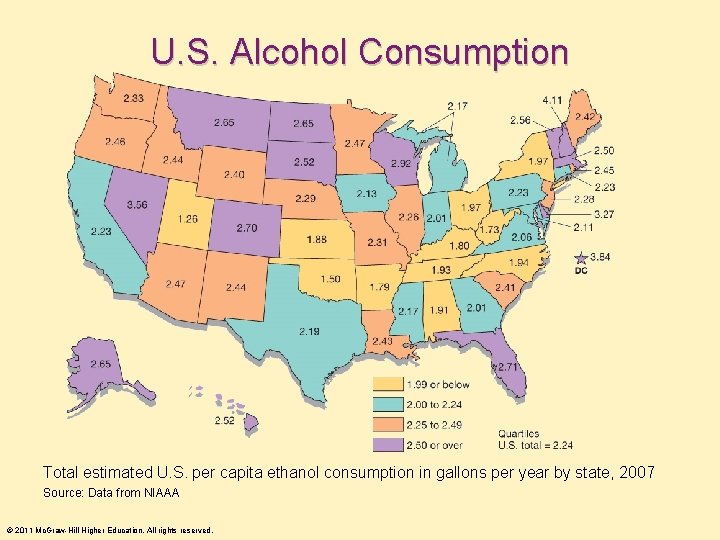
U. S. Alcohol Consumption § Regional differences in the United States § Stress index: Drinking rates higher in states where people experience a great deal of social stress and tension § Drinking norms: Drinking rates higher in states where people tend to approve of the use of alcohol to relieve stress – New Hampshire has the highest per-capita sales of alcohol © 2011 Mc. Graw-Hill Higher Education. All rights reserved.
U. S. Alcohol Consumption Total estimated U. S. per capita ethanol consumption in gallons per year by state, 2007 Source: Data from NIAAA © 2011 Mc. Graw-Hill Higher Education. All rights reserved.
U. S. Alcohol Consumption § § Gender differences: Males more likely to drink than females, and more likely to drink more Drinking among college students § College students drink more than their nonstudent peers § 62% of college students report drinking alcohol at least once within the past month. § Many campuses have banned sale and advertising of alcohol, and many fraternities have banned keg parties § Alcohol use and drinking behavior hasn’t changed significantly in response § Today’s college students are less likely to drink and drive compared to students in the early 1980 s © 2011 Mc. Graw-Hill Higher Education. All rights reserved.
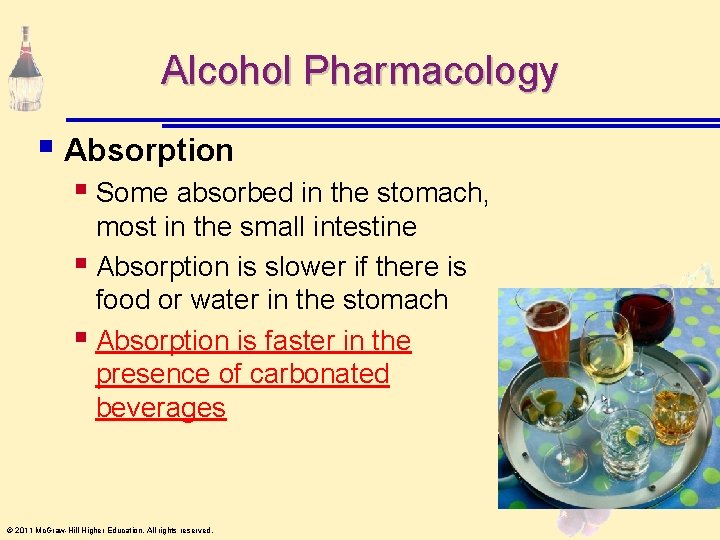
Alcohol Pharmacology § Absorption § Some absorbed in the stomach, most in the small intestine § Absorption is slower if there is food or water in the stomach § Absorption is faster in the presence of carbonated beverages © 2011 Mc. Graw-Hill Higher Education. All rights reserved.
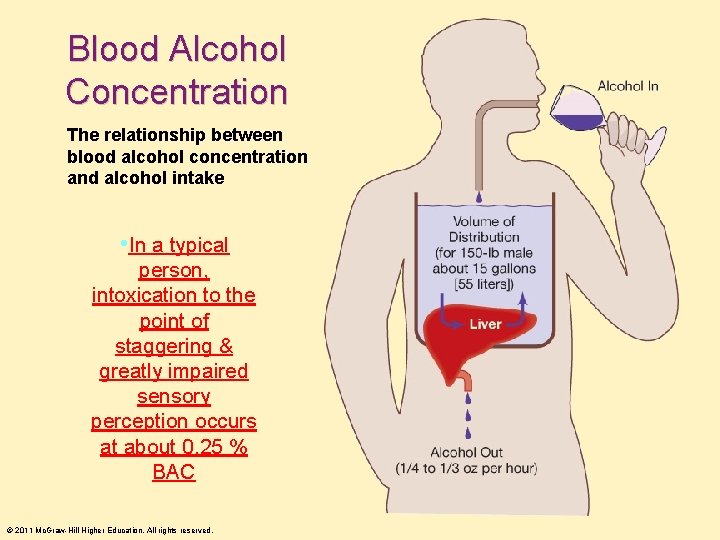
Alcohol Pharmacology § Distribution § Blood alcohol concentration (BAC) is a measure of § § § the concentration of alcohol in blood, expressed as a percentage in terms of grams per 100 ml Alcohol is distributed throughout body fluids Alcohol is less distributed in fatty tissues, so a lean person will have a lower BAC than a fatter person of the same weight Metabolism: Liver metabolizes about 0. 25 ounces of alcohol per hour § If rate of intake = rate of metabolism, BAC is stable § If rate of intake exceeds rate of metabolism, BAC climbs © 2011 Mc. Graw-Hill Higher Education. All rights reserved.
Blood Alcohol Concentration The relationship between blood alcohol concentration and alcohol intake • In a typical person, intoxication to the point of staggering & greatly impaired sensory perception occurs at about 0. 25 % BAC © 2011 Mc. Graw-Hill Higher Education. All rights reserved.
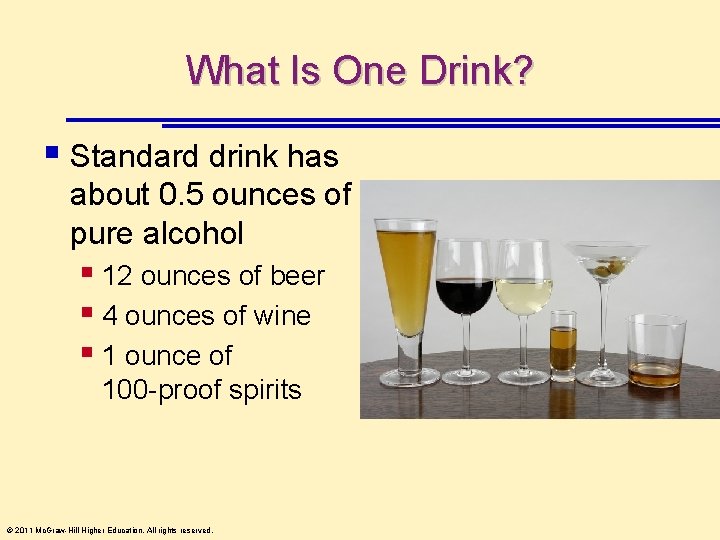
What Is One Drink? § Standard drink has about 0. 5 ounces of pure alcohol § 12 ounces of beer § 4 ounces of wine § 1 ounce of 100 -proof spirits © 2011 Mc. Graw-Hill Higher Education. All rights reserved.
Gender Differences § Women tend to be more susceptible than men to the effects of alcohol after consuming the same amount § Alcohol dehydrogenase (a stomach enzyme primary responsibly for metabolizing alcohol) is more active in men ØWomen absorb a greater proportion of the alcohol they drink § Women tend to weigh less and have a higher proportion of body fat Ø“Tank” into which alcohol is added is smaller © 2011 Mc. Graw-Hill Higher Education. All rights reserved.
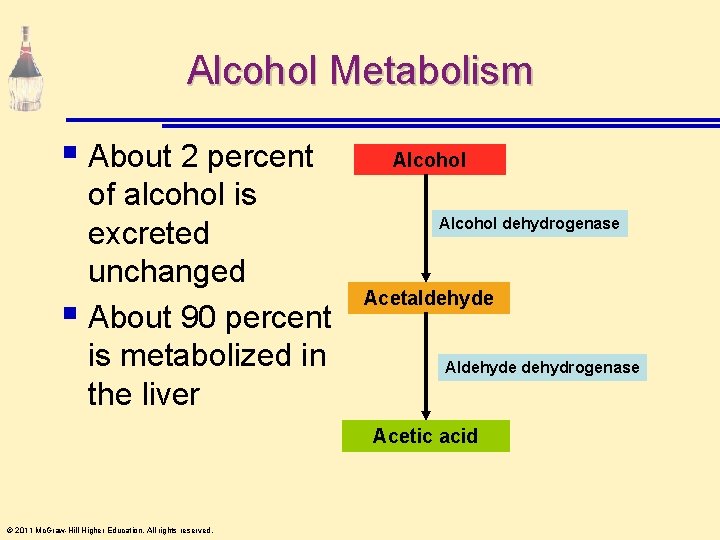
Alcohol Metabolism § About 2 percent of alcohol is excreted unchanged § About 90 percent is metabolized in the liver Alcohol dehydrogenase Acetaldehyde Aldehyde dehydrogenase Acetic acid © 2011 Mc. Graw-Hill Higher Education. All rights reserved.
Alcohol Metabolism § Exercise, coffee, and other strategies do not speed up the rate of metabolism § Liver responds to chronic intake of alcohol by increasing enzyme activity § Contributes to tolerance among heavy users § Can result in cross-tolerance to other depressants © 2011 Mc. Graw-Hill Higher Education. All rights reserved.
Mechanism of Action § § § Central nervous system depressant Used as anesthetic until the late 19 th century Alcohol has many effects on the brain and the mechanisms are difficult to pin down § Similar to barbiturates and benzodiazepines, it § § enhances the inhibitory effect of GABA at the GABA-A receptor At high doses, it blocks the effects of the excitatory transmitter glutamate It affects dopamine, serotonin, and acetylcholine neurons © 2011 Mc. Graw-Hill Higher Education. All rights reserved.
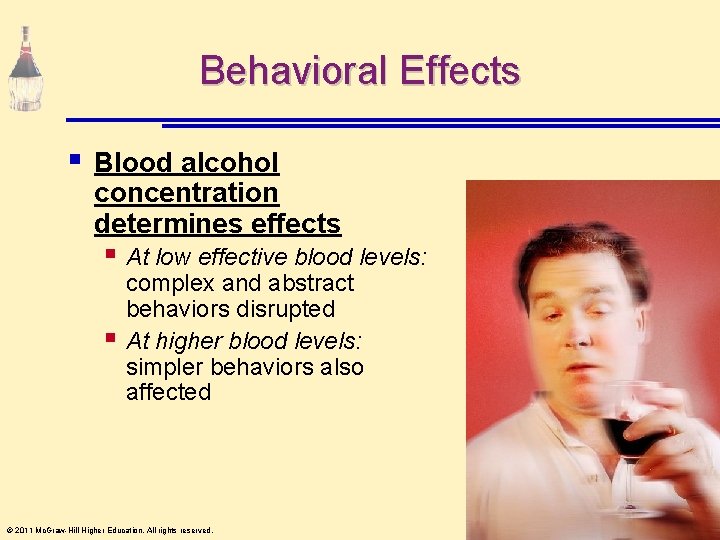
Behavioral Effects § Blood alcohol concentration determines effects § At low effective blood levels: § complex and abstract behaviors disrupted At higher blood levels: simpler behaviors also affected © 2011 Mc. Graw-Hill Higher Education. All rights reserved.
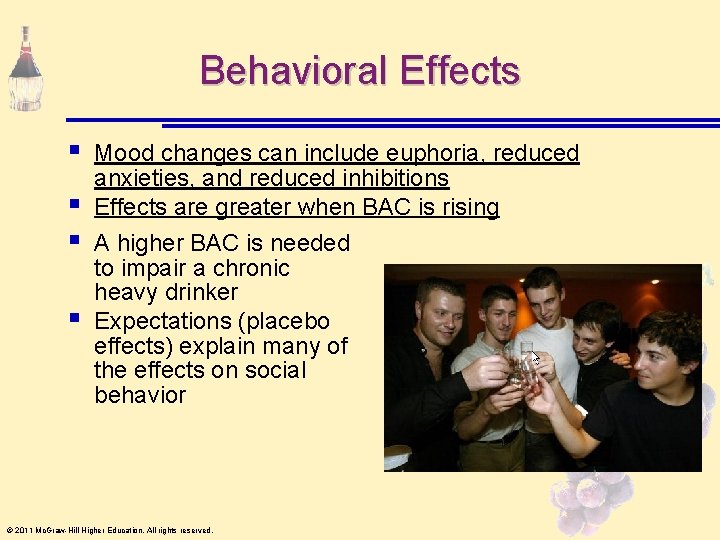
Behavioral Effects § § Mood changes can include euphoria, reduced anxieties, and reduced inhibitions Effects are greater when BAC is rising A higher BAC is needed to impair a chronic heavy drinker Expectations (placebo effects) explain many of the effects on social behavior © 2011 Mc. Graw-Hill Higher Education. All rights reserved.
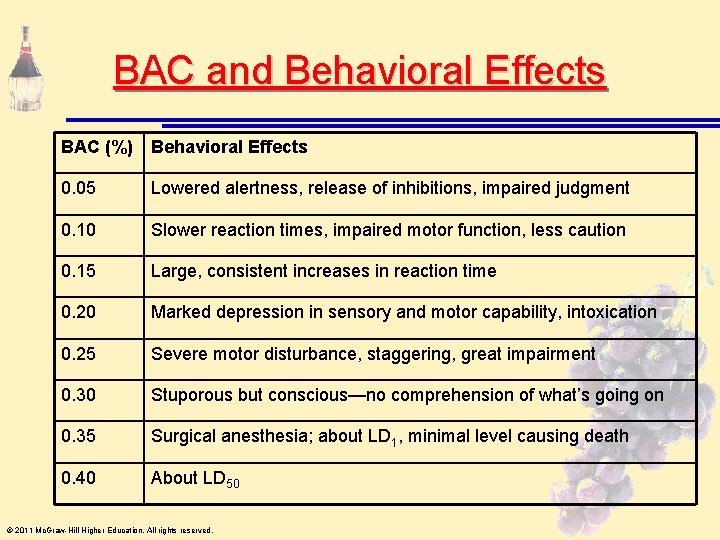
BAC and Behavioral Effects BAC (%) Behavioral Effects 0. 05 Lowered alertness, release of inhibitions, impaired judgment 0. 10 Slower reaction times, impaired motor function, less caution 0. 15 Large, consistent increases in reaction time 0. 20 Marked depression in sensory and motor capability, intoxication 0. 25 Severe motor disturbance, staggering, great impairment 0. 30 Stuporous but conscious—no comprehension of what’s going on 0. 35 Surgical anesthesia; about LD 1, minimal level causing death 0. 40 About LD 50 © 2011 Mc. Graw-Hill Higher Education. All rights reserved.
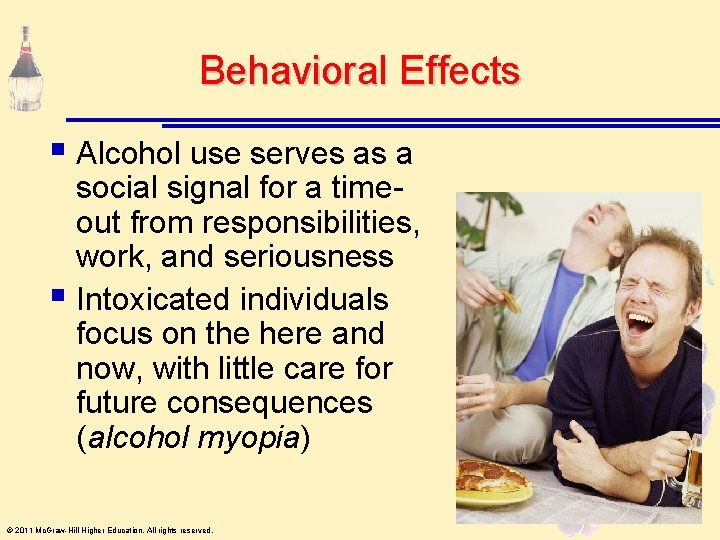
Behavioral Effects § Alcohol use serves as a social signal for a timeout from responsibilities, work, and seriousness § Intoxicated individuals focus on the here and now, with little care for future consequences (alcohol myopia) © 2011 Mc. Graw-Hill Higher Education. All rights reserved.
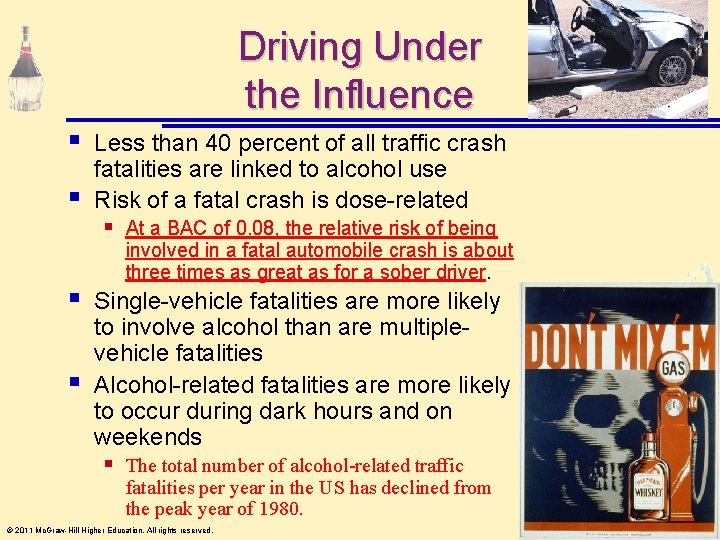
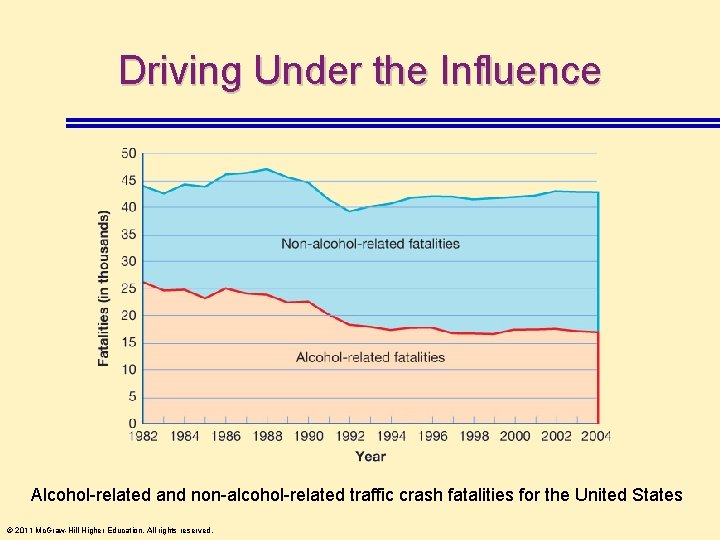
Driving Under the Influence § § Less than 40 percent of all traffic crash fatalities are linked to alcohol use Risk of a fatal crash is dose-related § At a BAC of 0. 08, the relative risk of being involved in a fatal automobile crash is about three times as great as for a sober driver. Single-vehicle fatalities are more likely to involve alcohol than are multiplevehicle fatalities Alcohol-related fatalities are more likely to occur during dark hours and on weekends § The total number of alcohol-related traffic fatalities per year in the US has declined from the peak year of 1980. © 2011 Mc. Graw-Hill Higher Education. All rights reserved.
Driving Under the Influence Alcohol-related and non-alcohol-related traffic crash fatalities for the United States © 2011 Mc. Graw-Hill Higher Education. All rights reserved.
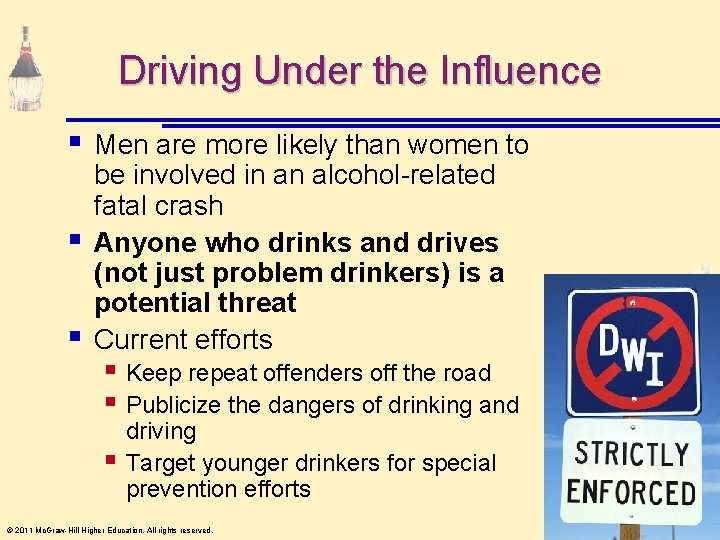
Driving Under the Influence § § § Men are more likely than women to be involved in an alcohol-related fatal crash Anyone who drinks and drives (not just problem drinkers) is a potential threat Current efforts § Keep repeat offenders off the road § Publicize the dangers of drinking and § driving Target younger drinkers for special prevention efforts © 2011 Mc. Graw-Hill Higher Education. All rights reserved.
Behavioral Effects § § § Sexual behavior § § Alcohol use enhances interest in sex but impairs physiological arousal Linked to unsafe sex Blackouts § A danger sign of excessive alcohol use Crime and violence—alcohol use is statistically related to violence § Homicide § In studies relating to homicide about half of all murderers & about half of all murder victims had been drinking § Assault, including family violence, sexual assault, and date rape § Suicide © 2011 Mc. Graw-Hill Higher Education. All rights reserved.
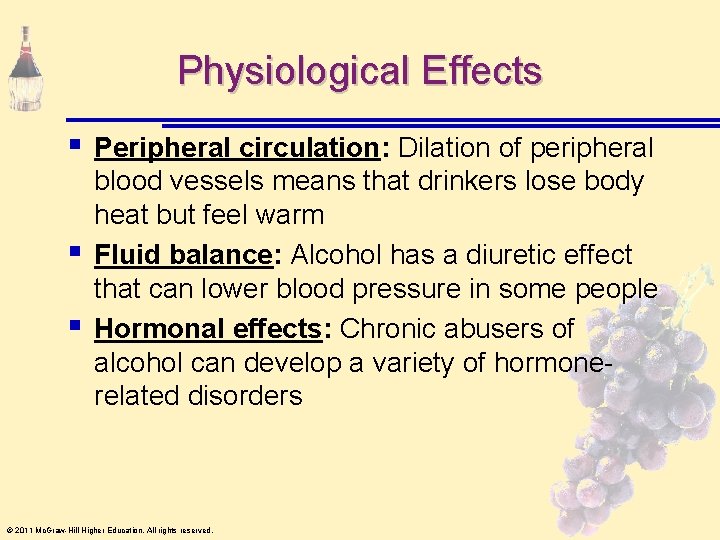
Physiological Effects § § § Peripheral circulation: Dilation of peripheral blood vessels means that drinkers lose body heat but feel warm Fluid balance: Alcohol has a diuretic effect that can lower blood pressure in some people Hormonal effects: Chronic abusers of alcohol can develop a variety of hormonerelated disorders © 2011 Mc. Graw-Hill Higher Education. All rights reserved.
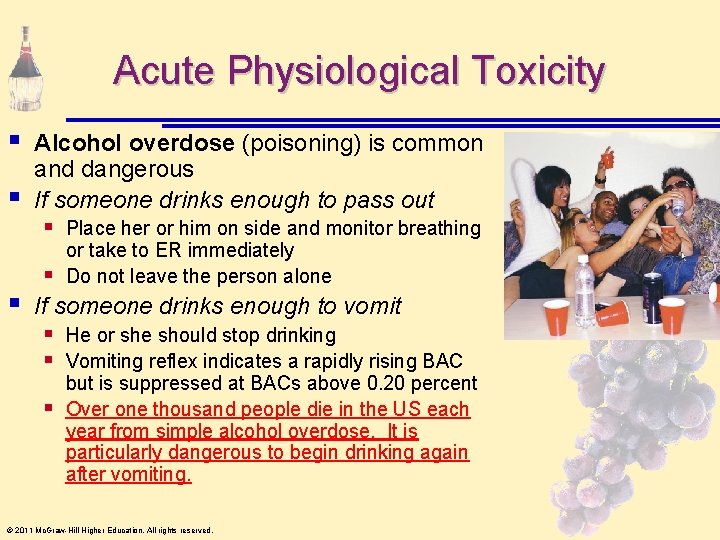
Acute Physiological Toxicity § § § Alcohol overdose (poisoning) is common and dangerous If someone drinks enough to pass out § § Place her or him on side and monitor breathing or take to ER immediately Do not leave the person alone If someone drinks enough to vomit § § § He or she should stop drinking Vomiting reflex indicates a rapidly rising BAC but is suppressed at BACs above 0. 20 percent Over one thousand people die in the US each year from simple alcohol overdose. It is particularly dangerous to begin drinking again after vomiting. © 2011 Mc. Graw-Hill Higher Education. All rights reserved.
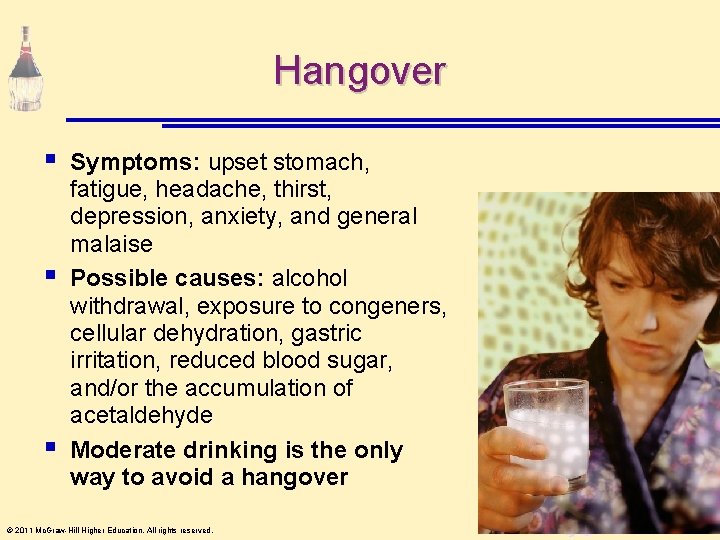
Hangover § § § Symptoms: upset stomach, fatigue, headache, thirst, depression, anxiety, and general malaise Possible causes: alcohol withdrawal, exposure to congeners, cellular dehydration, gastric irritation, reduced blood sugar, and/or the accumulation of acetaldehyde Moderate drinking is the only way to avoid a hangover © 2011 Mc. Graw-Hill Higher Education. All rights reserved.
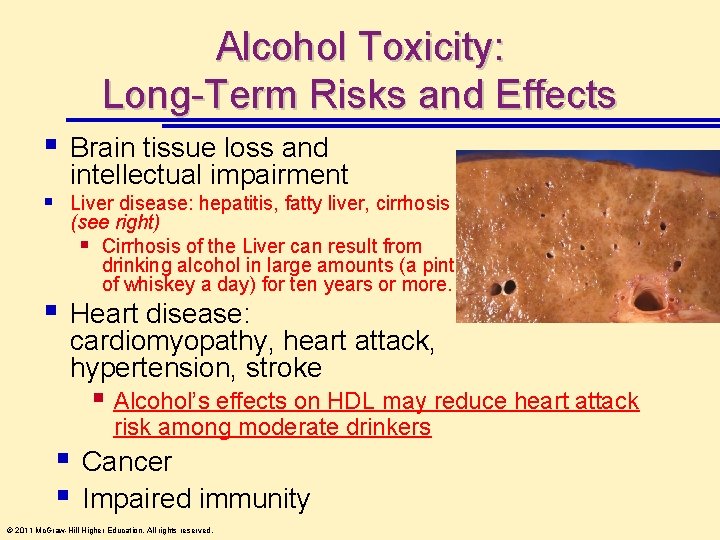
Alcohol Toxicity: Long-Term Risks and Effects § § § Brain tissue loss and intellectual impairment Liver disease: hepatitis, fatty liver, cirrhosis (see right) § Cirrhosis of the Liver can result from drinking alcohol in large amounts (a pint of whiskey a day) for ten years or more. Heart disease: cardiomyopathy, heart attack, hypertension, stroke § Alcohol’s effects on HDL may reduce heart attack § § risk among moderate drinkers Cancer Impaired immunity © 2011 Mc. Graw-Hill Higher Education. All rights reserved.
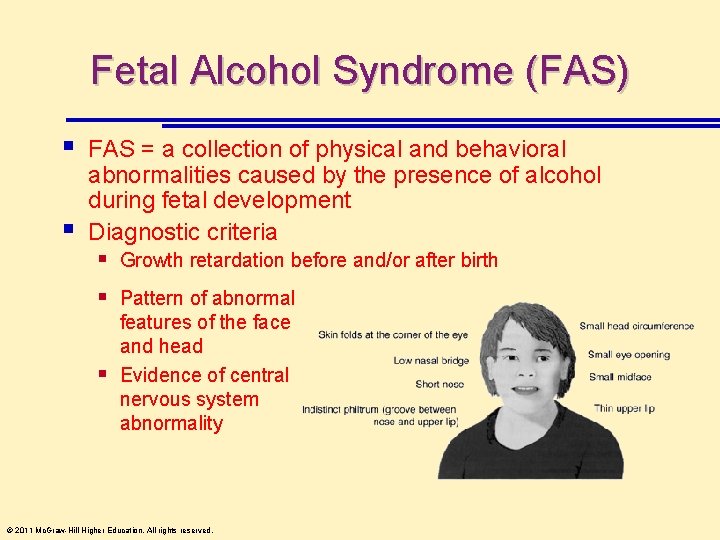
Fetal Alcohol Syndrome (FAS) § § FAS = a collection of physical and behavioral abnormalities caused by the presence of alcohol during fetal development Diagnostic criteria § § § Growth retardation before and/or after birth Pattern of abnormal features of the face and head Evidence of central nervous system abnormality © 2011 Mc. Graw-Hill Higher Education. All rights reserved.
Fetal Alcohol Syndrome and Fetal Alcohol Effects § § Fetal alcohol syndrome § Related to peak BAC and to duration of alcohol § exposure Prevalence: 0. 2 to 1. 5 per 1, 000 births Fetal alcohol effects § All alcohol-related developmental abnormalities associated with prenatal alcohol exposure § Prevalence: 80 to 200 per 1, 000 births Drinking during pregnancy increases risk of spontaneous abortion Data do not prove that low levels of alcohol use during pregnancy are safe or that they are unsafe © 2011 Mc. Graw-Hill Higher Education. All rights reserved.
Alcohol Dependence: Withdrawal Syndrome § § § Abstinence syndrome is medically more severe and more deadly than opioid withdrawal Abstinence syndrome occurs in stages § Stage 1: tremors, rapid heartbeat, hypertension, heavy sweating, loss of appetite, insomnia Stage 2: hallucinations (auditory, visual, and/or tactile) Stage 3: delusions, disorientation, delirium Stage 4: seizures § § § Initial detoxification should be carried out in an inpatient medical setting Sedatives given in stage 1 or 2 prevent stages 3 and 4 Some symptoms can last for up to several weeks © 2011 Mc. Graw-Hill Higher Education. All rights reserved.
Dependent Behaviors § Alcoholics Anonymous view—alcohol dependence as a disease—became popular beginning in the 1940 s and 1950 s § § § A progressive disease characterized by loss of control over drinking Requirements for membership into AA include only the desire to stop drinking. Only treatment is abstinence from alcohol Disease model: alcohol dependence is the primary disease and not the result of another underlying cause Criticisms of disease model § § What is the cause of the disease? Why don’t all dependent drinkers exhibit the same symptoms? © 2011 Mc. Graw-Hill Higher Education. All rights reserved.
Dependent Behaviors § APA defines substance abuse and dependence and includes alcohol as a psychoactive substances § Alcohol abuse is a maladaptive pattern indicated § § by continued use despite knowledge of having persistent problems caused by alcohol Alcohol dependence involves more serious psychosocial characteristics and includes the physiological factors of tolerance and withdrawal among the possible symptoms Cognitive and genetic factors are potential underlying causes of dependence © 2011 Mc. Graw-Hill Higher Education. All rights reserved.
Chapter 9 Alcohol © 2011 Mc. Graw-Hill Higher Education. All rights reserved.