
Chapter 9 Adaptation to Life in Varying Environments
- Slides: 34
Chapter 9: Adaptation to Life in Varying Environments Robert E. Ricklefs The Economy of Nature, Fifth Edition (c) 2001 by W. H. Freeman and Company
Background - Life in Varying Environments z. The giant red velvet mite lives in one of the most forbidding desert environments on earth. z. Its life history represents a series of adaptations that optimize survival, growth and reproduction while minimizing exposure to unsuitable conditions. (c) 2001 by W. H. Freeman and Company
Responses Right and Wrong z The appropriateness of a response is a function of: ythe qualities of the environment yecological circumstances z Consider the storage of fat by sparrows: ythe “right” choice if this fat will be needed: xfor migration xto carry the bird through bad weather ythe “wrong” choice in the absence of such needs, because stored fat: xreduces speed and maneuverability (c) 2001 by W. H. Freeman and xincreases risk of predation Company
Adaptation results from natural selection. z Genotype is the unique genetic constitution of an individual. z Evolution is any change in the genetic makeup of a population. z Natural selection results in evolutionary change when genetic factors cause differences in fecundity and survival among individuals. z Fitness is the reproductive success of an individual. (c) 2001 by W. H. Freeman and Company
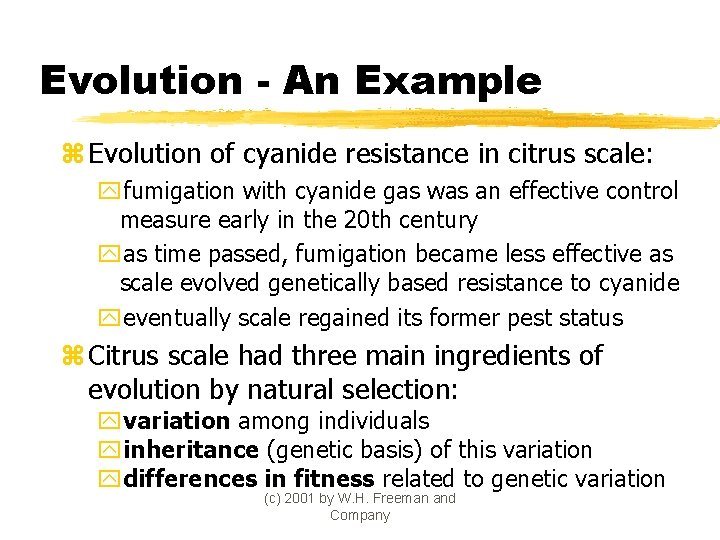
Evolution - An Example z Evolution of cyanide resistance in citrus scale: yfumigation with cyanide gas was an effective control measure early in the 20 th century yas time passed, fumigation became less effective as scale evolved genetically based resistance to cyanide yeventually scale regained its former pest status z Citrus scale had three main ingredients of evolution by natural selection: yvariation among individuals yinheritance (genetic basis) of this variation ydifferences in fitness related to genetic variation (c) 2001 by W. H. Freeman and Company
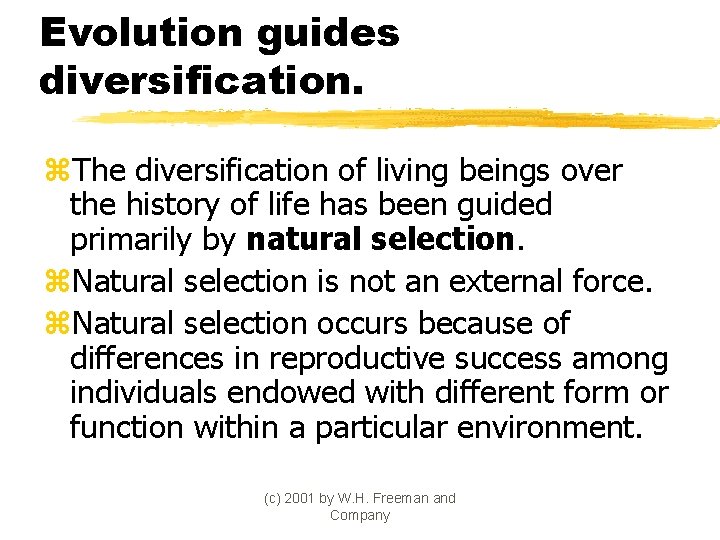
Evolution guides diversification. z. The diversification of living beings over the history of life has been guided primarily by natural selection. z. Natural selection is not an external force. z. Natural selection occurs because of differences in reproductive success among individuals endowed with different form or function within a particular environment. (c) 2001 by W. H. Freeman and Company
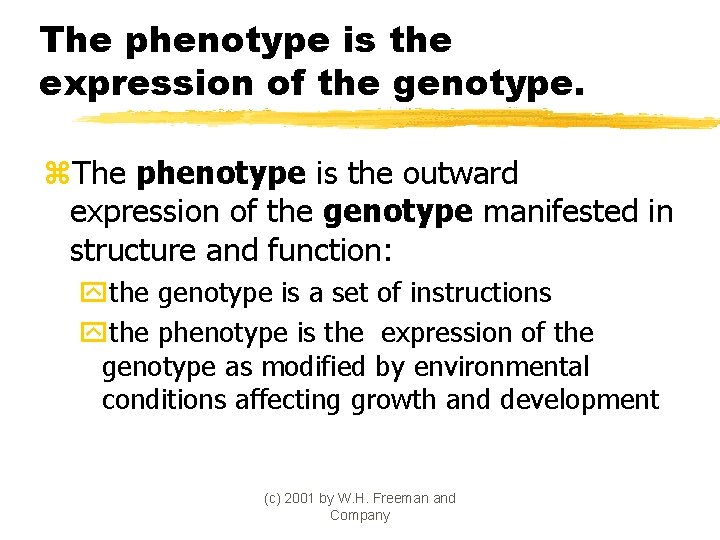
The phenotype is the expression of the genotype. z. The phenotype is the outward expression of the genotype manifested in structure and function: ythe genotype is a set of instructions ythe phenotype is the expression of the genotype as modified by environmental conditions affecting growth and development (c) 2001 by W. H. Freeman and Company
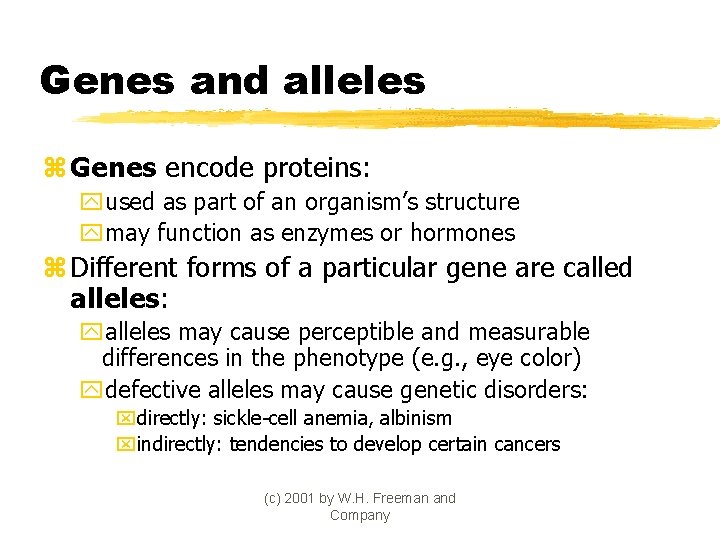
Genes and alleles z Genes encode proteins: yused as part of an organism’s structure ymay function as enzymes or hormones z Different forms of a particular gene are called alleles: yalleles may cause perceptible and measurable differences in the phenotype (e. g. , eye color) ydefective alleles may cause genetic disorders: xdirectly: sickle-cell anemia, albinism xindirectly: tendencies to develop certain cancers (c) 2001 by W. H. Freeman and Company
Allelic Diversity in Individuals z Each diploid individual has two copies of each allele, one inherited from its mother, the other from its father: ya heterozygous individual has two different alleles ya homozygous individual has identical alleles yalleles may be: xdominant (expressed in heterozygous individual) xrecessive (masked by dominant allele) xcodominant (result in intermediate phenotype in heterozygotes) ymost deleterious alleles are recessive (c) 2001 by W. H. Freeman and Company
Phenotypic Plasticity z. Environmentally induced variation in the phenotype is referred to as phenotypic plasticity. z. The capacity to exhibit phenotypic plasticity may itself be an evolved trait. z. It is important that we keep in mind the difference between: yplastic responses of individuals yevolutionary responses by populations (c) 2001 by W. H. Freeman and Company
Each type of organism has an activity space. z. The organism functions best within a narrow range of environmental conditions which define its activity space. yactivity is equivalent to performance yactivity may be measured as any trait (swimming speed, photosynthesis, survival) that influences individual’s fitness (c) 2001 by W. H. Freeman and Company
Biological activity is related to environmental conditions. z. For a given environmental factor, we can identify various ranges relative to activity: yoptimal range (above minimum level required to maintain population) ysuitable range (above minimum level required to maintain organism) ymarginal range (above minimum level required to maintain critical functions) yunsuitable range (fatal for extended (c) 2001 by W. H. Freeman and periods) Company
Organisms can select microhabitats. z Within habitats, there are finer-scale variations referred to as microhabitats or microenvironments: ythese represent distinct differences in temperature, moisture, salinity, and other factors within a particular habitat z In desert habitats, for example: yshaded ground under shrubs is cooler and moister than surrounding areas exposed to direct sunlight ysuch differences may vary diurnally or seasonally (c) 2001 by W. H. Freeman and Company
Behavioral Cycles in Lizards z. Lizards can regulate body temperature by diurnal behavioral cycles: ylizards do not regulate temperature by generating metabolic heat yby moving about, they select various microhabitats: xlizards take advantage of differences in solar radiation and temperatures of various surfaces to maintain body temperatures within a suitable range during a day (c) 2001 by W. H. Freeman and Company
Cactus wrens select microhabitats to optimize energy budgets. z The desert habitat offers varied microhabitats, ranging from exposed ground in full sun to deep shade of trees. z Cactus wrens of our southwestern deserts take advantage of various microhabitats: yin early morning, they forage widely yas the day becomes progressively warmer, they restrict activity to cooler microhabitats ynests are positioned to shelter from (spring) or face (summer) prevailing winds (c) 2001 by W. H. Freeman and Company
Acclimation is a reversible change in structure. z Acclimation is a shift in the range of physiological tolerances of the individual. z Some examples: ygrowing thicker fur in winter yproducing smaller leaves in the dry season yincreasing the number of red blood cells at higher elevations yproducing enzymes with different temperature optima yproducing lipids that remain fluid at different temperatures (c) 2001 by W. H. Freeman and Company
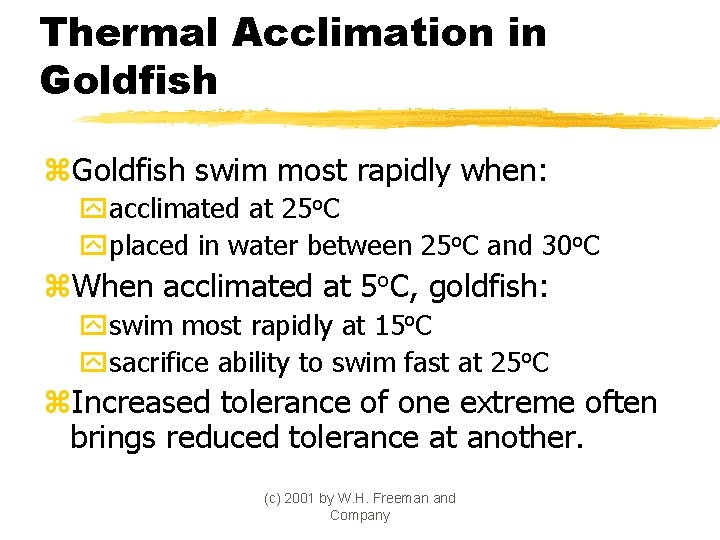
Thermal Acclimation in Goldfish z. Goldfish swim most rapidly when: yacclimated at 25 o. C yplaced in water between 25 o. C and 30 o. C z. When acclimated at 5 o. C, goldfish: yswim most rapidly at 15 o. C ysacrifice ability to swim fast at 25 o. C z. Increased tolerance of one extreme often brings reduced tolerance at another. (c) 2001 by W. H. Freeman and Company
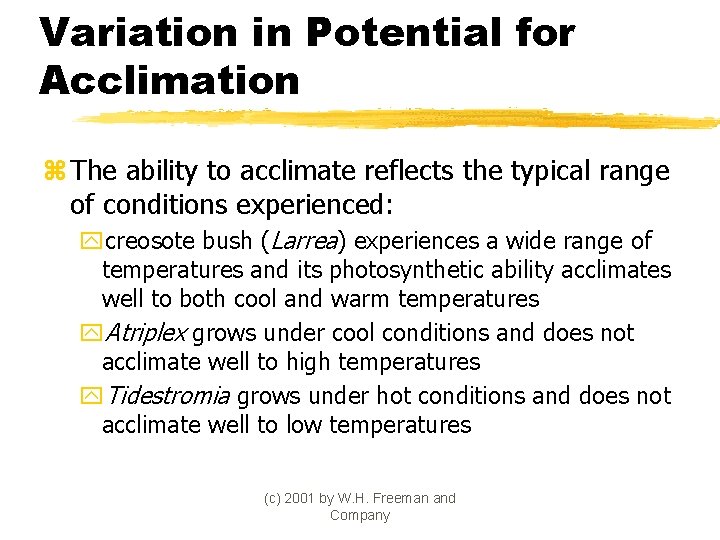
Variation in Potential for Acclimation z The ability to acclimate reflects the typical range of conditions experienced: ycreosote bush (Larrea) experiences a wide range of temperatures and its photosynthetic ability acclimates well to both cool and warm temperatures y. Atriplex grows under cool conditions and does not acclimate well to high temperatures y. Tidestromia grows under hot conditions and does not acclimate well to low temperatures (c) 2001 by W. H. Freeman and Company
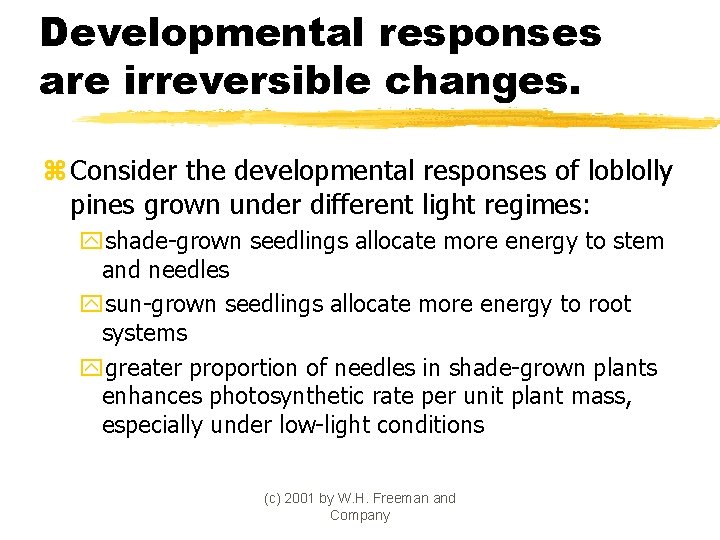
Developmental responses are irreversible changes. z Consider the developmental responses of loblolly pines grown under different light regimes: yshade-grown seedlings allocate more energy to stem and needles ysun-grown seedlings allocate more energy to root systems ygreater proportion of needles in shade-grown plants enhances photosynthetic rate per unit plant mass, especially under low-light conditions (c) 2001 by W. H. Freeman and Company
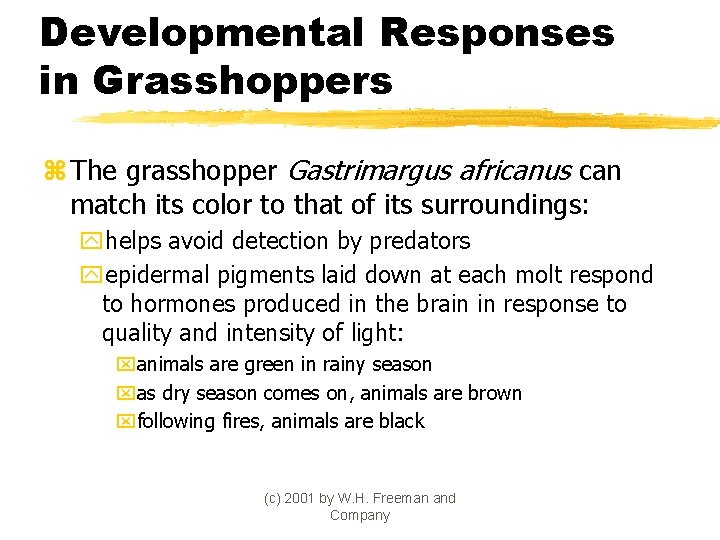
Developmental Responses in Grasshoppers z The grasshopper Gastrimargus africanus can match its color to that of its surroundings: yhelps avoid detection by predators yepidermal pigments laid down at each molt respond to hormones produced in the brain in response to quality and intensity of light: xanimals are green in rainy season xas dry season comes on, animals are brown xfollowing fires, animals are black (c) 2001 by W. H. Freeman and Company
Where do we find developmental responses? z. As a rule, plants and animals in habitats with persistent variation exhibit such responses. z. For plants, spatial heterogeneity creates the kind of persistent variation favoring developmental responses. (c) 2001 by W. H. Freeman and Company
Migration, Storage, and Dormancy z. When extremes of environment are so adverse as to prevent normal activities, organisms: ycannot adapt to such extreme conditions yor they can adapt, but such adaptations would be too costly z. Alternative strategies include migration, storage, and dormancy. (c) 2001 by W. H. Freeman and Company
Migration z Migration is moving to another region where conditions are more favorable: yarctic terns make annual migrations of 30, 000 km, moving from summer in Arctic to summer in Antarctic ymonarch butterflies migrate seasonally from Mexico and southern US into southern Canada y. African ungulates follow geographic patterns of rainfall and fresh vegetation ymigration in locusts represents a developmental response at high population densities (c) 2001 by W. H. Freeman and Company
Storage z Storage is the reliance on resources accumulated under more favorable conditions: ydesert cacti store water during rainy periods yplants of infertile habitats store nutrients during periods of temporary abundance yanimals of temperate and polar regions store fat for periods of severe weather during winter ysome mammals and birds cache food supplies (c) 2001 by W. H. Freeman and Company
Dormancy z Dormancy is becoming inactive: ytropical and subtropical trees shed leaves during seasonal droughts ymammals undergo hibernation ysome insects enter winter diapause, reducing their freezing point and metabolic rate yother insects enter summer diapause, tolerating dessication yplant seeds and spores of bacteria and fungi exhibit effective dormancy mechanisms (c) 2001 by W. H. Freeman and Company
Stimuli for Change z How do organisms sense impending environmental severity? yproximate factors are cues (such as day length) used to assess environmental factors but which do not directly affect well-being yultimate factors are features of the environment (such as food supply) which directly affect well-being z Different populations of the same species may respond in dramatically different ways to the same cues. (c) 2001 by W. H. Freeman and Company
Animals forage optimally z Theories of optimal foraging seek explanations for decisions that animals make while foraging: ywhere to forage yhow long to remain in a particular patch ywhich types of food to eat z Optimal foraging theories examine costs and benefits to animals of various decisions: yexpectation is that animals will select the behaviors that yield the greatest benefits (c) 2001 by W. H. Freeman and Company
Central Place Foraging z When animals are tied to a particular place (e. g. , a nest with offspring in it) they experience tradeoffs associated with distance they forage: yincreasing foraging range results in: xgreater potential for finding food xgreater time, energy costs, risks of travel yforaging range should maximize amount of food returned per unit time (c) 2001 by W. H. Freeman and Company
Are starlings optimal foragers? z Research with starlings shows that they can maximize return rates by selecting intermediate foraging times and returning with less than the maximum possible amount of food. z Experimental studies show that starlings do forage optimally, adjusting upward their load size as round-trip travel time increases, as predicted by foraging theory. (c) 2001 by W. H. Freeman and Company
Risk-Sensitive Foraging z. The value of a feeding area is reduced by the presence of risks, particularly predation: ypredation has been incorporated into foraging theory in studies of risk-sensitive foraging ydo animals incorporate risk of predation into decision-making? xexperimental studies, in which availability of food and predator density were both varied, showed that minnows incorporated predation risks into their foraging decisions (c) 2001 by W. H. Freeman and Company
Prey Choice z. Foraging decisions include choices concerning prey items: yeach food item has intrinsic value based on: xnutrient and energy content xdifficulty of handling xpotential danger from toxins ypoor-quality foods may require more handling time or take more time to digest, reducing overall rate of food intake (c) 2001 by W. H. Freeman and Company
Diet Mixing z. Why do foragers consume a mixed diet? ydifferent foods may be complementary, each providing essential nutrients missing in the other: xhumans can subsist on rice and beans, but not on either of these alone (complementary amino acids) xgrasshoppers foraging on mixed diets grow faster than those fed a single food xbirds selectively consume fruits that differ from the more abundant background (c) 2001 by W. H. Freeman and Company
Summary 1 z Responses of organisms to their environments have evolved in response to selective pressures in these environments. z Organisms have characteristic activity spaces and can select appropriate microhabitats. z Acclimation and developmental responses permit organisms to respond to varying environments. (c) 2001 by W. H. Freeman and Company
Summary 2 z. When environmental conditions exceed tolerances, organisms may migrate, rely on stored materials, or become dormant. z. Animals adjust their foraging activities to optimize the net capture of resources per unit time. z. Foragers also account for risks, and balance nutritional needs. (c) 2001 by W. H. Freeman and Company