
Chapter 9 Acids Bases and Salts 9 2
Chapter 9 Acids, Bases and Salts 9. 2 Reactions of Acids with Bases
D 12 - Explain the chemical composition of acids and bases, and explain the change of p. H in neutralization reactions.
Neutralization What is neutralization? This is a chemical reaction between an acid and a base. When neutralization occurs, there are two products formed … 1. salt 2. water
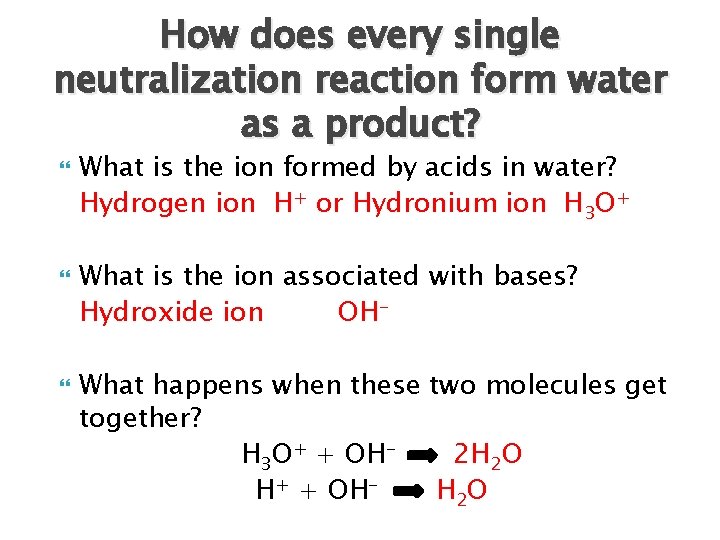
How does every single neutralization reaction form water as a product? What is the ion formed by acids in water? Hydrogen ion H+ or Hydronium ion H 3 O+ What is the ion associated with bases? Hydroxide ion OH- What happens when these two molecules get together? H 3 O+ + OH 2 H 2 O H+ + OHH 2 O

How does every single neutralization reaction form a salt as a product? Remember … not every salt is the “salt” that you are thinking about! A “salt” is any ionic compound formed from a cation (positive ion) and an anion (negative ion). While table salt (Na. Cl) is a “salt, ” it is certainly not the only one out there!
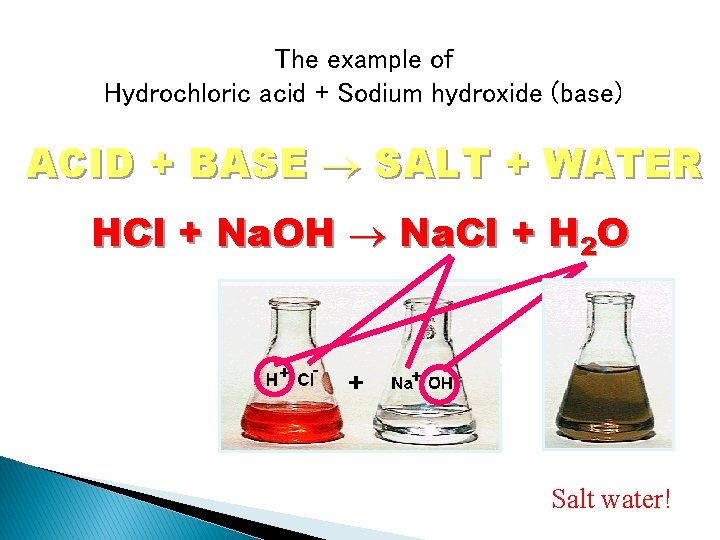
The example of Hydrochloric acid + Sodium hydroxide (base) ACID + BASE SALT + WATER HCl + Na. OH Na. Cl + H 2 O = Salt water!
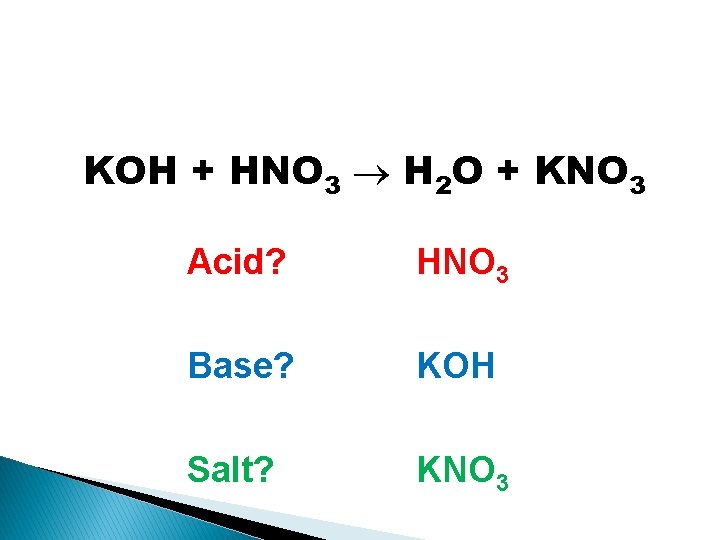
KOH + HNO 3 H 2 O + KNO 3 Acid? HNO 3 Base? KOH Salt? KNO 3
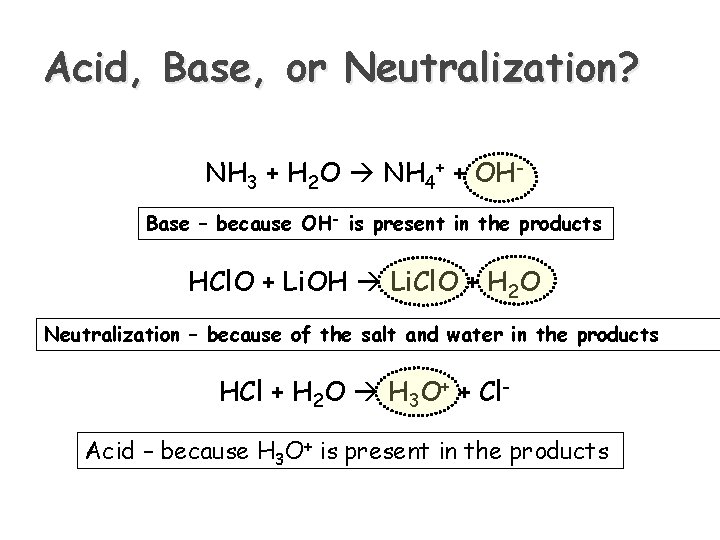
Acid, Base, or Neutralization? NH 3 + H 2 O NH 4+ + OHBase – because OH- is present in the products HCl. O + Li. OH Li. Cl. O + H 2 O Neutralization – because of the salt and water in the products HCl + H 2 O H 3 O+ + Cl. Acid – because H 3 O+ is present in the products
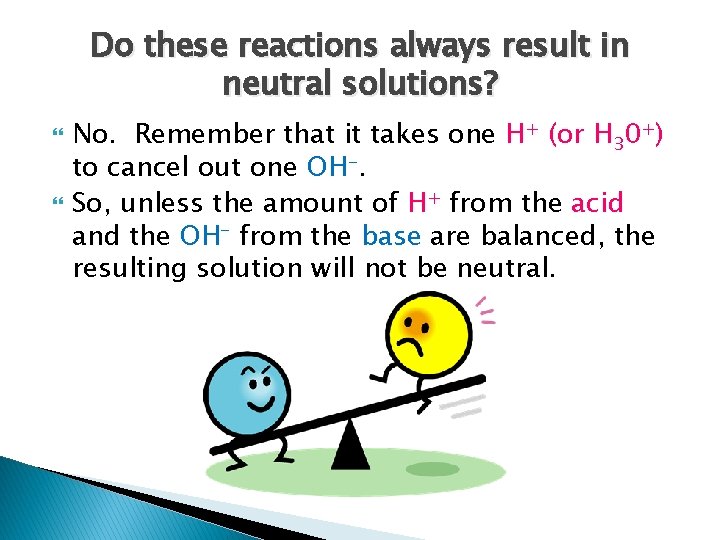
Do these reactions always result in neutral solutions? No. Remember that it takes one H+ (or H 30+) to cancel out one OH-. So, unless the amount of H+ from the acid and the OH- from the base are balanced, the resulting solution will not be neutral.
So, how can you tell if the resulting solution will be acidic or basic? The p. H of final solution depends on the amounts and strength of the acid and base. If there is more OH- present than H+, the resulting solution will be basic. If there is more H+ present than OH-, the resulting solution will be acidic.
You try … What would result from mixing equal amounts of a weak base and a strong acid? An acidic solution
Salts Remember, a salt is another name for an ionic compound, which is a combination of cations and anions. Common salts: Table salt - Na. Cl Baking soda – Na. HCO 3 Highway de-icers – often Ca. CO 3 and Mg. Cl 2 Fire extinguishers – Na. HCO 3, KHCO 3 and ((NH 4)H 2 PO 4 Antiperspirants and deodorants - Al. K(SO 4)2
Salts in the Body Minerals are inorganic elements that come from the soil and water. Your body needs minerals to grow and stay healthy. Minerals contain salts of elements that are needed by your body Ca – strong bones and teeth, nerves and muscles K and Na – nerve impulses, water content of cells P – transportation of energy, DNA replication
What’s next? We will use our knowledge of acids and bases to understand acid rain.
- Slides: 14