
Chapter 9 Academic Knowledge Body Systems for Support

Chapter 9 Academic Knowledge: Body Systems for Support and Movement

Warm-Up • How do you study new information? • What do your notes look like after a class period? • What do you know about the integumentary, skeletal, and muscular systems? Franck Boston/Shutterstock. com Copyright Goodheart-Willcox Co. , Inc. May not be posted to a publicly accessible website.

Study Skills for Health Science Students: Note Taking • Identify main ideas and use marker or highlighter, if allowed • Note taking methods – Outline style – Cornell style – Mind maps • Review notes in frequent, short practice sessions wavebreakmedia/Shutterstock. com Copyright Goodheart-Willcox Co. , Inc. May not be posted to a publicly accessible website.
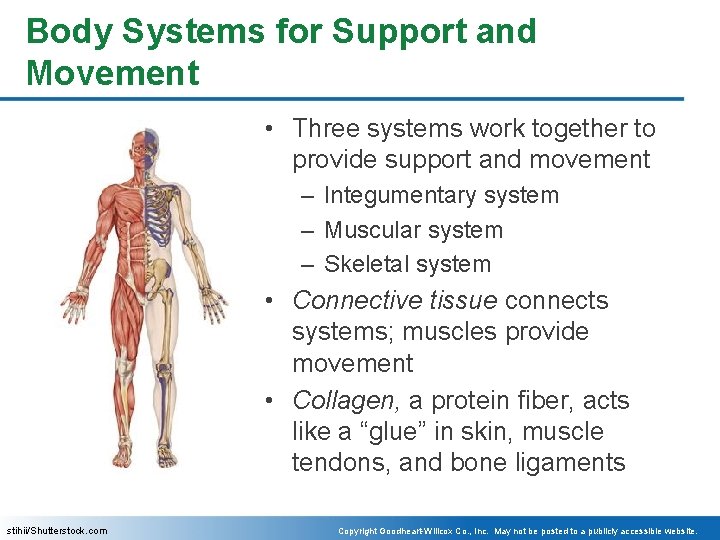
Body Systems for Support and Movement • Three systems work together to provide support and movement – Integumentary system – Muscular system – Skeletal system • Connective tissue connects systems; muscles provide movement • Collagen, a protein fiber, acts like a “glue” in skin, muscle tendons, and bone ligaments stihii/Shutterstock. com Copyright Goodheart-Willcox Co. , Inc. May not be posted to a publicly accessible website.
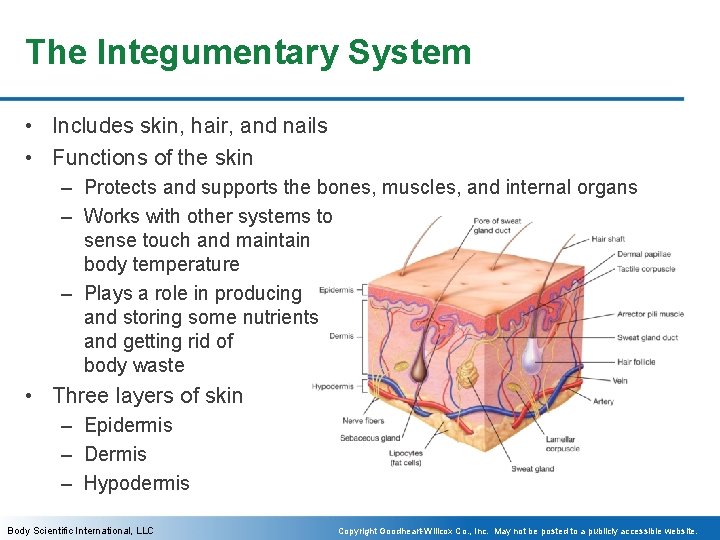
The Integumentary System • Includes skin, hair, and nails • Functions of the skin – Protects and supports the bones, muscles, and internal organs – Works with other systems to sense touch and maintain body temperature – Plays a role in producing and storing some nutrients and getting rid of body waste • Three layers of skin – Epidermis – Dermis – Hypodermis Body Scientific International, LLC Copyright Goodheart-Willcox Co. , Inc. May not be posted to a publicly accessible website.
The Epidermis • Thin outer layer of skin • Made up of mostly dead skin cells • Protects the body from bacteria and holds in moisture to prevent dehydration • Contains melanin, or pigment Mike Flippo/Shutterstock. com Copyright Goodheart-Willcox Co. , Inc. May not be posted to a publicly accessible website.
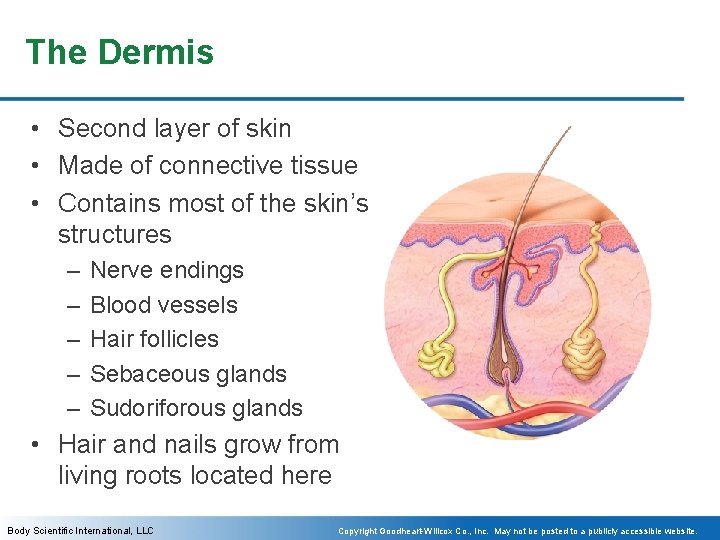
The Dermis • Second layer of skin • Made of connective tissue • Contains most of the skin’s structures – – – Nerve endings Blood vessels Hair follicles Sebaceous glands Sudoriforous glands • Hair and nails grow from living roots located here Body Scientific International, LLC Copyright Goodheart-Willcox Co. , Inc. May not be posted to a publicly accessible website.
The Hypodermis • Innermost layer of skin, located beneath the dermis • Contains connective tissue that attaches the skin to the muscle below • Made mostly of subcutaneous fat, which has some important functions – Provides padding – Holds in body heat – Stores energy and nutrients • Some fat is necessary, but excess fat is linked to diseases such as diabetes, heart disease, and cancer Copyright Goodheart-Willcox Co. , Inc. May not be posted to a publicly accessible website.
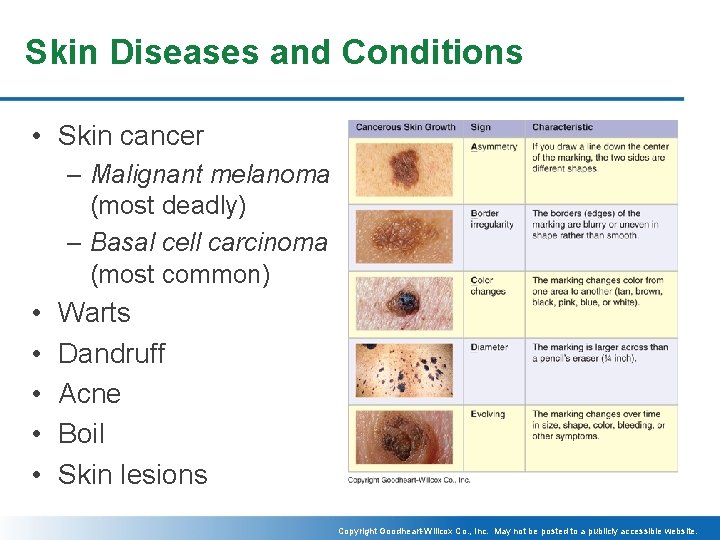
Skin Diseases and Conditions • Skin cancer – Malignant melanoma (most deadly) – Basal cell carcinoma (most common) • • • Warts Dandruff Acne Boil Skin lesions Copyright Goodheart-Willcox Co. , Inc. May not be posted to a publicly accessible website.

Skin Injuries • Abrasions to the epidermis heal without scarring; lacerations that cut into deeper layers leave a scar • Pressure ulcers (caused by lack of circulation to the skin; bedsores) • Burns (heat, electricity, chemicals) – First-, second-, third-, and fourthdegree – Rule of nines • Plastic surgery – Cosmetic: enhances beauty – Reconstructive: repairs damage michaeljung/Shutterstock. com Copyright Goodheart-Willcox Co. , Inc. May not be posted to a publicly accessible website.

Critical Thinking Explain the ABCDE rule. • This acronym describes how to detect possible skin cancer • Stands for Asymmetry, Border irregularity, Color changes, Diameter, and Evolving Distinguish between the different degrees of burns. • First-degree: affects only the epidermis • Second-degree: causes blisters and damage to dermis • Third-degree: damages full thickness of the skin, including the subcutaneous layer (hypodermis) • Fourth-degree: causes injury to muscle, tendons, and bone; requires surgery to remove dead skin, place skin grafts, and manage the scars and skin tightening that occur Copyright Goodheart-Willcox Co. , Inc. May not be posted to a publicly accessible website.
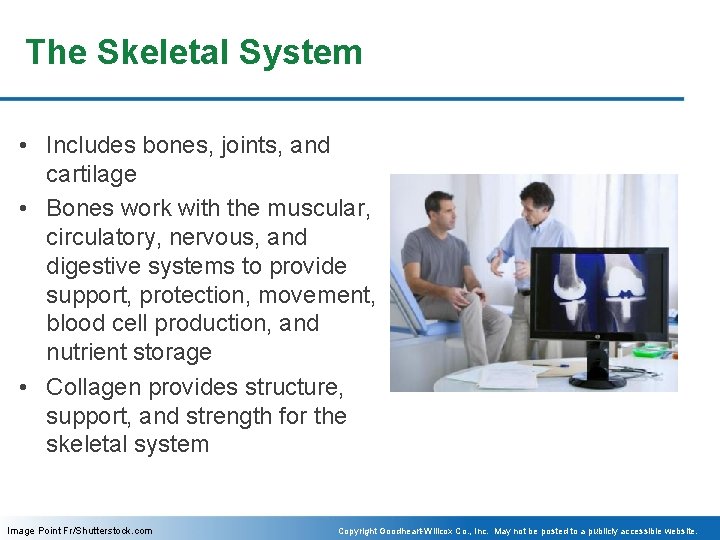
The Skeletal System • Includes bones, joints, and cartilage • Bones work with the muscular, circulatory, nervous, and digestive systems to provide support, protection, movement, blood cell production, and nutrient storage • Collagen provides structure, support, and strength for the skeletal system Image Point Fr/Shutterstock. com Copyright Goodheart-Willcox Co. , Inc. May not be posted to a publicly accessible website.
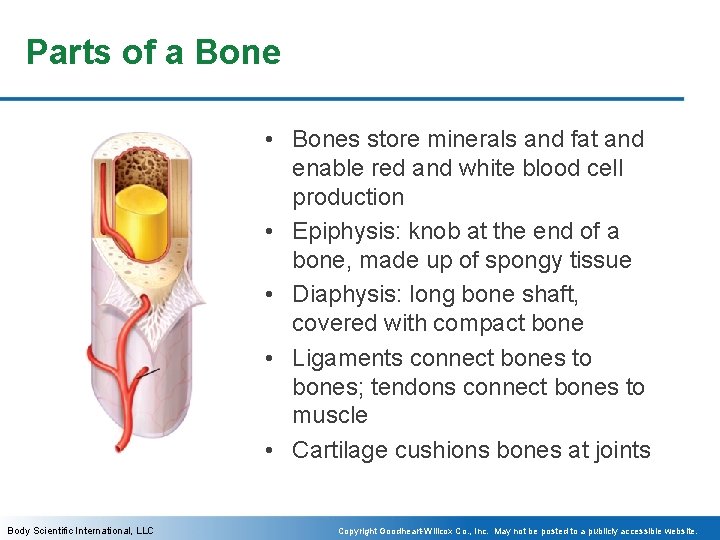
Parts of a Bone • Bones store minerals and fat and enable red and white blood cell production • Epiphysis: knob at the end of a bone, made up of spongy tissue • Diaphysis: long bone shaft, covered with compact bone • Ligaments connect bones to bones; tendons connect bones to muscle • Cartilage cushions bones at joints Body Scientific International, LLC Copyright Goodheart-Willcox Co. , Inc. May not be posted to a publicly accessible website.
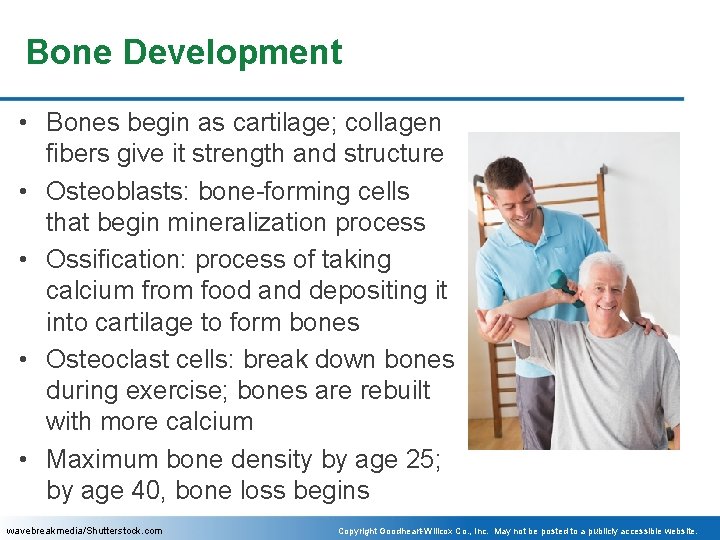
Bone Development • Bones begin as cartilage; collagen fibers give it strength and structure • Osteoblasts: bone-forming cells that begin mineralization process • Ossification: process of taking calcium from food and depositing it into cartilage to form bones • Osteoclast cells: break down bones during exercise; bones are rebuilt with more calcium • Maximum bone density by age 25; by age 40, bone loss begins wavebreakmedia/Shutterstock. com Copyright Goodheart-Willcox Co. , Inc. May not be posted to a publicly accessible website.
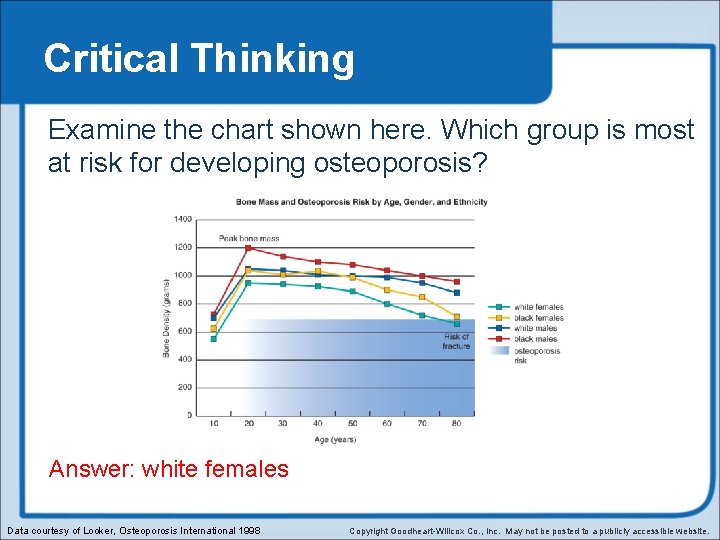
Critical Thinking Examine the chart shown here. Which group is most at risk for developing osteoporosis? Answer: white females Data courtesy of Looker, Osteoporosis International 1998 Copyright Goodheart-Willcox Co. , Inc. May not be posted to a publicly accessible website.
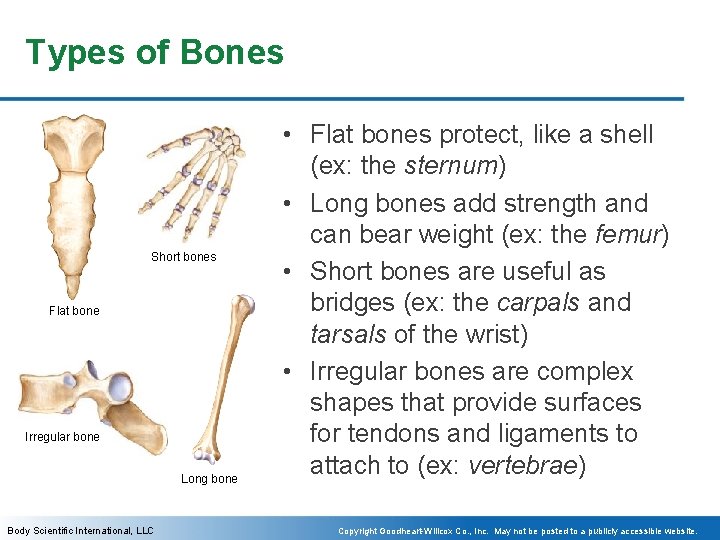
Types of Bones Short bones Flat bone Irregular bone Long bone Body Scientific International, LLC • Flat bones protect, like a shell (ex: the sternum) • Long bones add strength and can bear weight (ex: the femur) • Short bones are useful as bridges (ex: the carpals and tarsals of the wrist) • Irregular bones are complex shapes that provide surfaces for tendons and ligaments to attach to (ex: vertebrae) Copyright Goodheart-Willcox Co. , Inc. May not be posted to a publicly accessible website.
Critical Thinking What are some types of bone markings? • • • Condyles: rounded knobs at the ends of bones Epicondyles: similar, but smaller bumps Malleoli: bumps that form the ankle Process: part of the bone that projects out Tuberosity: a long bump that is hard to detect Crest: a raised ridge at the edge of a bone Copyright Goodheart-Willcox Co. , Inc. May not be posted to a publicly accessible website.
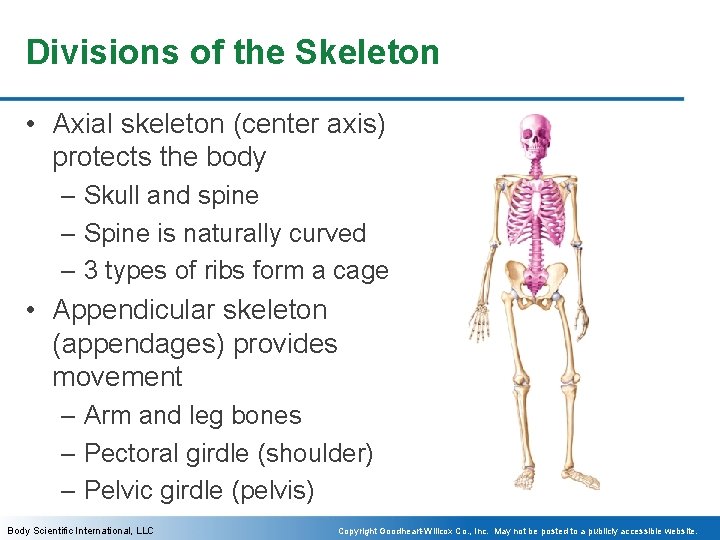
Divisions of the Skeleton • Axial skeleton (center axis) protects the body – Skull and spine – Spine is naturally curved – 3 types of ribs form a cage • Appendicular skeleton (appendages) provides movement – Arm and leg bones – Pectoral girdle (shoulder) – Pelvic girdle (pelvis) Body Scientific International, LLC Copyright Goodheart-Willcox Co. , Inc. May not be posted to a publicly accessible website.
Types of Joints • Diarthroses, or synovial joints, are the most freely movable; enclosed in bursa of synovial fluid – Ball-and-socket joints provide widest range of motion (ex: hip and shoulder) – Condylar joints move in the shape of an ellipse rather than a full circle (ex: wrist and fingers) – Hinge joints open and close (ex: elbow and jaw) • Amphiarthroses are partially movable – Vertebrae • Synarthroses are fused, immovable joints – Skull, sacrum Copyright Goodheart-Willcox Co. , Inc. May not be posted to a publicly accessible website.
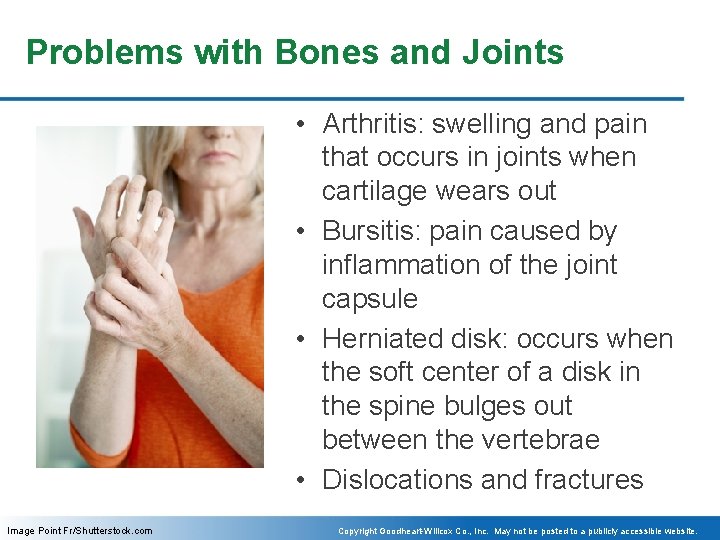
Problems with Bones and Joints • Arthritis: swelling and pain that occurs in joints when cartilage wears out • Bursitis: pain caused by inflammation of the joint capsule • Herniated disk: occurs when the soft center of a disk in the spine bulges out between the vertebrae • Dislocations and fractures Image Point Fr/Shutterstock. com Copyright Goodheart-Willcox Co. , Inc. May not be posted to a publicly accessible website.
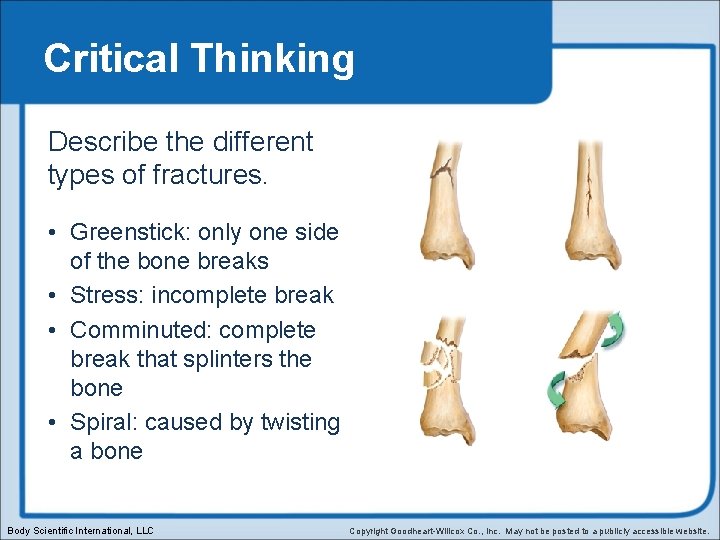
Critical Thinking Describe the different types of fractures. • Greenstick: only one side of the bone breaks • Stress: incomplete break • Comminuted: complete break that splinters the bone • Spiral: caused by twisting a bone Body Scientific International, LLC Copyright Goodheart-Willcox Co. , Inc. May not be posted to a publicly accessible website.
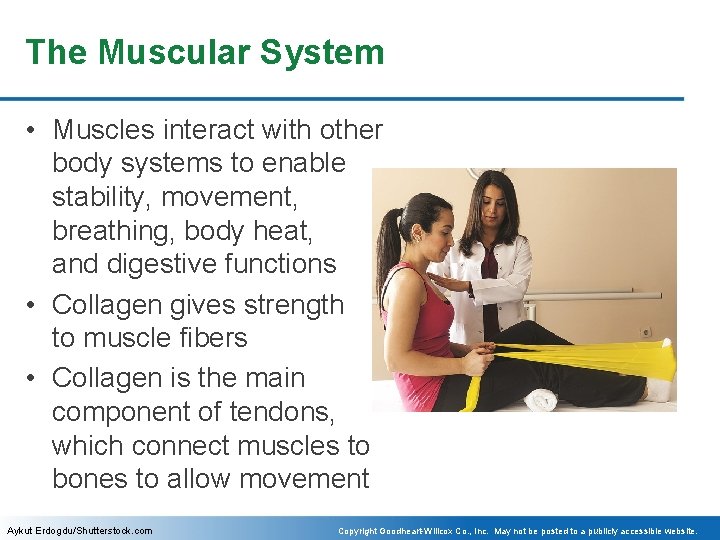
The Muscular System • Muscles interact with other body systems to enable stability, movement, breathing, body heat, and digestive functions • Collagen gives strength to muscle fibers • Collagen is the main component of tendons, which connect muscles to bones to allow movement Aykut Erdogdu/Shutterstock. com Copyright Goodheart-Willcox Co. , Inc. May not be posted to a publicly accessible website.
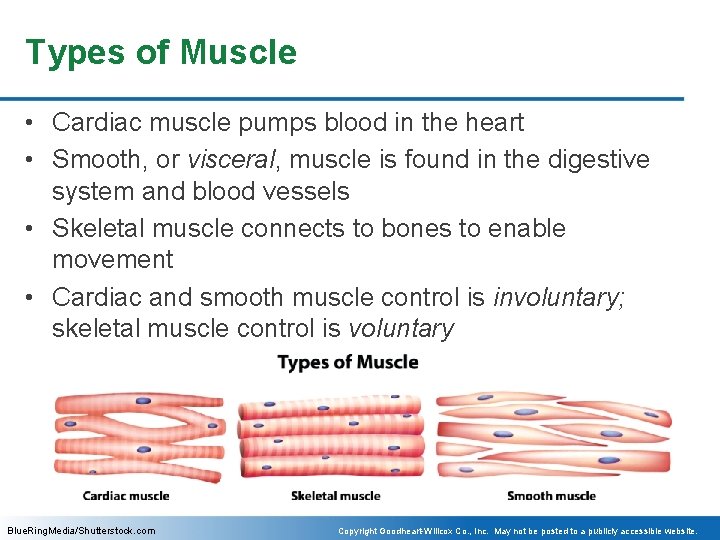
Types of Muscle • Cardiac muscle pumps blood in the heart • Smooth, or visceral, muscle is found in the digestive system and blood vessels • Skeletal muscle connects to bones to enable movement • Cardiac and smooth muscle control is involuntary; skeletal muscle control is voluntary Blue. Ring. Media/Shutterstock. com Copyright Goodheart-Willcox Co. , Inc. May not be posted to a publicly accessible website.
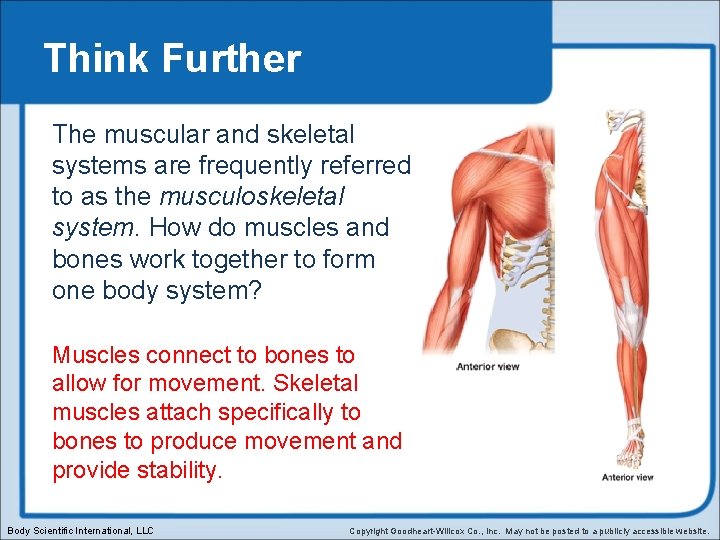
Think Further The muscular and skeletal systems are frequently referred to as the musculoskeletal system. How do muscles and bones work together to form one body system? Muscles connect to bones to allow for movement. Skeletal muscles attach specifically to bones to produce movement and provide stability. Body Scientific International, LLC Copyright Goodheart-Willcox Co. , Inc. May not be posted to a publicly accessible website.
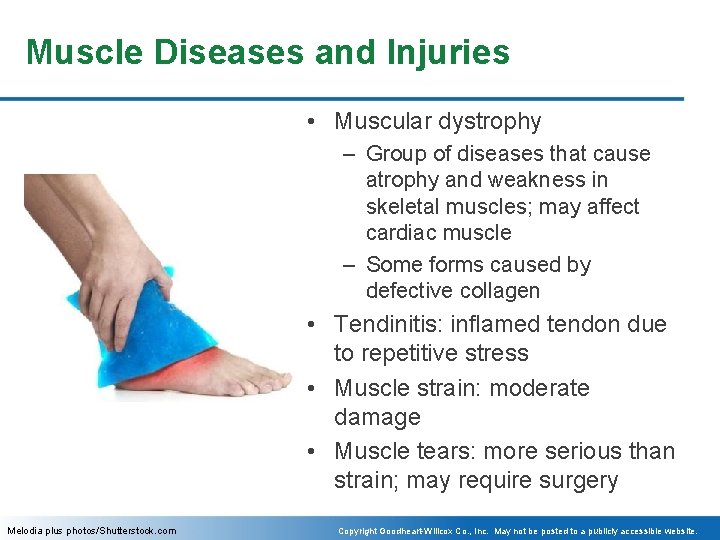
Muscle Diseases and Injuries • Muscular dystrophy – Group of diseases that cause atrophy and weakness in skeletal muscles; may affect cardiac muscle – Some forms caused by defective collagen • Tendinitis: inflamed tendon due to repetitive stress • Muscle strain: moderate damage • Muscle tears: more serious than strain; may require surgery Melodia plus photos/Shutterstock. com Copyright Goodheart-Willcox Co. , Inc. May not be posted to a publicly accessible website.
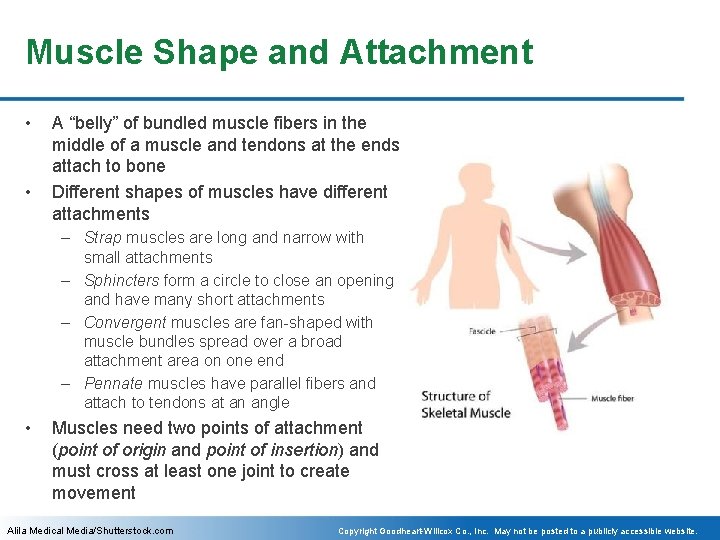
Muscle Shape and Attachment • • A “belly” of bundled muscle fibers in the middle of a muscle and tendons at the ends attach to bone Different shapes of muscles have different attachments – Strap muscles are long and narrow with small attachments – Sphincters form a circle to close an opening and have many short attachments – Convergent muscles are fan-shaped with muscle bundles spread over a broad attachment area on one end – Pennate muscles have parallel fibers and attach to tendons at an angle • Muscles need two points of attachment (point of origin and point of insertion) and must cross at least one joint to create movement Alila Medical Media/Shutterstock. com Copyright Goodheart-Willcox Co. , Inc. May not be posted to a publicly accessible website.
Muscle Movements • Muscles contract when stimulated by electrical impulses from the brain • Muscles grow stronger the more they are stimulated; unused muscle will shrink, or atrophy • Muscles work in opposing pairs (agonist/antagonist) or in groups (synergists) • Types of joint movement – Flexion/extension – Hyperflexion/hyperextension – Abduction/adduction – Rotation and circumduction Copyright Goodheart-Willcox Co. , Inc. May not be posted to a publicly accessible website.
Critical Thinking Explain how the following muscle names indicate each muscle’s action, structure, location, shape, or size. • Adductor longus – A long muscle that brings the leg toward the body (adduction) • Extensor digitorum – Extends the finger (digit) • Tibialis anterior – Located on the front (anterior) of the tibia • Triceps brachii – Has three (tri-) attachments on the upper arm • Deltoid – Has a triangular shape (delta) • Gluteus maximus – A large muscle Copyright Goodheart-Willcox Co. , Inc. May not be posted to a publicly accessible website.
- Slides: 29