
Chapter 9 2 Language What is language Whorfs

- Slides: 27
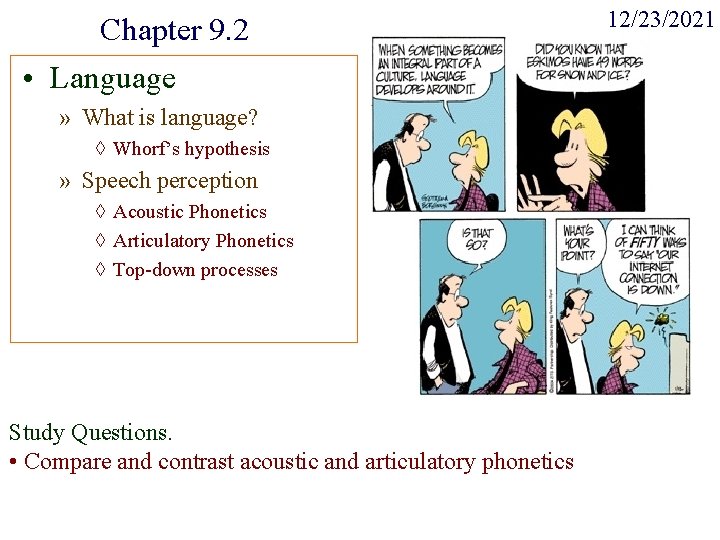
Chapter 9. 2 • Language » What is language? ◊ Whorf’s hypothesis » Speech perception ◊ Acoustic Phonetics ◊ Articulatory Phonetics ◊ Top-down processes Study Questions. • Compare and contrast acoustic and articulatory phonetics 12/23/2021
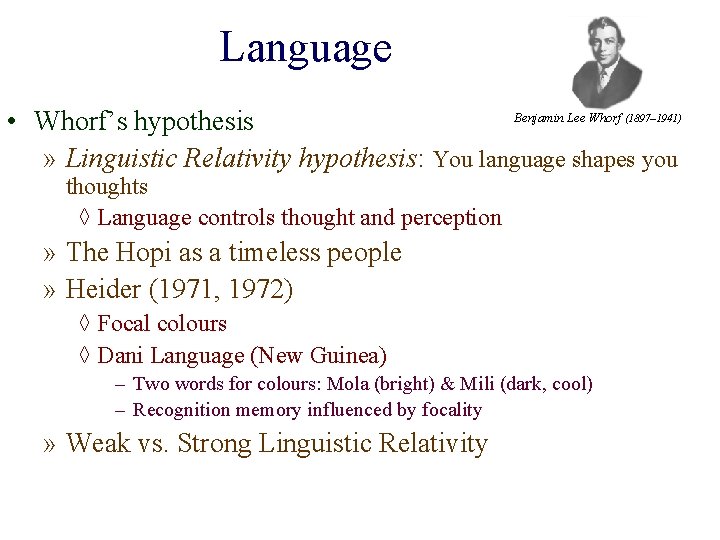
Language Benjamin Lee Whorf • Whorf’s hypothesis » Linguistic Relativity hypothesis: You language shapes you (1897– 1941) thoughts ◊ Language controls thought and perception » The Hopi as a timeless people » Heider (1971, 1972) ◊ Focal colours ◊ Dani Language (New Guinea) – Two words for colours: Mola (bright) & Mili (dark, cool) – Recognition memory influenced by focality » Weak vs. Strong Linguistic Relativity
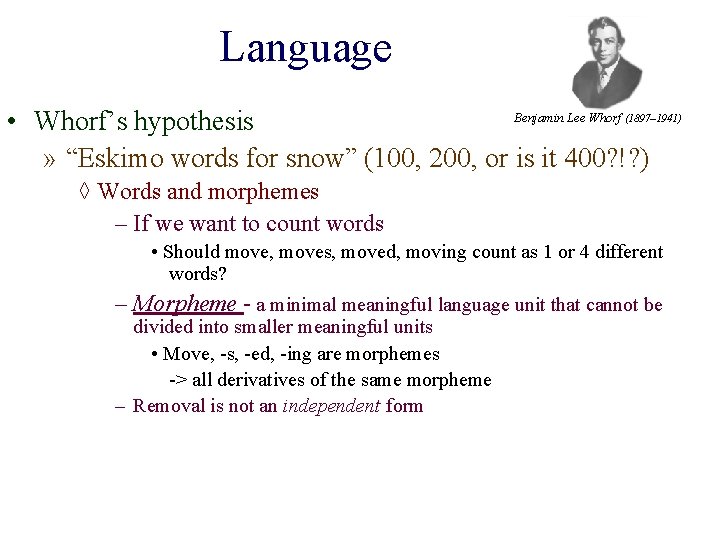
Language Benjamin Lee Whorf • Whorf’s hypothesis » “Eskimo words for snow” (100, 200, or is it 400? !? ) (1897– 1941) ◊ Words and morphemes – If we want to count words • Should move, moves, moved, moving count as 1 or 4 different words? – Morpheme - a minimal meaningful language unit that cannot be divided into smaller meaningful units • Move, -s, -ed, -ing are morphemes -> all derivatives of the same morpheme – Removal is not an independent form
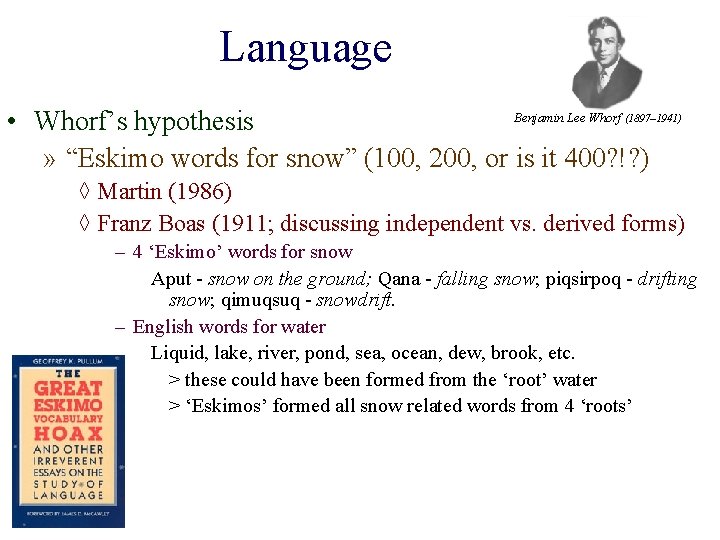
Language Benjamin Lee Whorf • Whorf’s hypothesis » “Eskimo words for snow” (100, 200, or is it 400? !? ) (1897– 1941) ◊ Martin (1986) ◊ Franz Boas (1911; discussing independent vs. derived forms) – 4 ‘Eskimo’ words for snow Aput - snow on the ground; Qana - falling snow; piqsirpoq - drifting snow; qimuqsuq - snowdrift. – English words for water Liquid, lake, river, pond, sea, ocean, dew, brook, etc. > these could have been formed from the ‘root’ water > ‘Eskimos’ formed all snow related words from 4 ‘roots’
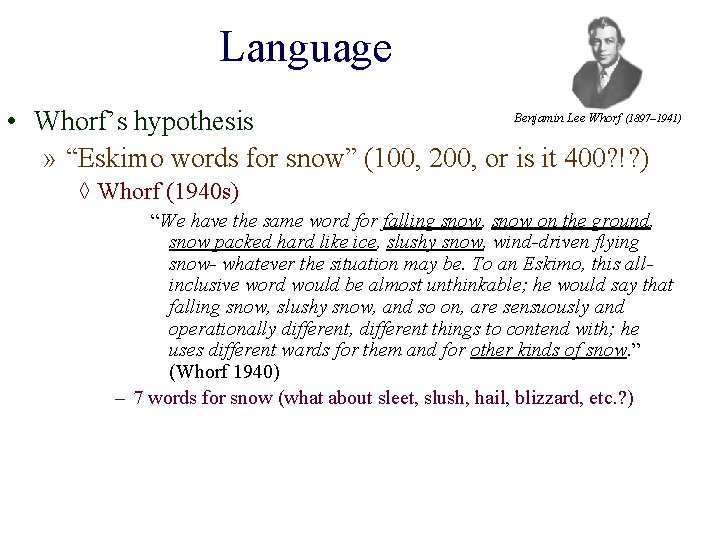
Language Benjamin Lee Whorf • Whorf’s hypothesis » “Eskimo words for snow” (100, 200, or is it 400? !? ) (1897– 1941) ◊ Whorf (1940 s) “We have the same word for falling snow, snow on the ground, snow packed hard like ice, slushy snow, wind-driven flying snow- whatever the situation may be. To an Eskimo, this allinclusive word would be almost unthinkable; he would say that falling snow, slushy snow, and so on, are sensuously and operationally different, different things to contend with; he uses different wards for them and for other kinds of snow. ” (Whorf 1940) – 7 words for snow (what about sleet, slush, hail, blizzard, etc. ? )
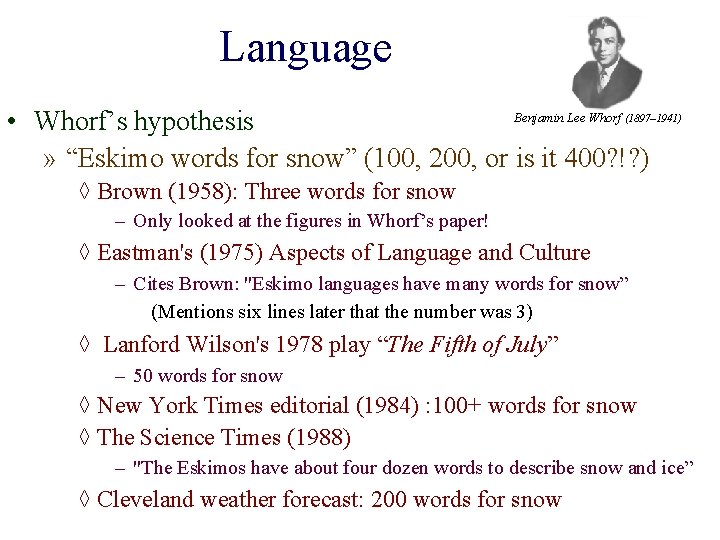
Language Benjamin Lee Whorf • Whorf’s hypothesis » “Eskimo words for snow” (100, 200, or is it 400? !? ) (1897– 1941) ◊ Brown (1958): Three words for snow – Only looked at the figures in Whorf’s paper! ◊ Eastman's (1975) Aspects of Language and Culture – Cites Brown: "Eskimo languages have many words for snow” (Mentions six lines later that the number was 3) ◊ Lanford Wilson's 1978 play “The Fifth of July” – 50 words for snow ◊ New York Times editorial (1984) : 100+ words for snow ◊ The Science Times (1988) – "The Eskimos have about four dozen words to describe snow and ice” ◊ Cleveland weather forecast: 200 words for snow
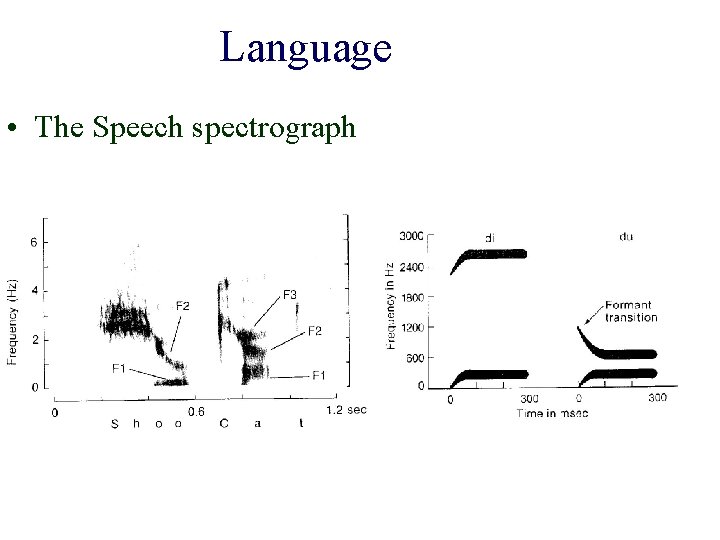
Language • Phonology: The rules underlying production and comprehension of speech. • Phonetics: The nature of linguistic sounds. » Articulatory phonetics: Placement of the mouth, tongue, lips, etc. used to produce particular sounds. » Acoustic phonetics: Physical characteristics of speech sounds. ◊ The Speech Spectrograph
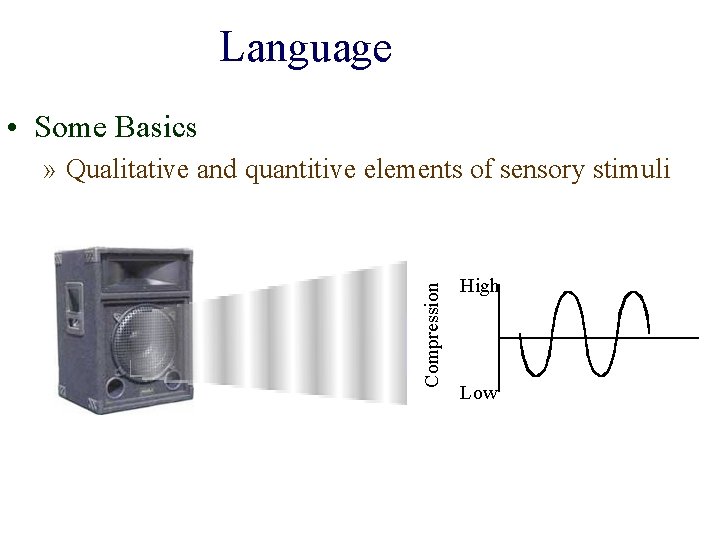
Language • Some Basics Compression » Qualitative and quantitive elements of sensory stimuli High Low
Language • The Speech spectrograph
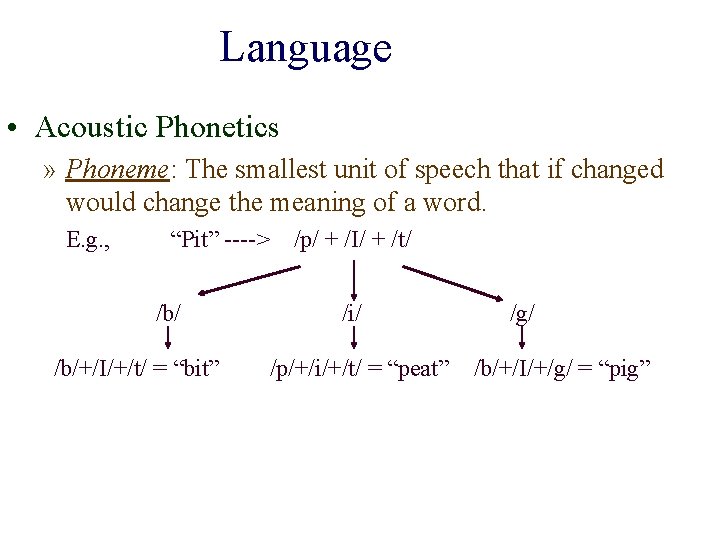
Language • Acoustic Phonetics » Phoneme: The smallest unit of speech that if changed would change the meaning of a word. E. g. , “Pit” ----> /b/+/I/+/t/ = “bit” /p/ + /I/ + /t/ /i/ /p/+/i/+/t/ = “peat” /g/ /b/+/I/+/g/ = “pig”
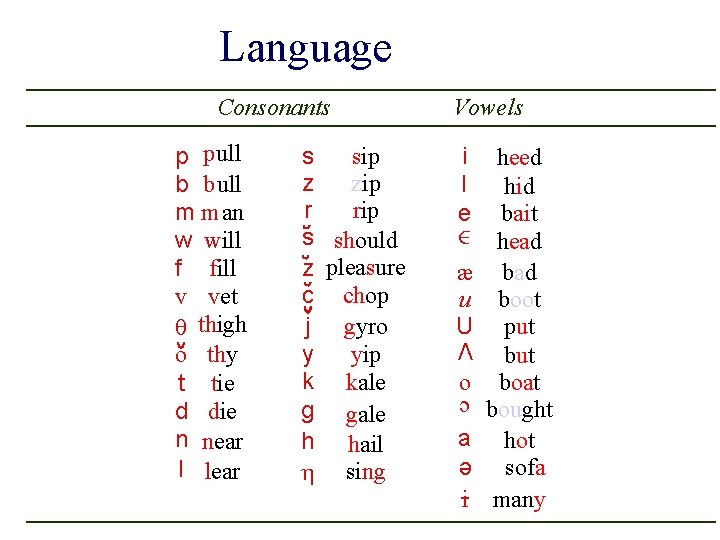
Language i I e æ u U o c a e sip s zip z rip r s should z pleasure c chop j gyro yip y k kale g gale h hail h sing V p pull b bull m man w will f fill v vet q thigh o thy t tie d die n near l lear Vowels ' Consonants i heed hid bait head boot put boat bought hot sofa many
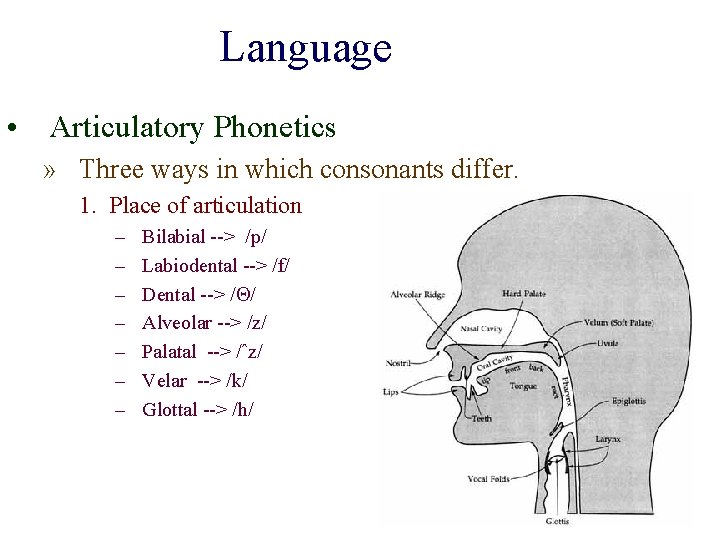
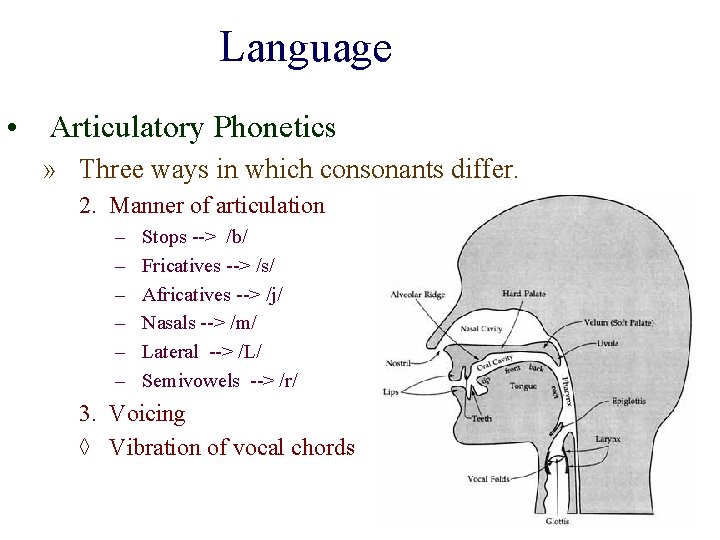
Language • Articulatory Phonetics » Three ways in which consonants differ. 1. Place of articulation – – – – Bilabial --> /p/ Labiodental --> /f/ Dental --> /Q/ Alveolar --> /z/ Palatal --> /ˆz/ Velar --> /k/ Glottal --> /h/
Language • Articulatory Phonetics » Three ways in which consonants differ. 2. Manner of articulation – – – Stops --> /b/ Fricatives --> /s/ Africatives --> /j/ Nasals --> /m/ Lateral --> /L/ Semivowels --> /r/ 3. Voicing ◊ Vibration of vocal chords
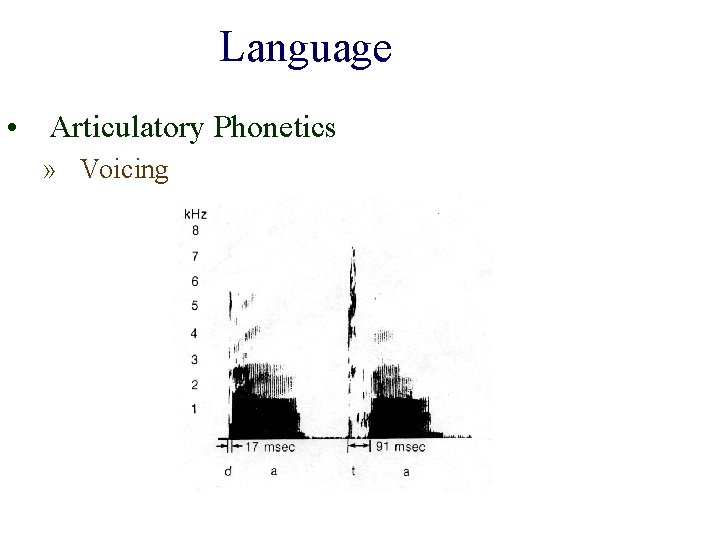
Language • Articulatory Phonetics » Voicing
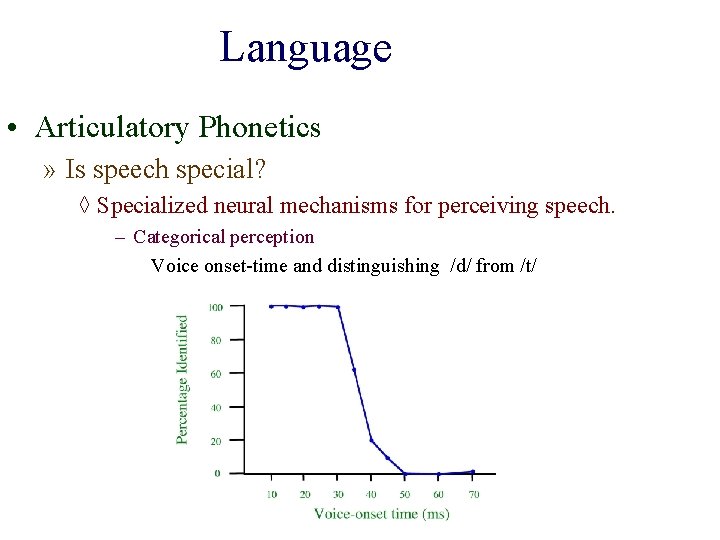
Language • Articulatory Phonetics » Is speech special? ◊ Specialized neural mechanisms for perceiving speech. – Categorical perception Voice onset-time and distinguishing /d/ from /t/
Language • Articulatory Phonetics » Vowels ◊ Positioning and part of tongue – Height High (/i/ beet) Med (/e/ bait) Low (/a/ pot) – Part Front (/I/ bit) Central (but) Back (/o/ boat)
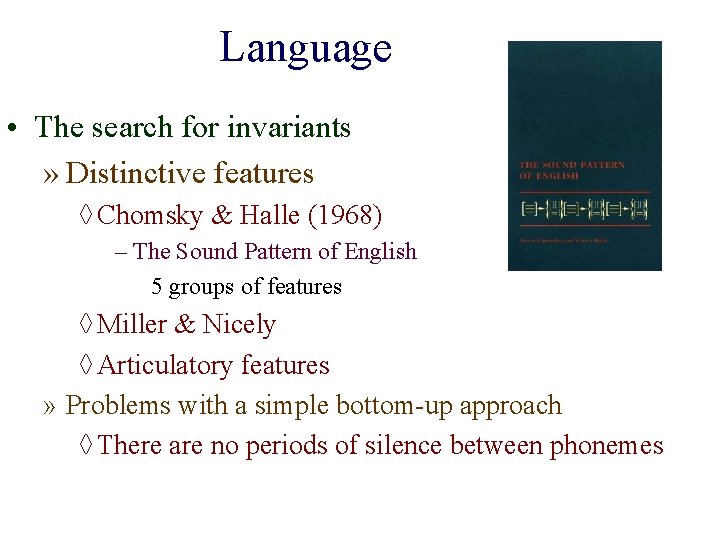
Language • The search for invariants » Distinctive features ◊ Chomsky & Halle (1968) – The Sound Pattern of English 5 groups of features ◊ Miller & Nicely ◊ Articulatory features » Problems with a simple bottom-up approach ◊ There are no periods of silence between phonemes
Language • The search for invariants » Phonemic information is presented in parallel ◊ Coarticulation ◊ E. g. Cf. /M/ in “Tim” vs. “/M/ in “mad” » We perceive them as the same, but they are different » We perceive the same sound differently according to the context ◊ E. g. : Writer vs. Rider ◊ E. g. : Insert a silence between /s/ and /i/ --> “ski” Insert a silence between /s/ and /u/ --> “spew”
Language • Top down processes » Phonemic restoration effect (Warren, 1970) ◊ Their respective legi*latures ◊ Found a *eel on the axle ◊ Found a *eel on the shoe
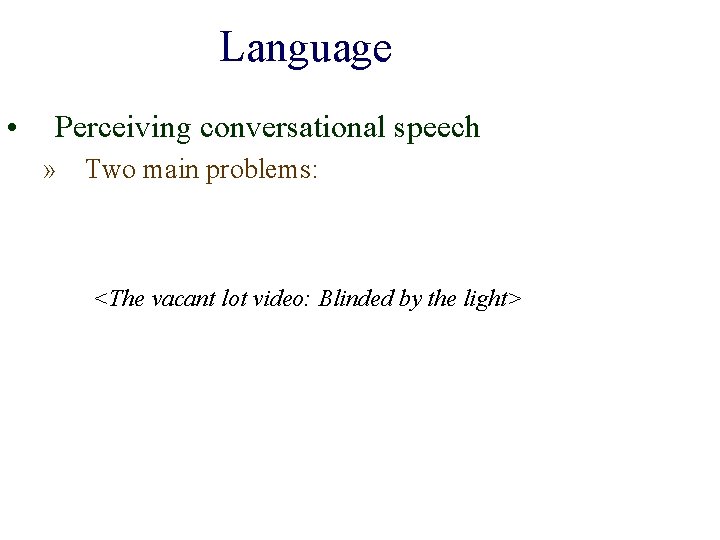
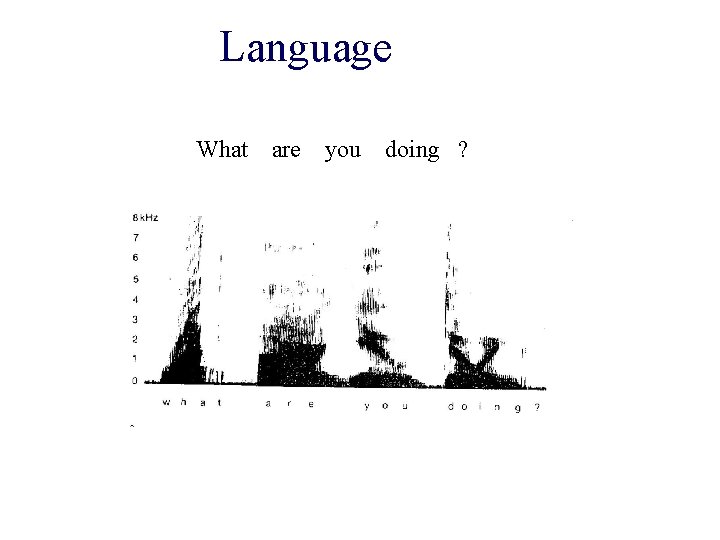
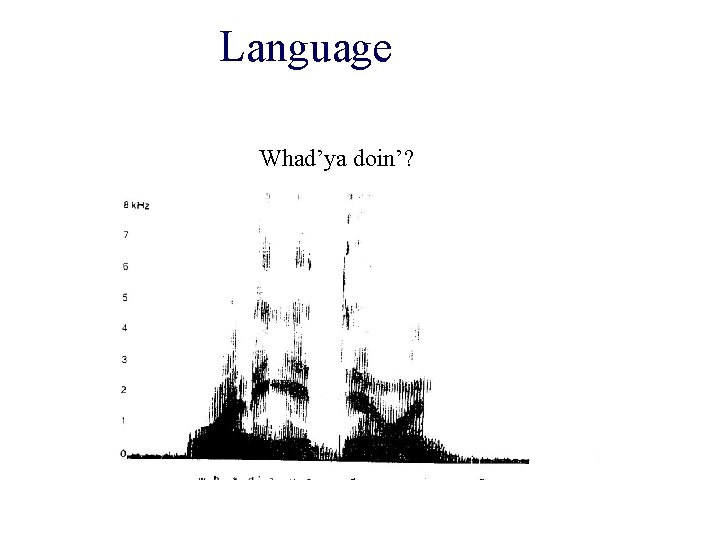
Language • Perceiving conversational speech » Two main problems: 1. There are no physical boundaries between words – Anna Mary candy lights since imp pulp lay thing 2. Speech is sloppy – -> Misheard Lyrics – -> This was the best buy vs. She is a bad girl
Language • Perceiving conversational speech » Two main problems: <The vacant lot video: Blinded by the light>
Language What are you doing ?
Language Whad’ya doin’?
Language • Top-down processes and speech perception » Phonemic perception ◊ The Mc. Gurk Effect Video - The Mc. Gurk effect
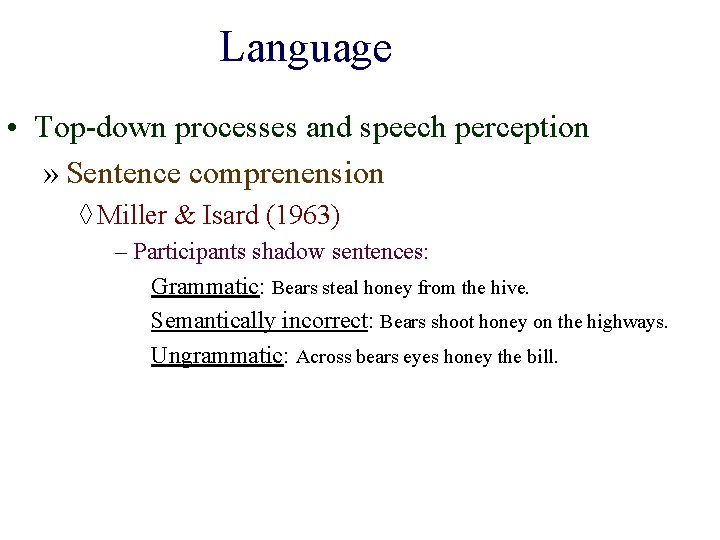
Language • Top-down processes and speech perception » Sentence comprenension ◊ Miller & Isard (1963) – Participants shadow sentences: Grammatic: Bears steal honey from the hive. Semantically incorrect: Bears shoot honey on the highways. Ungrammatic: Across bears eyes honey the bill.
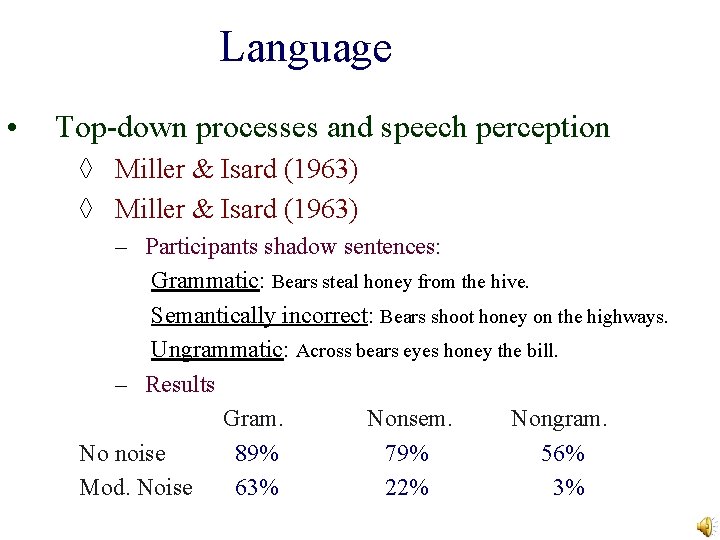
Language • Top-down processes and speech perception ◊ Miller & Isard (1963) – Participants shadow sentences: Grammatic: Bears steal honey from the hive. Semantically incorrect: Bears shoot honey on the highways. Ungrammatic: Across bears eyes honey the bill. – Results Gram. Nonsem. Nongram. No noise 89% 79% 56% Mod. Noise 63% 22% 3%