
Chapter 9 2 9 4 Cellular Respiration STAGE
- Slides: 18
Chapter 9. 2 & 9. 4 Cellular Respiration STAGE 1: Glycolysis
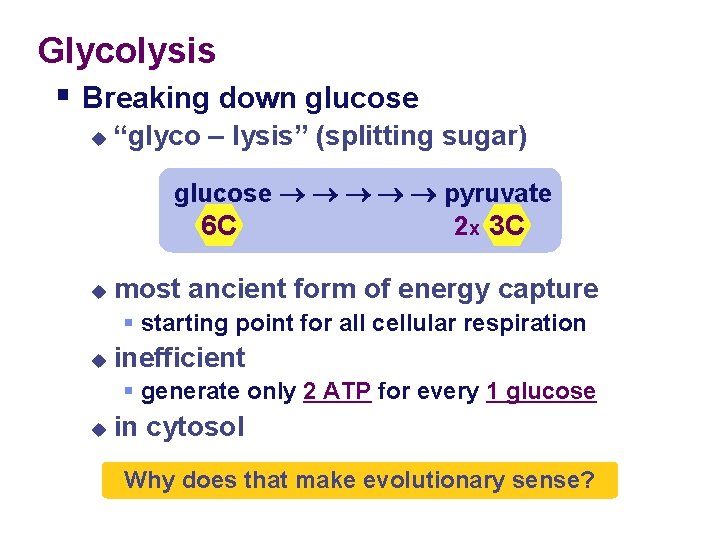
Glycolysis § Breaking down glucose u “glyco – lysis” (splitting sugar) glucose pyruvate 2 x 3 C 6 C u most ancient form of energy capture § starting point for all cellular respiration u inefficient § generate only 2 ATP for every 1 glucose u in cytosol Why does that make evolutionary sense?
Evolutionary Perspective § Life on Earth first evolved without free oxygen (O 2) in atmosphere u energy had to be captured from organic molecules in absence of O 2 § Organisms that evolved glycolysis are ancestors of all modern life u all organisms still utilize glycolysis You mean, I’m…we’re related to them? !
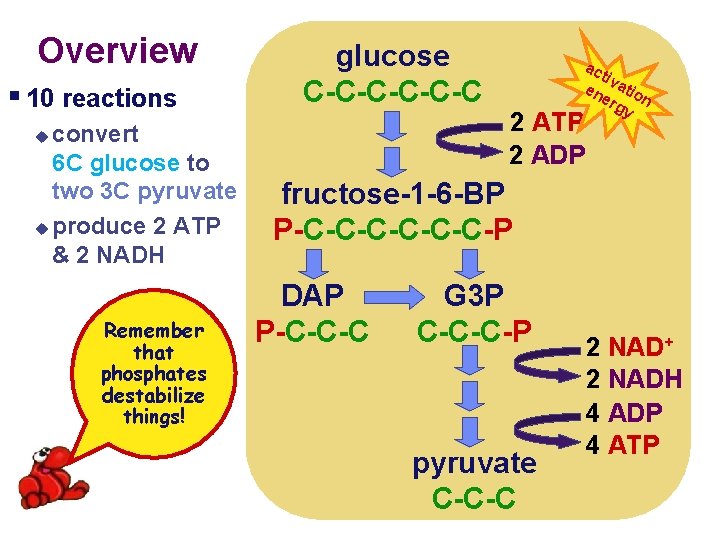
Overview § 10 reactions convert 6 C glucose to two 3 C pyruvate u produce 2 ATP & 2 NADH glucose C-C-C-C u Remember that phosphates destabilize things! ac tiv en atio erg n y 2 ATP 2 ADP fructose-1 -6 -BP P-C-C-C-P DAP P-C-C-C G 3 P C-C-C-P pyruvate C-C-C 2 NAD+ 2 NADH 4 ADP 4 ATP
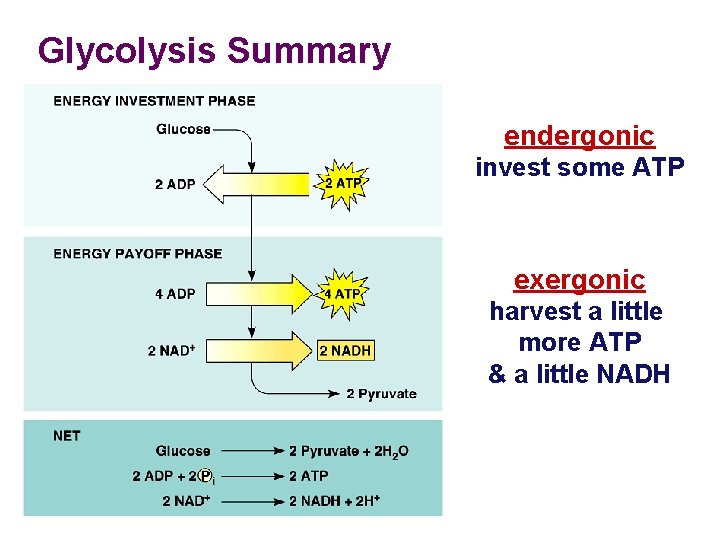
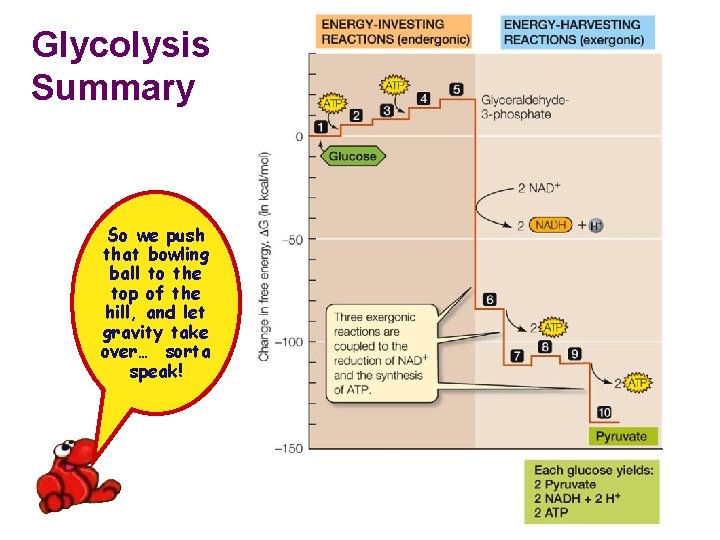
Glycolysis Summary endergonic invest some ATP exergonic harvest a little more ATP & a little NADH
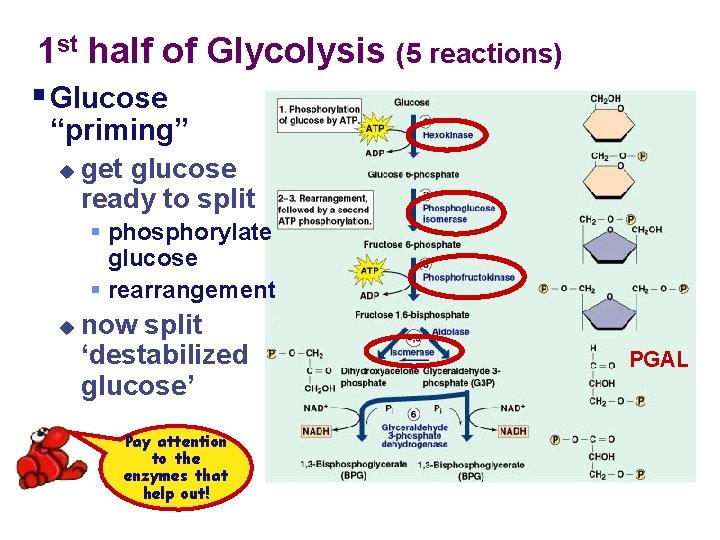
1 st half of Glycolysis (5 reactions) § Glucose “priming” u get glucose ready to split § phosphorylate glucose § rearrangement u now split ‘destabilized glucose’ Pay attention to the enzymes that help out! PGAL
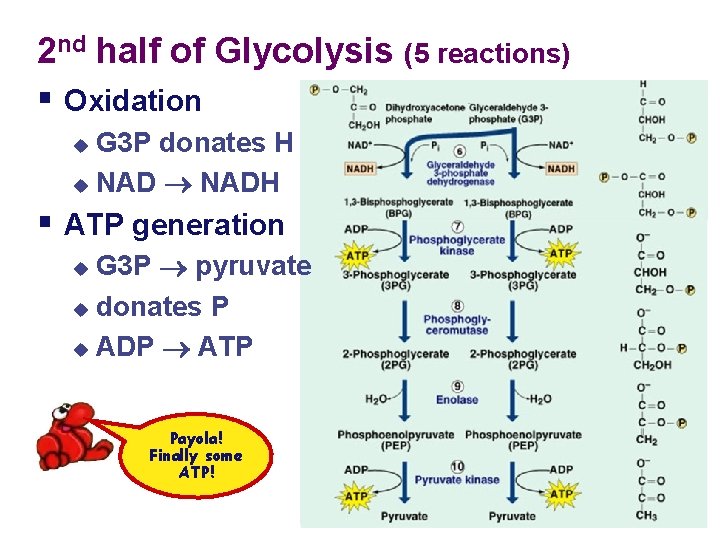
2 nd half of Glycolysis (5 reactions) § Oxidation G 3 P donates H u NADH u § ATP generation G 3 P pyruvate u donates P u ADP ATP u Payola! Finally some ATP!
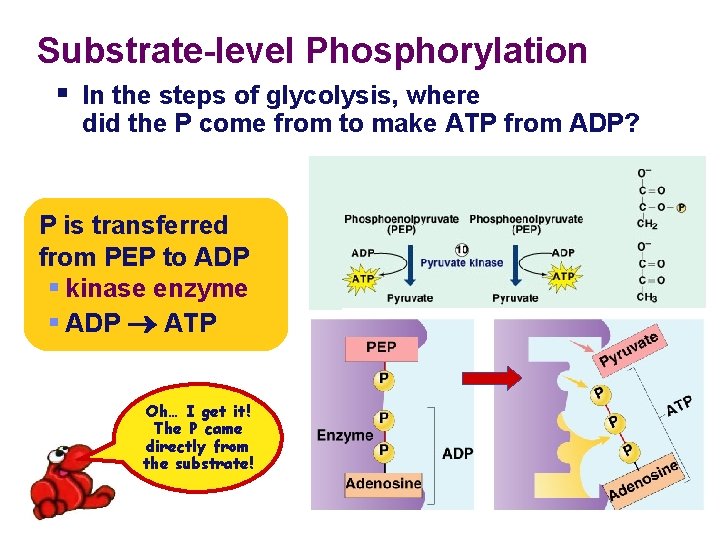
Substrate-level Phosphorylation § In the steps of glycolysis, where did the P come from to make ATP from ADP? P is transferred from PEP to ADP § kinase enzyme § ADP ATP Oh… I get it! The P came directly from the substrate!
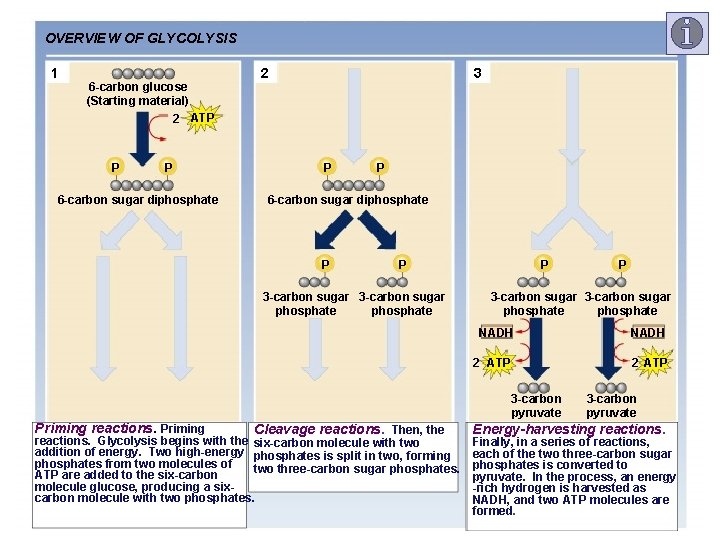
OVERVIEW OF GLYCOLYSIS 1 6 -carbon glucose (Starting material) 2 3 2 ATP P P 6 -carbon sugar diphosphate P P 3 -carbon sugar phosphate NADH 2 ATP 3 -carbon pyruvate Priming reactions. Priming Cleavage reactions. Then, the reactions. Glycolysis begins with the six-carbon molecule with two addition of energy. Two high-energy phosphates is split in two, forming phosphates from two molecules of two three-carbon sugar phosphates. ATP are added to the six-carbon molecule glucose, producing a sixcarbon molecule with two phosphates. P 3 -carbon pyruvate Energy-harvesting reactions. Finally, in a series of reactions, each of the two three-carbon sugar phosphates is converted to pyruvate. In the process, an energy -rich hydrogen is harvested as NADH, and two ATP molecules are formed.
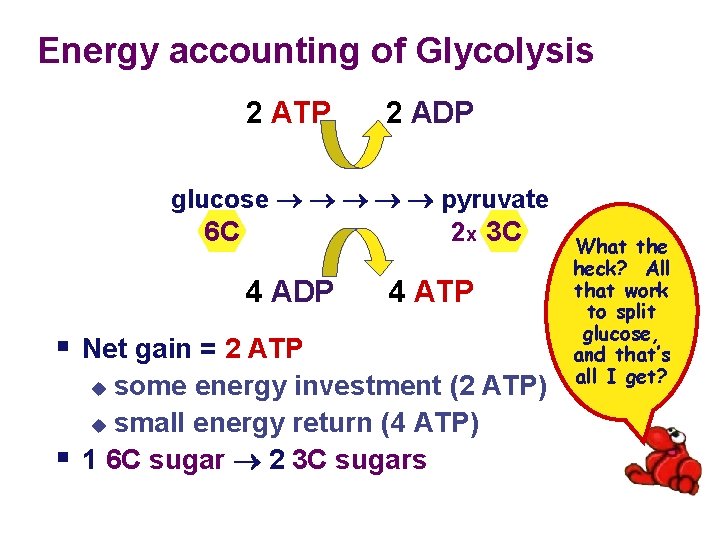
Energy accounting of Glycolysis 2 ATP 2 ADP glucose pyruvate 2 x 3 C 6 C 4 ADP 4 ATP § Net gain = 2 ATP some energy investment (2 ATP) u small energy return (4 ATP) 1 6 C sugar 2 3 C sugars u § What the heck? All that work to split glucose, and that’s all I get?
Glycolysis Summary So we push that bowling ball to the top of the hill, and let gravity take over… sorta speak!
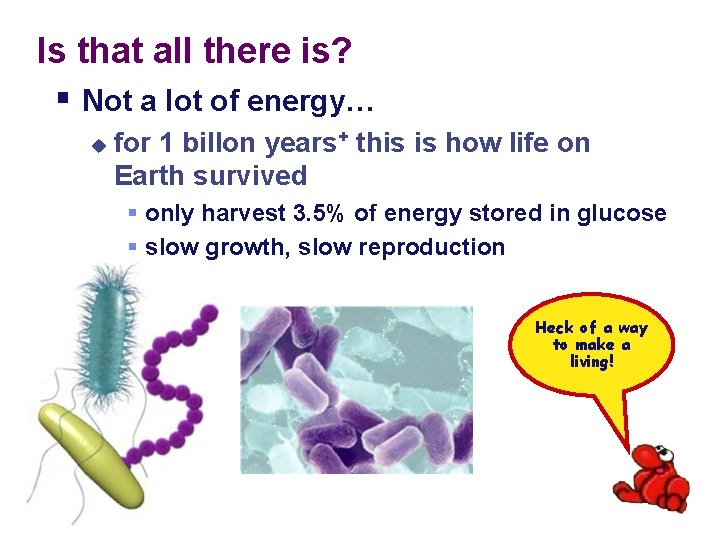
Is that all there is? § Not a lot of energy… u for 1 billon years+ this is how life on Earth survived § only harvest 3. 5% of energy stored in glucose § slow growth, slow reproduction Heck of a way to make a living!
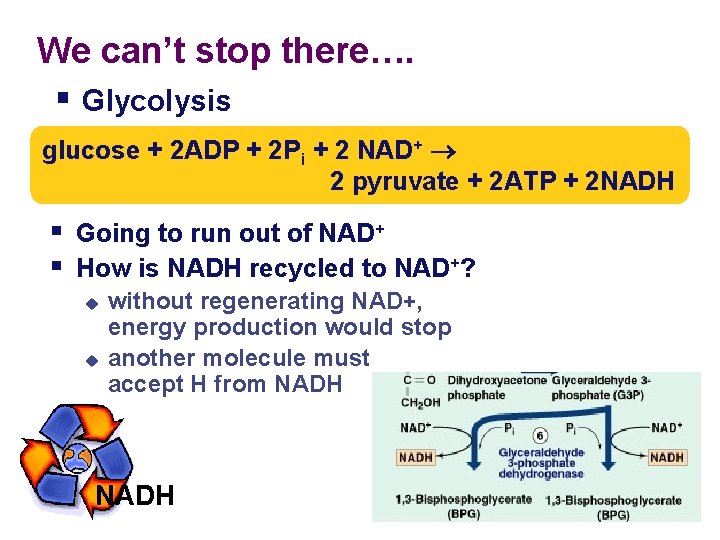
We can’t stop there…. § Glycolysis glucose + 2 ADP + 2 Pi + 2 NAD+ 2 pyruvate + 2 ATP + 2 NADH § Going to run out of NAD+ § How is NADH recycled to NAD+? u u without regenerating NAD+, energy production would stop another molecule must accept H from NADH
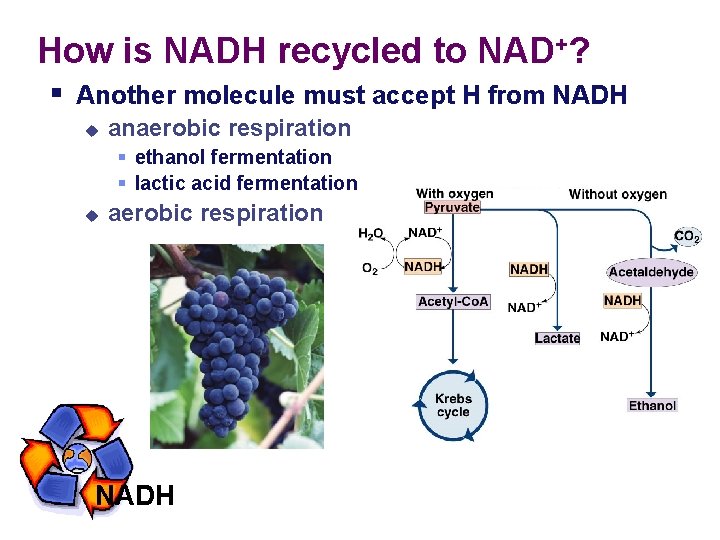
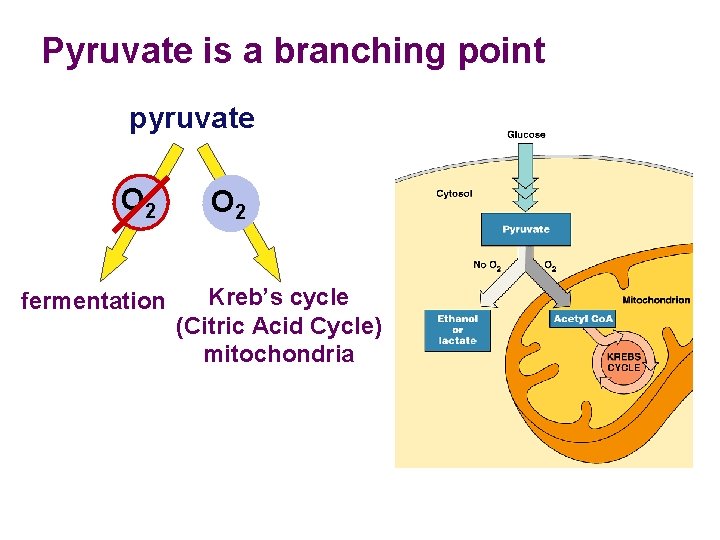
How is NADH recycled to NAD+? § Another molecule must accept H from NADH u anaerobic respiration § ethanol fermentation § lactic acid fermentation u aerobic respiration NADH
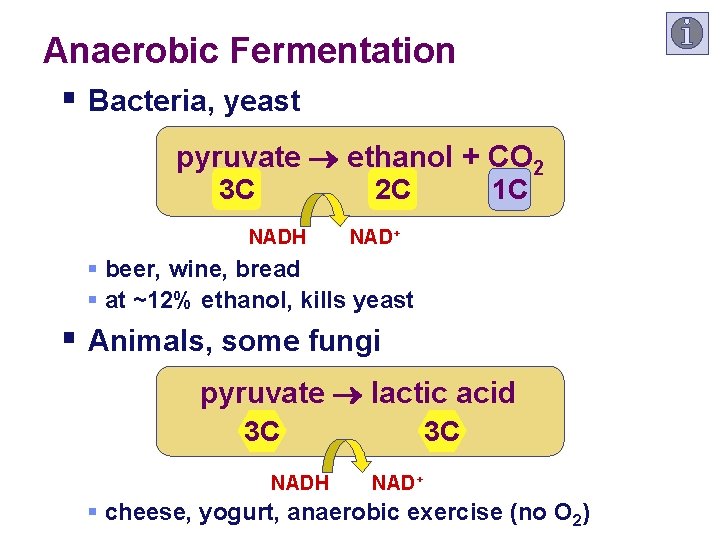
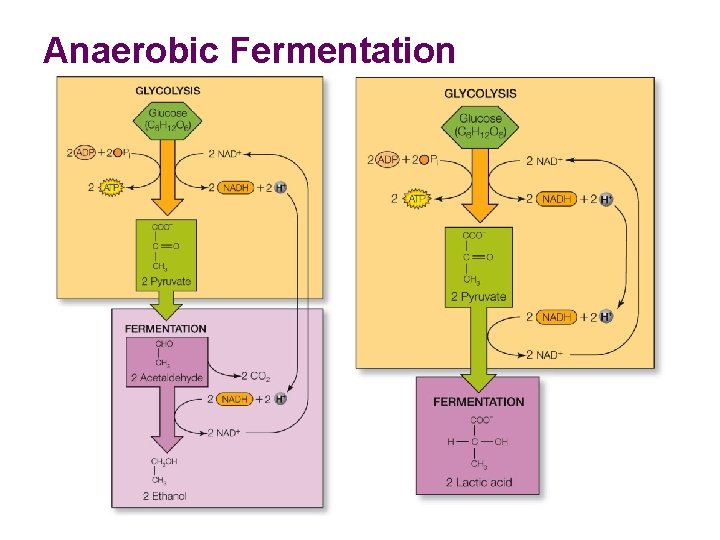
Anaerobic Fermentation § Bacteria, yeast pyruvate ethanol + CO 2 3 C 2 C NADH 1 C NAD+ § beer, wine, bread § at ~12% ethanol, kills yeast § Animals, some fungi pyruvate lactic acid 3 C NADH 3 C NAD+ § cheese, yogurt, anaerobic exercise (no O 2)
Anaerobic Fermentation
Pyruvate is a branching point pyruvate O 2 fermentation O 2 Kreb’s cycle (Citric Acid Cycle) mitochondria
What’s the point? ATP The Point is to Make ATP! Any Questions? ?